

Atticus vs Built&Written for Coaches: Which Is Actually Better in 2026?
The short answer: pick by manuscript status, not price. Atticus ($147 one-time) is the best interior formatting tool for a coach who already has a finished manuscript. Built&Written (from $19/month) is the right pick for a coach who still needs the book written, because it ingests scattered content, drafts in your voice, formats, and exports KDP-ready files. Both are credible. Neither does the same job.
Rich Litvin and Steve Chandler's The Prosperous Coach became a word-of-mouth standard in the coaching world, and it took the classic path: a finished manuscript that needed a route to a formatted, printable, sellable book.
But the coach reading this in 2026 has a different problem. Not "I have a manuscript and need a formatter." More often: "I have three years of LinkedIn posts, a podcast, a client workbook, and a rough outline in my notes app. I need a book."
That coach is looking at two tools. Atticus is the name that keeps coming up. So does Built&Written. Picking the wrong one costs you weeks of rework.
This article tells you which one to pick. We built a seven-axis comparison framework, the Coach's Book Tool Decision Matrix, and ran both tools through it. The verdict is not close, but it is honest. Atticus wins some axes. Built&Written wins others. Where each wins matters a great deal depending on where you are in your book project.
Start here:
| Built&Written | Atticus | |
|---|---|---|
| Best for | Coaches with scattered content (LinkedIn, podcasts, notes) who need writing assistance, assembly, and formatting under one roof | Coaches with a finished or near-finished manuscript who need best-in-class interior formatting and cover design |
| Pricing | from $19/month | $147 one-time |
| AI writing | Yes, coach-tuned with Voice DNA | No |
| Content ingest | Native (LinkedIn, transcripts, notes) | Manual import only |
| KDP-ready export | Yes | Yes |
| Cover design | Yes | Yes |
| Voice preservation | Voice DNA (named feature) | N/A |
| Best analogy | Architect who also builds | Master finisher who needs to see the framing first |
Key takeaway: For coaches in 2026, the right tool depends entirely on manuscript status. Built&Written is the only platform that handles writing, content ingest, Voice DNA, KDP formatting, and cover design in one workflow. Atticus is the best formatting tool on the market when you already have a finished manuscript. These tools solve different problems.
Why most coaches pick the wrong tool when comparing Atticus and Built&Written
Most coaches who search "Atticus vs Built&Written" are in a specific trap. They've read about Atticus's beautiful typography, seen the $147 one-time price tag, and compared that against a from $19/month subscription. The math feels obvious: one-time is cheaper. Buy Atticus.
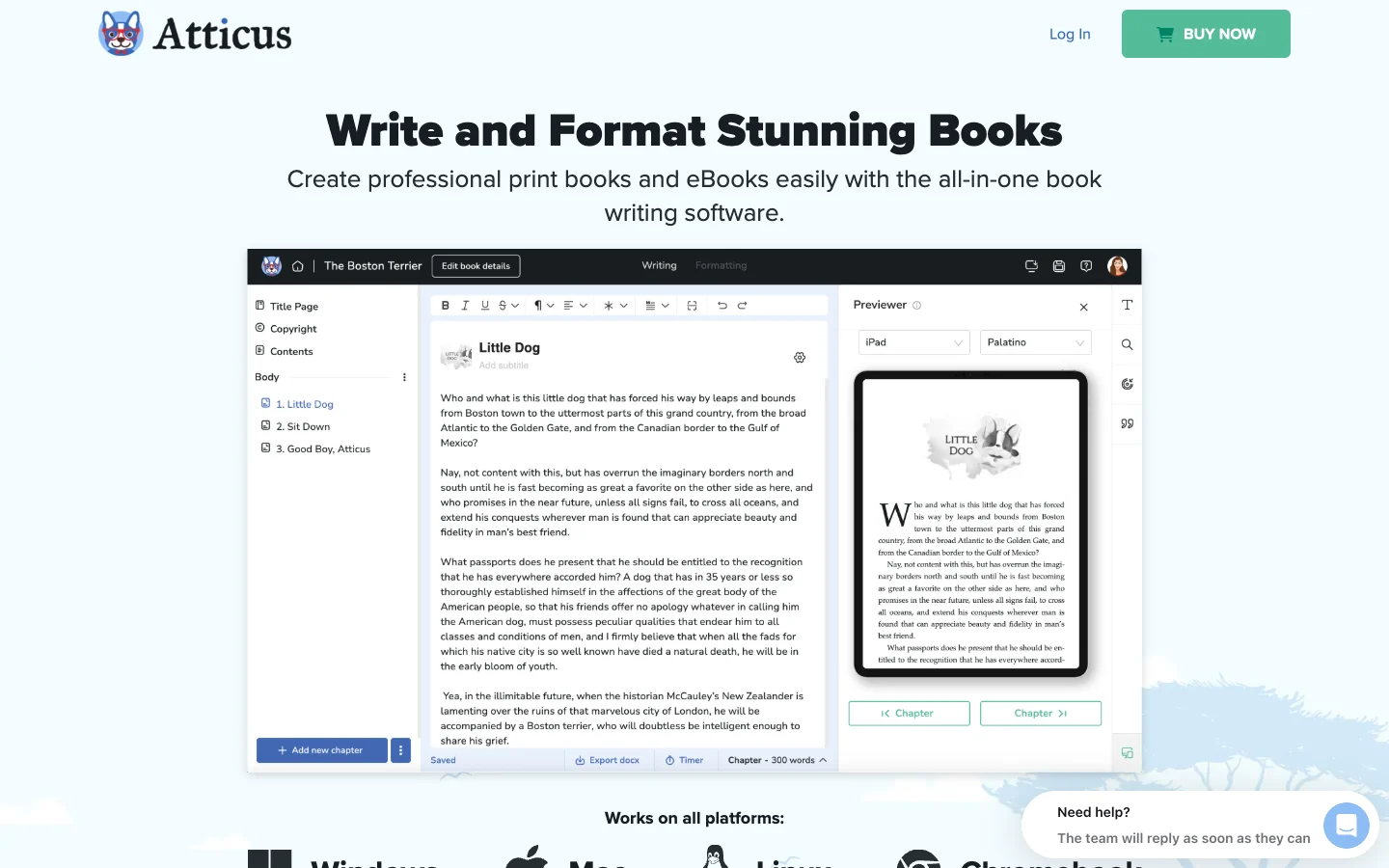
Then they open Atticus, paste in their LinkedIn archive, and discover the tool has no idea what to do with it. Atticus is a formatter. It does not write. It does not ingest scattered content. It does not know what a Voice DNA profile is. It is, genuinely, the best interior-formatting tool in the non-fiction self-publishing space. But if you don't have a finished manuscript, Atticus is a beautiful instrument you can't play yet.
The same trap runs in the other direction. A coach with a completed Word doc, wanting only professional formatting before KDP upload, might land on Built&Written and find themselves paying a monthly fee for writing-assistance features they don't need. For that coach, Atticus at $147 is the honest answer.
The confusion is a category error, not a quality gap. Both tools are good. They solve different problems. The Coach's Book Tool Decision Matrix exists to make that distinction visible before a purchase.
The Decision Matrix: seven axes, two tools
The Coach's Book Tool Decision Matrix scores each tool on seven axes that matter specifically to coaches, not to novelists or KDP volume publishers. The seven axes:
- Writing assistance. Does the tool actually generate or assemble written content, or does it only format what you give it?
- Formatting craft. How polished is the interior typography, page layout, and print-ready output?
- Content ingest. Can the tool take LinkedIn posts, podcast transcripts, voice memos, and notes as raw input?
- Voice fidelity. Does the output sound like the coach, or like a generic AI?
- KDP export. Does the tool produce a print-ready PDF that passes KDP's technical requirements without manual fixing?
- Cover design. Does the tool produce a professional print cover (front, back, spine)?
- Ongoing pricing model. What does the tool cost over two years, and does the pricing model match how coaches actually use it?
Each axis is scored 1 (absent or weak) to 5 (best-in-class). Maximum score: 35.
Why the Decision Matrix matters more than review-site star ratings
General review sites rate Atticus highly because Atticus is excellent at what it does. The star ratings are not wrong. They're just not calibrated for coaches who arrive with three years of LinkedIn content instead of a finished Word doc.
The International Coaching Federation's industry research shows that the fastest-growing segment of coaches are digital-native practitioners who have been building an audience online before they ever thought about a book. These coaches don't have manuscripts. They have archives. A tool review that doesn't account for that workflow is answering the wrong question.
The Forbes Coaches Council has documented the same pattern: coaches increasingly treat a book as the anchor of a content-to-client funnel, not as a stand-alone publishing project. That's a different use case than the traditional author who writes a manuscript and then formats it.
At-a-glance verdict: when each tool wins
Before the deep dive, here is the declarative answer. Read this section, decide if it matches your situation, and either stop here or keep reading for the full breakdown.
Atticus wins when:
- You have a completed or near-completed manuscript (Word doc, Google Doc, or Scrivener export) and need to format it for Amazon KDP Print and Kindle.
- You plan to publish one book and stop. No ongoing writing assistance needed, no subscription makes sense.
- Typography and interior design quality are your top priority. Atticus is the best interior formatter in the non-fiction self-publishing category, full stop.
- You work primarily on Mac and prefer a desktop app (Atticus is cross-platform; Vellum is Mac-only but also excellent for Mac users who want the same quality).
- Your book is long-form structured writing (memoir, academic, research-based) and you already have the writing done.
Built&Written wins when:
- You have scattered existing content (LinkedIn posts, podcast transcripts, client session notes, course outlines, blog drafts) and need a tool that ingests it, organizes it, and writes the connective tissue.
- You want AI writing assistance that preserves your voice, not generic AI output.
- You plan to publish more than one book, workbook, or lead-magnet booklet in the next two years. The subscription model pays off fast when it keeps shipping new capabilities.
- You have no manuscript. None. Just an idea and a content archive.
- You want an all-in-one workflow: writing assistance plus formatting plus cover design without juggling three separate tools.
The honest edge case: A coach with a finished manuscript who also wants to turn future LinkedIn content into future books should consider both. Start with Built&Written's free tier for the writing workflow; the formatting output is KDP-ready. Revisit Atticus when the question is "I need the most beautiful interior possible for a long-form, text-heavy book." The two tools are not mutually exclusive.
How does Atticus actually compare to Built&Written across the 7 Decision Matrix axes?
This is the comparison section most people come for. Per axis, with honest scores for both tools.
Axis 1: Writing assistance
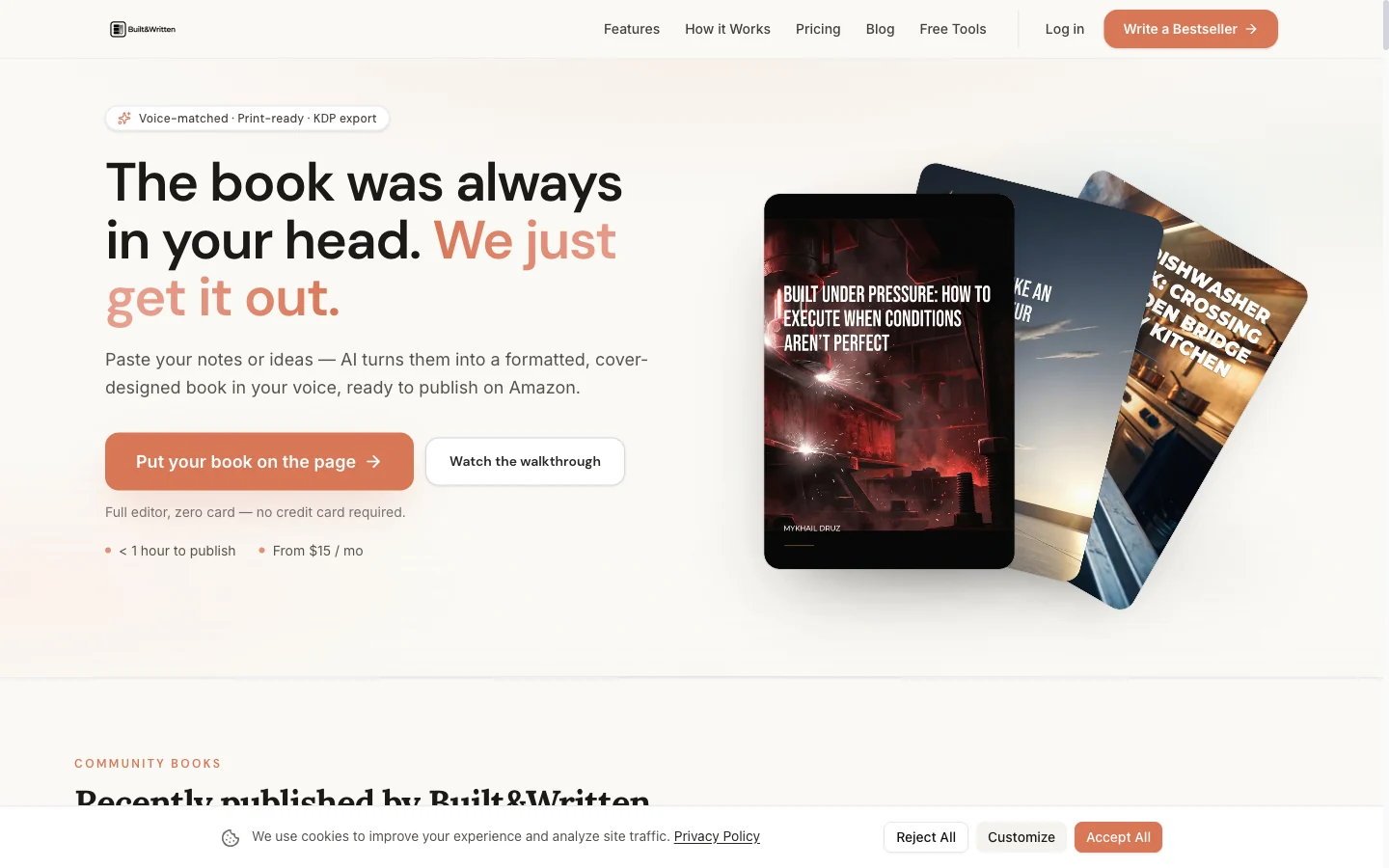
Built&Written: 5/5. The tool generates and assembles written content. It ingests raw material, proposes chapter structures, drafts bridge content, and writes from outlines. The writing output is AI-assisted (the coach's expertise is the input; AI does the assembly). This is not ChatGPT-style general writing. It's coach-specific: the output is calibrated for a non-fiction coaching voice, not a fiction register or a blog register.
Atticus: 0/5. Atticus does not write. Not a sentence, not a transition, not a chapter heading. This is not a criticism; Atticus was designed this way deliberately. If you expect writing assistance from Atticus, you've misread the product. If you know Atticus is a formatter and you're fine with that, zero on this axis is irrelevant to your decision.
The category difference is total on this axis.
Axis 2: Formatting craft
Atticus: 5/5. This is where Atticus is genuinely best-in-class. The interior typography is the best in the self-publishing tool category, including Vellum (which is Mac-only) and Reedsy (which is free but less customizable). Atticus gives you full control over fonts, line spacing, chapter headers, drop caps, scene breaks, and running headers. The output looks like a book from a traditional publisher.
Built&Written: 4/5. The formatting output is KDP-ready and professional. For most coaches, it's indistinguishable from Atticus output on the page. The gap is in customization depth: Atticus gives you more knobs to turn if you care about typographic granularity. Built&Written's formatting is opinionated (sensible defaults) rather than fully configurable. For the median coach, the defaults are exactly right. For a coach who has strong typography opinions, Atticus wins this axis clearly.
Axis 3: Content ingest
Built&Written: 5/5. The content ingest capability is the product's core differentiator. LinkedIn posts (via export or paste), podcast transcripts, voice memos, notes, blog drafts, course outlines: the tool accepts them and identifies thematic clusters. This is the workflow that lets a coach with three years of LinkedIn content see a chapter structure in 20 minutes instead of three months. See our broader review of AI book tools for coaches for how this compares to every major tool in the category.
Atticus: 1/5. Atticus accepts Word documents, RTF files, and text files via manual import. There is no ingest for LinkedIn exports, podcast transcripts, or scattered notes.
Axis 4: Voice fidelity
Built&Written: 5/5. Voice DNA is the named feature. The tool fingerprints the coach's existing writing: sentence length distribution, vocabulary preferences, rhetorical patterns, use of specific phrases or structures. That fingerprint is used to bridge content into chapters without overwriting the author's voice. The output reads like the coach wrote it with an editor's help, not like AI pretending to be the coach.
Atticus: N/A. Voice fidelity is not applicable to Atticus because Atticus does not write. Your voice is your voice because you wrote the manuscript. Atticus formats what you give it without changing a word.
Axis 5: KDP export
Both tools: 5/5. Both produce a print-ready PDF for Amazon KDP Print that conforms to KDP's trim size, margin, gutter, and bleed requirements. Both produce a Kindle-ready ePub. Both handle the spine math when you provide your page count. For the full KDP technical walkthrough, see the complete KDP self-publishing walkthrough.
Axis 6: Cover design
Built&Written: 5/5. Cover design is integrated. The tool generates a print cover (front, back, spine) with correct spine math based on your trim size and page count. The output is professional enough for KDP upload without hiring a designer.
Atticus: 4/5. Atticus's cover designer is solid and genuinely useful. It's more limited than a dedicated design tool but better than Canva for the specific task of a book cover. The slight downside: the cover templates are recognizable as Atticus templates to a trained eye.
Axis 7: Ongoing pricing model
Atticus: $147 one-time. Built&Written: from $19/month (free tier available).
The pricing math depends entirely on how many books you're planning. If you publish one book and stop, Atticus wins. If you publish a second book, a companion workbook, or a lead-magnet booklet in the same window, Built&Written's subscription is paying for writing assistance on all of them.
The full Decision Matrix scorecard
| Axis | Built&Written | Atticus |
|---|---|---|
| Writing assistance | 5 | 0 |
| Formatting craft | 4 | 5 |
| Content ingest | 5 | 1 |
| Voice fidelity | 5 | N/A |
| KDP export | 5 | 5 |
| Cover design | 5 | 4 |
| Ongoing pricing | 4 | 5 |
| Total (out of 35) | 33 | 20 |
Atticus's score on writing assistance is zero because it doesn't write. If you don't need writing assistance (because you have a finished manuscript), that axis is irrelevant to your decision and Atticus effectively scores 20 out of 25 on the axes that apply to you. For the broader formatting-tools comparison, see the formatting-tools-only comparison.
What's the right workflow for a coach who has neither finished manuscript nor existing content yet?
The short answer: Built&Written is still the better starting point, but the workflow is different. Coaches without a content archive face the blank-page problem that kills most book projects. The correct starting point is content creation. A practical target: 90 LinkedIn posts on your core coaching methodology before opening any book tool.
If you have only a rough outline and some notes, that's the sweet spot for Built&Written. The tool can ingest those materials and propose a chapter structure. Atticus does not help at all at this stage.
Will KDP reject an AI-assisted coaching book in 2026?
No. Amazon KDP's AI content policy requires disclosure but does not prohibit AI-assisted books. The disclosure is a checkbox during upload. Coaches using a tool like Built&Written produce AI-assisted output. Check the box and publish.
From idea to KDP upload: a coach's checklist
If using Built&Written:
- Start the free tier.
- Upload Voice DNA samples: 5 to 50 pages of your most characteristic writing.
- Ingest content archive by theme grouping.
- Review and edit the proposed chapter structure.
- Draft chapter by chapter, edit before moving on.
- Export print-ready PDF and ePub.
- Upload to KDP. Check AI disclosure. Publish.
If using Atticus:
- Buy Atticus at $147 (one-time, all platforms).
- Open Atticus, create a new book project.
- Import your completed manuscript (Word or RTF).
- Choose a formatting theme.
- Export print PDF.
- Design or import cover.
- Upload to KDP. Publish.
The verdict for the median coach in 2026
The median coach in 2026 is not sitting on a finished manuscript. They're sitting on a LinkedIn archive, a podcast feed, a folder of workshop notes, and a conviction that a book would do for their business what three more years of posting never will.
For that coach, the verdict is Built&Written. Not because Atticus is bad (it isn't) but because Atticus is the wrong category of tool for the starting point that coach is actually at.
We're biased. We sell Built&Written. The honest version: if a coach asked us "should I use Atticus instead, since I already have a manuscript?" we'd say yes. If a coach asked "should I use Sudowrite for my coaching memoir?" we'd say it depends, but probably yes. The recommendation is "Built&Written wins for the median coach who has scattered content and wants a finished book."
Key takeaways
- Atticus and Built&Written are not direct substitutes. They solve different problems at different stages of the book production process.
- The Coach's Book Tool Decision Matrix scores Built&Written 33/35 and Atticus 20/35.
- If writing assistance is not relevant to your situation (finished manuscript, just need formatting), Atticus is a legitimate choice.
- KDP's 2026 AI policy requires disclosure, not prohibition.
- Voice fidelity is not optional for a coaching book. A book that sounds like ChatGPT does not build authority.
- For the median coach with a content archive and no manuscript, Built&Written is the right tool.
Frequently asked questions
Atticus costs $147 one-time. Built&Written costs from $19/month. At 8 months ($152), the cumulative cost exceeds Atticus.
Yes. Use Built&Written to assemble and draft, then import into Atticus for final formatting if you want Atticus typographic granularity.
Both have manageable learning curves. Atticus is a familiar word-processor layout. Built&Written requires Voice DNA setup that has no Atticus equivalent.
No. Both produce KDP-compliant output. KDP 2026 AI policy requires disclosure but does not reject AI-assisted books.
No. Atticus is a pure formatting tool. For AI writing assistance integrated with formatting, use Built&Written.
Yes. Atticus cannot do anything with LinkedIn posts. Built&Written ingests them directly and organizes into chapter structure.
Sources & References
- https://www.atticus.io
- https://www.builtwritten.com/
- https://vellum.pub
- https://kdp.amazon.com/help/topic/G201834180
- https://kdp.amazon.com/en_US/help/topic/G200672390
- https://coachingfederation.org/research
- https://reedsy.com
- https://www.builtwritten.com/editor
About the author

Mykhailo Druz
More in AI Book Tools
Ready to write your book?
Turn your expertise into a professional book with Built&Written.