

The Coach's Complete Guide to Writing & Publishing a Book with AI in 2026
In 2017, Marshall Goldsmith had a problem most coaches would envy. He had a manuscript, a publisher, and a method that had already reshaped executive coaching. What he also had was a decade of notes, talks, and client session patterns that never made it into any book, scattered across keynote files and workshop handouts. The books that did ship, including What Got You Here Won't Get You There, which has sold over one million copies, were the distilled version of a far larger archive. The rest stayed in the drawer.
That was 2017. In 2026, that drawer problem has a solution.
AI book tools now exist that can reach into a coach's content archive, organize it by theme, and assemble it into a coherent manuscript while preserving the author's voice. Not all of them actually do this for coaches. Most were built for novelists or KDP volume publishers. A few were built for the specific person reading this article: a coach with years of content, no finished manuscript, and a book that should exist but doesn't.
This guide is the complete map. We built a framework called the Coach's Book Production Stack, a five-stage process that takes a coach from raw content archive to a live book on Amazon. Every stage gets evaluated, every AI tool in the category gets placed, and the decisions that trip up coaches most often get addressed directly.
By the end, you'll know exactly where to start, which tools to use at each stage, and what a realistic timeline looks like for shipping your first book in 2026.
Key takeaway: For coaches in 2026, the fastest path from scattered content to a KDP-live book is the Coach's Book Production Stack: five stages that move existing content through AI-assisted structuring, Voice DNA drafting, KDP formatting, and lead-gen wiring. Built&Written is the only platform that handles all five stages in one workflow.
Why a book is the highest-leverage marketing asset for a coach
Before the framework, the case for the book. Not the motivational case. The economic case.
A coaching book is not a vanity project and not a revenue stream. Not primarily. The coaches who treat it as a product to sell are usually disappointed: $9.99 paperbacks don't pay the mortgage. The coaches who treat it as a marketing asset understand what it actually does.
A book does three things no other marketing channel does simultaneously.
It signals authority at scale. A podcast episode signals authority to the person who listened. A LinkedIn post signals authority to the people who saw it that week. A book signals authority indefinitely, to anyone who finds it on Amazon, sees it on a shelf, or receives it as a recommendation from a client. Marshall Goldsmith didn't become the world's most credentialed executive coach because he was on a podcast. He became that because he wrote books that executives read before they hired him. What Got You Here Won't Get You There is not a book. It's a calling card that runs on autopilot.
It converts cold traffic to warm leads without a sales call. Mel Robbins built her speaking and coaching business on The 5 Second Rule as the primary trust-builder. Marie Forleo's Everything is Figureoutable became the entry point into her ecosystem. Jay Shetty's Think Like a Monk generated more discovery conversation than a decade of social media. The pattern is consistent: the book is the thing that filters and qualifies prospects before they ever contact you. A person who read your book and then books a discovery call is not a cold lead. They're pre-sold.
It prices you out of the generalist market permanently. The International Coaching Federation's industry research documents the rate gap between credentialed coaches and non-credentialed coaches. A published book functions as a credential that no certification can replicate. It's verifiable, permanent, and sits in the Amazon catalog. The average coach who publishes a methodology book raises their session rate in the 12 months following publication, not by pitching new rates, but because inbound prospects arrive having already read the book and already believing in the method. A $3,000 cold-outreach client becomes a $30,000 inbound retainer. We see this math repeatedly in coaches who publish: a book that arrives in a prospect's hands before the discovery call closes at a meaningfully higher rate than a cold pitch.
The credibility gap coaches underestimate
The Harvard Business Review has published consistently on the authority signals that matter most in professional services: published research, practitioner frameworks with named methodologies, and books. Coaches have access to all three, but most stop at the first. LinkedIn content satisfies the "published thinking" criterion on a small scale. A book satisfies it at category-defining scale.
Sir John Whitmore's Coaching for Performance introduced the GROW model to a global audience. Tim Gallwey's The Inner Game of Tennis established the vocabulary of internal interference that now shapes ICF training. Carol Kauffman's Real-Time Leadership brought coaching methodology into Harvard's executive education context. These coaches aren't famous because they coached famous people. They're famous because they wrote the books that defined the terms of the conversation. That is what publishing does at its highest level.
The coach who hasn't published is not unknown. They're just not in the conversation at the level where the highest-value clients search.
The 2026 window: why now matters
The AI book writing category is producing a wave of low-quality books. Coaches who publish a book that sounds like ChatGPT are not building authority. They're burning it. The gap between a well-made coaching book and a generic AI-generated one is visible to any experienced reader, and coaching clients are experienced readers.
This creates a window. Coaches who publish a well-made book in 2026 (one that sounds like them, that carries a distinctive methodology, that is formatted professionally and wired to a lead-gen funnel) will own the category positioning in their niche before the low-quality wave makes readers skeptical of any AI-assisted book. The window is 12 to 18 months. After that, the market will have sorted and the early movers will have the Amazon catalog presence, the review volume, and the inbound lead flow.
Lewis Howes didn't wait for the podcast-to-book path to be proven before he published The School of Greatness. He recognized early that a book was the asset that would make every other channel more effective. The coaches who recognize the same thing in 2026 are the ones who will look back at this as the obvious move they made at the right time.
The Coach's Book Production Stack: 5 stages from idea to launch
The Coach's Book Production Stack is the framework this guide is built around. Five sequential stages. Each stage has a specific job, specific tools, and specific outputs. None of the stages are optional. Skipping any one of them is the source of most failed book projects.
Here is the Stack at a glance:
| Stage | Name | What happens | Output |
|---|---|---|---|
| 1 | Mining | Audit and extract your existing content archive | Organized raw material (50,000+ words) |
| 2 | Structuring | Use AI to cluster themes and propose a chapter architecture | A reviewed, approved chapter outline |
| 3 | Drafting with Voice DNA | Generate manuscript with AI, preserving your voice | A complete first-draft manuscript |
| 4 | Cover and KDP Prep | Format for print, generate cover, pass KDP technical checks | A KDP-ready print PDF, ePub, and cover |
| 5 | Launch and Lead-Gen Integration | Wire lead-gen funnel, set pricing, launch on Amazon | A live book generating inbound leads |
The Stack is not linear in the sense that you never go back. You will revise Chapter 3 after drafting Chapter 7. You will adjust the cover after the page count settles. But the stages define the correct order of operations: no one should be thinking about their cover in Stage 2, and no one should be generating chapters before the chapter structure is approved in Stage 2.
The most common mistake coaches make is Stage 4 before Stage 2: they start thinking about covers and formatting before they have a structure, which causes them to draft in a direction that doesn't match the final outline and to redo entire sections.
The second most common mistake is skipping Stage 1: they assume they know what content they have, open a writing tool, and start from scratch. The content audit almost always reveals an archive two to four times larger than the coach expected. Every hour skipped in Stage 1 costs five hours in Stage 3.
How does the Stack work in practice?
This is the deep walkthrough. Each stage gets the specific actions, the common failure modes, and the tool recommendations. If you read one section of this guide closely, make it this one.
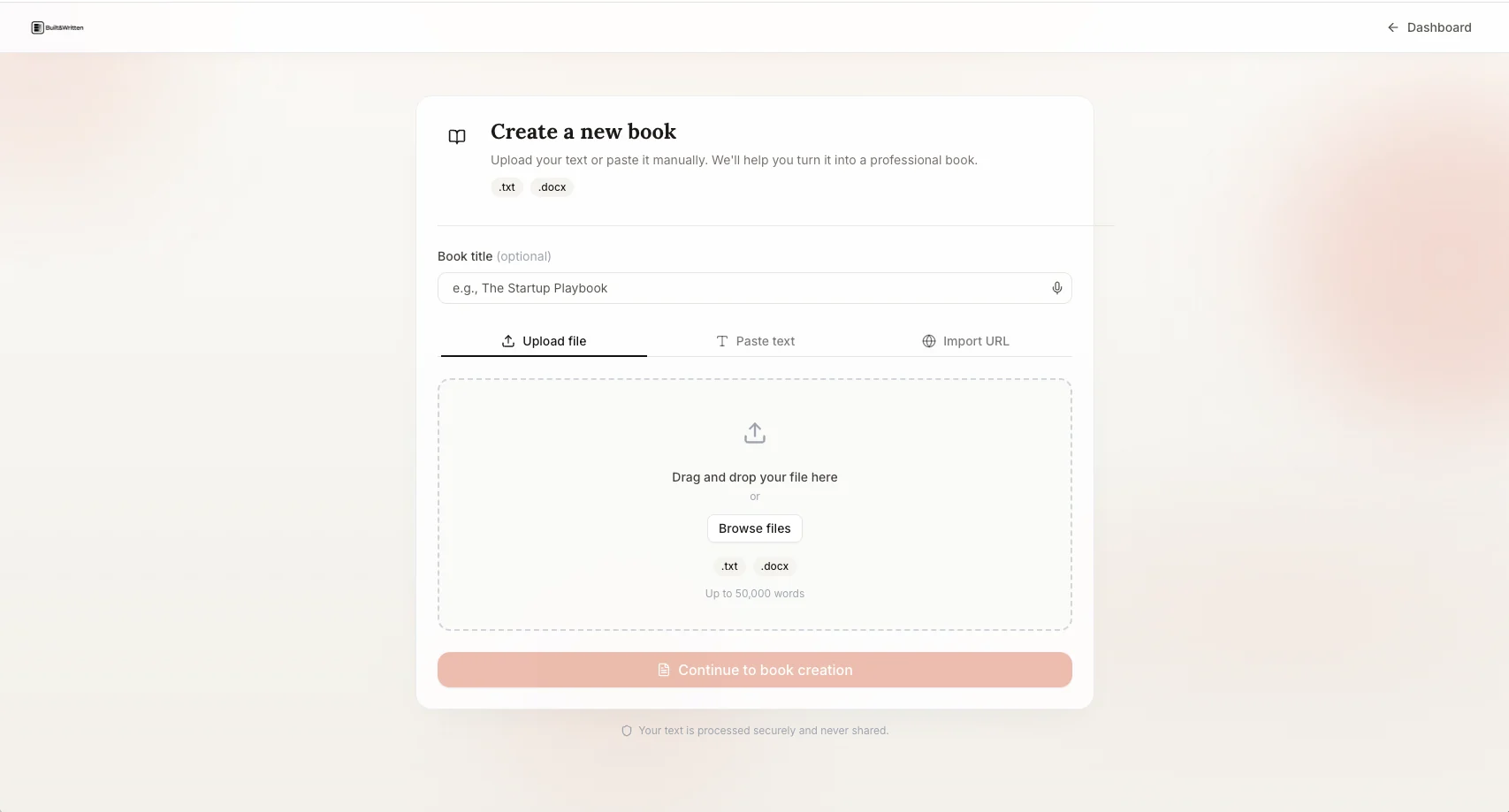
Stage 1: Mining your existing content
The Coach's Book Production Stack starts with one assumption: you have already written most of your book. You just don't know it yet.
The average coach who has been active on LinkedIn for two years has 150 to 400 posts. At 200 words per post on average, that's 30,000 to 80,000 words. Add a podcast with 50 episodes, each transcribed to roughly 4,000 words, and you have another 200,000 words of audio content. Add client session notes, workshop outlines, course scripts, and email newsletters, and the average active coach has written between 100,000 and 500,000 words on coaching topics before they ever open a book-writing tool.
A 50,000-word coaching book is about 175 pages. Most coaches have that in their archive twice over, in raw form. The book exists. It just needs assembly.
The content audit process:
Start with LinkedIn. Export your full data archive via LinkedIn Settings (the option is under "Data Privacy," then "Get a copy of your data"). The export includes all your posts in a CSV file. The export takes up to 24 hours. Download it, open the posts file, sort by engagement, and read through the top 50 posts. You'll see themes emerging. Those themes are your chapters.
For podcast content: use Otter.ai, Descript, or Rev to transcribe episodes you haven't already transcribed. Most podcast hosts will have a rough transcript from their platform. Quality varies, but even a rough transcript is useful raw material. Collect them all in one folder.
For everything else: client session notes (with all identifying information removed), workshop outlines, course slides, webinar transcripts, email sequences, blog posts. Collect everything in one location before sorting it.
Count your total word volume. If you have fewer than 30,000 words of existing content across all sources, your first priority is content creation, not book-writing tools. The Stack works best when the raw material volume is high. Build the archive first.
Common failure mode in Stage 1: Coaches assume they know their archive and skip the audit. They begin the book from memory and miss 60% of their best material. The audit is not optional, and it should be the first thing you do, before opening any writing tool.
Stage 1 output: A folder organized by theme, a word count total across all sources, and a rough list of 5 to 10 themes that appear consistently across your content. These themes are the skeleton of your chapter outline.
Stage 2: Structuring with AI
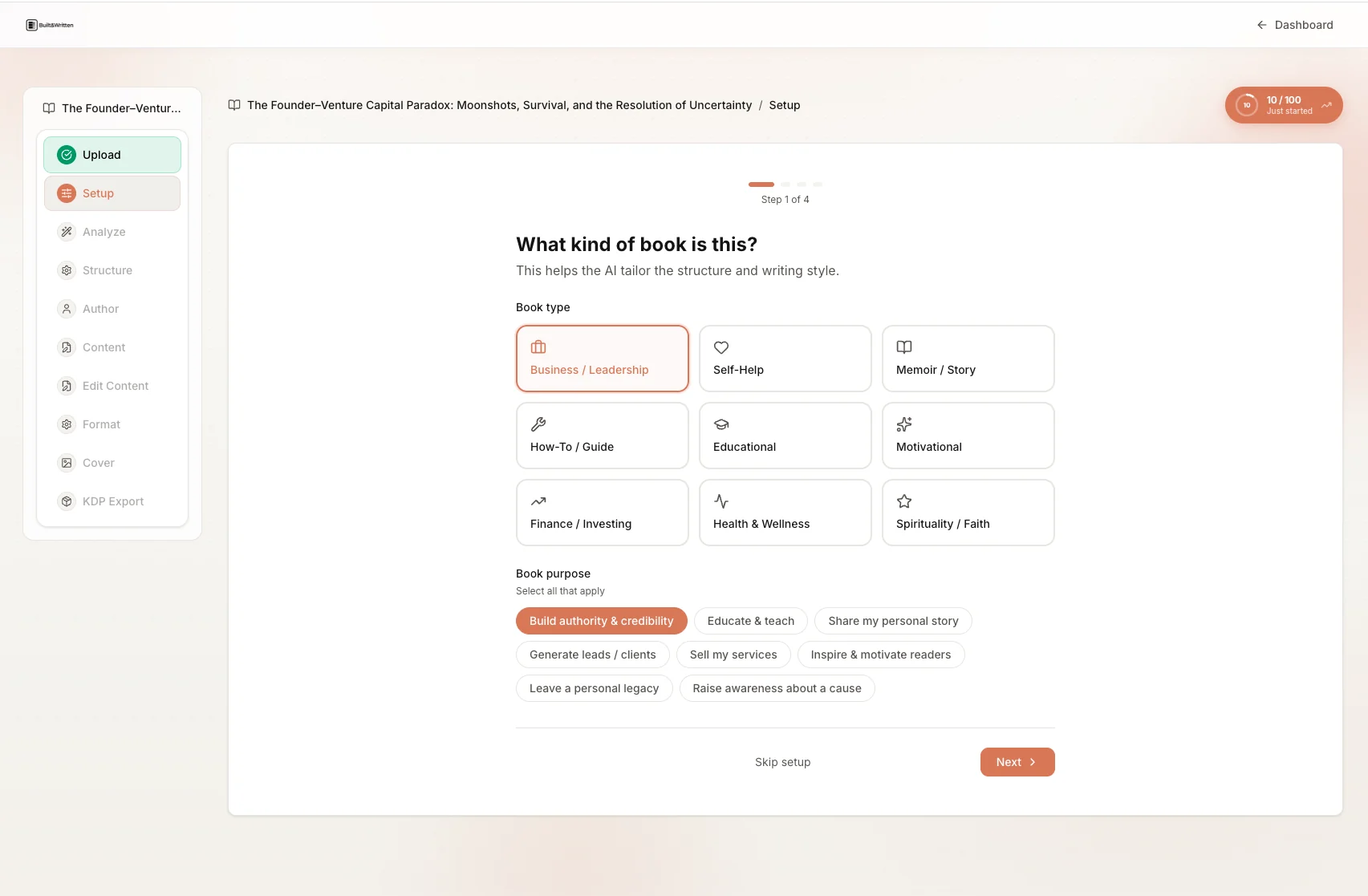
Stage 2 is where raw material becomes architecture. The goal is a chapter structure you believe in before a single chapter gets drafted.
Most coaches skip directly from "I should write a book" to "let me start writing Chapter 1." This is the mistake that produces a half-finished manuscript that sits in a Google Doc for three years. Chapter 1 gets written. Then the coach realizes they don't know what Chapter 2 should say, or whether Chapter 1 should even come first. The outline never got designed. The structure gets discovered retroactively, which means undoing everything written to fit it.
Stage 2 prevents this. The AI's job in Stage 2 is to cluster your content archive by theme and propose a chapter architecture. Your job is to review it, edit it until it's right, and approve it before Stage 3 begins.
How to run Stage 2 in practice:
If you're using Built&Written, paste your LinkedIn content, paste your podcast transcripts, and add your additional materials. The platform groups them by theme and proposes a chapter structure. You'll see something like: Chapter 1 (your core coaching philosophy), Chapter 2 (client assessment methodology), Chapter 3 (the first 90 days framework), and so on. The groupings won't be perfect out of the box. Edit them. This editing process is itself high-value: you'll discover which themes are well-developed in your content (meaning you have a lot of material on them) and which are thin (meaning you'll need to write new content for those chapters).
If you're using ChatGPT or Claude directly, paste your top 50 LinkedIn posts into a conversation and ask the model to identify the 5 to 7 themes and propose a chapter sequence. Then upload podcast transcript excerpts and ask it to identify which themes they reinforce. This works but requires more manual organization on your part. The advantage of a purpose-built tool is that the ingest step is handled for you.
The chapter architecture decisions that matter:
Decide the book type before locking the architecture. A methodology book (like The Coaching Habit by Michael Bungay Stanier or Coach the Person, Not the Problem by Marcia Reynolds) has a specific structure: it presents a framework, then unpacks each component. A lead-magnet booklet (shorter, more specific, a single concept with exercises) has a different structure. A case-study anthology (like The Prosperous Coach by Rich Litvin) has yet another. The structure follows the book type, not the other way around.
For a methodology book: 6 to 10 chapters, each covering one component of the methodology, with the framework introduced in Chapter 1 and applied across subsequent chapters.
For a lead magnet: 3 to 5 chapters, each around 3,000 to 4,000 words. Tight, actionable, with exercises at the end of each chapter that connect to your coaching offer.
For a memoir-style book (like Mel Robbins's The High 5 Habit or Marie Forleo's Everything is Figureoutable): narrative-first, with the methodology woven through personal stories.
Stage 2 output: An approved chapter outline with working titles for each chapter, a brief summary of what each chapter covers, and a note on which existing content feeds each chapter. This document is the project spec. Every decision in Stage 3 refers back to it.
Stage 3: Drafting with Voice DNA
Stage 3 is where the manuscript gets written. It is also where most AI-assisted book projects fail.
The failure mode is predictable: the coach opens a writing tool, feeds it a chapter prompt, and the tool produces 2,000 words that are technically correct and sound nothing like the coach. The coach edits it. Hours pass. The output still doesn't feel right. The coach concludes "AI can't write a coaching book" and goes back to staring at a blank Word document.
The failure is not AI. The failure is AI without voice setup.
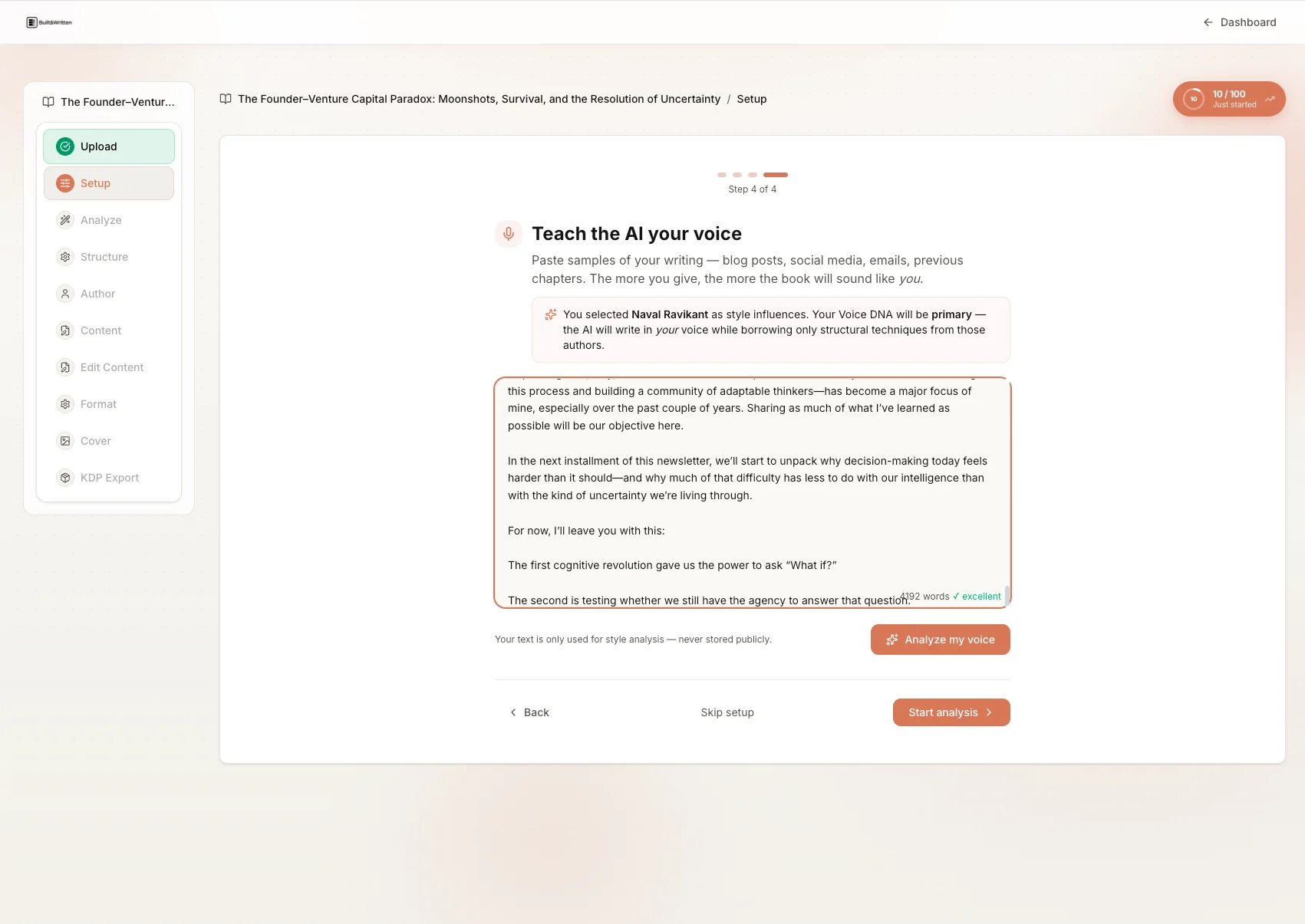
Voice DNA is the solution. Voice DNA is a process of training an AI tool on a coach's existing writing samples before generating any new content. The model fingerprints the coach's voice from those samples. That fingerprint becomes the constraint applied to every output. The result reads like the coach wrote it, because the constraint forcing it was built from the coach's own writing.
Built&Written has Voice DNA built in as a named feature. Other tools require you to approximate it manually: upload your best writing samples, reference them in every prompt, and explicitly instruct the model to match the voice rather than its defaults.
How to set up Voice DNA correctly:
Choose 5 to 50 pages of your most characteristic writing. Not your most-engaged-with LinkedIn posts (those are optimized for engagement, which introduces patterns that don't belong in a book). Your most authentically-voiced posts: the ones where you wrote exactly how you'd say it on a coaching call. The posts where the formatting tricks (three-word lines, dramatic paragraph breaks) were not the point and the idea was.
Feed those samples before generating any content. In Built&Written, this is the Voice DNA setup step in the wizard. In ChatGPT, paste them in at the start of the conversation and explicitly say: "The following is how I write. Every output you produce for this book project should match this voice, not improve on it, not formalize it, and not make it more literary."
The chapter-by-chapter drafting rhythm:
Draft one chapter. Edit it before moving to the next. Not all chapters first, then edit. The drift from your voice accumulates across chapters and is hardest to catch when you've been reading the same manuscript for three weeks. One chapter at a time, the drift is obvious in real time.
After drafting each chapter, run the voice check: read it aloud. If a paragraph sounds like it could have come from any AI tool, it probably did. The tells are consistent:
- Sentences starting with "Furthermore," or "Moreover,"
- The word "delve" in any context
- Hedge phrases: "It's worth noting," "It's important to understand," "One must consider"
- Three-item bullet lists as the default structure for every argument
- The phrase "in today's landscape" or any variant
- Chapters closing with a paragraph that begins "In summary,"
Cut these on sight. Replace with your natural patterns: shorter sentences, direct statements, the specific example rather than the general category.
How much new writing is required:
Stage 3 is not purely assembly. Even with a rich content archive, there are usually three types of new content needed:
Connective tissue. Transitions between chapters, framing passages that orient the reader to the methodology, chapter introductions and closings. This is the most important new writing and the most rewarding: it's where your authorial voice is strongest because no archive material exists to constrain it.
Bridging content. When two LinkedIn posts on the same theme were written months apart and have a conceptual gap between them, the AI bridges it. Your job is to verify the bridge is true: that the connection the AI drew is actually the connection you intended.
Thin chapter repairs. Chapters where the archive material is sparse (you identified these in Stage 2). For these, you're drafting more from scratch using AI assistance. The Voice DNA setup is most important here.
Stage 3 output: A complete first-draft manuscript. At minimum 40,000 words for a lead-magnet booklet, 50,000 to 75,000 words for a methodology book. The draft will need editing. That is expected. A good AI-assisted first draft is not a finished manuscript; it's raw material for the editing pass that produces a finished manuscript. Budget one editing hour for every five drafting hours.
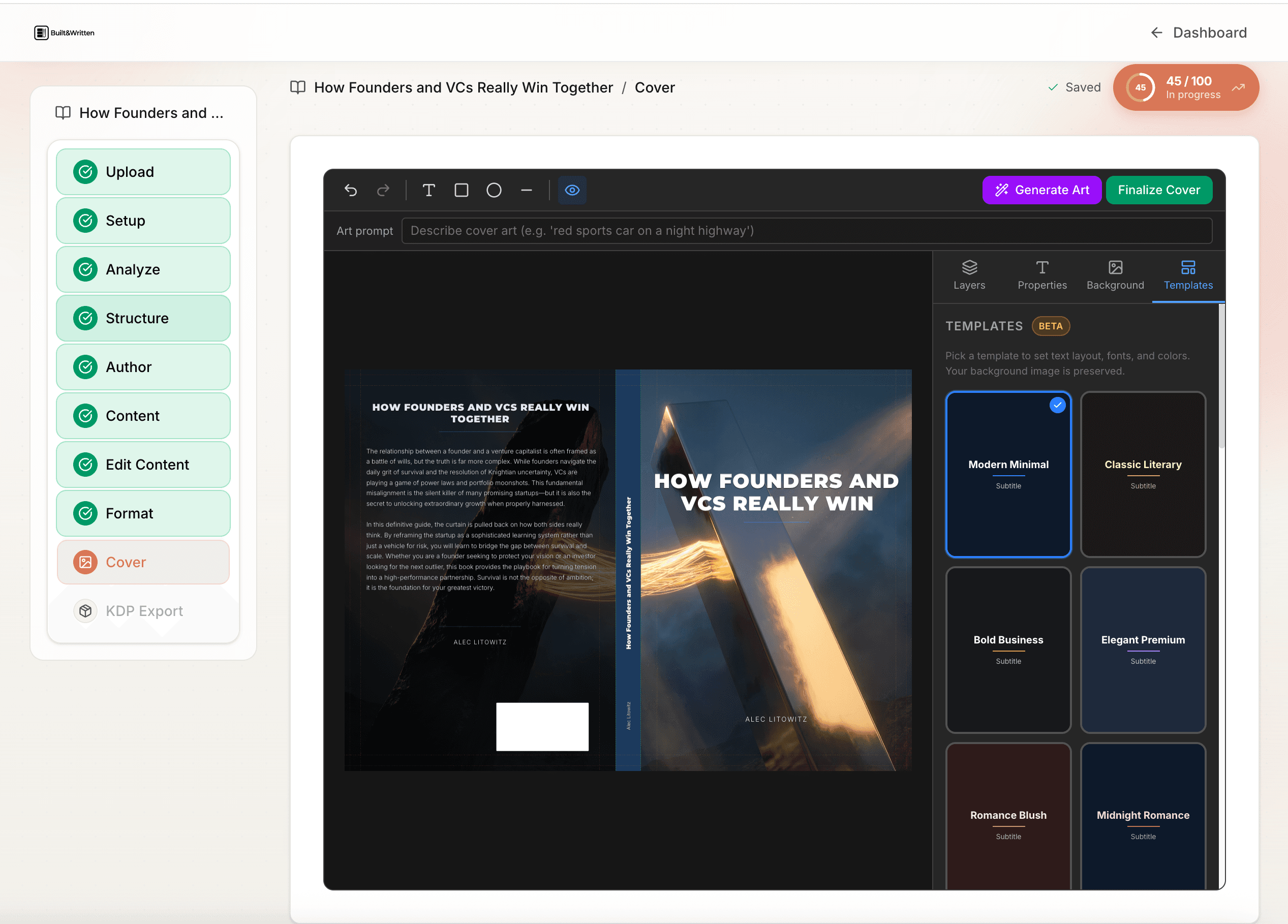
Stage 4: Cover and KDP Prep
Stage 4 is logistics. It is not glamorous, but it is where most books die. A coach who completed a 60,000-word manuscript and then discovered they don't know how to format it for Amazon has not written a book. They've written a document.
KDP has specific technical requirements. Trim size, margins, gutters, bleed, spine width (calculated from page count and paper type), image resolution, and font embedding. Get any of these wrong and KDP rejects the upload. The rejection is not harsh: KDP tells you what failed and lets you resubmit. But the iteration takes time, and each rejection is a delay.
The trim size decision:
This is the first decision in Stage 4 and it should have been decided in Stage 2. Commit to it before formatting.
For lead-magnet booklets: 5x8 inches. Smaller, slimmer, feels like a focused resource rather than a doorstop.
For flagship methodology books: 6x9 inches. This is the standard business book trim. Atomic Habits by James Clear, Building a StoryBrand by Donald Miller, The Five Dysfunctions of a Team by Patrick Lencioni: all 6x9. It reads as a serious book.
For workbooks with exercises, diagrams, and worksheets: 8.5x11. The extra page width accommodates the layout.
The spine math:
Spine width is calculated by KDP based on your page count and paper type. KDP's formula for white paper (60lb): page count x 0.002252 inches. A 200-page book has a spine of 0.45 inches. A 300-page book has a spine of 0.68 inches. This matters because your cover designer needs the exact spine width to position text correctly. Get it wrong and the spine text runs off the edge or doesn't appear.
If you're using a tool with integrated cover design (Built&Written handles this), the spine math is calculated automatically when you enter your page count. If you're using Atticus or designing the cover in Canva separately, calculate the spine width manually before sending it to any designer.
KDP's formatting requirements:
Amazon KDP's formatting guidelines specify the following for a standard 6x9 paperback:
- Inside margins: at least 0.375 inches for books under 150 pages, scaling up for longer books
- Outside margins: at least 0.25 inches
- Top and bottom margins: at least 0.25 inches
- Gutter (inside margin for the binding): 0.125 to 0.5 inches additional, depending on page count
- Bleed (for covers with content extending to the edge): 0.125 inches on all three sides
These numbers are not flexible. KDP's pre-press check catches margin violations and rejects the upload. Both Built&Written and Atticus handle these specifications in their export templates. Kindle Create, Amazon's free formatting tool, also handles them for the Kindle version.
The cover:
A coaching book's cover does one job before anyone reads a word of it: it signals "serious non-fiction by a credible author." The signals are typographic (font choice, weight, spacing), color (professional palette, not clipart colors), and compositional (author photo or object-based imagery, not stock photo people).
You don't need to spend $1,200 on a designer. You do need to not use a Canva template that looks like a Canva template. The difference is in the details: letter spacing, font pairing, and the professional finishing that comes from actually understanding what coaching books look like.
Coaching for Performance by Sir John Whitmore uses a clean, text-forward cover with a strong sans-serif. Coach the Person, Not the Problem by Marcia Reynolds uses an object-based image rather than a person. Real-Time Leadership by Carol Kauffman uses a bold typographic treatment with a strong color. Study the covers of coaching books that have sold well. They share a visual vocabulary.
Built&Written's integrated cover generator produces output in this vocabulary. If you're using Atticus, the cover designer is solid for producing clean, professional covers. If you're working in Canva separately, use one of the book cover categories, not the general design templates, and choose fonts from the serif or clean sans-serif categories.
The proof copy:
Order one physical proof copy from KDP before setting your book live. KDP charges the printing cost (usually $3 to $7 depending on page count) plus shipping. Budget two weeks between ordering the proof and approving final files.
Read the proof physically. You will catch things you didn't catch on screen: margin violations that looked fine in the PDF, image resolution issues that look sharp at 72dpi and poor at 300dpi, typos your eye skipped. The proof copy step is not optional. Every coach who skipped it regretted it.
Stage 4 output: A print-ready PDF (trim size, margins, bleed, and spine math all correct), a Kindle-ready ePub, and a print cover PDF (front, back, and spine with correct dimensions). These three files are what you upload to KDP.
Stage 5: Launch and Lead-Gen Integration
Stage 5 is where most coaches stop thinking about the book, and where the book actually starts working.
Publishing on Amazon is not a marketing plan. A book uploaded to KDP with no launch strategy, no back-matter call-to-action, and no external promotional push will sit in the Amazon catalog indefinitely, known only to the people who already know the coach. That is not the outcome the Stack is designed for.
Stage 5 has three components: the launch sequence, the back-matter funnel, and the ongoing integration into the coach's client acquisition pipeline.
The back-matter funnel:
Before the book launches, the back matter (the pages after the final chapter) must be built. At minimum:
- An "About the Author" section with a photo, credentials, and coaching background.
- A direct offer. Not a gentle "find me online." A specific offer: "Book a free 30-minute discovery call at [your URL]." If you have a lead magnet (a free chapter, a companion worksheet, a self-assessment), offer it here with a URL and a QR code.
- A QR code. Printed books go on physical shelves and get handed to people. A QR code on the last page, linking directly to your discovery call calendar or lead capture page, converts a physical handoff into a digital lead.
The lead-gen funnel behind the book matters as much as the book itself. The book sells for $9.99. The book sells your coaching engagement through the funnel you build. Build the funnel first, then finalize the back matter, then launch.
The KDP pricing strategy:
Lead-magnet booklets (under 120 pages, focused on one framework): price at $0.99 to $2.99. The goal is maximum distribution, not revenue from book sales. Price low enough that a target client buys it on impulse.
Flagship methodology books (175 to 300 pages, full coaching system): price at $9.99 to $14.99 paperback, $4.99 to $7.99 Kindle. This is the standard pricing range for the business/coaching category on Amazon. Pricing above this range requires significant external credibility (a major press publication, an established platform, a pre-existing bestseller list appearance).
The launch sequence:
Week 1 (pre-launch, two weeks before publish date): Send an email to your list announcing the book. If you don't have a list, post on LinkedIn with a pre-order link. Ask five clients and five peer coaches to buy on launch day and leave a review.
Week 2 (launch week): Go live on KDP (set the publish date in advance). Post on LinkedIn the day it goes live. Send a launch email to your list with the purchase link. Ask your beta readers to post their reviews. Reach out to podcasts you've been on asking if they'll mention it in an episode.
Weeks 3 to 8 (post-launch): Systemize the book's place in your lead-gen flow. Add the book to your email signature. Add it to your LinkedIn profile. Include a "get the book" section on your website. When a discovery call goes well, send the prospect a copy. When a workshop participant asks for resources, the book is the resource.
For a deep dive on the lead-gen strategy specifically, see How a Coaching Book Generates Leads.
Stage 5 output: A live book on Amazon, a back-matter funnel converting readers to discovery calls, and a systematic integration of the book into the coach's existing client acquisition process.
What's the best AI tool for each stage of the Stack?
This is the practical tool layer. For each stage of the Coach's Book Production Stack, here are the tools, what they do well, what they don't, and the recommended choice.
Tool landscape overview
| Tool | Stage 1 (Mining) | Stage 2 (Structuring) | Stage 3 (Drafting) | Stage 4 (KDP Prep) | Stage 5 (Lead-Gen) | Coach-fit score |
|---|---|---|---|---|---|---|
| Built&Written | Paste / upload / URL | AI clustering | Voice DNA | Integrated export + Launch Co-pilot | Pre-filled launch post | 5/5 |
| Atticus | Import only | No | No | Best-in-class | No | 3/5 (Stage 4 only) |
| ChatGPT | Copy-paste | Strong with prompting | Strong with prompting | No | No | 3/5 |
| Claude | Copy-paste | Strong with prompting | Strong with prompting | No | No | 3/5 |
| Sudowrite | Limited | Fiction-oriented | Fiction voice | No | No | 1/5 |
| Squibler | No | Template-based | Fast but generic | No | No | 2/5 |
| Vellum | Import only | No | No | Excellent (Mac) | No | 2/5 (Stage 4 only) |
| Reedsy | Import only | No | No | Good (free) | No | 2/5 (Stage 4 only) |
| Kindle Create | No | No | No | Kindle only | No | 1/5 (Kindle only) |
| Otter.ai | Transcription | No | No | No | No | 2/5 (Stage 1 only) |
| Descript | Transcription + edit | No | No | No | No | 2/5 (Stage 1 only) |
| Canva | No | No | No | Cover design | No | 2/5 (cover only) |
The table makes clear what the article has been building toward: no single tool other than Built&Written covers all five stages of the Stack. Every other path requires assembling a multi-tool workflow.
Stage 5 tools: Lead-Gen Integration
No dedicated book-publishing tool fully handles Stage 5. Built&Written's KDP Launch Co-pilot generates a complete Amazon listing (description, keywords, categories) and a pre-filled launch post for LinkedIn from your manuscript content. Useful for the launch step, but the broader lead-gen funnel (landing page, email sequence, Calendly link) lives in your existing tools.
For everything else in Stage 5: your existing website builder for the landing page, your email marketing platform for the launch sequence, and QR code generators (many are free) for the back-matter links. The tools are not the bottleneck in Stage 5. The bottleneck is deciding on the offer and building the landing page before the book goes live.
For the complete lead-gen strategy, see How a Coaching Book Generates Leads.
The verdict: every coach should write a book in 2026 if they want to scale
The argument is straightforward and the evidence is consistent: a coaching book is the highest-leverage marketing asset a coach can produce. It builds authority at scale, converts cold traffic to warm leads, and permanently repositions the coach out of the generalist market.
The obstacle that stopped coaches from doing this in 2019 was real: assembling 60,000 words from a content archive was a six-month project requiring a developmental editor and a formatter and a cover designer and a self-publishing guide. The total cost was $5,000 to $15,000. The total time was 12 to 18 months.
The obstacle in 2026 is not the same obstacle. The Coach's Book Production Stack, with the right AI tools, compresses the timeline to 12 weeks and the cost to a fraction of the 2019 number.
Built&Written is the right tool for most coaches working through the Stack. It handles the writing, structuring, formatting, cover, and KDP launch in one platform. The subscription is from $19 a month, with a free tier.
For coaches with a finished manuscript who only need Stage 4 formatting, Atticus at $147 one-time is a legitimate alternative.
The coaches who will look back at 2026 as the year they built a lasting authority asset are the ones who started the content audit this week, ran the Stack in 12 weeks, and had a book live on Amazon before the end of the year.
Start on the free tier of Built&Written. The content audit can begin today.
Key takeaways
- A coaching book is a marketing asset, not a revenue stream.
- The Coach's Book Production Stack is the five-stage framework: Mining, Structuring, Drafting with Voice DNA, Cover and KDP Prep, and Launch and Lead-Gen Integration.
- Most coaches already have 50,000 to 200,000 words of raw book material in their LinkedIn archive, podcast transcripts, and coaching notes.
- Voice DNA is the non-negotiable step in Stage 3.
- Amazon KDP does not reject AI-assisted books in 2026. Disclosure is required, not prohibited.
- Built&Written is the only tool that covers all five stages of the Stack.
- The full Stack takes approximately 12 weeks at one to two hours per day.
- The lead-gen funnel behind the book matters as much as the book itself.
- The strategic window for publishing before the low-quality AI-book wave makes readers skeptical is 12 to 18 months.
Frequently asked questions
Will Amazon KDP reject my AI-written coaching book in 2026?
No. KDP's current AI policy requires disclosure but does not prohibit AI-assisted books. A coach who builds a book from their own existing content (LinkedIn posts, podcast transcripts, coaching notes) is producing AI-assisted content. Check the disclosure box and upload.
How much does it cost to publish a coaching book on Amazon KDP in 2026?
Publishing on KDP itself is free. Your costs are the tools used to produce the book: Built&Written from $19/month, transcription tools if needed, and the proof copy from KDP. Under $100 for total tool costs.
How long will it take to write a coaching book with AI?
Approximately 12 weeks at one to two hours per day, five days per week.
Sources and references
- Built&Written
- Built&Written free tier
- Amazon KDP Content Guidelines
- Amazon KDP AI Content Policy
- Amazon KDP Author Page
- International Coaching Federation research
- Atticus
- Vellum
- Reedsy
- Otter.ai
- Descript
Related guides
- Best AI Book Writing Tools for Coaches in 2026
- Atticus vs Built&Written for Coaches in 2026
- How to Self-Publish a Coaching Book on Amazon KDP in 2026
- Best Book Formatting Tools for Coaches on KDP 2026
- Built&Written vs Sudowrite vs Squibler for Coaches 2026
- How to Turn Your LinkedIn Posts Into a Coaching Book
- How a Coaching Book Generates Leads (with Real Numbers)
- How to Turn Your Podcast Into a Coaching Book on KDP
- How Long Should a Coaching Book Be?
Sources & References
- https://www.builtwritten.com/
- https://kdp.amazon.com/help/topic/G201834180
- https://kdp.amazon.com/en_US/help/topic/G200672390
- https://author.amazon.com
- https://coachingfederation.org/research
- https://www.atticus.io
- https://vellum.pub
- https://reedsy.com
- https://otter.ai
- https://www.descript.com
- https://www.boxofcrayons.com/the-coaching-habit-book/
About the author

Mykhailo Druz
More in AI Book Tools
Ready to write your book?
Turn your expertise into a professional book with Built&Written.