

eBook vs Print Book for Coaches in 2026: The Format Decision That Actually Matters for Your Business
eBook vs Print Book for Coaches in 2026: The Format Decision That Actually Matters for Your Business
In late 2024, a leadership coach named Dana finished the manuscript she had been piecing together for eleven months. She had poured client stories, frameworks, and hard-won lessons into 52,000 words. Then she hit the format question and spent the next six weeks going in circles.
Should she publish the ebook first because it was cheaper and faster? Or should she lead with print because that was what people saw on her desk during Zoom calls? She asked three colleagues and got three different answers. She read four blog posts and came away more confused. She eventually launched both at once with no pricing strategy, no launch sequence, and no idea which format was actually working.
Within ninety days, her ebook was earning sporadic $4.99 royalties while her paperback sat unsold because she had priced it $3 below break-even without realising it.
This article answers the question Dana needed answered before she published: what is the real difference between an ebook and a print book on Amazon KDP, which format serves coaches better, and how do you build a strategy that makes both work together rather than against each other.
Quick answer: The difference between an ebook and a print book on KDP is not just physical versus digital. It is a difference in authority signal, royalty structure, pricing ceiling, and audience expectation. For coaches, print builds the credibility that attracts clients and stages; ebooks extend reach and lower the cost of a first yes. The FORMAT Decision Matrix below tells you which to lead with based on your current business goal.
What "Format" Really Means When You Publish on Amazon KDP
When most coaches hear "ebook vs print," they picture the obvious: one lives on a Kindle, the other sits on a shelf. That framing misses what actually matters for a business.
On Amazon KDP in 2026, you can publish three physical formats: paperback, hardcover, and a large-print edition. You can publish two digital formats: Kindle ebook (MOBI/KFX) and, via KDP Select, a Kindle Unlimited-accessible version. Each format has different royalty logic, different pricing constraints, different production costs, and a different relationship with the reader who buys it.
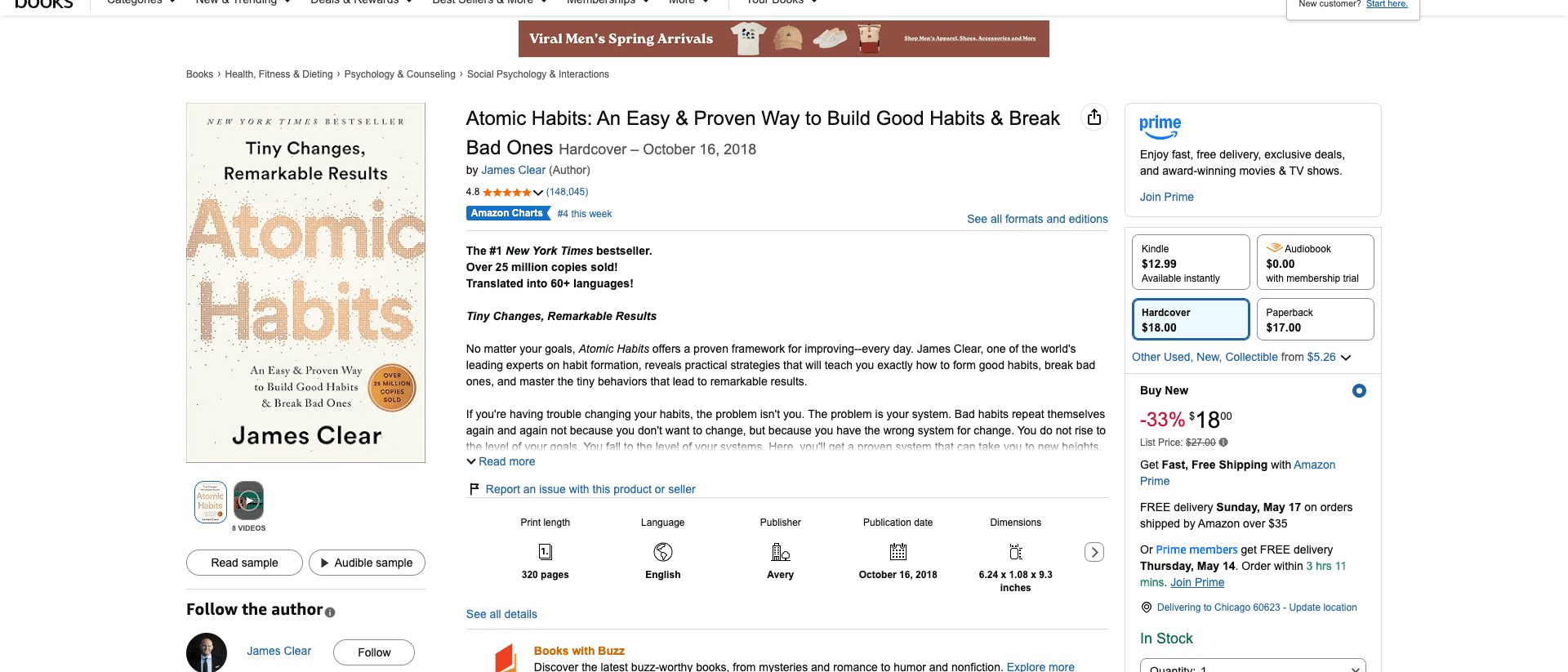
For entrepreneurs and coaches specifically, format is a positioning decision before it is a production decision. A $29.99 paperback sitting on a prospect's desk signals expertise in a way a $4.99 ebook file never will, regardless of which one took more effort to write. But a free or $0.99 ebook distributed to your email list converts new leads into engaged readers in a way a print book cannot match at scale.
The confusion most coaches experience comes from treating these as competing options. They are not. They are tools with different jobs. The goal of this article is to give you enough understanding of each format's economics and psychology to decide which job you need done first.
The Four Dimensions That Actually Matter
When comparing ebook and print for a coaching business, the four dimensions worth examining are:
Royalty structure: How much you earn per sale, and what you can control.
Pricing ceiling: The range of prices the market will accept for each format.
Authority signal: What the format communicates to a prospect before they read a word.
Distribution behaviour: Where and how each format reaches readers.
We will cover all four in depth. Let us start with the money.
eBook Royalties on KDP: What You Actually Earn
Amazon offers two royalty tiers for Kindle ebooks. Understanding the difference between them is the first thing any coach should know before setting a price.
The 70% Tier
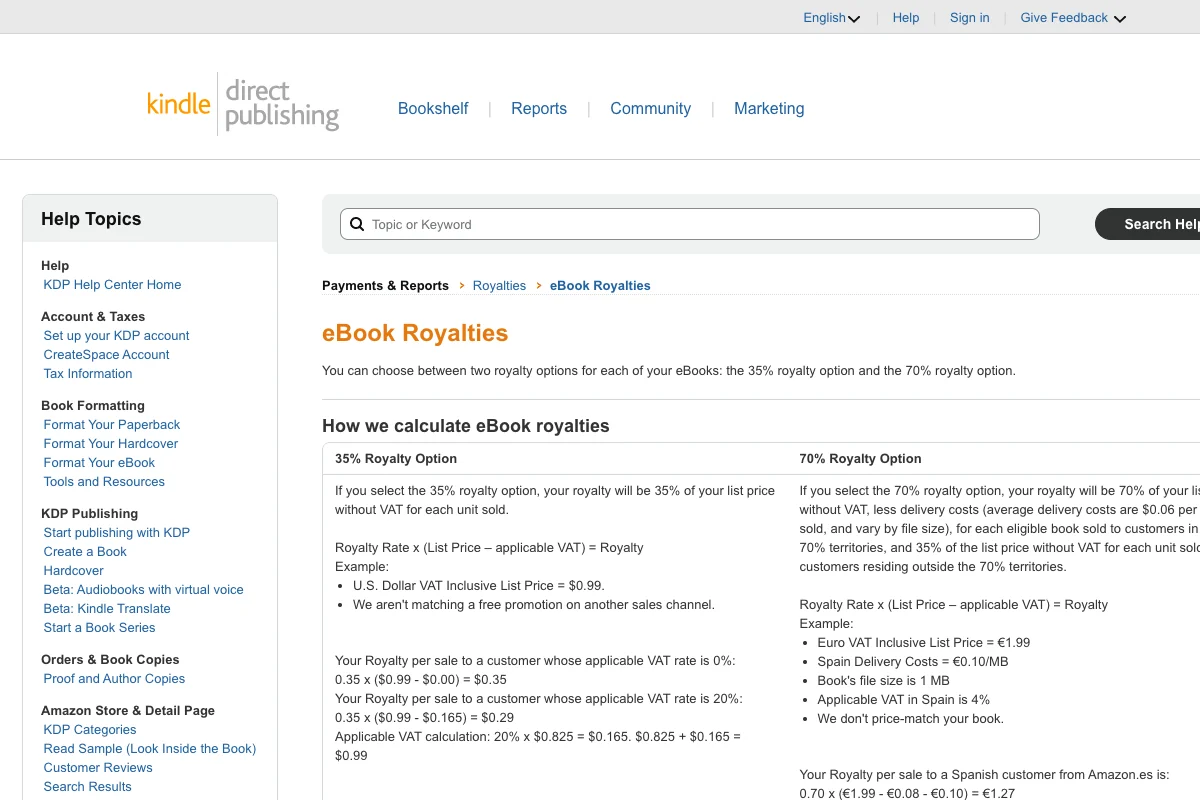
If you price your ebook between $2.99 and $9.99 (inclusive) in eligible territories, you qualify for the 70% royalty option. The territories that qualify include the United States, United Kingdom, Canada, Australia, Germany, France, Spain, Italy, Netherlands, Japan, Brazil, Mexico, and India.
The 70% sounds straightforward. It is not quite 70% of your list price because Amazon also deducts a delivery fee of $0.15 per megabyte of your ebook file size. A typical coaching book formatted as a Kindle file runs between 0.5 MB and 2 MB depending on how many images and charts you include. That delivery fee is usually between $0.08 and $0.30 per sale.
Example: A $9.99 ebook with a 1 MB file.
- Gross royalty at 70%: $6.99
- Delivery fee: $0.15
- Net royalty: $6.84 per sale
Example: A $4.99 ebook with a 1 MB file.
- Gross royalty at 70%: $3.49
- Delivery fee: $0.15
- Net royalty: $3.34 per sale
If you have both a print and a digital edition, Amazon requires your ebook price to be at least 20% below the print price to keep the 70% tier. So if your paperback is priced at $17.99, your ebook must be $14.39 or lower to maintain the 70% royalty.
The 35% Tier
If you price your ebook below $2.99 or above $9.99, you fall into the 35% tier. There is no delivery fee deduction in this tier, but you earn far less per sale.
Example: A $1.99 ebook.
- Royalty at 35%: $0.70 per sale
Example: A $14.99 ebook.
- Royalty at 35%: $5.25 per sale (vs. $10.34 at 70% if it qualified)
The price ceiling at $9.99 is the reason most coaching ebooks cluster there. Going above it drops you into the 35% tier, making it nearly impossible to earn meaningfully on individual sales.
What This Means for Pricing Strategy
For a coach who wants royalty income, $9.99 is the obvious ceiling. The difference between a $6.99 and a $9.99 ebook is $2.10 per sale at the 70% tier. Over 500 sales in a year, that is $1,050. Over 1,000 sales, it is $2,100. Not a career-defining number, but real money that coaches routinely leave on the table by pricing "generously" at $4.99 or below.
If your goal is broad distribution and lead generation rather than royalty income, $0.99 and even free periods (via KDP Select) can make sense. But you should make that choice deliberately, not by default.
Print Book Royalties on KDP: The Formula Behind the Numbers
Print royalties on Amazon KDP work differently from ebook royalties. Instead of a simple percentage of list price, your print royalty is a function of list price minus a per-book printing cost.
The Royalty Rate (Updated June 2025)
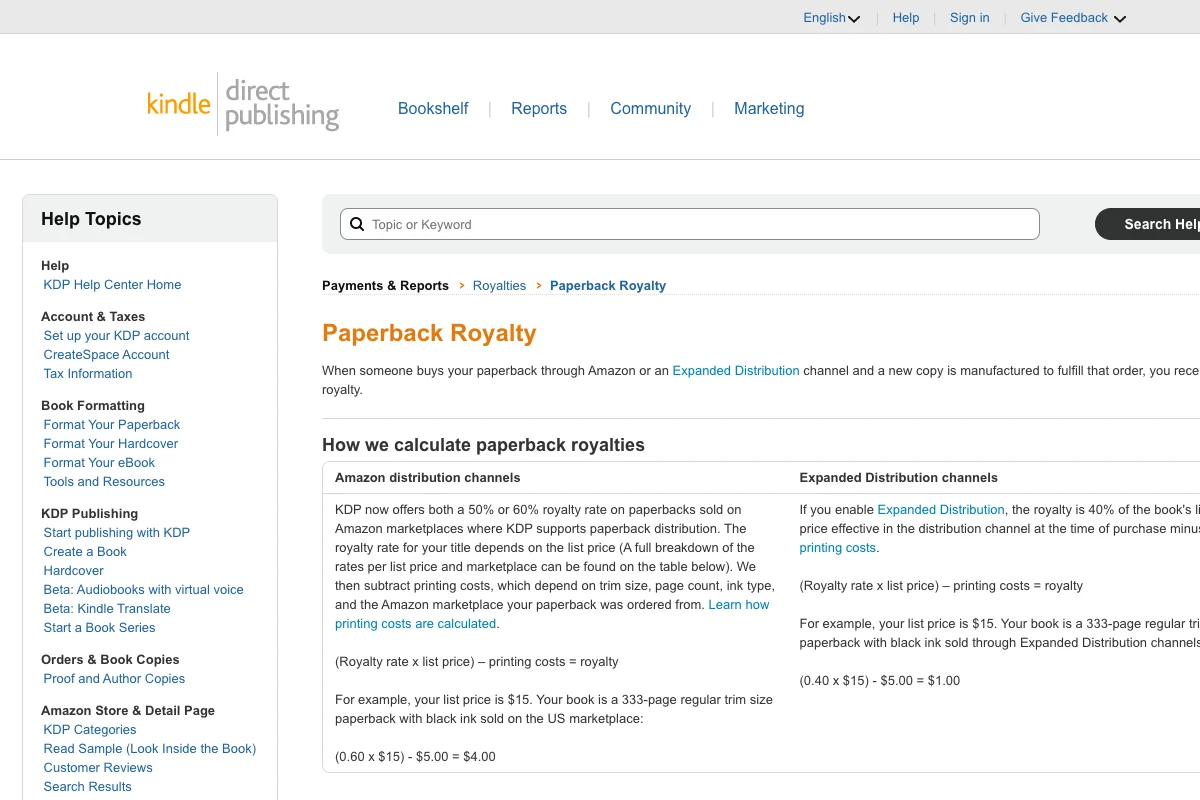
As of June 2025, KDP's print royalty structure changed to a tiered model:
- Books priced at $9.99 or above: 60% royalty rate
- Books priced below $9.99: 50% royalty rate
For US marketplace sales, the formula is:
Royalty = (List Price × Royalty Rate) - Printing Cost
The royalty for expanded distribution channels (bookstores, libraries, online retailers other than Amazon) drops to 40% of list price minus printing cost.
Understanding Printing Costs
KDP prints your book on demand. You carry no inventory. Amazon prints a copy each time someone orders, deducts the printing cost from your royalty, and remits the remainder.
For a standard black-and-white paperback (the most common coaching book format), the printing cost in the US is:
$0.85 + ($0.012 × number of pages)
A 200-page book: $0.85 + $2.40 = $3.25 to print
A 250-page book: $0.85 + $3.00 = $3.85 to print
A 300-page book: $0.85 + $3.60 = $4.45 to print
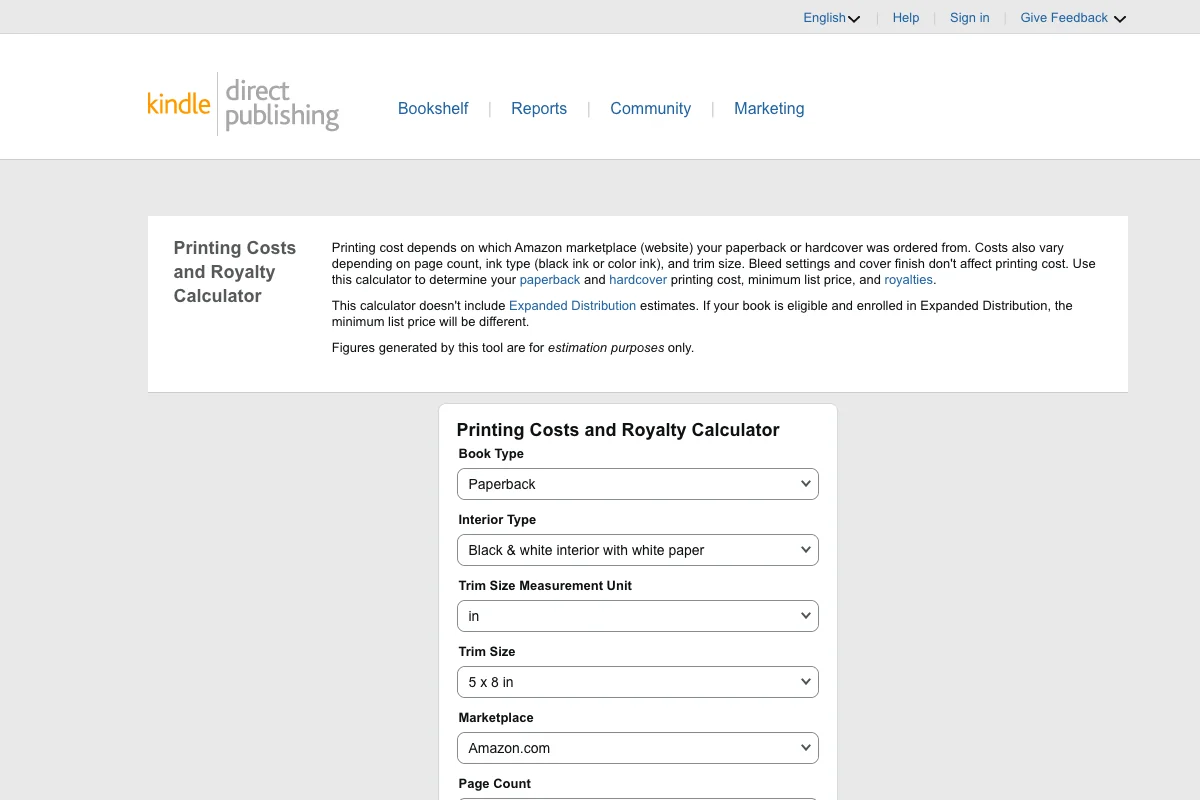
Trim size and paper color also affect cost. Standard sizes (6x9 or 5.5x8.5) use the formula above. Premium cream paper adds a small premium. Color interior printing costs substantially more, typically $0.07 per page, which makes a 200-page color book cost $0.85 + $14.00 = $14.85 to print.
Real-World Royalty Calculations
Example: 200-page coaching paperback priced at $17.99
- Royalty rate: 60% (price above $9.99)
- Gross royalty: $17.99 × 0.60 = $10.79
- Printing cost: $3.25
- Net royalty: $7.54 per sale
Example: 200-page coaching paperback priced at $14.99
- Royalty rate: 60%
- Gross royalty: $14.99 × 0.60 = $8.99
- Printing cost: $3.25
- Net royalty: $5.74 per sale
Example: 250-page coaching paperback priced at $19.99
- Royalty rate: 60%
- Gross royalty: $19.99 × 0.60 = $11.99
- Printing cost: $3.85
- Net royalty: $8.14 per sale
These numbers are before Amazon's standard transaction fees, which are embedded in the royalty rate calculation.
The Break-Even Price
You need to price your print book high enough that the royalty exceeds the printing cost. The minimum viable list price is:
Minimum price = Printing Cost ÷ 0.60
For a 200-page book: $3.25 ÷ 0.60 = $5.42 minimum list price
Many coaches inadvertently price below this threshold because they worry about seeming too expensive. A 200-page coaching paperback priced at $9.99 earns only $2.74 per sale (before any additional fees). That same book at $16.99 earns $6.94 per sale.
The lesson: pricing your print book too low does not make it more competitive. It just means you earn almost nothing per copy while Amazon earns the same margin either way.
Hardcover Royalties
Hardcover publishing on KDP uses the same royalty formula (60% minus printing cost), but the printing cost is substantially higher. A 200-page hardcover costs approximately $7.25 to print. At $29.99, a 200-page hardcover earns:
- Gross: $29.99 × 0.60 = $17.99
- Printing: $7.25
- Net: $10.74 per sale
Hardcover books carry the highest authority signal and the highest royalty per unit, but they also face the highest consumer price resistance. For most coaching books in 2026, paperback remains the default print format.
Key takeaway: The royalty difference between ebook and print is not as large as most coaches assume. A $9.99 ebook earns $6.84. A $17.99 paperback earns $7.54. The ebook wins on volume potential; the paperback wins on per-unit margin at higher price points and on the authority it builds outside of Amazon.
The Authority Gap: Why Physicality Still Moves Rooms
Royalties are one part of the equation. The other part is what each format does to how people perceive you.
What Happens When Someone Holds a Print Book
There is a tactile legitimacy to a physical book that digital files cannot replicate. A coaching book sitting on a shelf, landing in a prospect's mailbox, or sitting on a conference table during a client discovery call communicates something specific: this person did the full thing.
This is not about status. It is about cognitive shortcuts. Prospects, speaking event organisers, podcast hosts, and corporate clients use surface signals to quickly assess whether someone is credible enough to engage. A published print book is one of the strongest signals available because it implies a threshold of commitment that most people never reach.
Coaches who have gone through the KDP print process consistently report the same experience: after receiving their first author copy, introductions in rooms change. The book becomes a physical proof of the system behind the coaching.
This authority gap matters most in these situations:
- Speaking engagements: Conference organisers and event producers routinely ask whether a speaker has a book. A Kindle file does not satisfy that question in the same way a spine-out paperback does.
- Corporate and executive coaching: Decision-makers in B2B environments are accustomed to evaluating vendors by credentials. A print book reads as a credential; an ebook reads as a resource.
- Media appearances: Podcast hosts, journalists, and journalists requesting review copies need something physical to reference. A print ISBN also unlocks some media coverage options that a digital-only release does not.
- Gift and referral distribution: A print book can be handed to someone, mailed as a welcome gift to new clients, or left behind after a keynote. The physical handoff creates a moment that an ebook download link does not.
What Ebooks Do Better
Digital files win on different terms. They do not build authority the same way a physical book does, but they excel at these jobs:
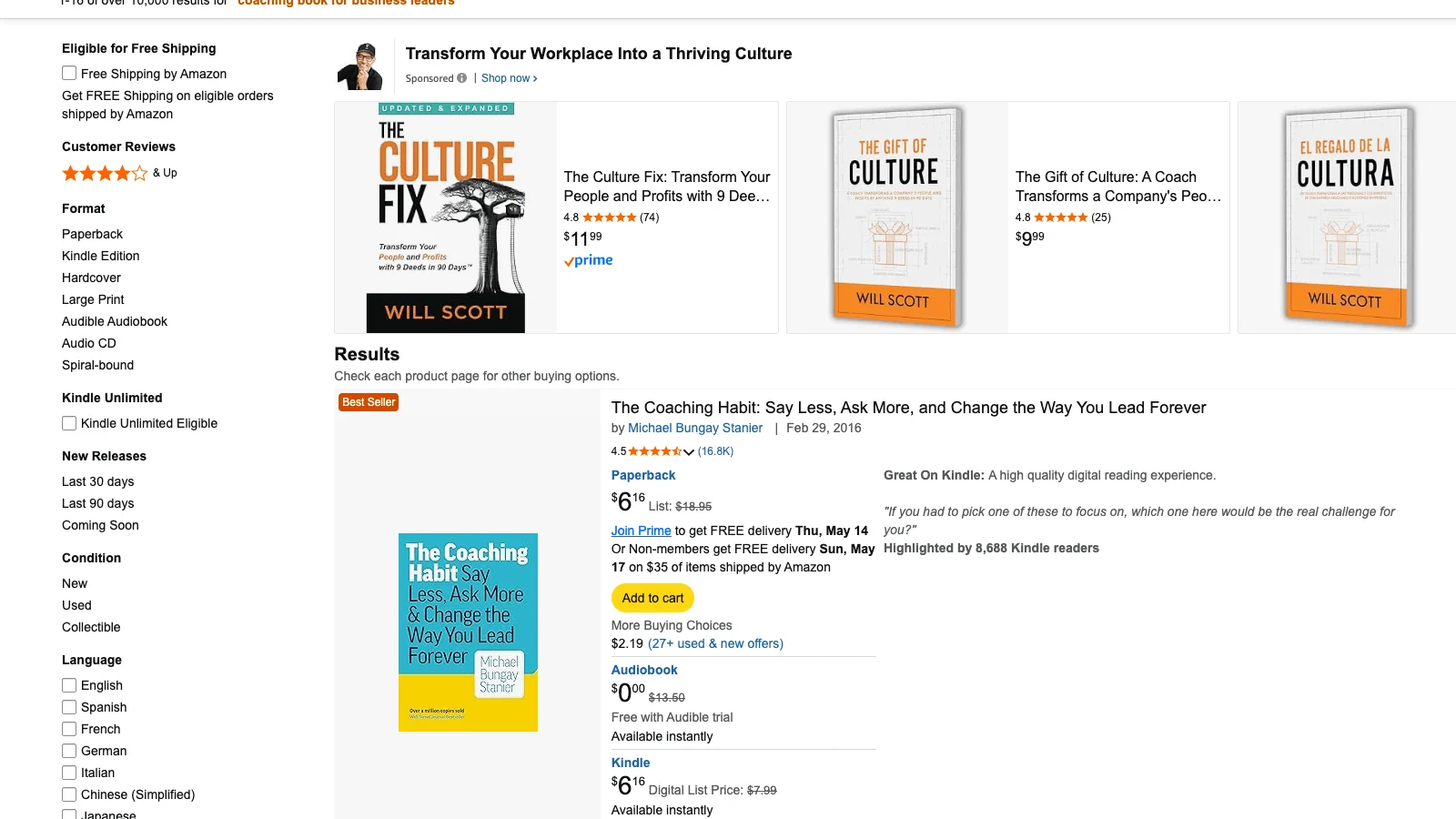
Lead generation at scale. An ebook can be priced at $0.99 or offered free as a lead magnet without the economics falling apart. A print book cannot. At $0.99, a print book earns nearly nothing after printing costs; at $0.00, it loses money on every sale.
Immediate access. A prospect who finds you at 11pm on a Tuesday can download your ebook and start reading within ninety seconds. A print book ships in two to five days. For impulse-driven discovery moments, speed matters.
Global reach with no shipping friction. Ebooks reach every country where Kindle operates without shipping costs or import complications. This matters for coaches with international audiences.
KDP Select and Kindle Unlimited. Enrolling your ebook in KDP Select gives you access to promotional tools including free promotional periods (up to five days per 90-day enrollment period) and Kindle Countdown Deals. Coaches have used free ebook days to generate hundreds or thousands of downloads in a single day, converting a portion of those downloaders into email subscribers and eventually into paying clients.
Searchability. Kindle ebooks are searchable on-device, which increases reader engagement with reference-heavy books. A coach whose book contains a framework with specific steps gets better use from a digital reader who can search and return to a chapter than from a print reader who has to flip through pages.
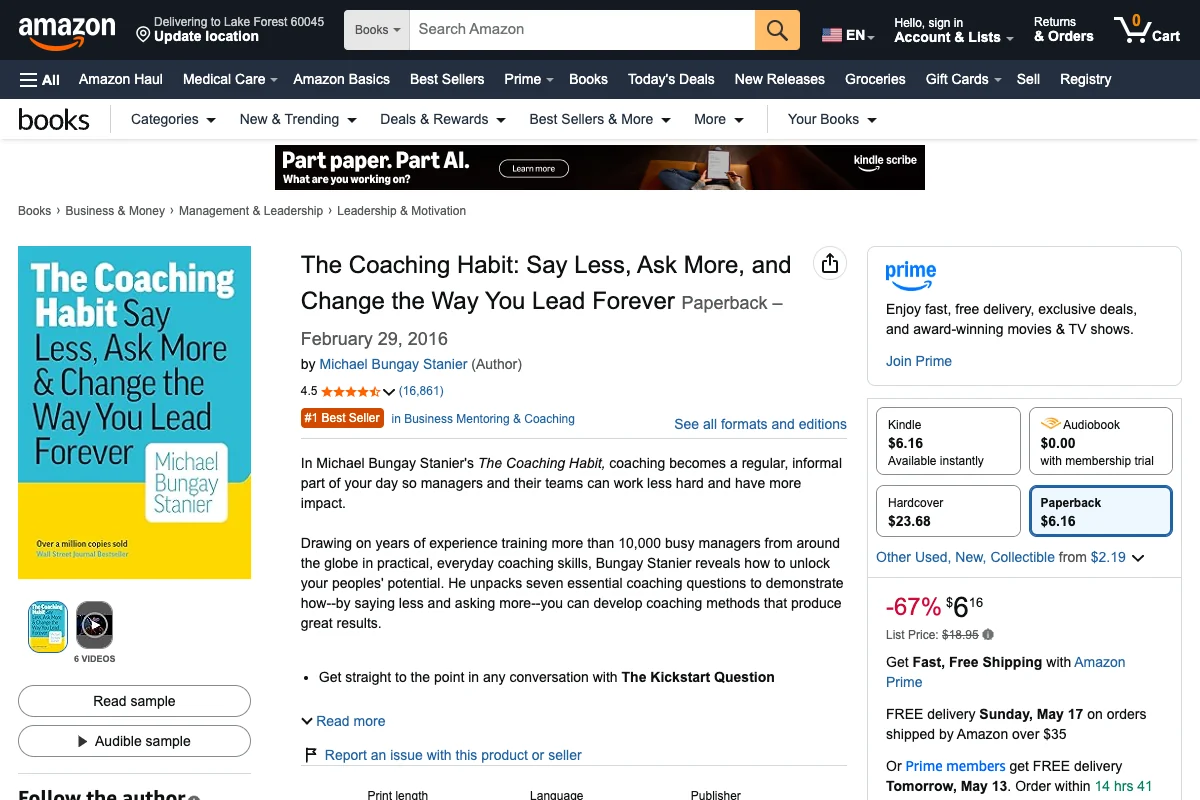
The FORMAT Decision Matrix
The question "ebook or print?" does not have a single right answer. It depends on what you are trying to accomplish in your business right now. The FORMAT Decision Matrix gives you a structured way to decide.
The acronym stands for:
- F (First Goal): What is the primary business objective for publishing?
- O (Offer Type): Are you selling the book or using it as a business asset?
- R (Reader Location): Where do your ideal clients discover and buy things?
- M (Margin Target): Do you want royalty income or scale and distribution?
- A (Authority Stage): Are you building initial credibility or reinforcing existing status?
- T (Timeline): How quickly do you need the book live and working?
Working Through the Matrix
If your first goal is speaking gigs, media, or B2B client acquisition: Lead with print. The physical book is the asset that opens those doors. Start with a paperback on Amazon, order fifty author copies, and put them in relevant hands before worrying about your Kindle ranking.
If your first goal is lead generation and email list growth: Lead with ebook. Set up a KDP Select enrollment, run a free promotion, and capture emails through a bonus resource inside the book. Print can follow once you have built the list.
If your offer is the book itself (you want royalty income): Publish both simultaneously and optimise each for royalty. Price your ebook at $9.99 (70% tier ceiling). Price your paperback between $16.99 and $19.99 depending on page count. Use the 20% pricing rule to stay in the 70% ebook tier.
If your offer uses the book as a door-opener (you want clients, not book income): Price for access, not royalties. $4.99 ebook, $14.99 paperback. The lower prices increase the chance of a prospect reading the book and entering your pipeline.
If your readers are primarily online and internationally distributed: Prioritise ebook. Digital removes shipping friction entirely.
If your readers are primarily local, corporate, or in-person contexts: Prioritise print. The physical handoff and shelf presence matter more to this audience.
If your margin target is maximising per-unit royalty: At the same perceived price ceiling, a $9.99 ebook earns $6.84 and a $9.99 paperback (assuming a 150-page book with $2.65 printing cost) earns $3.29. Ebook wins at the $9.99 ceiling.
If your authority stage is early (first book, few public credentials): Print builds the signal faster than digital. It is harder to dismiss.
If your authority stage is established (known in your niche, with an audience): Ebook first. Your existing audience will buy the digital version on launch day, generating early ranking and reviews. Print can be positioned as the premium format for your most engaged readers.
If your timeline is under thirty days: Ebook only. Print requires file setup, cover review, and a waiting period for KDP to approve and distribute. A formatted ebook can go live within 24 to 72 hours.
If your timeline is ninety days or more: Both simultaneously. There is no strategic reason to delay either format once you have the manuscript ready.
How to Price Your Book Across Both Formats (The 2026 Framework)
Pricing is the lever most coaches get wrong on both formats. The common mistake is pricing too low across the board out of imposter syndrome or fear of rejection. Here is a practical pricing framework for 2026.
The Anchoring Principle
Print prices anchor ebook prices. If your paperback is priced at $19.99 and your ebook is priced at $14.99, readers perceive the ebook as a deal. If your paperback is priced at $9.99, your ebook must be $7.99 or lower to meet the 20% rule, and both prices feel like commodity content rather than premium expertise.
Start with the paperback price, then work backwards to your ebook price.
Paperback Pricing Guidelines for Coaching Books
For a standard coaching manuscript of 150 to 250 pages in B&W:
- Minimum viable price: $12.99 (covers printing and leaves a small royalty)
- Mid-range authority price: $16.99 to $19.99 (strong royalty, credible positioning)
- Premium positioning: $24.99 to $29.99 (works for highly niched expert books in corporate or executive markets)
Most coaching books on Amazon in 2026 cluster between $14.99 and $19.99 for paperback. Pricing in this range does not disadvantage you competitively; it signals that you are not giving away your expertise.
Ebook Pricing Guidelines
Given the 20% rule and the 70% royalty tier ceiling at $9.99:
- Lead-generation ebook: $0.99 to $2.99 (temporary; use for launches and email list builds)
- Standard pricing: $7.99 to $9.99 (maximises royalty while staying accessible)
- Course-companion or workbook ebook: $4.99 to $6.99 (when the ebook is one part of a larger offer)
Avoid the $4.99 to $5.99 range for a standalone expert book unless you have a specific reason. At $4.99 with the 70% rate, you earn $3.34 per sale. At $9.99, you earn $6.84. That is more than double for the same book.
The Launch Sequence
A pricing sequence that has worked well for coaches publishing on KDP:
- Pre-launch: Set ebook at $0.99 for the first seven days to collect early reviews and sales rank velocity.
- Month one: Move ebook to $4.99, paperback at $14.99.
- Month two onward: Move ebook to $9.99, paperback stays at $14.99 to $19.99.
- Annual KDP Select free day: One free ebook day per quarter to spike downloads and generate email subscribers.
This sequence front-loads reviews and ranking, then captures the royalty upside once the book has social proof.
The "Publish Both" Playbook in 90 Days
Most coaches overthink this decision because they assume publishing two formats means twice the work. It does not. The manuscript is the same. The difference is a formatting step and a cover spine calculation.
Here is the 90-day playbook for coaching book formatting as a solo entrepreneur.
Days 1 to 30: Write and Complete the Manuscript
Write to a target of 25,000 to 50,000 words for a standard coaching methodology book. Below 25,000 words, a print book starts to feel thin (the spine barely shows at under 100 pages). Above 50,000 words, you are writing past what most coaches' clients will actually read.
For practical KDP purposes, 160 to 220 pages is the sweet spot. It gives you a visible spine on the shelf, a reasonable per-unit printing cost, and a manuscript length that feels complete without padding.
You can learn more about the page count and spine-width question in our guide on how long a coaching book should be.
Days 31 to 50: Format for Both Formats Simultaneously
This is where many coaches waste weeks by formatting twice. The efficient approach:
- Write in a single document (Google Docs or Word).
- Use a formatting tool that exports both a Kindle (.epub or .mobi) file and a print-ready PDF from the same source document. Several tools designed for KDP do this in one pass.
- Your interior PDF needs bleed settings, proper margins (at least 0.5 inches on all sides, with a larger inside/gutter margin for longer books), and a correctly sized trim.
- Your cover design needs two files: a front cover image (JPEG, minimum 1000x625 pixels) for the ebook, and a full wrap (front + spine + back) for the print edition.
The spine width on a print cover is calculated from your page count and paper type. KDP provides a spine width calculator. For a 200-page B&W paperback, the spine is approximately 0.45 inches.
Our guide to the best book formatting tools for coaches publishing on KDP covers the tools that handle dual-format output.
Days 51 to 70: Upload, Review, and Approve
Upload both formats to KDP in your account. For the ebook, KDP's online previewer shows you how each chapter will look across Kindle devices. For the print edition, KDP generates a print preview PDF that you can download and review before approving.
Order one paperback proof copy before going live. Author copies are sold at printing cost, not retail price, so a 200-page proof costs you $3.25 plus shipping. It is worth it. The errors that survive a PDF review often show up immediately in a physical copy.
Days 71 to 90: Launch and Distribute
- Set your ebook live first (it is faster to approve).
- Use KDP Select enrollment for your first 90 days if you want access to free days and Countdown Deals.
- Set your paperback live once the proof review is complete.
- Submit for expanded distribution to libraries and non-Amazon retailers.
- Order author copies to distribute physically.
The full walkthrough for the KDP publishing process, including ISBN assignment and category selection, is in our guide on how to self-publish a coaching book on Amazon KDP.
What Successful Coaches Actually Do in 2026
Looking across the coaches who have published and actively use their book as a business asset in 2026, a pattern is clear: the format question is not actually the most important decision. The strategy behind each format is.
The Coaches Who Prioritise Print and Why
Coaches who focus on in-person consulting, corporate training, executive coaching, and keynote speaking consistently report that the print book opens more doors than the ebook. Their clients are decision-makers who evaluate credibility through tangible signals. These coaches often invest in a higher-quality cover, order bulk author copies to mail to prospects, and use the book's ISBN to secure speaking gigs.
For this group, the ebook is a secondary format. They publish it because it is essentially free to do so once the print version exists, and it does pick up organic Kindle sales over time. But they do not run ebook promotions or optimise for Kindle rankings. Their book is a business card with 200 pages, not a royalty vehicle.
The Coaches Who Prioritise eBooks and Why
Coaches who build their business primarily online, through podcasts, social content, email, or digital courses, often find that the ebook moves faster and generates more engagement early on. Their audience is accustomed to digital consumption and expects low-friction access.
These coaches typically run their ebook at $9.99, use occasional KDP Select free days to build their email list, and treat the print book as the "physical edition for superfans." They may offer the print version exclusively through their own website or during live events rather than just on Amazon.
The Combined Strategy (The Most Common in 2026)
Nearly every indie author in a 2025 survey published both ebook and paperback, with 98% using ebook format and 97% using paperback. This is not coincidence. Publishing both formats costs nothing extra in manuscript production. The marginal effort is in formatting and cover design.
The combined strategy that most business coaches use in 2026:
- Launch simultaneously with both formats.
- Price the ebook at $9.99 (70% tier, maximum royalty).
- Price the paperback between $16.99 and $19.99 based on page count.
- Run one KDP Select free day per quarter on the ebook to generate downloads and email subscribers.
- Order 50 author copies for personal distribution to clients, prospects, and speaking event organisers.
- Use the print book's Amazon listing as the primary link for media and speaking bios.
The ebook and print book are not competing for the same reader. They are reaching the same reader at different moments and for different purposes.
KDP Select, Kindle Unlimited, and the Ebook Advantage Most Coaches Miss
One dimension of the ebook vs. print comparison that rarely gets explained clearly is KDP Select and what it means for discoverability.
What KDP Select Actually Does
When you enroll your ebook in KDP Select, it becomes available to Kindle Unlimited subscribers. Kindle Unlimited is a subscription service (roughly $12 per month for US readers) that gives subscribers access to millions of enrolled ebooks. When a subscriber reads your enrolled ebook, you earn money from the Kindle Unlimited Global Fund based on the number of pages read (measured as Kindle Edition Normalized Pages, or KENP).
The per-page rate fluctuates monthly but has historically hovered between $0.004 and $0.005 per page in the US. For a 200-page coaching book read in full:
- Pages read: 200 (roughly)
- At $0.0045 per page: $0.90 per full read
That sounds low compared to a $6.84 royalty from a direct $9.99 Kindle sale. But Kindle Unlimited subscribers are a distinct audience from direct purchasers. A coach whose book is enrolled in KU may reach 2,000 additional readers per year who would never have purchased the book outright, and each of those readers is a potential consulting client, podcast guest invitation, or referral source.
The business case for KU is not the per-page royalty. It is the reader reach.
The 90-Day Exclusivity Trade-Off
KDP Select enrollment requires 90-day exclusivity on the digital edition. During that period, you cannot legally sell or distribute the ebook on Apple Books, Kobo, Google Play, or any other platform. If your readers are spread across multiple platforms, this exclusivity has real cost.
For most business coaches in 2026 whose audiences are primarily Amazon-based, the KDP Select trade-off is worth making for at least the first enrollment period. After 90 days, you can opt out of Select and go wide to other platforms if your data shows meaningful demand there.
Print books are never subject to this exclusivity restriction. Your paperback can simultaneously appear on Amazon, IngramSpark, Barnes and Noble, and any other distribution channel from day one.
The Free Promotion Tool
One of the most effective tools in KDP Select is the free promotion period. You can make your ebook available at $0.00 for up to five days per 90-day enrollment period.
Coaches have used free ebook days strategically: they announce a free window to their email list and social followers, the download volume during the promotion period spikes the book's Amazon ranking in its categories, and new readers often leave reviews after reading. The best outcomes from a well-executed free day include:
- 500 to 2,000 downloads in a single day for a book with an active audience
- A jump into the top 100 of the category (which increases organic visibility)
- 10 to 50 new reviews over the following two weeks from readers who downloaded during the free period
This mechanism does not exist for print books. You cannot run a "free paperback day" on KDP. The free promotion tool is a meaningful distribution advantage unique to the ebook format, and it is one of the key reasons many coaches lead with ebook for the first 90 days even when they plan to prioritise print long-term.
Kindle Countdown Deals
The other KDP Select promotional tool is the Kindle Countdown Deal. During a Countdown Deal, you temporarily reduce your ebook price (while still earning royalties as if it were the full price) for a limited promotional window. The deal is displayed with a countdown timer on the Amazon listing, which creates urgency.
Countdown Deals are not available to print books. They are exclusively for enrolled Kindle ebooks.
For coaches who want to periodically discount their ebook for a sales push without permanently lowering the price, Countdown Deals offer a way to do it while preserving the 70% royalty rate.
The Financial Reality Check
Before closing, let us look at what the royalty income actually looks like for a typical coaching book in year one.
A realistic estimate for a coaching book with active promotion:
- 300 ebook sales at $9.99 (70% tier): 300 × $6.84 = $2,052
- 100 paperback sales at $17.99 (60% tier, 200-page B&W): 100 × $7.54 = $754
- Total royalty income, year one: $2,806
This is not a transformative income stream on its own. Coaches who publish books should be clear about this. Royalty income from a coaching book typically does not cover the cost of professional editing, cover design, and marketing in year one unless the book achieves substantial volume.
What changes the math is the downstream revenue the book generates.
A coach who uses their book to land two additional consulting engagements at $5,000 each has generated $10,000 from a $2,806 investment in royalties. A coach whose book positions them for a keynote speaking fee of $7,500 has generated that from a $750 royalty on paperback copies.
The real ROI from a coaching book in 2026 is not on the KDP royalty statement. It is in the clients and stages it opens. The format question matters for royalty optimisation. It matters much more for how the book positions you and who it puts you in front of.
Our analysis of the full financial case for a coaching book, including client acquisition and speaking revenue, is in how a self-published book generates coaching leads.
Sources
- Amazon KDP: Paperback Royalty
- Amazon KDP: eBook Royalties
- Amazon KDP: Printing Cost and Royalty Calculator
- Amazon KDP: Digital Book Pricing
- KDP Community: Changes to royalty rates for print books starting June 2025
- Written Word Media: 2025 Indie Author Survey Results
- KDP Royalty Rates 2026: Complete Guide
- Spoonbridge Press: 5 Things Authors Need to Publish a Business Book in 2026
Frequently asked questions
An ebook on Amazon KDP is a digital file (EPUB/MOBI format) that readers download to a Kindle device or Kindle app. A print book is a physical paperback or hardcover printed on demand when a customer orders. They use different royalty calculations, different price ranges, and serve different purposes for coaches and entrepreneurs.
At the $9.99 price point, an ebook earns more per sale ($6.84 at 70%) than a $9.99 paperback ($2.74 at 60% minus printing cost). However, a $17.99 paperback earns $7.54 per sale, slightly more than a maxed-out $9.99 ebook. The winner depends on your pricing and how your readers prefer to buy.
Yes. KDP allows you to publish both formats under a single account and link them as editions of the same book. Your ebook and paperback listings will appear on the same Amazon product page, and Amazon automatically shows readers both options.
For print books, you need an ISBN. KDP will provide a free ISBN for your print edition, or you can purchase your own for portability. For Kindle ebooks, an ASIN (Amazon Standard Identification Number) is used instead of a traditional ISBN. If you publish through Kindle Direct Publishing, Amazon assigns the ASIN automatically.
In practice, yes. Speaking event organisers and conference programmers almost universally ask about books as part of their speaker vetting process. A print book with an ISBN and an Amazon listing is a more convincing credential than a Kindle listing alone, because it signals the additional investment of a physical production process.
The minimum viable price depends on your page count. The formula is: minimum price = printing cost divided by 0.60. For a 200-page B&W paperback, printing cost is $3.25, so the minimum price to avoid earning zero is $5.42. To earn a meaningful royalty, price it at least at $12.99.
An ebook typically goes live within 24 to 72 hours of submission if your file passes KDP's technical review. A print book takes 3 to 5 business days to approve and distribute. Ordering and reviewing a physical proof copy adds another 7 to 10 days for shipping in the US. Allow 2 to 3 weeks total to have both formats live.
KDP Select gives you access to promotional tools including free ebook days and Kindle Countdown Deals. The trade-off is 90-day exclusivity on the ebook, meaning you cannot sell the digital version on other platforms (Apple Books, Kobo, etc.) during the enrollment period. For coaches whose readers are primarily on Amazon, KDP Select is generally worth enrolling for at least the first 90 days.
Sources & References
- Amazon KDP: Paperback Royalty
- Amazon KDP: eBook Royalties
- Amazon KDP: Printing Cost and Royalty Calculator
- Amazon KDP: Digital Book Pricing
- KDP Community: Changes to royalty rates for print books starting June 2025
- Written Word Media: 2025 Indie Author Survey Results
- KDP Royalty Rates 2026: Complete Guide
About the author

Mykhailo Druz
More in informational
Ready to write your book?
Turn your expertise into a professional book with Built&Written.