How to Price Your Coaching Book on Amazon KDP in 2026
How to Price Your Coaching Book on Amazon KDP for Maximum Revenue in 2026
Quick answer: For most coaching books in 2026, price your ebook at $9.99 to capture the full 70% royalty on Amazon, and price your paperback between $14.99 and $19.99 to cover printing costs and remain competitive with similar nonfiction titles. A 200-page B&W paperback costs $3.40 to print through KDP; at $16.99 you keep roughly $6.79 per copy sold on Amazon.com.
In early 2026, a leadership coach running a mid-size corporate consulting practice set her KDP ebook price at $12.99. She had looked at a few competitors, decided she wanted to position above $9.99, and figured the extra dollars would signal that her thinking was worth more than the typical self-published business book. Three months later she logged into her KDP dashboard. Her royalty per sale was showing $4.55.
A peer from the same online mastermind had published a nearly identical-length coaching book two weeks earlier and priced it at $9.99. He was earning $6.99 on every copy sold through Amazon.
Same market. Similar page count. Same nonfiction business audience. The Austin coach was forfeiting $2.44 per sale because crossing above the $9.99 threshold had moved her from a 70% royalty plan to a 35% royalty plan. Over the 300 copies she sold in that window, that pricing error cost her $732.
The frustrating part: the $9.99 book felt no less authoritative to buyers. Amazon product pages do not show the royalty rate. What buyers saw was a well-designed cover, strong reviews, and a clear description of what the book would do for them. The price was a footnote.
This guide covers everything you need to know about pricing your coaching book on Amazon KDP in 2026: how the royalty tiers work, how to calculate your exact paperback royalty before you publish, when KDP Select makes sense, and a five-step framework called PRICE that gives coaches a repeatable way to set and adjust their prices with confidence.
1. Why Coaches Get KDP Pricing Wrong (and What It Costs Them)
Most coaches approach book pricing the same way they approach their consulting rates: they look at what others charge, subtract a little to seem accessible, and land somewhere in the middle. This logic works reasonably well for services. It breaks down entirely for Amazon KDP ebooks because Amazon's royalty structure creates a hard break at $9.99 that makes "middle of the road" pricing genuinely expensive.
Here is the core problem: Amazon offers two royalty plans for ebooks, and the better one (70%) is only available when your ebook is priced between $2.99 and $9.99. Cross that $9.99 ceiling and your royalty rate drops to 35%, cutting your per-sale earnings by more than half.
Run the numbers on what this means in practice:
| Ebook Price | Royalty Plan | Royalty Per Sale (approx.) |
|---|---|---|
| $2.99 | 70% | $2.04 |
| $4.99 | 70% | $3.49 |
| $7.99 | 70% | $5.59 |
| $9.99 | 70% | $6.99 |
| $10.99 | 35% | $3.85 |
| $11.99 | 35% | $4.20 |
| $14.99 | 35% | $5.25 |
| $19.99 | 35% | $6.99 |
To earn the same royalty from a 35% plan as you get from $9.99 at 70%, you need to price at $19.98. That is not a typo. Nearly double the price is required to reach the same per-sale earnings.
This creates a dead zone between $10 and $20 where your ebook earns worse royalties per copy than a $9.99 price would, but the book is not priced high enough to compensate through sheer list price. A $13.99 ebook earns $4.90 per sale at 35%; a $9.99 ebook earns $6.99 per sale at 70%. The $13.99 book would need to sell nearly 43% more copies to generate the same total royalty income.
The second common error is paperback pricing set without understanding the printing cost formula. KDP's paperback royalty is calculated as: (60% of list price) minus printing cost. That means printing cost is subtracted from your royalty, not from your list price. A coach who sets a $9.99 paperback price on a 200-page book earns (60% x $9.99) minus $3.40, which comes to $2.59 per copy. The same book at $14.99 earns $5.59 per copy. That $5 increase in price produces $3 more in take-home royalty per sale because the printing cost is fixed regardless of your price.
Both errors stem from the same root cause: pricing by instinct instead of by formula. Once you know the formulas, the right price range becomes obvious.
2. How KDP Ebook Royalties Actually Work
Amazon offers two royalty plans for Kindle ebooks. Understanding what each requires and when each applies is the first step in making a rational pricing decision.
The 35% royalty plan applies at any price between $0.99 and $200 and in any territory Amazon serves. There is no delivery fee deducted. What you set as your list price (minus VAT in applicable countries) is the base for calculating your 35% royalty. The simplicity is the only advantage: you can price wherever you like and the math is always straightforward.
The 70% royalty plan earns you 70% of your list price minus delivery costs in eligible territories. To qualify, your ebook must:
- Be priced between $2.99 and $9.99 on Amazon.com (with equivalent thresholds in other eligible marketplaces)
- Be an original in-copyright work (public domain titles are limited to 35%)
- Be sold in one of Amazon's designated 70% territories (US, UK, Germany, France, Spain, Italy, Netherlands, Japan, Brazil, Canada, Mexico, Australia, and India)
Sales outside those territories earn 35% even if your price and everything else qualifies for 70%.
The delivery fee at the 70% plan is approximately $0.15 per megabyte of your ebook file size. For a coaching book that is mostly text with a few charts, your file is typically under 1MB, making the delivery fee negligible. A 500KB file incurs a delivery fee of roughly $0.075, dropping a $9.99 sale from $6.993 to about $6.92. For coaching books with many worksheets, checklists, or images, file size matters more: a 5MB file at 70% royalty incurs a $0.75 delivery fee, bringing your per-sale earnings on a $9.99 ebook down to about $6.24.
Before uploading your ebook to KDP, compress images to 150 DPI, remove redundant embedded fonts, and export from your formatter as a clean EPUB rather than a converted Word document. This typically keeps a well-formatted coaching ebook under 2MB, meaning delivery fees stay under $0.30 per sale.
A practical comparison of per-sale earnings at different price points:
| Price | Plan | Delivery Fee (est.) | Your Royalty |
|---|---|---|---|
| $3.99 | 70% | $0.06 | $2.73 |
| $5.99 | 70% | $0.06 | $4.13 |
| $7.99 | 70% | $0.06 | $5.53 |
| $9.99 | 70% | $0.06 | $6.93 |
| $11.99 | 35% | none | $4.20 |
| $14.99 | 35% | none | $5.25 |
The delivery fee estimate of $0.06 reflects a typical text-heavy coaching ebook under 500KB. Your actual figure depends on file size.
3. The Ebook Pricing Sweet Spot for Coaches
Within the $2.99 to $9.99 range where the 70% royalty applies, coaches have a narrower band that works best.
The practical sweet spot: $7.99 to $9.99.
Below $5.99, a coaching ebook can undermine the authority it is supposed to build. A reader who has seen your speaking clips, read your LinkedIn content, or been referred by a client will buy a $9.99 ebook without hesitating. A $2.99 price signals that the content might not contain anything beyond what the reader can find in a free blog post. For coaches selling expertise, price is a credibility signal.
There is also a simple read-the-room argument: your coaching programs likely cost thousands of dollars. A book priced at $2.99 creates a cognitive gap between the perceived value of your time and the value of your thinking. Pricing at $7.99 or $9.99 closes that gap without crossing into the royalty dead zone.
When $4.99 to $6.99 makes sense:
Early in your publishing career, when you have fewer than 10 reviews and limited name recognition outside your immediate network, a lower price accelerates the review-gathering process. Readers who see a $4.99 business ebook from a name they do not yet recognize are more likely to take the buy than the same reader seeing $9.99 from an unknown author. Reviews are the social proof that makes higher prices sustainable later.
If your primary goal is list growth (using the book to acquire email subscribers), a lower price maximizes the reach. The coaching book lead generation guide covers how to structure this approach with a backend that converts readers into clients.
$9.99 as the default:
For coaches with an established presence (a podcast, a speaking circuit, an email list, or a consulting track record), $9.99 is the rational default. It earns the maximum royalty in the 70% tier, positions the book as a premium nonfiction purchase, and is below the threshold that triggers buyer hesitation for a business title.
If you are planning to price the ebook and paperback together, pricing the ebook at $9.99 and the paperback at $16.99 or $17.99 creates a natural format hierarchy: the ebook is clearly the accessible version, and the paperback is the artifact worth keeping on the shelf.
4. Paperback Pricing: Calculate Your Royalty Before You Set Your Price
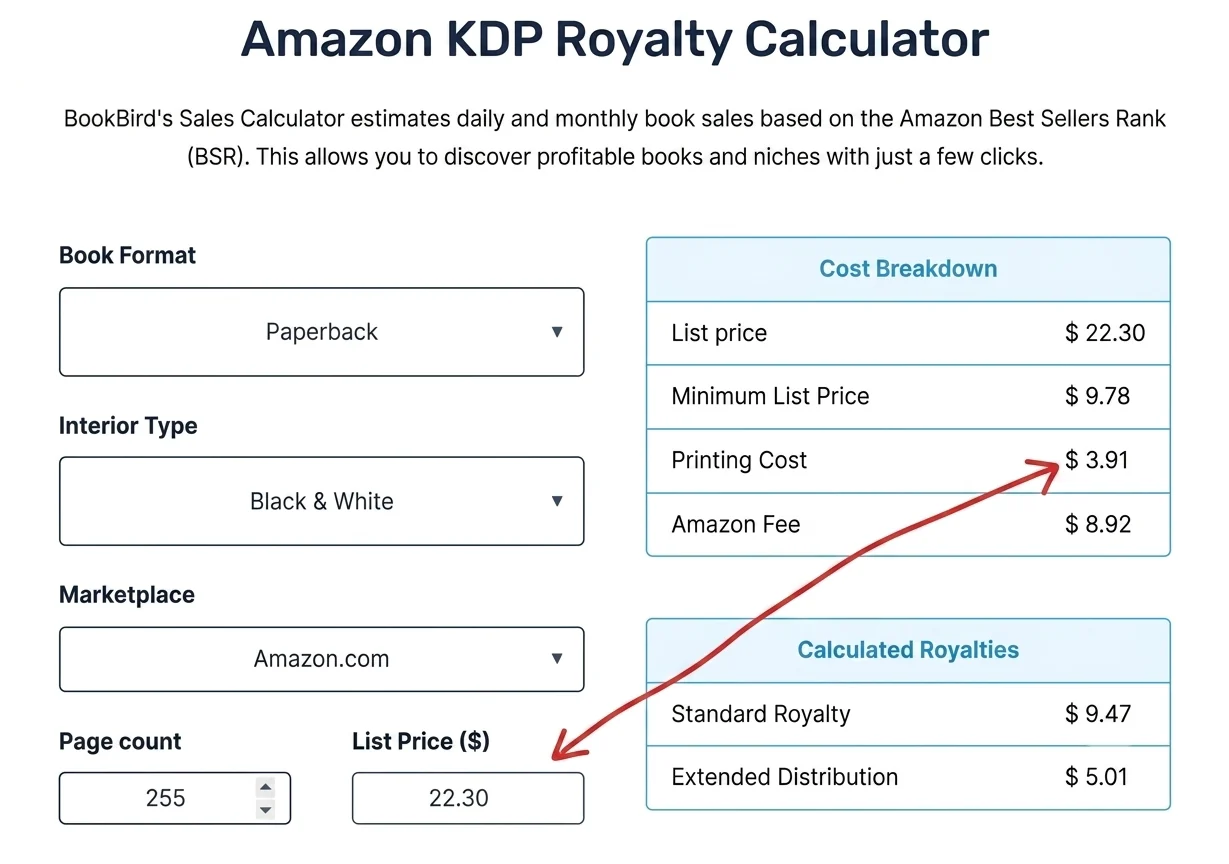
For paperbacks, the math is deterministic. You can calculate your exact royalty at any price point before you publish. There is no royalty tier decision to make; paperback royalties are always 60% of list price minus the printing cost.
KDP's current printing costs for black-and-white paperbacks on Amazon.com:
- Books with 24 to 108 pages: $2.30 fixed cost (no per-page charge)
- Books with 110 to 828 pages: $1.00 fixed cost + $0.012 per page
For color interiors (less common for coaching books):
- Standard color (72 to 600 pages): $1.00 + $0.0255 per page
- Premium color (42 to 828 pages): $1.00 + $0.065 per page
Printing costs for common coaching book lengths (B&W, US marketplace):
| Page Count | Calculation | Print Cost |
|---|---|---|
| 120 pages | $1.00 + (120 × $0.012) | $2.44 |
| 160 pages | $1.00 + (160 × $0.012) | $2.92 |
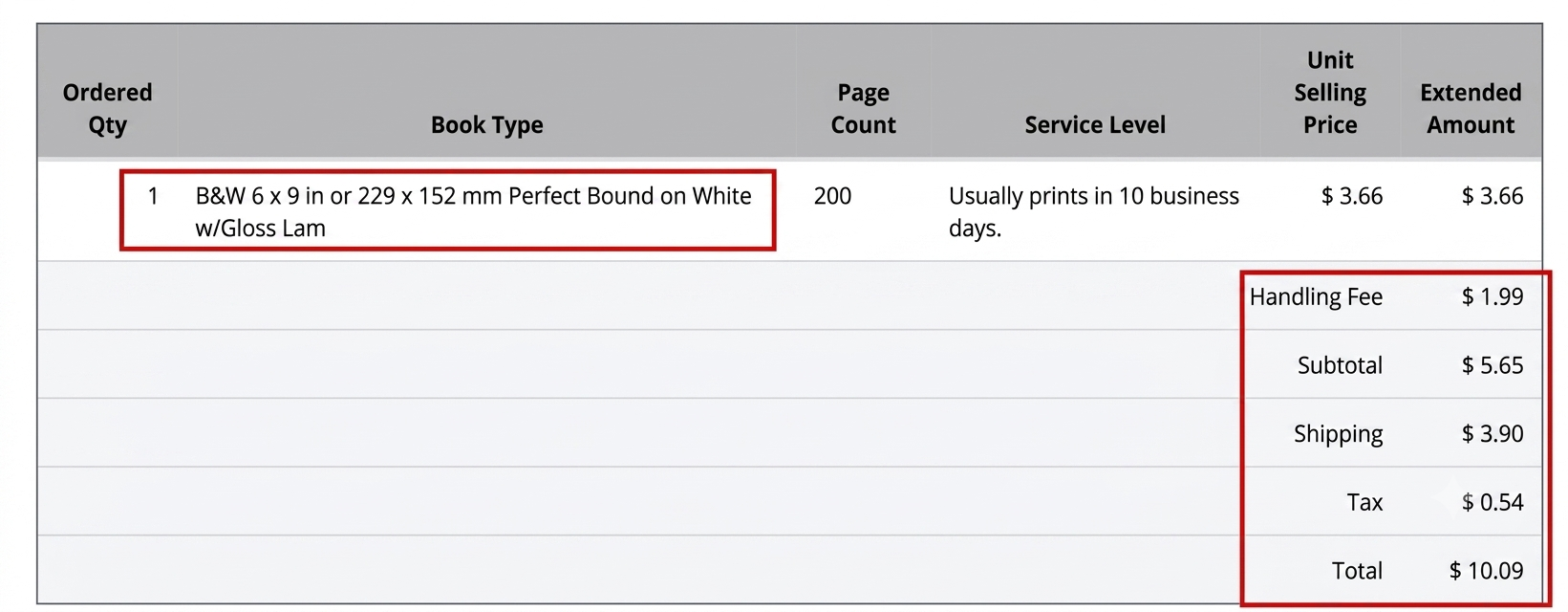
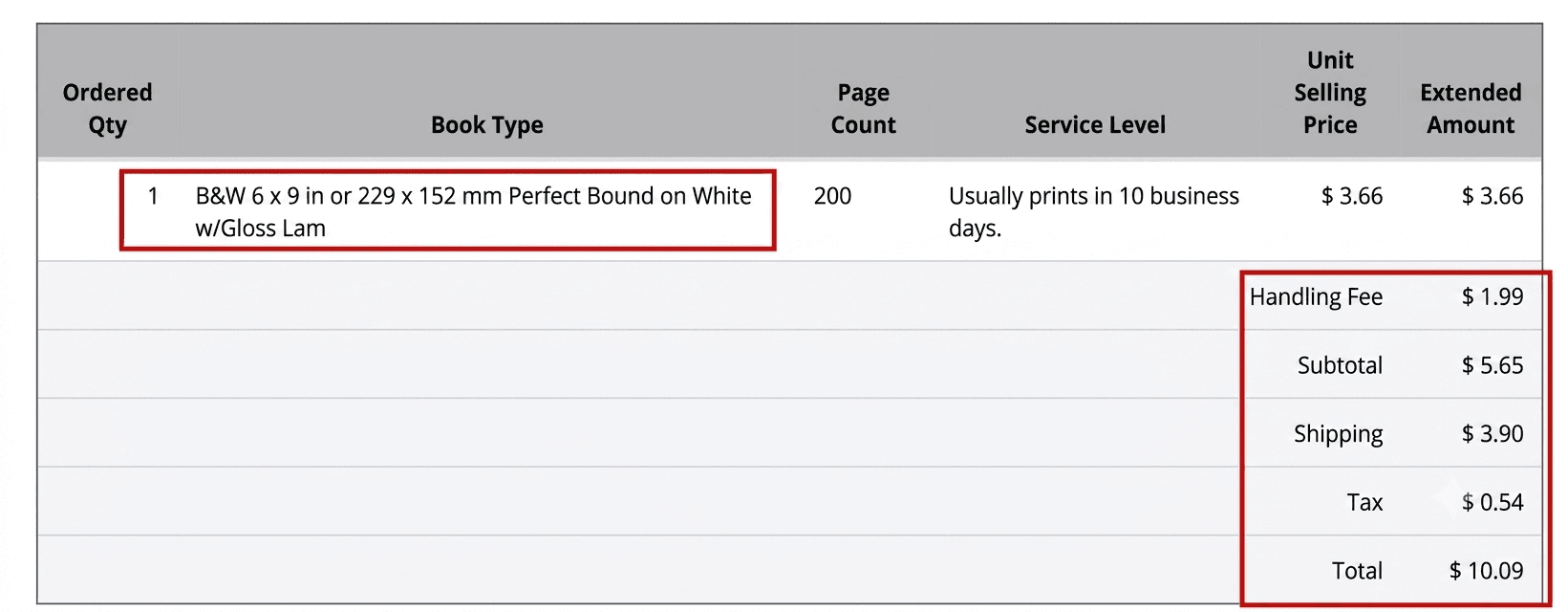
| 200 pages | $1.00 + (200 × $0.012) | $3.40 |
| 250 pages | $1.00 + (250 × $0.012) | $4.00 |
| 300 pages | $1.00 + (300 × $0.012) | $4.60 |
| 350 pages | $1.00 + (350 × $0.012) | $5.20 |
Royalty at different price points for a 200-page coaching book (print cost: $3.40):
| List Price | Royalty Formula | Your Royalty |
|---|---|---|
| $9.99 | (0.60 × $9.99) - $3.40 | $2.59 |
| $12.99 | (0.60 × $12.99) - $3.40 | $4.39 |
| $14.99 | (0.60 × $14.99) - $3.40 | $5.59 |
| $16.99 | (0.60 × $16.99) - $3.40 | $6.79 |
| $19.99 | (0.60 × $19.99) - $3.40 | $8.59 |
| $24.99 | (0.60 × $24.99) - $3.40 | $11.59 |
The jump from $12.99 to $14.99 adds $2.20 per copy. The jump from $14.99 to $19.99 adds $3.00 per copy. This is why pricing a 200-page coaching paperback at $9.99 or $12.99 represents a significant missed opportunity: you are competing in the same market as books priced at $16.99, but earning $4.00 to $5.00 less per copy.
The credibility signal matters here too. A $9.99 paperback for a coaching or leadership title reads as an entry-level book or a self-help title aimed at a general audience. A $16.99 or $19.99 paperback reads as a professional resource, which is the category most coaching books belong in. If you use the book as a leave-behind after speaking engagements or as a calling card with corporate clients, pricing below $15 can work against the authority goal. The author credibility and business revenue guide covers this positioning tension in more depth.
Hardcover pricing on KDP:
KDP also offers hardcover printing for authors who want a premium physical format. Hardcover printing costs are higher (typically $6 to $10 for a standard 200-page book), and the royalty structure is the same (60% of list price minus printing cost). Most coaching books are priced between $24.99 and $34.99 for the hardcover edition. If you have an existing audience that would pay for a hardcover or if you are planning a bulk sale to a corporate client, the hardcover adds perceived value at a meaningful margin.
A note on the minimum price threshold:
KDP requires your paperback list price to be high enough that the royalty is positive. For a 200-page B&W book (printing cost $3.40), your minimum price is $3.40 ÷ 0.60 = $5.67. Below that, KDP will not allow you to publish the paperback at that price. In practice, no coaching book should be priced this low; this is only relevant for short guides or workbooks.
5. KDP Select and Kindle Unlimited: The Exclusivity Decision Every Coach Faces
When you set up your KDP ebook, Amazon will invite you to enroll in KDP Select. This decision is separate from pricing but directly connected to how many readers you reach and what you earn from some of them.
What KDP Select includes:
Enrolling in KDP Select makes your ebook exclusive to Amazon for 90 days at a time. In exchange, you gain:
- Kindle Unlimited availability: Your book appears in the Kindle Unlimited catalog, where subscribers read it for free and you earn per-page royalties from the KU global fund
- Countdown Deals: You can run time-limited discount promotions where your book is discounted for up to 7 days during the 90-day period and still earns 70% royalties (not 35%) during the promotion
- Free Book Promotions: You can offer your ebook for free for up to 5 days during each 90-day enrollment period, which can accelerate reviews and boost your Amazon ranking
What you give up:
You cannot distribute the ebook anywhere outside Amazon. No Apple Books. No Kobo. No Google Play. No PDF on your own website. No files distributed to clients via email. Amazon enforces this seriously: if they detect your ebook available elsewhere during an active KDP Select period, they can terminate your entire KDP account and withhold unpaid royalties.
How KU earnings work:
Kindle Unlimited pays a per-page rate that comes from a shared global fund. The rate has historically ranged from $0.004 to $0.005 per page read. On a 200-page coaching book read in full by a KU subscriber, you earn roughly $0.80 to $1.00. Compare that to $6.93 from a direct $9.99 sale. KU readers need to read your book approximately seven times (across seven different subscribers) to equal one direct sale.
Who benefits from KDP Select:
Coaches publishing their first book who have no existing audience and need discovery through Amazon's algorithm often benefit from an initial KDP Select enrollment. The Countdown Deal tool lets you run a launch promotion at $0.99 while still earning 70% royalties, which is unique to KDP Select. Free days generate downloads that push your Amazon ranking, which increases organic visibility.
Coaches who fit this profile: no podcast, no established newsletter, no significant social following, and writing a book on a broadly searched topic (general leadership, productivity, mindset) where KU readers are likely to organically find the book.
Who should skip KDP Select:
Coaches with an existing audience outside Amazon are often better served going wide: publishing on Apple Books, Kobo, and Google Play alongside Amazon. Your existing clients and newsletter subscribers will buy directly; you do not need KU visibility to reach them. Selling on multiple platforms also means that if Amazon's algorithm deprioritizes your book at any point, you have other channels that continue generating sales.
If you use the book as part of a broader funnel, such as a lead magnet that drives readers to a free discovery call or a paid course, you will likely want to sell direct copies through your own website or platform. KDP Select prohibits this for the ebook format.
The auto-renewal trap: KDP Select enrollment renews automatically at the end of every 90-day period. If you decide to go wide after your initial enrollment, you must actively turn off the auto-renewal before the enrollment period expires. Missing this step keeps your ebook locked into exclusivity for another 90 days.
6. The PRICE Framework for Coaching Books
Pricing a book is not a one-time decision; it is an ongoing optimization. The PRICE framework gives coaches a repeatable five-step sequence for setting an initial price that makes sense and adjusting it over time based on real data.
P: Print cost baseline
Before you can set any price, know your exact printing cost. For a paperback, use the KDP formula: $1.00 + (page count × $0.012) for B&W books with 110 to 828 pages. This number is your floor. For ebooks, the floor is $2.99 (the minimum for 70% royalties). Both numbers belong on a notepad before you open the KDP pricing interface.
Coaches who skip this step often publish at a price that generates a trivially small royalty per paperback, then wonder why their book feels like it costs money rather than generating it. A 180-page coaching book at $12.99 earns $4.63 per paperback copy. The same book at $16.99 earns $7.19. Neither requires any additional effort; the difference is knowing the formula before you publish.
R: Royalty tier selection
For ebooks: the 70% tier requires a price between $2.99 and $9.99. Decide whether you are targeting this tier or going above it. In most cases, staying at or below $9.99 is the right call, and $9.99 is almost always preferable to $8.99 or $7.99 because it earns more per copy without leaving the tier.
For paperbacks, the royalty rate is fixed at 60%. There is no tier selection; the formula applies regardless of price. Your only royalty-related decision for paperbacks is whether to enable Expanded Distribution, which makes your book available through non-Amazon retailers and libraries at a slightly lower royalty per copy.
I: Industry comp research
Search Amazon for the five to ten books that most closely match your book in audience, niche, topic depth, and page count. Look at both their ebook and paperback prices. Note where most cluster and where the outliers sit. This tells you the competitive price band. Your goal is not to match the median but to understand the range within which your target reader will buy without questioning the price.
For leadership and executive coaching books, this range is typically $8.99 to $9.99 for ebooks and $14.99 to $24.99 for paperbacks. For niche or specialized coaching books (executive sales coaching, therapeutic modalities, narrow industry coaching), the range is often higher because the audience is smaller and more willing to pay for specific expertise.
C: Credibility positioning
Within the competitive price band you identified in step I, decide where your book should sit based on your brand positioning.
A coach who is building name recognition and wants maximum reach should price at the lower end of the band ($7.99 ebook, $14.99 paperback). A coach with an established platform, speaking circuit, or recognizable brand should price at the upper end ($9.99 ebook, $19.99 to $24.99 paperback).
The book's price is a signal that precedes reading the actual content. A $9.99 coaching ebook signals "established author with something worth your time." A $3.99 coaching ebook on the same topic signals "new voice trying to get traction." Both books may be equally good; only one price tells the story you want to tell.
E: Experiment and optimize
Set your initial price based on steps P through C, then observe for 60 to 90 days before changing anything. KDP lets you change ebook and paperback prices at any time with no fee and no review process. Price changes for ebooks typically appear within 24 to 48 hours.
After your observation period, run one deliberate experiment:
- Drop your ebook price by $2 for 30 days. If unit sales increase enough to offset the lower royalty, the new price is working. If not, the higher price was justified.
- Run a Kindle Countdown Deal at $1.99 for five days during a speaking engagement or podcast appearance. Measure how many new reviews you collect and whether your BSR improves.
- Raise your paperback price by $2. Observe whether your conversion rate (clicks to purchases on your Amazon listing) changes meaningfully. Most paperback buyers are not particularly price-sensitive within a $3 to $4 range.
Your Amazon product page shows your Best Seller Rank (BSR). A BSR below 100,000 in the Books category means at least one or two sales per day. A BSR above 500,000 means sales have essentially stopped. Track your BSR monthly alongside total units and total royalties. Price changes that move your BSR lower (closer to 1) while maintaining or increasing royalty income are worth keeping.
7. Launch Pricing vs. Evergreen Pricing
The price your book launches at can and often should differ from the price it settles into for the long term. Treating them as separate phases gives you both the early velocity you need to build social proof and the sustainable margin you need once the book is part of your business development infrastructure.
Phase 1: The launch window (weeks one through six)
The goal in the launch window is reviews. Early reviews are the social proof that turns strangers into buyers, and every review that comes in during the first 60 days is worth more than a review that comes in at month 12 because early reviews establish the book while it is still ascending in Amazon's algorithm.
A common launch sequence for coaching books:
- Days 1 to 5: Use a Free Book Promotion (KDP Select required) or a $0.99 Countdown Deal to maximize downloads and reader access. This drives your BSR dramatically lower and gives readers the book with minimal friction.
- Days 6 to 30: Raise to a mid-range price ($3.99 to $5.99) to capture readers who discovered the book during the launch but are purchasing later. These buyers are warmer because they have already seen the promotion or been referred by an early reader.
- Month 2 onward: Raise to your evergreen price ($7.99 to $9.99 for ebooks).
This sequence takes advantage of the fact that Amazon pays attention to new releases. The algorithm notices a book that moves from high-velocity downloads to a sustained sales pattern and continues to give it organic placement.
Phase 2: The evergreen price (month three onward)
Evergreen pricing is the price that the book lives at for years. Set it using the PRICE framework. For most coaching books, the evergreen price is $9.99 for the ebook and $16.99 to $19.99 for the paperback.
The book's job determines whether you use volume pricing or authority pricing in the evergreen phase:
Volume pricing ($6.99 to $7.99 ebook, $13.99 to $15.99 paperback): Appropriate when your primary goal is reader acquisition, email list building, or general brand awareness. You accept lower royalties per sale in exchange for more copies in more hands. Coaches who run group programs or online courses where the book serves as a discovery tool often benefit from volume pricing.
Authority pricing ($9.99 ebook, $18.99 to $24.99 paperback): Appropriate when the book's primary job is positioning you as a premium resource for corporate buyers, high-value individual clients, or event organizers. At this price level, the book is less likely to be an impulse buy and more likely to be a considered purchase by someone who already has a reason to take you seriously.
Coaches who hand copies to C-suite contacts, leave books after keynotes, or use them in sales conversations often report that a $19.99 or $24.99 paperback generates a different reception than a $12.99 copy. The price is not the only signal, but it is the first one the buyer encounters before opening a single page. Getting it right means the book does its job from the moment it changes hands.
Adjustments over time:
A book that launches at $9.99 and becomes a genuine resource in its niche can sometimes support a price increase in year two. If your reviews are strong and your BSR is consistently below 50,000 in your category, a modest increase to $9.99 (if you are below that) or a paperback increase of $2 to $3 is worth testing. Established authority in a niche allows for price expansion that would not have been possible on day one.
For the complete picture of how the book fits into your broader coaching lead funnel, the how books help business growth article covers the financial case for author positioning in detail.
8. Three Operational Actions That Protect Your Earnings After Publishing
Pricing decisions made before publishing do not always translate to the royalties you expect once the book is live. Three operational factors can quietly reduce your take-home without any obvious warning in your KDP dashboard.
Action 1: File size optimization
At the 70% royalty rate, Amazon deducts a delivery fee of approximately $0.15 per megabyte before paying your royalty. For a coaching book with rich worksheets, diagrams, or screenshots, this fee accumulates. A 10MB ebook incurs a $1.50 delivery fee per sale, which means your $9.99 ebook at 70% earns about $5.49 instead of $6.99. That is a 21% reduction from a factor that appears nowhere in the KDP pricing interface.
Before uploading your ebook, optimize images to 150 DPI, remove redundant or embedded fonts, and generate the EPUB from a dedicated book formatter rather than exporting directly from a word processor. Most text-heavy coaching books should stay under 1MB after proper compression. At 500KB, your delivery fee is about $0.075 per sale, which is negligible.
This is particularly relevant for coaches who use Built&Written or other formatting tools that include rich design elements. Image-heavy layouts are beautiful on screen but expensive in delivery fees; compress before publishing.
Action 2: Expanded Distribution for paperbacks
Enabling Expanded Distribution through KDP makes your paperback available through book wholesalers (Ingram, Baker & Taylor) and indirectly through independent bookstores, libraries, and academic institutions. There is no additional cost to enable it, though Expanded Distribution sales pay a lower royalty than Amazon-direct sales because the distributor takes a margin.
For coaching books, Expanded Distribution is almost always worth enabling. Your coaching audience is primarily on Amazon. But libraries, HR departments, and learning and development teams at corporations sometimes source books through library networks and distributors. These are buyers who will never find your book via an Amazon search but may encounter it through a library acquisition catalog. Any sale through these channels is incremental.
Action 3: Price-match monitoring
Amazon has a price-matching system that can reduce your effective royalty per sale if your ebook is found cheaper elsewhere. If you sell your ebook on another platform (Apple Books, Kobo, Google Play) at a lower price than Amazon, Amazon may match the lower price on their platform. In most cases, KDP calculates your royalty on your list price even when Amazon has applied a price match, but this can vary and is worth checking periodically.
Log into your KDP dashboard quarterly and check your actual royalty per unit against your expected calculation. If your average royalty per ebook sale is meaningfully lower than (0.70 × list price) minus the delivery fee you expect, investigate whether a price match is active. You can resolve this by either aligning prices across platforms or removing the ebook from the lower-priced platform.
Checking your KDP dashboard also catches erroneous territory reporting. If significant sales show up in non-70% territories and you were not expecting that volume from those markets, it may indicate your marketing is reaching an audience that earns you 35% instead of 70% per sale.
Key takeaway: A coaching ebook priced at $9.99 earns $6.93 per sale at Amazon's 70% royalty rate. The same book at $11.99 earns $4.20 at the 35% rate. Over 500 sales, that $2.73-per-copy difference compounds to $1,365 left on the table. Pricing a coaching book is arithmetic first, positioning second.
FAQ: Pricing Your Coaching Book on Amazon KDP
What is the minimum price for a KDP ebook to earn 70% royalties?
The minimum is $2.99 on Amazon.com. Below $2.99, all ebook sales default to the 35% royalty plan regardless of other settings. This floor exists in other eligible territories as well, with equivalent local-currency minimums.
Does Amazon charge additional fees on top of the royalty deduction?
For ebooks at the 70% royalty rate, Amazon deducts a delivery fee based on file size (approximately $0.15 per megabyte) before paying your royalty. There is no separate listing fee or sales commission for any format. For paperbacks, printing cost is deducted from your royalty as part of the formula; there is no additional fee beyond that.
Can I change my KDP price after publishing?
Yes. KDP lets you update your list price at any time at no cost. Ebook price changes typically appear on the Amazon product page within 24 to 48 hours. Paperback price changes can take a day or two longer depending on the marketplace.
Should I price my ebook and paperback the same?
Almost never. The paperback costs more to produce and buyers expect to pay more for a physical book. Pricing them identically signals either that the ebook is overpriced or the paperback is underpriced, and both erode trust. A standard pairing for coaching books is an ebook at $9.99 and a paperback at $16.99 or $17.99. Coaches who want to emphasize the ebook as a premium format sometimes go $9.99 ebook and $22.99 paperback; this works well if the paperback is a high-quality lay-flat or perfect-bound edition.
What price makes sense when using the book as a speaking credential?
If you hand the book to event organizers, include it in your media kit, or sell copies at the back of the room after keynotes, a paperback priced at $18.99 to $24.99 tends to carry more perceived weight than a $12.99 copy. The price signals the caliber of the thinking inside. For a complete strategy on using a book to land speaking engagements, the speaking gigs and book authority guide walks through the full approach.
Is Kindle Unlimited worth it for coaching books long-term?
For most coaches with an existing audience, no. KU pays $0.004 to $0.005 per page read, so a 200-page coaching book read completely earns roughly $0.80 to $1.00 from a KU subscriber versus $6.93 from a direct $9.99 ebook sale. For launch promotions, Kindle Countdown Deals through KDP Select can be valuable. As an evergreen distribution strategy, going wide (Apple Books, Kobo, Google Play, and your own site) usually outperforms KU exclusivity for coaches who already have platforms.
How do I calculate my exact paperback royalty before publishing?
Use the formula: (0.60 × list price) minus printing cost = royalty per copy. For a B&W book with 110 to 828 pages, printing cost = $1.00 + (page count × $0.012). Plug your page count and planned list price into this formula before you open the KDP publishing interface. Your royalty should be at least $4 per copy for the book to function as a meaningful income stream alongside its other business development purposes.
Can I sell printed copies of my book through my own website at a higher price?
Yes. You can purchase author copies from KDP at the print cost rate ($1.00 + page count × $0.012 for B&W) and resell physical copies through your own website, at events, or directly to clients at any price you choose. This does not violate KDP Select terms because you are selling physical inventory you purchased, not distributing a competing digital file. Your margin on direct sales is typically higher than on Amazon royalties: at $29 per copy with a print cost of $3.40, you keep $25.60 versus $8.59 at $19.99 on Amazon.
What about pricing a workbook or companion guide?
Workbooks and companion guides are often shorter (60 to 120 pages) and more visual, which affects both the ebook and paperback pricing. For ebooks, a 60-page workbook rarely justifies $9.99; $4.99 to $6.99 is more appropriate. For paperbacks, the higher printing cost per page (or the fixed $2.30 cost for books under 108 pages) and the layout complexity often push workbook prices above their equivalent prose book. A 90-page full-page coaching workbook with color elements can cost $5 to $7 to print and typically sells at $19.99 to $27.99 for the paperback.
Sources
- Paperback Printing Cost (Amazon KDP Help)
- eBook Royalties (Amazon KDP Help)
- Price Your Book (Amazon KDP Help)
- Paperback Royalty (Amazon KDP Help)
- KDP Select (Amazon KDP Help)
- KDP Royalty Rates 2026: Complete Guide, KDPEasy
- Amazon KDP Pricing Strategy, BookBloom
- Pricing Strategies for KDP Books, Book Bolt
- Amazon KDP Pricing for Profit, Rankings and Long-Term Sales, BookAutoAI
Frequently asked questions
What is the minimum price for a KDP ebook to earn 70% royalties?
The minimum is $2.99 on Amazon.com. Below $2.99, all ebook sales default to the 35% royalty plan regardless of other settings.
Does Amazon charge additional fees on top of the royalty deduction?
For ebooks at the 70% royalty rate, Amazon deducts a delivery fee based on file size (approximately $0.15 per megabyte) before paying your royalty. For paperbacks, printing cost is deducted from your royalty as part of the formula.
Can I change my KDP price after publishing?
Yes. KDP lets you update your list price at any time at no cost. Ebook price changes typically appear within 24 to 48 hours.
Should I price my ebook and paperback the same?
Almost never. A standard pairing for coaching books is an ebook at $9.99 and a paperback at $16.99 or $17.99.
Is Kindle Unlimited worth it for coaching books long-term?
For most coaches with an existing audience, no. KU pays $0.004 to $0.005 per page read, so a 200-page coaching book read completely earns roughly $0.80 to $1.00 versus $6.93 from a direct $9.99 sale.
How do I calculate my exact paperback royalty before publishing?
Use the formula: (0.60 x list price) minus printing cost equals royalty per copy. For a B&W book with 110 to 828 pages, printing cost equals $1.00 plus (page count times $0.012).
Can I sell printed copies of my book through my own website at a higher price?
Yes. You can purchase author copies from KDP at print cost and resell physical copies through your own website at any price you choose.
What about pricing a workbook or companion guide?
For ebooks, a 60-page workbook rarely justifies $9.99; $4.99 to $6.99 is more appropriate. For paperbacks, higher printing costs often push workbook prices to $19.99 to $27.99.
Sources & References
Ready to write your book?
Turn your expertise into a professional book with Built&Written.
Put your book on the page