

Atticus vs Vellum for Coaches: Which Actually Wins in 2026?
Atticus vs Vellum comes down to two questions: what computer you own, and whether your manuscript is done. Atticus ($147 one-time) runs on any machine and includes a writing editor. Vellum ($199.99 ebook, $249.99 print tier) is Mac-only and produces the most polished interior in the category. If you are not on a Mac, Atticus wins by default.
Why does the interior matter at all? Hal Elrod self-published The Miracle Morning in 2012, and it went on to sell millions of copies and spawn a whole series. A book that reads like a coach's PDF handout does not sit on a nightstand for a decade. A book with a clean, typeset interior does.
Every coach reading this in 2026 hits the same wall. You have the expertise. Maybe you even have a draft. Then you open the manuscript, look at the default Word margins, and realize a print book is not a long document. It is a designed object with trim sizes, gutters, running headers, and chapter openers that have to line up. That is the moment two names come up in every self-publishing forum: Atticus and Vellum.
This is a head-to-head on Atticus vs Vellum, written for coaches, consultants, and founders who want a credibility book and not a hobby. Both tools are good. They solve a real problem. But they solve the second problem, not the first one. By the end of this you will know which one fits your setup, and you will also know the part nobody selling formatting software wants to say out loud.
Key takeaway: For coaches in 2026, the best formatting tool depends on your computer and whether your manuscript is already written. Atticus ($147, one-time, cross-platform) writes and formats in one place. Vellum ($199.99 to $249.99, one-time, Mac-only) produces the most beautiful interior on the market. Neither writes the book for you. That gap is where most coaches actually stall.
Here is the short version before the long one. Atticus and Vellum are both one-time-purchase formatting tools that turn a finished manuscript into a print-ready PDF and an ePub. Atticus runs in a browser on any machine and includes a writing editor. Vellum runs only on a Mac and produces typeset interiors that look like they came from a traditional publisher's production department. The decision comes down to five things: your operating system, whether your words are already written, how much the interior craft matters, your total cost to a first printed proof, and the blank-page problem neither tool touches. We call that decision the Coach's Formatting Fit Test, and it is the spine of this article.
Why coaches stall long before formatting becomes the problem
There is a quiet lie inside the question "Atticus or Vellum?" The lie is that formatting is the bottleneck. For a novelist with a finished 90,000-word draft, formatting really is the last mile. For a coach, it almost never is.
Walk the actual timeline. A business coach decides to write a book because a book turns a $3,000 cold-outreach client into a $30,000 inbound retainer. That math is the whole reason coaches publish. The book is a positioning asset, not a revenue line. The International Coaching Federation tracks a profession that runs on credibility, and a printed book is the densest credibility signal a coach can hand a prospect. So the goal is clear and the motivation is high.
Then the work starts. The coach has years of raw material: LinkedIn posts, workshop slides, client frameworks, a podcast, voice memos from drives between sessions. What they do not have is 45,000 assembled words in chapter order. The manuscript is scattered across six places and lives mostly in their head. This is the real wall. Surveys of would-be authors consistently find that most people who say they want to write a book never produce a finished draft, and the reason is rarely formatting software. It is the months of assembly between "I have expertise" and "I have a manuscript."
Atticus and Vellum both start at the manuscript. They assume the words exist. Open either one and the first thing it wants is your chapters. If you do not have chapters, the prettiest typesetting engine on earth has nothing to typeset. This is not a knock on the tools. It is a scope fact, and it is the single most important thing for a coach to understand before spending $147 or $250. You can read our longer breakdown of book formatting software for coaches for the wider category view, but the category-level truth is this: formatting tools are downstream of a problem most coaches have not solved yet.
There is a tempting middle path that fails quietly: just format it in Word and skip the tools. It almost works. You set the trim size, fix the margins, add running headers, and upload to KDP. Then the proof copy arrives and the spacing is slightly off, the chapter openers do not line up, the page breaks land in awkward places, and the whole thing reads as homemade. A prospect cannot name what is wrong, but they feel it, and feeling it costs you exactly the credibility you published the book to gain. That is the reason Atticus and Vellum exist. They remove the dozen small tells that mark a book as amateur. They are worth the money once you have a manuscript. They just cannot manufacture the manuscript.
So the honest framing for a coach is a sequence, not a single purchase. Assemble the draft. Format it. Publish it. Atticus and Vellum own the middle step and own it well. The mistake is buying the middle-step tool while the first step is still undone, then blaming yourself when the tool sits empty.
So as we compare these two, hold two questions in your head at once. Which tool formats better? And, separately, have you done the thing that makes a formatting tool useful at all?
The Coach's Formatting Fit Test: five axes that actually decide it
Most Atticus vs Vellum comparisons score on feature checklists: does it export ePub, does it do drop caps, how many themes ship by default. Those matter, but they bury the decision under trivia. For a coach, five axes carry almost all the weight. Here is the test.
| Axis | What it measures | Why a coach should care |
|---|---|---|
| Platform reality | Does it run on the computer you already own? | Vellum is Mac-only. If you are on Windows, the comparison is over before it starts. |
| Manuscript origin | Does the tool help you get the words, or only format them? | Both assume a finished draft. This is where coaches stall. |
| Interior craft | How professional does the printed page look? | A book that reads like a handout damages the credibility you bought it for. |
| Cost to first book | Total dollars to hold a printed proof in your hand | One-time cost plus the cost of getting to a manuscript at all. |
| The blank-page gap | Does it reduce the months of assembly before formatting? | Neither does. The tool that closes this gap wins the coach's real problem. |
Score Atticus and Vellum on those five axes and the picture gets honest fast. Both win on interior craft and cost. Atticus wins on platform reality. Both score zero on the blank-page gap, because closing it is simply not what a formatting tool is for. We will run each tool through the test, then score them side by side, then give a verdict that does not pretend the blank-page gap does not exist.
One more framing note. This test is built for the coach buyer, not the prolific fiction author. A romance author publishing eight books a year weighs interior craft and per-book cost very differently than a coach publishing one flagship book to win retainers. If you publish at volume, weight interior craft and cost-per-book heavily and skip ahead to the scoring table. If you are publishing one book that has to make you look like the authority in your niche, weight platform reality and the blank-page gap.
What Atticus is built for
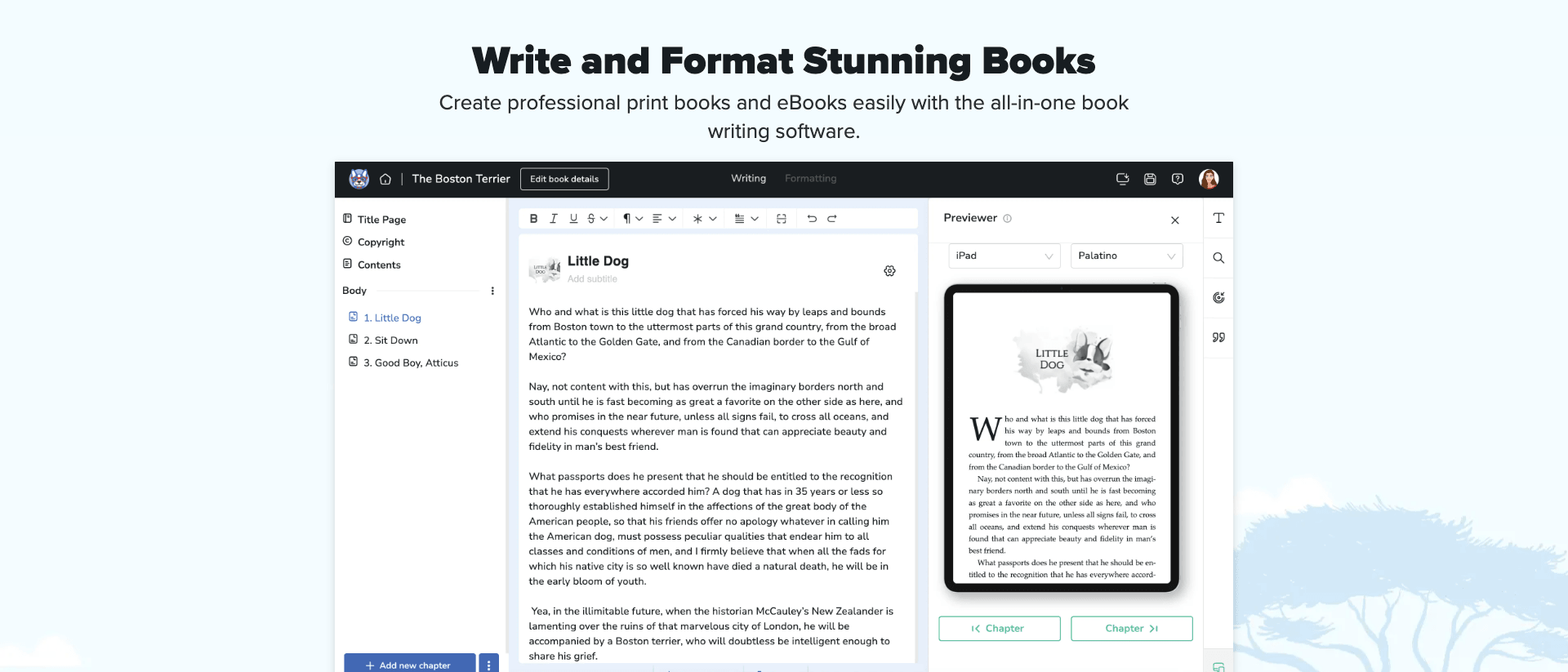
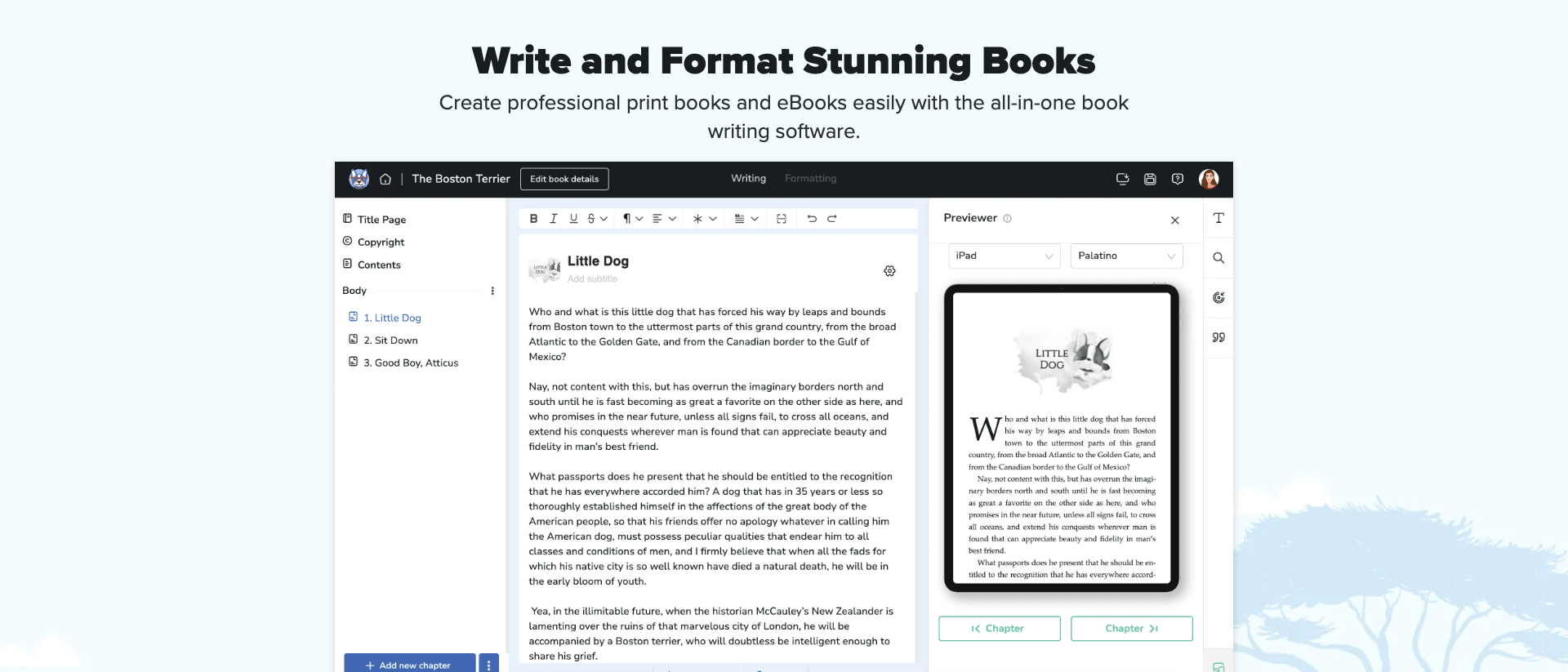
Atticus is an all-in-one writing and formatting tool built by Dave Chesson, the same person behind Kindlepreneur and Publisher Rocket. It launched as a deliberate cross-platform answer to Vellum's Mac-only limitation, and that origin shapes everything about it.
What it does well
Atticus runs in a web browser, which means it works on Windows, Mac, Linux, and Chromebook, and it also installs as an offline app through a progressive web app you can download. For the roughly two-thirds of the world on Windows, this is the headline. You do not need to borrow a Mac or run a virtual machine. You open a browser and you are in.
It includes a real writing editor, not just an importer. You get chapter and scene organization, word-count goals, and a distraction-free writing mode. A coach who has a half-draft can keep writing inside Atticus and then format in the same place, with no export-import shuffle between a word processor and a formatter. The formatting side ships with themes, custom chapter-opener design, drop caps, ornamental breaks, and image handling, and it exports both print PDF and ePub from a single project.
The customization depth is genuinely useful for a coach with a brand. You can match fonts and chapter-opener styling to a visual identity you already use across your slides and site, so the book feels like part of the same system rather than a one-off. Updates are pushed continuously and included in the price, so the tool you buy this year keeps getting features without a renewal fee. And because it runs in the browser, you can write a paragraph on a Chromebook at a coffee shop and format on a desktop at home, all in the same project. For a coach who works across devices, that continuity removes a small but constant source of friction.
Where it falls short
Atticus has no AI features. There is no draft assistance, no outline help, no autocomplete. If you sit down with a blank Atticus project and scattered notes, you are doing the assembly entirely by hand, the same as you would in Microsoft Word or Reedsy's free editor. The writing editor is a place to type, not a system that helps you produce a manuscript from existing content.
The interior output is good, and for most coach books it is more than good enough. But Vellum users and professional typesetters will tell you Atticus interiors are a notch below Vellum on the fine details: spacing, kerning, and the optical polish that separates "clearly self-published" from "could be a Penguin Random House paperback." For a coach, that gap is usually invisible to your prospect. For a designer, it is real.
Pricing and platform
Atticus is $147 as a one-time purchase. That single price covers both ebook and paperback formatting, lifetime updates, and use on every device you own. It ships with a 30-day money-back guarantee. There is no subscription, no per-book fee, and no credit system. For a coach publishing one book, $147 is the entire software cost from blank project to KDP-ready files. We cover the writing-tool side of Atticus in depth in our Atticus guide for coaches, and the formatting specifics in our Atticus book formatting walkthrough.
Best for
Atticus is best for the coach who is not on a Mac, who wants to write and format in one tool, and who values cross-platform freedom and a lower combined price over the last five percent of typographic polish.
What Vellum is built for
Vellum is the prestige name in indie book formatting. Ask a hundred self-published authors which tool makes the most beautiful interiors and the majority will say Vellum without hesitating. It earned that reputation honestly. The catch is right there in the system requirements.
What it does well
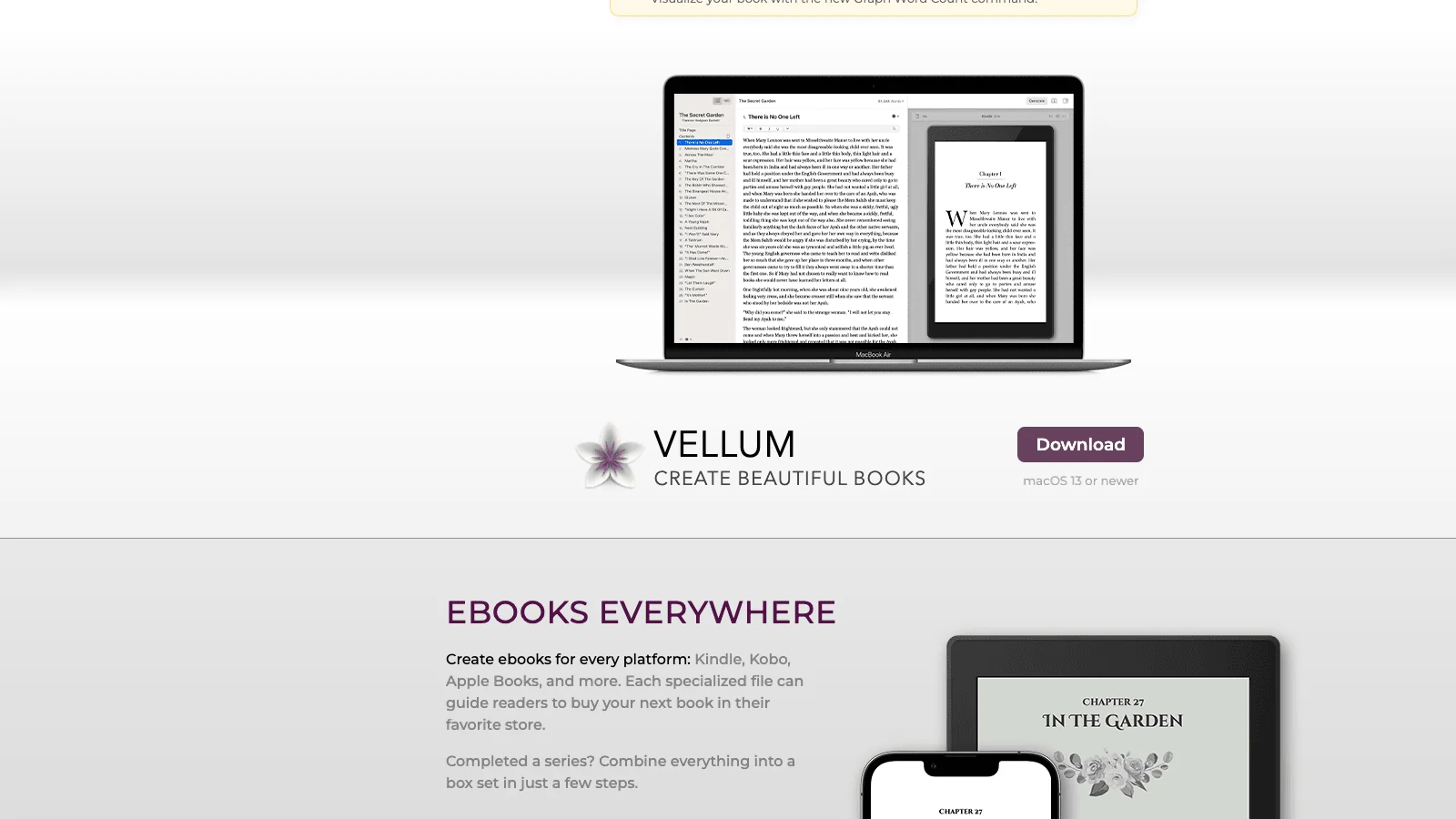
Vellum's typesetting engine is the reason to buy it. It handles widows and orphans, ligatures, kerning, and optical margin alignment automatically, the kind of fine typographic control that traditional publishers pay production departments to manage. You pick a style, point Vellum at your manuscript, and it produces an interior that genuinely looks like it came off a professional press. The live preview shows you the print book, the Kindle, the iBooks, and other ereaders side by side as you work, so you see exactly what readers will see.
For a coach who wants the book to signal "serious author" the moment a prospect opens it, this is the strongest argument in the entire comparison. The interior is the part of a book most authors underestimate and the part that most quietly separates a credible book from a printed blog. Vellum nails it with almost no effort from you. You can read our full Vellum software guide for coaches and the conceptual overview in what is Vellum for the deeper tour.
Where it falls short
Vellum runs only on macOS. There is no Windows version, and the company has publicly said it does not intend to build one. If you are on a PC, Vellum is simply not an option unless you buy or borrow a Mac, rent a cloud Mac, or run macOS in a virtual machine, all of which add cost and friction that usually wipe out the reason you chose Vellum in the first place.
Vellum is also formatting-only. There is no writing editor, no draft mode, no goal tracking. It expects a finished manuscript, almost always a Word document, and its job begins where your writing ends. For a coach who has not finished assembling the manuscript, Vellum sits idle until the words exist.
Pricing and platform
Vellum is a one-time purchase with two tiers: $199.99 for Vellum Ebook, which exports ebooks only, and $249.99 for Vellum Press, which exports both ebooks and print PDFs. Both include unlimited books and all updates. For a coach producing a paperback for KDP, you need the $249.99 tier, because the print PDF is the file you upload. That makes Vellum's real entry price $249.99 plus the cost of owning a Mac, against Atticus at $147 on hardware you may already have.
Best for
Vellum is best for the Mac-owning coach with a finished manuscript who wants the most beautiful interior available and is happy to pay a premium for it. If you publish multiple books, the per-book cost falls and the typographic quality compounds across your catalog.
Atticus vs Vellum head to head: the five axes scored
Now run both through the Coach's Formatting Fit Test. This is the section to screenshot and keep.
| Axis | Atticus | Vellum |
|---|---|---|
| Platform reality | Windows, Mac, Linux, Chromebook, browser | macOS only |
| Manuscript origin | Writing editor included, but no assembly help | Formatting only, no writing mode |
| Interior craft | Very good, a notch below Vellum on fine detail | Best in category, publisher-grade |
| Cost to first book | $147 one-time, all platforms | $249.99 for print tier, plus a Mac |
| The blank-page gap | Not addressed | Not addressed |
A few things jump out when you see it scored this way.
On platform reality, this is not close. Atticus runs everywhere. Vellum runs on one operating system. For a coach on Windows, the rest of the table does not matter, because Vellum is off the board. This single axis decides the comparison for a large share of readers before any discussion of kerning.
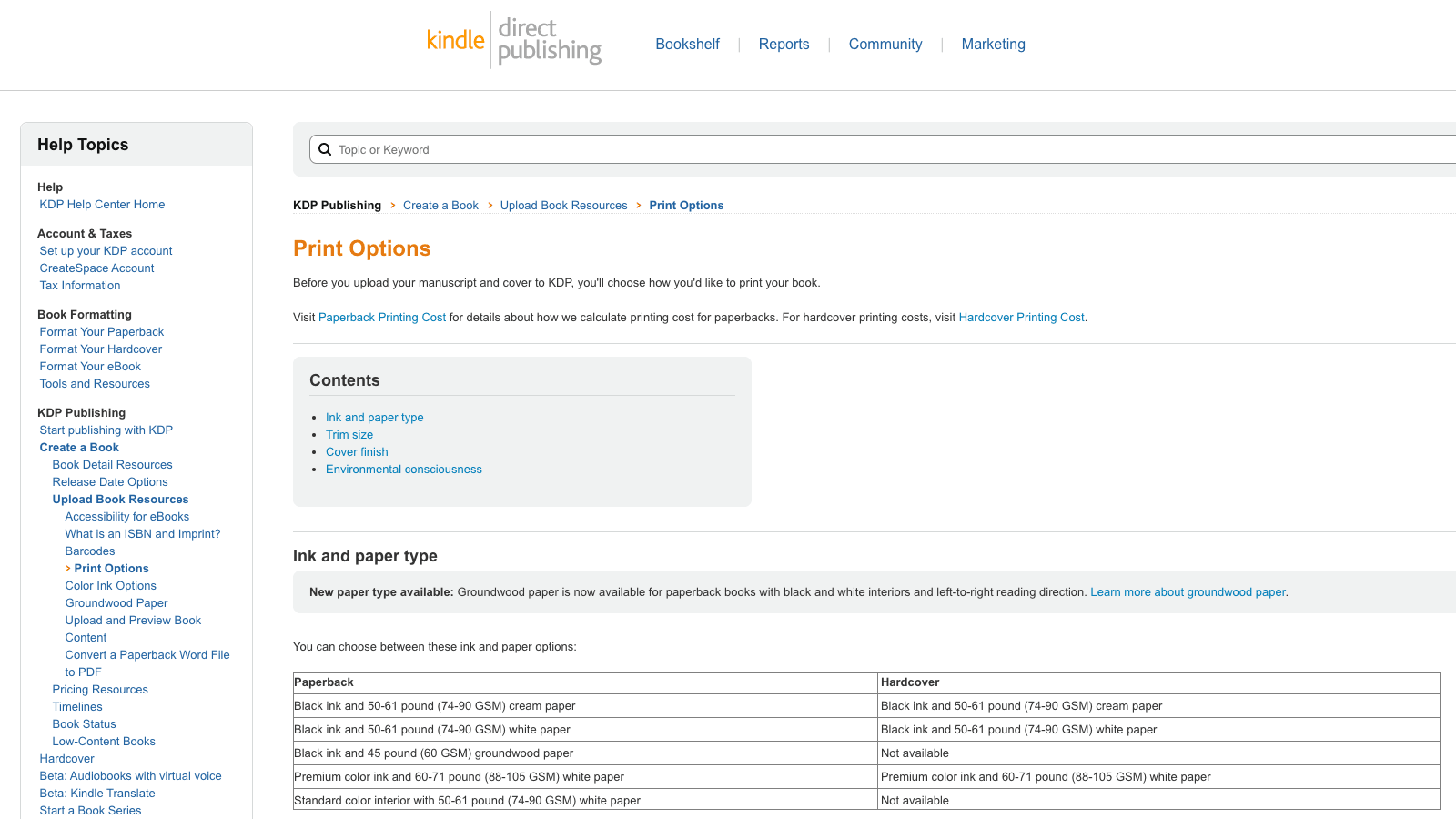
On interior craft, Vellum wins, but the margin is smaller than its reputation suggests, and it is narrowest exactly where coaches live. A business or coaching book is mostly body text, headings, the occasional pull quote, and a few diagrams. Both tools handle that cleanly. Vellum's advantage shows up most in dense literary typesetting that coach books rarely require. The Amazon KDP print specifications both tools target are the same, and you can see the actual requirements in the KDP paperback formatting guidelines.
On cost to first book, Atticus is cheaper in two ways. The software is $102 less at the print tier ($147 versus $249.99), and it does not require Mac hardware. For a coach who already owns a Mac and only counts software, the gap is $102. For a coach on a PC, the real gap is $147 versus $249.99 plus a Mac, which is not a close call.
On manuscript origin, both tools include exactly what they advertise and nothing more. Atticus gives you a place to type. Vellum gives you a place to format what you typed somewhere else. Neither one shortens the months between scattered content and an ordered draft.
What about the ebook and Kindle side?
Coaches sometimes forget the ebook entirely and fixate on the paperback, but the Kindle edition matters because it is the cheapest way for a prospect to sample your thinking before they ever book a call. Both tools export a clean ePub, and both let the same project produce print and ebook from one source, so you are not formatting twice.
Vellum's live preview is the standout here. As you edit, it shows the print book, the Kindle, Apple Books, and other ereaders side by side, so you see precisely how each device renders your chapter openers and images before you export anything. Atticus offers preview as well, and its ePub output is solid and standards-compliant, but the multi-device live view is less polished than Vellum's. For a coach, both produce a Kindle file that looks professional in the store. The difference is in how confident you feel before you hit export, not in what the reader finally receives.
One practical note: if you only ever plan to sell the Kindle edition and never a paperback, Vellum's $199.99 ebook-only tier undercuts the assumption that Vellum is always the pricier option. But most coaches want the physical book, because the paperback is the object you hand across a table at a conference. For that use case you need Vellum Press at $249.99 or Atticus at $147.
Learning curve and time to first proof
Neither tool is hard, and that is part of why they are recommended so often. Vellum is famously close to effortless: import your Word document, pick a style, and you have a formatted book in an afternoon. The tradeoff for that simplicity is less granular control, which rarely bothers a coach and frequently bothers a designer who wants to override a specific setting.
Atticus gives you more knobs, which means a slightly longer learning curve and more ability to customize chapter openers, fonts, and spacing to match your brand. For a coach building a book that has to match an existing visual identity, that extra control can matter. For a coach who just wants a clean book fast, it is one more set of choices. Either way, the time from finished manuscript to a print-ready PDF is measured in hours, not days. The time from scattered content to a finished manuscript, the step neither tool addresses, is the part measured in months.
Which brings us to the axis that decides the coach's real problem.
The blank-page gap is the score that matters
Both tools score zero on the blank-page gap, and that is not a defect. It is the boundary of what formatting software is. But for a coach, the blank-page gap is the entire game. You did not set out to format a book. You set out to have a book, and the longest, most painful stretch of that journey is producing the manuscript from the expertise you already carry around.
This is the part nobody selling formatting software says out loud, so we will. A coach who buys Atticus or Vellum before solving the manuscript problem has bought a beautiful finishing tool for a thing that does not exist yet. The most common failure mode in this whole category is not picking the wrong formatter. It is spending $147 or $250, opening the tool, staring at an empty chapter list, and quietly closing the laptop, because the assembly work the tool assumes you already did is the work that stopped you in the first place.
That is the wedge Built&Written was built for, and it is a genuinely different scope than either tool here.
The verdict: which wins for coaches in 2026
Here is the decision tree, stated plainly, no hedging.
If you are on Windows, Linux, or a Chromebook, choose Atticus. Vellum cannot run on your machine without buying more hardware, and once you add a Mac to the price, Vellum stops making sense for a single-book coach. Atticus gives you a writing editor and a formatter in one cross-platform tool for $147. This is the right answer for most coaches simply because most coaches are not on Macs.
If you own a Mac, have a finished manuscript, and the interior craft is the thing you care about most, choose Vellum. The output is the best in the category and the workflow is close to effortless once the words exist. Pay the $249.99, get the print tier, and produce an interior that looks like a traditional publisher made it. If you plan to publish several books, Vellum's per-book cost and consistent quality make it even easier to justify.
If you have a Mac but want one tool to both write and format and you would rather keep $102, choose Atticus. The interior is a notch below Vellum and invisibly so to your readers, and you get a writing environment Vellum does not offer. For the coach who is still drafting, that integrated write-and-format flow is worth more than the last five percent of typographic polish.
We compare the AI-writing side of this decision in Atticus vs Built&Written for coaches and rank the whole field in best AI book writing tools for coaches. But the verdict above is honest about formatting, and both Atticus and Vellum are good tools that do what they promise.
Now the harder verdict.
If you do not have a finished manuscript yet, which describes most coaches reading this, neither tool is your next purchase. Your bottleneck is not formatting. It is producing the draft from the content you already have. A formatting tool cannot help you with that, by design.
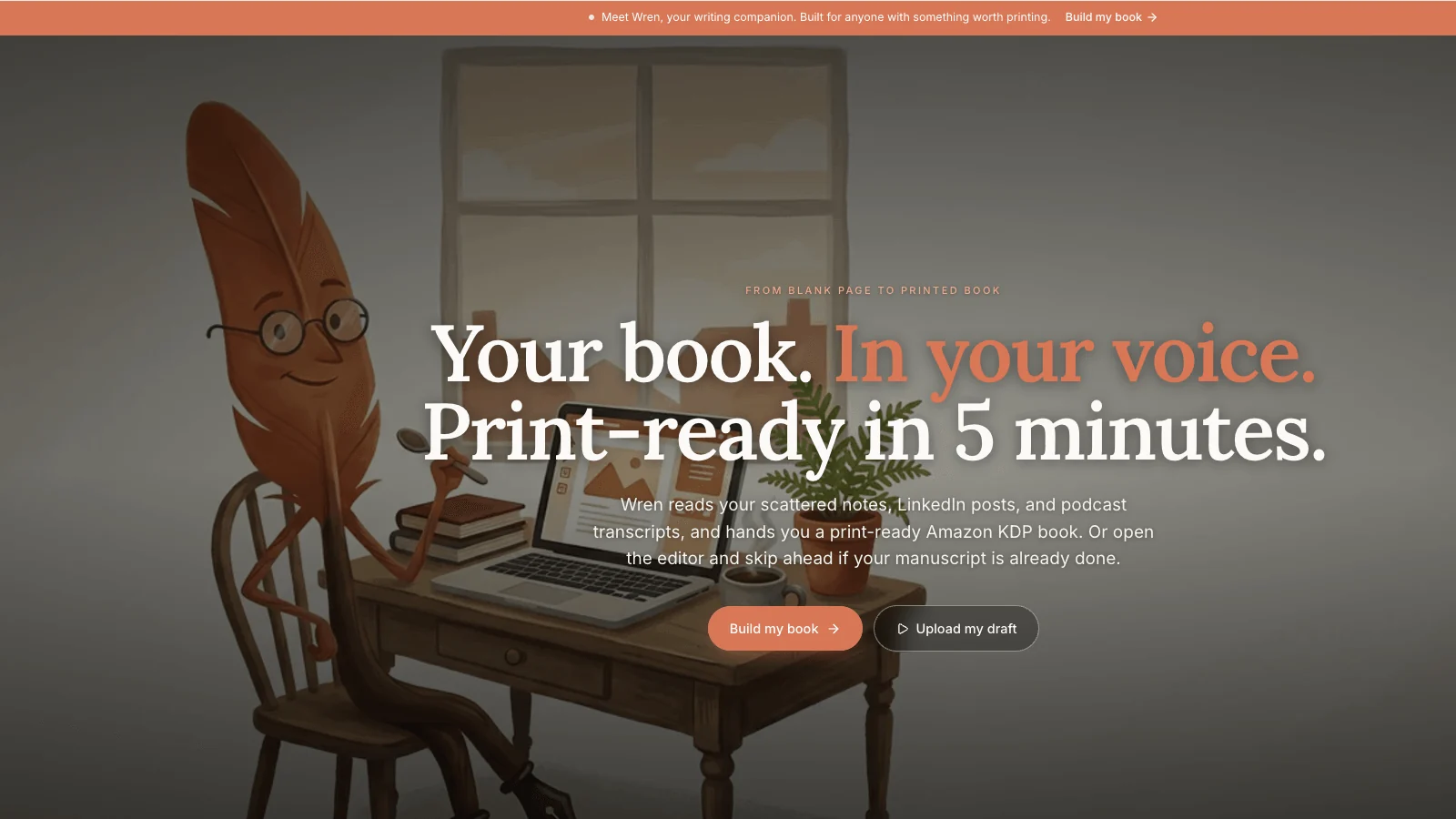
Built&Written is not a formatting tool competing on kerning. It takes the material a coach already owns, pasted LinkedIn posts, uploaded notes, pasted podcast transcripts, content imported from a URL, and assembles it into a structured, outlined draft. Its Voice DNA feature learns your writing samples so the assembled book sounds like you and not like generic AI. It then exports KDP-ready PDF and ePub files and generates a complete Amazon listing through its KDP Launch Co-pilot. It is from $19 a month with a free tier, and it works in a browser on any machine.
Read the scope carefully, because honesty cuts both ways. Vellum's typeset interior is more refined than what Built&Written produces, and a coach who wants that exact level of typographic craft on a Mac with a finished manuscript should still buy Vellum. Built&Written's advantage is not that it out-formats Vellum. It is that it solves the blank-page gap that both formatting tools, by definition, leave untouched. For the coach whose real problem is "I have the expertise but not the manuscript," that is the difference between a published book this quarter and another year of good intentions. You can start at the editor or read the coaches landing page for the full pitch.

So the full verdict, in order: solve the manuscript, then pick the formatter. If your manuscript is done, the Atticus vs Vellum choice comes down to your operating system and how much the interior craft is worth to you, and both are good enough that you will not regret either one. If your manuscript is not done, that is the problem to solve first, because no formatting tool, however beautiful its output, will write the book that earns you the retainer. Get the words assembled, and the rest of this comparison becomes an easy decision you can make in an afternoon.
Key takeaways
Run the Coach's Formatting Fit Test and the decision collapses to a few clean rules.
- Platform reality first. Vellum is macOS-only with no Windows version planned. Atticus runs on Windows, Mac, Linux, Chromebook, and any browser. If you are not on a Mac, choose Atticus or stop comparing.
- Both are one-time purchases. Atticus is $147 for ebook and print combined, with a 30-day money-back guarantee. Vellum is $199.99 for ebook-only and $249.99 for the print tier you actually need.
- Vellum wins interior craft. Its typesetting engine produces the best interiors in the category. The margin is real but narrow for text-heavy coaching books, and invisible to most prospects.
- Atticus wins versatility and price. It includes a writing editor, runs everywhere, and costs $102 less at the print tier. For most single-book coaches it is the practical pick.
- Neither closes the blank-page gap. Both assume a finished manuscript. The months of assembly between scattered content and an ordered draft is the real coach bottleneck, and formatting software does not touch it.
- Sequence matters. Solve the manuscript, then format, then publish. Built&Written assembles a KDP-ready draft from existing content from $19 a month, then exports the files a formatter would. If your words are already done and you want the most beautiful interior on a Mac, Vellum is still the craft winner.
Frequently asked questions
Is Atticus or Vellum better for coaches?
For most coaches, Atticus is the more practical choice because it runs on any operating system, includes a writing editor, and costs $147 against Vellum's $249.99 print tier. Vellum produces a more refined interior but only runs on macOS and only formats, with no writing mode. The deciding factor is usually your computer: if you are not on a Mac, Atticus wins by default.
Does Vellum work on Windows?
No. Vellum runs only on macOS and the company has stated it does not plan to build a Windows version. Windows users who want Vellum have to buy or borrow a Mac, rent a cloud Mac, or run macOS in a virtual machine, all of which add cost and friction. For Windows coaches, Atticus is the standard cross-platform alternative.
How much do Atticus and Vellum cost?
Atticus is a one-time $147 purchase that covers both ebook and print formatting on all platforms, with a 30-day money-back guarantee. Vellum is also one-time, at $199.99 for ebook-only or $249.99 for the print tier. Neither charges a subscription or per-book fee. For a coach producing a paperback, the real comparison is Atticus at $147 against Vellum at $249.99 plus Mac hardware.
Will Atticus or Vellum write my coaching book for me?
No. Both are formatting tools that begin with a finished manuscript. Atticus includes a place to type, and Vellum includes nothing for writing at all, but neither helps you assemble a draft from existing content. If your bottleneck is producing the manuscript from LinkedIn posts, notes, or podcast transcripts, a tool like Built&Written is built for that step, and a formatting tool comes after.
Do I need formatting software to publish on Amazon KDP?
Not strictly, but it helps. KDP accepts a properly formatted PDF for print and an ePub or formatted Word file for Kindle, and you can produce those manually in Word with the right templates. The KDP formatting guidelines spell out the requirements. Atticus and Vellum exist to hit those specs automatically so your interior looks professional instead of like a printed document.
Which tool gives the most professional-looking book interior?
Vellum. Its typesetting engine handles widows, orphans, ligatures, kerning, and optical margin alignment automatically, producing interiors that look traditionally published. Atticus is very good and usually indistinguishable to a general reader, but a professional designer will see Vellum's edge in fine spacing and polish. For a text-heavy coaching book, the gap is small and rarely worth changing your operating system over.
Can I start in one tool and switch to the other later?
Yes, with some rework. Both tools work from your manuscript text, so you can always export your words and bring them into the other tool, but the formatting itself does not transfer. Chapter-opener designs, styles, and theme choices have to be redone in the new tool, because each uses its own formatting model. The practical advice is to pick based on your operating system and your manuscript status now, rather than buying one as a placeholder. A coach on a Mac with a finished draft who wants the best interior should just start with Vellum. A coach on any other machine should start with Atticus and not look back.
I have content but no manuscript. What should I buy first?
Solve the manuscript before you buy a formatter. The most common mistake coaches make is purchasing Atticus or Vellum, opening it, and facing an empty chapter list, because the assembly work both tools assume is the work that stopped them. Built&Written assembles your existing content into an outlined, KDP-ready draft and preserves your voice, then exports the same kind of files a formatter would. Read Atticus vs Built&Written for coaches for that comparison.
Sources & References
Frequently asked questions
For most coaches, Atticus is the more practical choice because it runs on any operating system, includes a writing editor, and costs $147 against Vellum's $249.99 print tier. Vellum produces a more refined interior but only runs on macOS and only formats, with no writing mode. The deciding factor is usually your computer: if you are not on a Mac, Atticus wins by default.
No. Vellum runs only on macOS and the company has stated it does not plan to build a Windows version. Windows users who want Vellum have to buy or borrow a Mac, rent a cloud Mac, or run macOS in a virtual machine, all of which add cost and friction. For Windows coaches, Atticus is the standard cross-platform alternative.
Atticus is a one-time $147 purchase that covers both ebook and print formatting on all platforms, with a 30-day money-back guarantee. Vellum is also one-time, at $199.99 for ebook-only or $249.99 for the print tier. Neither charges a subscription or per-book fee. For a coach producing a paperback, the real comparison is Atticus at $147 against Vellum at $249.99 plus Mac hardware.
No. Both are formatting tools that begin with a finished manuscript. Atticus includes a place to type, and Vellum includes nothing for writing at all, but neither helps you assemble a draft from existing content. If your bottleneck is producing the manuscript from LinkedIn posts, notes, or podcast transcripts, a tool like Built&Written is built for that step, and a formatting tool comes after.
Not strictly, but it helps. KDP accepts a properly formatted PDF for print and an ePub or formatted Word file for Kindle, and you can produce those manually in Word with the right templates. Atticus and Vellum exist to hit those specs automatically so your interior looks professional instead of like a printed document.
Vellum. Its typesetting engine handles widows, orphans, ligatures, kerning, and optical margin alignment automatically, producing interiors that look traditionally published. Atticus is very good and usually indistinguishable to a general reader, but a professional designer will see Vellum's edge in fine spacing and polish. For a text-heavy coaching book, the gap is small and rarely worth changing your operating system over.
Yes, with some rework. Both tools work from your manuscript text, so you can always export your words and bring them into the other tool, but the formatting itself does not transfer. Chapter-opener designs, styles, and theme choices have to be redone in the new tool. The practical advice is to pick based on your operating system and your manuscript status now, rather than buying one as a placeholder.
Solve the manuscript before you buy a formatter. The most common mistake coaches make is purchasing Atticus or Vellum, opening it, and facing an empty chapter list, because the assembly work both tools assume is the work that stopped them. Built&Written assembles your existing content into an outlined, KDP-ready draft and preserves your voice, then exports the same kind of files a formatter would.
Sources & References
About the author

Mykhailo Druz
More in comparison
Ready to write your book?
Turn your expertise into a professional book with Built&Written.