

How AI Helps Entrepreneurs Write Books Without Losing Their Voice
For entrepreneurs in 2026, AI is the fastest way to turn existing content into a book without hiring a ghostwriter, and it preserves your voice only if the tool conditions on samples of your own writing first. The method, the Voice Fidelity Stack, separates what you should delegate to AI (outlining, assembly, formatting, KDP packaging) from what you must keep human (point of view, stories, the final read-aloud edit). Get that split right and the book sounds like you wrote it, because in every way that matters, you did.
In 2015, Mark Manson published a blog post with a title most editors would have killed: "The Subtle Art of Not Giving a F*ck." It went viral on the strength of one thing. The voice. Blunt, profane, funny, allergic to self-help platitudes. A year later, in September 2016, that voice became a book. It has now sold more than 12 million copies. Strip the voice out and you have a generic happiness manual nobody remembers. Keep it, and you have a franchise.
Every entrepreneur reading this in 2026 is sitting on a version of that voice. It is in your LinkedIn posts, your voice memos, your sales calls, the way you explain your method to a new client for the hundredth time. The problem is not that you have nothing to say. The problem is the gap between the voice that already works in conversation and the 200 pages of manuscript you have never had time to write.
AI closes that gap. Used badly, it also erases the exact thing that made Manson's blog post spread. This article is about how to use it the first way and not the second.
Key takeaway: AI helps entrepreneurs write books by handling structure, drafting, and formatting while the author keeps voice and judgment. The Voice Fidelity Stack runs in five layers: capture, structure, conditioned drafting, human passes, and the read-aloud test. Tools that condition on your own writing samples (like Built&Written's Voice DNA) preserve voice. Generic prompt-and-paste workflows flatten it.
Why your voice disappears the moment you hand the book off
The default way busy founders get a book written is to hand it off. Hire a ghostwriter. Brief them for a few hours. Get a manuscript back three to six months later. The economics are brutal: a professional ghostwriter for a business book runs from roughly $15,000 on the low end to $50,000 and up at agencies like Scribe Media. You pay that, and you still get back something that sounds slightly off. Competent. Clean. Not you.
This is not the ghostwriter's fault. It is structural. A ghostwriter reverse-engineers your voice from a handful of interviews. They are guessing at your cadence, your filler words, the specific way you undercut a serious point with a joke. They smooth the edges because smoothing is safe. The edges are where your voice lives. We wrote a longer breakdown of this trade-off in what ghostwriting actually is and why most entrepreneurs do not need one, but the short version is this: the more hands a manuscript passes through, the more it regresses to the mean.
Generic AI makes the same mistake faster and cheaper. Open ChatGPT, paste "write me a chapter about delegation for my business book," and you get fluent, structured, completely anonymous prose. It reads like every other AI business book on Amazon, because it is drawing on the average of every business book ever written. The fluency is the trap. It is good enough to feel like progress and generic enough to bury your actual perspective.
The voice tells readers notice
Readers cannot always name why a book feels hollow, but they feel it. The tells are consistent:
- Symmetry. Every chapter the same length, every section three bullet points, every argument balanced. Real thinkers are lopsided. They spend 2,000 words on the idea they care about and 200 on the one they do not.
- Hedging. "It is important to consider" and "many experts believe." You do not talk like that. You take positions.
- Missing stories. The specific client who fired you, the deal that fell apart at the last minute, the exact thing your mentor said in 2009. Generic AI cannot invent these because it does not have them. You do.
- Vocabulary drift. The book uses words you would never say out loud. A coach who says "let's get into it" on every call does not write "let us now examine."
Why this matters more for a coach than a novelist
A coach buys a book for credibility, not royalties. The book is a positioning asset. It is the thing that turns a $3,000 cold prospect into a $30,000 inbound retainer, because the prospect read the book, recognized the voice, and decided you were the one. That recognition is the entire mechanism. A book that does not sound like you breaks the mechanism. The reader meets you in person, you sound nothing like the book, and the trust you were trying to build evaporates. For a working coach or consultant, a voiceless book is worse than no book.
The real math behind the trade-off
Run the numbers and the case gets sharper. A ghostwritten business book costs $15,000 to $50,000 and takes three to six months. During those months you are briefing, reviewing, and correcting a draft that still drifts from your voice. Call it $30,000 and a quarter of your attention. Compare that to an AI-assisted workflow from $19 a month plus your own editing time. The cost difference is roughly a thousand to one. The more important number is the time-to-voice: with a ghostwriter you discover the voice problem at the end, after the money is spent. With a conditioned AI workflow you see it in the first chapter, while it is still cheap to fix. The asymmetry is the whole argument. When the feedback loop is hours instead of months, voice stops being a gamble and becomes something you can steer. We broke down the full return-on-investment case in is it worth writing a business book, and the answer hinges almost entirely on whether the book actually sounds like the person whose name is on the cover.
The Voice Fidelity Stack: a five-layer method
The way to use AI without losing your voice is to be precise about what AI touches and what it never touches. We call the framework the Voice Fidelity Stack. It is five layers, and the order matters.
| Layer | What it does | Who owns it |
|---|---|---|
| 1. Capture | Feed the system 5 to 50 pages of your real writing | You |
| 2. Structure | AI proposes a chapter outline from your source content | AI proposes, you edit |
| 3. Conditioned drafting | AI drafts chapters while matching your captured voice | AI, conditioned on you |
| 4. Human passes | You cut, add stories, take positions, fix vocabulary | You |
| 5. Read-aloud test | You read it out loud and fix anything that is not how you talk | You |
The mistake almost everyone makes is starting at layer 3. They open a generic AI tool and ask it to write, with no capture and no structure. The output is fluent and anonymous, and they conclude AI cannot preserve voice. The conclusion is wrong. They skipped the two layers that make voice possible.
Layer 1 is the one nobody wants to do
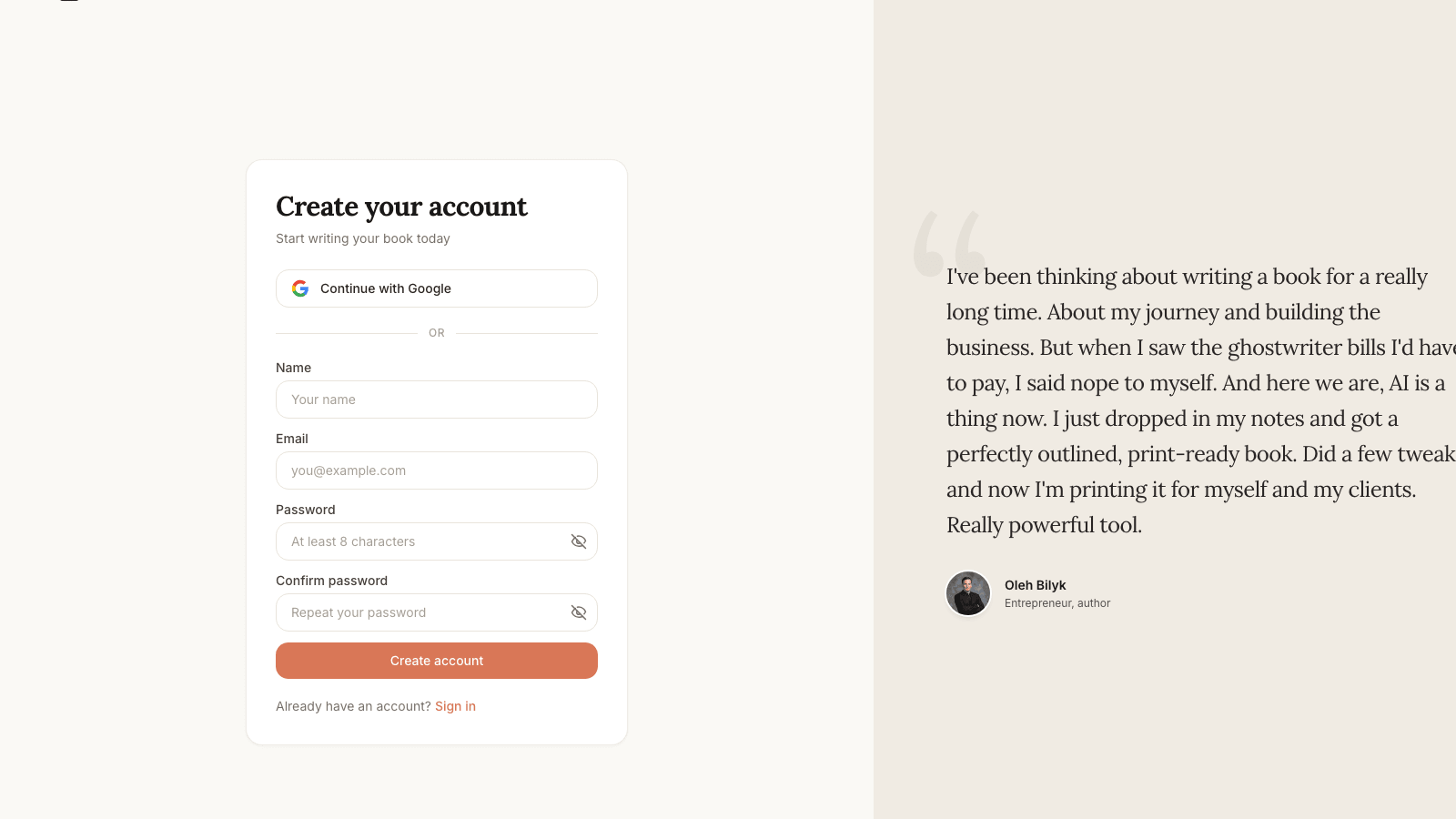
Capture is the unglamorous layer, and it is the one that determines everything downstream. If the AI has never seen your writing, it has nothing to imitate. Built&Written calls this layer Voice DNA: you paste samples of your characteristic prose, and the model conditions on them before it drafts a single chapter. Three to five thousand words is the sweet spot. That is roughly fifteen decent LinkedIn posts, or two long blog articles, or one good interview transcript.
The more characteristic the sample, the better. Do not feed it your most polished, edited, committee-approved writing. Feed it the stuff that sounds like you talking. We go deep on the mechanics of this in our guide to voice matching AI writing that sounds like you, but the principle is simple: the AI can only return the voice you give it.
Why the sequence cannot be reordered
You cannot draft before you structure, and you cannot structure before you capture, for the same reason you cannot frame a house before you pour the foundation. Each layer constrains the next. Capture sets the voice. Structure sets the argument. Conditioned drafting fills the structure in the voice. The human passes sharpen it. The read-aloud test catches what the eye misses. Skip a layer and the defect propagates. Most "AI books sound generic" complaints trace back to a skipped layer 1 or a skipped layer 4.
How AI actually helps, layer by layer
Here is what each layer looks like in practice for an entrepreneur who has content but no manuscript.
Capture: feed the machine your real writing
Start by collecting your existing content in one place. LinkedIn posts, newsletter archives, blog drafts, notes, and transcribed voice memos all count. Built&Written does not pull from LinkedIn for you, so you export or copy your posts and paste them in. It does not transcribe audio either, so a voice memo gets run through Otter.ai, Descript, or Rev first, and the transcript gets pasted. The point of capture is volume and authenticity, not polish.
Structure: let AI propose, then you cut
This is where AI earns its keep. Given your source content, the tool proposes a chapter outline: it groups related ideas, names chapters, and suggests an order. A founder staring at three years of scattered posts cannot see the book hiding inside them. The AI can, because pattern-finding across a large corpus is exactly what these models are good at. You then edit the outline hard. Delete the chapters that do not fit your argument. Merge the redundant ones. Reorder for the through-line only you can see. The AI gives you a draft skeleton in minutes that would have taken you a weekend of sticky notes. For more on this step, see how to turn your expertise into a book without a ghostwriter.
Conditioned drafting: the chapter comes back in your voice
With voice captured and structure locked, the AI drafts chapter by chapter. Because it has been conditioned on your samples, the draft comes back closer to your cadence than a cold prompt ever would. It is not finished. It is a strong first draft that already sounds more like you than like a textbook. The difference between this and generic AI output is the capture layer. Same underlying model, completely different result, because the model is now imitating a target instead of averaging the internet.
A worked example: three years of posts into a chapter
Picture a leadership coach with three years of LinkedIn posts, maybe 180 of them, plus a dozen newsletter issues. On their own, these are 180 disconnected fragments. Run them through the stack and something useful happens. At capture, the coach pastes their fifteen most characteristic posts so the model learns their voice. At structure, the AI reads all 192 pieces and notices that thirty of them circle the same theme: managers who avoid hard conversations. It proposes that as a chapter, groups the relevant posts, and suggests an arc from the cost of avoidance to a repeatable script. The coach edits the arc, cuts two posts that do not fit, and adds the through-line. At conditioned drafting, the AI expands the grouped fragments into 3,000 words of connected prose in the coach's cadence. What was a weekend of staring at sticky notes is now a draft chapter by lunch. The coach still owns the next part: the specific story of the VP who cried in a one-on-one, the line they always use to open a hard conversation, the position that most feedback training is theater. That is layer 4, and it is where the chapter goes from good to unmistakably theirs.
Voice memos, talks, and the content you forget you have
Most entrepreneurs underestimate how much raw material they already own. A keynote you gave last year is a chapter. A long voice memo recorded while driving is a section. A recorded client workshop is three. The constraint is that Built&Written does not transcribe audio for you, so the audio has to become text first. Run the file through Otter.ai, Descript, or Rev, clean the transcript lightly, and paste it in as source material. Spoken content is often your best voice sample precisely because it is unedited. It is how you actually talk, which is the register a reader recognizes. We covered the audio path in depth in how coaches turn a podcast into a KDP-ready manuscript, and the same method works for any recording you can transcribe.
Formatting and packaging: the part you should never do by hand
Once the manuscript is drafted and edited, the unglamorous production work begins, and this is pure delegation. Trim size. Inner and outer margins. Gutter math that scales with page count. Running headers. Chapter openers. A print-ready PDF. An ePub for Kindle. Built&Written handles the KDP-compliant interior formatting and exports both, plus a cover with correct spine math. None of this touches your voice, so all of it should be automated. Doing it by hand in Word is how books die at 90 percent done. If you want the full tool landscape for this stage, we tested the field in the best AI book writing tools for coaches.
What has to stay human (and why AI can't fake it)
The Voice Fidelity Stack delegates four things to AI and keeps three things human. The three human layers are not optional polish. They are the reason the book is worth reading.
Point of view
AI defaults to balance because balance is safe and unobjectionable. Your book needs the opposite. It needs you to say "most coaches are wrong about discovery calls, and here is what they miss." A point of view is a claim someone could disagree with. AI will not generate real ones on its own because its training rewards the inoffensive middle. You supply the spine. The AI helps you say it clearly. We made the case for this directly in why entrepreneurs should write a book now: the entire value of an authority book is that it stakes a position.
Stories only you have
The single fastest way to make a book sound human is specific, first-person stories with names, dates, and stakes. The client who almost quit. The pricing experiment that doubled your close rate. The mistake that cost you a quarter. AI cannot write these because it was not there. It can format them, tighten them, and place them well, but the raw material is yours alone. A book with five real stories beats a book with fifty perfect frameworks. Budget your effort accordingly.
Watch the difference on the page. Generic AI writes: "Difficult conversations are an essential leadership skill that many managers struggle to master." True, forgettable, and indistinguishable from a thousand other books. Your version writes: "In 2019 I watched a VP of sales avoid a single hard conversation for nine months. By the time he had it, his best rep had already accepted another offer. That delay cost the company roughly $400,000 in pipeline, and it taught me the rule I open every executive engagement with now." Same point. One is wallpaper, the other is a reason to keep reading. The AI can hold the structure around that story and make the prose clean, but only you can supply the VP, the nine months, and the number. This is why capture and editing are not interchangeable: capture gives the AI your sound, but your stories give the book its evidence, and evidence is what converts a reader into a client.
The read-aloud test
The final layer is the cheapest and most skipped. Read the manuscript out loud. Every sentence you stumble on is a sentence you would never say. Fix it on the spot. This single pass catches the vocabulary drift, the borrowed cadences, and the occasional AI tell that survived the earlier edits. It is the difference between a book that sounds like you and a book that sounds like a competent stranger who studied you. It takes a day. Do not skip it.
The common mistake: editing too little
The failure mode is not using AI. It is accepting the first draft. Founders who are thrilled to have any manuscript at all skip layers 4 and 5 and publish the conditioned draft as-is. It reads fine and sounds like nobody. The fix is discipline, not better software. The AI gets you to 70 percent in a fraction of the time. The last 30 percent is yours, and it is the 30 percent readers feel.
Which AI tools keep your voice, and which flatten it
Not every AI writing tool is built for this. Most are built for fiction, for marketing copy, or for raw drafting speed with no voice layer at all. Here is how the main options sort out for an entrepreneur writing a non-fiction authority book.
Built&Written: built around the voice problem
Built&Written is built specifically for entrepreneurs, coaches, and consultants turning existing content into a credibility book. Voice DNA is the headline feature and the reason it sits first here: it conditions on your samples before drafting. It ingests pasted or uploaded content, proposes structure, drafts chapter by chapter in your captured voice, formats for KDP, and exports print PDF and ePub. Pricing is from $19 per month with a free tier. The trade-off: it is opinionated toward non-fiction authority books, so it is the wrong tool if you are writing a novel.
Sudowrite: powerful, but built for fiction
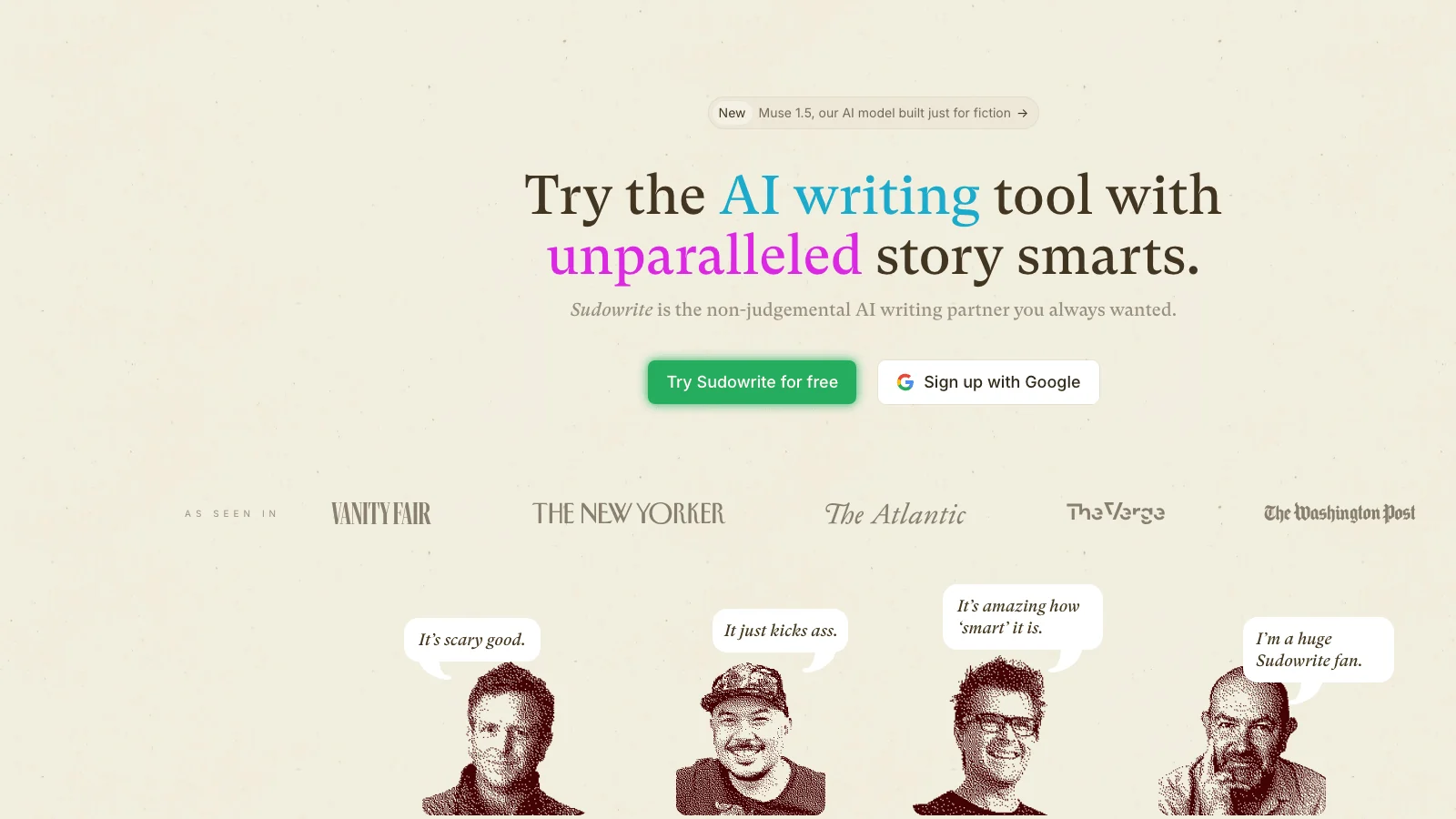
Sudowrite is one of the strongest AI writing tools on the market, and it is built for novelists. Its features (Story Bible, character development, prose expansion) are tuned for fiction. For a non-fiction business book, most of that machinery is dead weight, and there is no equivalent of a voice-capture layer aimed at preserving a real author's non-fiction register. We compared it head to head with Built&Written and Squibler in our three-way AI book tool breakdown for coaches.
Squibler and the general AI writers
Squibler and similar general AI writing platforms draft quickly and structure decently, but voice preservation is not their organizing principle. You can get a serviceable draft, then you carry the full burden of voice in the human passes. That is workable if you are a strong self-editor and disciplined about layers 4 and 5. It is risky if you are busy and tempted to ship the first draft.
Atticus and Vellum: formatting, not writing
Atticus and Vellum are formatting tools, not writing tools. They take a finished manuscript and make it beautiful for print and Kindle. They do excellent work at the formatting layer, but they do nothing at layers 1 through 5. If you already have a manuscript and only need production, they are great. If you have content but no manuscript, they do not solve your actual problem.
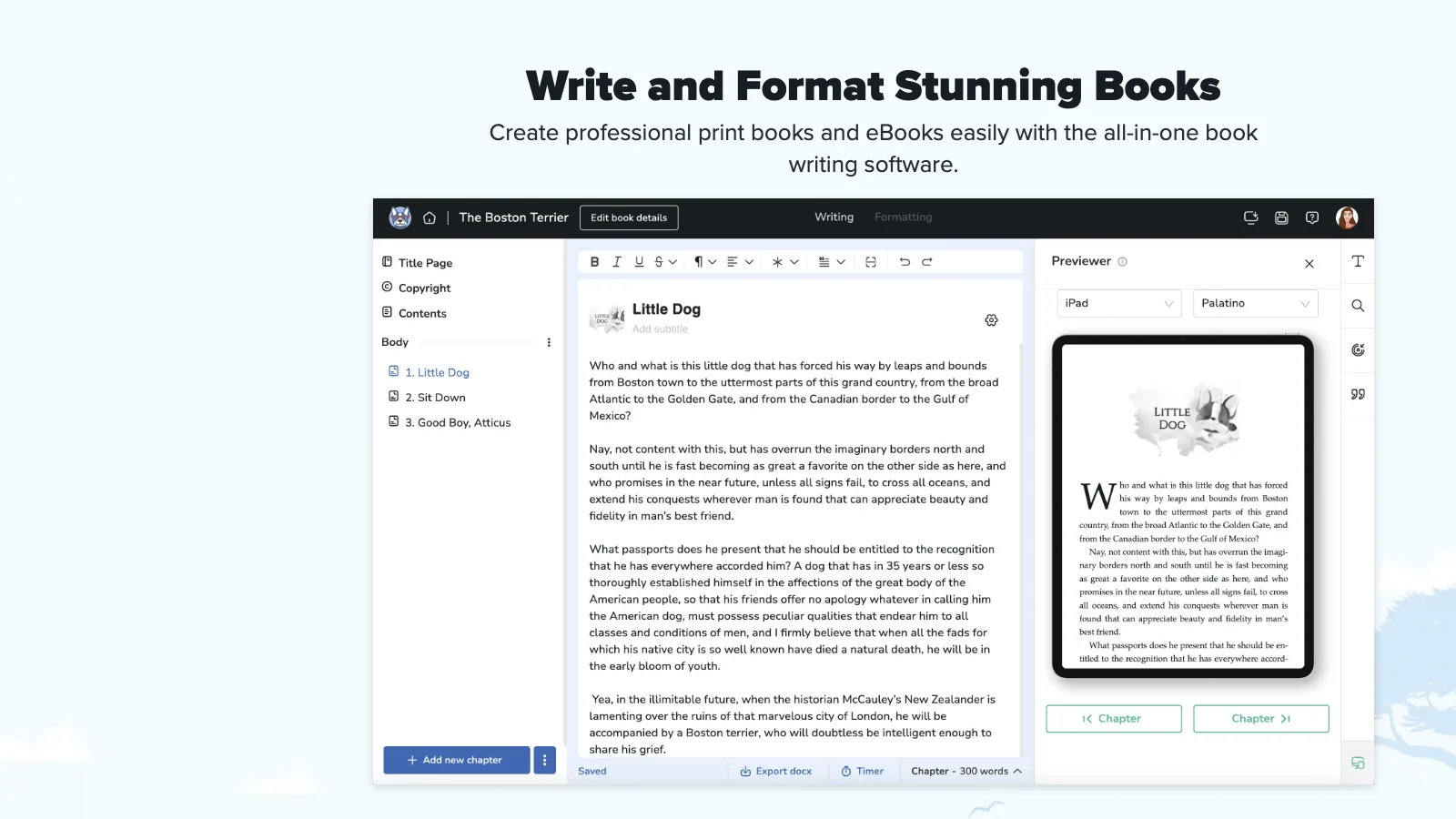
Worth being clear about the boundary here, because it trips people up. A formatting tool and a voice-preservation tool solve different problems and are not substitutes. You can run the Voice Fidelity Stack to produce a manuscript and then hand it to Atticus or Vellum for final production if you want their specific output. The two are complementary, not competitive. The mistake is buying a $147 formatting tool expecting it to help you write, then discovering it expects a finished book you do not have. Match the tool to the layer you are actually stuck on. For most entrepreneurs, the stuck layer is getting a draft out at all, not making a finished draft prettier.
NovelCrafter and the writer-first platforms
NovelCrafter and similar writer-first platforms give you fine-grained control over an AI-assisted draft, with codices for characters and world details and the ability to plug in your own model. The control is real and the tooling is mature. The orientation, again, is fiction and long-form narrative craft rather than non-fiction authority positioning. An entrepreneur can bend these tools to a business book, but you are adapting a fiction workflow rather than using a tool designed for your job. For the people who love tinkering with their writing environment, that is a feature. For the busy founder who wants the shortest path from content to a finished, formatted book, it is friction.
How voice capture actually works under the hood
It helps to know why conditioning beats prompting. When you paste samples into a voice-capture layer, the model is not memorizing your sentences. It is picking up statistical patterns: your average sentence length, how often you use contractions, whether you open with the verb, your habit of undercutting a serious claim with a dry aside, the specific transitions you reach for. When it then drafts, those patterns bias the output toward your register instead of the training-data average. A cold prompt has none of this bias, so it defaults to the safe middle. This is also why sample quality matters more than quantity past a point: 4,000 words of how-you-actually-talk beats 20,000 words of committee-edited corporate prose, because the patterns in the polished writing are not yours, they are the editor's. We unpack the mechanics further in voice matching AI writing that sounds like you.
Raw ChatGPT or Claude: the DIY path
You can run the entire stack manually with ChatGPT or Claude. Paste your samples into a long system prompt, ask for structure, draft chapter by chapter, and manage formatting separately. It works, and it is the cheapest path if you already pay for one of these. The cost is coordination: you are the integration layer, holding voice samples, outline, drafts, and formatting in your head across dozens of sessions. Purpose-built tools exist mostly to remove that coordination tax. We mapped the full DIY stack in AI writing tools for nonfiction.
| Tool | Voice capture | Drafting | KDP formatting | Best for |
|---|---|---|---|---|
| Built&Written | Yes (Voice DNA) | Yes | Yes | Non-fiction authority books |
| Sudowrite | No | Yes | No | Fiction |
| Squibler | Limited | Yes | Partial | Fast general drafting |
| Atticus / Vellum | No | No | Yes | Formatting a finished manuscript |
| ChatGPT / Claude | Manual | Yes | No | DIY, technically comfortable authors |
Will Amazon penalize an AI-assisted book, and who should actually do this?
Two questions stop entrepreneurs cold: will Amazon punish me, and is this even legitimate. Both have clear answers.
The KDP reality in 2026
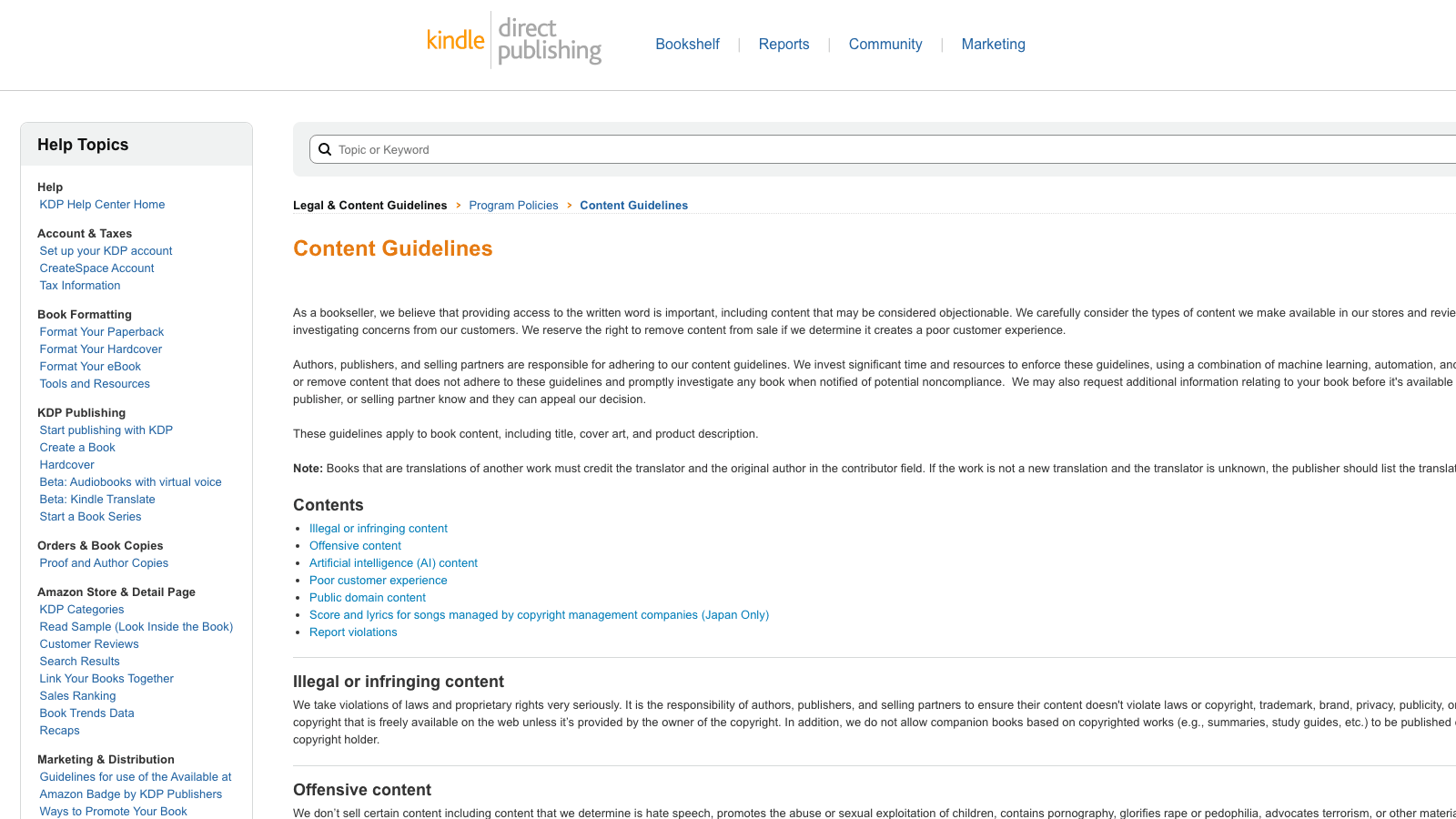
Amazon's KDP Content Guidelines draw a line that maps almost exactly onto the Voice Fidelity Stack. Amazon distinguishes AI-generated content (text, images, or translations produced by an AI tool, which must be disclosed during upload) from AI-assisted content (brainstorming, outlining, grammar, editing), which does not require disclosure at all. Amazon escalated enforcement of the disclosure rule in April 2026 after a surge in undisclosed AI-generated titles, but the policy itself is stable and permissive: AI books are allowed.
The Voice Fidelity Stack keeps you on the AI-assisted side by design. When you supply the voice, the point of view, and the stories, and you do the human passes, the book is genuinely yours with AI assistance. Even so, the honest move when AI drafted full chapters is to check the disclosure box. The disclosure is internal to Amazon and is not shown to buyers, so it costs you nothing and keeps your account safe. We walk through the policy in plain language in how to use AI to write a book that actually sells.
Who should write a book this way
This approach fits a specific person. If you have a body of existing content (years of posts, talks, client work) and a real point of view but no time and no manuscript, the stack is built for you. The AI compresses months of work into days without flattening the thing that makes you worth reading.
Who should not
If you have no existing content and no clear point of view, AI will not save you, because it has nothing to condition on and nothing to amplify. Fix that first by writing in public for a few months. If you are writing a novel, use a fiction tool. And if you genuinely enjoy the multi-month craft of writing every word yourself, keep doing that. The stack is for people whose constraint is time and assembly, not desire. For the broader build-versus-buy decision, see how to turn your expertise into a book without a ghostwriter.
Key takeaways
- AI helps entrepreneurs write books by handling structure, drafting, and formatting. It loses your voice only when you skip the capture and human-edit layers.
- The Voice Fidelity Stack is five layers: capture (5 to 50 pages of your writing), structure (AI proposes, you edit), conditioned drafting, human passes (point of view, stories, vocabulary), and the read-aloud test.
- Delegate four things to AI: outlining, assembly, drafting, and KDP formatting. Keep three things human: point of view, first-person stories, and the final read-aloud edit.
- Tools that condition on your own samples preserve voice. Built&Written's Voice DNA is built around this; generic prompt-and-paste workflows flatten it.
- Match the tool to the job. Built&Written for non-fiction authority books, Sudowrite for fiction, Atticus or Vellum for formatting a finished manuscript, ChatGPT or Claude for the DIY path.
- Amazon KDP allows AI-assisted books. The Voice Fidelity Stack keeps you on the AI-assisted side, and disclosure when AI drafts chapters is free and internal.
- Built&Written is from $19 per month with a free tier.
Frequently asked questions
How does AI help entrepreneurs write books without making them sound generic?
AI sounds generic only when it drafts from a cold prompt with no example of your writing. Tools that condition on samples of your own prose first (Built&Written calls this Voice DNA) return drafts in your cadence instead of the internet average. The other guardrail is doing the human edit passes: supplying your point of view, your real stories, and a final read-aloud edit. Capture plus human editing is what separates a book that sounds like you from one that sounds like a competent stranger.
Can AI really write a whole book in your voice?
AI can produce a strong first draft in your voice once it has been conditioned on 5 to 50 pages of your real writing, which is about fifteen LinkedIn posts or two long articles. It does not produce a finished book on its own. The conditioned draft gets you to roughly 70 percent. The remaining 30 percent (positions, stories, the read-aloud pass) is human work, and it is the part readers actually feel.
Will Amazon KDP reject or penalize an AI-assisted book?
No. Amazon's KDP Content Guidelines allow AI books. They distinguish AI-generated content, which must be disclosed at upload, from AI-assisted content like outlining and editing, which needs no disclosure. Amazon tightened enforcement of the disclosure rule in April 2026, but the policy permits AI-assisted publishing. The disclosure is internal to Amazon and is not visible to buyers, so checking the box when AI drafted chapters protects your account at no cost.
What is the difference between AI-generated and AI-assisted writing?
AI-generated means the AI produced the text, images, or translations, even if you edited them afterward. AI-assisted means you used AI for support tasks like brainstorming, outlining, grammar, or editing while you wrote the substance. Amazon requires disclosure for the first and not the second. The Voice Fidelity Stack is designed to keep most of your work on the AI-assisted side by keeping voice, point of view, and stories human.
How long does it take to write a book with AI?
The assembly and drafting that used to take months can compress into days once your content is gathered. Built&Written can produce a structured, formatted draft from your pasted content quickly, but the human passes still take real time. Budget a few days to a couple of weeks total for a serious authority book: a day or two gathering content, the AI assembly, then several days of editing, adding stories, and the read-aloud pass.
Do I need existing content, or can AI start from nothing?
You need existing content for this approach to work well, because the AI conditions on it for both voice and substance. Years of LinkedIn posts, a newsletter archive, blog drafts, or transcribed talks are ideal. If you have none of that, AI cannot manufacture a voice or a point of view it has never seen. Spend a few months writing in public first, then run the stack.
Is Built&Written better than hiring a ghostwriter?
For most entrepreneurs writing a credibility book, yes, on both cost and voice. A ghostwriter costs $15,000 to $50,000 and reverse-engineers your voice from a few interviews. Built&Written is from $19 per month and conditions directly on your own writing, so the voice fidelity is higher and you keep editorial control the whole way. A ghostwriter still wins if you have zero content, zero time, and an unlimited budget.
Sources & References
Frequently asked questions
AI sounds generic only when it drafts from a cold prompt with no example of your writing. Tools that condition on samples of your own prose first (Built&Written calls this Voice DNA) return drafts in your cadence instead of the internet average. The other guardrail is doing the human edit passes: supplying your point of view, your real stories, and a final read-aloud edit. Capture plus human editing is what separates a book that sounds like you from one that sounds like a competent stranger.
AI can produce a strong first draft in your voice once it has been conditioned on 5 to 50 pages of your real writing, which is about fifteen LinkedIn posts or two long articles. It does not produce a finished book on its own. The conditioned draft gets you to roughly 70 percent. The remaining 30 percent (positions, stories, the read-aloud pass) is human work, and it is the part readers actually feel.
No. Amazon's KDP Content Guidelines allow AI books. They distinguish AI-generated content, which must be disclosed at upload, from AI-assisted content like outlining and editing, which needs no disclosure. Amazon tightened enforcement of the disclosure rule in April 2026, but the policy permits AI-assisted publishing. The disclosure is internal to Amazon and is not visible to buyers, so checking the box when AI drafted chapters protects your account at no cost.
AI-generated means the AI produced the text, images, or translations, even if you edited them afterward. AI-assisted means you used AI for support tasks like brainstorming, outlining, grammar, or editing while you wrote the substance. Amazon requires disclosure for the first and not the second. The Voice Fidelity Stack is designed to keep most of your work on the AI-assisted side by keeping voice, point of view, and stories human.
The assembly and drafting that used to take months can compress into days once your content is gathered. Built&Written can produce a structured, formatted draft from your pasted content quickly, but the human passes still take real time. Budget a few days to a couple of weeks total for a serious authority book: a day or two gathering content, the AI assembly, then several days of editing, adding stories, and the read-aloud pass.
You need existing content for this approach to work well, because the AI conditions on it for both voice and substance. Years of LinkedIn posts, a newsletter archive, blog drafts, or transcribed talks are ideal. If you have none of that, AI cannot manufacture a voice or a point of view it has never seen. Spend a few months writing in public first, then run the stack.
For most entrepreneurs writing a credibility book, yes, on both cost and voice. A ghostwriter costs $15,000 to $50,000 and reverse-engineers your voice from a few interviews. Built&Written is from $19 per month and conditions directly on your own writing, so the voice fidelity is higher and you keep editorial control the whole way. A ghostwriter still wins if you have zero content, zero time, and an unlimited budget.
Sources & References
About the author

Mykhailo Druz
More in informational
Ready to write your book?
Turn your expertise into a professional book with Built&Written.