


What Is Ghostwriting? (And Why Entrepreneurs Don't Need One in 2026)
Ghostwriting is the practice of hiring a professional writer to produce a book, article, or speech that is published under your name. You own the ideas, the copyright, and the byline. The writer is paid and stays invisible. In 2026, a professionally ghostwritten business book costs $15,000 to $50,000 and takes 12 to 16 weeks of active collaboration.
Now run the numbers the way a coach has to run them. Picture a coach charging $4,500 per client whose quotes come back at $28,000, $35,000, and $47,500 with "a co-author credit option." The cheapest quote is six clients. Six clients who would need to be acquired, onboarded, and served before the book paid for itself, assuming the book converted at all.
More and more coaches in that position take a third path. They do not hire the ghostwriter, and they do not write the book themselves. They upload the content they already have (years of LinkedIn posts, podcast transcripts, workshop scripts) into Built&Written and edit the assembled draft instead of writing from scratch.
That math is why "what is ghostwriting" is the wrong starting question for most coaches and entrepreneurs in 2026. The right question is whether ghostwriting is actually the right tool for your situation. That depends on three things, which we have named the Authority Gap Test. But first, let's establish exactly what ghostwriting is, how it works, and what it actually costs, because most people's mental model is off by a factor of two.
Key takeaway: Ghostwriting in 2026 costs $15,000 to $50,000 for a book most coaches will use to book $5,000 to $15,000 engagements. The Authority Gap Test settles the decision in three questions: voice, time, material. Hire a ghostwriter when the voice gap is your problem. Use Built&Written from $19 a month when the gap is time.

What Ghostwriting Actually Is (And the Three Models You'll See)
Ghostwriting is the practice of writing content that someone else will publish under their own name. The writer is hired on a work-for-hire or contractual basis. The author gets full legal ownership and byline credit. The ghostwriter is paid for their work and, by agreement, stays invisible.
This has been standard practice in publishing for over a century. Presidential memoirs, celebrity autobiographies, business bestsellers from executives who run companies and do not have time to stare at a blank page. A significant portion of the business books on the airport bookstore shelf were written, partly or substantially, by a professional writer who is not named on the cover. There is no deception involved. The ideas, experiences, and frameworks belong to the named author. The prose is the ghostwriter's contribution.
Three distinct operating models exist in the market. Understanding which one you are actually buying matters a great deal for what you can expect.
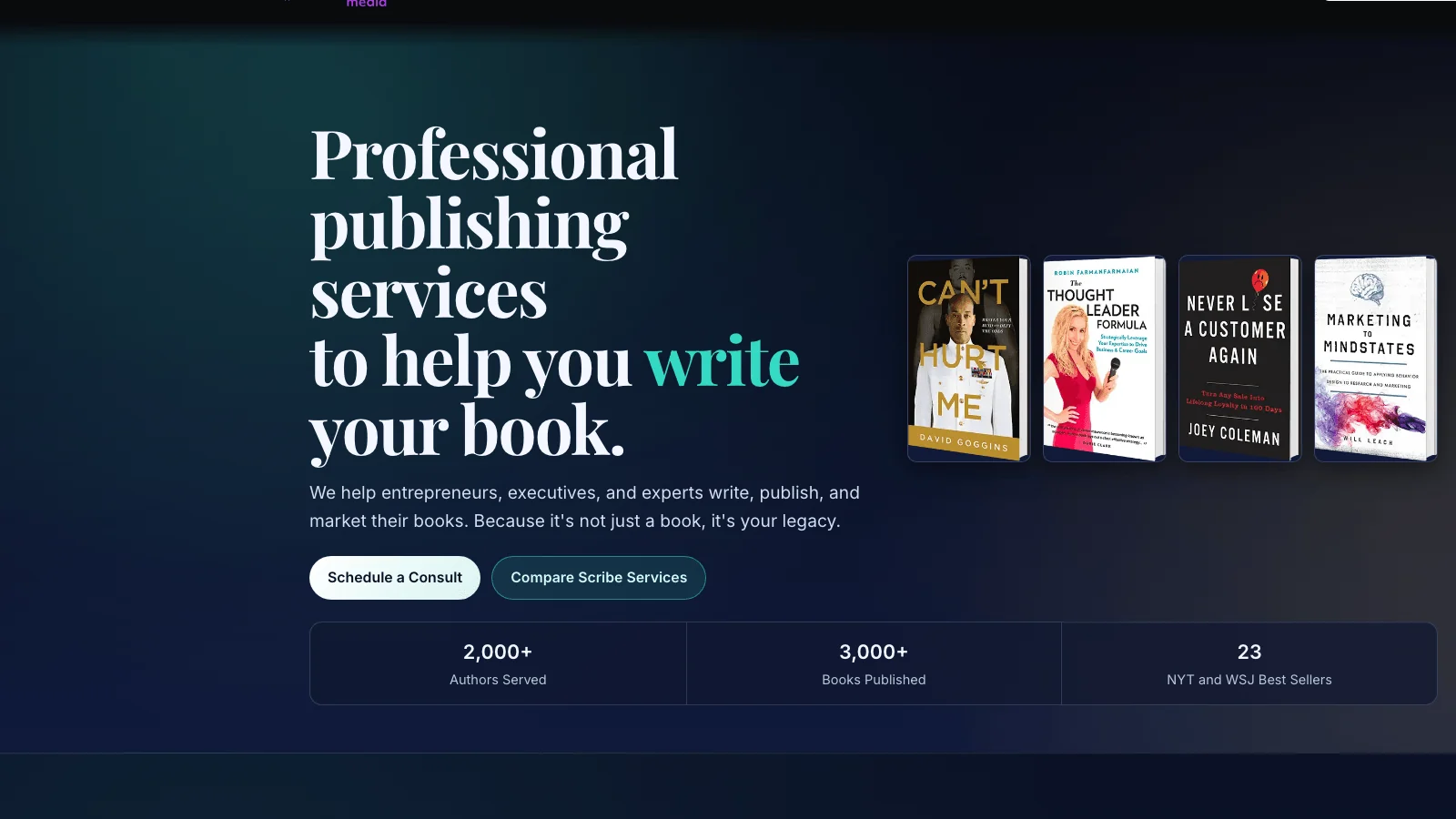
Model 1: Full ghostwriting. The ghostwriter does the writing entirely. They interview you for 20 to 40 hours over several months, study your existing content (talks, posts, transcripts), draft every chapter, and revise through multiple rounds until you approve the manuscript. You review and edit, but you do not write. The output is a complete, polished manuscript. This is the most expensive model. Services like Scribe Media operate here, as do most boutique ghostwriting agencies charging $25,000 and up. The ghostwriter's name appears nowhere on the book.
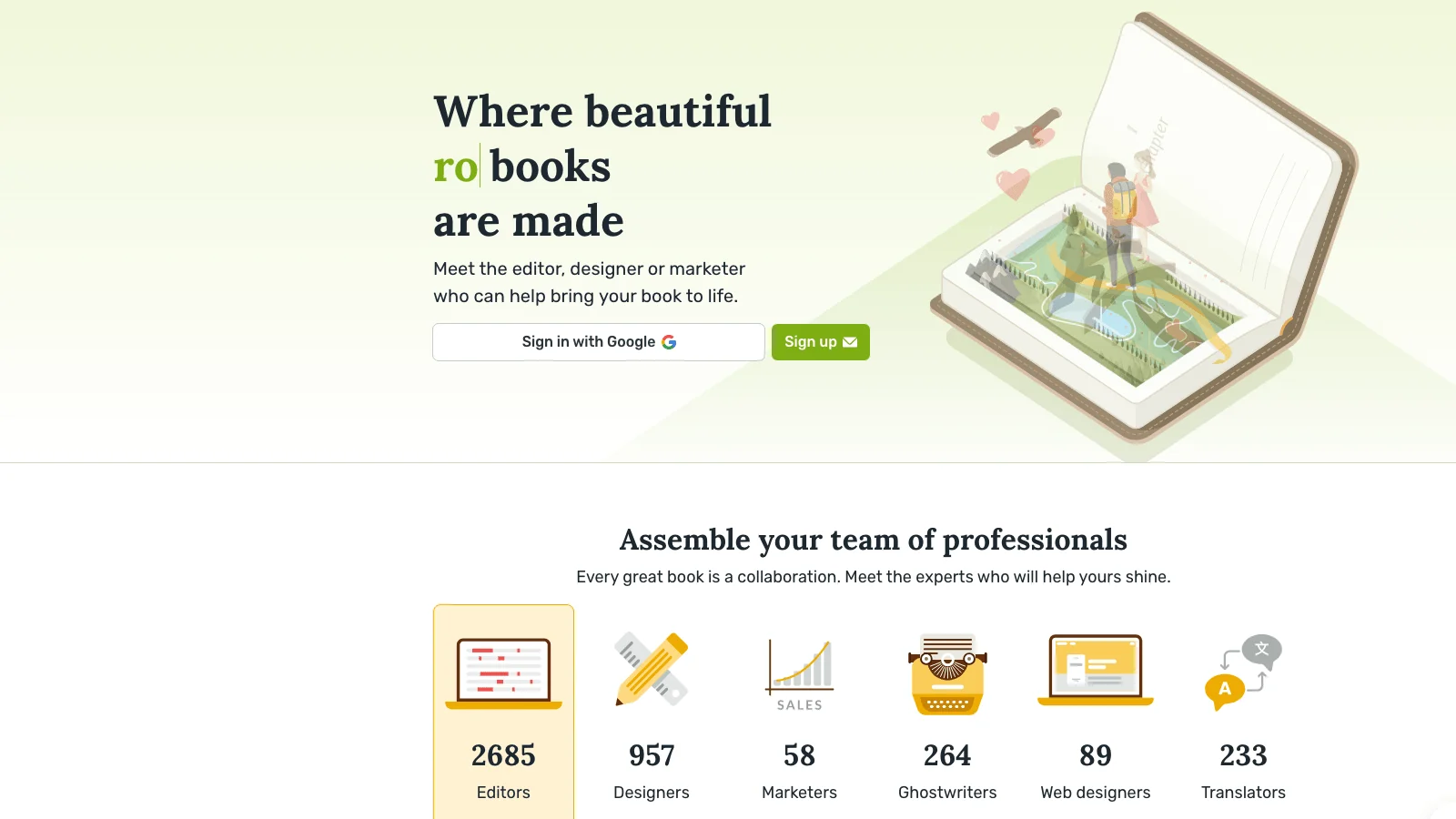
Model 2: Collaborative co-author. The author and the writer share the writing, sometimes with a "with [name]" credit on the cover and sometimes without. The author writes rough chapters or detailed outlines. The co-author shapes, expands, and polishes. This model is common in the memoir space and for executives who have a strong sense of what they want to say but need a skilled writer to execute it. Pricing varies widely. It can run from $10,000 to $40,000 depending on scope and the writer's credential level. The Reedsy marketplace lists ghostwriters for this kind of project, and rates on their platform run from $0.10 to $0.40 per word, which maps to $20,000 to $80,000 for an 80,000-word manuscript.
Model 3: "As told to" memoir or narrative nonfiction. The ghostwriter conducts extensive interviews, often 60 to 100 hours of recorded conversation, and then reconstructs the author's story, voice, and perspective in long-form narrative prose. The "as told to" credit is sometimes explicit on the cover ("as told to [ghostwriter name]") and sometimes not. This model has deep roots in celebrity memoir publishing. The writer is less a transcriptionist than a narrative architect. This model is rarely used for entrepreneur business books. It is more common in sports, entertainment, and political memoir.
Price bands across all three models in 2026 look like this. On the low end, individual ghostwriters on freelance platforms (Fiverr, Upwork) will offer project quotes from $1,000 to $5,000 for a full business book. Quality at this tier varies enormously. Many writers at this price point are producing AI-drafted content at scale, which means you may be paying $3,000 for something a well-prompted tool would produce for $45. The Reedsy marketplace mid-tier runs from $5,000 to $25,000 for professional freelancers. Boutique agencies and experienced solo ghostwriters charge $15,000 to $50,000. The top-tier full-service model, represented by Scribe Media and comparable services, runs from $25,000 to over $50,000.
To understand where those numbers come from, consider what a full ghostwriting engagement requires. The writer needs to learn your subject area well enough to write authoritatively about it. They need to develop a voice match through intake interviews and sample reading. They need to draft, revise, and polish 50,000 to 80,000 words. That is a six-month engagement at a minimum. A senior ghostwriter billing at $150 per hour at 300 hours of work is at $45,000 before any project overhead. The math is not mysterious.
The question for a coach trying to decide whether to hire one is whether that investment generates enough return. A coaching book is not primarily a revenue vehicle. It is an authority asset. It is the thing that lets you raise your rates, get speaking gigs, and convert qualified leads who come to discovery calls already convinced you know what you are doing. If your current coaching rate is $5,000 to $15,000 per client, the book needs to bring in somewhere between two and ten new clients over its lifetime to break even on a $30,000 ghostwriter fee. That is not an impossible ask, but it is a real hurdle.
The honest verdict: ghostwriting makes sense for a specific subset of entrepreneurs. Whether you are in that subset is what the Authority Gap Test determines.
How a Ghostwriting Engagement Actually Runs (12-Week Inside View)
The idealized version of a ghostwriting engagement goes like this: you sign a contract, show up for a few interviews, and three months later a polished manuscript arrives. The actual version is more demanding. If you are considering hiring a ghostwriter, you need to know what you are agreeing to, including the parts that get undersold in sales conversations.
Weeks 1 to 2: Intake and orientation. The engagement starts with a discovery phase. The ghostwriter reads everything you have given them (prior talks, LinkedIn posts, course transcripts, blog content) and conducts an initial intake interview lasting two to four hours. This interview is diagnostic: what is the book's core argument, who is the reader, what are the two or three ideas the reader absolutely must leave with. The writer is building a map of your thinking. You are talking, not writing. But you need to be specific. Vague answers here produce vague chapters later.
Weeks 3 to 4: Outline and voice samples. The ghostwriter produces a chapter-by-chapter outline, typically eight to twelve chapters with a 200-word description of each. You review and approve or revise. In parallel, the writer drafts two to three sample sections, usually the introduction and one body chapter, to test voice alignment. You read the samples and tell the writer whether the voice sounds like you. This is the highest-value feedback moment in the engagement and the one most clients rush through. A poorly aligned voice sample that gets approved here will produce a manuscript that does not sound like you.
Weeks 5 to 9: Drafting. The writer drafts two to three chapters per week, depending on length and complexity. Each batch arrives for your review. Your job is to mark what sounds like you, what does not, what is factually wrong, and what is missing. The writer revises. You are not rewriting. You are directing. Experienced clients hold weekly thirty-minute check-in calls. This phase is where the engagement either builds momentum or starts to slip.
Weeks 10 to 12: Assembly, polish, and final review. The completed chapter drafts are assembled into a single manuscript. The writer does a full read-through for consistency, then a prose pass for quality. You receive the full manuscript for final review. This review is typically where scope creep starts: requests for new sections, wholesale changes to the framing of a chapter, additions based on client calls that happened during the writing period. Most ghostwriting contracts have a cap on revision rounds. If you blow past that cap, you are in change-order territory.
Where engagements break. Three failure modes account for most unhappy outcomes. Scope creep is the most common: the client keeps adding new material past the agreed outline, and the manuscript becomes a moving target. Voice drift is the second: if the client does not give specific, actionable feedback on the voice samples in weeks three and four, the manuscript settles into the writer's voice rather than the author's, and catching this in the final review is expensive to fix. Missed deadlines from the client side is the third: ghostwriting is not a "set it and forget it" service. The client needs to show up to review calls, turn around feedback in 48 to 72 hours, and complete the intake interviews with specificity. When the client goes dark for two weeks, the engagement stops.
A realistic estimate of the client's time commitment: 30 to 50 hours over 12 weeks. That is not a lot, but it is not zero. Clients who assume ghostwriting requires nothing from them end up with manuscripts that do not sound like them and need substantial revision on the back end, which costs both time and money.
The standard delivery is a manuscript. It does not include KDP formatting, cover design, or launch support unless those are add-ons in the contract. Read the scope carefully before you sign.
What Ghostwriting Costs in 2026 (And Why the Numbers Are So Wide)
The range of ghostwriting quotes in the market, from $1,000 to $100,000 for a full business book, is confusing until you understand what actually drives the variation. There are five levers.
Lever 1: The writer's experience and track record. A ghostwriter who has produced two New York Times bestselling business books commands a different rate than someone who just added "ghostwriting" to their Fiverr profile. The former has a network of publishing contacts, a track record of voice-matching for complex subject-matter experts, and a method developed across dozens of projects. They also know how to push back productively when a client's proposed structure won't work. That expertise is priced accordingly.
Lever 2: Niche knowledge. A writer who knows leadership coaching, executive development, or organizational psychology does not need 40 hours of subject-area orientation. They can read your LinkedIn posts and identify the two key frameworks in a first read because they understand the domain. That saves 20 to 30 hours of ramp-up time. Writers who specialize in a niche charge more per hour but often save total cost. Writers who work across any topic take longer to produce informed prose.
Lever 3: Edit cycles included. Contracts that include two full revision rounds are priced differently from contracts that cap at one. Understand exactly how many rounds of revision are included, what counts as a revision (full chapter rewrites or copy-level changes), and what happens if you need more. The typical contract includes two or three rounds. Anything beyond that should be scoped and priced separately before you need it, not during.
Lever 4: Manuscript length. A 40,000-word introductory methodology book is a different project than an 80,000-word comprehensive career coaching guide. Ghostwriters who quote by the word (roughly $0.15 to $0.40 per word for mid-to-top tier) make this math explicit. Ghostwriters who quote by the project often embed a word-count assumption in the rate. Ask.
Lever 5: Delivery timeline. A six-month standard engagement and a three-month rush engagement are different prices. Rushing a ghostwriter means higher per-week rates, less thinking time per chapter, and a higher risk of voice drift. If you have a conference in four months where you want to sell books from the back of the room, factor the rush premium into your decision.
Here is the tiered market in 2026 with named reference points:
| Option | Typical 2026 price | Model | Your time commitment |
|---|---|---|---|
| Fiverr / Upwork freelancers | $1,000 to $5,000 | Full ghostwriting, quality varies widely | 30 to 50 hours |
| Reedsy marketplace | $5,000 to $25,000 ($0.10 to $0.40 per word) | Verified freelance ghostwriters | 30 to 50 hours |
| Boutique / solo ghostwriters | $15,000 to $50,000 | Full ghostwriting or collaborative co-author | 30 to 50 hours |
| Scribe Media (full service) | $25,000 to $50,000+ | Turn-key: writing, editing, cover, KDP filing | 30 to 50 hours |
| Built&Written (AI assembly) | from $19 per month | You supply the content, AI assembles, you edit | 15 to 20 hours |
Scribe Media is the best-known full-service option. Their current offerings range from their guided writing tier (which is more collaborative and priced in the lower five figures) to their full ghost service, which runs $25,000 to $50,000 and above depending on scope and package. They include a professional editing process, cover design, and KDP filing. If you want a complete turn-key service, this is the benchmark. Boutique ghostwriters who operate as solo practitioners with established business book track records charge in the $15,000 to $50,000 range. The Reedsy marketplace lists verified freelance ghostwriters at $0.10 to $0.40 per word, which means $8,000 to $32,000 for a 80,000-word manuscript. Reedsy's editorial standards for listed ghostwriters are stricter than Fiverr, and you can read reviews before hiring.
The low end of the market (Fiverr and Upwork, $1,000 to $5,000 for a full book) exists and does produce books. Some writers at this tier are genuinely skilled and underpriced. Many are producing AI-drafted content with light editing and submitting it as a "ghostwritten" manuscript. If you are considering this tier, ask for a paid sample of 2,000 words on a specific topic from your material before committing to the full project. See what the voice alignment looks like and whether the prose reflects actual understanding of your domain.
The honest cost-benefit framing for a coach: if your rate is $5,000 per client, a $30,000 ghostwriter fee requires six new clients who can trace their decision to buy to the book. That is a reasonable return on a well-executed book with a good launch strategy. It is a poor return on a book that sits on Amazon with 12 reviews and 5 organic sales per month. The book's marketing plan and your platform size matter as much as the manuscript quality for whether the investment pays out.
For coaches with established platforms (10,000 or more LinkedIn followers, consistent speaking schedule, strong referral network), the math works. For coaches who are building their platform and using the book as the foundational credibility asset, the from $19 per month alternative is a different risk profile entirely.
The Voice Problem No One Talks About
Every ghostwriter will tell you they can capture your voice. Most of them are correct, within limits. The limits are the part of the pitch that does not make it into the sales call.
Voice matching works well when the subject-matter expert is a clear communicator with a distinctive style and the ghostwriter is given adequate sample material and time. When either of those conditions is missing, something else ends up in the manuscript: a plausible approximation of the author's voice that passes the first reading but does not hold up to sustained engagement.
A coach who has five years of LinkedIn posts, six podcast episodes, and a detailed workshop script is giving the ghostwriter a 50,000-word voice sample. A writer skilled at voice analysis can extract sentence rhythm, favorite analogies, vocabulary register, and structural preferences from that material. The match will be strong. A coach who shows up to the engagement with two blog posts and an interview transcript is giving the ghostwriter roughly 5,000 words of source material. The writer will do their best, but there is not enough signal to extract voice with precision. What fills the gap is the writer's own default register.
Voice slippage is observable in published business books and it is almost always invisible to the author until readers point it out. The coach's clients, who have listened to them present the same frameworks for three years, pick it up on page forty. The sentences are "more formal somehow." The specific verbal tics the coach uses on stage (the pause-and-repeat, the rhetorical question, the admission of uncertainty before a strong claim) are not there. What is there is a coherent, well-structured business book that could have been written by any skilled business writer who spent three months studying this topic. That is not the same thing as a book that sounds like you.
The "as told to" memoir tradition in celebrity publishing has documented this problem extensively, though the discussion happens mostly within the publishing industry rather than publicly. When a ghostwriter is given 80 hours of interview recordings and asked to reconstruct someone's voice across 300 pages of narrative prose, the result depends on the writer's skill and the quality of the interview transcripts. For celebrity memoirs with readers who know the subject's public persona intimately, any significant voice slippage gets detected immediately. For business books, readers may not have a strong prior sense of the author's voice, so they accept the manuscript as-written. The author, however, knows.
This is directly relevant to any AI-based writing approach, including Built&Written's Voice DNA feature. The premise is identical: give the system enough samples of your actual writing (5 to 50 pages) and the output will be calibrated to your register. The same input that makes a good ghostwriting engagement possible (prior written material, podcast transcripts, workshop notes) is the input BW uses directly. The difference is what happens to that input: in a ghostwriting engagement, it passes through a human writer's interpretation. In BW, it is analyzed for structural and stylistic patterns and applied directly to chapter generation.
Neither approach is a perfect voice replication. Both require the author to review, edit, and push back where the output drifts. The question is what you are paying for the imperfect replication and how much editorial control you retain. A ghostwriter charges $15,000 to $50,000 for their version of voice matching. BW charges from $19 per month. Both require your active participation. Ghostwriting requires more total hours from you than most clients expect. BW requires you to do the review and editing yourself.
The voice problem is not a deal-breaker for ghostwriting. It is a known variable that good ghostwriters account for with extended intake processes and careful voice sampling. The point is that "a ghostwriter captures your voice" is a process, not a feature. It requires your investment of time and specific, detailed feedback.
Introducing the Authority Gap Test
The Authority Gap Test is a three-question framework for deciding whether you need a ghostwriter, an AI assembly tool, or to spend more time building material before you attempt a book at all. The questions are:
Question 1: Voice gap. Can you write 800 words that sound like you, or does every draft come out sounding like a press release? The voice gap question is not about whether you are a "good writer." It is about whether the distinctive way you think and communicate your ideas comes through when you type. A coach who writes the way they speak, with personality and specificity and the occasional deliberate fragment, does not have a voice gap. A coach who types into a Google Doc and produces sentences that sound like a LinkedIn ghostwriting service has a voice gap.
Question 2: Time gap. Do you have 50 or more usable focus hours over the next four to six months, or is your calendar already 90 percent booked with client work? "Usable focus hours" means time when you can sit down without interruption and do concentrated review work. This is not calendar blocks labeled "book writing" that end up absorbed by urgent client requests. It is actual protected time. Fifty hours is the realistic minimum for the author's contribution in either a ghostwriting engagement or an AI-assisted assembly process.
Question 3: Material gap. Do you already have 30,000 or more words of typed content, including LinkedIn posts, blog drafts, podcast transcripts, workshop scripts, or notes? Or are you starting from a blank page? Material gap is the most commonly underestimated factor. A coach who has been posting consistently on LinkedIn for three years likely has 100,000 to 200,000 words of existing material. A coach who has been running client sessions and workshops but publishing nothing digitally may have almost nothing typeable. These are different starting positions.
Here is how the test maps to decisions:
Coach 1: Voice gap yes, time gap yes, material gap yes. All three tests come back as gaps. You cannot write a convincing draft in your voice, you do not have the time to participate in the process, and you have no existing material. This person is not ready for a book. The correct move is to start creating: publish LinkedIn posts, record podcast episodes, write workshop scripts. Build material for six to twelve months, then revisit.
Coach 2: Voice gap yes (cannot write convincingly in own voice), time gap no (has time), material gap no (has content). This is the ghostwriter use case. You have material and time to participate in interviews but cannot translate your expertise into written prose that sounds like you. A skilled ghostwriter can extract your voice through intake interviews and produce a manuscript you can endorse with confidence.
Coach 3: Voice gap no (can write in own voice), time gap yes (no protected time), material gap no (has content). This is the Built&Written use case. You have a voice that comes through clearly in your writing. You have the material. You do not have 50 hours of writing time over the next four months, but you do have 15 to 20 hours to review and edit AI-generated chapter drafts. BW takes your existing content (LinkedIn posts, transcripts, notes), proposes a chapter outline, generates chapters in your voice using the Voice DNA feature, and you review and edit. The writing hours go from 200 to 400 (if you wrote the book yourself) to 15 to 20 (if you review BW's assembly). The output is still a book that sounds like you, because it was built from content that already sounds like you.
Coach 4: Voice gap no (can write in own voice), time gap no (has time), material gap yes (no content). You can write but have nothing to start from. The correct move is to spend the first six weeks building material directly: post on LinkedIn, write workshop scripts, draft blog posts on the methodology you teach. Then move into either a self-written first draft or BW-assisted assembly. Skipping this step produces a thin book that does not show your full thinking.
The simplest version of the decision: if you have material and voice, use AI assembly. If you have material and no voice, consider a ghostwriter. If you have neither, build material first.

When a Ghostwriter Is Still the Right Call
Ghostwriting is not the wrong answer. It is the right answer for a specific set of circumstances. Let's be honest about when that set applies.
Memoir with traumatic or hard-to-articulate material. Some experiences are difficult to write about directly because they are emotionally complex, legally sensitive, or involve articulating something that resists the structures of business writing. A coach who survived a significant personal event and wants to weave that into a memoir-style book may find that working with a skilled ghostwriter who conducts extended narrative interviews is genuinely the best way to get the story out. The writer is functioning as part interviewer, part structural architect. That is a different value proposition than "someone to write the words for me."
Celebrity or public-figure books where the co-author's publishing track record matters. If you are a well-known figure in your field, publishers and publicists know that your book's credibility partly rests on the quality of the prose. Bringing in a ghostwriter with a visible track record (even if they are not credited) is a credibility signal to publishers and major media outlets. This matters for book deals and large-scale PR campaigns. It does not matter much for coaches building authority in a vertical market.
No usable raw material and no inclination to create any. Some people have deep expertise and genuinely cannot or will not produce written content. They do not post on LinkedIn. They do not do podcasts. Their knowledge exists in their head and in client sessions that were never recorded. For these people, the ghostwriter's interview-based intake process is the only practical way to externalize their expertise. The alternative, building a content archive first, requires two years of consistent publishing before there is enough material to work with.
Books intended for a traditional publishing deal. If you are pursuing a traditional publisher, you may need your proposal to reflect a level of prose quality that a polished ghostwriter can deliver. Agents and acquisitions editors read proposals from a competitive standpoint. If the prose in your proposal is rough, the deal may not happen. A ghostwriter who has navigated the traditional publishing process knows how proposals are structured, what agents want to see, and how to write sample chapters that convert. That specific expertise is worth paying for if a traditional deal is the goal.
Outside those four categories, the honest assessment is that most coaches considering a ghostwriter in 2026 are doing so because they assume it is the only professional path. It is not. The coaching book market has an alternative that did not meaningfully exist five years ago. Understanding both options is the point.
We wrote a longer take on this in how to turn expertise into a book without a ghostwriter for coaches who want the full argument.
The Modern Alternative: Assembly Over Ghostwriting
The AI book market in 2026 is noisy. Tools like Sudowrite are built for fiction writers. General-purpose AI like ChatGPT produces plausible-looking content that does not hold up to a domain expert's reading. Atticus and Vellum are excellent formatting tools but do not have an AI generation layer. None of these solve the specific problem a coach with existing content needs solved: take what I already have and turn it into a book that sounds like me.
Built&Written was built for that specific problem. Here is what it actually does, without overclaiming.
You paste your existing content directly into the editor. LinkedIn posts, blog drafts, meeting notes, workshop scripts, podcast transcripts (which you transcribe externally using any transcription tool, then paste). You can also upload files in .docx, .txt, or .md format, or import from a URL if your content is on a public web page. You do not need to have everything organized. You just need to have the raw material.
You upload 5 to 50 pages of your most characteristic writing as a Voice DNA sample. This is the foundation of the voice matching system. The AI analyzes your sentence rhythm, vocabulary register, paragraph structure, and the specific ways you frame ideas. That analysis becomes the voice anchor for the entire book generation process.
The system proposes a chapter outline based on your source content. You review and edit the outline before generation begins. This is a critical step: the outline is your book's architecture, and getting it right before chapter generation saves significant editing time later.
With the outline approved, you generate chapters one by one. Each chapter is built from your thematically related source material, written in the voice calibrated from your Voice DNA sample. You review each chapter in the integrated editor, make edits, and move to the next. You are not a passive audience here. You are an editor making active decisions about what stays, what goes, and where the argument goes next.
When the manuscript is complete, BW handles KDP-compliant formatting: trim sizes (5x8, 6x9, 8.5x11), margins, gutters that scale with page count, running headers, and chapter openers. You control typography (font, size, line spacing). The integrated cover designer produces front, back, and spine PDFs with correct spine math based on your page count. The KDP Launch Co-pilot generates your Amazon listing (title, subtitle, description, keywords, categories) and a LinkedIn announcement post for launch day. You download the full package (PDF manuscript, cover PDF, ePub, metadata) and upload it to KDP yourself.
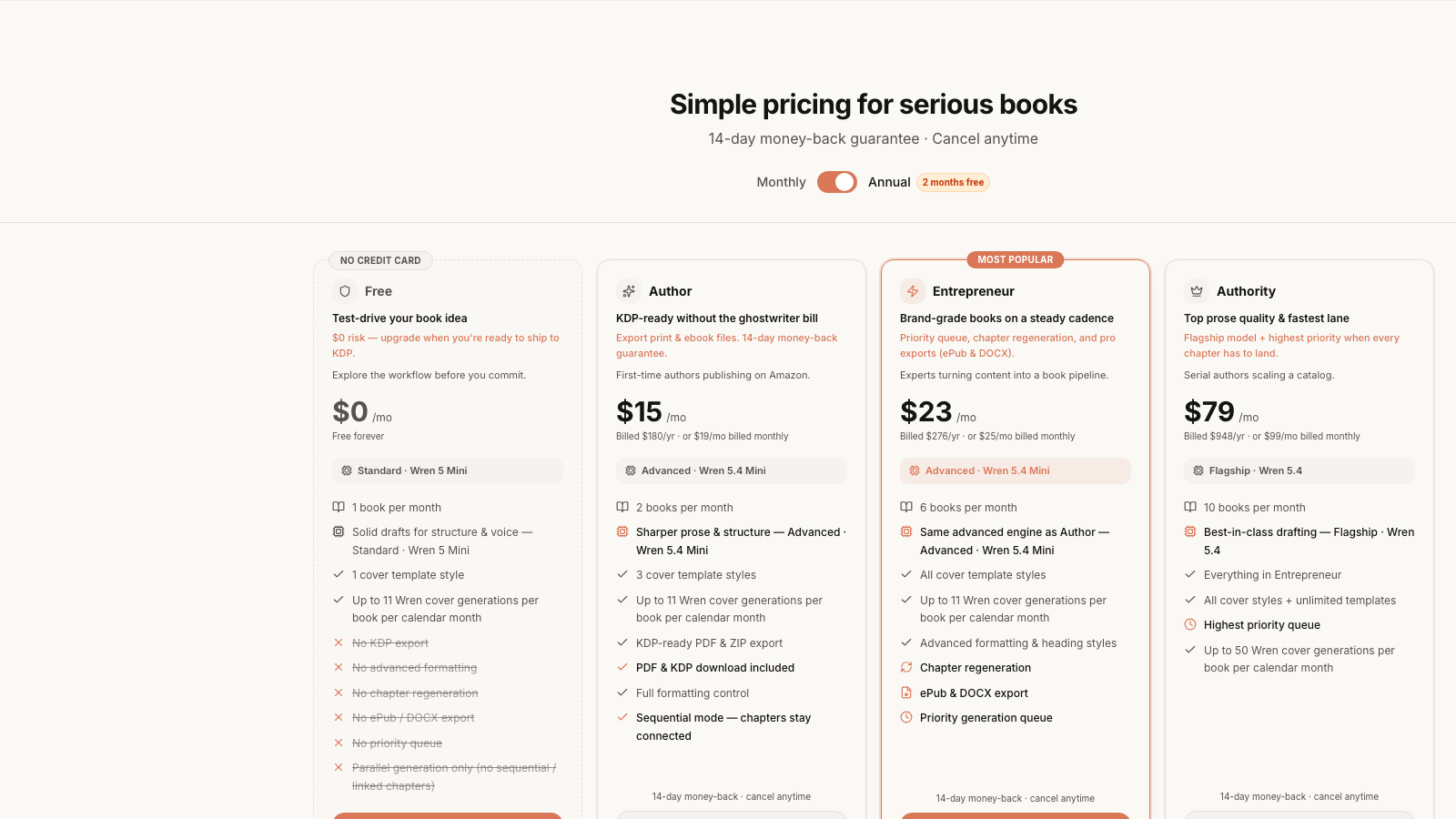
The price is from $19 per month. There is a free tier. You can start at builtwritten.com, see the full plan comparison at builtwritten.com/pricing, and access the editor directly at builtwritten.com/editor.
Let's do the math plainly. A mid-range ghostwriter costs $25,000. Built&Written costs from $19 per month, which is $57 over a three-month build and $228 for a full year on the platform. The quality of the output depends on the quality of your input material and the care you put into Voice DNA setup and editorial review. But the price difference is not marginal. It is three orders of magnitude.
BW will not write the book for you with no input. If you have no existing content and no inclination to review AI-generated drafts, it is not the right tool. The correct minimum to start: about five pages of your own writing (voice sample) and something to assemble from (posts, notes, transcripts). Both requirements also happen to be prerequisites for a successful ghostwriting engagement. The difference is what you do with those inputs next.
We cover the full assembly workflow in more detail at how to write a book without a ghostwriter and how long it takes to write a business book.
The Decision Framework (And What Happens Next)
The Authority Gap Test gives you a decision. Here is how to use it.
Run the three questions in order. Voice gap first: can you produce 800 words that sound like you on a specific topic you know well? If you are not sure, write them right now. Set a timer for 30 minutes and write about the core insight from your coaching methodology. Then read it back. If it sounds like you, the voice gap is closed. If it sounds like a LinkedIn ghostwriter wrote it, the gap is open.
Time gap second: pull up your calendar and find 50 hours over the next 16 weeks. Not aspirational blocks. Real protected time. If you cannot find it, the time gap is open. Note that the time gap does not mean you cannot have a book. It means you need a process that requires fewer total hours from you, not more.
Material gap third: open a Google Doc and start dropping your existing content. Three years of LinkedIn posts, a podcast transcript, a workshop script. How many words do you have? Under 10,000 words and you are starting from almost nothing. 30,000 words or more and you have enough to build from.
The combinations and their outcomes:
Voice gap closed, time gap closed, material gap closed: you can write the book yourself. See how to write an executive book for a process that works for coaches with this profile.
Voice gap closed, time gap open, material gap closed: this is the Built&Written use case. Start on the free tier, upload your Voice DNA sample, and run the assembly workflow. You will have a first-draft manuscript in weeks, not months.
Voice gap open, time gap closed, material gap closed: ghostwriter or collaborative co-author. Take your content inventory to a Reedsy intake call or contact Scribe Media for a quote. Budget $20,000 to $40,000.
Voice gap open, time gap open, material gap closed: not ready yet. Build material first. Read what is a thought leadership book to understand what the book needs to contain before you commission it.
Three no-es: start publishing. Write one LinkedIn post per week for six months. Record a few podcast episodes. Run a workshop. You are 12 months from having enough material for a book.
One honest acknowledgment about the AI assembly path: BW will not produce a finished, publication-ready manuscript with no effort on your part. The Voice DNA input requires 5 to 50 pages of your actual writing. The chapter review and editing requires engagement. The outline requires your sign-off before generation runs. If you show up expecting a push-button book, you will be disappointed. If you show up with good raw material and a willingness to edit, you will have a book that sounds like you, is KDP-formatted, and is ready to upload to Amazon. That is a genuinely different outcome from either writing it yourself over 18 months or paying $30,000 to have someone else write it for you.
The right next step is whichever the Authority Gap Test points you to. If that is ghostwriting, understand what you are buying before you sign. If that is AI assembly, try Built&Written on the free tier with your real content. If that is building more material first, read traditional publishing vs self-publishing to understand the full landscape before you make any bets on distribution.
The book does not get done by deciding to write it. It gets done by running the right process for your specific combination of voice, time, and material.
Frequently Asked Questions
How much does ghostwriting cost in 2026?
Ghostwriting costs vary significantly by tier. Freelancers on platforms like Fiverr and Upwork quote $1,000 to $5,000 for a full business book, with highly variable quality. The Reedsy marketplace lists professional ghostwriters at rates that translate to $5,000 to $25,000 for a standard-length business manuscript. Boutique ghostwriting agencies and experienced solo ghostwriters charge $15,000 to $50,000. Full-service agencies like Scribe Media run from $25,000 to over $50,000 for their top-tier service.
How long does ghostwriting a business book take?
A standard ghostwriting engagement for a business book runs 12 to 16 weeks from kick-off to final manuscript delivery. This assumes active client participation (two to four hours of intake interviews in the first two weeks, timely feedback on each chapter draft, and a prompt final review). Rush engagements at three months are possible but add cost and increase the risk of voice drift. Add another four to eight weeks for editing, cover design, and KDP upload if those are not included in the ghostwriting scope.
Can a ghostwriter really capture my voice?
Yes, with the right inputs and enough time for calibration. A ghostwriter who receives 30,000 to 50,000 words of your prior writing (LinkedIn posts, transcripts, blog content) and conducts 20 to 40 hours of recorded interviews has enough signal to approximate your voice well. The approximation improves with specific, detailed feedback on the voice samples delivered in weeks three and four of the engagement. Ghostwriters who are given thin source material and rushed through the intake process produce manuscripts that sound professionally written but do not sound like the author. The voice problem is a function of inputs and feedback quality, not ghostwriter skill alone.
What's the difference between ghostwriting and AI writing tools like Built&Written?
Ghostwriting is a human service where a professional writer conducts interviews, analyzes your existing content, and produces the manuscript. You direct. They write. The cost is $15,000 to $50,000 for a business book. Built&Written is a software tool that takes your existing content (LinkedIn posts, transcripts, notes in .docx, .txt, or .md format), captures your Voice DNA from 5 to 50 pages of samples, proposes a chapter outline, and generates chapter drafts that you review and edit in an integrated editor. The cost is from $19 per month. Both approaches require your active participation and are only as good as the input material you provide.
Do I own the book if I use a ghostwriter?
Yes, in a properly structured ghostwriting contract. The standard arrangement is work-for-hire: the ghostwriter assigns all intellectual property rights to you, the named author, in exchange for their fee. A well-written contract includes an NDA (the ghostwriter cannot disclose their involvement), a copyright assignment clause transferring all rights to you, and language specifying what happens to the manuscript if either party terminates the engagement early. Always review the IP assignment clause before signing. Some lower-tier freelancers use looser contracts. If the contract does not explicitly assign copyright to you, do not sign it without having a lawyer review it first.
When is ghostwriting worth it for a coach?
Ghostwriting is worth the investment when at least two of these are true: you have a platform large enough to generate book sales (10,000 or more engaged followers across LinkedIn, a podcast, or a speaking schedule), you have a memoir or narrative element that benefits from a skilled human interviewer, you are pursuing a traditional publishing deal where proposal quality is gated by prose standards, or you have no usable existing content and are not going to build it. For most coaches who have been creating content consistently for two or more years and can write competently in their own voice, the combination of existing material and AI assembly tools like Built&Written makes more financial sense than hiring a ghostwriter.
Sources and References
- Scribe Media - Ghostwriting Services and Pricing
- Reedsy - Find a Ghostwriter for Your Book
- Amazon KDP Help - Publishing Process and Requirements
- International Coaching Federation - Coaching Research and Resources
- Atticus - Book Writing and Formatting Software
- Vellum - Book Formatting for Mac
- Sudowrite - AI Writing Tool for Fiction
- Built&Written - AI Book Creation for Coaches and Entrepreneurs
- Built&Written - Plans and Pricing
- Built&Written - Book Editor
- Built&Written - For Coaches
- The Coaching Habit by Michael Bungay Stanier - Amazon
- Atomic Habits by James Clear - Amazon
- The Lean Startup by Eric Ries - Amazon
- Publishers Weekly - Industry News and Analysis
Frequently asked questions
Ghostwriting costs vary significantly by tier. Freelancers on Fiverr and Upwork quote $1,000 to $5,000 for a full business book, with highly variable quality. The Reedsy marketplace lists professional ghostwriters at rates that translate to $5,000 to $25,000 for a standard-length business manuscript. Boutique ghostwriting agencies and experienced solo ghostwriters charge $15,000 to $50,000. Full-service agencies like Scribe Media run from $25,000 to over $50,000 for their top-tier service.
A standard ghostwriting engagement for a business book runs 12 to 16 weeks from kick-off to final manuscript delivery. This assumes active client participation: two to four hours of intake interviews in the first two weeks, timely feedback on each chapter draft, and a prompt final review. Rush engagements at three months are possible but add cost and increase the risk of voice drift. Add another four to eight weeks for editing, cover design, and KDP upload if those are not included in the ghostwriting scope.
Yes, with the right inputs and enough time for calibration. A ghostwriter who receives 30,000 to 50,000 words of your prior writing (LinkedIn posts, transcripts, blog content) and conducts 20 to 40 hours of recorded interviews has enough signal to approximate your voice well. The approximation improves with specific, detailed feedback on the voice samples delivered in weeks three and four of the engagement. Ghostwriters who are given thin source material and rushed through the intake process produce manuscripts that sound professionally written but do not sound like the author.
Ghostwriting is a human service where a professional writer conducts interviews, analyzes your existing content, and produces the manuscript. You direct. They write. The cost is $15,000 to $50,000 for a business book. Built&Written is a software tool that takes your existing content (LinkedIn posts, transcripts, notes in .docx, .txt, or .md format), captures your Voice DNA from 5 to 50 pages of samples, proposes a chapter outline, and generates chapter drafts that you review and edit in an integrated editor. The cost is from $19 per month. Both approaches require your active participation and are only as good as the input material you provide.
Yes, in a properly structured ghostwriting contract. The standard arrangement is work-for-hire: the ghostwriter assigns all intellectual property rights to you, the named author, in exchange for their fee. A well-written contract includes an NDA (the ghostwriter cannot disclose their involvement), a copyright assignment clause transferring all rights to you, and language specifying what happens to the manuscript if either party terminates the engagement early. Always review the IP assignment clause before signing. If the contract does not explicitly assign copyright to you, do not sign it without having a lawyer review it first.
Ghostwriting is worth the investment when at least two of these are true: you have a platform large enough to generate book sales (10,000 or more engaged followers across LinkedIn, a podcast, or a speaking schedule), you have a memoir or narrative element that benefits from a skilled human interviewer, you are pursuing a traditional publishing deal where proposal quality is gated by prose standards, or you have no usable existing content and are not going to build it. For most coaches who have been creating content consistently for two or more years and can write competently in their own voice, the combination of existing material and AI assembly tools like Built&Written makes more financial sense than hiring a ghostwriter.
Sources & References
- Scribe Media - Ghostwriting Services and Pricing
- Reedsy - Find a Ghostwriter for Your Book
- Amazon KDP Help - Publishing Process and Requirements
- International Coaching Federation - Coaching Research and Resources
- Atticus - Book Writing and Formatting Software
- Vellum - Book Formatting for Mac
- Sudowrite - AI Writing Tool for Fiction
- Built&Written - AI Book Creation for Coaches and Entrepreneurs
- Built&Written - Plans and Pricing
- Built&Written - Book Editor
- Built&Written - For Coaches
- The Coaching Habit by Michael Bungay Stanier - Amazon
- Atomic Habits by James Clear - Amazon
- The Lean Startup by Eric Ries - Amazon
- Publishers Weekly - Industry News and Analysis
About the author

Michael Pavlovskyi
More in informational
Ready to write your book?
Turn your expertise into a professional book with Built&Written.