

10 Entrepreneurs Whose Books Built Their Business in 2026
10 Entrepreneurs Whose Books Built Their Business in 2026
In 2002, Patrick Lencioni handed in the manuscript that became The Five Dysfunctions of a Team. He was running a small consultancy in the Bay Area called The Table Group. The firm was good. The firm was not famous. The book was a fable about a fictional CEO learning why her executive team kept failing each other. It was 229 pages. It went to Jossey-Bass. It came out the same year.
Twenty-four years later, The Table Group is a multi-million-dollar consulting and training firm with a global network of facilitators. Lencioni did not stop writing. He shipped The Advantage, The Ideal Team Player, The 6 Types of Working Genius, and a dozen more. Each new book pulled more leaders into the firm's orbit. Each new framework became a Table Group product.
That is the move. That is what coaches and consultants in 2026 keep missing when they think about books.
You, sitting here reading this in 2026, already know the playbook works. You have seen it on every shelf at every airport. You have probably read three of the books on this list. What you have not done yet is turn yours into the same kind of engine. That is what this article is for.
Key takeaway: A book is not a product for entrepreneurs. It is a positioning asset that compounds. The Book-Compound Pattern has three stages: Codify the expertise you have been giving away verbally, Distribute it into rooms you will never enter, Compound every reader into a citation, a referral, or a funnel entry. The 10 entrepreneurs in this article all ran the same play.
The Book-Compound Pattern: how a book becomes a durable business engine
Most coaches we speak with treat a book like a product. They calculate the royalty math. They look at Amazon rankings. They wonder if it will pay for itself in book sales. They are looking at the wrong column on the spreadsheet.
A book for a coach is not a revenue product. It is a credibility purchase. The Book-Compound Pattern is the three-stage system that runs underneath every case in this article. Name it, use it, build for it.
Stage 1: Codify. You already have the expertise. You have given it away verbally on a thousand sales calls. You have repeated the same five points on every panel you have ever sat on. You have written the same threads, the same posts, the same emails. The first job of a book is to take that scattered, repeated, spoken material and lock it down in writing. Once it is locked down, two things change. First, the framework gets a name. A name is a handle. A handle is what gets repeated. Second, the work stops being yours alone. Other people can carry it.
Codification is the part most coaches resist. They feel like writing the book is "giving the work away." That fear is backwards. The clients who read your book and apply it on their own were never going to hire you anyway. The clients who read your book and feel the gap between reading and doing show up at your door already pre-sold. That is the expert-positioning play that turns a published book into the backbone of a consulting business.
Stage 2: Distribute. Once the framework is named and written, it goes into rooms you will never personally enter. A copy of Profit First sits on a CPA's desk in Tulsa. A copy of Never Split the Difference sits in the briefcase of a hostage negotiator's protégé in Bogotá. A copy of your book sits next to the bed of a CEO you have never met, in a city you have never visited, on a continent where you do not have a single contact.
The cover, the spine, the Amazon page, the audiobook on a commute. These are now the entry points to your funnel. They run while you sleep. They do not require you to be in the room. This is the part that breaks the time ceiling of consulting. You can only sit in so many meetings. A book sits in unlimited meetings simultaneously.
Stage 3: Compound. Every reader becomes one of three things. A citation (they mention your framework on their podcast or in their next book). A referral (they buy three copies and hand one to a peer). A funnel entry (they come to your site, your email list, your program). The math here is not subtle. A coach who turns 1% of their book readers into clients at a $30,000 retainer has built a $30,000-per-100-readers engine. Sell 10,000 copies, run the conversion, do the arithmetic.
The book sits at the top of the funnel and feeds everything underneath it. The newsletter signups. The cohort program. The high-ticket retainer. The keynote bookings. The licensing deals. The certification program. The next book.
Codify. Distribute. Compound. Read the rest of this article through that lens. Every case study below shows the same pattern. Patrick Lencioni did not get rich on hardcover royalties. He built The Table Group on top of The Five Dysfunctions of a Team. Donald Miller did not get rich on royalties either. He built a certification network on top of Building a StoryBrand. The pattern repeats. The names change.
The business book on your shelf is not the product. The business behind it is.
Patrick Lencioni: how a leadership fable built The Table Group
Patrick Lencioni published The Five Dysfunctions of a Team with Jossey-Bass in 2002. The book is a leadership fable. A fictional Silicon Valley CEO named Kathryn Petersen takes over a struggling tech company and has to fix an executive team that does not trust each other, will not have hard conversations, and is missing every quarterly target.
The story is the wrapper. The framework underneath is what made the book a Codify masterpiece. Five dysfunctions, stacked as a pyramid. Absence of trust at the base. Fear of conflict above it. Lack of commitment above that. Avoidance of accountability above that. Inattention to results at the top. Knock out the bottom, the top falls.
Once that pyramid existed, every executive who read the book wanted to assess their own team against it. That is where The Table Group came in. Lencioni's firm did not invent the consulting work after the book. The firm already existed. The book did something different. It gave the firm a curriculum.
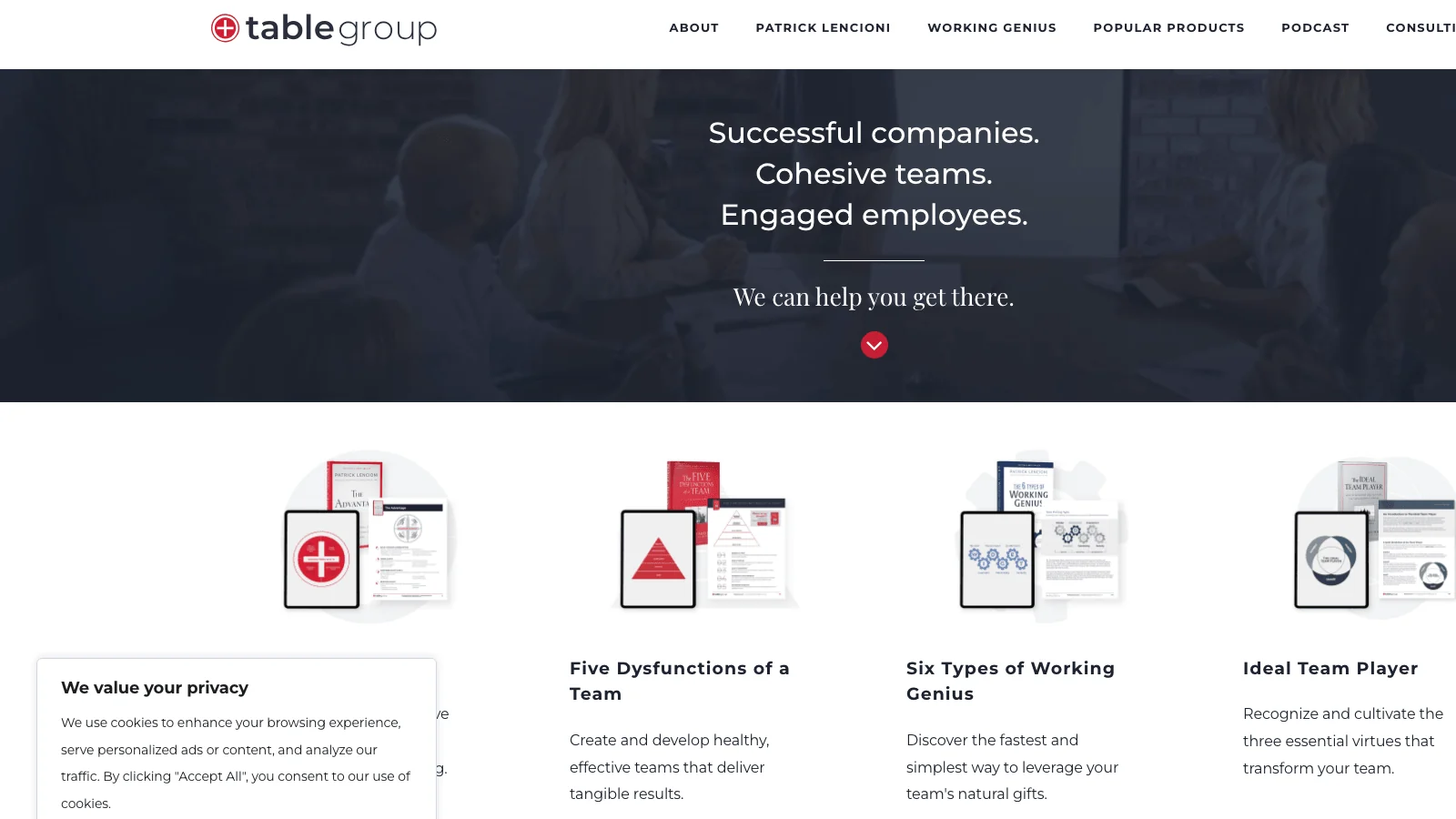
Look at what The Table Group sells in 2026. Online assessments for the Five Dysfunctions framework. Workshops. A certified consultant program where other consultants pay to be trained to deliver Lencioni's frameworks to their own clients. Books. Podcasts. Keynote speeches. Conferences.
Every single one of those revenue lines is downstream of the 2002 book.
Lencioni did not stop. He shipped Death by Meeting in 2004. Silos, Politics and Turf Wars in 2006. The Advantage in 2012, which is the most direct articulation of his organizational health model. The Ideal Team Player in 2016. The Motive in 2020. The 6 Types of Working Genius in 2022, which spawned its own assessment tool and its own certification track inside The Table Group.
Each book did the same thing the first one did. Codify a framework. Distribute it into corporate America. Compound back into the consulting firm's revenue.
This is the part that matters for coaches reading in 2026. Lencioni did not write The Five Dysfunctions of a Team hoping it would be a bestseller. He wrote it because his consulting clients kept asking the same questions. The fable was his answer at scale. The book was the operating manual for the firm he was already running.
The fable format itself is worth noting. Lencioni picked it because corporate executives read fiction faster than they read business theory. The story carries the framework into the brain without resistance. The framework then sits there waiting for the reader to recognize their own team in it. When they do, they call The Table Group.
Honestly, this is the most quoted business book of the 21st century in HR and leadership circles. Twenty-four years on, executives still hand it to new hires. Books on the shelf compound. Memos in a Slack channel do not.
The verdict on Lencioni is simple. A short, well-named framework wrapped in a story format will outlast every podcast, post, and panel you ever do. Codify the framework. Lock it in print. Build the firm on top.
Donald Miller: how StoryBrand became a global certification machine
Donald Miller published Building a StoryBrand with HarperCollins Leadership in 2017. The book teaches a seven-part marketing framework based on classic story structure. The brand is the guide, the customer is the hero, and the hero has a problem the guide can solve.
The framework is called the StoryBrand 7. Hero, problem, guide, plan, call to action, success, failure. Seven beats. Memorable. Repeatable. Teachable.
That last word is the one that built the company.
StoryBrand is not a publishing company. It is a marketing certification company. Miller took the framework from the book and built an entire training and certification business around it. A StoryBrand Certified Guide pays for the certification, gets trained in the framework, and then sells marketing services to their own clients using StoryBrand language and StoryBrand assets. There are guides in the United States, the United Kingdom, Australia, Canada, and beyond.
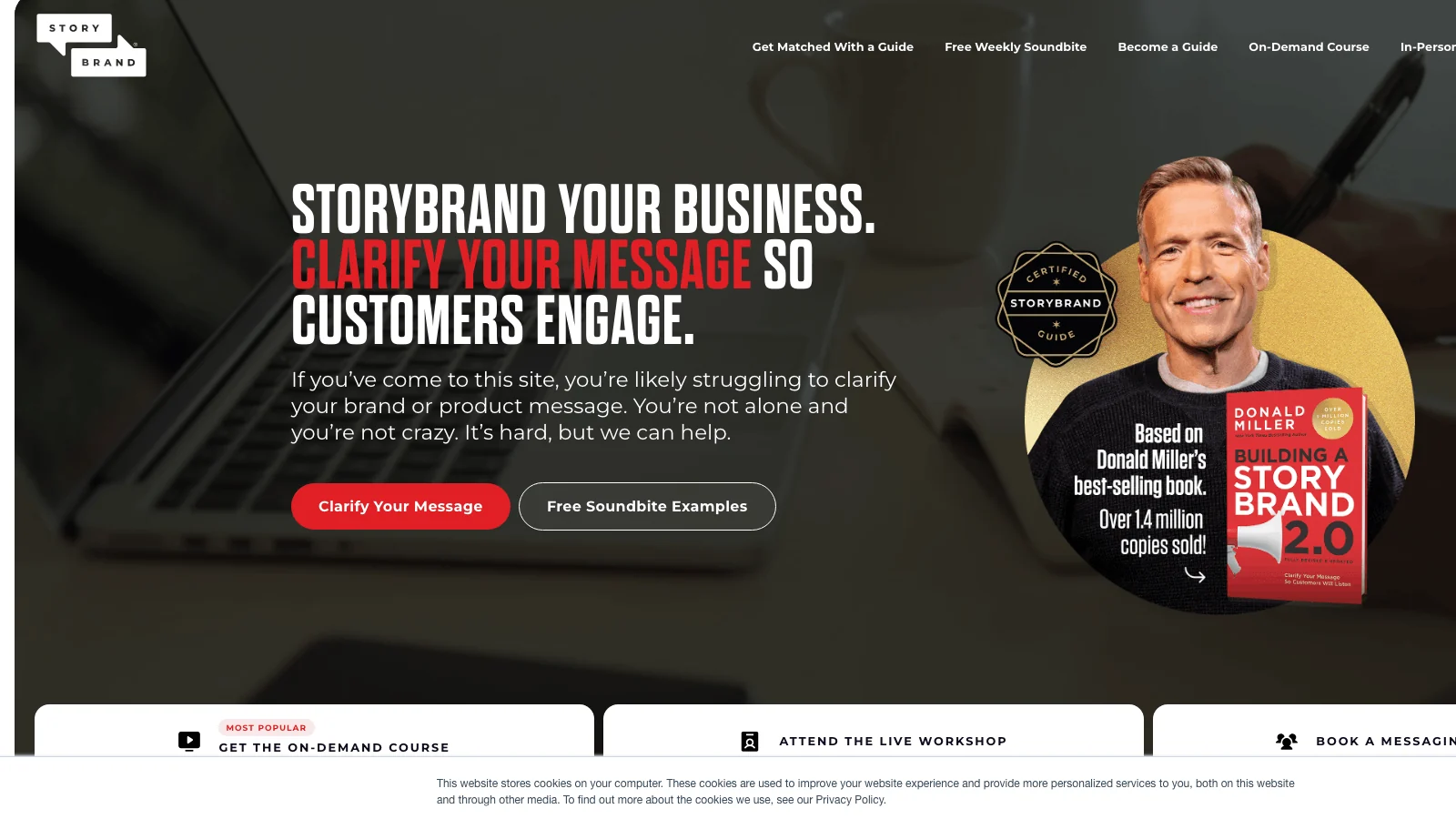
This is a textbook Codify-Distribute-Compound pattern. Codify the StoryBrand 7 framework in a 240-page book. Distribute via HarperCollins's distribution network plus Miller's substantial pre-existing audience from his memoir career. Compound every reader who read the book and then went on to either buy the workshop, become a certified guide, license the software product (StoryBrand AI, BrandScript, the Marketing Made Simple framework), or hire a guide who sends a referral fee back to the network.
The numbers on this thing are absurd. The book has sold well into seven figures of copies. The certified guide network is in the hundreds. Each guide pays an annual fee. Each guide funnels work back through the StoryBrand ecosystem. Each guide sells the next book and the next workshop to their own clients. Compound interest, in business form.
Notice what Miller did not do. He did not build a consultancy of his own that sells marketing services directly to companies. He built the curriculum, then trained other marketers to deliver it. He is selling the framework to the people who sell to the clients. That is one layer above where most coaches stop.
A coach reading this in 2026 should pay attention to that move. There are two ways to compound a book. You can sell directly to the end client (a CEO, a founder, a leader who needs your help). Or you can sell to the practitioners (the other coaches, consultants, and advisors who serve those end clients). The second option scales further with less of your time on the calendar.
Miller's second book in the system, Marketing Made Simple, expanded the framework into the operational steps of running a marketing plan. Business Made Simple extended the brand into broader entrepreneurship training. The book series is the curriculum spine. The certification, the software, and the workshops sit on top.
For a coach figuring out how to choose a book topic, the StoryBrand example is the gold standard. Pick a problem your audience already knows they have. Solve it with a named framework. Make the framework teachable to a third party. The book then becomes infrastructure.
The verdict on Miller is sharper than Lencioni's. He did not just build a firm on a book. He built a curriculum that other firms now pay to license. That is the highest-payoff move on this list. Steal the move.
Tim Ferriss: how The 4-Hour Workweek launched a media business
Tim Ferriss got rejected by 27 publishers before The 4-Hour Workweek came out at Crown in 2007. He has discussed the rejections publicly. The book was not what publishers thought a business book should be. It was part memoir, part operating manual, part travelogue, part lifestyle manifesto. It had bullet lists. It had email templates. It had outsourcing scripts. It read like a friend handing you their playbook over beers.
Crown took the gamble. The book hit. Then it kept hitting. The 4-Hour Workweek has been on the New York Times bestseller list for years, has been translated into dozens of languages, and has been re-released in expanded editions. It became the founding artifact of the modern lifestyle business movement.
What Ferriss did next is the interesting part for our purposes. He did not start a consulting firm. He did not certify other workweek-coaches. He did something different. He built a media business with the book as the trust artifact at the front.
The book came first. Then the tim.blog site at scale. Then The Tim Ferriss Show, the most-downloaded business podcast of the past decade, with billions of total downloads and a guest list that reads like a who's-who of investors, athletes, founders, and authors. The podcast funded the books. The books funded the podcast. The combined audience funded the deal flow.
That deal flow turned Ferriss into a startup investor. He was an early investor in Uber, Facebook, Twitter, Shopify, Duolingo, and dozens of others. He has been open that the readership and the listenership are what got him the introductions. Founders pitched him because they had read the books. The compound effect on a media platform built on top of a book is hard to overstate.
Ferriss did not stop at one book. The 4-Hour Body came out in 2010. The 4-Hour Chef in 2012. Tools of Titans in 2016, which is a 700-page compendium of routines, habits, and tactics from his podcast guests. Tribe of Mentors in 2017. Each book pulled more listeners into the ecosystem. Each new ecosystem entrant raised the value of every existing asset.
The lesson for coaches in 2026 is not "become a podcaster." Most coaches will not, and most should not. The lesson is what the book did at the front of the funnel. A book is the artifact that makes you investable to your audience. They do not commit to your other products. They do not subscribe to your newsletter. They do not book your call. Not until they have given you the credibility test the book applies.
Ferriss has said he writes books slow and ships them rare because each book has to clear the bar of being worth a stranger's eight to twelve hours. The bar is right. A coach reading this who treats their book as a weekend dump of LinkedIn posts will get the result of a weekend dump. A coach who treats it as the trust artifact at the front of their entire business will get something else.
The verdict on Ferriss is that the book unlocked everything downstream. Podcast. Investments. Brand. The book did not have to outrun the rest of the business. It had to start it. Coaches who think they need the audience before the book have it backwards. The book builds the audience.
The Operator-Coaches: Verne Harnish, Eric Ries, and John Warrillow
Three case studies, one playbook. Each of these authors built a coaching or consulting network on top of a book that codified an operating methodology. The book is the operating manual. The network is the delivery mechanism.
Verne Harnish published Scaling Up in 2014 through his own firm, Gazelles, Inc. (now Scaling Up). The book is the operating manual for growing a mid-market business. It covers people, strategy, execution, and cash. It comes with one-page tools (the One-Page Strategic Plan, the Cash Acceleration Strategies, the FACe rhythms) that companies actually fill out and use.
The book did not just sell well. It became the curriculum of the Scaling Up coaching network. Scaling Up Certified Coaches go through a training program, get certified to deliver the framework, and then run engagements with mid-market clients applying the methodology in the book. Harnish trains the coaches, the coaches deliver to the companies, and the network compounds.
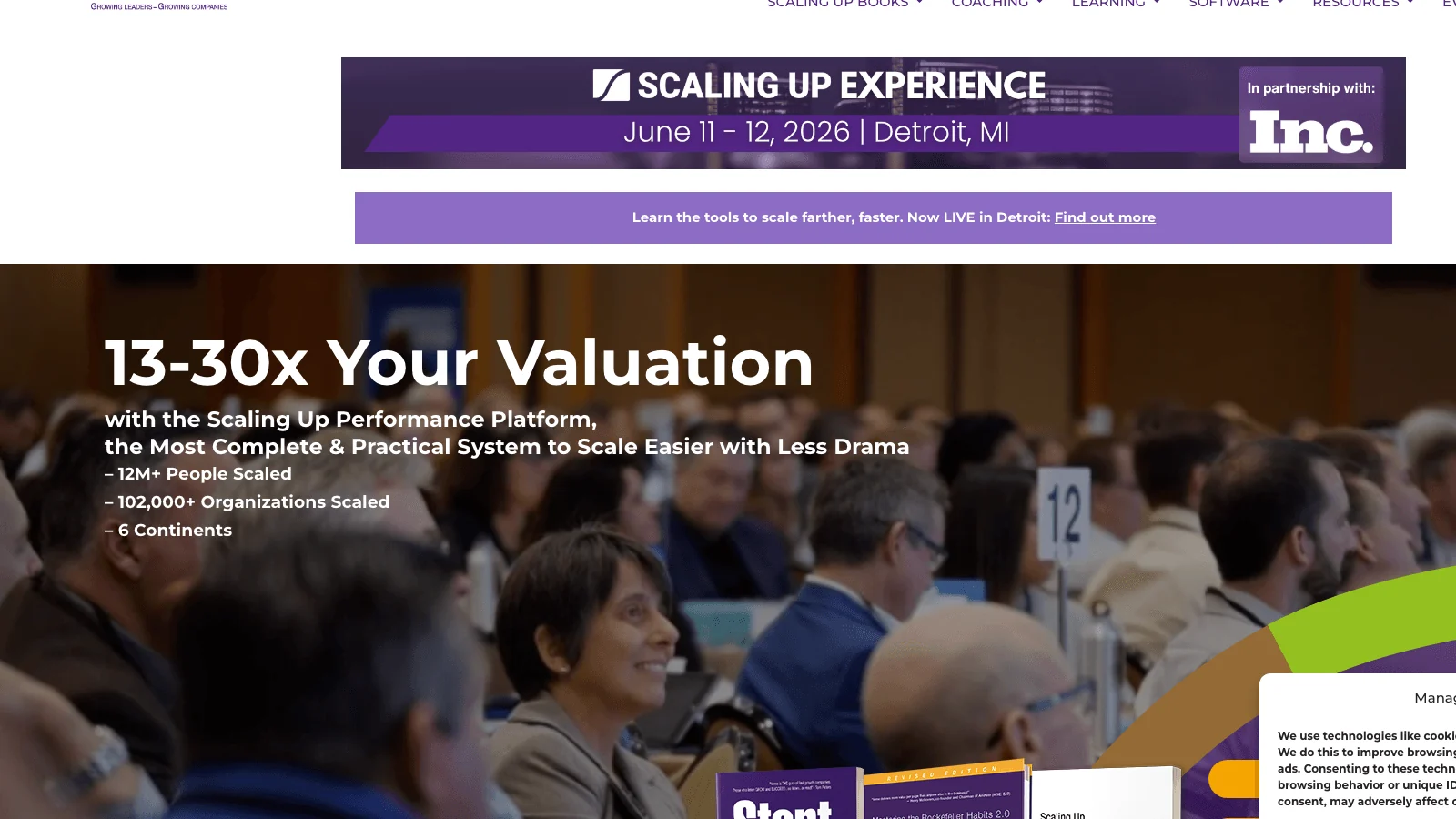
Harnish had already written Mastering the Rockefeller Habits in 2002, which seeded the methodology. Scaling Up in 2014 became the modern expansion. He shipped Scaling Up Compensation in 2021. The series functions as a continually-updated curriculum. Coaches in the network buy the books for their clients in bulk. Conference attendees get a copy in the welcome bag. The book never stops being the trust artifact and the recruitment tool.
The Operator-Coach Pattern shows up clearly here. The framework is in the book. The certification is the business. The book sells the certification. The certified coaches sell the framework to companies. Harnish takes a cut at every layer.
Eric Ries published The Lean Startup with Crown Business in 2011. The book (dp/0307887898) crystallized the methodology Ries had been writing about on a personal blog for years. Build-Measure-Learn loops. Minimum Viable Product. Validated learning. Pivot or persevere.
Before the book, "Lean Startup" was a blog. After the book, it was a movement. A global conference series. A consulting practice. A community. Eventually a public-company project (the Long-Term Stock Exchange, which Ries co-founded in 2019). The Startup Way in 2017 expanded the methodology into established corporations.
The Ries pattern is slightly different from Harnish. He did not build a tightly certified coaching network with a recurring fee structure. He built a movement with an open methodology that companies, accelerators, and innovation teams adopted on their own. The compound effect was less channeled but broader. Ries became the named expert. Speaking fees, board seats, consulting engagements, and the LTSE startup all flowed from the book's authority.
Coaches reading this should notice the trade-off. A tightly licensed framework (StoryBrand, Scaling Up, EOS, Profit First) compounds tighter and pays predictable certification revenue. An open methodology (Lean Startup, Getting Things Done, Atomic Habits) compounds wider and pays in speaking fees, deals, and named-expert positioning. Both work. Pick the model that fits how much control you want.
John Warrillow published Built to Sell in hardcover in 2010 (paperback 2011) with Portfolio. The book is a fable, in the Lencioni mold, about a small business owner discovering why his company is not actually sellable. The framework underneath is the Sellability Score, a diagnostic that ranks a business across eight drivers of value.
The diagnostic is the move. Warrillow turned it into The Value Builder System, a network of advisors who deliver the Sellability assessment to their own clients. Accountants, exit planners, fractional CFOs, business coaches. They pay for the certification, get the platform, and use it to help business owners make their companies more sellable. Warrillow runs the platform. The advisors run the engagements. The book sits on every business owner's desk and seeds the entire pipeline.
He shipped The Automatic Customer in 2015 (the playbook for recurring-revenue business models) and The Art of Selling Your Business in 2021 (the playbook for actual exit transactions). Each book extends the curriculum. Each book is a recruitment tool for the advisor network.
These three operator-coaches each built coaching businesses on top of books. None of them sold their books for the royalties. All three sold them for the network underneath. That is the Codify-Distribute-Compound pattern at its sharpest. The book is the operating manual. The network is the engine.
If you are a coach in 2026 with a methodology you have been refining for years (a hiring framework, an executive presence framework, a sales-team playbook, a leadership-team intervention), the Operator-Coach path is the most direct way to monetize it at scale. The first move is locking the methodology into print. The book-as-business-card play handles the awareness side. The certification and network handle the revenue side.
The verdict on the Operator-Coach trio is that none of them are famous for being writers. They are famous for being builders. The book is one piece of infrastructure in a larger company. Build for the company, not for the book.
The Specialty Niches: Chris Voss and Mike Michalowicz
Two more cases. Different specialty niches. Same pattern.
Chris Voss published Never Split the Difference with HarperBusiness in 2016. Voss had been the FBI's lead international hostage negotiator. The book teaches a set of tactical negotiation techniques pulled from that career: mirroring, labeling, the late-night FM DJ voice, calibrated questions, getting the other side to say "that's right" instead of "you're right."
The book hit hard. It cleared a million copies fast and is still on bestseller lists almost a decade later. The framework is tight and memorable. Black Swan Method tactics show up in sales trainings, executive coaching, and every "how to negotiate your salary" article on the internet.
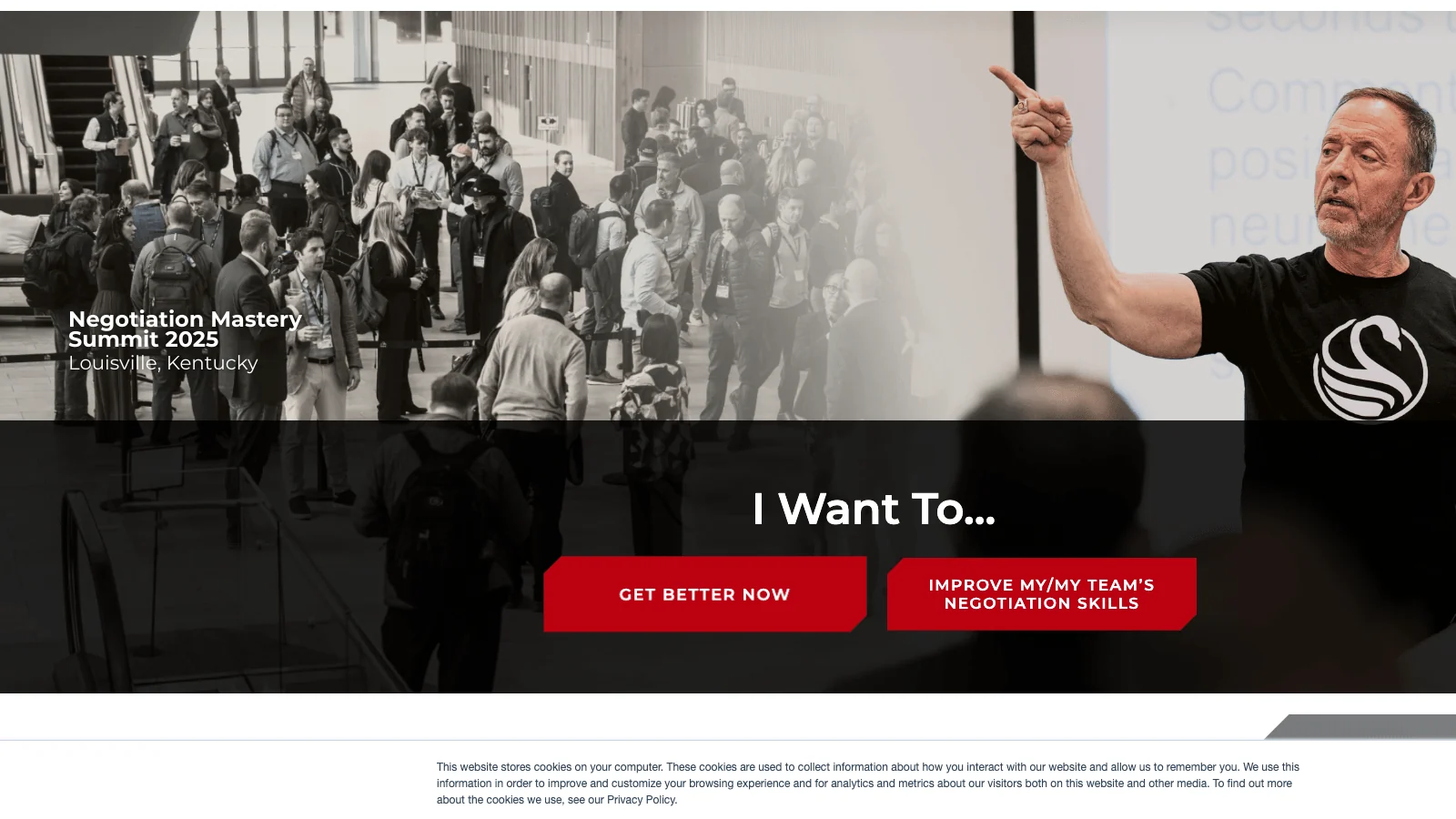
The Black Swan Group is the consulting and training firm Voss runs. They train executive teams. They train sales teams. They train law firms. They run online courses. They run keynote events. Every single client engagement is downstream of a reader picking up the book and recognizing that what they need is what Voss can teach.
The Voss pattern is the specialty-domain version of the Codify-Distribute-Compound system. The specialty is so distinct (FBI hostage negotiation applied to business) that no other competitor can credibly claim it. The book establishes the credentials in the first chapter. The framework is unforgettable because the stories are unforgettable. Bank robbers, hostage takers, prison standoffs. Then the application to a salary negotiation or a vendor contract.
The lesson is about specialty positioning. If you are a coach in a niche (executive coaches working with founders, sales coaches working with B2B sales teams, life coaches working with newly-divorced women in their forties), your book is where the specialty becomes legible. Without the book, you are one of hundreds. With the book, you are the one with the framework that has a name and a curriculum.
Mike Michalowicz published Profit First originally in 2014 (self-published) and then in a revised-and-expanded edition with Portfolio in 2017 (the current edition on Amazon). The book's core idea is to reverse the standard accounting equation. Instead of Sales minus Expenses equals Profit, the formula becomes Sales minus Profit equals Expenses. The mechanics are bank-account splits, where revenue is divided into separate accounts the moment it comes in and the business is forced to operate from what remains.
The Codify step here is pristine. One framework, one formula, one set of bank accounts. Any small-business owner can read the book on a flight and execute the methodology the next Monday.
The Distribute step is where Michalowicz did something interesting. He did not just hand the book to small business owners. He went to their accountants. He built Profit First Professionals, a certified network of accountants and bookkeepers who apply the Profit First methodology to their own client portfolios. The accountants pay for the certification, get tools and training, and roll out Profit First to every small business they serve.
The Compound step is the network effect. Every certified accountant pulls more small business owners into the Profit First system. Every small business owner buys the book to share with their partners and team. Every new reader is a candidate for either becoming a Profit First-using business or becoming a Profit First Professional themselves.
Michalowicz did not stop at one book. The Pumpkin Plan in 2012. Clockwork in 2018. Fix This Next in 2020. Get Different in 2021. All In in 2024. Each book targets a different layer of small business pain. Each book pulls in a different reader profile. The catalog is now wide enough to cover the lifecycle of a small business from founding to exit.
For a coach in 2026 with a niche methodology that other practitioners could adopt, the Michalowicz model is the licensing play. Write the book. Build the certification. Train the practitioners. Let them deliver to the end client. You take the certification fee plus the upside of the network effect.
The verdict on the specialty-niche pair is that a tight specialty wins over a broad expertise every single time. Voss is not a generic communication coach. He is the FBI hostage negotiator who teaches business negotiation. Michalowicz is not a generic small-business advisor. He is the guy with the bank-account framework. Tight specialty. Named framework. Book as anchor. Network as engine.
The Personal-Brand Amplifiers: Marie Forleo and Ben Horowitz
The last two cases are different from the operator-coaches. These two used a book to amplify a personal brand that already existed and was already monetized. The book did not start the business. The book solidified it.
Marie Forleo published Everything Is Figureoutable with Portfolio in 2019. By that point, Forleo had been running her primary business, B-School, for almost a decade. B-School is an online program for entrepreneurs that ran annually and built her into one of the most recognized names in online education.
The book did not replace B-School. It funneled into it. Everything Is Figureoutable is a personal-development manifesto with stories, frameworks, and exercises. The title phrase comes from Forleo's mother, who used to say everything is figure-out-able. That phrase became the brand mantra. The book turned it into a globally recognized one.
After the book, Forleo's audience expanded into bookstore-shopper territory that her online videos and email list had not reached. Library readers. Airport browsers. People who had never been to her site but picked up the hardback. Each new reader was a candidate for the email list, the YouTube channel, the next B-School cohort.
Visit marieforleo.com today. The funnel structure is visible at every layer. The book promotes the email list. The email list promotes the video series. The video series promotes B-School. B-School converts at a high ticket. The book sits at the top of the funnel, doing the work that LinkedIn ads cannot do at the same scale.
This is the Personal-Brand Amplifier pattern. The business was already there. The audience was already there. The book opened a distribution channel (traditional publishing) that the existing channels could not reach. That distribution channel pumped new readers into the existing funnel.
For a coach in 2026 with an existing audience (a newsletter, a podcast, a course, a private community), the Forleo model is the amplification play. You are not starting a business with the book. You are giving the business a new front door that bookstore browsers and airport shoppers and library patrons can walk through. The book-to-email-list of ideal clients play is exactly this.
Ben Horowitz published The Hard Thing About Hard Things with HarperBusiness in 2014. Horowitz was already the co-founder of Andreessen Horowitz, the venture capital firm. The firm was already famous. Horowitz was already on the short list of operator-friendly investors. The book did not create his career. The book solidified the firm's brand identity.
The Hard Thing About Hard Things is a candid, sometimes brutal memoir of the years Horowitz spent running Opsware (formerly Loudcloud) during the dot-com crash and into its sale to HP. He writes about firing executives, demoting his friend, surviving layoffs, and the particular psychological pain of being the CEO. It is not a how-to. It is a what-it-actually-feels-like.
What did the book do for a16z? It positioned the firm as operator-friendly in a way that no marketing campaign could. Founders read the book, recognized their own pain, and put a16z at the top of their fundraising target list. The book functioned as a pre-call qualifier. By the time a founder sat down with a16z partners, they had already seen Horowitz's worldview. They had already aligned themselves with it. The pitch meeting started 30 minutes ahead of where it would have started without the book.
Horowitz shipped What You Do Is Who You Are in 2019, which expanded the memoir-style format into a study of organizational culture across history. Each book reinforced the firm's intellectual brand.
The pattern here is what coaches often miss. A book does not have to be the operating manual for a methodology. It can be the worldview document for a firm. The Hard Thing pattern. You tell the truth about what your work actually feels like, with enough specificity that the right clients self-select toward you and the wrong clients self-select away.
For an executive coach, that book might be the candid memoir of the conversations you have had with CEOs in crisis. For a fractional CFO, it might be the war stories of cleaning up the books at companies before an exit. The format does not have to be a five-step framework. It can be a worldview.
The verdict on the personal-brand amplifiers is that the book amplifies what is already there. If the business is already running, the book is fuel on the fire. If the business is not yet running, the book has to do double duty (start the business and amplify it). Both jobs are doable. The Forleo and Horowitz cases just remind us the book is not always the starter. Sometimes it is the multiplier.
What this means for coaches in 2026
Ten books. Ten businesses. One pattern.
Patrick Lencioni codified five dysfunctions into a fable and built The Table Group on top of it. Donald Miller codified the StoryBrand 7 and built a global certification network. Tim Ferriss codified a lifestyle methodology and built a media empire that turned into a venture career. Verne Harnish codified Scaling Up and trained certified coaches on the framework. Eric Ries codified Lean Startup and seeded a global movement plus a public-company project. John Warrillow codified the Sellability Score and built the Value Builder advisor network. Chris Voss codified FBI hostage tactics into business negotiation and built Black Swan. Mike Michalowicz codified Profit First and built a certified-accountants network. Marie Forleo codified "everything is figureoutable" and amplified B-School. Ben Horowitz codified the worldview of an operator-CEO and amplified a16z.
Codify. Distribute. Compound.
Now the coach math. A typical executive coach in 2026 charges between $500 and $1,500 per hour. The cold-outreach client they convert through LinkedIn DMs might be a $3,000 to $10,000 engagement. The inbound client who walks in pre-sold from a book is a $20,000 to $50,000 retainer with renewal. The book is not the revenue product. The retainer is the revenue product. The book is the credibility purchase that changes what kind of retainer the client signs.
Run the arithmetic. A coach who turns 50 book readers per year into clients at a $30,000 retainer is running a $1.5M-per-year book-fed engine. A coach who turns 200 book readers per year into clients at the same retainer is at $6M. The book itself, at $20 of royalty per copy, would have to sell 75,000 copies a year to generate the same revenue. The book never has to sell that many. The retainers do the work.
Coaches we speak with hit the same objection at this point. The time objection. "I do not have six months to write a book."
Honestly, this used to be the killer objection. Writing a 60,000-word manuscript from a blank page took most coaches between nine months and two years, and that is if they did not give up. Hiring a ghostwriter solved the time problem and created a credibility problem (ghostwritten books often read like ghostwritten books). Hiring a "book agency" (the Scribe Media tier) solves both at $15,000 to $50,000, which puts the book out of reach for most coaches before they have even validated whether it will work.
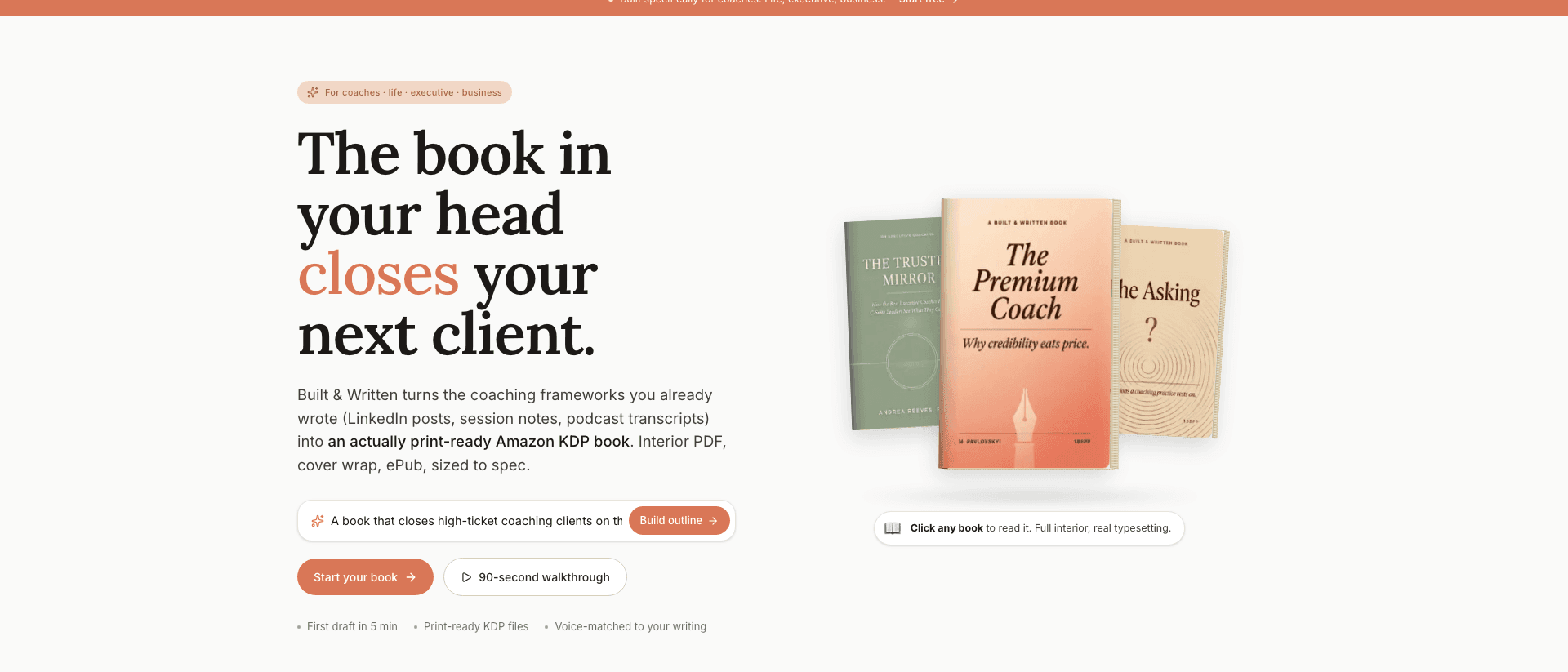
That is the gap Built and Written exists to close.
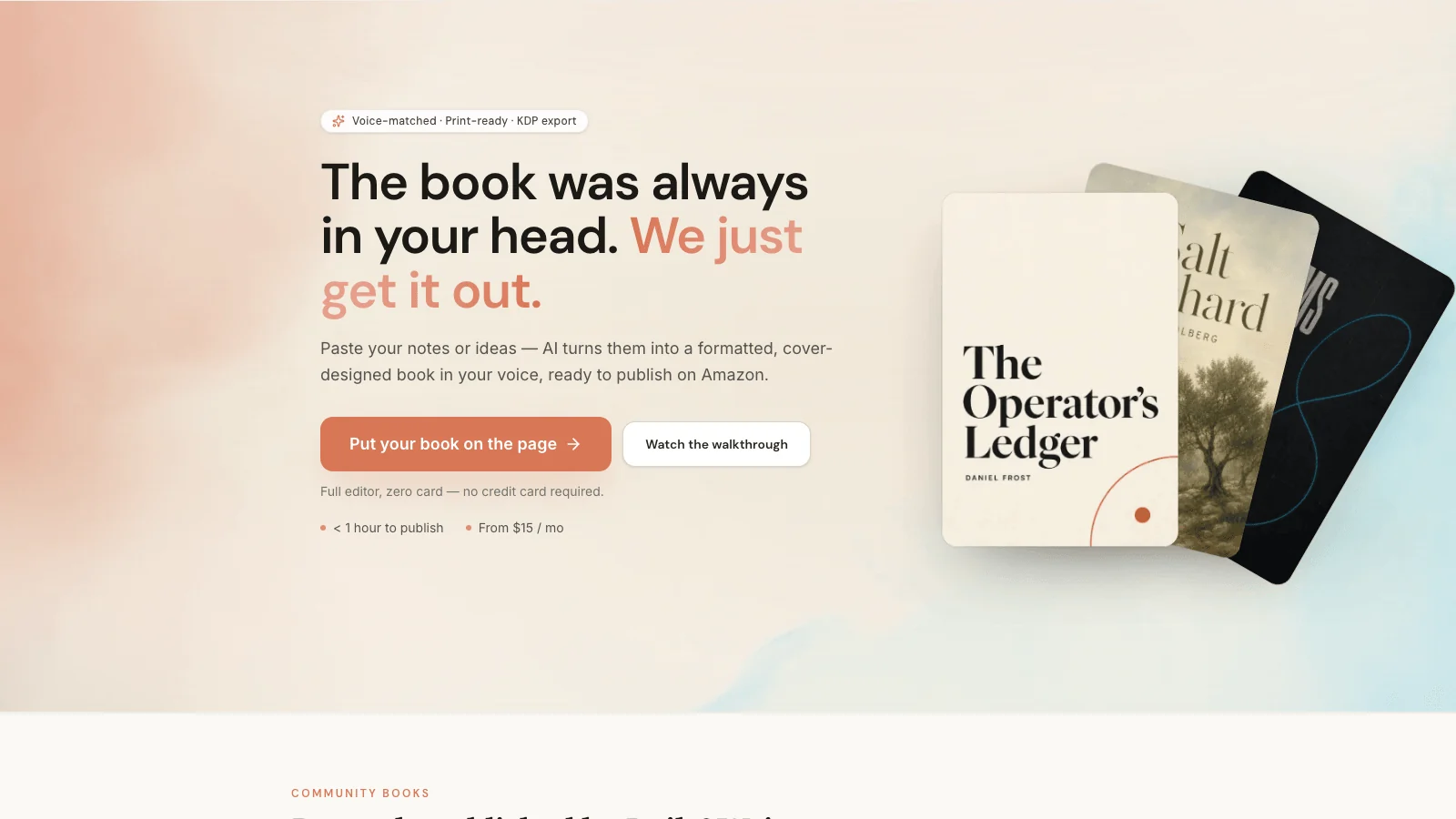
Here is how it works in practice. You already have the content. You have the LinkedIn posts that landed. You have the podcast transcripts. You have the voice memos. You have the notes from a hundred sales calls. You have the long-form emails to your top clients. That is the raw material.
Built and Written pulls all of it in. You can paste text into the app. You can upload .txt or .docx files. You can import a URL and the app scrapes the post. You can talk into the voice-to-text feature and dictate fresh material. Once it is in, the AI assembles it. The output is a 200-plus-page manuscript with a table of contents, chapter structure, sub-chapter breaks, and KDP-compliant formatting. The whole assembly takes about five minutes of guided wizard steps.
The Voice DNA feature is the part that matters for a coach. You paste in samples of your existing writing (emails, blog posts, LinkedIn posts, transcripts) and the model conditions itself on how you actually sound. The output reads like you wrote it, not like an AI wrote it. That is the difference between a book that reads as ghostwritten and a book that reads as yours.
The pricing is from $19 per month, with a free tier. Compare that to Scribe Media's $15,000 to $50,000 range and the math gets uncomfortable for the legacy book-services tier. Compare it to a ghostwriter's $25,000 to $80,000 range and the math gets worse for the ghost. A coach in 2026 deciding to write a book is no longer choosing between $50K and "nine months of evenings." They are choosing between $19 per month and an afternoon.
The integrated cover designer handles the cover. The KDP Launch Co-pilot walks through the Amazon publishing flow. The output is print-ready and KDP-ready. From there, you list it on Amazon KDP, order author copies, and start putting copies in the hands of clients, podcast hosts, and event organizers.
If you are a coach, the dedicated Built and Written for coaches page walks through the exact use case for the coaching profession, the same use case the International Coaching Federation credentialed members run into when they look for an authority artifact. How to launch a book that fuels your business handles the post-publication play. How to use a book for lead generation handles the funnel mechanics. Personal brand around your book handles the positioning side. Business book ideas for entrepreneurs handles the topic-selection question.
Real content. Real frameworks. Real distribution. A book is real content in a world where AI-generated LinkedIn posts have become noise. A book on a desk does not get scrolled past. A book on a shelf does not get archived. A book in a podcast guest's hands does not get muted. That is the asset.
Patrick Lencioni did it in 2002 with a manuscript and a fax machine. You can do it in 2026 with a subscription and an afternoon. The book is the move. The Book-Compound Pattern is the operating system. Codify, Distribute, Compound.
That is the verdict. Build the book. Build the business behind it.
Sources & References
- The Five Dysfunctions of a Team on Amazon
- The Table Group (Patrick Lencioni)
- StoryBrand (Donald Miller)
- Building a StoryBrand on Amazon
- Tim Ferriss official site
- Scaling Up (Verne Harnish)
- The Lean Startup (Eric Ries)
- The Value Builder System (John Warrillow)
- The Black Swan Group (Chris Voss)
- Profit First Professionals (Mike Michalowicz)
- Marie Forleo official site
- Andreessen Horowitz (Ben Horowitz)
- Built and Written homepage
- Built and Written for coaches
- Amazon KDP help center
- International Coaching Federation
Frequently asked questions
Not directly, and that is the wrong question. Royalty math on a typical business book at $20 cover with 7% to 15% royalties means you earn $1.40 to $3 per copy sold. Selling 10,000 copies (which is a respectable run) nets $14,000 to $30,000 in royalties. That is not the business. The business is what 10,000 readers do for your funnel. Inbound retainers. Speaking bookings. Podcast invitations. Certification signups. The retainers and downstream products are where the real revenue lives. Treat the book as a credibility purchase, not a revenue product.
There is no single answer, and the question depends on what you mean by best. By units sold and cultural impact, The 4-Hour Workweek by Tim Ferriss and Building a StoryBrand by Donald Miller both belong in the top tier. By framework durability inside corporate America, The Five Dysfunctions of a Team by Patrick Lencioni has been on the most leadership reading lists for two decades. By movement-building impact, The Lean Startup by Eric Ries. By raw operator candor, The Hard Thing About Hard Things by Ben Horowitz. Pick the one closest to your own positioning.
Both, and the book is the multiplier on the coaching. A coach with no book has to fill the pipeline through DMs, referrals, and outbound. A coach with a book has inbound from readers who self-select toward the methodology. The book is not a distraction from the coaching practice. It is the long-term marketing infrastructure that keeps the coaching practice full. The time tradeoff used to be a blocker (six months to two years to write). In 2026, with tools like Built and Written, the time blocker is gone.
The traditional answer is six months to two years if you write it yourself, working evenings and weekends. The ghostwriter answer is three to nine months for a working manuscript at $25,000 to $80,000 in fees. The book-agency answer (Scribe Media and similar) is six to twelve months at $15,000 to $50,000. The Built and Written answer for a coach who already has the content (LinkedIn posts, podcast transcripts, voice memos, notes) is closer to an afternoon for the manuscript assembly and a few additional weeks for review, polish, cover, and KDP listing.
Amazon KDP allows AI-assisted content. The platform requires disclosure if a book is AI-generated. The ranking question is not about whether the book ranks. It is about whether the book actually reads well and converts the reader. A book that sounds like generic AI output will not convert no matter how it ranks. A book assembled from your own existing content with Voice DNA preserving your writing voice reads as yours, ranks normally, and converts the reader because the framework and the voice are real.
No. Half the books in this article were initially self-published or hybrid-published. Profit First was self-published in 2014 before Portfolio acquired it for the 2017 revised edition. Scaling Up was published through Verne Harnish's own firm Gazelles, Inc. Self-publishing through KDP gets your book into Amazon search, into the hands of readers, and onto your funnel without a year-long agent search and a publisher's deadline structure. Traditional publishing adds distribution into bookstores and airport shelves, which matters for a Forleo-style amplification play, but is not required to start.
Yes, if you handle the production work properly. KDP-compliant formatting, a designed cover, a clean interior layout, and an ISBN are the production minimums. Built and Written produces KDP-ready PDF output with integrated cover design. The book on your shelf looks like the book on the shelf at Barnes & Noble. Coaches we have spoken with who handed out their author copies at conferences report the audience does not distinguish between traditionally published and self-published unless the audience checks the spine for an imprint.
Start with the questions you keep answering. The same five questions you get on sales calls. The same three frameworks you find yourself drawing on whiteboards. The same handful of concepts you have spoken about at every panel you have ever sat on. Those are the framework candidates. Name the framework so it is repeatable. Test the name with three trusted clients. If it sticks, build the book around it. The book topic guide walks through the selection process in detail.
Sources & References
- The Five Dysfunctions of a Team on Amazon
- The Table Group (Patrick Lencioni)
- StoryBrand (Donald Miller)
- Building a StoryBrand on Amazon
- Tim Ferriss official site
- Scaling Up (Verne Harnish)
- The Lean Startup (Eric Ries)
- The Value Builder System (John Warrillow)
- The Black Swan Group (Chris Voss)
- Profit First Professionals (Mike Michalowicz)
- Marie Forleo official site
- Andreessen Horowitz (Ben Horowitz)
- Built and Written homepage
- Built and Written for coaches
- Amazon KDP help center
- International Coaching Federation
About the author

Michael Pavlovskyi
More in informational
Ready to write your book?
Turn your expertise into a professional book with Built&Written.