
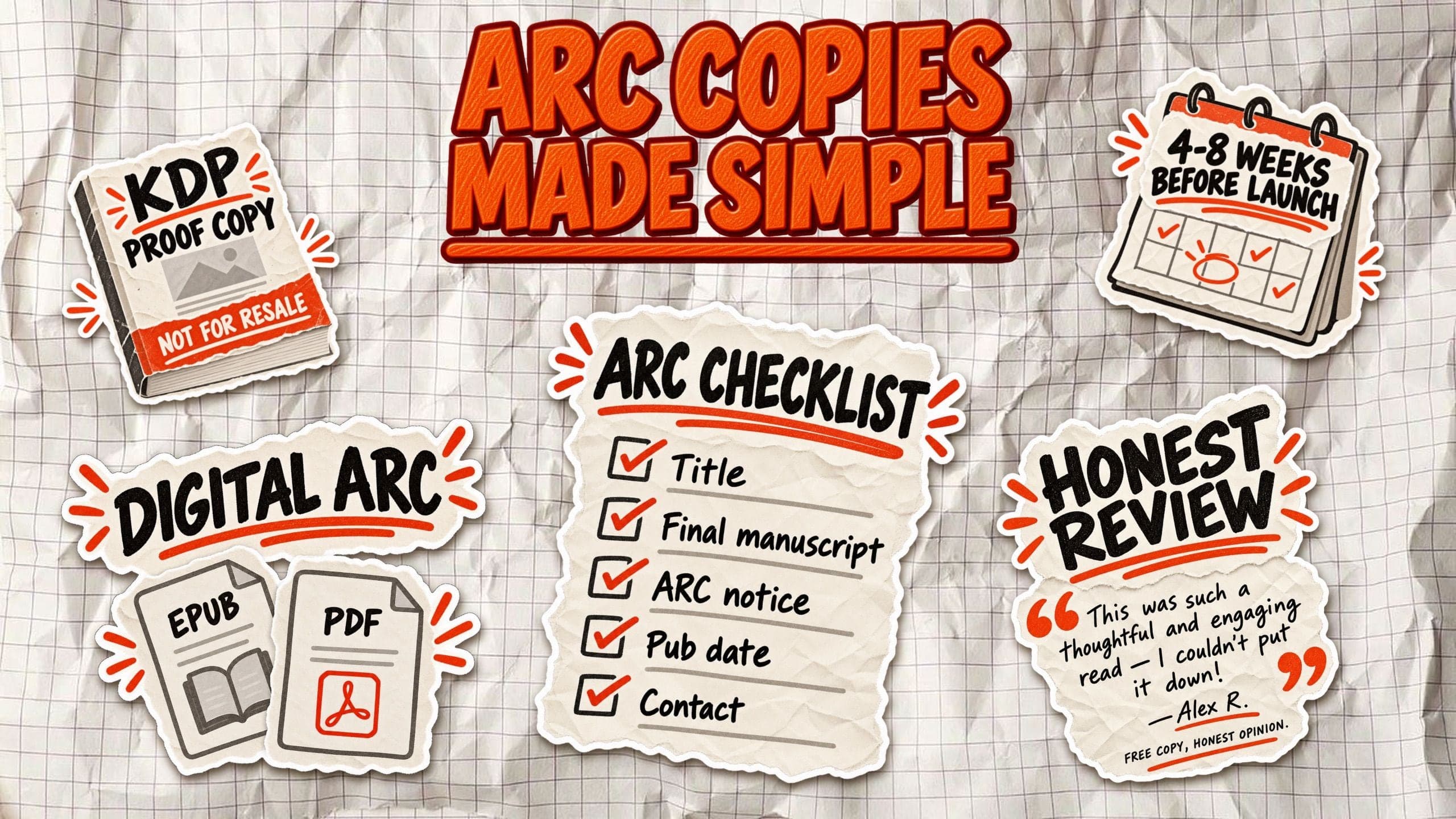

What an Advance Reader Copy Is, and How to Make One on KDP
An advance reader copy (ARC) is a free, pre-publication version of a book sent to selected readers, reviewers, or industry contacts before its official release. The goal is simple: give people time to read the book and, if they choose, share an honest review around launch day.
For self-published authors, making an ARC doesn't require a traditional publisher or an expensive print run. You can order proof copies through Amazon KDP, prepare a digital PDF or EPUB, and distribute copies directly or through services like BookFunnel and StoryOrigin.
The trick is knowing which version to send, when to send it, and how to request reviews without violating Amazon's rules.
What is an advance reader copy (ARC)?
An advance reader copy (ARC) is an early version of a book distributed before its publication date to generate reviews, recommendations, and early interest. Publishers have used ARCs for decades to give journalists, booksellers, and reviewers time to read a book before it reaches stores.
Self-published authors can do the same. Instead of waiting until launch day to find reviewers, you send selected readers a free copy several weeks in advance. They read it, form their own opinions, and may publish an honest review when the book becomes available.
An ARC can be a physical paperback or a digital file, usually EPUB or PDF. It should be close to the final book, but it doesn't have to be perfect. Some ARCs still contain minor typos or formatting issues that will be corrected before publication.
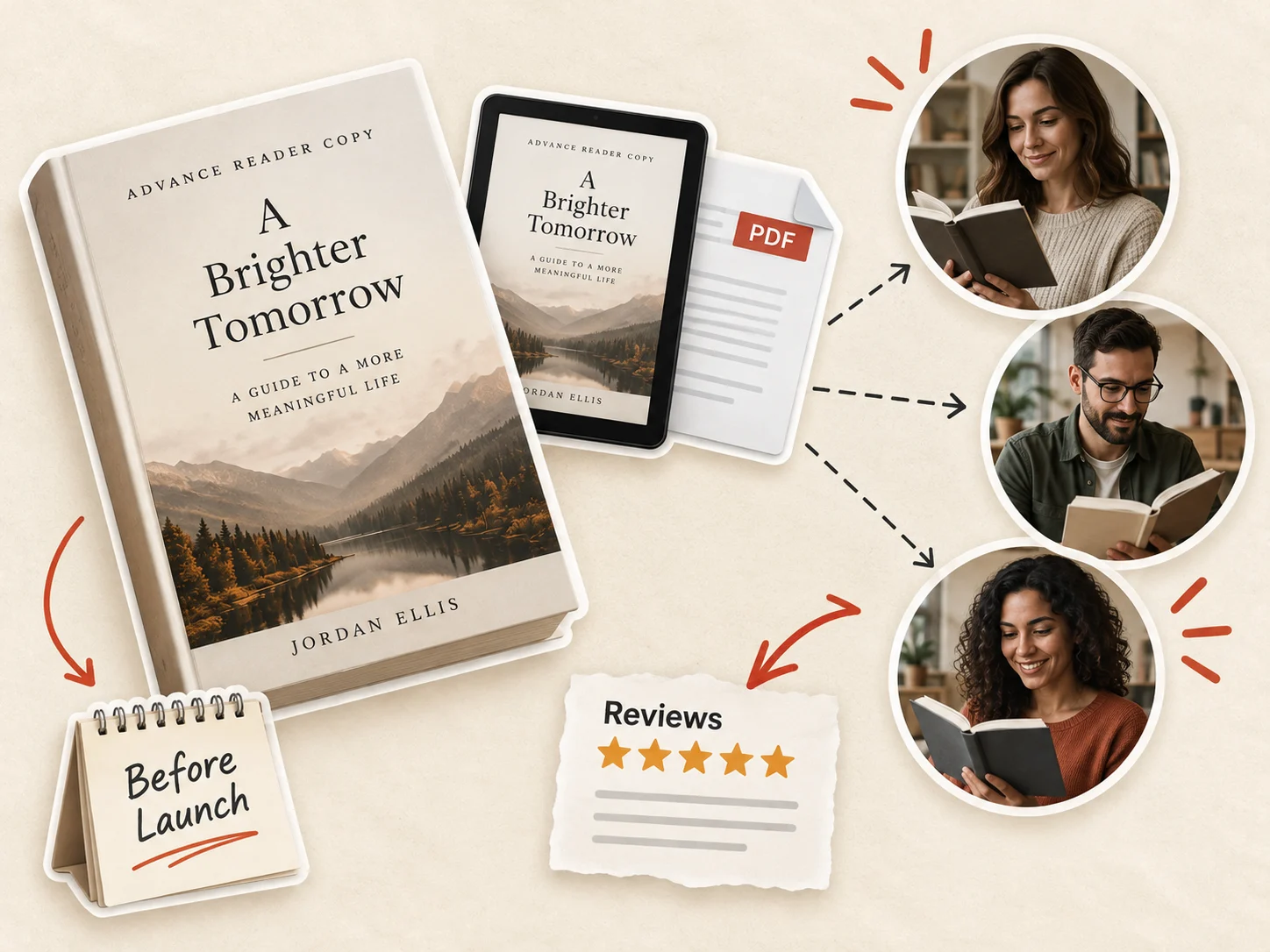
An ARC should contain the same core chapters, arguments, and examples readers will find in the published edition. Minor corrections are normal, but substantial rewrites after distribution can make early reviews less representative of the finished book. If your manuscript still needs structural changes, finish beta reading before recruiting ARC reviewers.
The distinction is purpose. An ARC isn't meant to collect detailed editorial feedback or help rewrite chapters. That's what beta readers and editors are for. Its job is to put an almost-finished book in front of potential reviewers.
For a self-published business book, those readers might include industry experts, newsletter writers, podcast hosts, or people in your target audience. The goal isn't necessarily hundreds of reviews. A handful of credible, independent responses can be more useful than a large list of people who never open the file.
ARC vs. galley vs. proof copy vs. beta reader
These terms often get mixed up, but they describe different stages of preparing a book for publication.
| Term | What it means | Main purpose |
|---|---|---|
| Advance reader copy (ARC) | An almost-finished book sent to early readers before publication. | Generate honest reviews and early interest. |
| Galley | A pre-publication version traditionally used for reviewing typeset text. Today, the term is often used interchangeably with ARC. | Editorial checks or advance reviews. |
| Proof copy | A printed sample used to inspect the book's layout, cover, and print quality. | Catch production mistakes before release. |
| Beta reader copy | An unfinished manuscript shared with selected readers. | Collect feedback on structure, clarity, and content. |
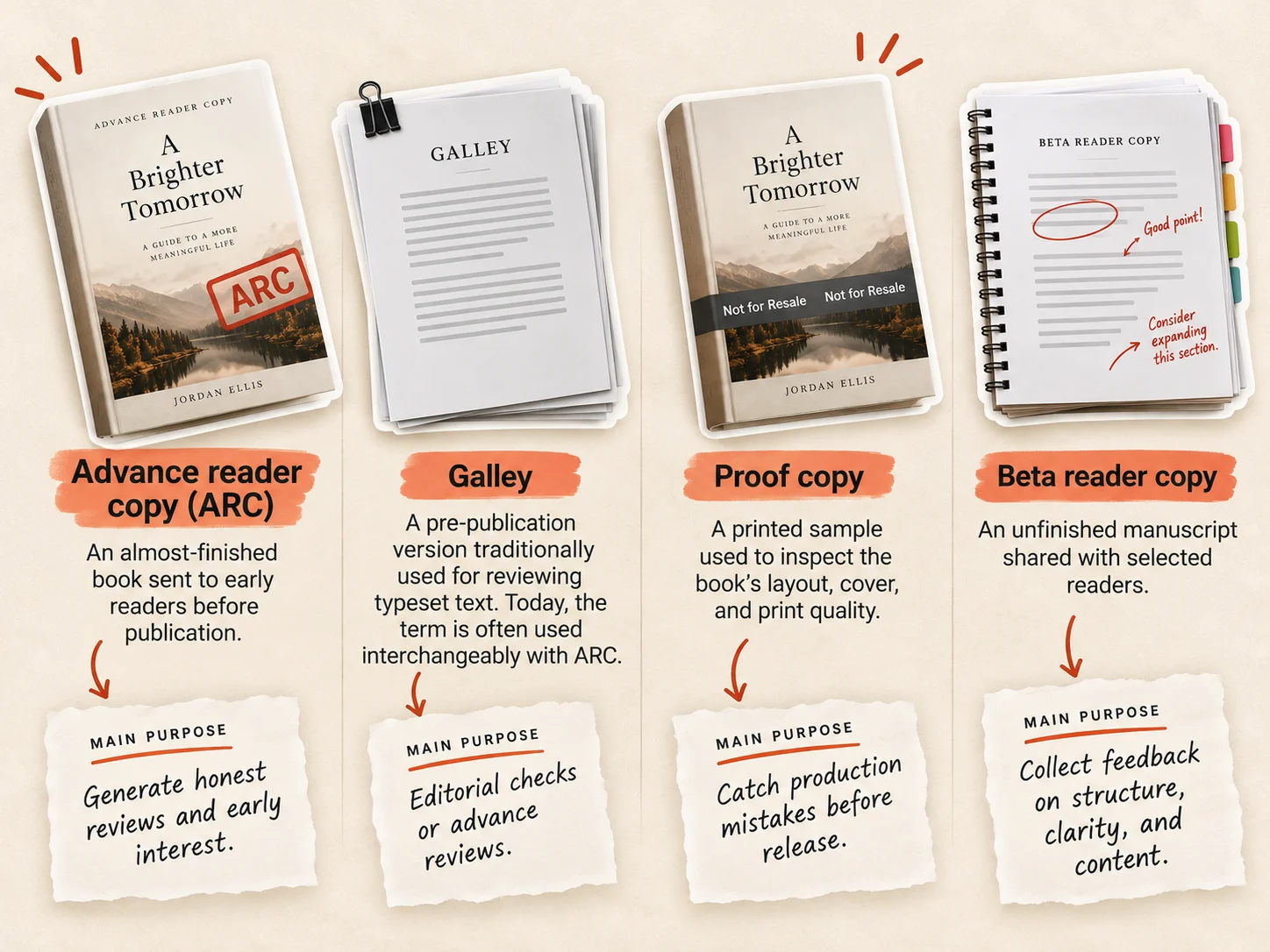
The difference between an ARC, a galley, a proof copy, and a beta-reading manuscript is when each is used and what kind of feedback the author needs.
Beta readers help improve the manuscript. Proof copies help catch printing and formatting problems. ARC readers evaluate the book as something close to finished.
For self-publishers, there's some overlap. A KDP proof copy can double as a physical ARC if the book is ready for reviews, although Amazon prints a “Not for Resale” band on proof copies.
The practical rule: finish major revisions before sending ARCs. Readers shouldn't have to review a book you're still substantially rewriting.
How to make an ARC using Amazon KDP
Amazon Kindle Direct Publishing (KDP) doesn't have a dedicated ARC service, but you can use its printed proof copies to prepare physical advance reader copies before your book goes live.
Step 1: Order a KDP proof copy
Sign in to your KDP Bookshelf.
Upload your paperback manuscript and cover files, checking the cover PDF's technical requirements with the KDP Cover Validator before submission.
Open Print Previewer and approve the book.
From the three-dot menu, select Request Printed Proofs.
Choose your quantity (up to five copies per order), select a marketplace, and submit your request.
Complete the purchase through the email link Amazon sends you.
KDP proofs have a “Not for Resale” band across the cover and a special barcode. They're designed for production checks, but you can also give them to selected early readers.
Step 2: Calculate your ARC printing costs
As of October 2026, a 200-page, 6 × 9-inch paperback with black ink and white paper costs approximately $3.40 per copy through KDP's US marketplace.
That's $17 for five copies, before shipping and applicable taxes. Prime shipping benefits don't apply.
Use Amazon's Printing Cost & Royalty Calculator to estimate your configuration.
Printing isn't the only expense. KDP proof orders also incur shipping and applicable taxes, and they don't qualify for Amazon Prime's free shipping benefits. If you're sending physical ARCs to reviewers in different locations, compare the full delivered cost with distributing EPUB files digitally.
You can enter a reviewer's delivery address when ordering a proof, but availability and shipping charges depend on the destination and Amazon marketplace. Check the final checkout total before ordering.
Step 3: Consider author copies after publication
Once your paperback is live, you can order author copies, which don't have the proof watermark. KDP allows up to 999 per order, at printing cost plus shipping and applicable taxes.
The tradeoff: author copies require a published book, while proofs can be ordered before release.
How to create and distribute a digital ARC
Digital ARCs are cheaper to distribute than printed copies, especially if you're sending your book to dozens of reviewers. You don't need KDP to create one. You need a nearly finished manuscript, an appropriate file format, and a way to deliver it.
Step 1: Prepare your ARC file
Export your book as an EPUB for e-readers and a PDF for readers who prefer a fixed layout. For a text-heavy business book, EPUB is usually the better primary ARC format because readers can adjust the font and text size on their devices. PDF works better when the book contains worksheets, detailed diagrams, or page layouts that must remain fixed. Offering both gives reviewers more flexibility, but check each file separately before sending it.
Include the cover, copyright page, and a short notice identifying the file as an advance reader copy.
For PDFs, consider adding a discreet “Advance Reader Copy: Not for Sale” watermark. You can also personalize copies with a reviewer's name or email address to discourage unauthorized sharing.
Before distribution, check both files for missing chapters, broken formatting, and unfinished editorial comments.
About Built&Written: If you're preparing the book in Built&Written, you can export an EPUB for digital ARC readers and a PDF for print preparation. For a separate review edition, add your ARC notice before exporting or use a suitable file editor afterward. Built&Written prepares the book files; it doesn't recruit reviewers or manage ARC distribution.
Step 2: Choose how to distribute it
You have three practical options:
| Method | Cost (October 2026) | Best for |
|---|---|---|
| Direct delivery | Free using existing email or file-sharing tools | A small, trusted reviewer list |
| BookFunnel | Paid plans; pricing varies by features | Device-friendly delivery, download tracking, and watermarked copies through Certified Mail |
| StoryOrigin | Standard: $10/month or $100/year | Reviewer applications, tracking, and automated follow-ups |
BookFunnel's Certified Mail feature provides individualized ARC delivery. StoryOrigin's Standard plan includes tools for vetting reviewers and managing review copies.
Step 3: Send copies to selected readers
Start with your newsletter subscribers, relevant bloggers, industry contacts, and interested readers in your niche.
Send each person clear download instructions, your publication date, and an optional request for an honest review.
For a book that hasn't been published yet, proof copies are the practical KDP option. For a book already live on Amazon, author copies are better when you want clean, unmarked copies for events, gifts, or later promotional campaigns.
Remember: Neither distribution service guarantees reviews. The platform handles delivery; finding readers who genuinely want your book is still your responsibility.
Can ARC readers leave Amazon reviews?
Yes. Amazon allows reviews from readers who received a free advance reader copy, provided the author doesn't require a review or try to influence what the reader says.
As of October 2026, Amazon's Community Guidelines explicitly allow readers to:
"Review free books (advanced reader copies) from authors or publishers."
But receiving a free book must never depend on leaving a review, giving a positive rating, or meeting a deadline.
What authors can and cannot do
Allowed: Give readers free ARCs and invite honest, voluntary reviews.
Not allowed: Offer gift cards, payments, or other rewards for reviews.
Not allowed: Ask reviewers to leave five stars, avoid criticism, or change a negative review.
Not allowed: Make receiving a free copy conditional on posting a review.
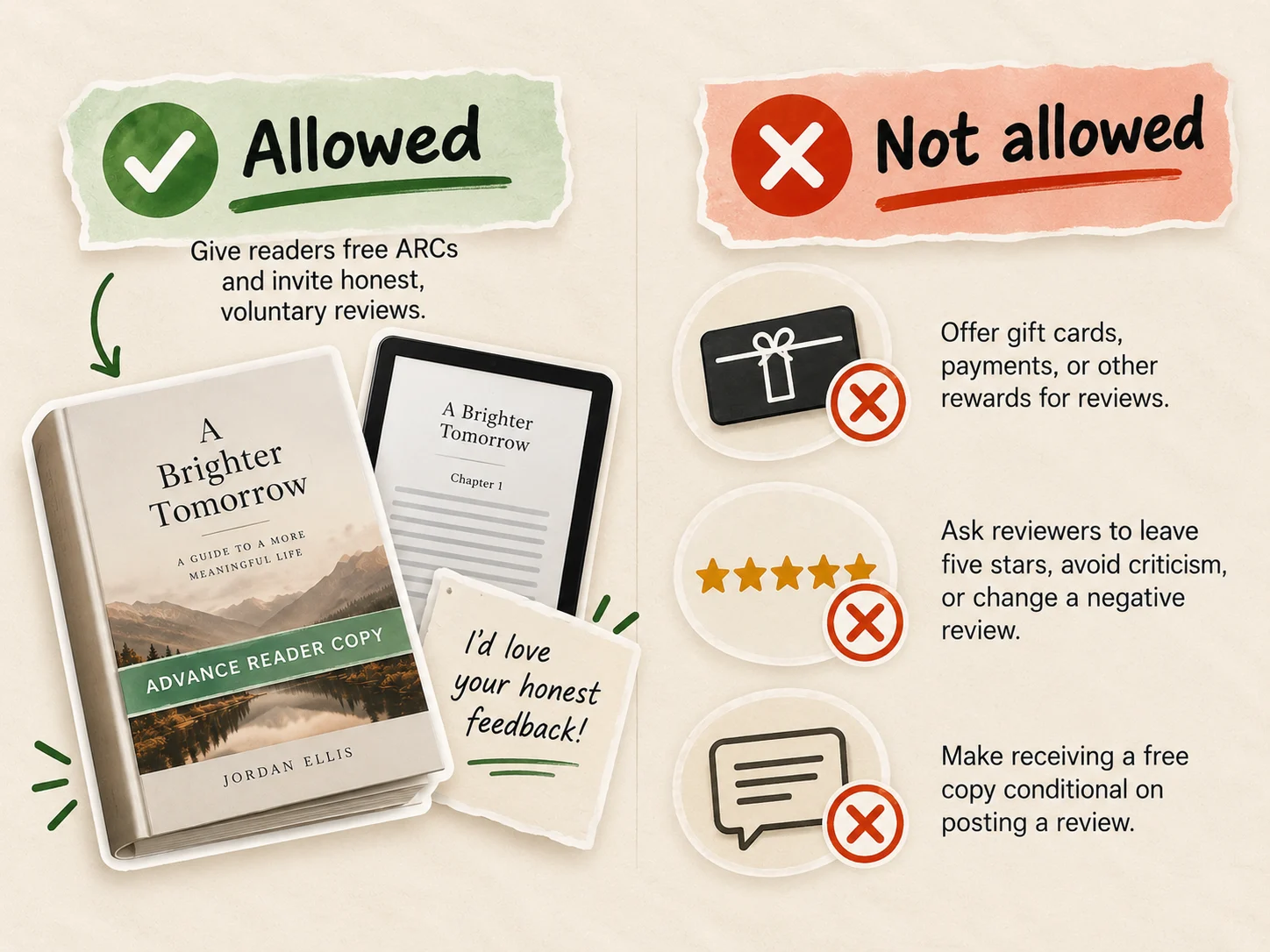
Amazon's KDP guidance confirms these restrictions.
Should ARC readers disclose that they received a free copy?
Readers should disclose that they received a free ARC so other customers understand the circumstances of the review. A simple disclosure is:
"I received a free advance reader copy of this book. This review reflects my honest opinion."
This is a suggested disclosure, not a mandatory phrase prescribed by Amazon.
Amazon's policy allows reviews of free advance reader copies, but the author cannot require a review or influence its content. A disclosure doesn't make payments, gift cards, or other prohibited incentives acceptable.
ARC reviews may appear without a Verified Purchase label, and Amazon can still reject or remove reviews that fail its eligibility or authenticity checks.
What to include in your ARC
An advance reader copy should look and read like a finished book, with two additions: a notice explaining its pre-publication status and a simple request for an honest review.
Before sending your advance reader copy, check that it includes:
The book's title, subtitle, and author name.
A complete, nearly final manuscript.
A clean table of contents and working navigation.
An ARC notice stating that the copy isn't for sale.
The expected publication date.
An author website or contact email.
A brief, optional request for an honest review.
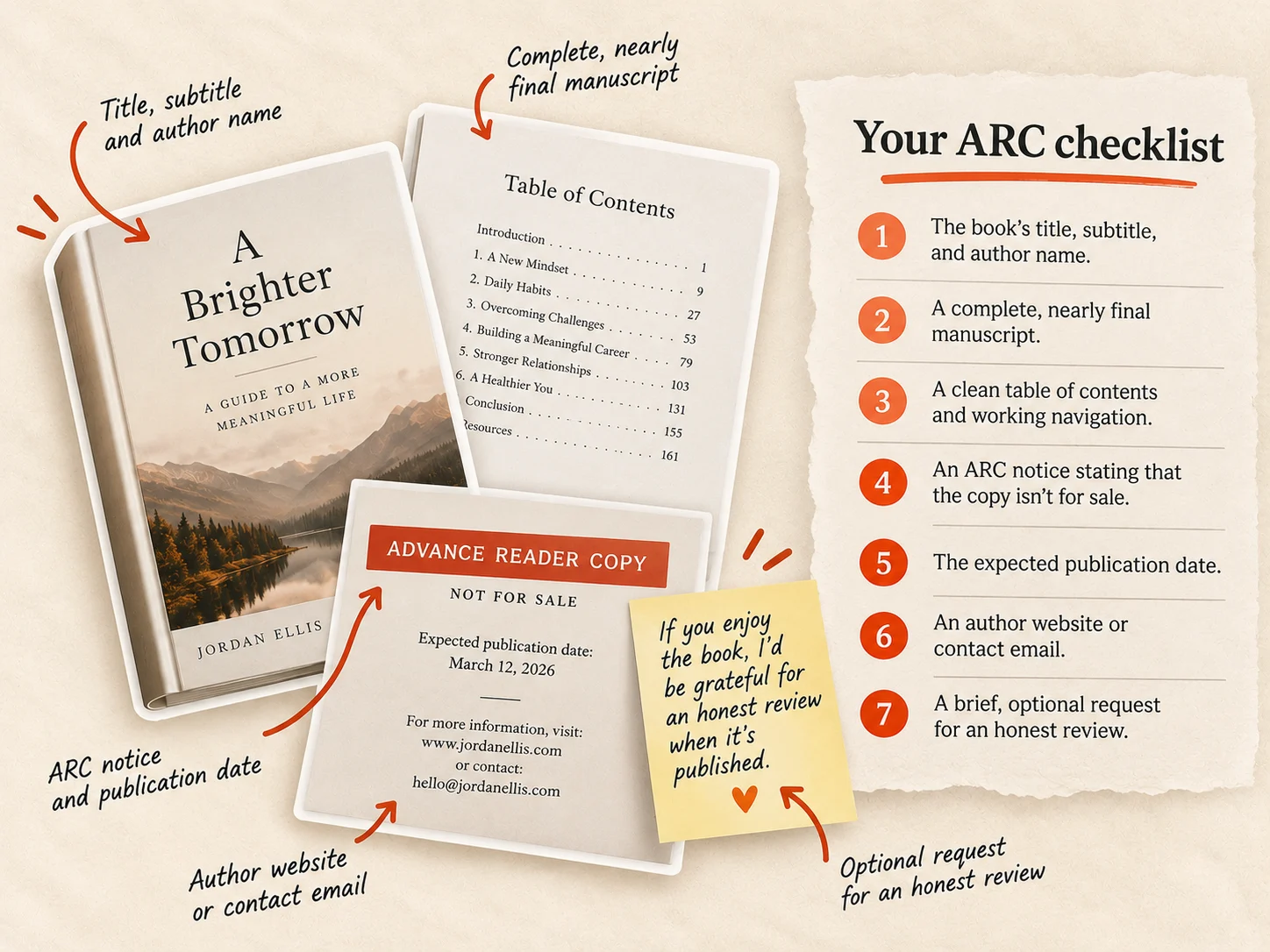
For digital copies, test the file on at least one reader device or app. For printed proofs, inspect the cover, margins, page numbers, and chapter breaks before sending additional copies.
Front matter: ARC notice
Place this after the title page or copyright page:
Advance Reader Copy: Uncorrected Proof
This is a pre-publication edition provided for review purposes only. Not for sale or redistribution. Minor corrections may be made before the final edition is published.
Publication date: [Month Day, Year]
Contact: [Author email or website]
Use “Uncorrected Proof” only if the file may still receive corrections. Otherwise, “Advance Reader Copy: Not for Sale” is clearer.
Back matter: Review request
Add a short note after the final chapter:
Thank you for reading this advance copy. If you found the book useful, I'd appreciate an honest review on Amazon or your preferred book-review platform after publication. Reviews are entirely optional, and all opinions are welcome.
Include the publication date and a link to your author website or review instructions. Keep the request voluntary, with no incentives or expectations about ratings.
When to send ARCs before your book launch
Send advance reader copies 4–8 weeks before publication. That gives readers enough time to finish the book without making the launch feel too distant. For longer nonfiction books, start closer to eight weeks.
Here's a practical ARC timeline for self-published authors:
8 weeks before launch: Finalize your manuscript, prepare ARC files, and recruit interested readers from your audience or professional network.
6 weeks before launch: Distribute digital ARCs or mail physical copies. Include your publication date and optional review instructions.
3 weeks before launch: Send one friendly check-in, asking whether readers received the book and need any help accessing it. Don't pressure them to finish.
1 week before launch: Prepare your review links and check that your final publishing files are ready. For Kindle ebook pre-orders, KDP requires the final manuscript to be submitted at least 72 hours before release. Scheduled print releases have a different deadline: submit the final manuscript at least five days before the release date.
Launch day: Once the book's Amazon listing accepts customer reviews, share the review link with interested ARC readers.
1–2 weeks after launch: Send one optional reminder thanking readers for their time.
Amazon may reject or remove reviews that violate its policies, so don't promise a specific review count or publication date.
Frequently asked questions
An ARC (advance reader copy) is a pre-publication version of a book sent free to selected readers, reviewers, or industry contacts. Its purpose is to generate honest reviews and early interest before the official release.
Start with newsletter subscribers, relevant book bloggers, online reading communities, and professional contacts in your niche. You can also recruit reviewers through BookFunnel or StoryOrigin. Prioritize readers who genuinely want your type of book.
Yes. Amazon permits reviews of free advance reader copies, provided reviews aren't required, paid for, or influenced by the author. Readers should disclose that they received a free copy.
A galley traditionally refers to an early typeset proof used for editorial checks. An ARC is distributed primarily for advance reviews. In modern publishing, the terms are often used interchangeably.
For physical copies, order printed proofs from your KDP Bookshelf. KDP lets authors order up to five printed proofs per order before publication. For digital ARCs, export your manuscript as EPUB or PDF and distribute it independently.
Four to eight weeks before launch is a practical starting point. Longer nonfiction books may need more time. Give readers enough notice to finish without making a review mandatory.
Yes. A PDF can be used as a digital ARC, especially for nonfiction books containing charts, worksheets, or fixed page layouts. For text-heavy books, EPUB is generally more comfortable on e-readers because readers can resize the text. You can offer both formats to make the ARC easier to read on different devices.
Sources & References
About the author

Polina Karlashchuk
More in Book Marketing
Ready to write your book?
Turn your expertise into a professional book with Built&Written.