


Entrepreneurs Don't Want a Bigger Exit. They Want Their Thinking to Outlive the Company
- Founder-dependent companies often sell 30 to 50% below comparable businesses, and can struggle to clear a 3 to 4x EBITDA multiple where a less dependent company clears 7 to 8x. (Strategic Exit Advisors, 2025)
- Roughly a third of small-business owners report no long-term plan for their company at all. (Gallup, 2025)
- A sale transfers contracts, inventory, and cash. It never transfers the judgment calls behind a founder's biggest decisions.
- Wren, Built&Written's AI platform, already turns a founder's notes, calls, and decisions into a finished book, the same process behind every fix in this piece.
- Founders who write that thinking down stop being the single point of failure in their own business.
Most exit conversations start with a number: what the business is worth, what multiple it clears, what the wire lands at. Founders optimize for that number for years, then find out it was never the part they most wanted to keep. What actually built the business was judgment, a decade of decisions no balance sheet lists and no signature transfers. Built&Written exists for that gap. Wren, our AI platform, already turns a founder's notes, calls, and decisions into a finished book, so that judgment has somewhere to go besides one person's memory.
Built&Written is the company behind Wren. Founders already use it to turn notes, call transcripts, and years of decisions into a finished business book in their own voice, no ghostwriter and no blank page. The process is proven: give Wren what you already have, and it studies your voice, structures the book, and drafts the chapters with you checking every step.
1. What a sale actually transfers
A sale transfers contracts, inventory, cash, and a logo. It does not transfer the thing a buyer worries about most: whether the business still works once the founder stops answering the phone. Buyers price that risk in. Founder-dependent companies often sell 30 to 50% below comparable businesses. They struggle to clear a 3 to 4x EBITDA multiple, where a less dependent company clears 7 to 8x, per Strategic Exit Advisors' 2025 analysis of lower middle market deals. That discount is the price of judgment nobody wrote down. Wren exists to get it written before the deal gets priced, not after.
Wren already does this for founders getting ready to sell, retire, or just get their thinking out of their own head. It turns notes, client calls, and the reasoning behind past decisions into a finished manuscript, the exact material a buyer or successor currently has to guess at. Once it exists, that judgment becomes something a buyer, a successor, or a new hire can actually study, the value covered in how to build authority as an entrepreneur fast and author credibility in business that drives revenue.
2. Why founders write books that have nothing to do with money
Most small-business owners nearing retirement still do not have a real plan for what happens to what they know. Roughly a third report no long-term plan at all, per Gallup's research on small-business succession. Founders who write a book are usually already past needing more leads or a bigger exit. What they want is simple: the thinking should keep existing after they stop being the one who explains it, whether the company sells, gets handed to a successor, or eventually closes. Wren is what makes that possible without spending a year writing it themselves.
Wren already helps founders turn decades of reasoning into a finished book instead of leaving it in their head. That is the difference between owning an entity and leaving a legacy, covered in why entrepreneurs should write a book now and what is thought leadership, and why books still win. Founders who already did this are the subject of 10 entrepreneurs whose books built their business, proof of a process that already works.
3. The real reason most founders never write it down
Founders do not skip this because they lack material. A decade of running a company produces more raw material than most books need, real decisions made under real pressure. What stops them is what looks like months of work: structuring it, facing a blank page, or briefing a ghostwriter on years of judgment nobody else lived through. That gap, not a shortage of things to say, is why most of what a founder knows never leaves their head. Wren removes exactly that step.
Wren already turns a founder's notes, client calls, and past decisions into a structured manuscript, with an editor that checks voice and reasoning while you write. If procrastination is the real blocker, book writing procrastination: a 4P fix for founders covers getting unstuck. If the concern is never having written this much before, this guide for founders who aren't writers and how AI helps entrepreneurs write books cover the mechanics. The result reads like the founder wrote it, because they did. Wren just removed the blank page.
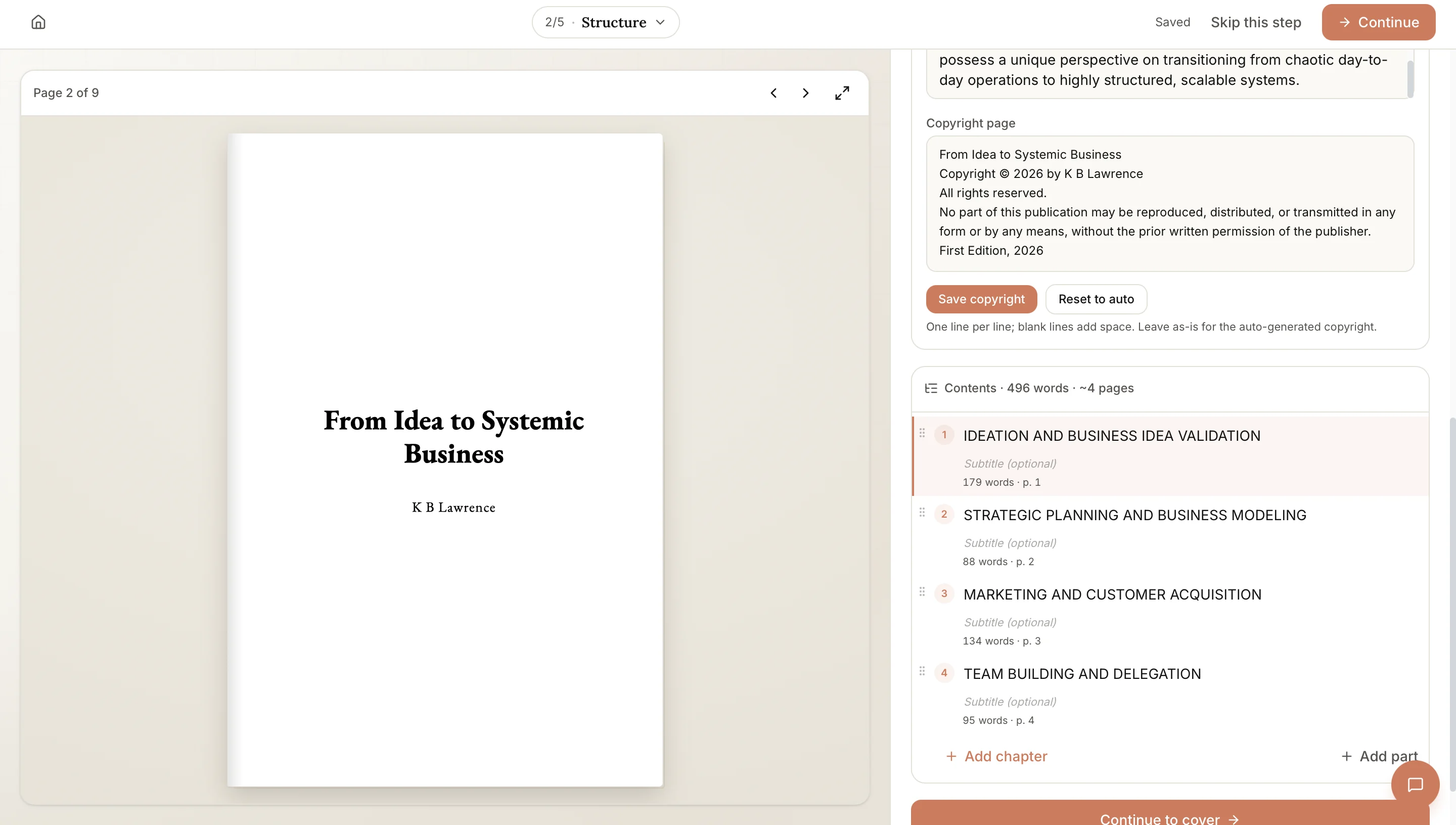
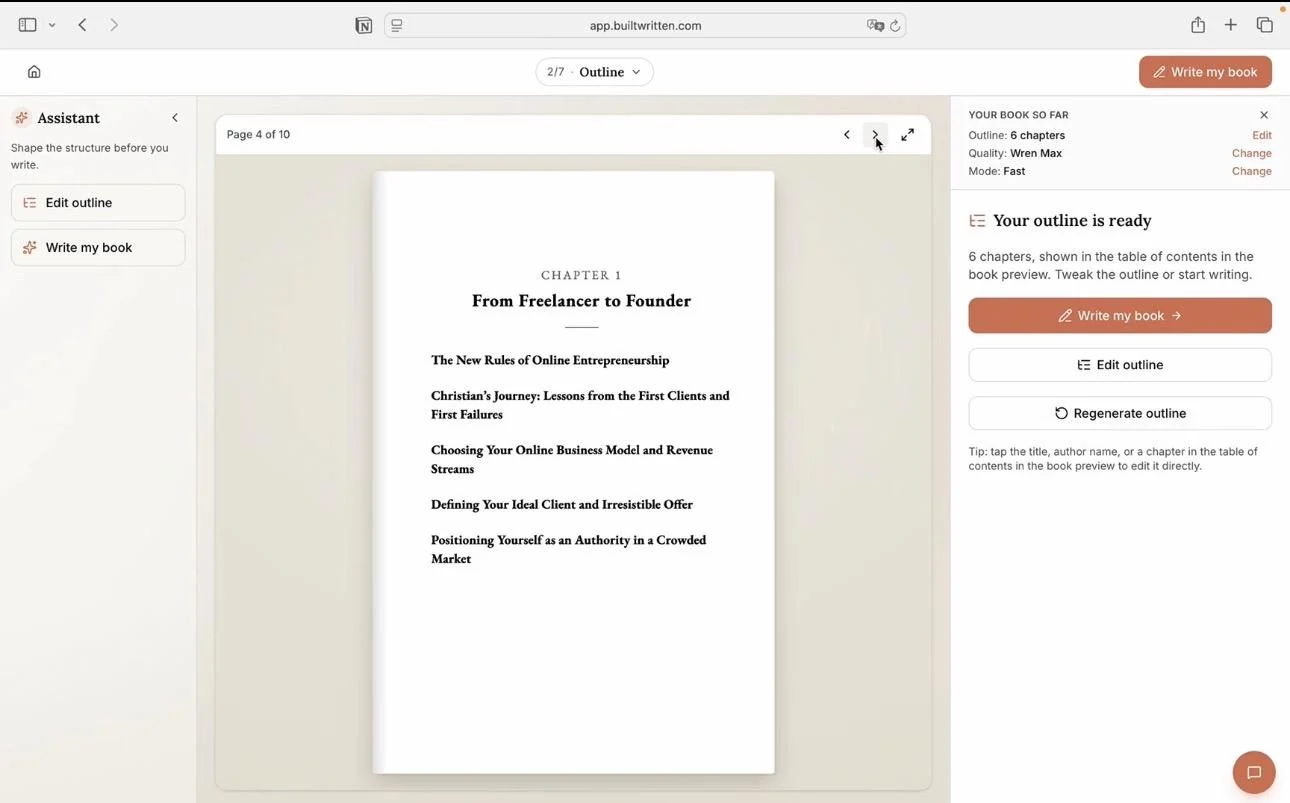
4. What working with Wren actually looks like
Here is what actually happens. A founder brings notes, call transcripts, or old LinkedIn posts, whatever already exists. Wren studies that material, builds a structured outline, and drafts chapters in the founder's own voice, one section at a time, with a live editor checking tone and reasoning as it goes. None of it requires sitting down to write from a blank page, the actual reason most business books never get finished.
Wren already runs this exact process for founders who want a business book without losing a year of nights and weekends to it. The mechanics are covered in how to use AI to write a book that actually sells and the real numbers in how much it actually costs to write a book. Once the manuscript is done, publishing follows what Amazon KDP actually is.
A sale measures one thing: what the business is worth on paper today. It says nothing about whether the thinking that built it is findable anywhere else tomorrow. A founder who never writes any of it down is betting that judgment stops mattering the day the deal closes, or that someone downstream will reconstruct it from scratch. Wren is how founders stop making that bet.
Final thoughts
Here is the actual choice underneath all of this. A founder can keep the reasoning behind their best decisions in their own head and hope someone reconstructs it later: a successor guessing, a buyer's team discounting the deal, or their own memory fading a decade after the fact. Or they can put it down now, while the reasoning is still sharp and there is still time to do it right.
Built&Written already helps founders do exactly this: turn notes, calls, and years of decisions into a finished book that becomes a real business asset, not a nice-to-have on a shelf. Founders who write one stop being the single point of failure in their own company, the case covered in full at how to establish credibility in your industry fast and what is a thought leadership book, really.
The number on the closing documents will always matter. It was never the whole story. The founders who come out ahead are the ones who write the thinking down before someone else has to guess at it, and Wren is how they do it without losing a year to a blank page. If a decade of decisions is sitting in your head right now, that is the actual asset worth protecting next.
Frequently asked questions
No, selling is only the moment the gap becomes visible. It shows up just as often with a new successor or a founder's own memory of early reasoning fading after ten years. See why entrepreneurs should write a book now, or browse more on Writer's Corner.
Sometimes, at a steep price, and often with a polished but generic result, the tradeoff compared in ghostwriting vs self-writing a book for founders and what is ghostwriting. Wren works from a founder's own notes and calls, so the reasoning stays theirs.
No. The value comes from making judgment findable, not from an existing audience. 10 entrepreneurs whose books built their business covers founders who started with no following at all.
The same way the rest of Wren works, from material a founder already has, not a blank page. I want to write a book but don't have time, do this covers the exact mechanics.
Wren's plans are listed at builtwritten.com/pricing, with a 7-day money-back guarantee. From there, publishing follows the process in what Amazon KDP actually is.
Sources & References
About the author

Khrystyna Balushka
More in Self-Publishing
Ready to write your book?
Turn your expertise into a professional book with Built&Written.