

Book Printing Services Compared: KDP, IngramSpark, and Offset
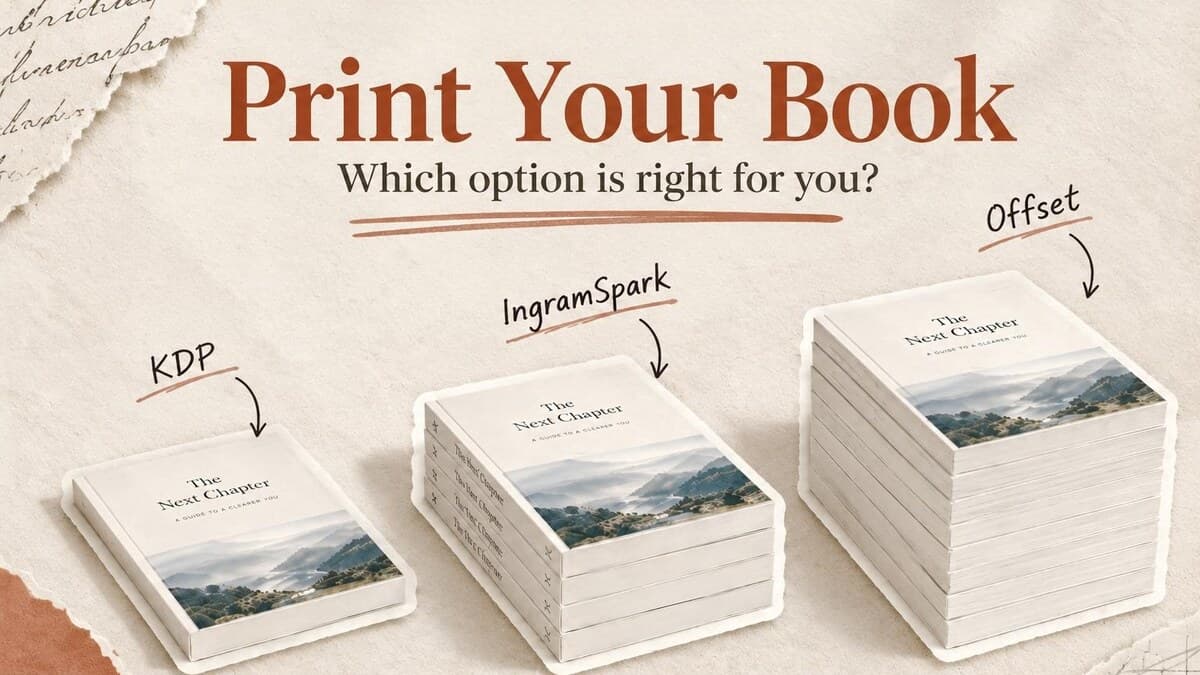
If you need fewer than 500 copies, print through Amazon KDP or IngramSpark: no warehouse, no upfront order. If you need 1,000 copies or more and can sell through them within a year, offset printing gets you a lower cost per copy. Everything between those two numbers is where most authors overspend. Here are the real numbers behind all three routes.
The decision: how many copies do you actually need
Amazon KDP, IngramSpark, and offset printing can all put a professional paperback in a reader's hands. The real difference is what happens to your money if the book sells slower than planned. Compare four things: copies committed, cost per copy, bookstore reach, and lead time.
| Route | Minimum order | Cost per copy (220-page B&W paperback) | Bookstore reach | Lead time |
|---|---|---|---|---|
| Amazon KDP | None, print on demand | $3.64 | Amazon.com, plus limited Expanded Distribution | Typically 2-5 days |
| IngramSpark | None, print on demand | $3.60 to $3.70 | 45,000+ retailers and libraries, with a 55% discount and returns enabled | Typically 1-2 weeks |
| Offset printing | 500 copies, realistically | $2 to $4, lower past 2,500 | Wherever you ship it yourself | 3-6 weeks including shipping |
Figures are for a standard 220-page, 6x9 black-and-white paperback. Your own trim size and page count will change these numbers.
What it actually costs to print a book on Amazon KDP
Printing is one line in a self-publishing budget. KDP prints on demand, no order, no minimum. Amazon deducts a fixed print cost from every sale before it pays you. A black-and-white paperback under 110 pages costs a flat $2.30 to print. Past 110 pages, it's $1.00 plus $0.012 per page, per Amazon's own KDP pricing page. A 220-page paperback costs $3.64 to print. Price it at $14.99 and KDP's 60% print royalty rate leaves you with about $5.35 a copy, print cost already subtracted. Run your own page count and price through our KDP royalty calculator instead of doing the math by hand. The cover also has to match the spine your page count produces. Our spine width calculator gives you the exact spine, front, and back panel dimensions in seconds.
IngramSpark fees and when bookstores actually carry your book
IngramSpark prints the same way KDP does: no minimum, no warehouse, a print cost close to KDP's, usually $3.60 to $3.70 for a comparable 220-page paperback. Signing up and uploading a file costs nothing. The real cost is the wholesale discount: bookstores expect 55% off list price plus the right to return unsold copies. Set it lower and your book drops out of consideration at most physical stores. IngramSpark also takes a small distribution fee on copies sold through its network, currently around 1.5% to 1.9% of list price. That rate has changed more than once this year, so check your own account before pricing. IngramSpark's own site puts its reach at over 45,000 libraries, retailers, and online stores, the real case for choosing it over KDP when bookstore or library placement matters. Wren's KDP-ready export already matches IngramSpark's paperback trim, interior, and cover specs, so one file formats both. If your goal is selling to your own list and clients instead, KDP alone does the job with less friction.
Offset printing economics and the 1,000-copy trap
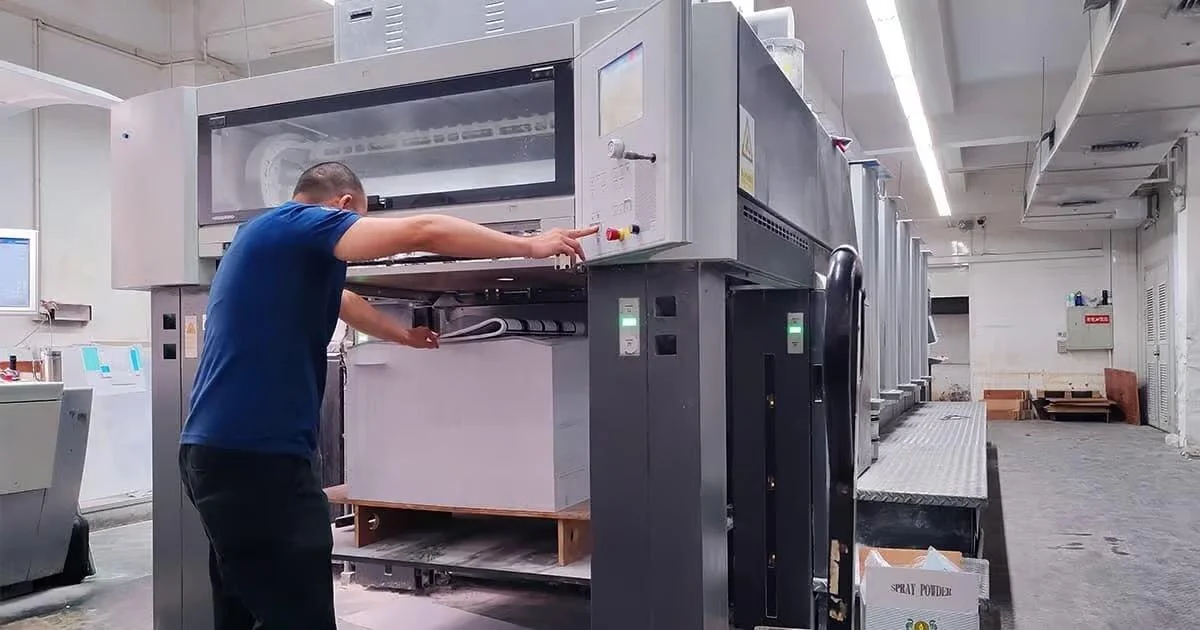
Offset is the only route with a real minimum order, and that minimum turns a print run into an inventory decision. Plate setup alone runs $200 to $800 per job before a single book comes off the press, so most printers set a 250 to 500 copy minimum before they'll quote a job. Above that line, the math gets better fast: roughly $2 to $4 per copy for a standard 220-page paperback at 500 to 1,000 copies, lower still past 2,500. Say you order 1,000 copies to land that price. Sell 300 in the first year and the other 700 sit as a storage bill: shipping alone runs $80 to $300 per pallet of 1,000 books. Offset also takes 3 to 6 weeks from press to your door, longer than either print-on-demand route, so it fits a launch with confirmed buyers, not a book you're still testing. A plate error is expensive to fix mid-run. Wren locks your manuscript's page count, layout, and cover into one export, so the spine width a printer quotes against matches what actually ships.
Print quality by route, honestly
KDP and IngramSpark both print digitally, one book at a time, and the quality is consistent: a solid trade paperback, matte or glossy cover, nothing that reads as cheap. Premium paper stock, foil, and spot UV stay exclusive to offset, and hardcover choices are limited. IngramSpark opens up more paper and binding choices than KDP, plus real hardcover. Offset is where the ceiling lifts: better color fidelity at scale, more paper weights and finishes, and binding options like case laminate covers that neither print-on-demand route offers. That upgrade only pays off once you're printing enough copies to justify the plate cost, the same 500-copy line this decision runs on. Whichever route you pick, formatting and cover quality depend on the file you send in. Wren's cover generation keeps that baseline the same across all three.
Before you print a book, you have to write one
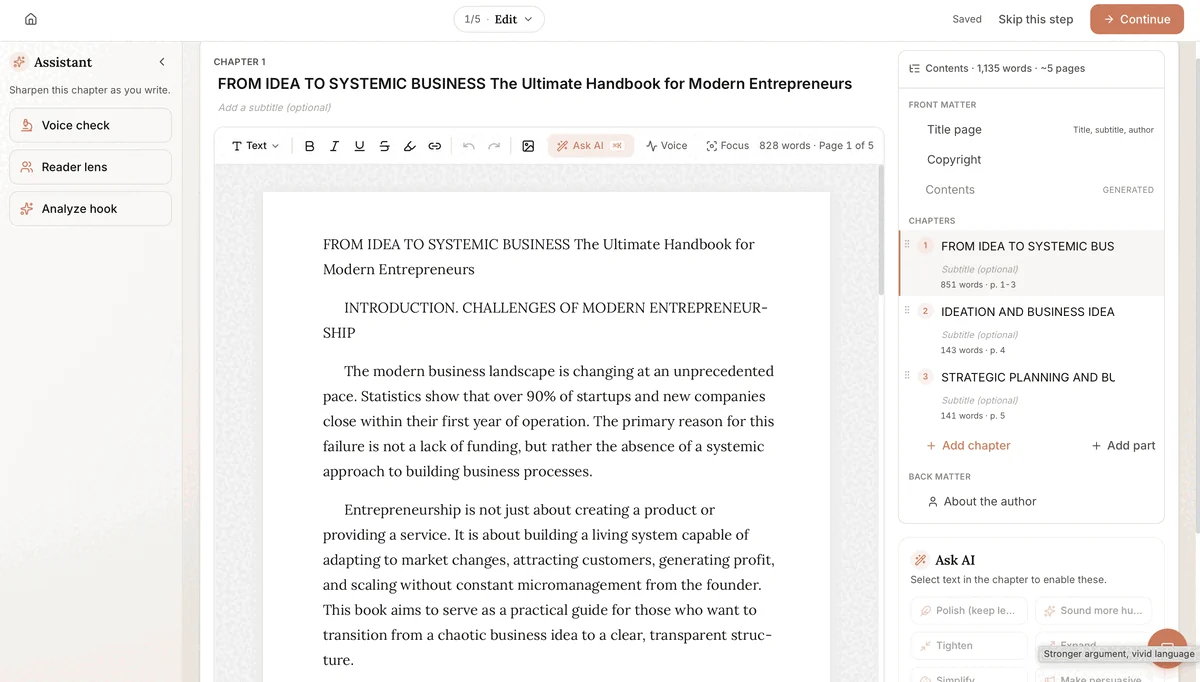
Every route in this comparison assumes one thing: a finished, print-ready manuscript. Most people weighing KDP against IngramSpark against offset haven't gotten there yet. They have notes, a rough draft, or a backlog of ideas they've never had time to turn into chapters. Wren writes with you at that stage. Upload notes, a recorded conversation, or a partial draft, and Wren drafts full chapters trained on your own writing samples, so the result sounds like you wrote it. Inside the chapter editor, an assistant panel on the right gives you one-click edits, Polish, Tighten, Expand, Simplify, Sound more human, and Make persuasive, so you can shape a chapter without retyping it. One founder used exactly this process to turn his notes into a finished book and publish it on Amazon without hiring a ghostwriter. Once the manuscript is done, Wren exports the same KDP-ready interior and cover file this article has been pointing to all along, the file every printing route above needs before it can run.
Under 500 copies, KDP or IngramSpark keeps your cash out of a warehouse. Past 1,000 confirmed sales, offset earns its lower per-copy cost. The gap between those numbers is where most authors overspend.
Final thoughts
Pick the route by copies, not by price alone. A founder selling at speaking events and through a newsletter rarely needs offset. A book aiming for bookstore shelf space needs IngramSpark's distribution terms. A launch with 1,000 confirmed buyers is the case offset was built for. Once you know your route, see our step-by-step KDP publishing guide for what comes next.
Most authors comparing these three routes are optimizing the wrong decision first. The real bottleneck isn't which printer you use. It's whether the file you're sending already has the right trim, spine, and cover specs. Get that wrong and you pay twice: in editing time, then in a reprint. Wren builds that file for you, drafting or formatting your manuscript and generating a cover matched to your exact trim size and page count, then exports it print-ready. From there, KDP, IngramSpark, and offset are three ways to use the same file.
Frequently asked questions
How much does it cost to print a book through Amazon KDP?
A black-and-white paperback under 110 pages costs $2.30 flat. Past 110 pages, it's $1.00 plus $0.012 per page, so a 220-page book costs $3.64. Run your own page count through our KDP royalty calculator to see what you'd keep per copy at your price.
Is IngramSpark better than KDP for getting into bookstores?
Yes, if bookstore or library placement is the goal. IngramSpark connects to over 45,000 libraries, retailers, and online stores, but only with a 55% wholesale discount and returns enabled. KDP's standard terms offer neither. See our full KDP vs IngramSpark comparison for how the two work together.
What's the minimum print run for offset printing?
Most offset printers won't quote a job below 250 to 500 copies, since plate setup alone runs $200 to $800. Below that, print on demand through KDP or IngramSpark is cheaper once you count the plates.
How many copies should I order for my first book launch?
If you don't have a confirmed list of buyers yet, order zero and start with print on demand through KDP or IngramSpark. Offset only makes sense once you can commit to 500 or more copies you're confident you'll sell within a year.
What's the actual difference between print on demand and offset printing?
Print on demand (KDP and IngramSpark) prints one copy at a time, no minimum, around $3.60 to $3.70 a copy. Offset needs 250 to 500 copies minimum but costs less per copy as the run grows.
Can Built&Written prepare my file for offset printing?
Wren exports a KDP-ready interior and cover PDF built to your exact trim size and page count. Most offset printers can work from that as a starting point, but confirm their bleed and color requirements directly, since specs differ by print shop.
Frequently asked questions
A black-and-white paperback under 110 pages costs $2.30 flat. Past 110 pages, it's $1.00 plus $0.012 per page, so a 220-page book costs $3.64.
Yes, if bookstore or library placement is the goal. IngramSpark connects to over 45,000 libraries, retailers, and online stores, but only with a 55% wholesale discount and returns enabled. KDP's standard terms offer neither.
Most offset printers won't quote a job below 250 to 500 copies, since plate setup alone runs $200 to $800. Below that, print on demand through KDP or IngramSpark is cheaper once you count the plates.
If you don't have a confirmed list of buyers yet, order zero and start with print on demand. Offset only makes sense once you can commit to 500 or more copies you're confident you'll sell within a year.
Print on demand prints one copy at a time, no minimum, around $3.60 to $3.70 a copy. Offset needs 250 to 500 copies minimum but costs less per copy as the run grows.
Wren exports a KDP-ready interior and cover PDF built to your exact trim size and page count. Most offset printers can work from that as a starting point, but confirm their bleed and color requirements directly, since specs differ by print shop.
About the author

Khrystyna Balushka
More in Self-Publishing
Ready to write your book?
Turn your expertise into a professional book with Built&Written.