
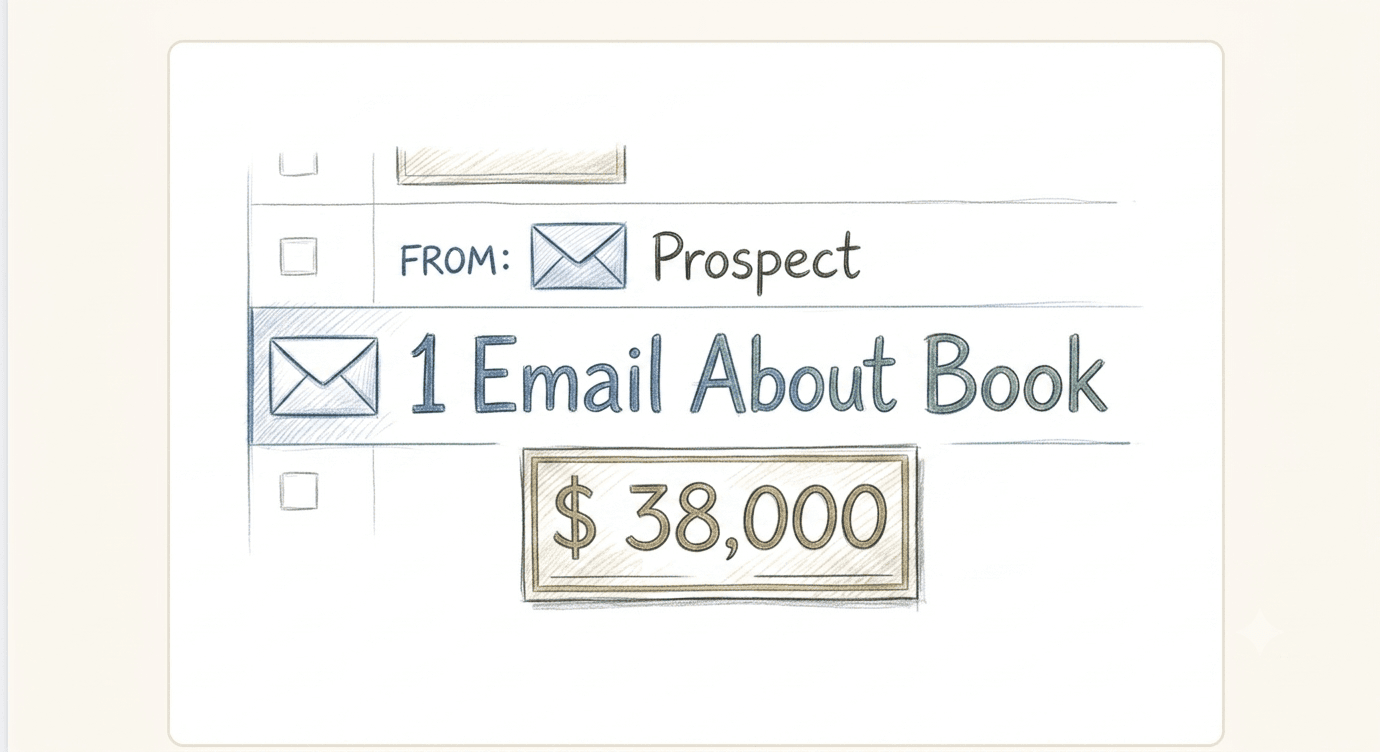

1 Email About Book Brought John Phillippe $38,000 From 1 Client
- A prospect emailed marketing consultant John Phillippe after finding his book on Amazon. Three and a half hours later, Phillippe had a $38,000 contract, and the book brought in $100,000 within six weeks. (John Phillippe, via Million Dollar Author client results)
- B2B sales consultant Charlie Moon had a $400 million nonprofit's CEO read his book on a Saturday morning and order 20 copies for his team that same day. (Charlie Moon, via Million Dollar Author client results)
- The median self-published author earns about $13,500 a year, and most earn far less. Judged by that number alone, both of these results would look irrelevant. (Alliance of Independent Authors, 2025)
- Amazon KDP has no upfront production cost: no print run, no warehouse, no minimum order. Neither Phillippe's nor Moon's result required hitting a sales-rank threshold first.
A prospect found John Phillippe's book on Amazon and sent him one email: "I saw your book on Amazon. Can you come meet with me?" Three and a half hours later, Phillippe had a $38,000 contract.
Six weeks after that first email, the book had brought in $100,000 in new business. Phillippe is a real marketing consultant, and this is a documented result he has shared publicly, not a hypothetical case study.
He is not the only one. Charlie Moon, a B2B sales consultant, had a $400 million nonprofit's CEO read his book on a Saturday morning and order 20 copies for his team that same day. Neither man needed a bestseller. They needed one reader.
Phillippe and Moon built their books through a different program, not Built&Written, and neither man has used Wren. We're citing their results because the pattern behind them, one reader deciding to hire someone because of a book, is exactly what Wren is built to help any founder or coach reproduce. Wren turns your own notes, calls, and case files into a finished book in your voice, so you don't need months, a ghostwriter, or a large program fee to build the same kind of asset.
1. One email, one $38,000 contract
Phillippe had published a business book the way many consultants do: without a marketing budget or a launch team, mostly to have something real to hand prospects.
A stranger found it on Amazon, read enough to trust him, and asked for a meeting the same day. Phillippe did not chase that lead. The book already had.
Within three and a half hours of that first email, he had a signed $38,000 contract. Within six weeks, the book had generated $100,000 in business, according to his own account.
The book did the convincing before Phillippe ever got on a call. Most founders never get this far, because writing a full manuscript alongside a business takes months nobody has, so the idea stays a folder of notes. Wren solves that specific problem: it turns the notes, proposals, and calls a founder already has into a finished draft, the same shortcut covered in turning your expertise into a book without a ghostwriter.
2. A $400 million CEO bought 20 copies on a Saturday
Charlie Moon spent decades helping professional services firms close bigger deals, but his reputation lived entirely inside his existing referral network.
After he published a book capturing his framework, a nonprofit CEO overseeing a $400 million organization read it on a Saturday morning and ordered 20 copies for his team before the week was out.
A separate organization flew Moon and his wife to Florida to discuss working with their 500 to 600 member companies, an opportunity his own account says would not have happened without the book.
Neither Phillippe's nor Moon's result came from book sales rank. It came from one reader deciding, on their own, that the person behind the book was worth hiring. Plenty of founders with a story just as strong never publish anything, because starting from a blank page feels impossible, or because they don't see themselves as writers. Wren removes that barrier by building the first draft from material a founder already has, the same fear covered in fear of writing a book is not about time and turning fear into a framework.
3. Why the voice behind the book has to be real
A prospect does not email a stranger asking for a meeting because a book sounds polished. They email because the person behind it sounds like someone worth trusting.
A business book that reads like generic, ghostwritten filler undermines the exact credibility that got Phillippe's prospect to reach out in the first place. The book has to sound like the person who is about to get on the call.
Keeping a founder's real voice is usually the hardest part of writing a book, and it's the reason many founders either hire an expensive ghostwriter or give up on the book entirely.
Wren drafts every chapter from a founder's own notes, calls, and language, not a generic template. See voice matching AI writing that sounds like you and how AI helps entrepreneurs write books without losing their voice.
4. Why one reader can outweigh a bestseller list
Consulting and coaching retainers commonly run $2,000 to $25,000 a month, and some engagements go far higher. A single signed client can be worth years of typical book royalties.
Amazon KDP has no upfront production cost: no print run, no warehouse, no minimum order. Phillippe's $38,000 contract and Moon's 20-copy order both arrived without either man needing to hit a sales-rank threshold first.
The median self-published author still earns about $13,500 a year, and most earn far less, according to the Alliance of Independent Authors. Judged by that number alone, plenty of books that changed a founder's business would look like failures.
Wren treats a finished book as a founder's highest-value sales asset, not a retail product competing for shelf space. See the full math in is it worth writing a business book and how book royalties actually work on Amazon KDP.
5. What happens before a prospect ever emails you
Buyers rarely contact a vendor first. Gartner's research on B2B buying shows most of the decision happens earlier, through the buyer's own research and comparison of options, long before a sales conversation starts.
Phillippe's prospect had already decided to meet before that first email went out. The book had answered enough questions that the only thing left to do was ask for a meeting.
That is the pattern behind author credibility that drives revenue and how to use a book for lead generation that converts. A book does the convincing before the founder ever gets on the call.
This is exactly what how a self-published book generates coaching leads and turning a signature framework into sales both describe. Wren is built to get a founder's real expertise into that kind of book.
6. What to track instead of copies sold
A royalty statement only counts strangers, and strangers are rarely who a business book is written for.
Track something else instead: how many current clients and referral partners have actually read it, and whether it comes up unprompted in a sales conversation. Has it ever turned a cold email into a signed contract the way Phillippe's did?
Two things usually stop a founder's book before it publishes: making sure every claim and example is accurate, and getting the file properly formatted for Amazon KDP. Wren checks every example against a founder's real files before a chapter is marked done, then formats the interior and exports a file ready for KDP.
Upload your notes, calls, and case files, with no blank page to face alone. Wren builds the outline, drafts the chapters in your voice, checks the claims, and formats the interior for Amazon KDP, the exact steps covered in how to format a book for Kindle. Why entrepreneurs should write a book now covers starting before a competitor writes theirs first.
Phillippe's book did not need to top a bestseller list to produce a $38,000 contract in one afternoon. Moon's did not need to sell widely to get a $400 million CEO's attention on a Saturday morning. Founders who check a royalty dashboard and conclude their book failed are usually asking the wrong question. The right one is whether the people who read it did anything differently afterward.
Final thoughts
Phillippe and Moon prove the pattern works, even outside Built&Written. Founders and coaches who write with Wren are already building the same kind of asset: real books, in their own voice, opening the same sales conversations. Several more are profiled in 10 entrepreneurs whose books built their business.
If you already have the expertise, the notes, and the client stories, the only thing missing is the finished book. Wren, Built&Written's AI platform, turns what you already know into a manuscript in your own voice, checks it against your real material, and formats it for Amazon KDP, without a ghostwriter, a blank page, or a large program fee. The next email in your inbox could be your next $38,000 contract.
Frequently asked questions
Yes. It is a client result published by Million Dollar Author, the program Phillippe used to write his book. Built&Written and Wren were not involved in his book. We're citing it because it shows the exact pattern Wren is built to help any founder reproduce: one reader turning into a contract.
Not necessarily. Royalty income is a poor measure of a business book's return. Both Phillippe's and Moon's results came from one reader each, not from bestseller-level sales.
Often just one, if that reader becomes a client. See the full math in is it worth writing a business book.
Wider reach helps, but it isn't the main goal. How to use a book for lead generation that converts covers pointing that reach at buyers likely to hire you, not at anonymous sales volume.
Track who read it among your prospects and referral partners, whether it comes up unprompted on sales calls, and whether deals close faster or at a better price. That is the pattern behind author credibility that drives revenue.
Sources & References
About the author

Michael Pavlovskyi
More in Lead Generation
Ready to write your book?
Turn your expertise into a professional book with Built&Written.