

Claude or ChatGPT for Writing a Book? We Gave Both the Same Notes
Key takeaways
- Is Claude better than ChatGPT for writing a book? In our test, Claude's chapters read more like a book. ChatGPT stayed closer to the notes. Neither chapter was ready to publish without an edit.
- What we tested: Claude Sonnet 5 and the free ChatGPT (GPT-5.6) each wrote two chapters from the same notes on September 27, 2026.
- Biggest difference: Claude added 8 details that were not in the notes, including invented client quotes. ChatGPT added 1 but put almost every sentence on its own line.
- For a whole book: in both chat apps you carry your notes and outline from chat to chat yourself. Built&Written keeps them in one project.
1. How We Tested Claude and ChatGPT on the Same Notes
On September 27, 2026, we wrote 390 words of test notes in the voice of a small-agency owner. They mix two LinkedIn posts, two voice-memo transcripts, and two short bullet lists. The notes are invented for this test. They include one client story (a dental-group website that grew from 12 pages to 26) and a few hard numbers. The bullets for Chapter 2 are deliberately thin.
Both models got the same brief. Write Chapter 1, “The Discount You Didn't Mean to Give,” in about 1,200 words and in the author's voice. Use only facts and stories from the notes. End with three actions for the week. Then, in the same chat, we asked for Chapter 2, “The Discount Starts on the First Call,” under the same rules.
Versions. Claude ran Sonnet 5 at medium effort in an incognito chat, so saved memory could not shape the voice. Sonnet is the model family on Claude's free plan. ChatGPT ran the free plan's default model, which the page reported as gpt-5-6. Neither had custom instructions, files, or web search.
What we scored: voice, structure, invented facts, length, and re-prompting. A script counted words, sentences, and paragraphs. We checked every factual sentence against the notes by hand. This is one run per model, so read it as a snapshot, not a benchmark.
2. Which One Sounded More Like the Author?
The notes average 8.7 words per sentence and speak to the reader as “you.” Here is how each model opened Chapter 1.
| Claude (Sonnet 5) | ChatGPT (GPT-5.6) | |
|---|---|---|
| Opening lines | “Here's how it goes. You quote $8,000. The client says ‘can you also...’ You say yes.” | “You quote $8,000.” Next line: “The client says, ‘Can you also...’ four times.” |
| Words per sentence, Chapter 1 | 9.3 | 7.3 |
| Words per sentence, Chapter 2 | 11.0 | 8.5 |
| Paragraphs in Chapter 1 | 29 | 139 |
Counted by script on the full text of each chapter.
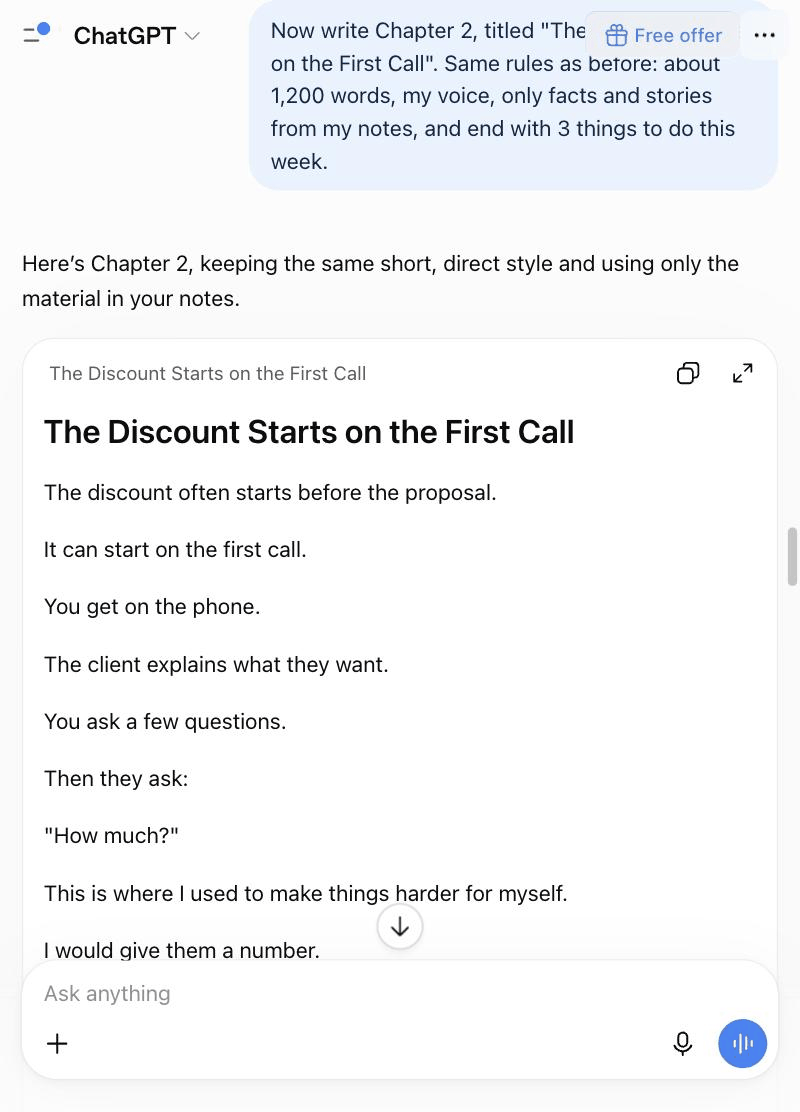
ChatGPT matched the sentence length of the notes. It did that by giving almost every sentence its own line: 139 paragraphs in 1,028 words. In a book, you would spend the edit joining those lines back into paragraphs.
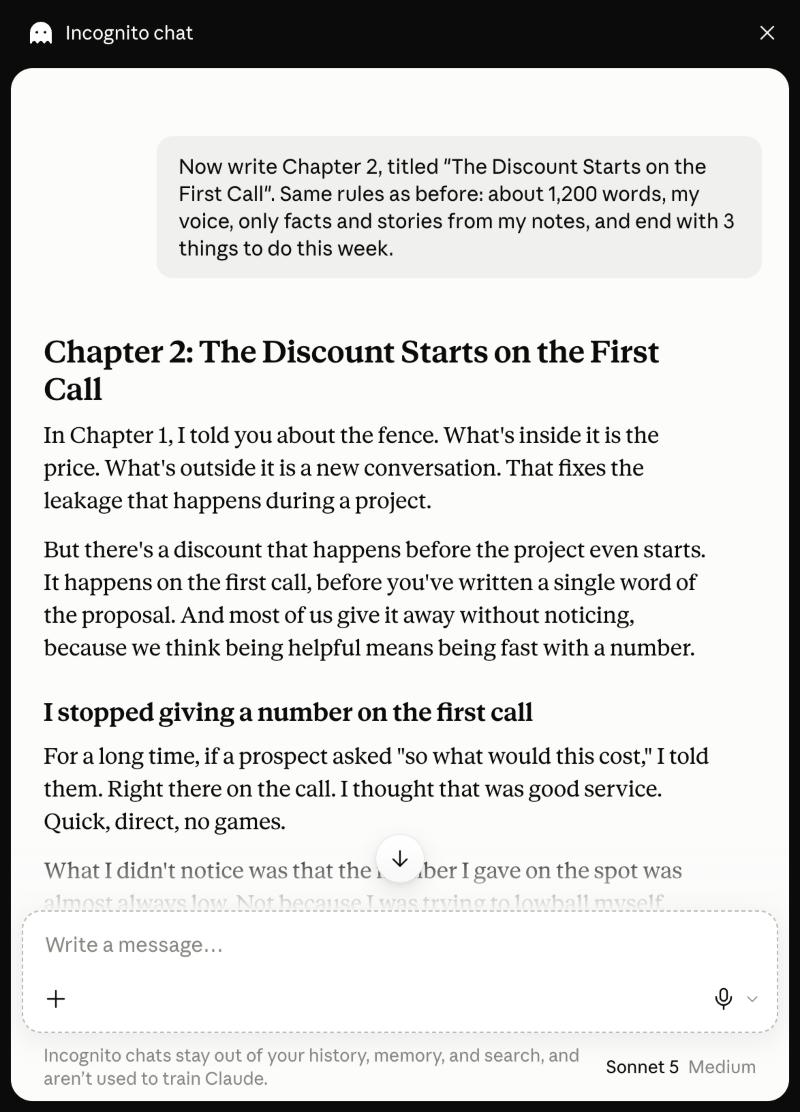
Claude wrote normal paragraphs and kept the author's best lines, such as “a scoping problem wearing a pricing costume.” It also added sentences the author never wrote. On voice, Claude's chapter needed less editing. On facts, it needed more (see section 4).
3. Which One Built a Better Chapter Structure?
Both chapters had subheads and ended with the three actions the brief asked for. The difference showed up in Chapter 2, where the notes give only five bullets.
Claude opened Chapter 2 with a short recap of Chapter 1 and gave each bullet its own section. The last section explained how the two chapters fit together. That kind of link between chapters is what a book needs.
ChatGPT reached 1,175 words by repeating itself. The question “What happens if you don't do this project?” appears four times. It never explains how Chapter 2 connects to Chapter 1. For help planning chapter order yourself, see our guide to nonfiction book structure.
4. Which One Invented Facts That Weren't in the Notes?
The brief banned any statistics, quotes, or stories not in the notes. We checked every factual claim in all four chapters against the source.
| Invented or changed detail | Model | Chapter |
|---|---|---|
| Treated Dana as a made-up name (“Let's call the client Dana”) | Claude | 1 |
| Said the fence is “one page. Maybe two, if you're wordy” (the notes say one page, max) | Claude | 1 |
| Said the 9-to-2 count came from comparing quotes to deliverables (the notes only say “from invoices”) | Claude | 1 |
| Promised readers “most of the time, they say fine” when quoted for extras | Claude | 1 |
| Said first-call numbers were “almost always low” | Claude | 2 |
| Added a history of good-better-best proposals “for years” | Claude | 2 |
| Wrote client quotes the author never recorded, such as “I mean, it'd be nice to have” | Claude | 2 |
| Promised clients “usually accept the date anyway” | Claude | 2 |
| Added a back-story: “Sometimes it was the right number. Sometimes it wasn't.” | ChatGPT | 2 |
Claude: 8 additions. ChatGPT: 1.
Each of Claude's additions makes the text read more smoothly. The risk is that an author approves them without noticing. Invented quotes and promises like “most of the time, they say fine” end up in print under the author's name. One change also contradicts the notes: the one-page rule became “maybe two.”
ChatGPT's one addition is a small inference from “I stopped giving a number.” It followed the rule more closely, but it repeated itself when the notes ran out. Before publishing a chapter from either model, run a fact check against your notes and the 6 signs your writing sounds like AI check.
5. Did Either One Hit the Word Count or Need Re-Prompting?
Neither model reached 1,200 words. ChatGPT wrote 1,028 and 1,175 words. Claude wrote 962 and 1,049. Across a 12-chapter book, falling 15% short per chapter means roughly 1.5 missing chapters.
Neither needed a second prompt to get the format right. The follow-up prompts come at the editing stage. Claude needs one to remove the invented details. ChatGPT needs one to merge lines into paragraphs and cut the repeats.
6. What Happened Between Chapter 1 and Chapter 2?
We asked for a second chapter in the same chat to see whether the voice held. Claude's average sentence grew from 9.3 to 11.0 words, moving further from the notes. ChatGPT's grew from 7.3 to 8.5, moving closer.
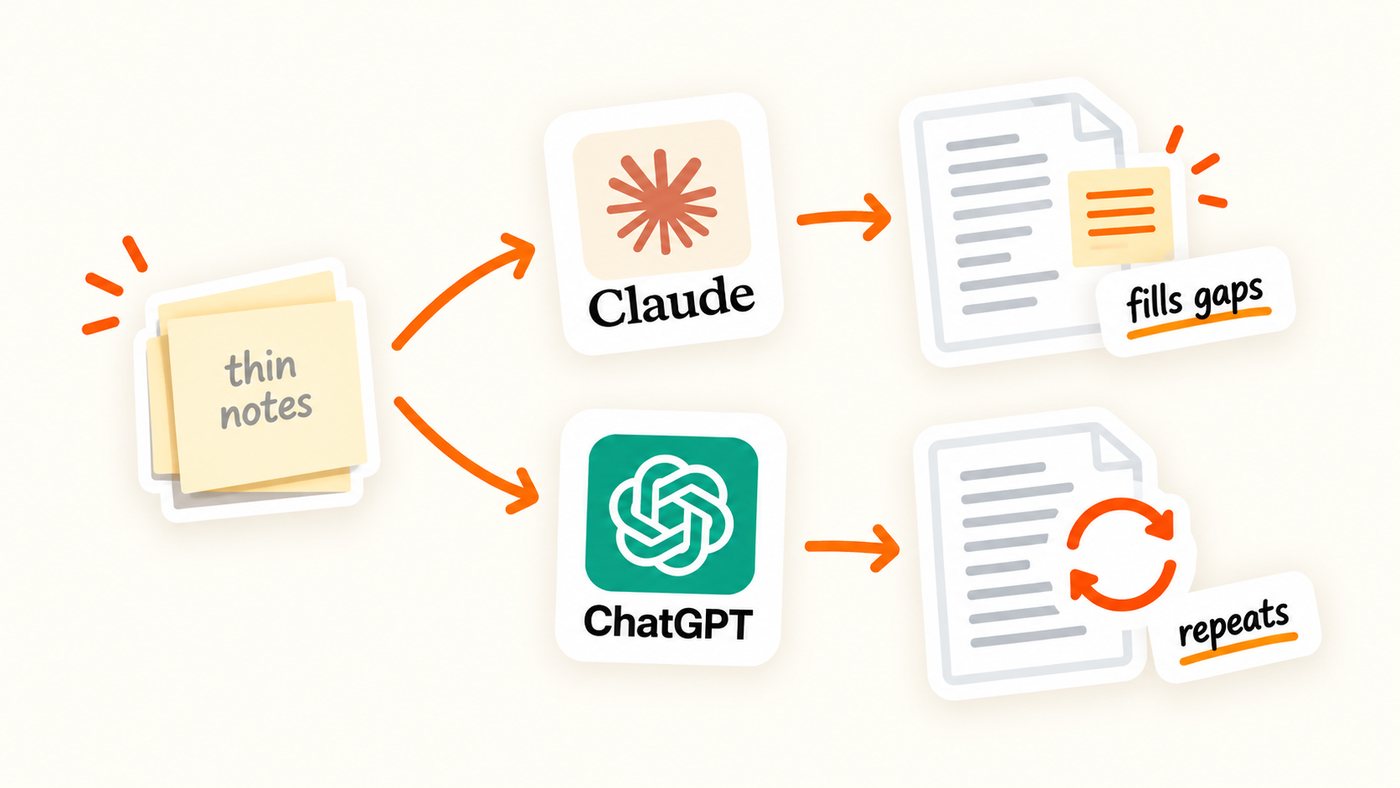
Facts drifted more than voice. Chapter 2 had the thinnest notes, and half of Claude's additions landed there. With less of your material to work from, a model fills the gaps itself.
7. Where Do Both Break at Book Length?
Two chapters in one chat is the easy case. A nonfiction book usually has 10 to 15 chapters written over several weeks and several chats. At that length, terms change between chapters, examples repeat, and you end up pasting the outline into every new chat.
We tested this in where ChatGPT breaks at book length and in can AI write a whole book, where the human edit took about three times as long as the AI draft. Claude linked its two chapters well because both were in one chat. A new chat starts with no memory of the earlier chapters.
8. What Do Claude and ChatGPT Cost Right Now?
We checked these prices on each company's site on September 27, 2026. They change often.
| Plan | Claude | ChatGPT |
|---|---|---|
| Free | $0, Sonnet and Haiku models, limited usage | $0, GPT-5.6 Luna, limited uploads |
| Main paid plan | Pro: $20 per month, or $17 per month billed yearly ($200) | Plus: $20 per month |
| Higher tier | Max: from $100 per month | Pro: see the pricing page |
Sources: claude.com/pricing, chatgpt.com/pricing, and OpenAI's ChatGPT Plus help article, all checked September 27, 2026.
During the test we hit Claude's usage limit on a Pro plan and waited several hours for the reset. If you plan long drafting sessions, check each plan's limits, not just its model list.
9. What Changes When the Model Has Your Material, Not a Prompt?
Both models made mistakes where the notes were thin. Claude filled the gaps with invented details, and ChatGPT filled them with repetition. The cause is the same: a chat model only knows what you pasted into that chat.
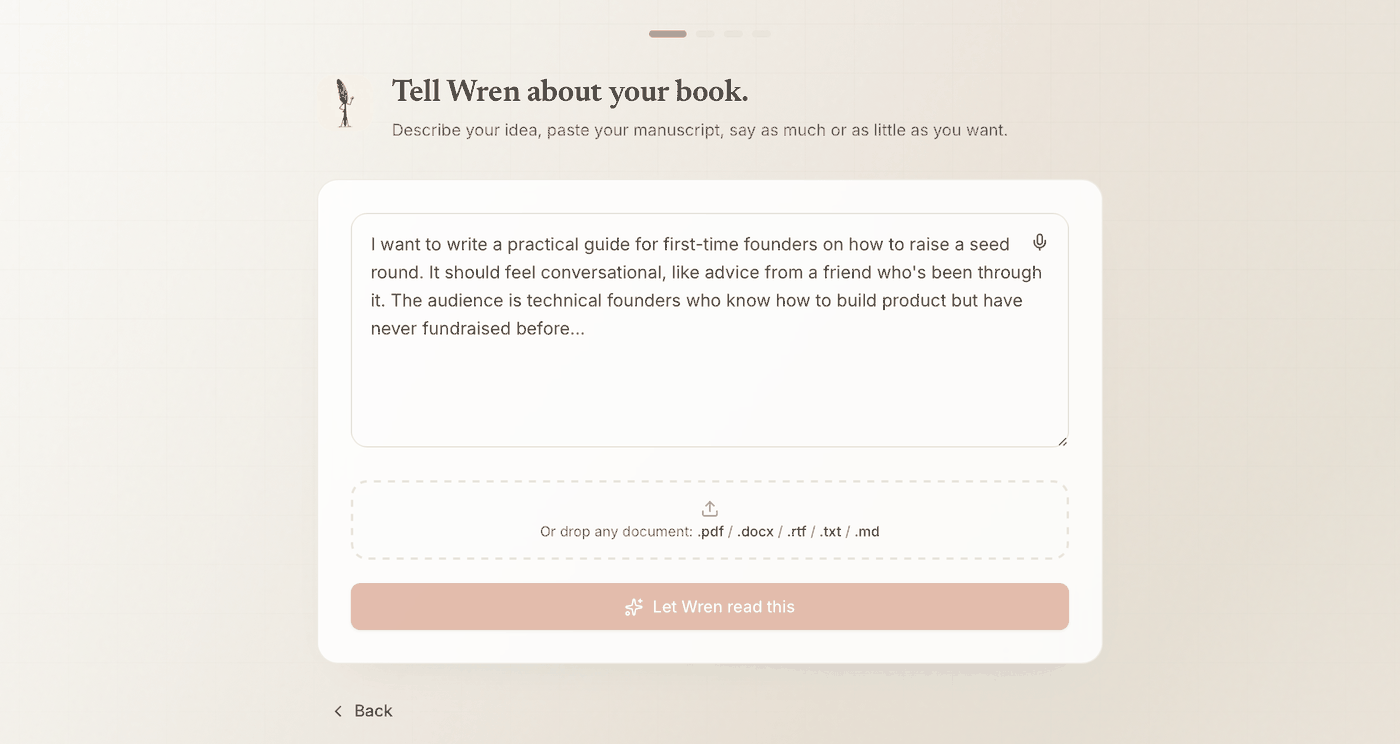
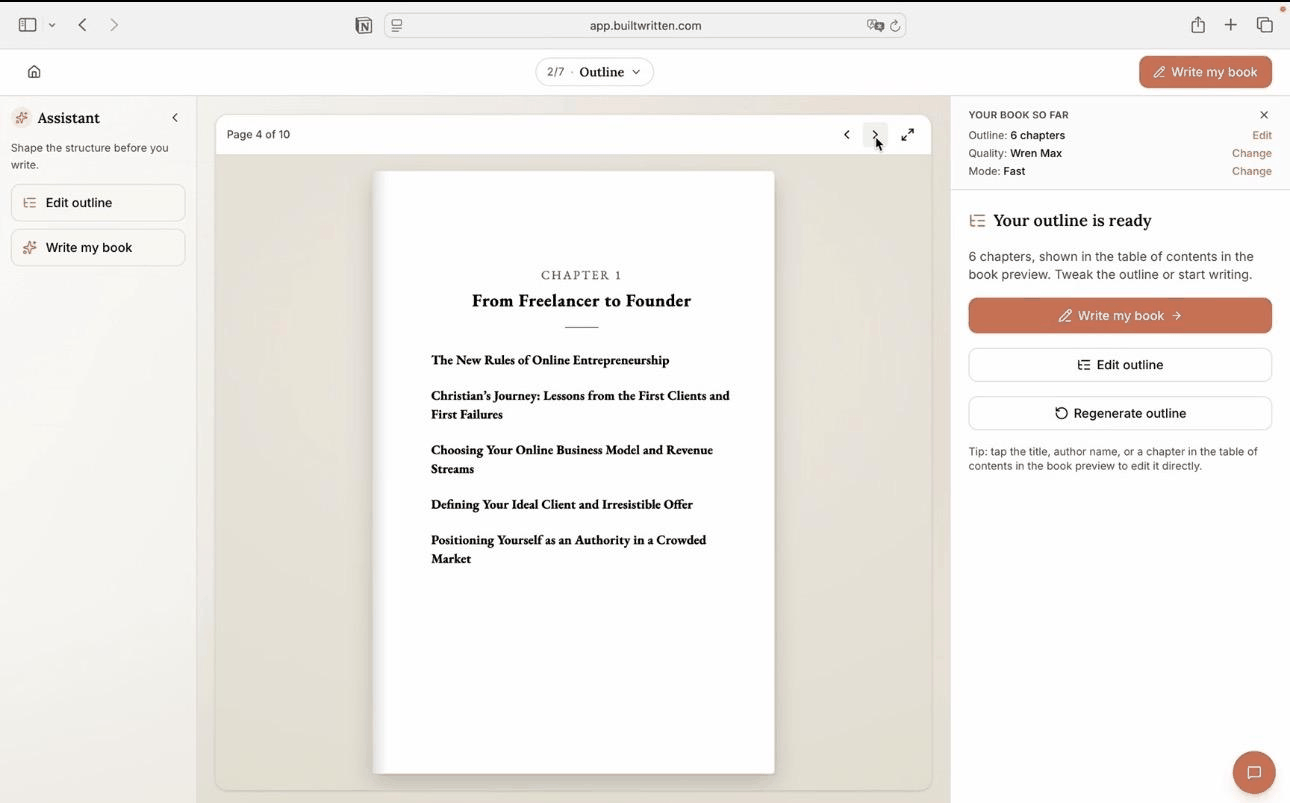
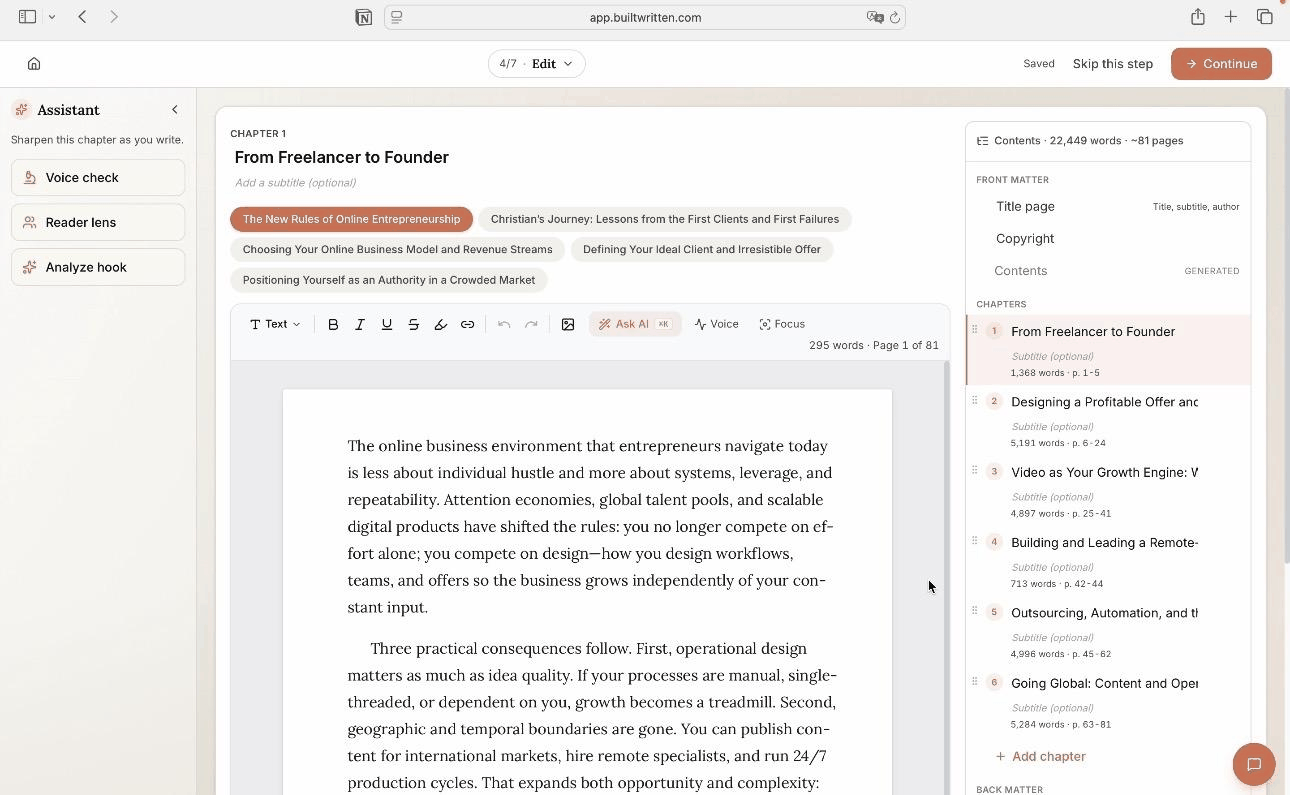
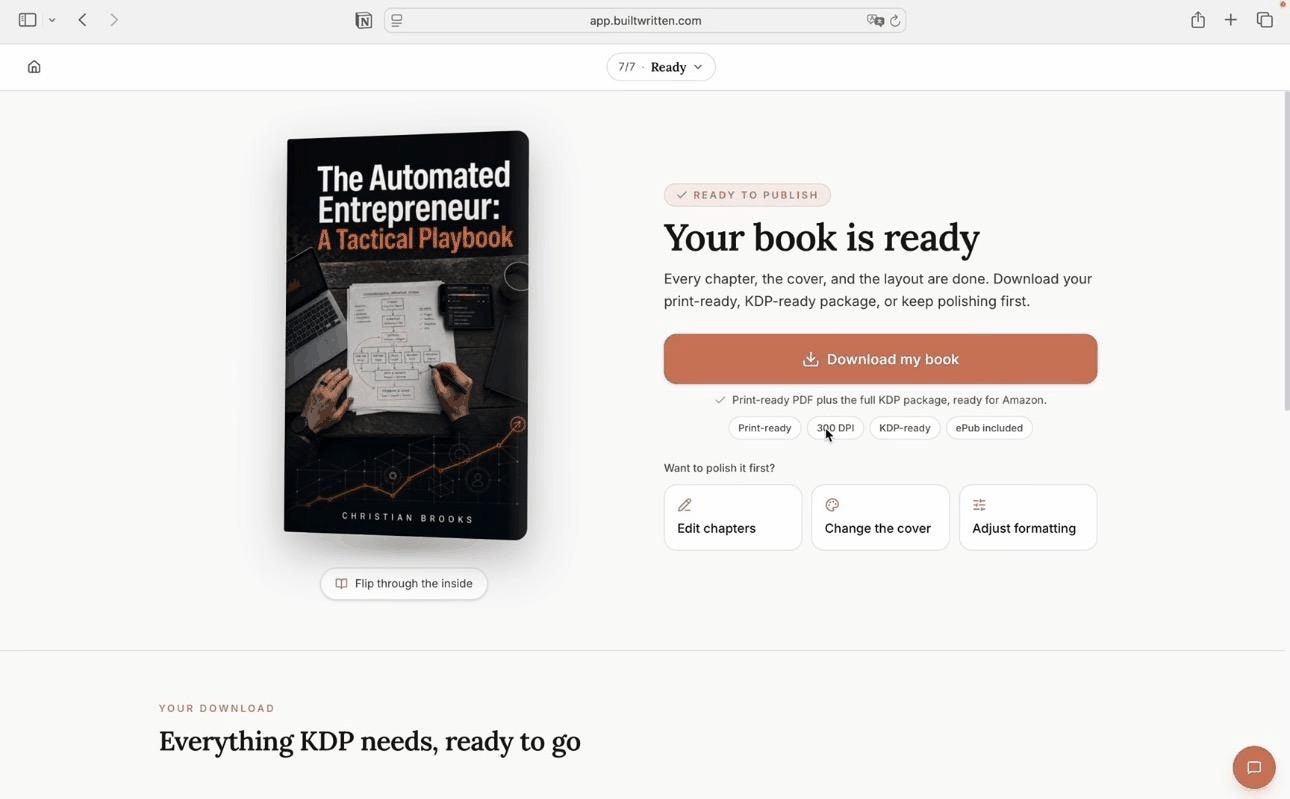
Built&Written works from your material instead of a prompt. You upload posts, notes, or transcripts into one book project. Voice DNA learns your style from 5 to 50 pages of your own writing. The outline stays in the project, so Chapter 9 follows the same plan as Chapter 1. When the book is done, you export KDP-ready PDF, ePub, and DOCX files. The step-by-step version is on how it works.
If you already write in Claude, the Built&Written connector for Claude adds these tools to Claude.ai and Claude Desktop. The connector page lists Claude Pro, Team, and Enterprise as supported. Built&Written does not offer human editing, so you still review every chapter. For a feature-by-feature view, see Built&Written vs Claude and Built&Written vs ChatGPT.
10. Claude, ChatGPT, or Built&Written: Which Should You Use?
We compare book tools on the KDP-Ready Stack Test, which covers planning, drafting, formatting, and publishing. The first two rows come from this test.
| Claude | ChatGPT | Built&Written | |
|---|---|---|---|
| Voice in this test | Book-like paragraphs, longer sentences in Chapter 2 | Matched sentence length, one line per paragraph | Not in this test, voice comes from a 5 to 50 page sample |
| Invented details in this test | 8 in two chapters | 1 in two chapters | Not in this test |
| Chapter-to-chapter continuity | Good within one chat | Weak | Outline and material stored in the project |
| Planning (outline) | Yes, by prompting | Yes, by prompting | Yes, built in |
| Production (full manuscript) | Chapter by chapter, you carry context | Chapter by chapter, you carry context | Drafts the book from your material |
| Packaging (KDP formatting) | No | No | Yes |
| Publishing (PDF, ePub, DOCX) | No | No | Yes |
| Price | Free, Pro $20/mo | Free, Plus $20/mo | See pricing |
Test rows from September 27, 2026. Built&Written was not run through this chat test; its rows describe what the product does.
- Pick Claude if you write one chapter at a time and will fact-check each one against your notes.
- Pick ChatGPT if staying close to your source matters more than flow, or for brainstorming titles and outlines on the free plan.
- Pick Built&Written if you already have posts, notes, or transcripts and want a KDP-ready nonfiction book in your voice. You can also run it inside Claude through the connector.
Final thoughts
Claude's chapters read better. ChatGPT's stuck closer to the notes. Both got weaker where the notes got thinner.
For one chapter, either model plus a careful edit is enough. For a whole book, decide where your notes and outline will live between chapters. If you start from notes, our guide to writing a book from notes in 5 stages shows the process. Then use our book editing services guide to decide whether you need a human editor. Before you upload, read whether you can publish an AI-written book on KDP and Amazon's own content guidelines.
Frequently asked questions
For long-form prose, Claude's chapters read more like a finished book in our September 2026 test. ChatGPT stayed closer to the source notes and invented less. If accuracy to your notes matters most, ChatGPT did better. If readability matters most, Claude did.
Claude can draft a book chapter by chapter, and it linked Chapter 2 back to Chapter 1 well within one chat. On its own it does not keep your outline across separate chats, format the book for KDP, or export print-ready files. In our test it also added details that were not in the notes, so check every chapter against your source.
For a nonfiction book built from material you already have, use a tool that stores your notes, voice sample, and outline in one project and exports KDP-ready files. That is what Built&Written does, and it also works inside Claude through the connector. For single chapters or brainstorming, Claude and ChatGPT both work on their free plans. Our test of 7 AI book tools compares more options.
Both can. With an explicit instruction to use only the notes, Claude added 8 details across two chapters and ChatGPT added 1. The thinner the notes for a chapter, the more a model fills in. Check every name, number, and quote before you publish.
Sources & References
About the author

Khrystyna Balushka
More in AI Book Tools
Ready to write your book?
Turn your expertise into a professional book with Built&Written.