

Can AI Write a Whole Book? We Ran It End to End
The real question is what happens between the first AI-generated draft and a book you would actually feel comfortable publishing. We ran the process end to end and tracked how long each stage took, where the AI handled the work well, and where human intervention was still necessary.
What we actually tested
For this experiment, we started with a real set of source material and used ChatGPT Plus to take it through the full book-writing process: identifying the central idea, building the structure, creating the outline, drafting the chapters, revising the manuscript, and preparing the final book file.
We tracked the process stage by stage, including how long each part took, where the AI produced usable results on the first attempt, and where we had to step in. We also paid close attention to repetition, consistency, factual accuracy, tone, and whether the finished manuscript actually read like a coherent book rather than a collection of generated chapters.
| AI tool | ChatGPT |
| Model | GPT-5.6 Sol |
| Input | 4 sources (articles, a podcast) |
| Output | 6 chapters |
| Workflow | Research → concept → outline → chapters → editing → export |
The goal was not to see whether ChatGPT could produce enough words to fill a book. It was to see how much work was still required after the AI had technically finished writing it.
What source material did we give the AI?
We wanted the source material to resemble the kind of research folder a consultant might have before deciding to turn their expertise into a book. At the same time, we avoided confidential client documents so that the experiment could be reproduced. Our source pack focused on one broad theme: how consultants define business problems, develop recommendations, work with clients, and turn advice into results.
We included 4 sources: McKinsey's material on structured problem solving and choosing the right problem-solving approach, Harvard Business Review articles on what consulting should actually accomplish and how professional service firms work with clients, and Bain research on managing implementation and delivering results during organizational change. Together, the sources covered the journey from diagnosing a problem to developing recommendations and helping an organization put them into practice.
We did not give ChatGPT a draft manuscript or a ready-made chapter structure. It received a collection of separate articles and frameworks and had to identify the recurring ideas, decide what belonged together, and turn that material into the basis for a coherent business book.
Could AI find a book inside a pile of consulting material?
Yes, but the useful part was not generating chapter ideas. It was finding a common thread across sources that were written for different purposes.
The McKinsey material focused heavily on defining problems correctly, breaking complex questions into smaller parts, and choosing the right problem-solving approach. Harvard Business Review pushed the idea further: consulting should go beyond delivering information or recommendations and help clients create change and improve their ability to solve problems themselves. Bain's research added the final piece by looking at what happens during implementation and why change efforts succeed or lose momentum.
From those themes, the AI proposed a book built around the journey from identifying the right problem to making the solution work in practice. Instead of creating one chapter about McKinsey, another about HBR, and another about Bain, it reorganized the material around questions a consultant would actually face:
- Are we solving the right problem?
- How should we break it down?
- Which problem-solving approach fits the situation?
- How do we turn analysis into a recommendation?
- How do we get the client involved rather than simply hand over advice?
- What gets in the way during implementation?
- How do we know the work actually produced a result?
That was enough to show that there was a viable book inside the source material. But the AI was much better at finding patterns than deciding which pattern was worth building a book around. It produced several plausible directions, including a general guide to consulting, a book about structured problem solving, and a book focused on implementing recommendations. We still had to choose the central promise and decide which ideas deserved the most space.
Could AI turn that material into a useful outline?
The AI picked up the strongest ideas in the source pack and arranged them into a sensible progression. McKinsey's material naturally pushed the early chapters toward defining the problem, breaking it into smaller parts, prioritizing what matters, and choosing an appropriate problem-solving approach. McKinsey also stresses that analysis only becomes useful when it is synthesized into a story that helps someone decide what to do.
That produced an initial outline along these lines:
- Define the real problem
- Break the problem down
- Choose the right approach
- Turn analysis into a recommendation
- Get the client involved
- Move from recommendation to implementation
- Manage resistance to change
- Measure the result
The later chapters came mainly from the HBR and Bain material. HBR argues that consulting often fails when recommendations are impractical or poorly implemented, while Bain's research shows how strongly execution can affect results: in its study of more than 300 change programs, the highest-performing group delivered at least 86% of promised results, compared with 43% for the lowest-performing group.
The outline was usable, but it was also predictable. We had to merge overlapping chapters and make the gap between good analysis and successful implementation more central. AI gave us the structure quickly; deciding what deserved emphasis was still our job.
| AI proposed | Human decision |
|---|---|
| Separate overlapping chapters | Combined them |
| Equal weight across topics | Made implementation more central |
| Predictable progression | Strengthened the main argument |
What happened when we generated the whole book?
The full manuscript looked convincing at first. The chapters followed the outline, the argument moved from diagnosis to implementation, and most of the source material appeared in the right places. The problem became clearer once we started reading rather than simply checking whether every chapter existed.
Some sections worked well. In the chapter on diagnosis, for example, the AI used McKinsey's emphasis on defining the problem before jumping into solutions and turned it into practical guidance about clarifying the objective, constraints, and dependencies before beginning an engagement. That translated naturally from research into book-style advice.
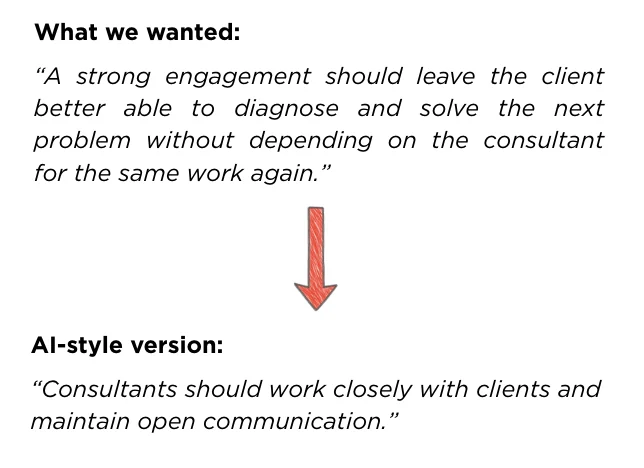
Other sections lost important nuance. Harvard Business Review presents consulting as a progression that can extend beyond providing recommendations toward helping clients implement change and improve their own ability to solve problems. In the generated manuscript, some of that became broader advice about "working closely with the client," which was accurate but much less useful than the original idea.
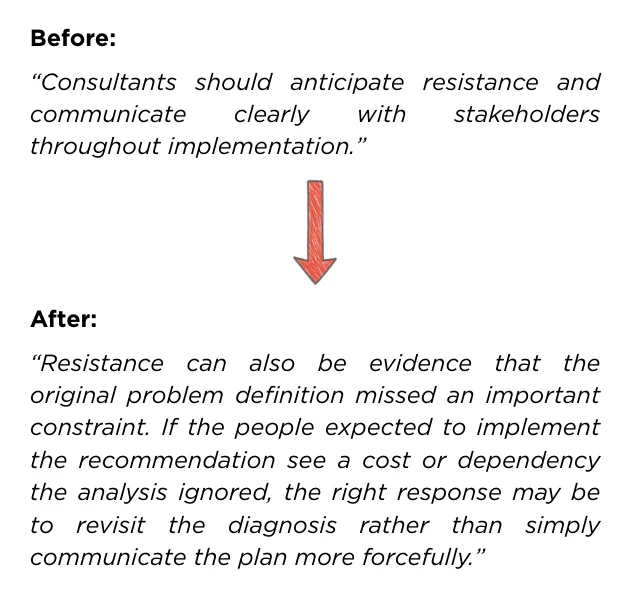
The same thing happened in the implementation chapters. Bain describes predictable changes in mood, cognitive bias, resistance, and execution risk during major transformations. One particularly useful point is that resistance is often a normal response to disruption and that managers sometimes need to listen rather than simply increase communication. Our draft repeatedly reduced ideas like these to generic advice about "managing resistance" and "maintaining stakeholder buy-in."
So AI succeeded at producing a complete, coherent first draft, but completion hid another problem: the most distinctive ideas in the sources were often the easiest ones to flatten into familiar business language. That became one of the main things we had to fix during editing.
Could AI maintain the argument across an entire book?
Mostly, but this was one of the clearest weaknesses in the manuscript.
The overall progression stayed intact: define the right problem, structure the analysis, develop a recommendation, and carry it through implementation. That matched the logic running through the McKinsey, HBR, and Bain sources. McKinsey, for example, stresses that analysis only becomes useful when it is synthesized into a clear story that supports a decision.
The problem was that some ideas weakened as the book went on. Early chapters used McKinsey's problem-definition framework well, but later implementation chapters drifted into generic advice about communication and stakeholder alignment.
The same happened with HBR's argument that consulting should go beyond recommendations and help clients build their own problem-solving capability. The idea appeared clearly at first, then became less specific in later chapters.
Bain's material on cognitive bias and resistance during change added useful detail, but the AI did not always connect those risks back to earlier decisions in the book.
So the book stayed consistent at the topic level, but we still had to strengthen the links between chapters so the argument kept building instead of simply moving from one related subject to the next.
Where did we have to step in?
This was the most important part of the experiment. The AI could produce a complete manuscript, but several parts still needed hands-on correction before the book felt credible.
The biggest issue was lost nuance. HBR's argument that consultants should help clients improve their own ability to solve problems was sometimes reduced to generic advice about "collaboration" or "good communication." We had to restore the stronger point: the goal is not only to deliver an answer, but to leave the client more capable than before.
We also had to fix repetition and weak connections between chapters. Ideas about defining problems, stakeholder alignment, and implementation appeared more than once in slightly different language. Some of Bain's more specific points about resistance, cognitive bias, and the emotional pattern of change were also flattened into broader phrases like "manage resistance effectively."
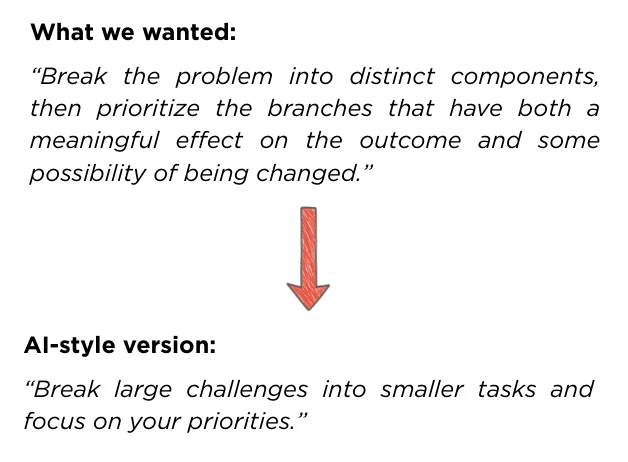
Finally, we had to check whether the advice still matched the source material. McKinsey's problem-solving framework is structured and specific, but parts of the draft turned it into general productivity advice. Those passages needed to be rewritten so they stayed connected to the original logic of defining, prioritizing, analyzing, and synthesizing a problem.
AI did most of the drafting. Our job was to restore specificity, remove repetition, reconnect the argument, and decide which ideas were actually worth keeping.
How long did the whole process actually take?
The AI-generated book appeared quickly, but the total project took much longer than the generation itself. Across the full workflow, we spent roughly two hours waiting for or working with AI output and about six hours doing hands-on work ourselves.
| Stage | AI / process time | Human time | Main time sink | Usable as-is? |
|---|---|---|---|---|
| Source analysis | ~10 min | ~25 min | Checking which ideas were worth keeping | Mostly |
| Book concept | ~5 min | ~20 min | Choosing the central argument | No |
| Outline | ~10 min | ~30 min | Removing overlap and reprioritizing chapters | No |
| Manuscript generation | ~45 min | ~25 min | Reviewing chapters as they appeared | Mostly |
| Structural review | ~10 min | ~1 hr 15 min | Repetition and weak links between chapters | No |
| Editing | ~20 min | ~2 hr 30 min | Restoring nuance and removing generic writing | No |
| Formatting and export | ~15 min | ~35 min | Final structure, headings, and file checks | Mostly |
The biggest difference was between generating the book and finishing it. The manuscript itself could be produced in under an hour, but editing and structural review took several times longer. That still made the process much faster than writing the book from a blank page. But the experiment also showed why claims that AI can "write a book in an hour" are misleading: it can generate one in that time, but the work required to make it coherent, specific, and publishable continues well after the last chapter appears.
What did AI save us time on and what remained our job?
AI saved the most time on organization, synthesis, and first-draft production. It could identify recurring themes, suggest a structure, and turn that structure into full chapters much faster than starting from a blank page.
What remained our job was judgment. We had to decide which ideas mattered most, check the source material, remove repetition, restore nuance, and rewrite passages that sounded generic.
The clearest split was simple: AI produced the material quickly; we still had to decide what was accurate, useful, and worth keeping.
Can AI write a whole book?
Yes, but that answer needs an important qualification.
AI can take source material, build an outline, generate every chapter, and produce a complete manuscript much faster than a person writing from scratch. In our test, it handled the production side of the process surprisingly well.
What it could not do reliably was decide which ideas deserved more weight, preserve every piece of nuance, eliminate repetition, or judge whether a passage was genuinely useful rather than simply plausible.
So AI can write a whole book in the literal sense. What it cannot yet do is remove the need for an author or editor. The manuscript can be generated by AI; the final book still depends on human judgment.
Frequently asked questions
Yes. AI can take source material, create an outline, generate individual chapters, and assemble them into a complete manuscript. The bigger challenge is turning that manuscript into something accurate, coherent, and worth publishing.
In our test, manuscript generation took roughly 45 minutes, while the complete AI-assisted workflow took around two hours of process time. We then spent approximately six hours reviewing, editing, and refining the result.
Yes. Our draft needed work on repetition, chapter connections, generic language, and lost nuance. The amount of editing will depend heavily on the quality of the source material and how specific the original instructions are.
To a point. The manuscript stayed consistent with the general topic and structure, but some ideas became weaker or disconnected as the book progressed. We had to strengthen the links between chapters manually.
AI was most useful for organizing source material, identifying recurring themes, building an initial structure, and producing first drafts quickly. These are the stages where it saved us the most time.
The human still needs to make the important editorial decisions: what belongs in the book, which ideas deserve emphasis, whether claims are accurate, where the writing has become repetitive, and whether the final manuscript actually says something useful.
For first-draft production, significantly so. But comparing generation time alone can be misleading. A manuscript may appear quickly, while reviewing, fact-checking, restructuring, and editing it can take several times longer.
Sources & References
About the author

Polina Karlashchuk
More in AI Book Tools
Ready to write your book?
Turn your expertise into a professional book with Built&Written.