

What is Voice DNA?
This article explains how Voice DNA works in practice, what kind of writing sample it needs, what changes you can expect in the finished manuscript, and where its limits are. The goal is to answer the main concern many writers have about AI-assisted books: will the final book still sound like me?
What Is Voice DNA?
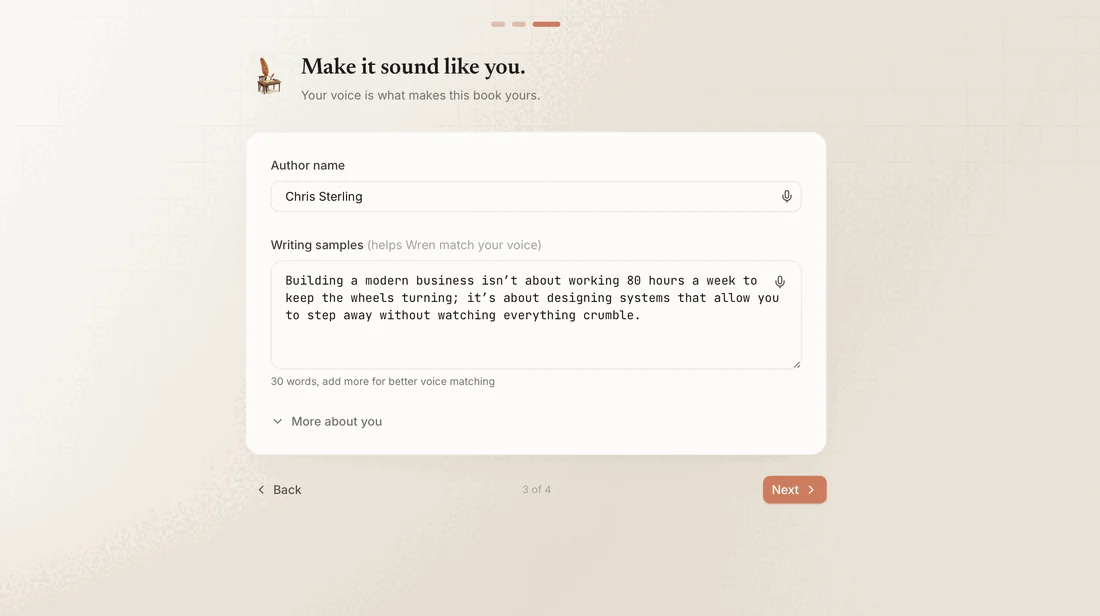
Voice DNA is Built&Written's way of learning how you naturally write before it helps assemble your book. You provide around 5 to 50 pages of your existing writing, and the system uses that sample to identify patterns in your sentence rhythm, vocabulary, and explanation style.
The goal is simple: instead of producing prose that sounds broadly like "AI writing," Built&Written has a reference for what you sound like. Voice DNA does not copy your old sentences. It gives the system a clearer model of your writing style so the finished manuscript can stay closer to your voice across multiple chapters.
Why AI-Written Books Often Sound Generic?
AI writing tends to default to patterns that are safe, polished, and broadly acceptable. Research into how well LLMs imitate individual writing styles found that models can approximate some styles but still struggle with the more nuanced patterns found in personal writing.
The problem becomes more obvious across a full book, where voice and style can begin to drift across chapters. A few paragraphs may sound fine, but over dozens of chapters, the lack of a consistent personal voice can make the manuscript feel flat or interchangeable. Voice DNA gives Built&Written a specific writing style to follow instead of relying on that generic default.
How Does Voice DNA Learn Your Writing Style?
Voice DNA starts with around 5 to 50 pages of your existing writing. This becomes part of the broader Built&Written book-writing workflow, where Wren starts with your existing material before outlining and drafting the book.
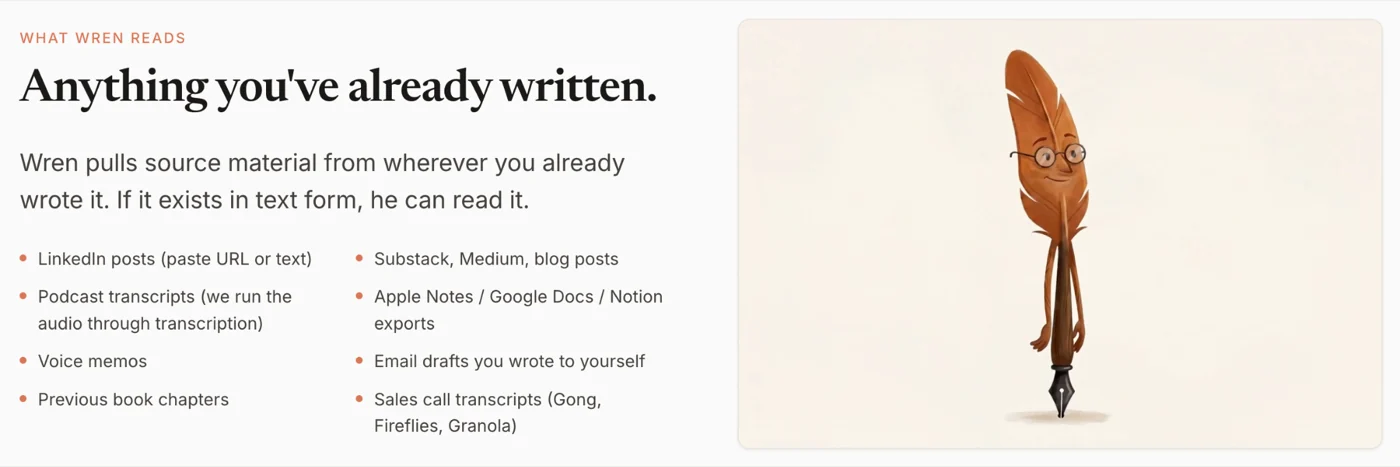
The best sample is material that genuinely sounds like you and reflects the tone you want the book to have. That could include articles, essays, newsletters, book chapters, or other long-form writing you created yourself.
Built&Written uses that sample to identify the patterns that shape your writing style, such as tone, sentence rhythm, vocabulary, and level of formality. Those patterns then become a reference for the manuscript, helping the writing stay closer to your natural voice across multiple chapters.
The sample does not need to be perfectly polished, but it should be representative. Heavily edited corporate copy, someone else's writing, or material that no longer sounds like you will give Voice DNA a less accurate picture of how you actually write.
Ten strong LinkedIn posts teach it more than fifty forgettable ones, and Wren doesn't need a finished manuscript to start. What matters is that you wrote it, not that it's polished.
- Works well: LinkedIn posts under your own name, or a transcript from a call where you did the talking.
- Skip: content someone else wrote for you, or anything so short and generic it could belong to anyone.
Writing Your Book With AI, From Claude or Built&Written
If you already write inside Claude, you can train Voice DNA there instead of switching tools. Built&Written connects to Claude through a Model Context Protocol connector: connect your account once, then plan, train Voice DNA, draft chapters, and export the finished manuscript without leaving the conversation.
For most founders, the real bottleneck sits one step earlier: arriving without writing samples ready to paste in. Drop a few LinkedIn posts or a call transcript into that first Claude session, and Voice DNA has something to learn from immediately.
What Does Voice DNA Actually Change in a Book?
Writing style is not just an abstract idea. Research has found that language-model representations can distinguish stylistic patterns between texts and that writing by the same authors tends to cluster differently from writing by different authors. A 2025 EMNLP study provides one example.
Voice DNA works across three practical layers: sentence rhythm, vocabulary, and explanation style. Besides, it affects more than sentence style. It also sets boundaries for how Wren handles weak, generic, or low-confidence content, helping preserve the author's control over the final wording.
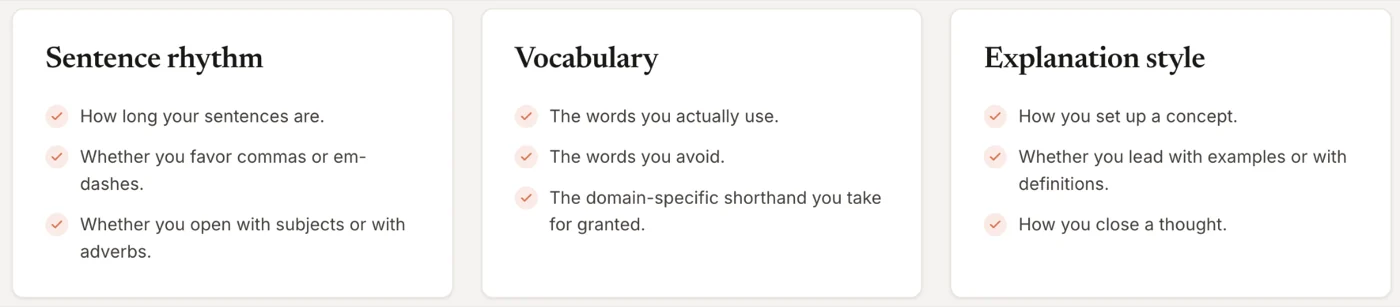
Here is a simple illustrative comparison:
| Element | Generic AI | Voice DNA |
|---|---|---|
| Sentence rhythm | Often balanced and predictable | Follows the author's usual pacing and sentence length |
| Vocabulary | Safe, broadly familiar wording | Reflects words and expressions the author tends to use |
| Tone | Neutral and polished | Closer to the author's natural level of formality and personality |
| Directness | Often explains every point carefully | Can be more concise, opinionated, conversational, or detailed depending on the author |
| Transitions | Uses familiar AI-style connectors | Better matches the author's normal way of moving between ideas |
| Overall feel | Clear, but potentially interchangeable | More consistent with the author's existing writing |
For example, a generic AI version might say:
"Developing a consistent writing habit can significantly improve productivity and help writers make steady progress toward their goals."
A more personal version could be:
"Writing gets easier when you stop waiting for the perfect session. A page today is more useful than five pages you keep planning to write tomorrow."
The purpose of Voice DNA is not simply to make the prose more stylish. It is to make the manuscript feel more like it came from the person whose name is on the cover.
What Can Voice DNA Not Fix?
Voice DNA is designed to improve how the book sounds, not solve every problem involved in writing one. A manuscript can match your voice and still contain weak arguments, factual errors, repetition, or poor structure. Those problems become especially important when AI is used across an entire book rather than a single chapter.
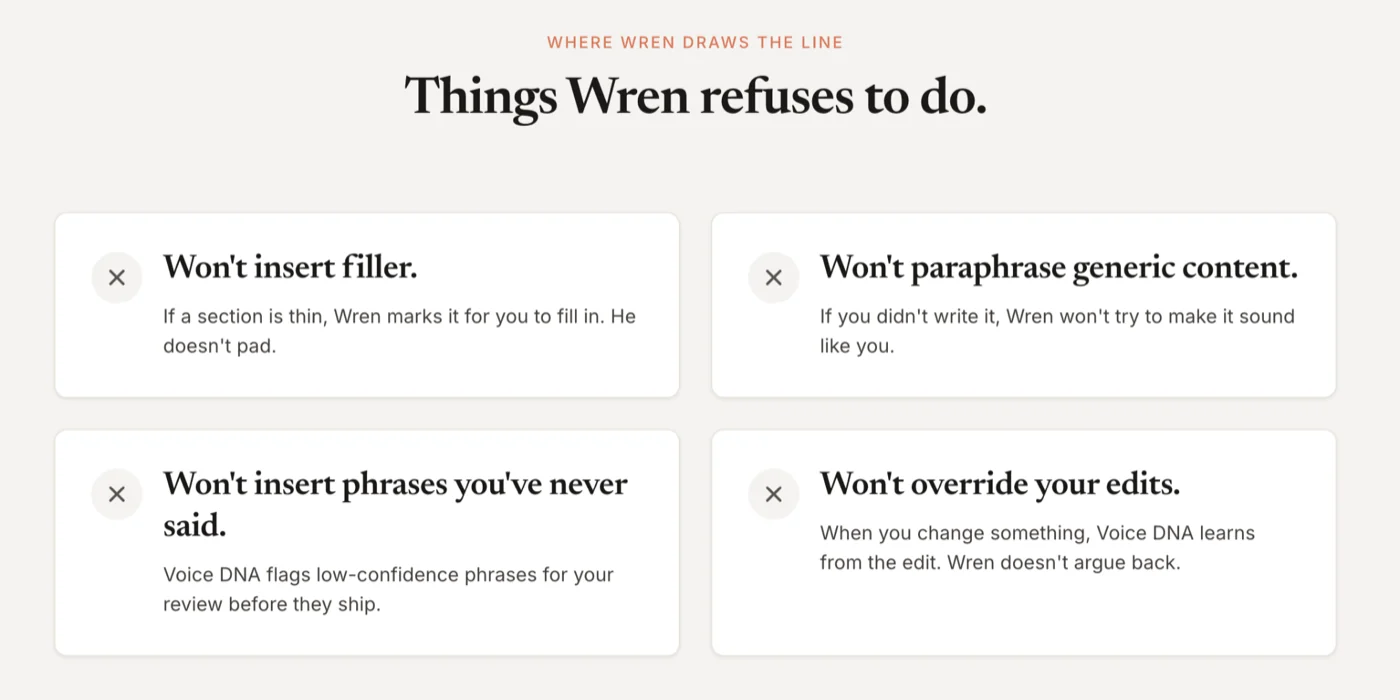
It also cannot compensate for a bad writing sample. If the material you provide does not represent how you actually write, the resulting voice will be less accurate.
Voice DNA reads what you've written, not how you sound. If you're picturing an AI narrator reading your book back in your own speaking voice, that's audio voice cloning, a different technology Built&Written doesn't offer.
Think of Voice DNA as a way to preserve the author's style across the manuscript. Research, structure, accuracy, ideas, and final editing still matter separately.
Who Gets the Most Value From Voice DNA?
Voice DNA is most useful for people who already have a recognizable way of writing and want that style to carry into a longer book. That includes authors, consultants, founders, coaches, and subject-matter experts who already have articles, newsletters, essays, posts, or other written material to draw from.
It is especially valuable for anyone worried that using AI will flatten their personality or make the manuscript sound generic. The clearer and more consistent your existing voice is, the more useful Voice DNA can be as a reference.
Ujjwal Majumder did exactly that: his own notes became a published book on Amazon KDP, drafted in his voice, the first of a planned trilogy. Built&Written plans start at $19 a month. If you already have writing to work from, that's most of what Voice DNA needs.
It may be less useful for someone with very little original writing, or for a writer who wants the book to sound deliberately different from their usual style. If you are still deciding whether AI belongs in your process at all, start here.
Frequently asked questions
Voice DNA works best with around 5 to 50 pages of your existing writing. That gives Built&Written enough material to identify recurring patterns in your tone, vocabulary, sentence rhythm, and overall style.
Use material that genuinely sounds like you. Articles, essays, newsletters, book chapters, and other long-form writing are good options. Try to avoid heavily edited material or writing created by someone else.
No. Voice DNA uses your writing as a reference for style rather than copying sentences or passages into the new manuscript.
Its purpose is to make the manuscript more consistent with your existing voice, but no voice-matching system should be treated as a perfect copy of the author. Your review and final edits still matter.
Voice DNA will be harder to build accurately without enough representative material. If you have only short posts or notes, it may be worth collecting several pieces that reflect the same natural writing style.
No. Voice DNA focuses on voice and style. The manuscript still needs to be reviewed for structure, accuracy, repetition, clarity, and other editorial issues.
No. Built&Written says Voice DNA samples are used for your private voice profile and are not used to train base models.
Yes. Each book can have its own Voice DNA profile, so the writing samples you use can reflect the style you want for that particular book. If your professional writing sounds very different from your personal writing, choose the material that best matches the intended manuscript.
Yes. Built&Written's Claude connector lets you train Voice DNA and draft chapters from inside a Claude conversation. It's technically a Model Context Protocol connector, which is also why some people search for it as a Claude "skill."
Sources & References
About the author

Polina Karlashchuk
More in AI Book Tools
Ready to write your book?
Turn your expertise into a professional book with Built&Written.