
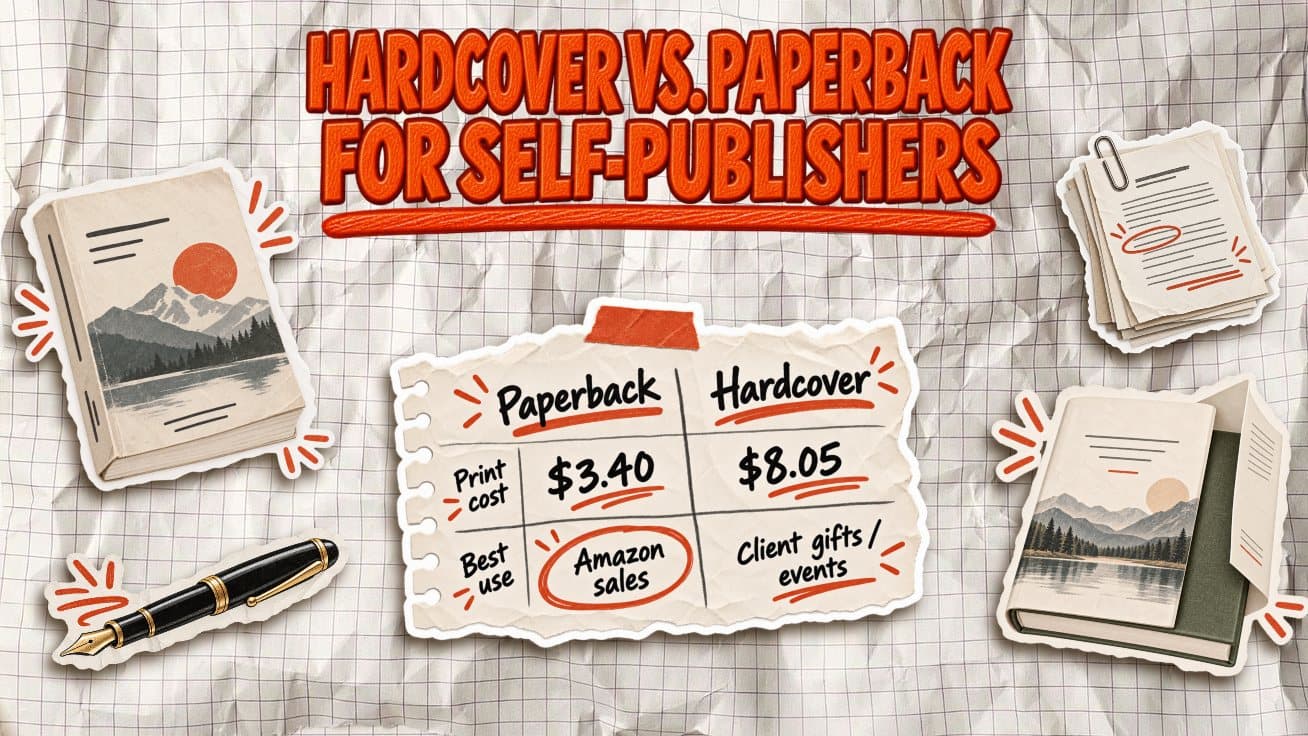

Hardcover or Paperback for Your First Self-Published Book?
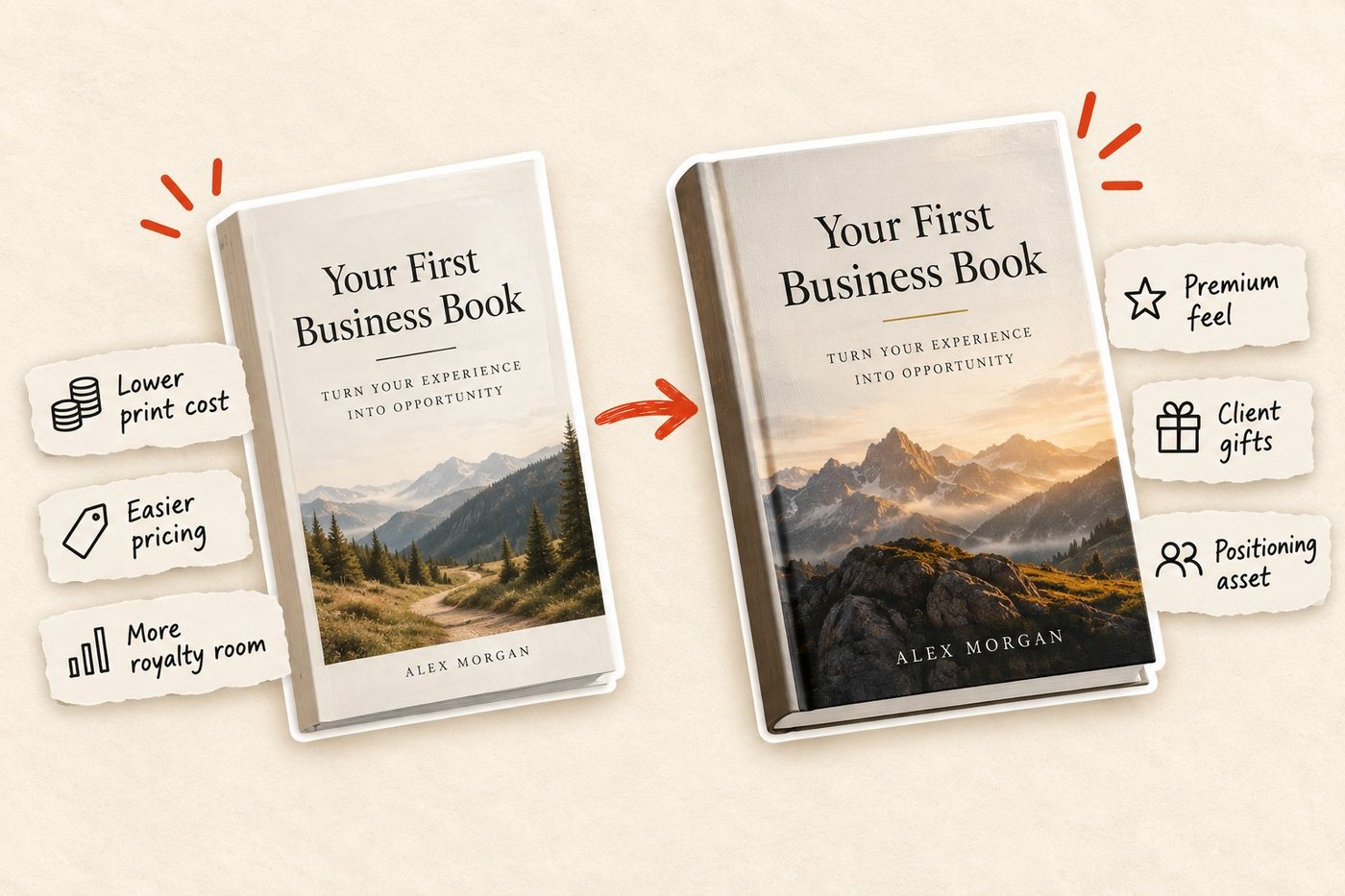
For most first-time self-publishers, paperback is the better place to start. It costs less to print, gives you more room on royalties, and is usually easier to price at a level readers will accept.
Hardcover starts to make more sense when the book is doing more than being read.
For a business author, consultant, coach, or speaker, a hardcover can become part of the product itself: something you hand to a premium client, sell at an event, display on stage, include in a high-ticket package, or use as a more substantial calling card.
Hardcover vs. paperback: what actually changes?
The biggest difference is not durability. It is economics.
A paperback is cheaper to manufacture, easier to price competitively, and gives you more flexibility on trim size and page count. A hardcover costs more per copy, but it can feel more substantial and work better when the physical book is part of how you present yourself or your business.
| Aspect | Paperback | Hardcover |
|---|---|---|
| Print cost | Lower | Higher |
| Perceived value | Standard, accessible | More premium and substantial |
| Portability | Lighter and easier to carry | Heavier and less portable |
| KDP trim sizes | Broad range of sizes | 5 sizes: 5.5 × 8.5, 6 × 9, 6.14 × 9.21, 7 × 10, and 8.25 × 11 in. |
| KDP page limits | Starts at 24 pages; maximum varies by trim, ink, and paper | 75-550 pages |
| Royalty impact | Lower print cost leaves more royalty at the same list price | Higher print cost reduces royalty unless you charge more |
| Best use case | First editions, general Amazon sales, lower-priced books | Client gifts, speaking, events, premium offers, direct sales |
As of October, 2026, KDP gives paperback authors considerably more production flexibility. For example, a standard black-and-white 6 × 9 paperback can run from 24 to 828 pages, while the same trim size in hardcover is limited to 75 to 550 pages. KDP hardcover is also available in only five trim sizes.
The royalty formula itself is not inherently better for paperback: KDP royalties are based on the list price and then subtract printing costs. The practical advantage is that the paperback costs less to manufacture, so more of the sale price can remain after printing.
For a first self-published book, that usually makes paperback the safer default. Hardcover becomes more interesting when readers are not the only audience for the physical copy.
How much more does a KDP hardcover cost?
As of October 4, 2026, the difference is substantial.
For a regular-trim, black-and-white book sold on Amazon.com, KDP calculates printing cost as a fixed charge plus a per-page charge. For books above 110 pages:
So take the same 200-page, 6 × 9-inch book in both formats:
| Paperback | Hardcover | |
|---|---|---|
| Fixed print cost | $1.00 | $5.65 |
| 200 pages × $0.012 | $2.40 | $2.40 |
| Total printing cost | $3.40 | $8.05 |
The hardcover costs $4.65 more per copy to manufacture. KDP subtracts that printing cost from your royalty rather than charging it upfront.
Now give both versions the same $19.99 list price. At that price, both qualify for KDP's current 60% royalty rate on Amazon:
Paperback: $19.99 × 60% − $3.40 = $8.59 royalty
Hardcover: $19.99 × 60% − $8.05 = $3.94 royalty
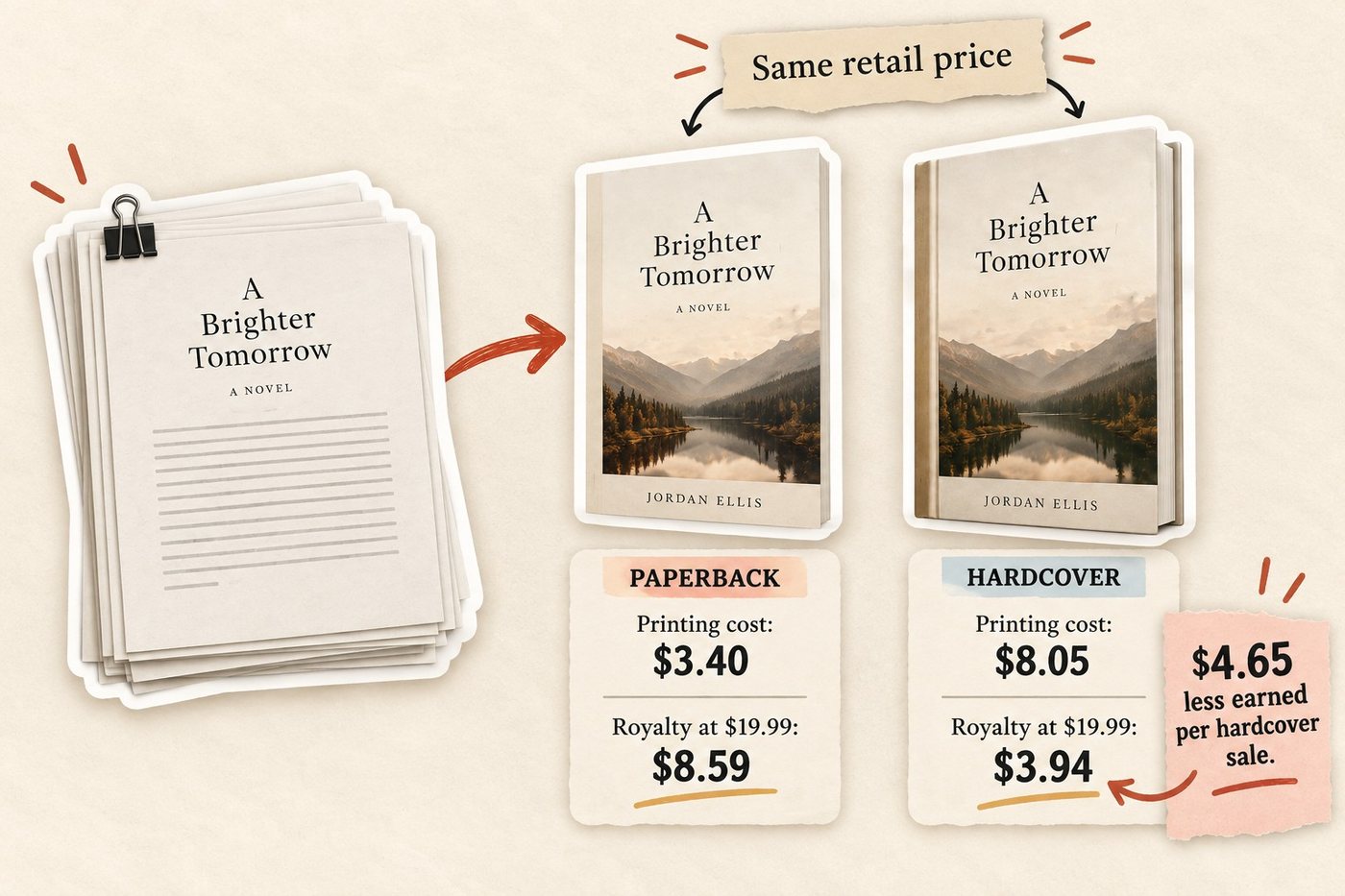
That is $4.65 less earned on every hardcover sale at the same price. The royalty percentage did not change; the manufacturing cost did. KDP currently pays either a 50% or 60% print royalty depending on list price, with the 60% tier beginning at $9.99 on Amazon.com.
This is why comparing hardcover and paperback at the same retail price can be misleading. In practice, you normally need to price the hardcover higher to preserve a similar royalty.
What does KDP actually offer for hardcover books?
KDP’s hardcover option is fairly simple, but also fairly limited.
Amazon prints KDP hardcovers as case laminate books. That means the cover artwork is printed directly onto the rigid boards. There is no dust jacket, so if the traditional cloth-bound, jacketed look is important to you, KDP is not the format for it.
As of October 4, 2026, KDP offers five hardcover trim sizes:
| Trim size | Page range |
|---|---|
| 5.5 × 8.5 in. | 75-550 pages |
| 6 × 9 in. | 75-550 pages |
| 6.14 × 9.21 in. | 75-550 pages |
| 7 × 10 in. | 75-550 pages |
| 8.25 × 11 in. | 75-550 pages |
For most nonfiction and business books, 6 × 9 inches is the most familiar option. KDP itself describes 6 × 9 as the most common U.S. paperback trim size, and it also carries over cleanly to hardcover.
There are a few other restrictions worth knowing. KDP hardcover supports black ink on white or cream paper and premium color on white paper, but not standard color or groundwood paper. Hardcover publishing is also currently unsupported on Amazon.co.jp, and right-to-left hardcover publishing for Hebrew and Yiddish is not available.
The main practical constraint is the 75-550 page range. A short lead magnet turned into a 60-page booklet cannot become a KDP hardcover, and a very long reference book may exceed the upper limit.
When is hardcover worth it for a self-published book?
A hardcover is easiest to justify when the book has value beyond the sale itself.
For a business author, that usually means the book is part of how you position your expertise. A hardcover can make more sense when you use it for:
- Speaking engagements, where the book is sold or handed out after a talk.
- Client gifting, especially for higher-value prospects or existing clients.
- Premium offers, where the book is included in a consulting, coaching, or training package.
- Events and workshops, where a more substantial physical edition can feel like part of the experience.
- Direct sales, where you control the offer, bundle, and margin instead of relying only on Amazon retail pricing.
In those situations, the extra print cost may matter less because the book is helping create a larger commercial outcome. A $20-30 hardcover that supports a consulting relationship worth thousands of dollars is doing a different job from a book competing for impulse purchases on Amazon.
The calculus changes when most of your sales are expected to come from ordinary readers browsing Amazon. There, price sensitivity matters more. A paperback is cheaper to produce, easier to price competitively, lighter to ship, and usually leaves more royalty per sale at the same list price.
Hardcover can also add a sense of permanence or authority, but that benefit is easy to overstate. Readers generally care more about whether the book looks professional and solves the problem they bought it for than whether the boards are rigid.
A useful rule is simple: if the book is mainly a product, paperback usually wins. If the book is also a positioning asset, hardcover becomes much easier to justify.
KDP hardcover vs. IngramSpark: what if you want a dust jacket?
If you want the traditional hardcover look with a removable dust jacket, KDP cannot produce it. KDP hardcovers are case laminate only: the artwork is printed directly onto the rigid cover boards.
For a jacketed hardcover, IngramSpark is the more flexible option. It offers case laminate hardcovers, jacketed case laminate, and Digital Cloth™ covers with a jacket. It also gives authors a broader range of hardcover trim sizes than KDP.
The extra finish also adds to the manufacturing cost. Using IngramSpark's current U.S. rate card, a 200-page, 6 × 9-inch, black-and-white hardcover on white paper works out like this:
| Case laminate | With dust jacket | |
|---|---|---|
| Cover charge | $5.31 | $7.76 |
| 200 pages × per-page rate | $2.64 ($0.0132 a page) | $2.94 ($0.0147 a page) |
| Estimated print cost | $7.95 | $10.70 |
So, in this configuration, adding the jacket increases manufacturing cost by about $2.75 per copy, before shipping, handling, taxes, or volume discounts. IngramSpark also applies bulk-print discounts beginning at 100 copies.
That makes IngramSpark particularly useful when the physical presentation is part of the reason for publishing the hardcover. A jacketed edition can make sense for premium client gifts, special editions, direct sales, or a book intended to look closer to a traditional trade hardcover.
The trade-off is complexity. A dust jacket needs its own correctly sized artwork, including the front and back flaps, spine, folds, and bleed. IngramSpark's file specifications are different from KDP's case-laminate cover requirements, so you should not expect to upload the same hardcover cover file to both platforms.
Can you publish paperback and hardcover together?
Yes. You can publish the same book as both a paperback and a hardcover on KDP, but they are treated as separate print formats.
The interior can often stay largely the same if both editions use the same trim size and the manuscript meets the requirements for each format. The cover cannot. KDP requires separate paperback and hardcover cover files because the spine, wrap, hinge, and case dimensions are different.
That means publishing both usually involves:
| What changes? | Paperback vs. hardcover |
|---|---|
| Cover file | Separate file required for each format |
| Spine and cover dimensions | Different, even with the same page count and trim size |
| ISBN | Each format needs its own ISBN |
| Interior file | Can sometimes be reused if dimensions match; update any ISBN printed inside |
| List price | Set separately for each format |
| Amazon listing | Formats can appear together on one product detail page |
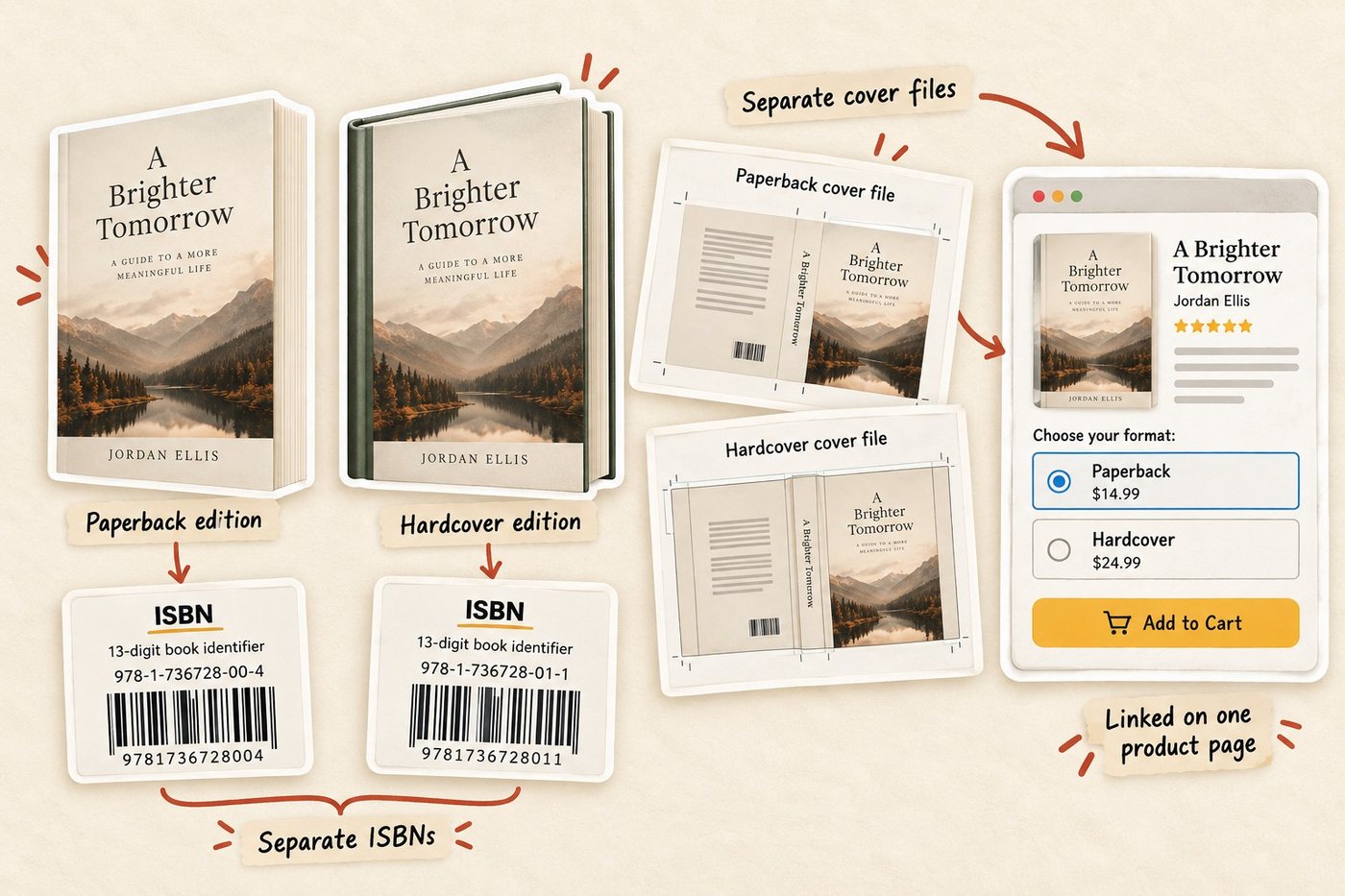
An ISBN identifies a specific format, so you cannot use the paperback ISBN for the hardcover. KDP can provide a free ISBN for each, or you can supply separate ISBNs you purchased yourself.
Be especially careful with the cover. Do not resize a paperback PDF and assume it will work as a hardcover. Generate the correct dimensions for the exact binding, trim size, paper type, and page count, then check the finished file's resolution and color mode with our KDP Cover Validator.
On Amazon, paperback and hardcover versions with matching metadata can be linked on the same product detail page, letting readers choose the format they want. Amazon says it uses details such as the title, subtitle, author, edition, language, and interior type to match editions. Linking can take up to about a week after the formats are live.
You also do not need to launch both on the same day. For many first-time authors, the simpler route is to publish the paperback first, confirm that the files and listing are working as expected, and add the hardcover when there is a reason for it.
Frequently asked questions
Not automatically. Hardcover feels more premium and is more durable, while paperback is cheaper to produce, lighter, and usually easier to sell at an accessible price.
Publish one if the premium physical format serves a purpose: client gifting, speaking, events, direct sales, or positioning. If your priority is ordinary Amazon sales, paperback is usually the better first format.
For the 200-page KDP example above, printing costs $8.05 in hardcover versus $3.40 in paperback as of October 4, 2026, a difference of $4.65 per copy.
Yes. KDP supports both formats. Each needs its own ISBN and cover file, while the editions can usually be linked together on one Amazon product page when their metadata matches.
No. The artwork can share the same design, but the final files need different dimensions. Hardcover case wrap, spine, hinge, and board requirements differ from paperback specifications.
Yes. Each print format requires its own ISBN. A paperback ISBN cannot also identify the hardcover edition.
Sources & References
About the author

Polina Karlashchuk
More in Self-Publishing
Ready to write your book?
Turn your expertise into a professional book with Built&Written.