

Which Self-Publishing Platform Should Your Book Go On First?
Key takeaways
- What is the best self-publishing platform? The one where your readers buy. For most nonfiction authors that's Amazon KDP: no upfront fees, 60% of list price minus print cost on paperbacks priced $9.99 and up, and 70% on ebooks priced $2.99 to $12.99.
- Need bookstores and libraries? Add IngramSpark. Setup and revisions are free since February 2026; it now takes a 1.875% market access fee per sale.
- Can you use more than one? Yes. The only exclusivity among the seven is KDP Select, and it covers ebooks only, for 90 days at a time.
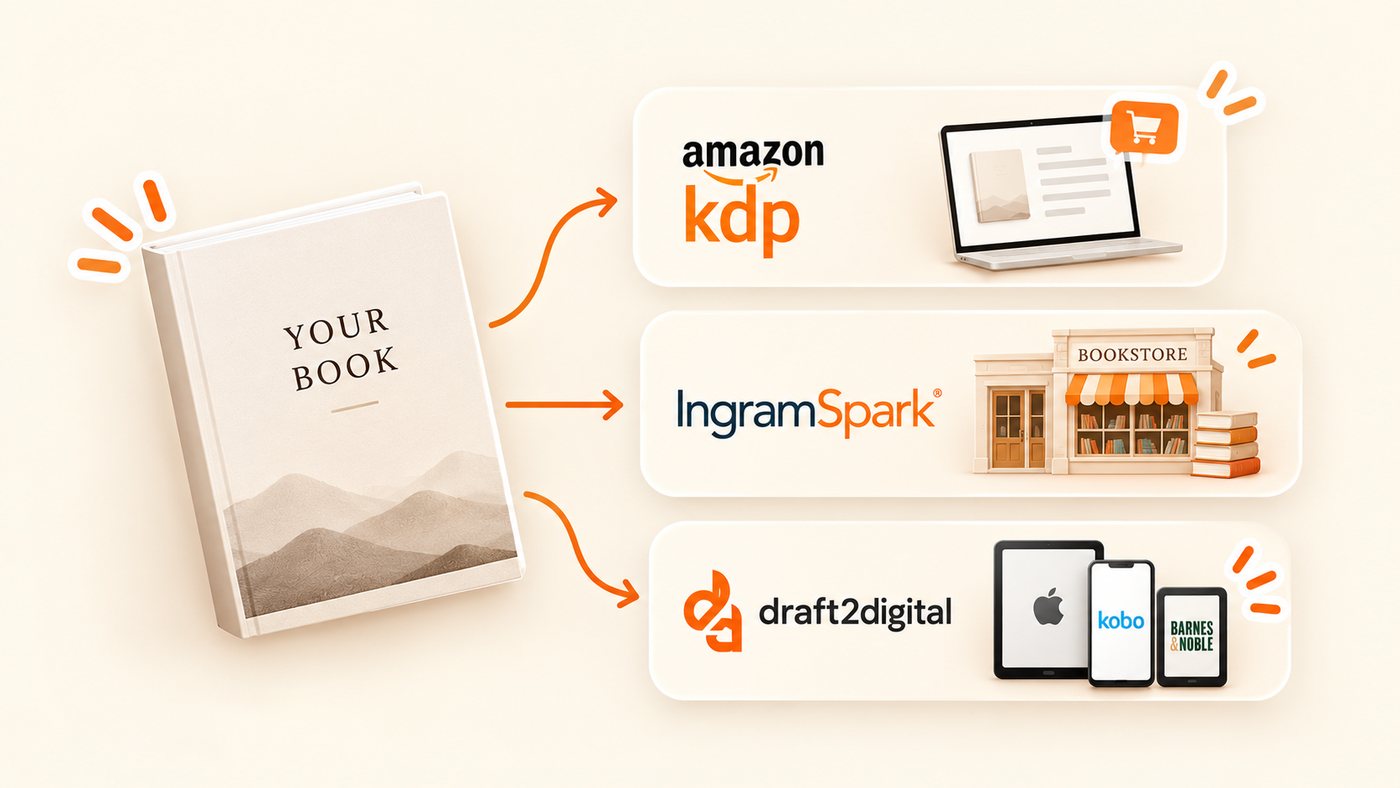
Seven platforms compete for the same upload. They differ on four things: what you earn per sale, where your book shows up, who owns the ISBN, and what it costs to get listed. Most comparisons skip the fourth. We checked all four on each platform's own site the day this was written.
What is Built&Written? An AI book platform for nonfiction. It turns your posts, notes, and transcripts into a structured book in your voice, then exports the KDP-ready PDF, ePub, and DOCX files these platforms ask for. It doesn't sell or print books, so it pairs with whichever platform below you choose.
1. What Is a Self-Publishing Platform, Exactly?
A self-publishing platform takes your finished files, lists the book in one or more stores, and pays you a royalty on each sale. You keep the rights. You set the price. The platform handles the storefront and, for print, prints each copy when someone orders it.
Two neighbors get confused with it. Writing and formatting tools produce the files; our self-publishing software stack covers those stage by stage. Printers make physical copies in bulk; our book printing services comparison covers print runs and offset. This page is only about where the book is sold.
Two of the seven blur the line. Lulu and BookBaby also sell books straight from their own bookstores, and BookBaby charges for packages that bundle services. We note where that changes the math.
2. How Do the Seven Self-Publishing Platforms Compare?
Here are the seven side by side. The paperback column uses a 200-page, 6 x 9 inch, black-and-white book at $14.99, the most common setup for a business book. Where a platform doesn't publish its print cost, we show its own formula.
| Platform | Ebook royalty | Paperback, 200 pages at $14.99 | Where it sells | ISBN | Upfront fees | Exclusivity |
|---|---|---|---|---|---|---|
| Amazon KDP | 70% at $2.99 to $12.99, minus delivery; 35% outside that band | Print cost $3.40; you earn about $5.59 per Amazon sale | Amazon stores | Free, Amazon only; ebooks need none | None | Optional: KDP Select, ebook only, 90 days |
| IngramSpark | 85% of what the retailer pays IngramSpark | About $3.50 to $3.70 at $15 with a 40% discount (ALLi estimate) | 45,000+ retailers, libraries, and online stores | Free for US authors, "Indy Pub" imprint | None; 1.875% market access fee per sale | None |
| Lulu | 90% of revenue after the retailer's share | Retailer takes 50% of list; you get 80% of what's left after print cost | Lulu Bookstore, Amazon, and bookstores via Ingram | Free, or bring your own | $4.99 one-time distribution review | None |
| B&N Press | 70% at $0.99 and up | 55% of list ($8.24) minus print cost | bn.com and Barnes & Noble | Free for print, B&N only | None | None |
| Draft2Digital | Keeps about 10% of list; about 60% of list to you at most stores | Paperbacks go to Amazon and Ingram; payout shown in D2D's print calculator | Apple, B&N, Kobo, library apps; Amazon ebooks by invitation | Free | $20 activation; $12/year if sales stay under $100 (waived year one) | None |
| BookBaby | 100% of net sales after the package fee | 50% royalty on BookBaby BookShop; 10% to 30% at other retailers | 60+ ebook retailers plus its own BookShop | Sold by BookBaby, which becomes publisher of record | $299 ebook distribution package; print is quoted | None |
| Kobo Writing Life | 70% at $2.99 and up (US); 45% below | No print: ebooks and audiobooks only | Kobo stores in 200+ countries | Optional for ebooks | None | None; Kobo Plus is optional |
| Built&Written (the file, not a store) | Exports the ePub every store above accepts | Exports a KDP-ready print PDF | Doesn't sell books | Doesn't issue ISBNs | See pricing | None |
Checked September 28, 2026 on each platform's own pricing and help pages. IngramSpark's paperback figure is the Alliance of Independent Authors' April 2026 estimate; IngramSpark itself publishes only a calculator. Amazon raised the top of its 70% ebook band from $9.99 to $12.99 on July 7, 2026, so older comparisons still show the old ceiling.
The table in four lines: Readers buy on Amazon → Amazon KDP. Bookstores and libraries → IngramSpark. Ebook in every store → Draft2Digital. Sales from your own site → Lulu.
3. How Much Will You Actually Earn Per Sale?
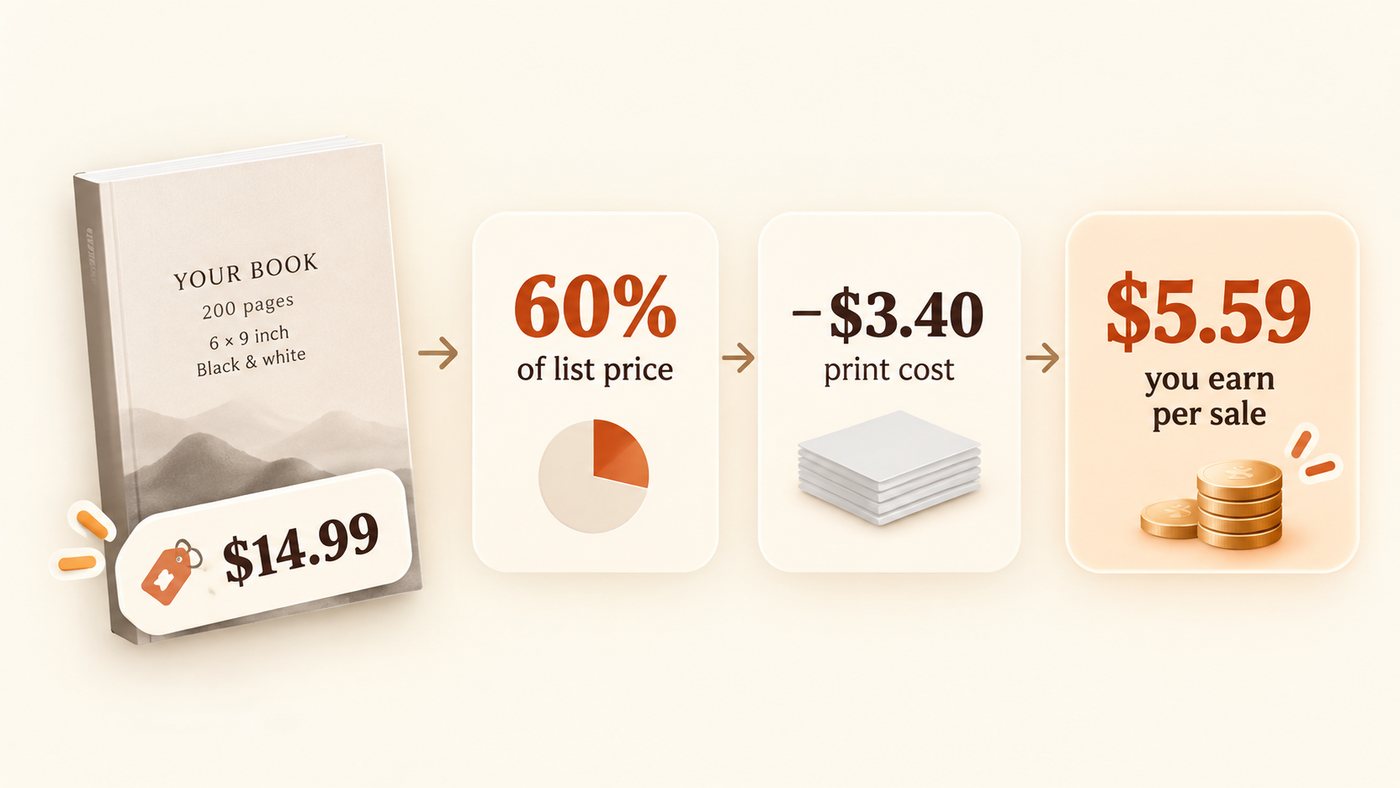
On Amazon, a 200-page paperback at $14.99 earns about $5.59. KDP's printing cost formula for a standard trim is $1.00 plus $0.012 per page, so 200 pages cost $3.40. KDP pays 60% of list price at $9.99 and up, which is $8.99. Subtract the $3.40 and you keep $5.59.
Drop the price to $9.98 and the rate falls to 50%: you earn $1.59 a copy instead of $2.59 at $9.99. One cent costs you a dollar. Run your own numbers in our free KDP royalty calculator before you set a price.
The other platforms pay differently because a bookstore sits in the middle. IngramSpark and Lulu's retail channel pay you what's left after the store's discount and the print cost. That is why the same $15 paperback earns roughly $3.50 through IngramSpark and $5.59 on Amazon. B&N Press sits in between: 55% of list minus print cost, but only for sales on Barnes & Noble.
Ebooks are simpler. KDP, B&N Press, and Kobo each pay about 70% inside their price bands. Draft2Digital pays about 60% at most stores and keeps roughly 10% of list for the convenience of one upload.
The math on one line: $14.99 list price × 60% = $8.99 − $3.40 print cost = $5.59 per copy. At $9.98: × 50% = $4.99 − $3.40 = $1.59.
4. Amazon KDP vs IngramSpark: Which Should Come First?
KDP first, when your readers shop on Amazon. For most nonfiction authors they do: Amazon is the largest online bookstore, and KDP's per-copy royalty beats anything paid through a wholesaler. It costs nothing to list, and a revised file goes live without a fee.
IngramSpark is the one to add when a bookstore order or a library copy matters. It reaches over 45,000 retailers, libraries, and online stores, which KDP doesn't. Its fees also got simpler this year. From February 1, 2026, revisions are free and unlimited, and the market access fee rose from 1.5% to 1.875% of list price. Print costs went up on most formats at the same time.
Two catches. Bookstores generally expect a 55% discount and returnable stock before they'll consider a title, which eats most of your margin. And IngramSpark's free ISBN is US-only, carries the "Indy Pub" imprint, and can't be used on KDP.
For the full royalty math and a plan for running both at once, see our KDP vs IngramSpark guide.
5. Can You Self-Publish on Multiple Platforms?
Yes, and most wide authors do. None of the seven platforms requires exclusivity by default. The single exception is optional: KDP Select puts your ebook in Kindle Unlimited, and in return you can't sell the digital edition anywhere else for 90 days. Your paperback stays free to go anywhere.
The real trap is the ISBN. KDP's free ISBN works only on Amazon. B&N Press gives a free print ISBN that works only on Barnes & Noble. IngramSpark's free one can't go to KDP. Take three free numbers and you have three editions of one book on record, each tied to a different platform.
If you plan to go wide, buy your own ISBNs once and use the same one for the same edition on every platform. A 10-pack from Bowker cost $295 in September 2026.
- Amazon only: KDP for print and ebook. KDP Select is worth testing if Kindle Unlimited readers are your audience.
- Amazon plus bookstores: KDP for Amazon sales, IngramSpark for everyone else, one ISBN you own.
- Ebook everywhere: KDP for Kindle, Draft2Digital for Apple, Kobo, B&N, and library apps. Skip KDP Select.
6. What Are the Other Five Good At?
Each of the remaining platforms wins one specific job. Here is the strength each one's own team would point to, and where it stops.
- Lulu: selling from your own site. Lulu's bookstore pays you 80% of the profit on print and 90% on ebooks, and it connects to Shopify and similar stores. Retail distribution pays much less, because the store takes half the list price first.
- B&N Press: Barnes & Noble readers. A flat 70% on ebooks from $0.99 and 55% of list on print. The free ISBN locks the book to B&N, so bring your own if you publish elsewhere.
- Draft2Digital: one ebook upload, many stores. Apple, Kobo, B&N, OverDrive, and Hoopla from one dashboard. It charges a one-time $20 activation fee, and Amazon ebook distribution is by invitation only, so upload your Kindle edition directly.
- BookBaby: someone else does the setup. You pay upfront ($299 for ebook distribution) and keep 100% of net ebook sales. If you buy their ISBN, BookBaby appears as the publisher.
- Kobo Writing Life: Kobo's own readers. Stores in more than 200 countries, 70% on ebooks from $2.99 in the US, and no print at all.
7. Which Self-Publishing Platform Fits Your Goal?
Pick by where your reader buys. That rule sits above every number in the table. A consultant who hands the book to prospects needs something different from an author chasing library shelves.
- Amazon only: Amazon KDP. It is the largest online bookstore, and it pays the most per copy, which is why it's the default for most nonfiction authors.
- Wide: KDP for Amazon, then Draft2Digital or direct uploads to Apple, Kobo, and B&N.
- Bookstores and libraries: IngramSpark, with your own ISBN, a 55% discount, and returns switched on.
- Direct sales from your own site: Lulu for the best margin on your own storefront, or BookBaby's BookShop if you want setup handled for you.
New to KDP? Our step-by-step KDP publishing guide walks through the upload screen by screen.
8. Which Platforms Accept a Built&Written File As-Is?
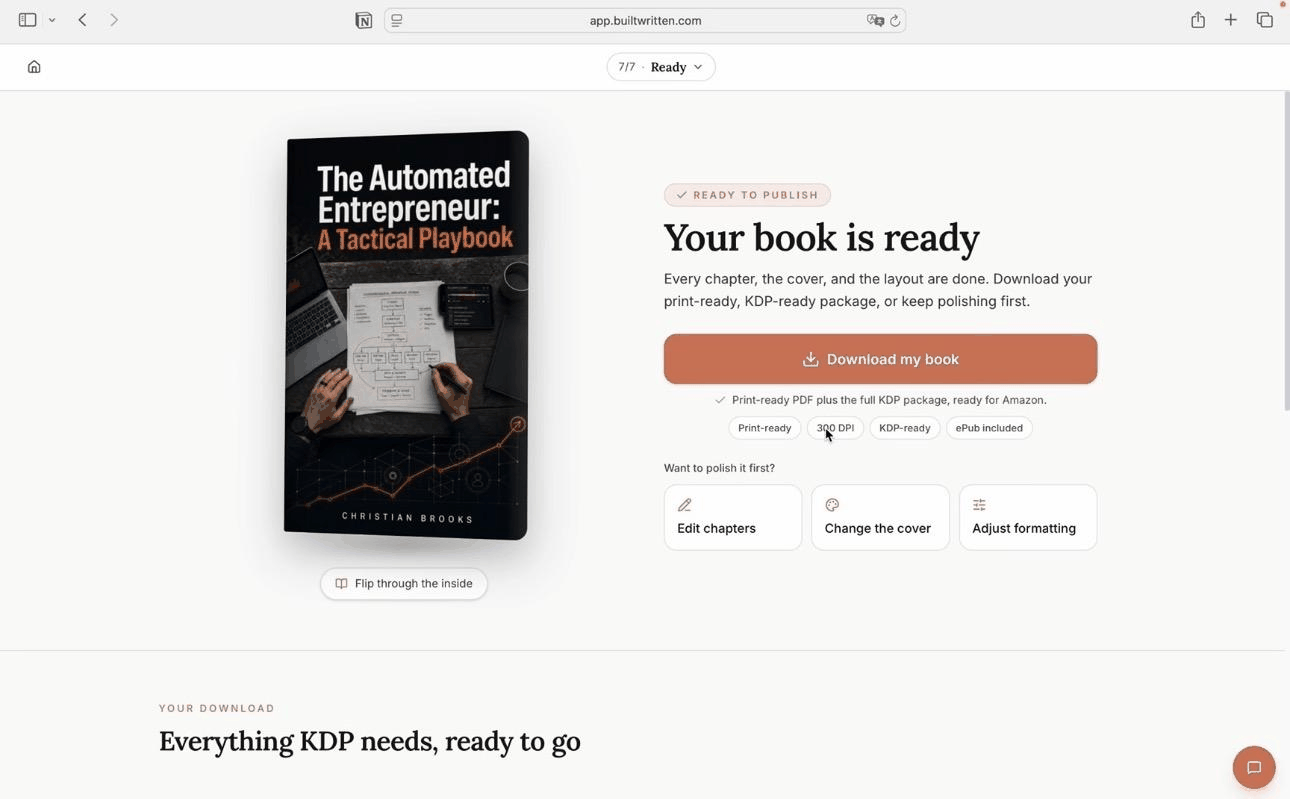
Every platform here asks for the same two files: an EPUB for the ebook and a print-ready PDF for the paperback. Built&Written exports both from the book you wrote or imported, plus a DOCX.
- Ebook, on every platform here: the ePub export uploads as-is. KDP, B&N Press, and Draft2Digital also accept DOCX and convert it themselves.
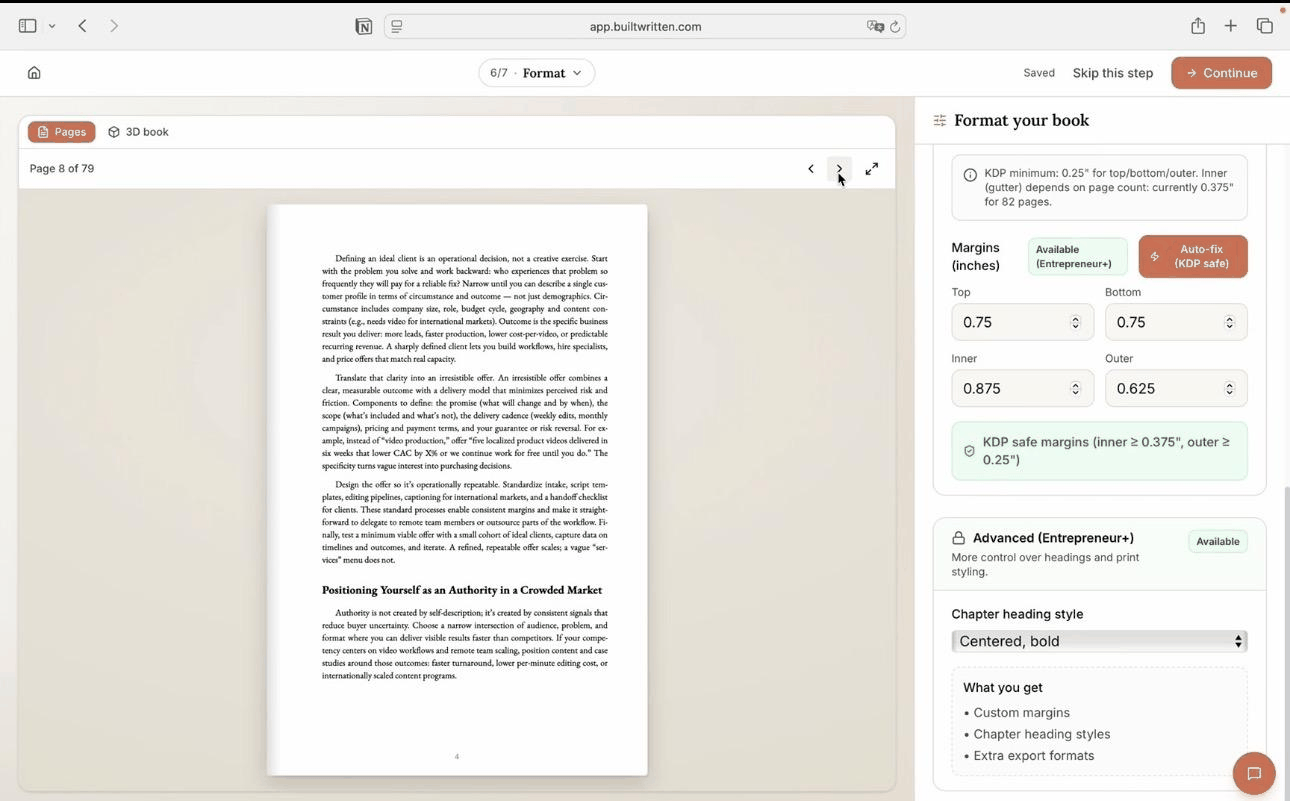
- Paperback on KDP: the print PDF is built to KDP's trim sizes and margins, and the cover's spine width is calculated from your page count.
- Paperback on IngramSpark, Lulu, or B&N Press: the interior PDF works at the same trim size with fonts embedded. Build the cover on each printer's own template, because IngramSpark requires its own barcode area and spine math.
The part no platform does is the book itself. If yours still lives in LinkedIn posts, workshop notes, or call transcripts, Built&Written's Wren structures that material into chapters, drafts them in your voice with Voice DNA, then fixes KDP-safe margins in one click before export.
Final thoughts
Choosing a platform takes an afternoon. Start on KDP, add IngramSpark or Draft2Digital when you have a reason, and own your ISBN if you plan to go wide.
The slow part is the book those platforms are waiting for. If you have the expertise and the raw material but no manuscript yet, that's the step to start with.
Frequently asked questions
The one where your readers buy. For most nonfiction authors that's Amazon KDP: no upfront fees, the largest online bookstore, and the highest per-copy royalty, about $5.59 on a 200-page paperback at $14.99. Add IngramSpark for bookstores and libraries.
Yes. None of the seven requires exclusivity by default. Only KDP Select does, and only for the ebook, in 90-day terms. Use one ISBN you own across platforms so the same edition isn't split into several listings.
KDP pays more per copy and reaches Amazon's readers. IngramSpark reaches 45,000+ retailers and libraries but pays less once the wholesale discount comes out. Most nonfiction authors start on KDP and add IngramSpark later.
Amazon KDP, B&N Press, and Kobo Writing Life charge nothing to publish. IngramSpark is free to set up but takes 1.875% of list price per sale. Lulu charges $4.99 per title for distribution review, Draft2Digital a one-time $20, and BookBaby $299 for ebook distribution (checked September 28, 2026).
Not to publish, but it's the cleaner route. Free ISBNs from KDP, B&N Press, and IngramSpark each work only on that platform. A purchased ISBN keeps one edition under one number everywhere.
Sources & References
About the author

Khrystyna Balushka
More in Self-Publishing
Ready to write your book?
Turn your expertise into a professional book with Built&Written.