

About the Author Pages That Get Experts Hired, With Examples
Most About the Author pages answer one question: Who wrote this book?
For an expert, that is not enough.
A business book is often read by potential clients, event organizers, podcast hosts, journalists, partners, and people deciding whether the author knows enough to help them. The author page is one of the few places in the book where you can turn that interest into a next step.
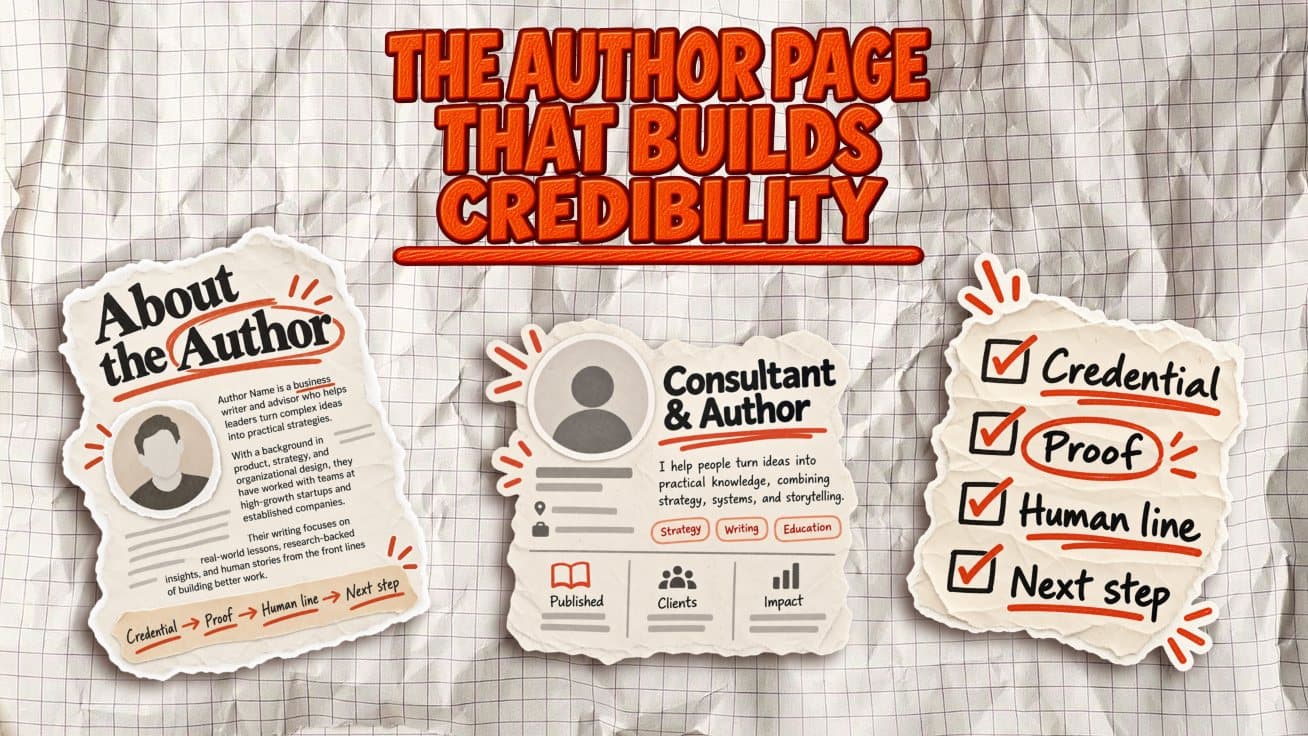
That does not mean stuffing the page with awards, job titles, and every company you have worked with. The strongest author bios do four things: establish the right credential, prove it with something concrete, add one human detail, and tell the reader where to go next.
The exact version changes depending on where it appears. A 60-word back-cover bio has a different job from an Amazon Author Central profile or a LinkedIn About section. But the underlying test stays the same: after reading it, does someone understand why you are credible, what you are known for, and what they can do next if they want more from you?
Below, we will look at real author bios from business books, break down what works in them, and turn those patterns into a template you can use for your own book.
What should an About the Author page include?
A strong About the Author page does not need your full career history.
For an expert, the useful structure is:
Credential → Proof → Human line → Next step
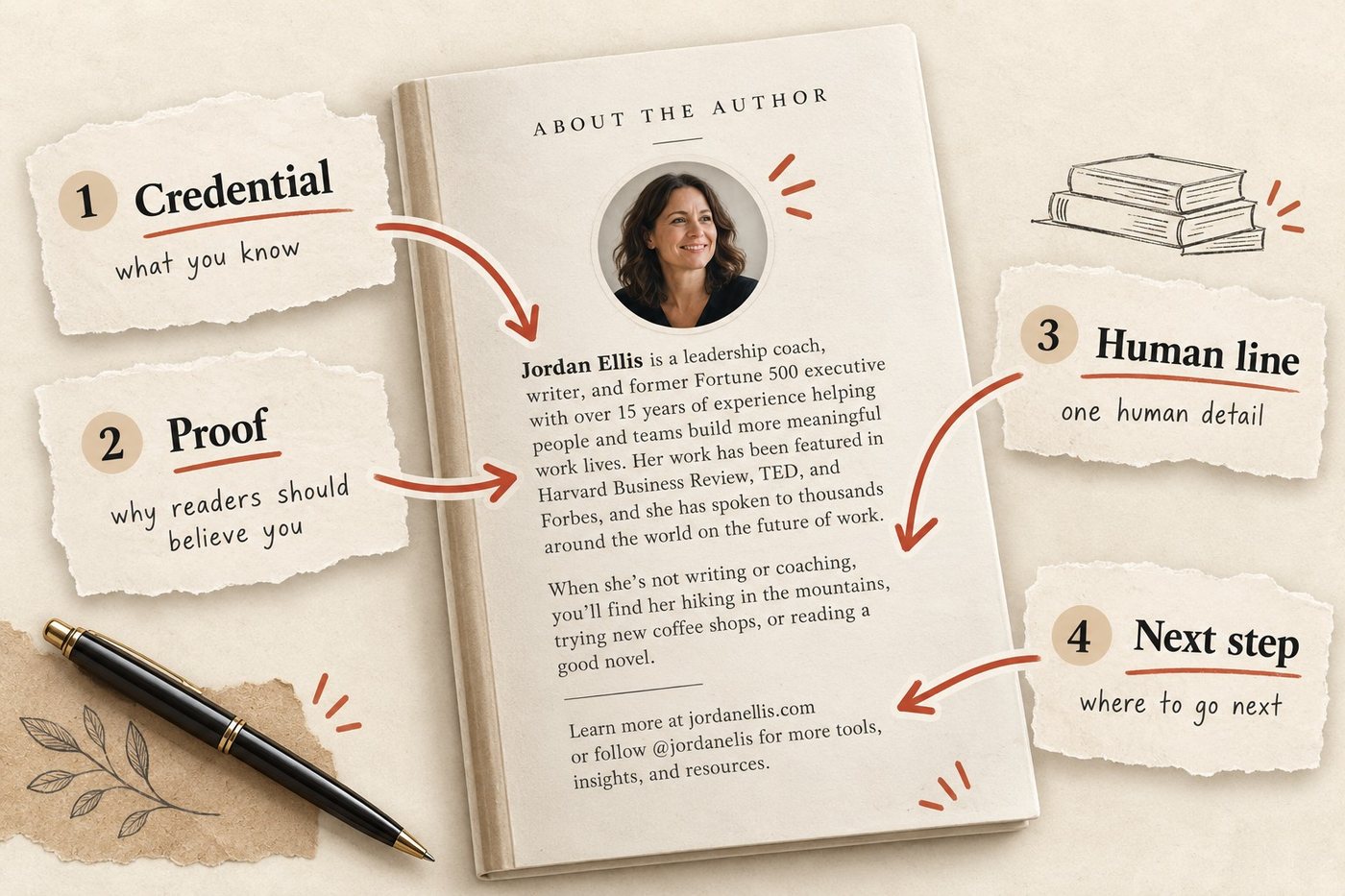
Each part answers a different question in the reader’s head.
| Part | What it does | What to include |
|---|---|---|
| Credential | Establishes why you are qualified to write the book | Your role, field, specialist expertise, or relevant experience |
| Proof | Shows that the credential is real | Clients, results, companies, publications, awards, research, audience, or years of experience |
| Human line | Makes you sound like a person rather than a résumé | A short detail about where you live, what you care about, or what sits outside your work |
| Next step | Gives interested readers somewhere to go | Your website, newsletter, company, speaking page, LinkedIn, or another clear destination |
The order matters.
Start with the credential because the reader needs context. Then add proof, because titles alone are easy to claim. The human line gives the bio some texture, but it should stay brief. Finally, give the reader a next step.
For example, “Jane Smith is a leadership consultant” is a credential. “She has advised executive teams at three Fortune 500 companies” is proof. “She lives in Austin and spends weekends restoring old motorcycles” is the human line. “Learn more at janesmith.com” is the next step.
The mistake is treating all four parts as equally important. They are not. For a business author, credential and proof should do most of the work. The human detail should make the bio more memorable, not derail it. And the next step should be specific enough that a reader knows what to do with their interest.
A useful test is this: if someone reads only your About the Author page, can they tell what you know, why they should believe you, and where to find you next?
If not, the bio is probably describing you without positioning you. That distinction matters for author credibility in business, where relevant evidence carries more weight than an impressive-sounding title.
About the Author examples from real business books
There is no single formula for a good author bio. Some lead with credentials, some with results, and some deliberately show more personality. What the stronger examples have in common is selectivity: they choose the details that reinforce what the author wants to be known for.
Here are six real examples.
1. Chris Voss, Never Split the Difference
“Chris Voss spent 24 years working for the FBI, culminating in him becoming the bureau's lead international hostage negotiator.”
That first sentence does almost everything a business author needs from a credential. It is specific, relevant to the subject of negotiation, and difficult to dismiss. The rest of the bio connects that experience to teaching at Georgetown and Harvard and to Voss's consulting work through the Black Swan Group.
Why it works: the credential is also the proof. Voss does not need several paragraphs explaining why readers should trust him on negotiation.
2. Donald Miller, Building a StoryBrand
“Donald Miller has helped more than 3,000 businesses clarify their marketing messages so their companies grow.”
Miller leads with an outcome, not an academic qualification. The bio then identifies him as CEO of StoryBrand, mentions his bestselling books, and closes with a personal detail about his life in Nashville.
Why it works: “3,000 businesses” turns a broad claim about marketing expertise into something concrete. It shows the scale of his experience before listing titles.
3. Michael Bungay Stanier, The Coaching Habit
“His books have sold over a million copies, with The Coaching Habit topping the Wall Street Journal bestseller list.”
Stanier's bio combines conventional authority with deliberately unconventional details. It establishes his work in coaching, his company, clients, media appearances and book sales, then moves into stories about digging holes, writing fiction and helping create stuffed-crust pizza.
Why it works: the unusual human details arrive after the proof. They make him memorable without asking personality to substitute for credibility.
4. Simon Sinek, Start With Why
“He teaches leaders and organizations how to inspire people.”
Sinek's bio is built around one clear territory: leadership and inspiration. It then widens the proof, noting that he has presented to organizations ranging from startups and Fortune 50 companies to Congress and the Pentagon. The final sentence sends readers directly to StartWithWhy.com.
Why it works: everything reinforces the same positioning. Just as importantly, the bio contains a clear next step instead of ending once the credentials are established.
5. Seth Godin, This Is Marketing
“He writes the most popular marketing blog in the world and speaks to audiences around the world.”
Godin's bio stacks several different kinds of proof: bestselling books, his blog, speaking, the altMBA, Squidoo, Yahoo and Yoyodyne. Then it finishes with a direct invitation to learn more at his website.
Why it works: the details all point back to the same subject. It is a long résumé compressed into evidence for one proposition: Seth Godin knows marketing.
6. Greg McKeown, Essentialism
“Greg McKeown was named a Young Global Leader by the World Economic Forum.”
The bio follows that credential with his role as CEO of a leadership and strategy firm, companies where he has taught, his Stanford MBA, and a short line about his family and where he lives.
Why it works: McKeown mixes third-party validation with practical experience. The family line softens what could otherwise read like a sequence of institutional credentials.
What these examples have in common
Voss leads with highly relevant professional experience. Miller quantifies his results. Sinek and Godin reinforce clearly defined areas of expertise. Stanier uses personality after establishing credibility. McKeown relies on third-party recognition to strengthen his professional credentials.
Each approach is different, but the principle is the same: choose the evidence that makes the subject of your book more believable.
That is the useful lesson for an expert writing their own page: do not ask what achievements deserve to be mentioned. Ask which details make the positioning of this particular book more believable.
Your About the Author page is not the place for everything impressive about you. It is the place for the few things that make the reader understand why you wrote this book.
How Long Should an Author Bio Be?
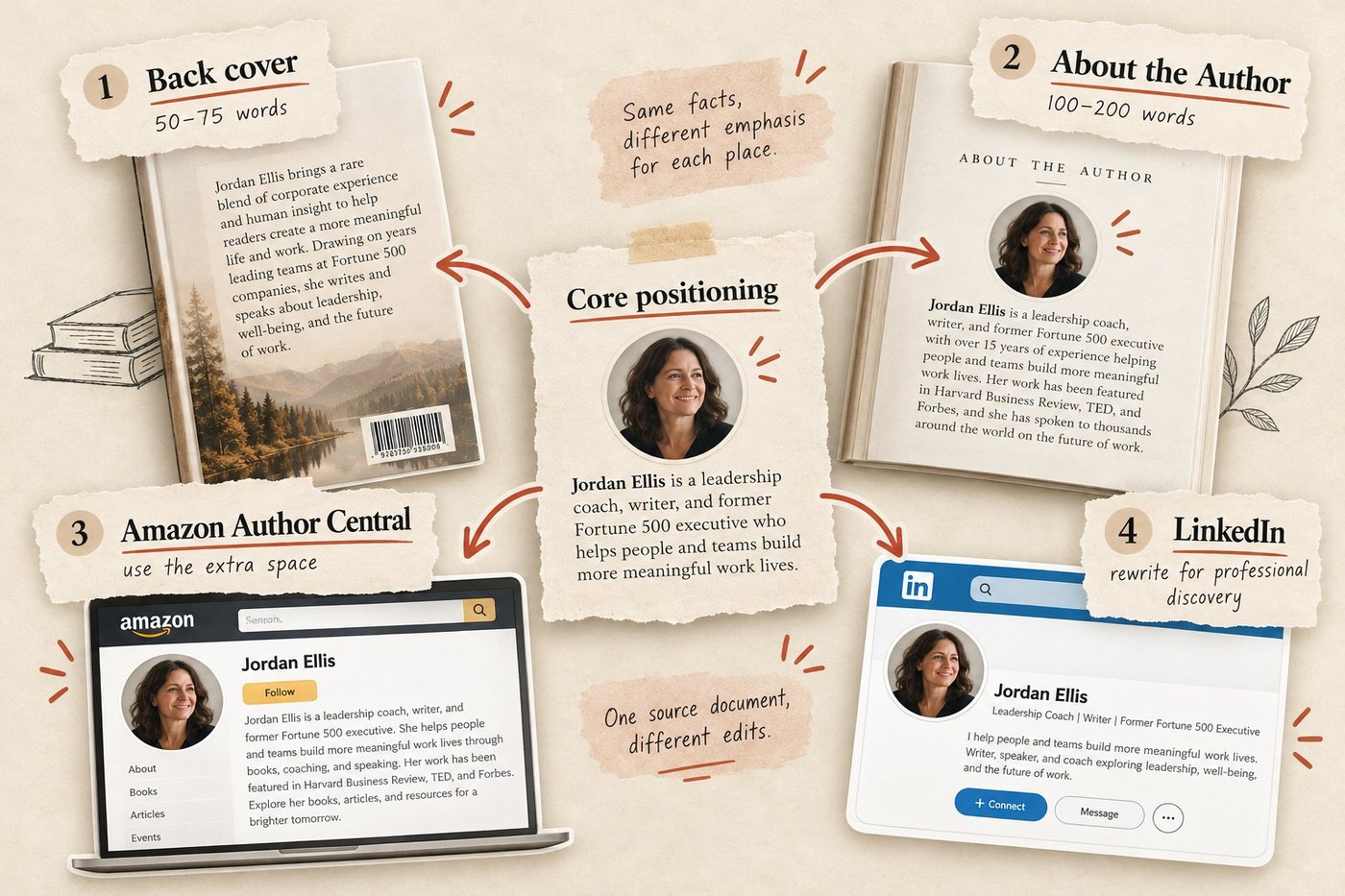
You do not need one author bio. You need a few versions of the same positioning.
The mistake is writing a long biography once, then pasting it everywhere. A back cover, an About the Author page, Amazon, and LinkedIn all give the reader different amounts of space and different reasons to care.
| Version | Good working length | What it should do |
|---|---|---|
| Back cover | 50 to 75 words | Establish credibility quickly and support the sale |
| Book/About the Author page | 100 to 200 words | Add proof, personality, and a clear next step |
| Amazon Author Central | Longer and more complete | Connect your books, expertise, background, and author identity |
| Adapt to the platform | Help clients, partners, and event organizers understand what you do now |
Back cover bio: 50 to 75 words
The back cover is not the place for your whole career.
Readers may be deciding whether to buy the book, so the bio needs to answer one thing quickly: why is this person worth listening to on this subject?
Lead with your strongest credential, add one or two pieces of proof, and stop. If your bio is competing with the book description for space, it is probably too long.
We cover the rest of that page in our guide to the back cover of a book.
About the Author page: 100 to 200 words
Inside the book, you have more room.
This is where the full Credential → Proof → Human line → Next step structure works best. You can explain your expertise, include a few selective achievements, add a line that makes you more memorable, and give readers somewhere to continue the relationship.
For most business authors, 100 to 200 words is enough. Go longer only when the background itself is unusually important to the book.
Amazon Author Central: use the extra space
Your Amazon Author Central bio can be more complete because the reader has already clicked through to learn about you.
That gives you room to connect your books to the broader work you do: consulting, speaking, research, a company, a newsletter, or another area of expertise. You can also give more context than you would on a back cover.
Do not simply paste the longest version of your book bio. Write for someone who may have found one of your books first and now wants to understand the author behind it.
For the setup itself, see our guide to Amazon Author Central.
LinkedIn: rewrite it for professional discovery
LinkedIn has a different job again.
Someone reading your LinkedIn profile may be considering hiring you, inviting you to speak, referring you, or trying to understand what you actually do. Your book is useful proof, but it should not necessarily be the center of the whole profile.
Instead of copying your book bio word for word, adapt the positioning:
- Say what you help people or companies do.
- Use the book as evidence of expertise.
- Add results, clients, or areas of specialization where relevant.
- Make the next step obvious.
The facts can stay the same. The emphasis should change.
Think of these versions as one source document with different edits, not four unrelated biographies. Your credentials and proof should remain consistent. What changes is how much context the reader needs and what you want them to do next.
Should an author bio be written in first or third person?
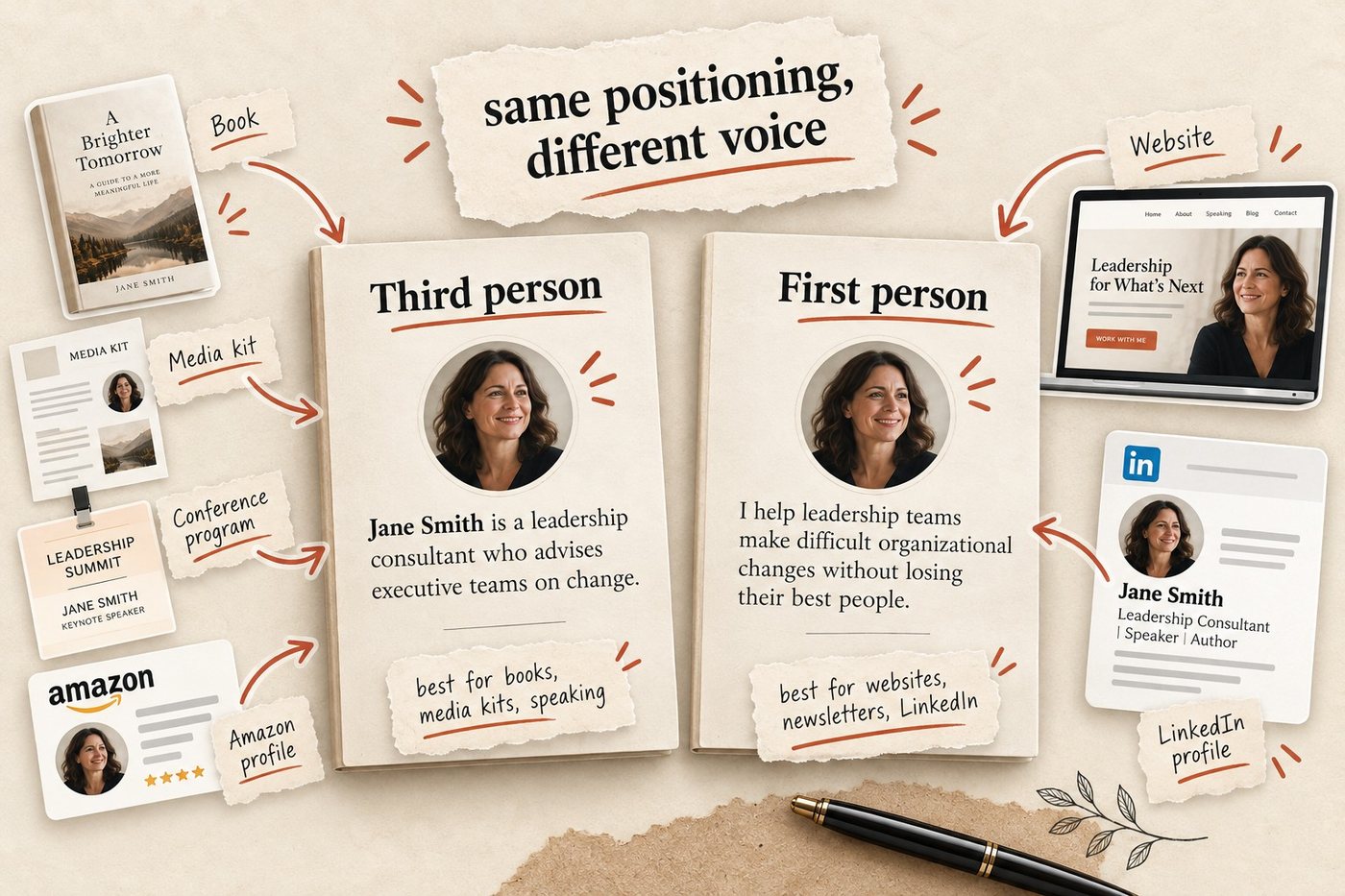
Use third person when someone else is effectively introducing you. Use first person when you are speaking directly to the reader.
That rule resolves most cases.
For books, back covers, media kits, conference programs, speaking introductions, and Amazon author profiles, third person usually feels more natural:
Jane Smith is a leadership consultant who advises executive teams on organizational change.
It reads like editorial information about the author and can be reused easily by publishers, journalists, event organizers, and podcast hosts.
First person fits better on your own website or a LinkedIn About section, where the reader expects to hear from you directly:
I help leadership teams make difficult organizational changes without losing their best people.
The first-person version is not less professional. It simply creates a different relationship with the reader.
| Use third person for | Use first person for |
|---|---|
| About the Author page in a book | Personal website |
| Back-cover bio | LinkedIn About section |
| Amazon author profile | Founder or consultant profile written in your own voice |
| Media kit | Newsletter author page |
| Speaker introduction | Other direct-to-reader pages |
Whichever version you choose, do not change the underlying positioning. Your credentials, proof, and area of expertise should stay consistent.
For most business books, third person is the safest default for the About the Author page. It also makes the bio much easier for someone else to copy when they need to introduce you.
A fill-in-the-blank About the Author template
Start with the version you actually need. For most experts, that means keeping one short bio for tight spaces and one fuller bio for the book itself.
Short author bio template
Use this for a back cover, event page, or other space where you only have around 50 to 75 words.
[Name] is a [role/profession] who helps [audience] [result]. [He/She/They] has [specific proof: advised X companies, led Y projects, worked with Z clients, built a company, published research, etc.]. [Name] is the author of [Book Title] and [optional second credibility point]. Learn more at [website].
Example structure:
Maya Chen is a pricing strategist who helps B2B software companies improve revenue without relying on discounting. She has advised more than 40 growth-stage companies across the US and Europe. She is the author of Pricing Without Guesswork. Learn more at mayachen.com.
Full About the Author template
Use this inside the book when you have room for proof, personality, and a clear next step.
[Name] is a [role/profession] specializing in [specific area of expertise]. [He/She/They] helps [audience] [specific result or transformation].
Over the past [number] years, [Name] has [strongest proof point]. [He/She/They] has also [second proof point: worked with notable organizations, founded a company, led teams, published research, taught, spoken, advised, or achieved a measurable result].
[Human line: Name lives in X, spends time doing Y, or cares deeply about Z outside work.]
To [work with / follow / learn more from] [Name], visit [website, newsletter, company, LinkedIn, or other destination].
The important part is not filling every blank. It is choosing the strongest evidence.
If you have three degrees, 20 clients, five awards, and two companies, you probably should not mention all of them. Pick the details that make the subject of the book more credible.
A good template gives you structure. It should not make the finished bio sound templated.
Three author bio mistakes that cost experts credibility
A weak author bio usually does not fail because the writer lacks experience. It fails because the experience is presented badly.
For experts, three mistakes show up repeatedly.
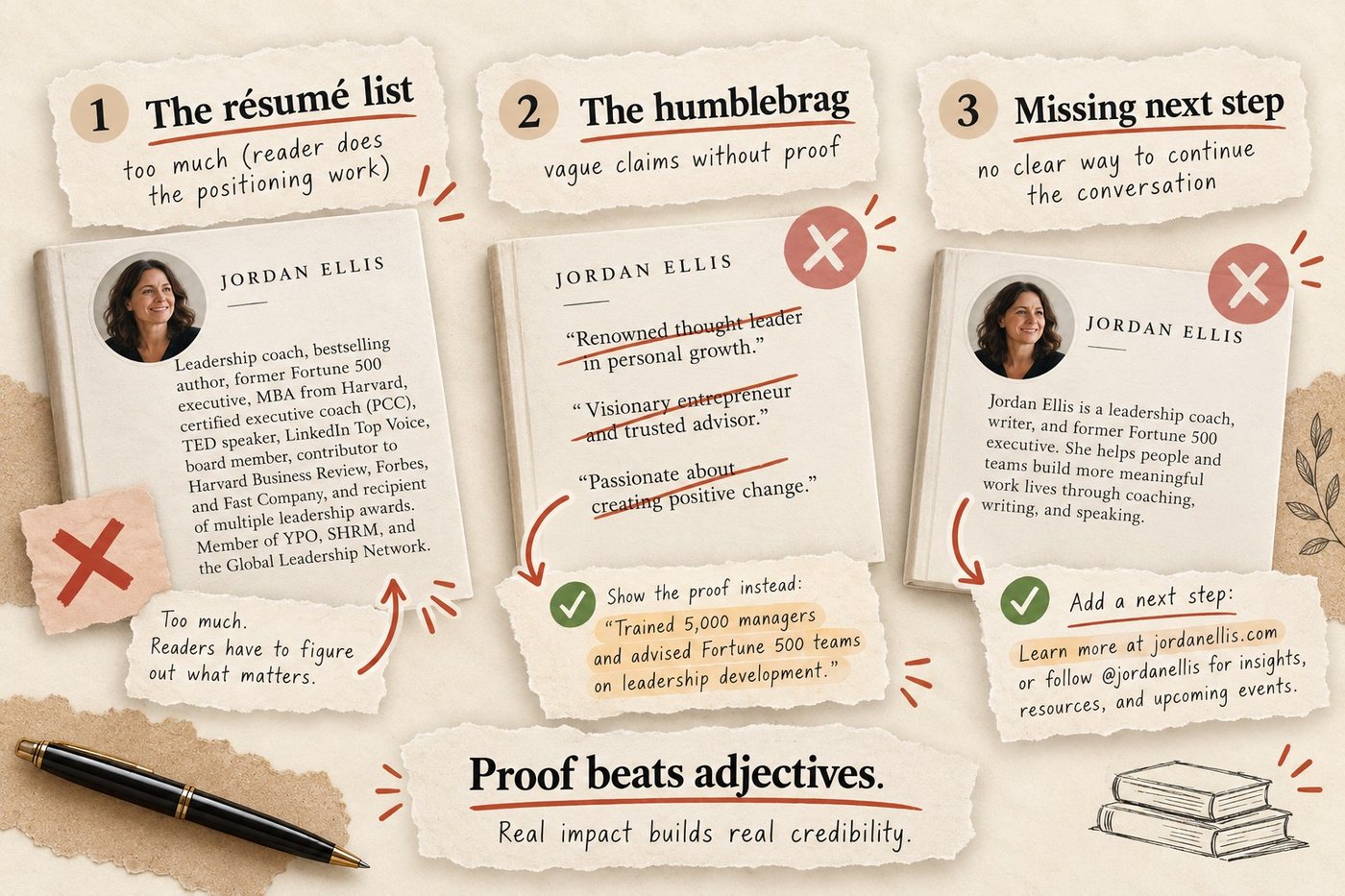
1. The résumé list
This is the bio that tries to include everything: degrees, job titles, certifications, companies, awards, boards, memberships, publications, and conference appearances.
The problem is not that any of those details are bad. The problem is that a long list makes the reader do the positioning work.
Instead of asking, “What have I done?”, ask:
Which two or three facts best prove that I know this subject?
A book about pricing does not need your complete employment history. A leadership book does not need every certification you have collected. Select the evidence that supports the promise of the book and cut the rest.
That same principle matters beyond the author page. A strong personal brand around your book becomes easier to understand when the same area of expertise shows up consistently across the book, website, LinkedIn, and speaking profile.
2. The humblebrag
The opposite problem is trying to sound impressive without saying anything concrete.
Phrases such as “highly sought-after expert,” “renowned thought leader,” or “visionary entrepreneur” are claims, not proof.
Specifics are stronger.
“Advises leadership teams at Fortune 500 companies” gives the reader something to evaluate. “Built and sold two software companies” does too. So does “has trained more than 5,000 managers.”
You do not need to make yourself sound important. You need to make your expertise easy to verify.
That distinction is central to author credibility in business: credibility comes from relevant evidence, not from increasingly grand adjectives.
3. The missing next step
This is the easiest mistake to fix.
A reader finishes the bio interested in the author, but there is nowhere obvious to go.
No website. No company. No newsletter. No speaking page. No indication that the author actually works with clients.
For an expert using a book as part of a business, that is a missed opportunity.
The call to action does not need to sound promotional. A simple line such as “Learn more at…”, “For speaking and consulting…”, or “Find additional resources at…” is enough.
The goal is not to turn the author page into an advertisement. It is to make sure that when the book creates interest, the reader does not have to search for what comes next.
The best author bios remove friction in both directions: they make it easy to understand why the author is credible and easy to act on that credibility.
Frequently asked questions
Start with your professional role and relevant expertise. Add one or two achievements that establish credibility, a personal detail if it helps, and a clear next step such as a website or contact page.
For a nonfiction or business book, 100 to 200 words is a useful starting point. Back-cover author bios are generally shorter, often around 50 to 75 words. Neither range is a strict requirement.
Third person is generally preferred for books, back covers, media kits, and speaking introductions. First person works well on personal websites, newsletters, and LinkedIn profiles.
No. An author photo is optional, but a professional image can help readers recognize the author and connect their identity to their expertise.
It usually appears in the back matter, after the main text, often near the acknowledgments, references, or other closing sections. Placement varies by book.
No. A back-cover bio is shorter and helps establish credibility before purchase. An interior About the Author page can provide more professional background, personality, and contact information.
Yes. A short website address or QR code can direct interested readers to your services, speaking page, or additional resources. For ebooks, use clickable links and test them before publication.
Sources & References
- Chris Voss, Never Split the Difference (Random House Business Books, 2017, ISBN 9781847941497)
- Donald Miller, Building a StoryBrand (HarperCollins, 2017, ISBN 9780718033323)
- Michael Bungay Stanier, The Coaching Habit (Page Two, 2026, ISBN 9781774586655)
- Simon Sinek, Start With Why (Penguin, 2009, ISBN 9781101149034)
- Seth Godin, This Is Marketing (Penguin, 2018, ISBN 9780525540847)
- Greg McKeown, Essentialism (Ebury, 2014, ISBN 9780753550281)
About the author

Polina Karlashchuk
More in Writing
Ready to write your book?
Turn your expertise into a professional book with Built&Written.