

Parts of a Book, in Order: Front Matter to Back Matter
The three main parts of a book are front matter, body matter, and back matter. Front matter appears before the main text and usually includes pages such as the title page, copyright page, table of contents, foreword, preface, and introduction. Body matter contains the book's core chapters or sections. Back matter follows the main text and may include acknowledgments, appendices, a glossary, references, an index, and an author bio.
A common order of the parts of a book is:
Half title → Title page → Copyright → Dedication → Table of contents → Foreword → Preface → Introduction → Chapters → Epilogue or conclusion → Acknowledgments → Appendix → Glossary → Index → About the author
However, not every book needs every section, and many of these parts are optional.
This article explains every major part of a book in order, what each section does, which ones are optional, and which elements matter when preparing a book for Amazon KDP.
What are the main parts of a book?
The main parts of a book are front matter, body matter, and back matter. These three sections organize everything from the title page to the final index or author bio.
| Part | What it includes | Purpose |
|---|---|---|
| Front matter | Title page, copyright page, dedication, table of contents, foreword, preface, introduction | Introduces the book and gives readers important context before the main content |
| Body matter | Chapters, sections, conclusion or epilogue | Contains the book's main content |
| Back matter | Acknowledgments, appendix, glossary, index, about the author | Adds supporting information after the main text |
For nonfiction books, this structure is flexible. Chapters are essential, but many front- and back-matter sections are optional. A book may need a table of contents and an appendix, for example, while having no foreword, dedication, glossary, or index.
The best structure depends on what helps the reader. Each section should have a clear purpose rather than being included simply because it appears in a traditional book layout.
Front matter: what goes before Chapter 1?
Front matter is everything that appears before the main body of a book begins. It introduces the book, provides publication details, and gives readers any context they need before reaching the first chapter. Amazon KDP notes that many front-matter elements are optional, so nonfiction authors do not need to include every section listed below.
A typical nonfiction book may include these parts in order:
- Half title: A simple page showing only the book title.
- Title page: Lists the full title, subtitle, author name, and sometimes the publisher.
- Copyright page: Contains copyright information, publication details, ISBN, edition information, and other legal notices.
- Dedication: A short message dedicating the book to a person or group.
- Table of contents: Lists the chapters and major sections so readers can see and navigate the book's structure.
- Foreword: An introduction written by someone other than the author, often to establish credibility or explain why the book matters.
- Preface: A note from the author explaining why the book was written, how it came together, or what readers should know about its background.
- Introduction: Prepares the reader for the subject and usually begins the book's actual argument, problem, or teaching.
The last three are easy to confuse. A foreword is written by someone else, a preface is the author talking about the book, and an introduction starts talking about the subject of the book.
You do not need all eight. For many practical nonfiction books, a title page, copyright page, table of contents, and introduction provide enough front matter, while a dedication, foreword, preface, or half title can be added when they serve a clear purpose. Amazon's own paperback guidance uses a conventional front-matter sequence but also stresses that many of these elements are optional.
Body matter: where the actual book begins
Body matter is the main content of the book. In nonfiction, this is where the author develops the argument, teaches the subject, presents the research, or guides the reader through the core ideas.
The body usually includes:
- Chapters: The main sections that organize the book's ideas, arguments, stories, or instructions.
- Conclusion or epilogue: A final section that closes the main content, summarizes the argument, or shows what comes next.
Of these, chapters are the essential part. A nonfiction book may work perfectly well without a formal introduction or epilogue, but it still needs a clear structure for the main content.
The number and length of chapters depend on the book, but each chapter should have a distinct job and move the reader forward. A good chapter structure also makes the book easier to navigate, revise, and format before publishing.
Back matter: what comes after the main text?
Back matter is the material that appears after the main body of a book. Its purpose is to support the reader with extra information, references, definitions, or details about the author.
Common back-matter sections include:
- Acknowledgments: Thanks the people, organizations, or collaborators who helped create the book.
- Appendix: Adds supporting material that would interrupt the flow of the main chapters, such as data, templates, examples, or technical details.
- Glossary: Defines specialized terms, abbreviations, or concepts used throughout the book.
- Index: Lists important topics and the pages where readers can find them.
- About the author: Gives readers a short biography and may point them toward the author's website, newsletter, or other work.
Not every nonfiction book needs all of these sections. An appendix is useful when readers need extra reference material, while a glossary makes more sense for books that use technical or unfamiliar terminology. An index is especially useful in books readers are likely to consult repeatedly rather than read only once.
Acknowledgments can appear in either front matter or back matter. Nonfiction books sometimes place them before the introduction, while other authors put them after the main text. The author bio, and index are more consistently treated as back matter.
Which parts of a book does Amazon KDP actually require?
Amazon KDP does not require authors to reproduce every traditional part of a book. For paperbacks, Amazon describes many front-matter and back-matter elements as optional and recommends choosing them according to the type of book and what readers expect.
That means a paperback does not need a half title, dedication, foreword, preface, acknowledgments, glossary, index, or similar section simply because those elements appear in traditional book layouts.
The rules are more specific for Kindle navigation. Amazon requires Kindle eBooks to include a working logical table of contents so readers can navigate between chapters or sections from the Kindle interface. A visible HTML table of contents near the beginning of the ebook is also strongly recommended.
| Element | Paperback | Kindle eBook |
|---|---|---|
| Half title | Optional | Optional |
| Title page | Conventional and recommended | Should include one |
| Copyright page | Worth including | Worth including |
| Dedication | Optional | Optional |
| Table of contents | Worth including | Worth including |
| Logical/navigation TOC | Not applicable | Required |
| Foreword or preface | Optional | Optional |
| Acknowledgments | Optional | Optional |
| Appendix | Optional | Optional |
| Glossary | Optional | Optional |
| Index | Optional | Optional |
| About the author | Worth including | Worth including |
KDP is stricter about the technical preparation of the file than about whether every traditional book section is present. Print books must meet requirements for dimensions, margins, bleed, fonts, images, and cover files, while Kindle books also need functioning navigation.
So when deciding which book parts to include, start with the reader and the format. Include a section because it helps readers understand, navigate, verify, or continue engaging with the book, not simply because traditional publishing gives that section a name.
Which book parts do you actually need for a nonfiction book?
A nonfiction book does not need every traditional section. In most cases, you can divide the parts into three groups: core, recommended, and optional.
| Level | Book parts | Why they matter |
|---|---|---|
| Core | Main body, usually chapters or clearly organized sections | These identify the book and contain its main content |
| Usually worth including | Title page, copyright page, table of contents for nonfiction, introduction, about the author | They make the book easier to navigate, understand, and publish professionally |
| Optional | Half title, dedication, foreword, preface, conclusion or epilogue, acknowledgments, appendix, glossary, index | Include them only when they serve the reader or the subject |
For most practical nonfiction books, a simple structure can work well:
Title page → Copyright page → Table of contents → Introduction → Chapters → Conclusion → Acknowledgments → About the author
From there, add extra sections only when they solve a real problem. A technical book may need a glossary. A research-heavy book may benefit from an appendix or index. A book written by an industry expert may gain credibility from a foreword by another recognized person.
The main rule is simple: every section should have a job. Adding more book parts does not automatically make a nonfiction book look more professional. A clear, useful structure usually matters more than following every traditional convention.
Printable book-parts checklist
Use this checklist to plan the structure of your nonfiction book. You do not need to include every item. Check only the sections that serve a clear purpose for your reader.
Front matter
- Half title
- Title page
- Copyright page
- Dedication
- Table of contents
- Foreword
- Preface
- Introduction
Body matter
- Chapters
- Conclusion or epilogue
Back matter
- Acknowledgments
- Appendix
- Glossary
- Index
- About the author
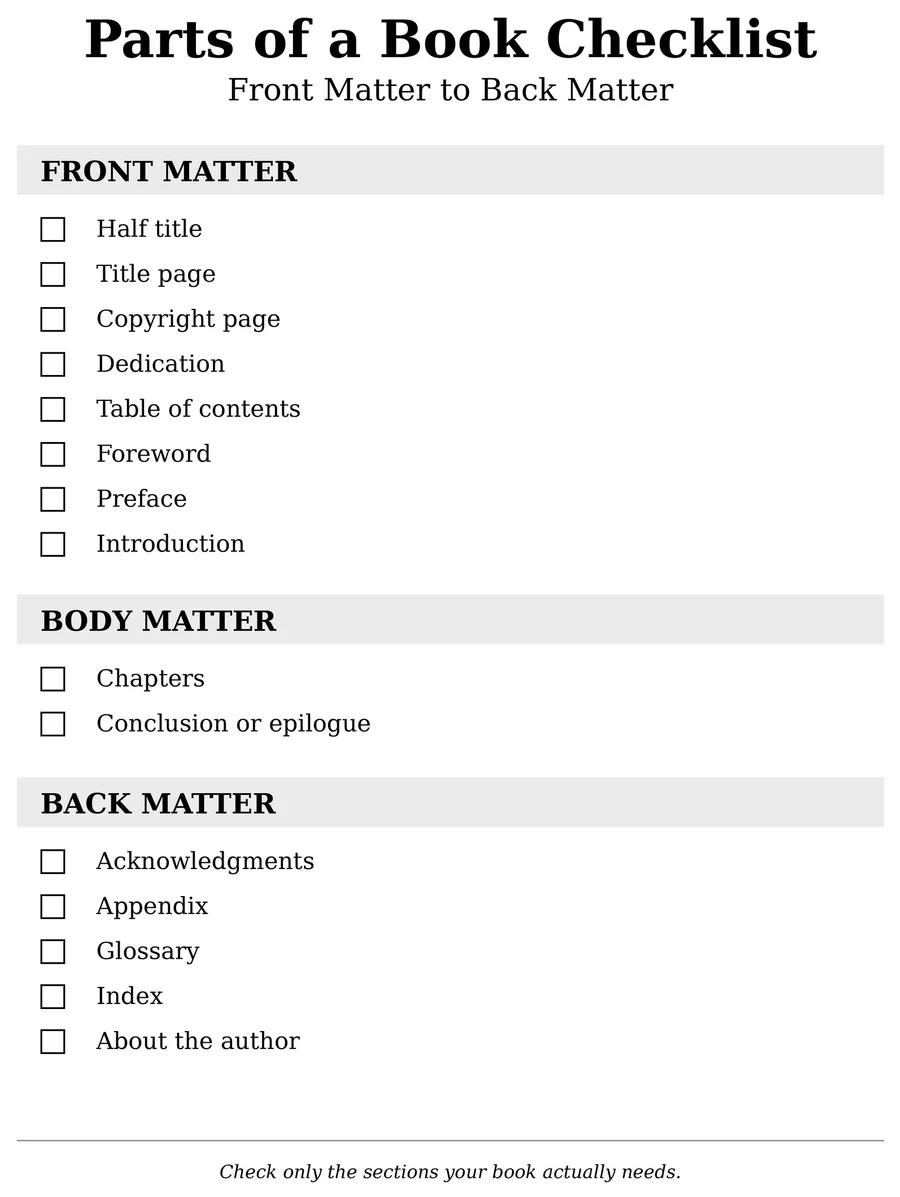
A simple nonfiction book may only need a title page, copyright page, table of contents, introduction, chapters, conclusion, and author bio. More specialized books can add a glossary, appendix, index, foreword, or other sections where they are useful.
Before formatting the manuscript, put the selected sections in their final order. This makes it easier to spot missing pages, unnecessary sections, or parts that belong somewhere else in the book.
How to put your book together for publishing
Once you know which parts your book needs, the next step is to assemble them in the right order and format the manuscript for publication.
- Choose the sections your book actually needs. Start with the essentials, then add optional parts such as a foreword, appendix, glossary, or index only when they help the reader.
- Put every section in its final order. Arrange the front matter, body matter, and back matter before you begin final formatting. This helps prevent missing pages, repeated sections, and last-minute structural changes.
- Format the complete manuscript. Apply consistent chapter headings, page breaks, margins, typography, page numbers, and navigation. The exact requirements will depend on whether you are publishing a paperback, hardcover, or eBook.
- Check the finished book before publishing. Review the table of contents, chapter order, page breaks, links, headers, and back matter in the final export, not only in the original manuscript.
Formatting software can simplify this process by turning a finished manuscript into a publication-ready file without requiring you to lay out every page manually.
The structure should be settled before the final formatting stage. It is much easier to move, remove, or add sections before the book has been fully laid out.
Frequently asked questions
What are the main parts of a book?
A book is usually divided into three sections: front matter, body matter, and back matter. Front matter comes before the main text, body matter contains the core content, and back matter appears after the main text.
What order do the parts of a book go in?
A common order is: title page, copyright page, dedication, table of contents, foreword, preface, introduction, chapters, conclusion or epilogue, acknowledgments, appendix, glossary, index, and about the author. Not every book includes every section.
What is the front matter in a book?
Front matter is everything that appears before the main body. It can include the half title, title page, copyright page, dedication, table of contents, foreword, preface, and introduction.
What is the body matter in a book?
Body matter is the book's main content. In nonfiction, it usually consists of chapters, sections, and conclusion.
What is the back matter in a book?
Back matter is the material that comes after the main text. Common examples include acknowledgments, appendices, glossaries, indexes, references, and an about-the-author page.
Which parts of a nonfiction book are optional?
Most front- and back-matter sections are optional. Elements such as a dedication, foreword, preface, acknowledgments, appendix, glossary, and index should be included only when they serve a clear purpose for the reader.
Does every book need a table of contents?
Not always. Print books can omit one when it does not add value, but Kindle eBooks with chapters or sections need a working logical table of contents for navigation. Kindle Create builds that navigation automatically from your chapter headings.
Frequently asked questions
A book is usually divided into three sections: front matter, body matter, and back matter. Front matter comes before the main text, body matter contains the core content, and back matter appears after the main text.
A common order is: title page, copyright page, dedication, table of contents, foreword, preface, introduction, chapters, conclusion or epilogue, acknowledgments, appendix, glossary, index, and about the author. Not every book includes every section.
Front matter is everything that appears before the main body. It can include the half title, title page, copyright page, dedication, table of contents, foreword, preface, and introduction.
Body matter is the book's main content. In nonfiction, it usually consists of chapters, sections, and conclusion.
Back matter is the material that comes after the main text. Common examples include acknowledgments, appendices, glossaries, indexes, references, and an about-the-author page.
Most front- and back-matter sections are optional. Elements such as a dedication, foreword, preface, acknowledgments, appendix, glossary, and index should be included only when they serve a clear purpose for the reader.
Not always. Print books can omit one when it does not add value, but Kindle eBooks with chapters or sections need a working logical table of contents for navigation.
About the author

Polina Karlashchuk
Ready to write your book?
Turn your expertise into a professional book with Built&Written.