
Who Owns a Book You Wrote With AI, and Can You Copyright It?
In this article you will learn:
- the difference between owning a book and copyright;
- what the US Copyright Office says about AI text;
- what ChatGPT did with our notes, sentence by sentence;
- how to register copyright for a book with AI text;
- how to turn your notes and posts into a book.
Key takeaways
- Who owns it? You do. Built&Written, a book platform, says the books you create stay yours, and ChatGPT's terms say you own what it writes for you.
- Can you copyright a book written with AI? The parts you wrote or shaped, yes. Text the AI wrote alone, no, says the US Copyright Office.
- Is a good prompt enough? No. The Office says prompts alone do not give a person enough control.
- What is the best start? Your own material. Notes, posts and talks give the book your ideas and more protection.
What is the difference between owning a book and AI copyright?
People often mix up these two words. This article is about US law. Other countries have their own rules, and none of this is legal advice.
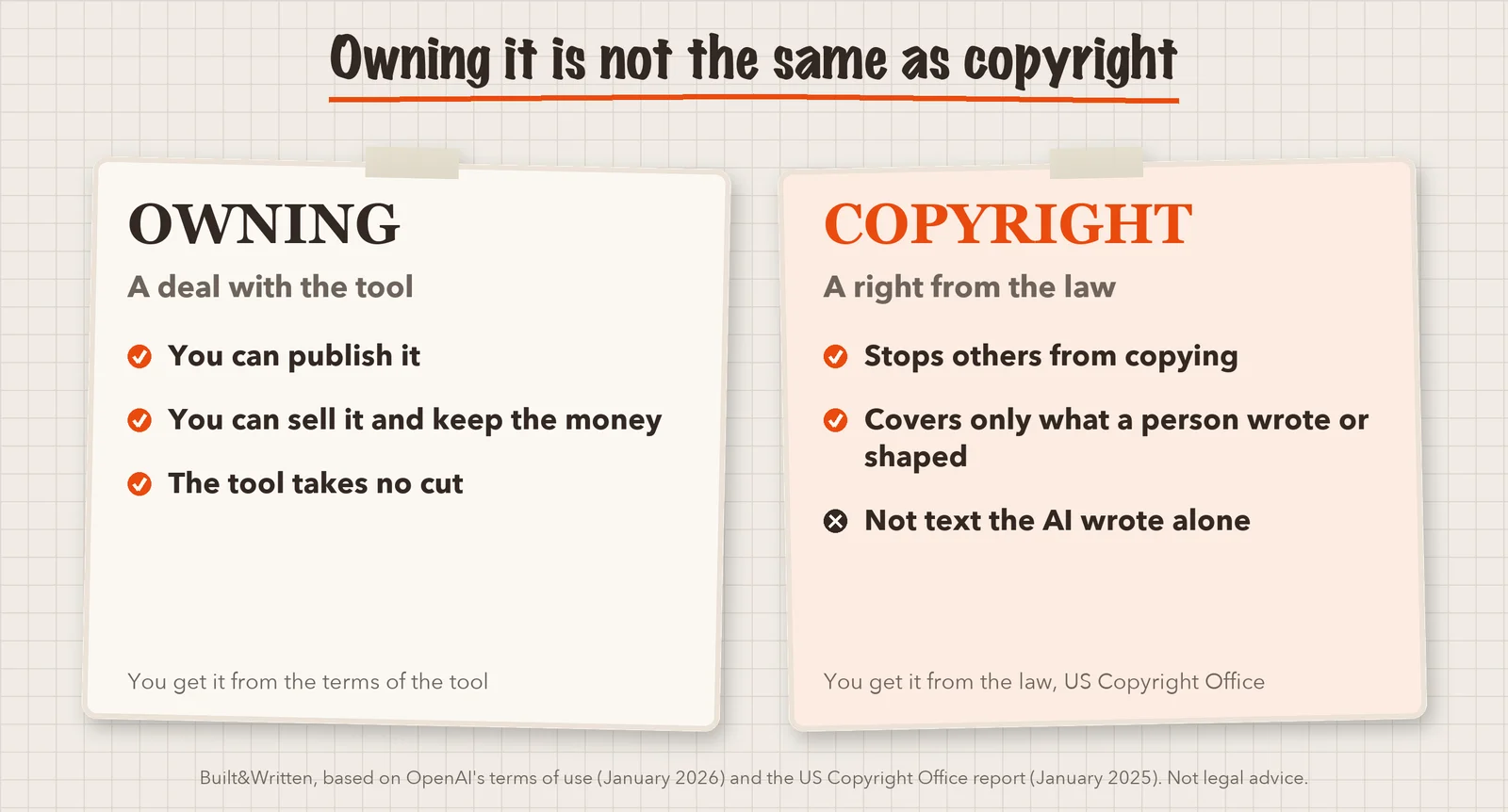
Owning is about contracts. The tool you used agrees that what you make is yours. It does not claim the book and takes no cut.
Copyright is about the law. It stops other people from copying your book. In the US, it covers only what a human author created.
Text in the image:
Owning it is not the same as copyright. Owning: a deal with the tool. You can publish it. You can sell it and keep the money. The tool takes no cut. Copyright: a right from the law. Stops others from copying. Covers only what a person wrote or shaped. Not text the AI wrote alone.
Here are two examples.
Example one. You ask ChatGPT for a book about your business and give it a short prompt. You may use every page. But the text came from the AI, so the law may not stop someone from copying it.
Example two. You give the AI your own stories and notes. You choose the chapters, rewrite the draft and add your examples. Now much of the book is your creative work, and that part has protection.
Who owns a book you wrote with AI?
You do, under the terms of the tools most authors use. We checked two of them on November 4, 2026.
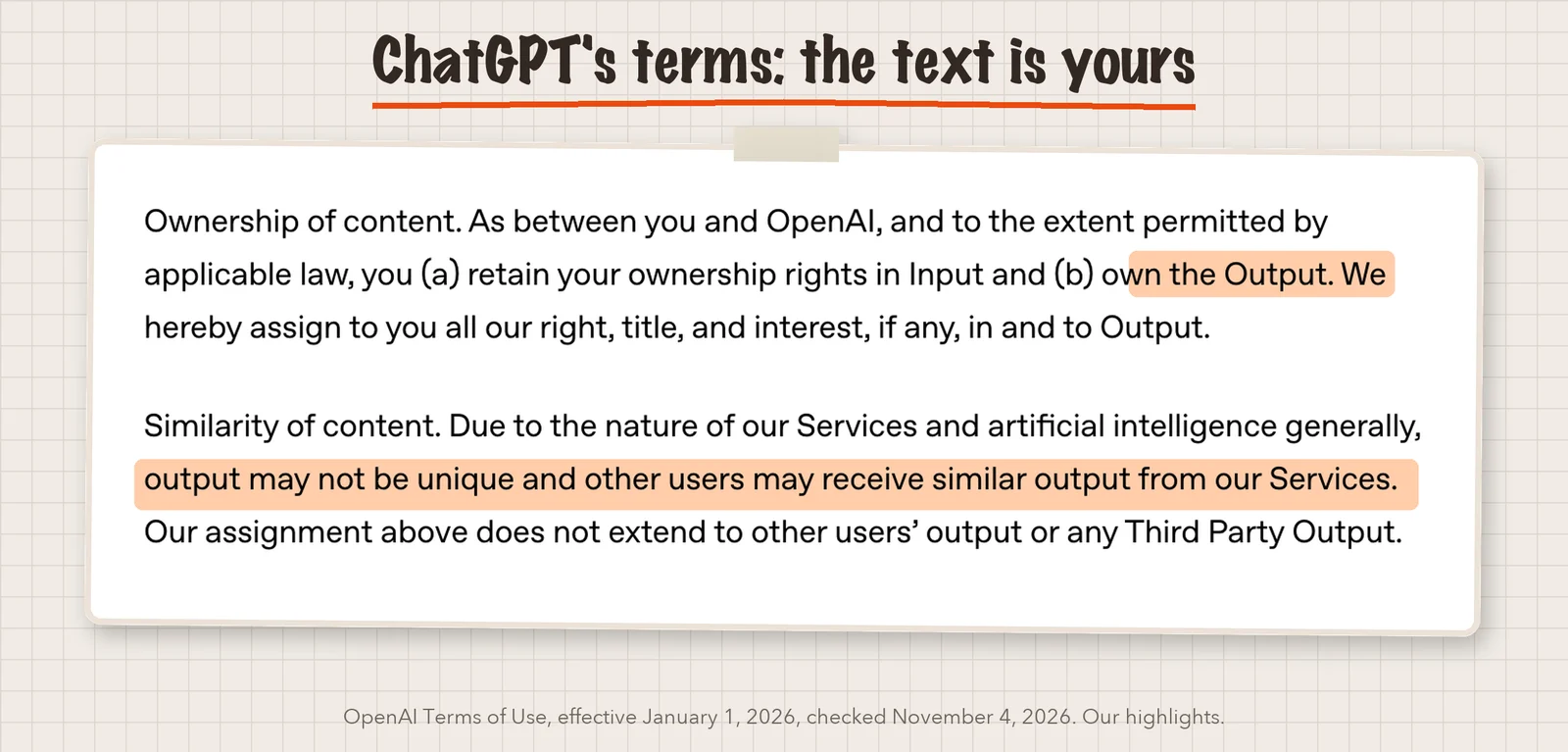
ChatGPT. OpenAI's terms of use, effective January 1, 2026, say you "own the Output". The same section adds a warning: other users may get similar output, and that output is not yours.
Text in the image:
"Ownership of content. As between you and OpenAI, and to the extent permitted by applicable law, you (a) retain your ownership rights in Input and (b) own the Output. We hereby assign to you all our right, title, and interest, if any, in and to Output." "Similarity of content. Due to the nature of our Services and artificial intelligence generally, output may not be unique and other users may receive similar output from our Services."
Built&Written. The platform's terms say "The books and materials you create remain your intellectual property." Its security page adds that your content is not used to train any AI model.
Can you copyright a book written with AI?
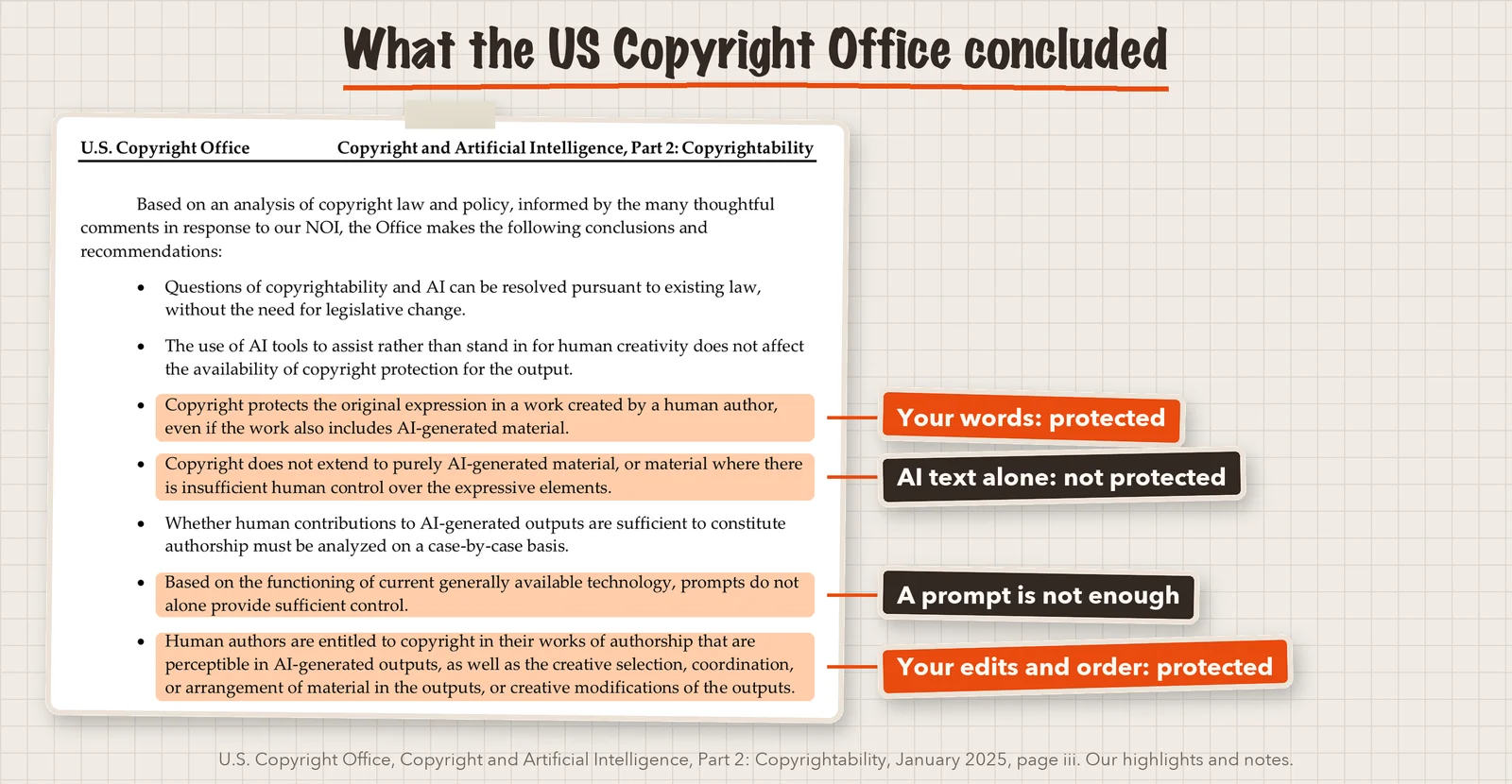
Partly. In January 2025, the US Copyright Office published its report on AI and copyrightability. Its summary page gives the answer.
Text in the image:
"Copyright protects the original expression in a work created by a human author, even if the work also includes AI-generated material." "Copyright does not extend to purely AI-generated material, or material where there is insufficient human control over the expressive elements." "Based on the functioning of current generally available technology, prompts do not alone provide sufficient control." "Human authors are entitled to copyright in their works of authorship that are perceptible in AI-generated outputs, as well as the creative selection, coordination, or arrangement of material in the outputs, or creative modifications of the outputs."
Here is what that means for a nonfiction book.
| What is in your book | What the US Copyright Office says |
|---|---|
| Text the AI wrote alone | Not protected on its own |
| Your own notes and stories, in your words | Can be protected |
| AI text you rewrote in a creative way | Your changes can be protected |
| Your choice and order of chapters | Can be protected, if the choice is creative |
| A long, detailed prompt | Not enough by itself |
The Office judges each case on its own. Nobody can promise you a share that counts as "enough". What helps is a clear record of what you wrote and what you changed.
What happened when we checked a ChatGPT chapter?
We checked what ChatGPT does with an author's notes. On November 4, 2026, we used the free plan of ChatGPT in one new chat.
As "our notes" we used 8 lines from The Art of Money Getting by P. T. Barnum, a book from 1880 that anyone can use freely. The lines are about advertising: sell only genuine goods, sow before you reap, and one ad is never enough. We asked for a 250-word chapter section in the first person. Then we checked every sentence.
Text in the image:
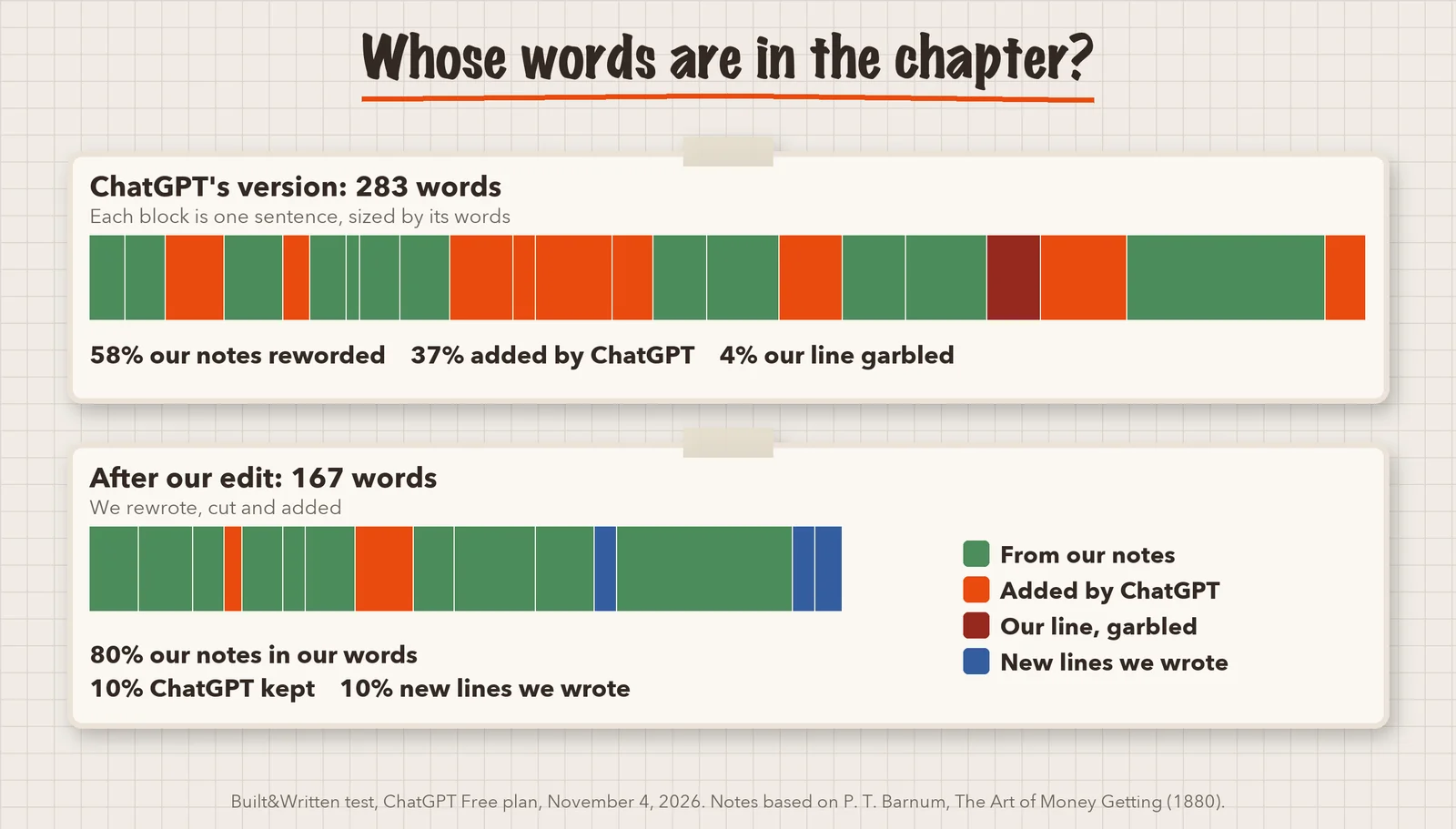
Whose words are in the chapter? ChatGPT's version: 283 words. 58% our notes reworded, 37% added by ChatGPT, 4% our line garbled. After our edit: 167 words. 80% our notes in our words, 10% ChatGPT kept, 10% new lines we wrote.
ChatGPT wrote 283 words. Here is what it did with our lines, and what we did next.
| Our note | ChatGPT wrote | What we did |
|---|---|---|
| "advertising is like learning: a little is a dangerous thing" | "advertising, like learning, is a little dangerous thing" | Fixed it. The proverb had lost its meaning. |
| First make sure your goods are genuine | "Whatever a man's business may be, he must first have something worth selling." | Rewrote it in the first person, as we asked. |
| Nothing | "Business is much the same." | Cut it, along with six other filler lines. |
| The man ran his ad three times | Told the story, then stopped | Added our point: "My man stopped at three. He quit four ads too early." |
Our final section was 167 words. It ends like this:
A French writer said the reader ignores the first ad, sees the second, reads the third, looks at the price on the fourth, tells his wife on the fifth, is ready on the sixth and buys on the seventh. My man stopped at three. He quit four ads too early.
What this shows: AI can write sentences, but it does not know which of your points matter most. You have to decide what stays. If you start from your own notes, there is less to fix.
We also asked ChatGPT who owns the section. Its answer was mostly right, but it never said how to register the book. That part is below.
You may already have enough material for a book
Many people think they have to start a book from a blank page. Often they do not.
Check what you already have: LinkedIn posts, articles, slides, recorded talks, answers to client questions, notes about your work.
These already contain your ideas. The work is to put them into one book: find the main topics, group the ideas, put the chapters in order and fill the gaps.
This also helps with copyright. The more of the book comes from your own words, the more of it is protected.
How to turn your existing writing into a book with Built&Written
About Built&Written
Built&Written is a platform that turns your notes, posts, recordings and past writing into a nonfiction book. It plans the chapters with you, writes them in your voice and makes a cover and files Amazon accepts.
The platform has two ways to start. Pick the one that fits what you have.
You have notes, posts or a rough draft. Paste them in, up to 50,000 words, or drop in a file. The platform reads your material and plans the chapters. You approve the plan, and then it writes the draft from your material in your voice. You edit any line you want.
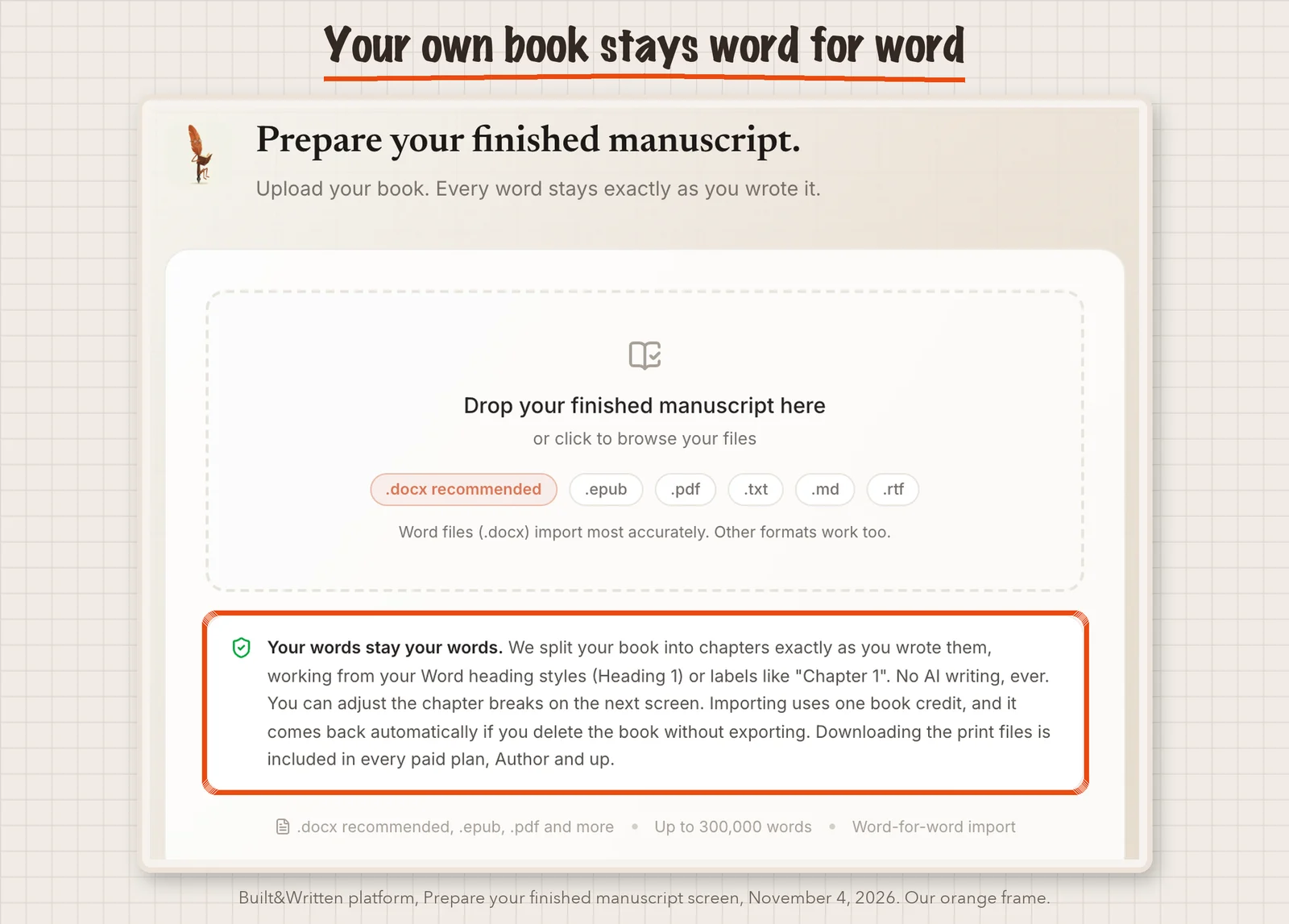
You have a finished manuscript, the full text of your book. Upload it to be formatted for print. In this mode the platform does no AI writing, so every word stays as you wrote it.
Text in the image:
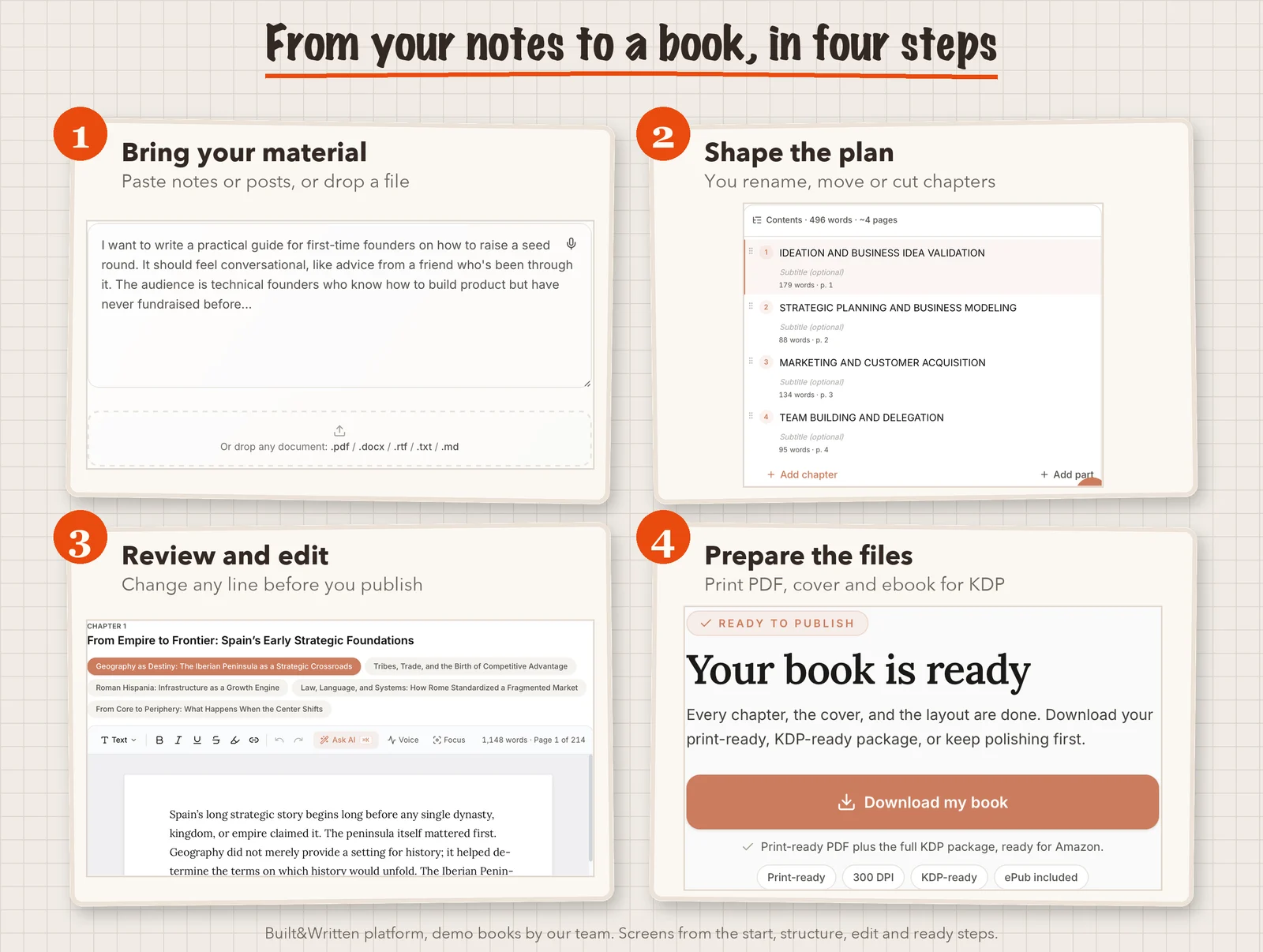
From your notes to a book, in four steps. 1 Bring your material: paste notes or posts, or drop a file. 2 Shape the plan: you rename, move or cut chapters. 3 Review and edit: change any line before you publish. 4 Prepare the files: print PDF, cover and ebook for KDP.
Here is what each step means for you:
- Bring your material. Copy your posts and notes into one document, or upload a file you already have.
- Shape the plan. You see the chapter list first. Rename, move or cut chapters before anything is written.
- Review and edit. Read every chapter. Fix names and numbers, and change any line that does not sound like you.
- Prepare the files. Download the print PDF, the cover and the ebook file, and upload them to Amazon KDP (Kindle Direct Publishing, Amazon's service for self-published books) yourself.
Text in the image:
"Prepare your finished manuscript. Upload your book. Every word stays exactly as you wrote it." "Your words stay your words. We split your book into chapters exactly as you wrote them, working from your Word heading styles (Heading 1) or labels like "Chapter 1". No AI writing, ever." "Up to 300,000 words. Word-for-word import."
The platform does not decide your copyright. Only the law does that.
How do you register AI copyright for your book?
In the US, copyright starts the moment you write. Registering is optional, but you need it before you can sue someone for copying. The Copyright Office explains the AI rules in its registration guidance from March 2023. Check the current rules before you file.
- Choose the Standard Application. The guidance says works with AI content must use it. It costs $65 online, as the Office's fee page shows.
- Describe what you wrote. In "Author Created", write something like "Text, editing and arrangement by the author."
- Exclude the AI text. If the AI wrote more than a tiny amount, list it under "Material Excluded", for example "Some passages generated by artificial intelligence."
- Keep your record. Save your notes, drafts and the AI's first version.
KDP has its own question about AI-generated text when you publish, and your answer stays private. Our guide to KDP's AI rules covers it.
Which way of writing a book fits you?
| Approach | You start with | What you get |
|---|---|---|
| Built&Written | Your notes, posts or a finished manuscript | A planned book from your own material, or your manuscript formatted, with files for Amazon |
| Your own material in a chat tool | Notes you paste into ChatGPT | Chapters you check, edit and put together yourself |
| A short prompt in a chat tool | A few lines of instructions | A fast draft with little of you in it, and little copyright |
| Writing every word yourself | A blank page | Full control and full copyright, and the most work |
Pick Built&Written if you already have notes or posts and want a book made from them.
Final thoughts
You own a book you wrote with AI. US copyright covers the parts you wrote or changed. So start from your own notes and posts, edit what the AI writes and keep your drafts.
If you want to make a book from what you already wrote, Built&Written can help:
- Start with what you have. Notes, posts and talks, up to 50,000 words, or a finished manuscript.
- Your plan. You approve and order every chapter.
- Your edits. You change any line before you publish.
- Your rights. The books you create stay yours, and your content is not used to train AI.
- Ready to publish. Print PDF, cover and ebook file, for you to upload to Amazon KDP.
See how it works.
Frequently asked questions
No, not in the US. The Copyright Office says copyright does not cover purely AI-generated material. You can still own it and sell it, but others may be free to copy it.
Yes. Copy your posts into one document and paste it into Built&Written, up to 50,000 words. The platform groups them into chapters, and you approve the plan before anything is written.
If you start from notes, yes, it writes the draft from your material, and you edit it. If you upload a finished manuscript, no, it only formats it and keeps every word.
Yes. You download the print PDF, cover and ebook file and upload them to KDP yourself. KDP will ask whether AI wrote any of the text.
There is a free plan for writing a book. Downloading the files needs a paid plan. The plans page shows what each plan includes.
Sources & References
- US Copyright Office: Copyright and Artificial Intelligence, Part 2 (January 2025)
- US Copyright Office: Registration Guidance for Works Containing AI-Generated Material (March 2023)
- US Copyright Office: Fees
- OpenAI Terms of Use (effective January 1, 2026)
- Built&Written Terms of Service
- P. T. Barnum, The Art of Money Getting (Project Gutenberg)
About the author
Khrystyna Balushka
More in Self-Publishing
Ready to write your book?
Turn your expertise into a professional book with Built&Written.