
Getting a Book Published When You Write It With AI
What is Built&Written? Built&Written is an online tool that turns what you have already written into a finished nonfiction book. You upload your posts, notes, talk transcripts or a rough draft. Wren, our AI writer, builds the chapters from that material in your voice. You approve the plan, edit every chapter and download files ready for Amazon KDP (AI-written books download on Entrepreneur and up). Already finished your book yourself? Built&Written formats it for print without changing a word, and no AI touches the text.
Key takeaways
- Can you publish a book written with AI? Yes, on Amazon KDP, IngramSpark, Draft2Digital, Barnes & Noble Press and Apple Books, each with its own rule. Kobo may reject it.
- Do you have to disclose AI? On KDP, Barnes & Noble and Apple, yes, if AI created the text, even if you edited it heavily afterwards.
- Will a traditional publisher take it? No industry rule exists. Some agencies refuse any manuscript AI helped write.
- Can you copyright it? Only the parts a human wrote, chose or changed, says the US Copyright Office.
Can you publish a book you wrote with AI?
Yes, but "with AI" means two different things, and every platform draws the same line between them:
- AI-generated: the AI wrote the text, images or translation. You may have edited it afterwards.
- AI-assisted: you wrote the text, and AI helped you edit, check or brainstorm.
Amazon KDP is clear about the first one: a text the AI wrote "is considered 'AI-generated,' even if you applied substantial edits afterwards" (checked November 2, 2026). AI-assisted work needs no disclosure on KDP. KDP (Kindle Direct Publishing) is Amazon's free service for selling your book on Amazon.
So the question isn't "can I use AI?" It's "how much did the AI write, and what do I tell each platform?" Our guide to publishing an AI-written book on KDP covers Amazon in detail. This article covers everywhere else.
How Built&Written keeps your book publishable
The platforms below share one worry: books made by a machine with no human behind them. Built&Written is built the other way around. The book starts from what you already wrote, and you stay in charge of every step.
- Your material first. You paste or upload your posts, notes, transcripts or a rough draft, up to 50,000 words. Wren, the Built&Written AI writer, builds the book from that, not from a guess about your topic.
- Your voice. Voice DNA learns how you write from 5 to 50 pages of your writing.
- Your outline. You see and change the chapter plan before any chapter is written.
- Your edits. Every chapter opens in an editor where you can rewrite any line by hand.
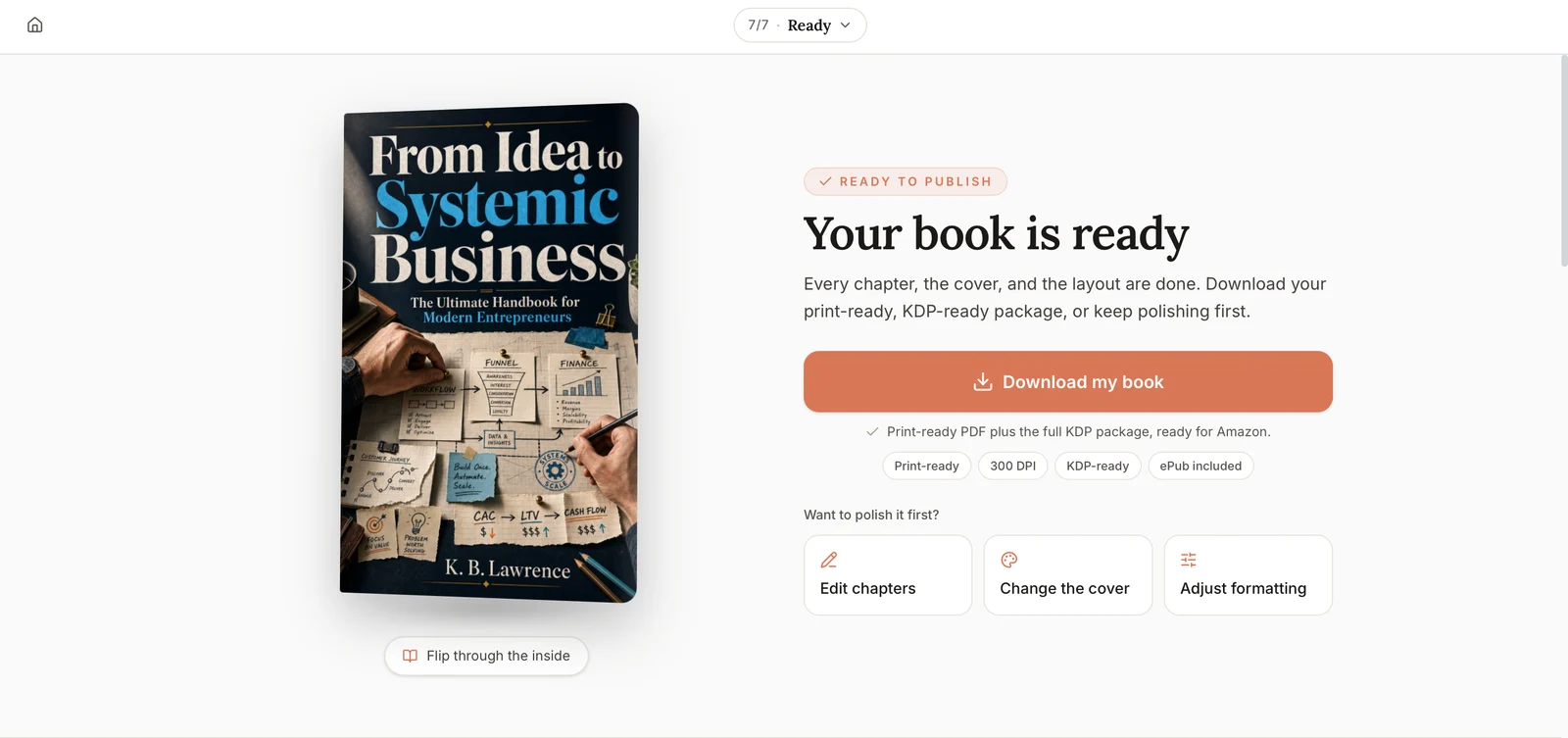
Text in the image: "Ready to publish." "Your book is ready." "Every chapter, the cover, and the layout are done. Download your print-ready, KDP-ready package, or keep polishing first." Button: "Download my book". "Want to polish it first?" Buttons: "Edit chapters", "Change the cover", "Adjust formatting".
| Step | With Built&Written | Writing in a chat app |
|---|---|---|
| Source of the facts | Your own notes, posts and drafts | What the model knows, plus what you paste |
| Human control | You approve the outline and edit every chapter | You copy, paste and stitch chapters yourself |
| Files for each platform | KDP-ready PDF, KDP package, EPUB and DOCX for AI-written books on Entrepreneur and up | None; you format somewhere else |
| AI disclosure | Still yours to answer: text Wren drafts counts as AI-generated | Yours to answer |
One honest limit: a chapter Wren drafts is AI-generated in KDP's and Barnes & Noble's terms, even after you edit it, so you tick "yes" on their AI question. Built&Written doesn't hide AI use, and it doesn't upload to any platform for you. You upload the files yourself.
Which platforms allow AI book publishing?
Most authors publish on more than one store. IngramSpark is a print and ebook distributor that sends your book to bookstores and libraries. Draft2Digital is an ebook distributor that delivers one upload to many stores. Barnes & Noble Press, Apple Books and Kobo Writing Life are the self-publishing doors to those stores. Each one writes its own AI rule.
Here is what each platform's own rules page said on November 2, 2026:
| Platform | AI-assisted book | Mostly AI-written book | What you do |
|---|---|---|---|
| Amazon KDP | Accepted, no disclosure | Accepted with disclosure | Answer the AI question when you publish |
| IngramSpark | Accepted | Not accepted if "created solely using generative AI" | Credit who created the work |
| Draft2Digital | Accepted | Not accepted without "extensive editing from a human" | May ask nonfiction authors to prove expertise |
| Barnes & Noble Press | Accepted, marked AI-Assisted | Accepted, marked AI-Created | Answer the required AI question |
| Apple Books | Accepted, no disclosure | Accepted with an "AI Generated by" credit | Say so in the book description |
| Kobo Writing Life | Unclear | "Wholly or partially AI generated" is a rejection reason | Expect a stricter review |
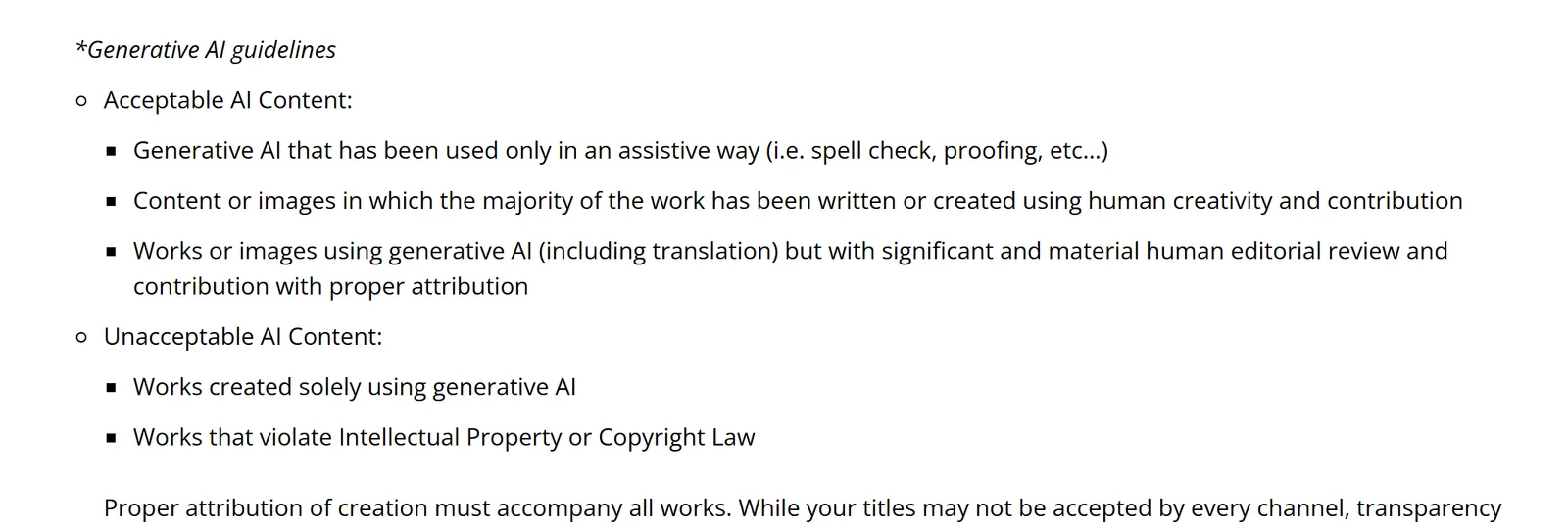
Text in the image: "Acceptable AI Content: Generative AI that has been used only in an assistive way (i.e. spell check, proofing, etc…)", "Content or images in which the majority of the work has been written or created using human creativity and contribution", "Works or images using generative AI (including translation) but with significant and material human editorial review and contribution with proper attribution". "Unacceptable AI Content: Works created solely using generative AI", "Works that violate Intellectual Property or Copyright Law". "Proper attribution of creation must accompany all works."
A few details matter for nonfiction:
- Draft2Digital checks expertise. It "may require further documentation of subject matter expertise for nonfiction content." An expert writing about their own field is exactly the case it wants. If you built your book in Built&Written from your own posts and talks, those originals are your proof. Keep them.
- IngramSpark wants credit. "Proper attribution of creation must accompany all works." It also warns that a title may not be accepted by every store it sells to.
- Kobo doesn't define "partially." If your book was drafted with AI, expect that Kobo may refuse it. If Kobo matters to you, write the book yourself and use Built&Written only to format it. No AI touches the text, and you can upload your own cover, so there is nothing AI-made to disclose.
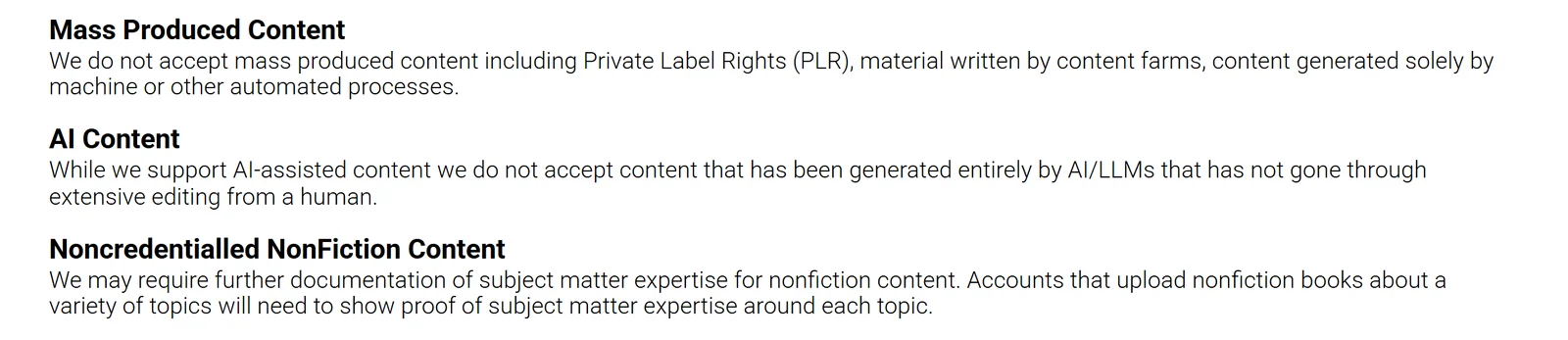
Text in the image: "AI Content: While we support AI-assisted content we do not accept content that has been generated entirely by AI/LLMs that has not gone through extensive editing from a human." "Noncredentialled NonFiction Content: We may require further documentation of subject matter expertise for nonfiction content. Accounts that upload nonfiction books about a variety of topics will need to show proof of subject matter expertise around each topic."
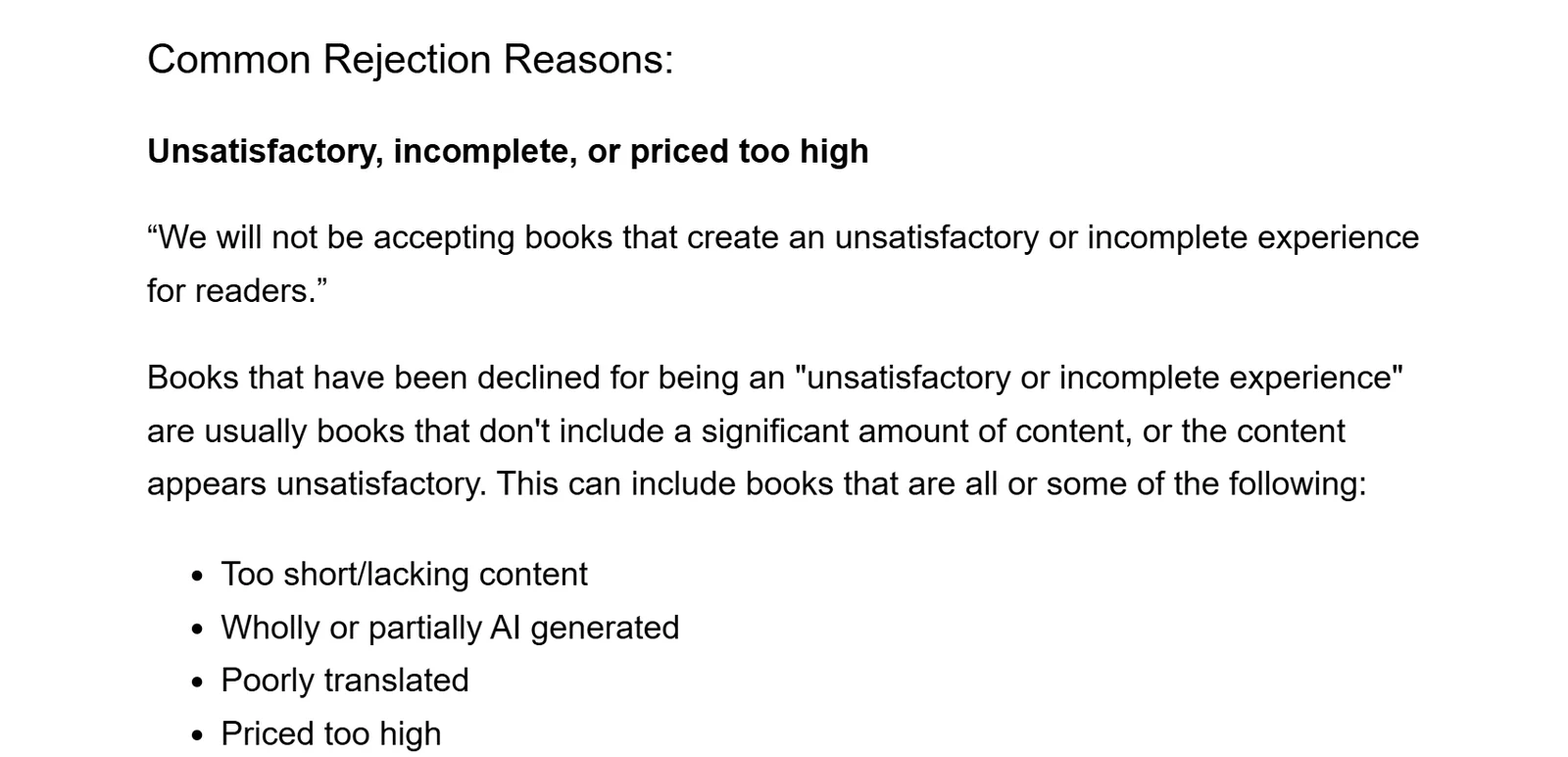
Text in the image: "Common Rejection Reasons: Unsatisfactory, incomplete, or priced too high." "We will not be accepting books that create an unsatisfactory or incomplete experience for readers." List: "Too short/lacking content", "Wholly or partially AI generated", "Poorly translated", "Priced too high".
KDP also limits how many new books you can add. Its help page allows "up to 2 titles per book format each week" (checked November 2, 2026). Our comparison of self-publishing platforms covers royalties and reach for each store.
What you have to disclose, platform by platform
Every platform asks a slightly different question. Answer the one in front of you:
- Amazon KDP. A yes or no question about AI-generated text, images and translations, asked when you publish or republish. Our guide to KDP's AI disclosure rules walks through the form.
- Barnes & Noble Press. A required AI disclosure on the rights page before the book can go live. B&N Press says a book is still "AI-Created if you used AI to generate the content and edit it afterward."
- Apple Books. If "a material portion" is AI-generated, Apple asks for the "AI Generated by" credit and a line in the description.
- IngramSpark. No checkbox, but IngramSpark requires proper attribution of who created the work.
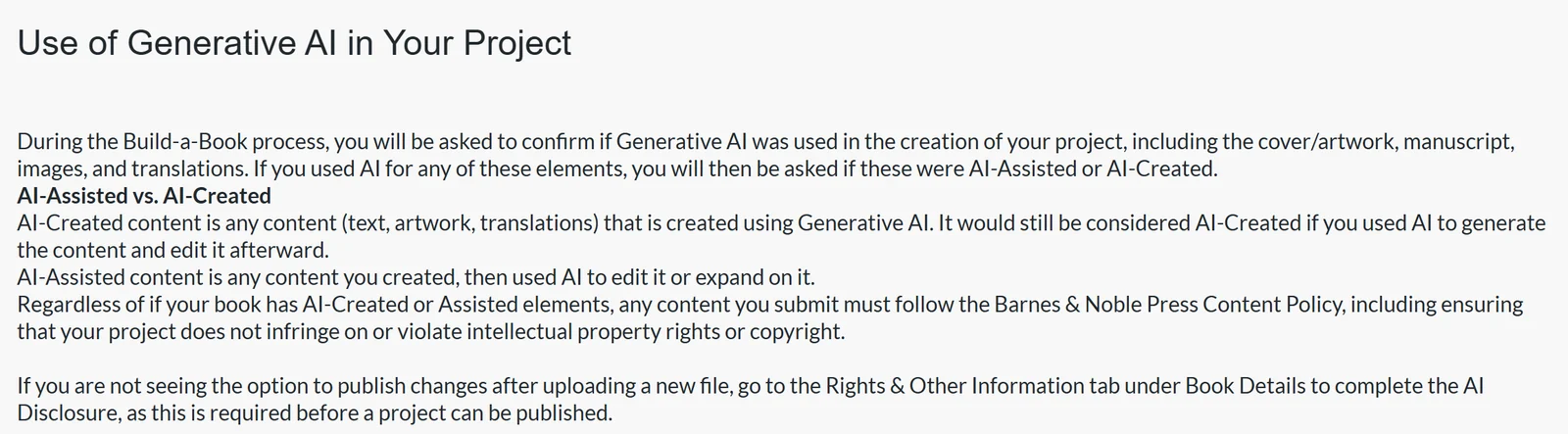
Text in the image: "Use of Generative AI in Your Project." "AI-Assisted vs. AI-Created." "AI-Created content is any content (text, artwork, translations) that is created using Generative AI. It would still be considered AI-Created if you used AI to generate the content and edit it afterward." "AI-Assisted content is any content you created, then used AI to edit it or expand on it." "...complete the AI Disclosure, as this is required before a project can be published."
On KDP, readers never see your answer. They only see what you choose to print in the book, such as a one-line AI note on the copyright page.
Will a traditional publisher or literary agent take it?
Maybe, but it's harder, and there's no single rule. A literary agent is the person who sells your book to a publisher, and each agency sets its own policy.
- Some agencies say no outright. P.S. Literary Agency, which represents fiction and nonfiction, says it is "unable to consider manuscripts that have been written, revised, or edited using AI tools, whether in whole or in part."
- Writers' groups say disclose. The Authors Guild tells authors to let their agent and publisher "know up front" that they used AI outputs. It also warns that AI text can break the warranty in a publishing contract, the promise that the work is your own.
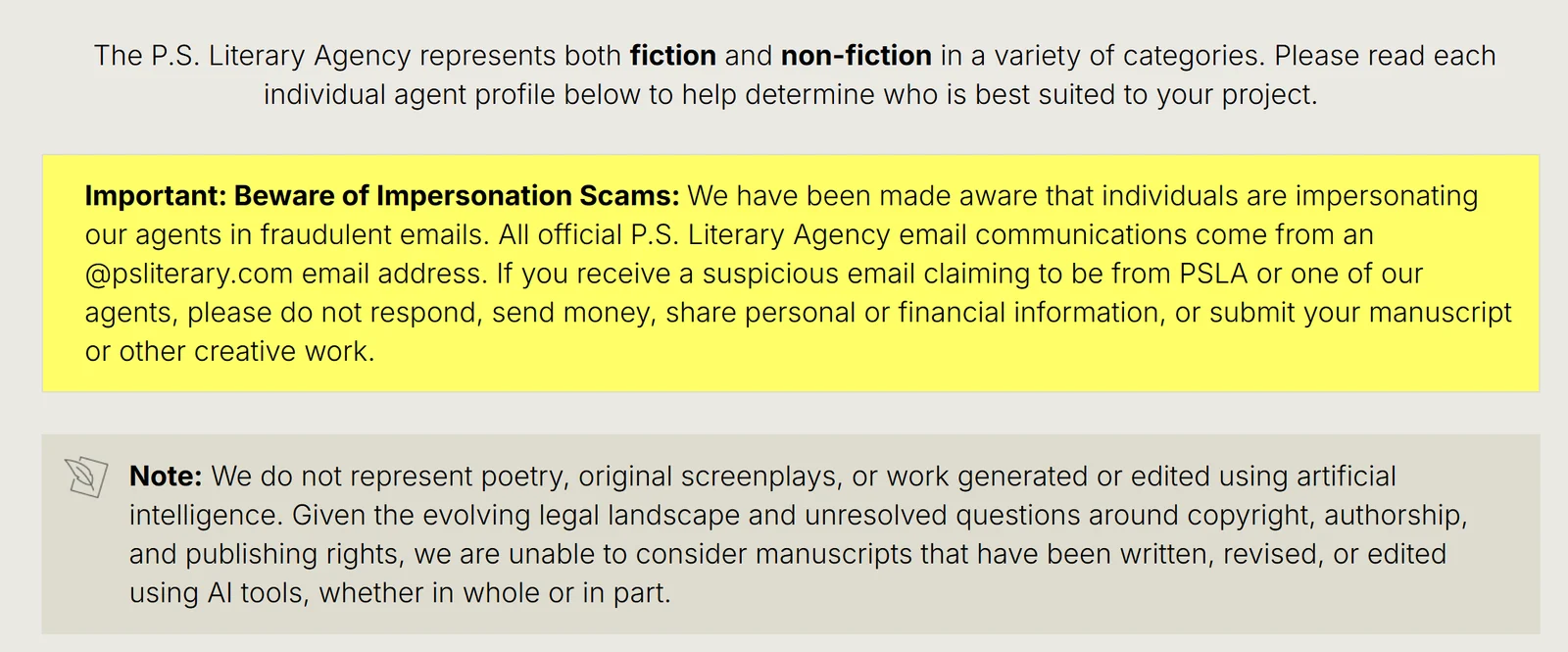
Text in the image: "The P.S. Literary Agency represents both fiction and non-fiction in a variety of categories." "Note: We do not represent poetry, original screenplays, or work generated or edited using artificial intelligence. Given the evolving legal landscape and unresolved questions around copyright, authorship, and publishing rights, we are unable to consider manuscripts that have been written, revised, or edited using AI tools, whether in whole or in part."
Read the submission page of every agency before you send anything. If a page says nothing about AI, ask. For most experts, self-publishing is the faster road anyway: book deals are down, as our look at why not to wait for a publisher shows.
Can you copyright a book written with AI?
Only the human part. The US Copyright Office says "copyright can protect only material that is the product of human creativity." Its January 2025 report adds that prompts alone don't make you the author of what the AI writes.
What you can protect:
- the parts you wrote yourself;
- your choice and order of the material, if it's creative;
- the changes you made to the AI's text.
If you register the book, you have to disclose AI-generated material and leave it out of your claim. The Copyright Office's guidance has said this since March 16, 2023.
In practice, this rewards the same habit the platforms reward. A book built in Built&Written from your own posts, talks and notes has more of your words in it, so more of it is yours to protect. A book the AI wrote from a one-line prompt has almost nothing you can register.
How AI book publishing works, step by step
These six steps keep a nonfiction book inside every rule above:
- Start from your own material. Posts, talks, notes and client stories you can stand behind.
- Check every fact. AI can invent sources and numbers. Our guide to writing a nonfiction book with AI without making up facts shows how.
- Edit every chapter yourself. That's what Draft2Digital and IngramSpark mean by human work.
- Write down what AI did. Keep notes on which parts AI drafted, so each platform's question takes a minute. If Wren drafted your chapters in Built&Written, your answer on KDP and Barnes & Noble is yes.
- Publish on KDP first. It's the biggest store and accepts AI-generated books with disclosure.
- Add other stores one by one. IngramSpark for wider print distribution, then Barnes & Noble and Apple. Leave Kobo for last.
Final thoughts
Built&Written turns the material you already have into a book you checked and shaped, which is what every platform here is looking for. You still answer the AI questions honestly, and you upload the files yourself.
AI book publishing is allowed on almost every major platform, with one rule in common: a human has to stand behind the book. Disclose what AI wrote, keep your own expertise at the center, and expect Kobo and some agents to be stricter than Amazon.
What Built&Written gives you:
- The human work the rules ask for. You approve the outline and edit every chapter, the kind of human review IngramSpark and Draft2Digital look for.
- Your expertise on the page. The book is built from your own posts, talks and notes, the material a nonfiction author can point to when Draft2Digital asks about expertise.
- No hidden AI. Text Wren drafts counts as AI-generated, and you answer each store's AI question yourself, with nothing to explain away later.
- Files for every store. A KDP-ready print PDF and KDP package for an AI-written book on Entrepreneur and up, plus EPUB (the ebook file) and DOCX (a Word file) for IngramSpark, Draft2Digital and the rest.
See how it works, or compare the plans.
Frequently asked questions
Yes. Amazon KDP accepts AI-generated books, but you have to say so when you publish. If you wrote the book and AI only helped you edit, KDP calls it AI-assisted, and you don't have to disclose it.
Not if the book was created only with generative AI. IngramSpark accepts books where a human did most of the work or reviewed and changed the AI's text, with proper credit for who created it.
There's no law that makes you, but the Authors Guild says to tell your agent and publisher up front. Many publishing contracts ask you to promise the work is your own, and AI text can break that promise.
Yes, the parts you wrote, chose and changed. The US Copyright Office doesn't protect text the AI generated on its own, and prompts alone don't make you its author.
Sources & References
- Amazon KDP Content Guidelines
- Amazon KDP: title creation and submission limits
- IngramSpark Content Guidelines
- Draft2Digital Content Guidelines
- Barnes & Noble Press: Use of Generative AI in Your Project
- Apple Books Formatting Guidelines, 1.13 AI-Generated Content Transparency
- Kobo Writing Life: Why was my Book Rejected or Blocked?
- US Copyright Office: Registration Guidance for Works Containing AI-Generated Material
- Authors Guild: AI Best Practices for Authors
- P.S. Literary Agency: Submission Guidelines
About the author

Khrystyna Balushka
More in Self-Publishing
Ready to write your book?
Turn your expertise into a professional book with Built&Written.