
AI Book Disclaimer Examples You Can Copy for a Health or Money Book
Key takeaways
- Do you need a disclaimer in your book? In most cases, no, and KDP's rules don't ask for one. For health and money advice, it is a smart, cheap habit.
- Where does it go? At the bottom of the copyright page, the page right after the title page.
- Do you have to say AI helped write the book? To Amazon, yes, if AI created text, images or translations. In the book itself, it's your choice.
- Does a disclaimer protect you? Only partly. The FTC says a disclaimer won't cure a claim that is false or misleading.
Do you need a disclaimer in your book?
In most cases, no rule makes you print one. A book disclaimer is a short note that tells readers what your book is not: not medical advice, not financial advice, not a promise of results.
Amazon KDP's content guidelines say nothing about disclaimers, medical claims or financial advice (checked November 2, 2026). KDP (Kindle Direct Publishing) is Amazon's free service for selling your book on Amazon. The closest its rules come is one line: "We do not allow descriptive content meant to mislead customers or that doesn't accurately represent the content of the book."
So why add one? Three reasons:
- It sets expectations. A reader with a heart condition should know your diet book doesn't replace a doctor.
- It shows care. Health and money books ask readers to act. A disclaimer says you know that.
- Publishers expect it. Gatekeeper Press, a self-publishing service, says the disclaimer usually sits "toward the bottom of the copyright page."
What a disclaimer can't do is turn a risky promise into a safe one. More on that below.
Where does a disclaimer go in a book?
On the copyright page. That's the page right after the title page, with your copyright line, ISBN (the book's unique 13-digit number) and edition. Our copyright page template shows every line that page can hold.
For a book with heavy medical or money advice, some authors add a second, longer note before chapter 1. Keep it to one page. Readers skip anything longer.
In an ebook, the copyright page sits in the same spot, so Kindle readers see the disclaimer when they open the book.
Built&Written handles the copyright page for you. It generates one automatically, and you can edit it "exactly as it should print," one line per line. Paste your disclaimer at the bottom and it appears in the print PDF and the ebook. There is no separate disclaimer feature, and you don't need one.
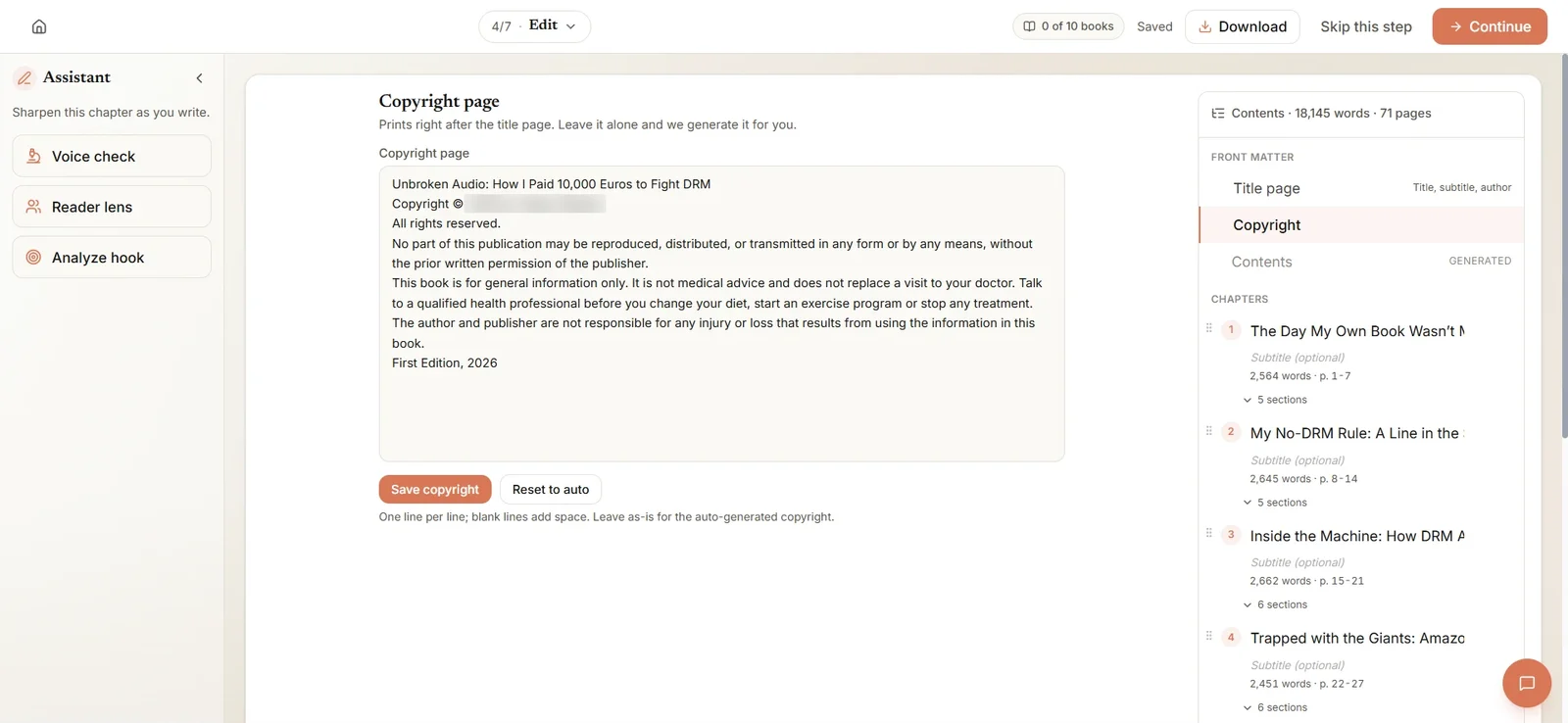
Text in the image: "Copyright page. Prints right after the title page. Leave it alone and we generate it for you." In the box: "This book is for general information only. It is not medical advice and does not replace a visit to your doctor." Buttons: "Save copyright", "Reset to auto". "One line per line; blank lines add space."
| Step | With Built&Written | In Word or Google Docs |
|---|---|---|
| Copyright page | Generated for you, then edited as it prints | You build it and keep it on its own page |
| Where the disclaimer prints | Right after the title page, in print and ebook | Wherever you place it, checked in each file |
| Health and money advice | Comes from your own notes and posts, so "The ideas in this book come from [Your name]'s own experience" stays true | Depends on what the model adds, so check every tip before you sign that line |
| Files for Amazon | KDP-ready files you upload yourself; AI-written books download on Entrepreneur and up | You format and export them yourself |
Health and medical book disclaimer examples
Use these for books on diet, fitness, sleep, stress or any health habit. Replace the words in brackets. These are starting points, not legal advice. If your book tells readers to change medication, fast for days or treat a condition, have a lawyer read your disclaimer.
Nutrition and fitness
This book is for general information only. It is not medical advice and does not replace a visit to your doctor. Talk to a qualified health professional before you change your diet, start an exercise program or stop any treatment. The author and publisher are not responsible for any injury or loss that results from using the information in this book.
General health and wellness
The ideas in this book come from [Your name]'s own experience and research. They are not a diagnosis or a treatment plan. Every body is different, and what worked for the author may not work for you. If you have a health condition, are pregnant or take medication, ask your doctor before you follow any advice in this book.
Mental health
This book is not therapy and is not a substitute for care from a licensed mental health professional. If you are in crisis or thinking about harming yourself, call your local emergency number now. In the United States, you can call or text 988 to reach the Suicide and Crisis Lifeline.
A good health disclaimer does three things: it says what the book isn't, it names who to ask instead, and it limits the author's liability in plain words.
Money and business book disclaimer examples
Money books carry the same risk: readers act on your advice with real money. These cover investing, business results and tax.
Investing and personal finance
This book is for education only. It is not financial, investment or tax advice, and the author is not your financial advisor. Investing involves risk, including the loss of money you invest. Past results do not guarantee future results. Talk to a licensed financial professional before you make investment decisions.
Business results and income stories
The results described in this book are the author's own or those of people the author worked with. They are not typical, and your results will depend on your work, your market and factors no one can control. Nothing in this book is a promise or guarantee of income.
Tax and legal topics
Tax and legal rules change and differ from country to country. The information in this book was accurate to the author's knowledge on [month, year], but it is not legal or tax advice. Ask a qualified accountant or lawyer about your own situation.
Notice the second example. Saying results "are not typical" is honest, but the FTC is clear that a line like "results not typical" doesn't excuse a dramatic promise. If chapter 1 says "you will make $10,000 in 30 days," no disclaimer fixes that sentence. Rewrite the sentence.
AI book disclaimer examples
If AI helped you write, you can say so in the book. In most cases no rule makes you, but some readers appreciate it, and it costs you one sentence. Pick the version that matches what you actually did.
AI helped you edit
The author wrote this book. AI tools were used to check grammar and suggest edits, and every change was reviewed by the author.
AI drafted from your material
This book was drafted with the help of AI from the author's own notes, articles and talks. The author reviewed, edited and approved every chapter and is responsible for its content.
AI images inside the book
Some illustrations in this book were created with AI image tools. All text is the author's own work.
AI cover
The cover of this book was created with AI image tools from the author's brief. The text was written by the author.
Which one fits a Built&Written book depends on how you made it:
- You built the book from your own notes. Use "AI drafted from your material." KDP counts that text as AI-generated, so you also answer yes on its AI question when you publish.
- You only formatted a finished manuscript. Your words don't change and no AI writes text, so there is nothing to disclose about the text.
- You let AI design the cover. Built&Written can generate the cover with AI, and paid plans often start one while the book is being written. Then the cover is AI-generated too: disclose it to KDP, and don't print "the cover is the author's own work." Use the AI cover line instead.
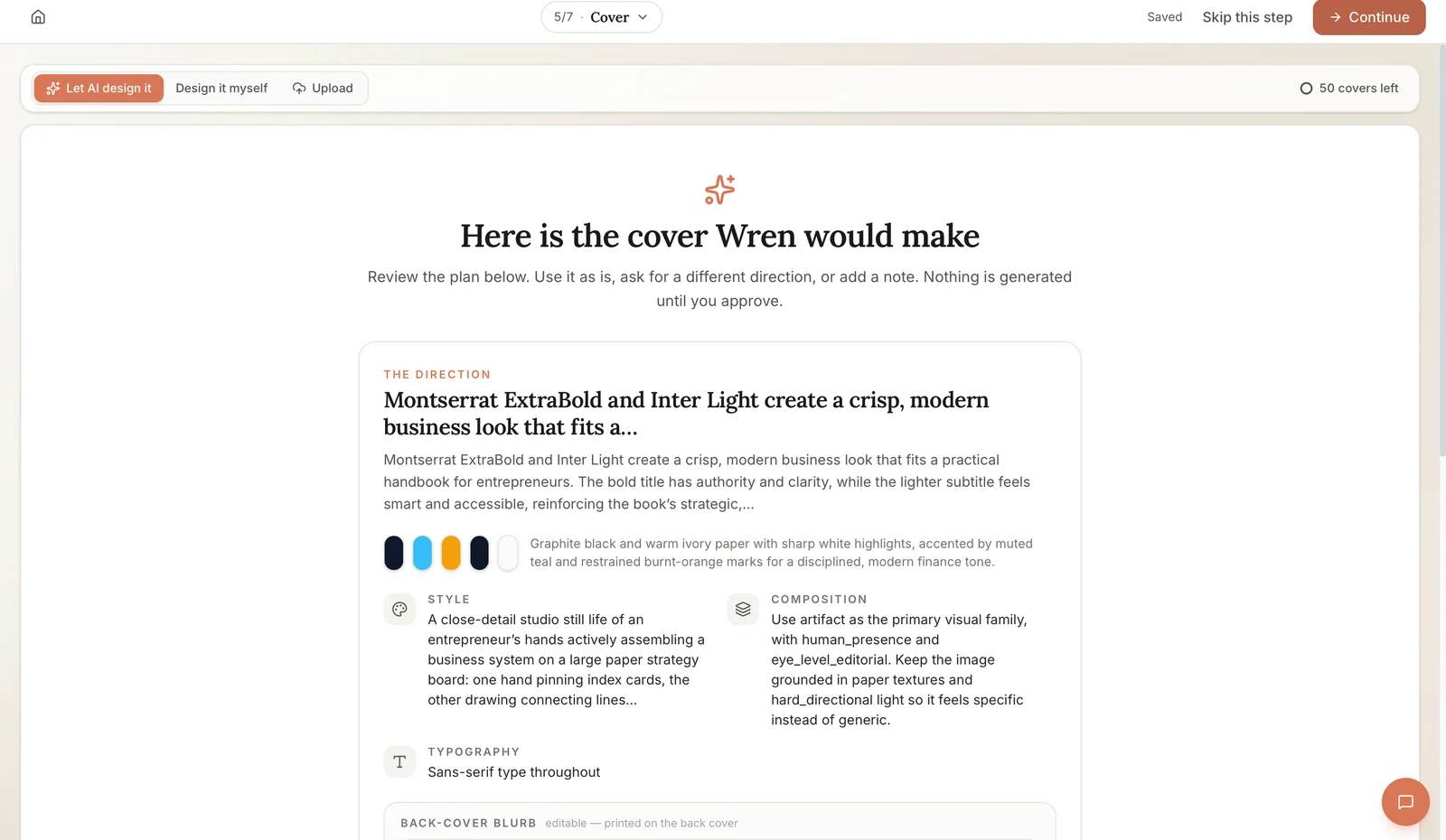
Text in the image: Tabs: "Let AI design it", "Design it myself", "Upload". "Here is the cover Wren would make." "Review the plan below. Use it as is, ask for a different direction, or add a note. Nothing is generated until you approve." Sections: "The direction", "Style", "Composition", "Typography".
Write only what is true. If you use the second example, make sure every fact in the book came from you or a source you checked. Our guide to writing a nonfiction book with AI without making up facts shows how.
For a health or money book, put the AI note after the main disclaimer, so the medical or financial warning comes first.
Is an AI disclaimer the same as KDP's AI disclosure?
No. KDP's AI disclosure is a private answer in the publishing form, required for "text, images, or translations created by an AI-based tool," and readers never see it. An AI disclaimer is optional text you print inside the book. Our guide to KDP's AI disclosure rules walks through the form.
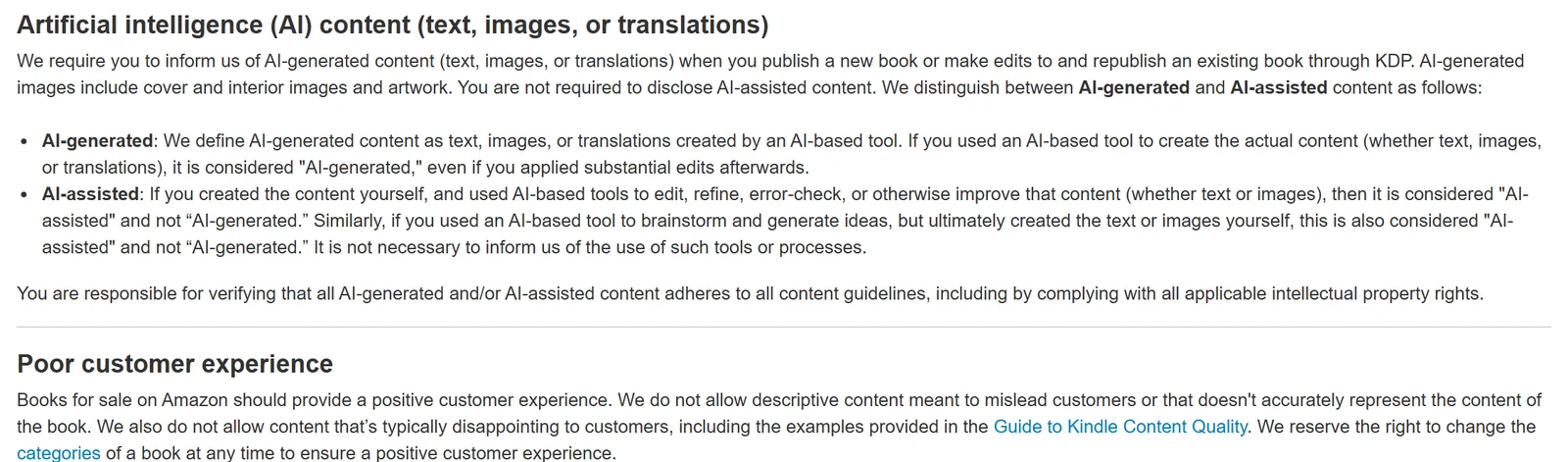
Text in the image: "Artificial intelligence (AI) content (text, images, or translations)." "We require you to inform us of AI-generated content (text, images, or translations) when you publish a new book or make edits to and republish an existing book through KDP. AI-generated images include cover and interior images and artwork. You are not required to disclose AI-assisted content." "Poor customer experience." "We do not allow descriptive content meant to mislead customers or that doesn't accurately represent the content of the book."
What a disclaimer can't fix
A disclaimer narrows what you promise. It doesn't erase what you wrote. Three limits to know:
- False claims stay false. The FTC's Health Products Compliance Guidance says a disclosure "can't directly contradict a claim." A disclaimer that says "not medical advice" won't save a chapter that says your diet cures diabetes.
- Amazon's rules still apply. KDP doesn't allow descriptive content "meant to mislead customers or that doesn't accurately represent the content of the book," and a disclaimer inside the book doesn't change what your title, description or cover promise.
- New EU rules on AI text. Since August 2, 2026, Article 50 of the EU AI Act requires a label on AI-generated text published to inform the public on matters of public interest. It doesn't apply when the text went through human review and a person holds editorial responsibility. The law doesn't say whether a self-published book counts, so if you sell in the EU and AI wrote large parts of your book, ask a lawyer.
The safest health or money book isn't the one with the longest disclaimer. It's the one where every claim is true, sourced and yours.
Final thoughts
Built&Written gives the disclaimer a fixed home: the copyright page it builds for you, which you edit as it prints. And because the book is built from your own notes, posts and talks, the advice behind the disclaimer is yours, not something a model guessed.
A book disclaimer is a short, honest note. For health and money books, add one at the bottom of the copyright page, name who readers should ask instead, and keep your promises realistic. If AI helped, say how in one true sentence.
What Built&Written gives you:
- A home for your disclaimer. The copyright page is generated for you, edited line by line and printed right after the title page.
- Advice you can stand behind. Health and money tips come from your own posts and notes, so "this comes from the author's experience" is true.
- A clear AI line. A book built from your notes fits the "AI drafted from your material" example, and a manuscript you only formatted needs no AI note for the text.
- The disclaimer in every file. It prints in the KDP-ready PDF and the EPUB (the ebook file), which download on Entrepreneur and up for an AI-written book.
See how it works, or compare the plans. For the rest of the pages around your disclaimer, see our guide to the parts of a book.
Frequently asked questions
To Amazon, yes, if AI created any text, images or translations: KDP asks about it when you publish, and that includes an AI-generated cover. Inside the book, in most cases no. An AI disclaimer on the copyright page is usually your choice.
Only partly. A disclaimer can limit what readers expect, but it won't cure a false or misleading claim, as the FTC's health guidance says. For a book with risky medical or financial advice, ask a lawyer to review it.
On the copyright page, the same as in print. It sits right after the title page, so readers see it when they open the book.
You can use the same ideas, but write your own words. Copying another author's text word for word can break their copyright, and their disclaimer was written for their book, not yours.
Sources & References
About the author

Khrystyna Balushka
More in Self-Publishing
Ready to write your book?
Turn your expertise into a professional book with Built&Written.