

Does AI Help With Writer's Block When You Write a Book?
Key takeaways
- Does AI help with writer's block? Yes. It helps most with starting: questions, an outline, a first sentence to react to.
- What worked best in our test? Asking ChatGPT to interview us. Five questions and three sentence starters gave us an opening in about two minutes.
- What worked worst? Asking it to write the opening for us. The paragraph was fluent and generic, with nothing from our notes in it.
- What does research say? In one experiment, people finished work texts in 40% less time. In another, AI ideas made stories more creative, and also more alike.
- Do you have to tell Amazon? Not if AI only helped you brainstorm and you wrote the text yourself. KDP (Kindle Direct Publishing, Amazon's service for self-published books) calls that "AI-assisted".
What does research say about AI and writer's block?
Writer's block is the feeling that you have something to say and cannot get it onto the page. For a nonfiction author, it shows up in three places. The first page. The plan for a chapter. The middle of a chapter that needs one more example.
AI can help in all three, and research backs this up.
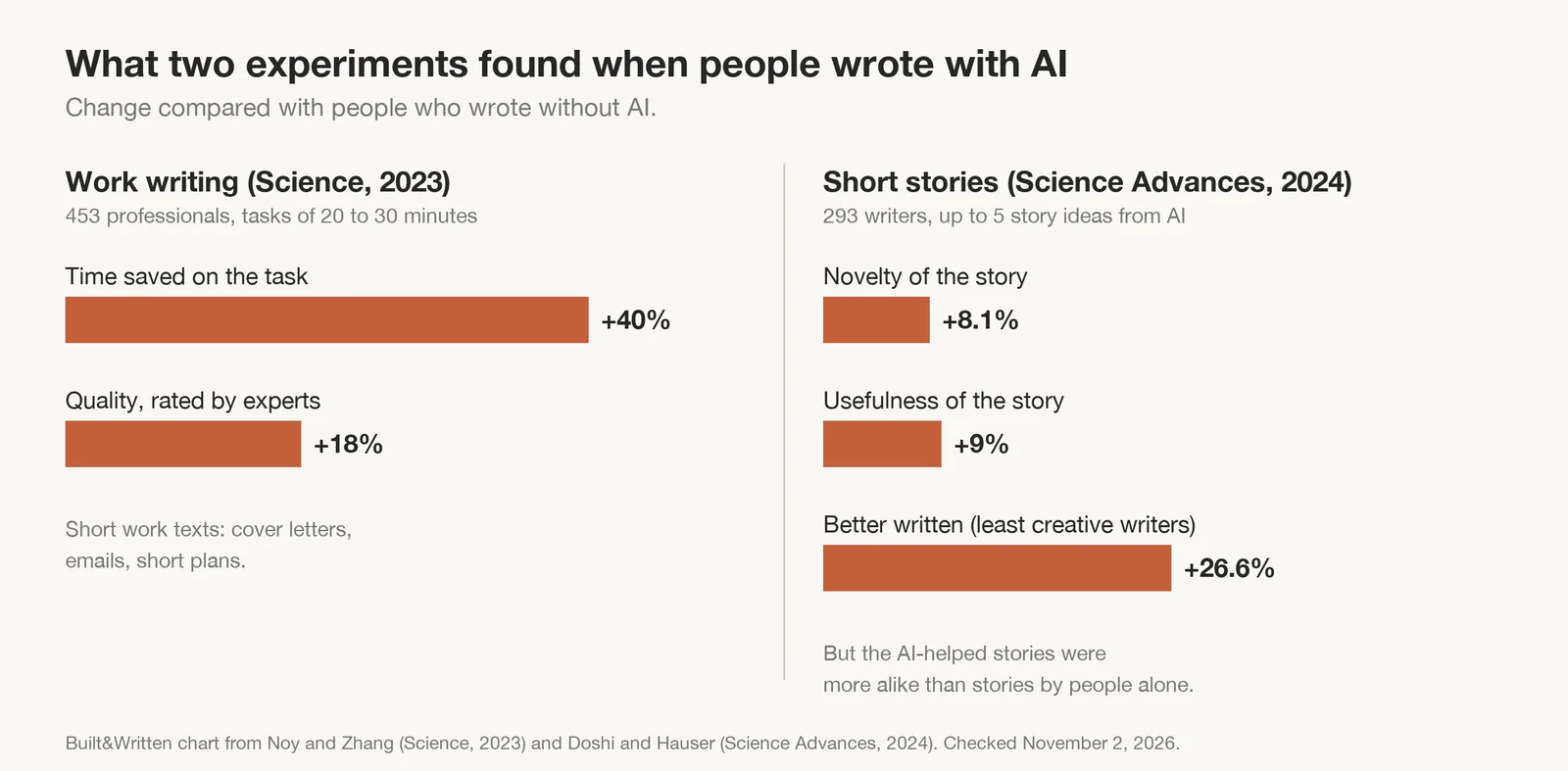
In a 2023 experiment published in Science, 453 professionals did short writing tasks for work, like cover letters and emails. Half of them could use ChatGPT. According to MIT's summary of the study, that group finished in 40% less time, and experts rated their work 18% better.
A 2024 study in Science Advances looked at creative writing. 293 people wrote short stories. Some could first ask GPT-4 for up to five story ideas. Their stories were rated more novel (8.1% higher) and more useful (9.0% higher). The biggest gains went to the least creative writers: their stories were rated up to 26.6% better written. The same study found a catch. Stories written with AI ideas were more similar to each other than stories by people alone.
Text in the image:
Work writing (Science, 2023), 453 professionals: time saved on the task +40%, quality rated by experts +18%. Short stories (Science Advances, 2024), 293 writers: novelty +8.1%, usefulness +9%, better written for the least creative writers +26.6%. The AI-helped stories were more alike than stories by people alone.
That catch matters for a book. Readers buy nonfiction for your experience and your view. If AI fills the page, it fills it with the average view.
What happened when we asked ChatGPT to beat writer's block?
We ran a small test on November 2, 2026. We used the free plan of ChatGPT, a new chat for each request. As "the author's notes" we used the first chapter of Frederick Taylor's The Principles of Scientific Management (1911), a book free for anyone to use.
We tried three requests that match the three places people get stuck.
Request 1: "Write the opening paragraph for me"
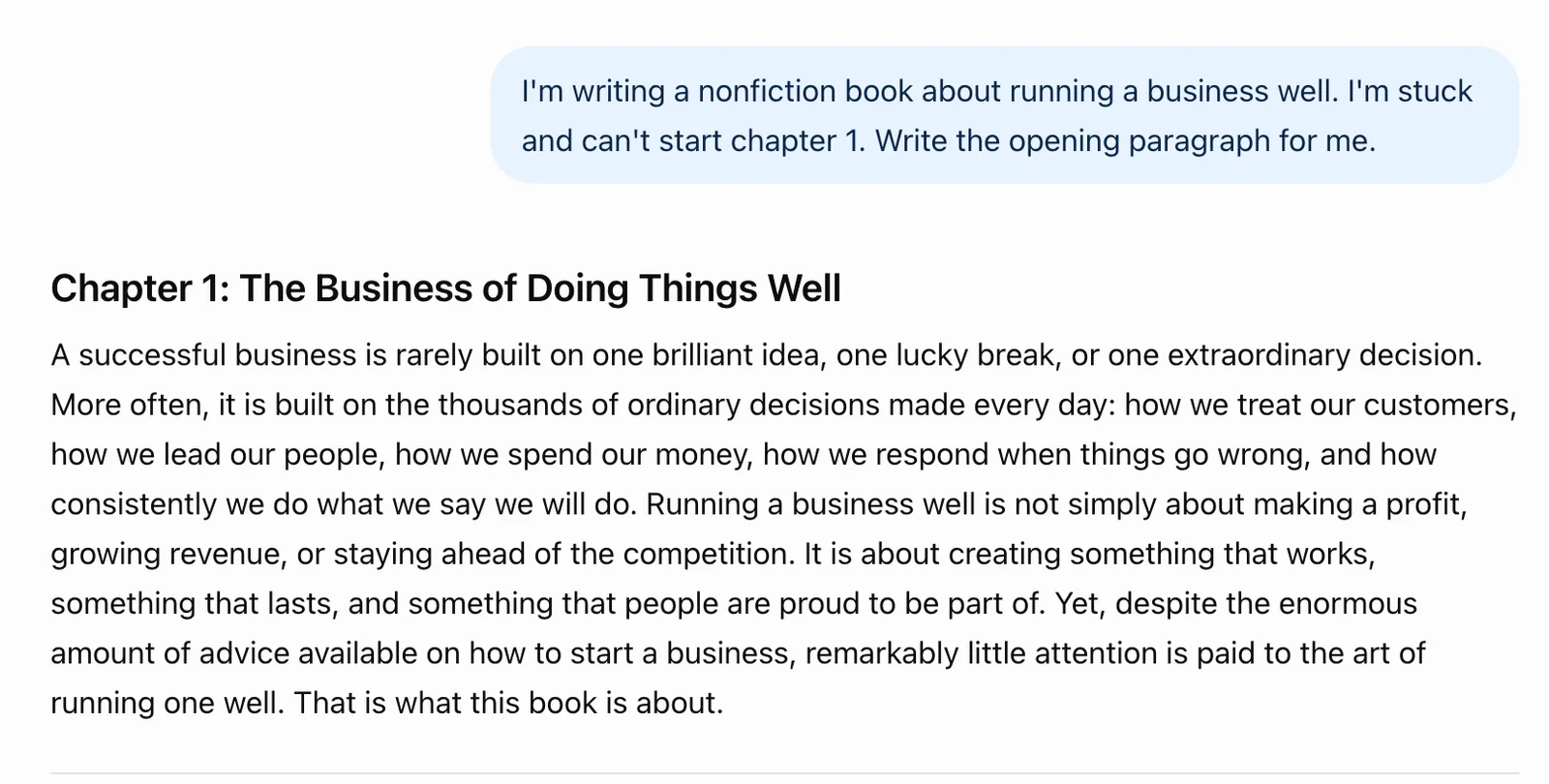
We told ChatGPT we were writing a book about running a business well and could not start chapter 1. Then we asked it to write the opening.
Text in the image:
"Chapter 1: The Business of Doing Things Well. A successful business is rarely built on one brilliant idea, one lucky break, or one extraordinary decision."
The answer came in about 10 seconds. It was smooth, and it had nothing in it from a real author: no story, no number, no opinion to disagree with. ChatGPT then offered to write the rest of the chapter. That is how one stuck page turns into a book you did not write.
Request 2: "Don't write it for me. Ask me 5 short questions"
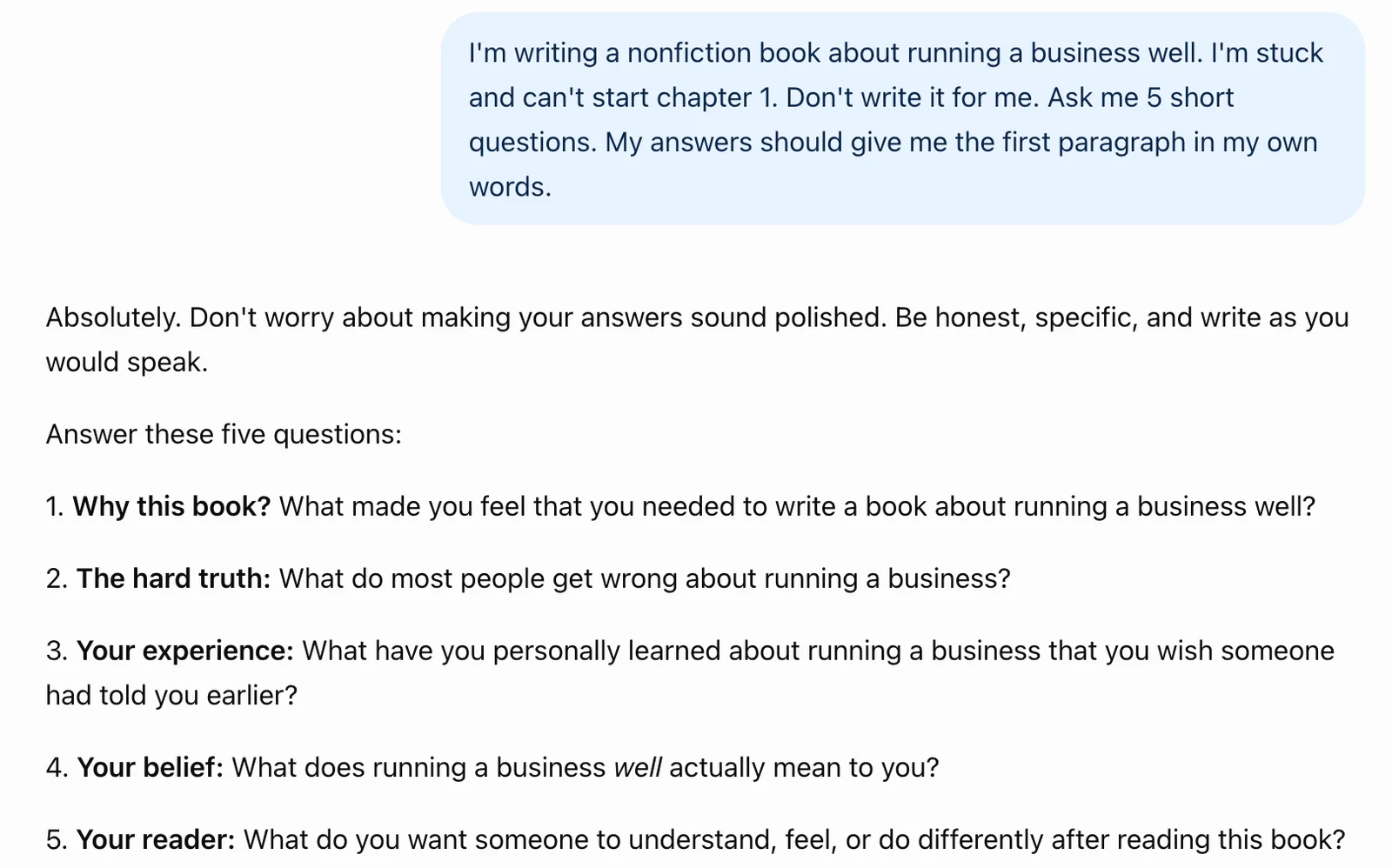
Same situation, one change. We asked ChatGPT not to write anything and to ask us five short questions instead.
Text in the image:
- Why this book? 2. The hard truth: What do most people get wrong about running a business? 3. Your experience. 4. Your belief: What does running a business well actually mean to you? 5. Your reader.
We answered in five short sentences, using the ideas from Taylor's chapter. ChatGPT still did not write the paragraph. It named the main idea in our answers and gave us three sentence starters to finish ourselves.
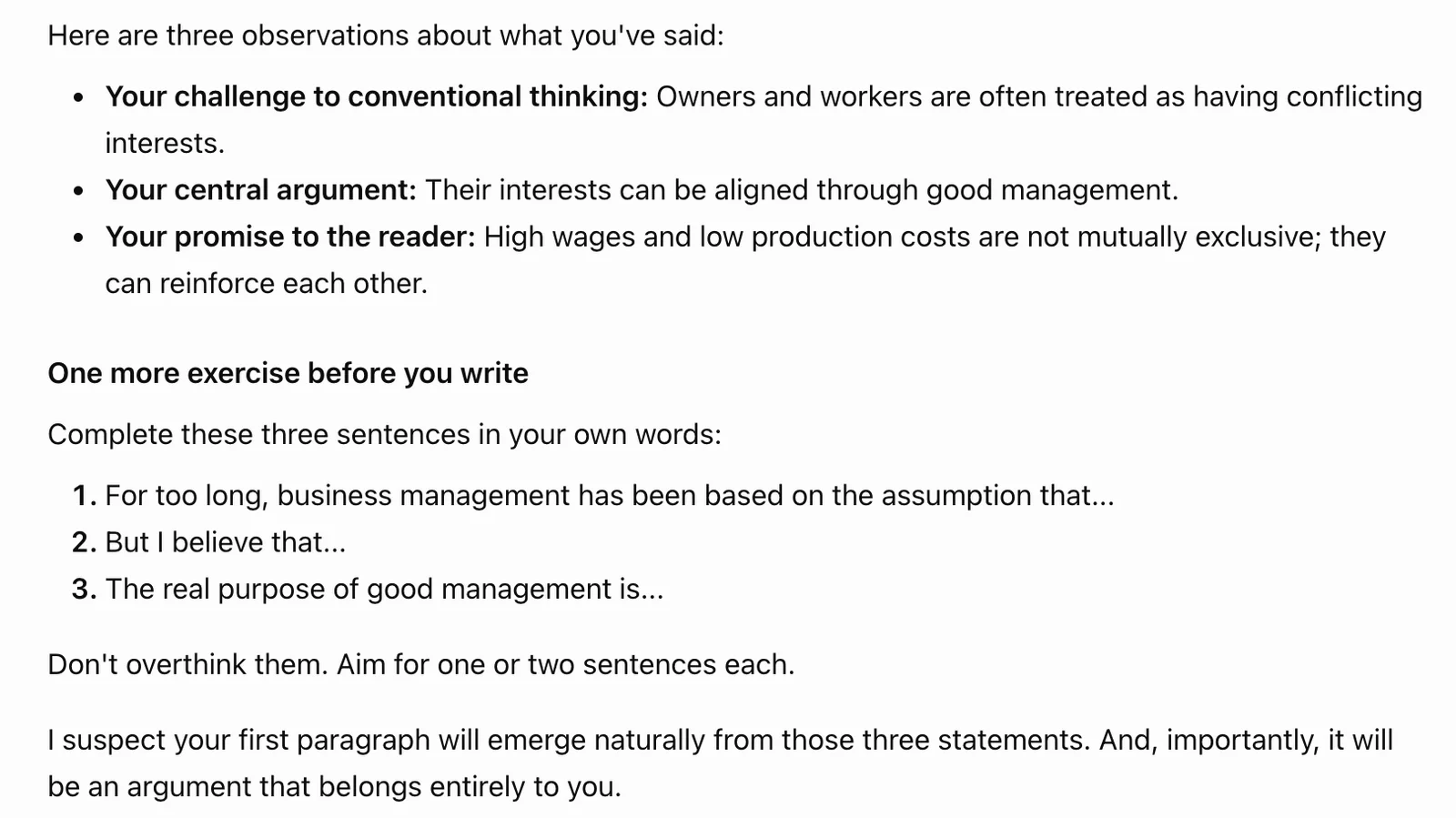
Text in the image:
"Complete these three sentences in your own words: For too long, business management has been based on the assumption that... But I believe that... The real purpose of good management is..."
Finishing those three lines took us about two minutes. The result was our own opening: "For too long, business management has been based on the assumption that owners and workers want opposite things. But I believe that their interests are the same. The real purpose of good management is lasting prosperity for both."
It is plain, and it is a real argument a reader can agree or disagree with.
Request 3: "Turn my notes into an outline"
The third block is the missing plan. You have notes and no idea what goes first. We pasted about 250 words of notes and asked for a 5-point outline using only what was in them.
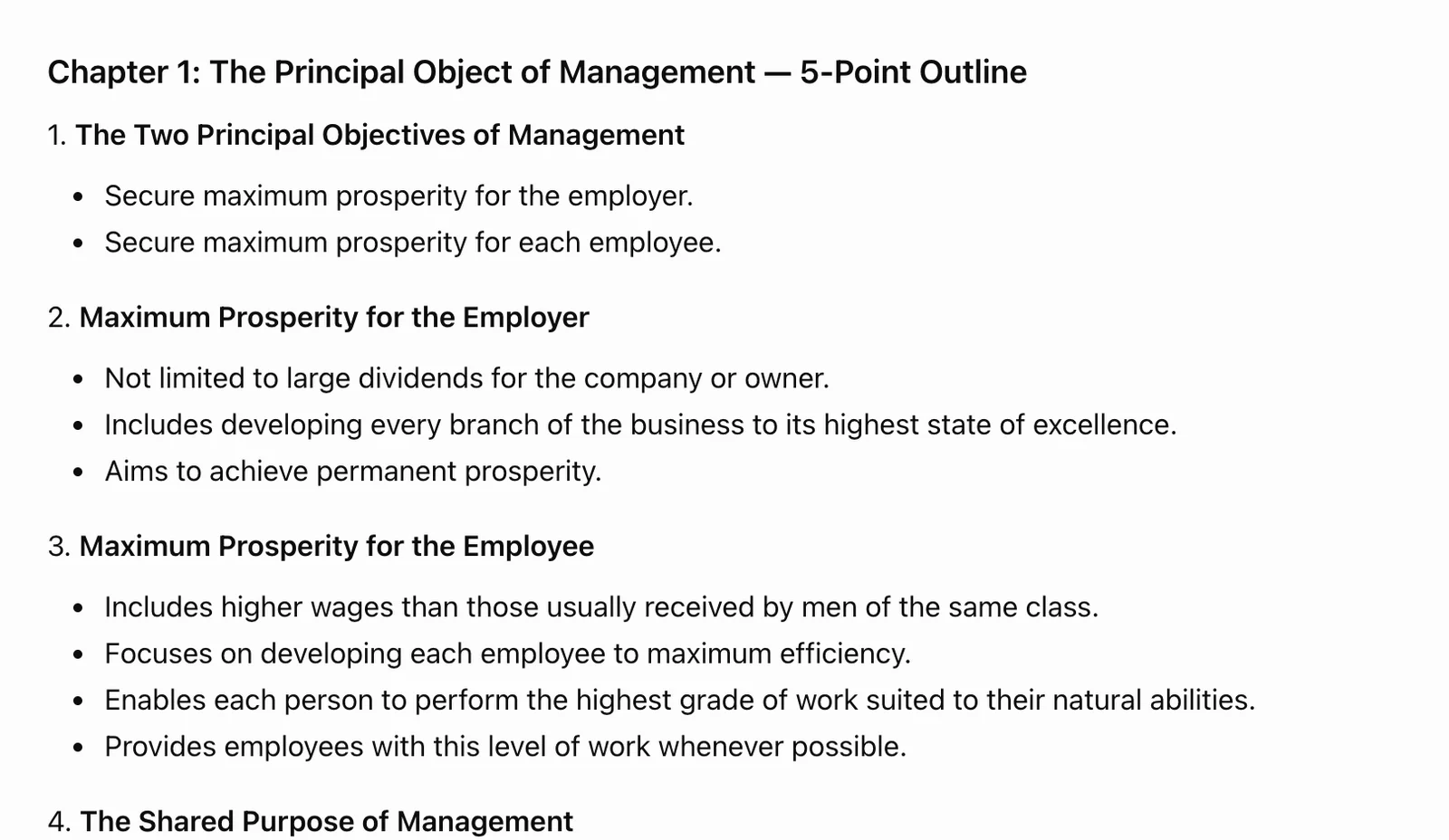
Text in the image:
"1. The Two Principal Objectives of Management. 2. Maximum Prosperity for the Employer. 3. Maximum Prosperity for the Employee. 4. The Shared Purpose of Management."
It took about 10 seconds. We checked all 13 bullets against the notes and found nothing added. This is the safest way to use AI on a stuck chapter, because the ideas stay yours and only the order changes.
Here is the whole test side by side:
| What we asked | Time | What we got | Whose words? |
|---|---|---|---|
| Write the opening paragraph | About 10 seconds | A fluent, generic paragraph | ChatGPT's |
| Ask me 5 questions | About 2 minutes in all | Three sentences we wrote | Ours |
| Outline my notes | About 10 seconds | 5 points, nothing added | Ours, reordered |
How do you use AI for writer's block without losing your voice?
These steps follow what worked in our test. They work in any chat tool, such as ChatGPT, Claude or Gemini.
- Paste your notes first. Old posts, a talk transcript or a page of bullet points is enough. AI works from what you give it, and more of your own material means more of you in the result.
- Ask for an outline that uses only your notes. Add the words "add nothing new". Then read each point and check it came from you.
- Ask for questions. Type "Don't write it for me. Ask me 5 short questions." Answer them fast, the way you would talk.
- Ask for sentence starters. If you are still stuck, ask for three half sentences to finish yourself.
- Write the paragraph yourself. Use your answers. It can be rough. Rough is easy to fix later.
- Check anything the AI adds. If it suggests an example, a name or a number, look it up before you keep it. Our guide to writing a nonfiction book with AI without making up facts shows how.
Tip: If you write better when you talk, answer the questions out loud and type what you said. Many first-time authors find this easier, as our article on writing a book when you're not a writer explains.
Do you have to tell Amazon if AI helped you get unstuck?
Usually not. Amazon KDP's content guidelines split AI use into two kinds.
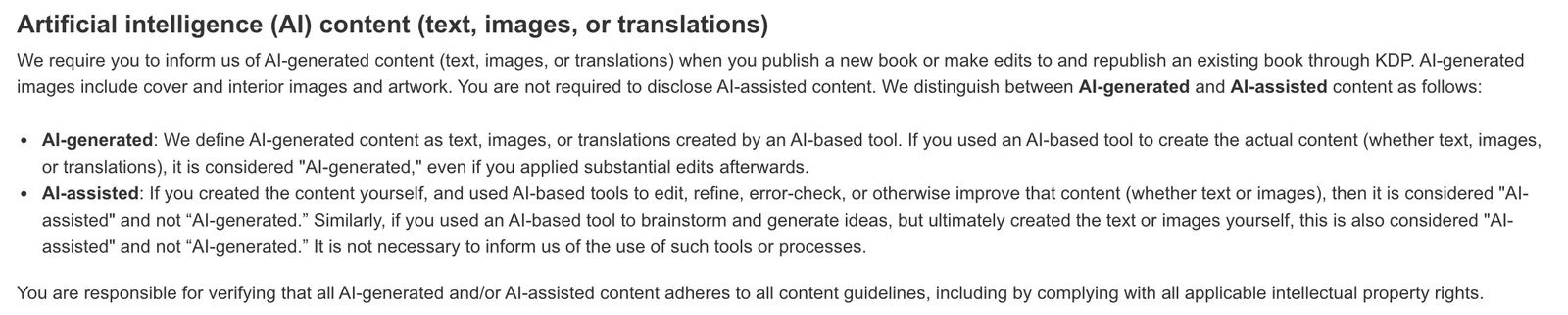
Text in the image:
"If you used an AI-based tool to brainstorm and generate ideas, but ultimately created the text or images yourself, this is also considered 'AI-assisted' and not 'AI-generated.' It is not necessary to inform us of the use of such tools or processes."
So the questions, the outline and the sentence starters from our test count as AI-assisted. The paragraph ChatGPT wrote in Request 1 would count as AI-generated, and you would answer "yes" in KDP, even after heavy edits. Our article on whether you have to disclose AI in your book walks through that question.
How Built&Written helps when you are stuck
About Built&Written
Built&Written is a platform that turns your notes, posts or talks into a finished nonfiction book for Amazon KDP. You paste what you already have, approve an outline, and the chapters are written in your voice.
A blank page is the hardest place to start, and on Built&Written you never start there. You begin with your own material, up to 50,000 words of it. The platform proposes a chapter plan from that material, and you change it before anything is written. Voice DNA learns how you write from 5 to 50 pages of your own text, so the chapters keep your way of saying things.
When one paragraph stalls, the editor has an Ask AI menu next to the page. It offers Polish, Sound more human, Tighten, Expand, Simplify, Make persuasive and Add example. We tried Add example on a stuck paragraph in our test book.
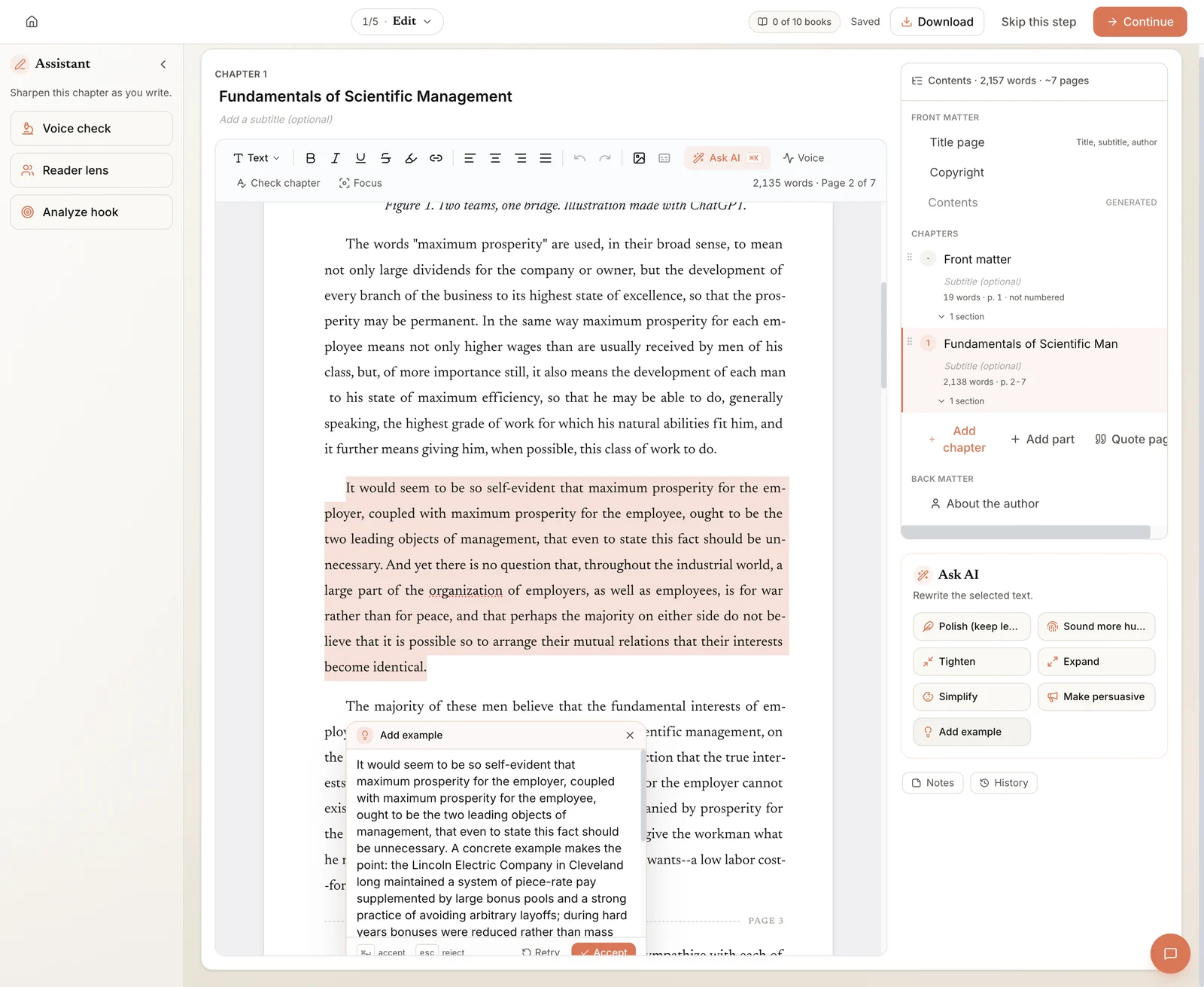
Text in the image:
Ask AI menu: Polish (keep length), Sound more human, Tighten, Expand, Simplify, Make persuasive, Add example. Box: "Add example ... A concrete example makes the point: the Lincoln Electric Company in Cleveland long maintained a system of piece-rate pay..." Buttons: accept, reject, Retry, Accept.
The suggestion appeared in about 20 seconds. Our first try added an example about the Lincoln Electric Company. A second try offered Henry Ford's $5 workday from 1914. We never gave it either fact, so check any AI example or swap in a story of your own. We rejected both, and the chapter stayed as it was.
Here is the same path from our steps, done by hand and on the platform:
| Step | With a chat tool | With Built&Written |
|---|---|---|
| Start from your notes | Paste them into each new chat | Paste or upload once, up to 50,000 words |
| Get a plan | Ask for an outline, check it | A chapter plan you approve and edit |
| Keep your voice | Answer questions, write it yourself | Voice DNA from 5 to 50 pages of your writing |
| Unstick one paragraph | Copy it into a chat and back | Ask AI on the page, with Accept or Reject |
| Finish the book | Format, cover and files on your own | Layout, cover, KDP checks and files in one place |
Final thoughts
AI does help with writer's block. It is best at the first step: questions to answer, an outline from your own notes, a half sentence to finish. Let it write the page for you and you get fluent text that sounds like everyone else, plus a "yes" on Amazon's AI question.
For most experts, the bigger block is the whole book. That is where Built&Written helps. It turns the material you already have into a finished book you can upload to Amazon:
- No blank page. You start from your notes, posts, talk transcripts or an old draft of your book.
- A plan you approve. You see the chapter outline and change it before writing starts.
- Chapters in your voice. Voice DNA learns from your own pages, so the book sounds like you.
- Help on the page. Ask AI can tighten, expand or add an example, and nothing changes until you accept it.
- A finished book. Layout, cover and KDP checks are done for you, and you upload the files in your own KDP account.
See how it works, or compare the plans.
Frequently asked questions
It can get you past it. AI is good at questions, outlines and first lines, which is where most people freeze. In our test, five questions and three sentence starters gave us an opening in about two minutes. The ideas still have to come from you.
Not if the ideas and the words are yours. Using AI to ask you questions or sort your notes is like talking to an editor. KDP calls this "AI-assisted" and does not ask you to report it.
The one that worked best for us was: "Don't write it for me. Ask me 5 short questions. My answers should give me the first paragraph in my own words." For a messy chapter, paste your notes and ask for an outline that adds nothing new.
No. KDP says that if you used AI to brainstorm and generate ideas but wrote the text yourself, it counts as AI-assisted, and you do not need to tell Amazon. If AI wrote the text, it counts as AI-generated and you must disclose it.
About the author

Khrystyna Balushka
More in informational
Ready to write your book?
Turn your expertise into a professional book with Built&Written.