

How to Write a Nonfiction Book With AI Without Making Up Facts
You have 20 years of consulting experience, dozens of presentations, client case studies, and enough research to fill a bookshelf. You ask AI to turn that knowledge into a chapter. Minutes later, you have 3,000 polished words.
Then you check the details. A statistic has no source. A study doesn't exist. One of your client examples now claims results you never achieved.
The writing sounds convincing. The facts are another story.
Why does AI make up facts when writing nonfiction?
AI struggles with factual nonfiction because large language models can generate convincing statements without verifying their accuracy. This can produce fabricated citations, misleading statistics, incorrect definitions, and unsupported conclusions, even when the writing sounds authoritative.
An AI hallucination is generated information that is false, unsupported, or inconsistent with the available evidence. In nonfiction writing, hallucinations can appear as fabricated research papers, invented quotations, incorrect statistics, or fictional details added to real case studies. Even when AI uses genuine sources, it can misinterpret their findings.
A discussion in r/WritingWithAI illustrates the problem. One author described using AI extensively for a nonfiction book, only to discover that some health-related claims were overstated or pointed toward incorrect conclusions.
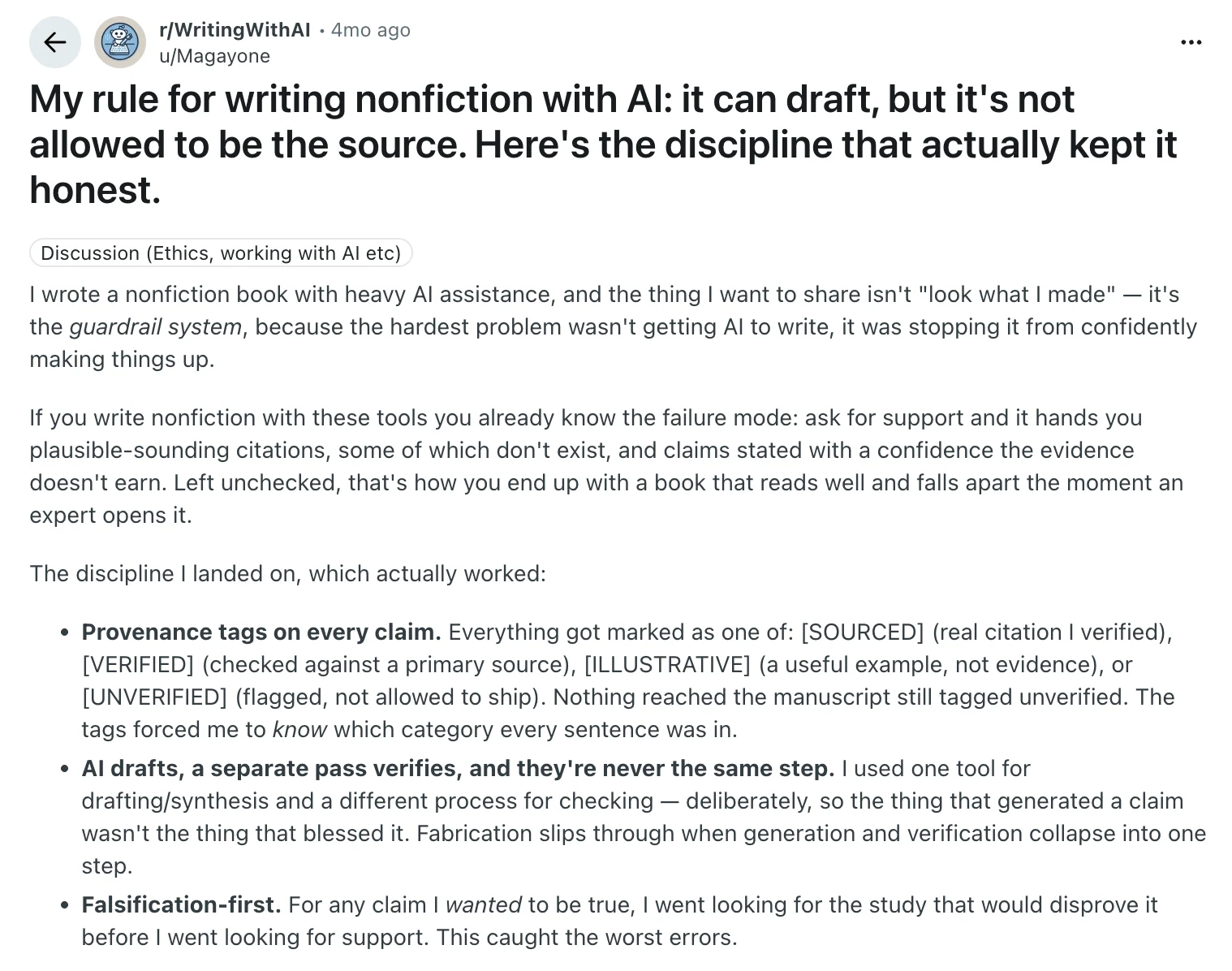
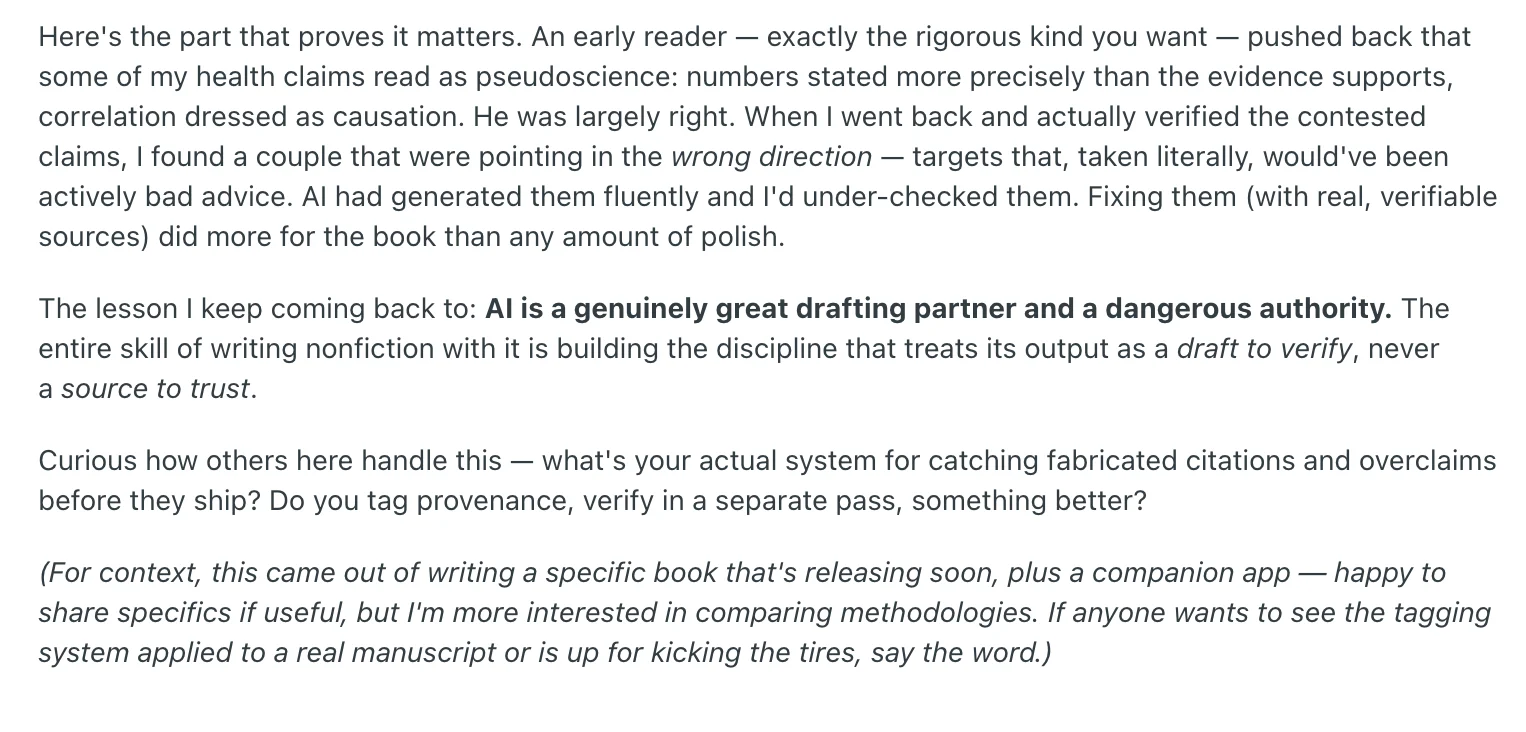
The author categorized claims as sourced, verified, illustrative, or unverified. Unverified claims were excluded from the final manuscript until they could be checked. This distinction kept plausible AI-generated explanations from being mistaken for established evidence.
This happens because large language models generate plausible text without independently establishing whether every statement is true.
For nonfiction authors, the risks include:
Fabricated references: Studies or citations that don't exist.
Distorted statistics: Real numbers presented with incorrect interpretations.
Missing qualifications: Research findings described as universal facts.
Inaccurate terminology: Technical concepts explained using incorrect definitions.
Chapter inconsistencies: Frameworks or facts that change throughout the manuscript.
Consider a leadership consultant writing about employee performance. Their case study shows that management training improved team satisfaction. AI rewrites the example to claim productivity increased by 35%, despite having no evidence for that figure.
The chapter now sounds more persuasive, but it's less trustworthy.
The Reddit author's solution was to track the source of each claim and separate AI drafting from factual verification.
That's the distinction serious nonfiction writers must understand: AI can help explain your expertise, but it cannot become the authority behind your evidence.
Which AI model is best for writing fact-based nonfiction?
Should you use ChatGPT, Claude, Gemini, or another model to write your nonfiction book?
That's what an author asked in a r/WritingWithAI discussion about long-form writing where facts matter.
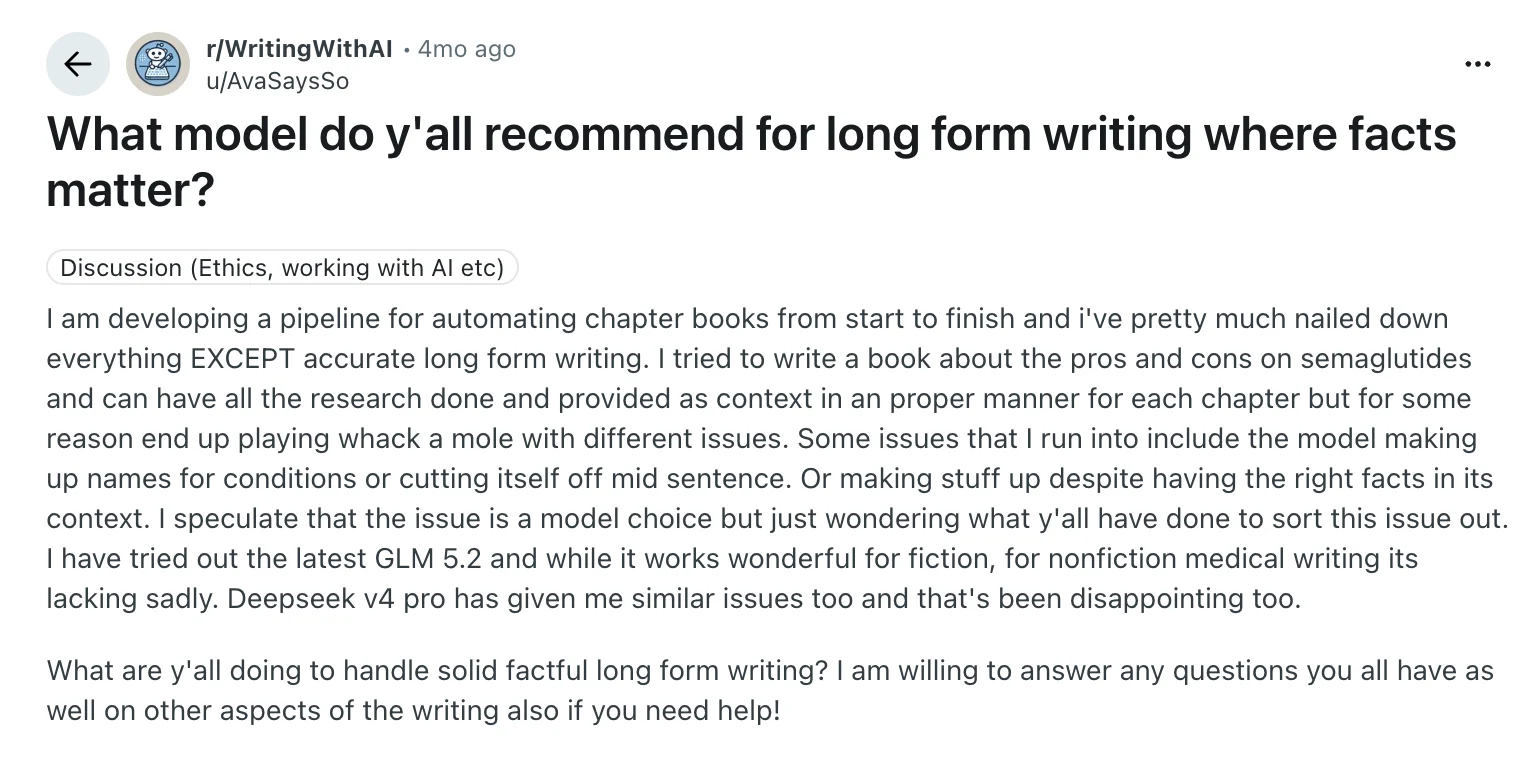
The author was developing a research-heavy medical nonfiction book. Despite supplying relevant research, AI kept inventing terminology and introducing inaccurate information. Switching models hadn't resolved the problem.
Other participants recommended separating drafting from verification, working in smaller sections, and maintaining reference documents.
These suggestions matter because each AI tool has different strengths:
ChatGPT can assist with research, chapter outlines, drafting, and reviewing arguments.
Claude can help analyze source documents, organize complex material, and develop structured chapters.
Gemini can summarize research, organize information, and develop explanations from supplied materials.
| Tool | Useful nonfiction-writing task | What the author must verify |
|---|---|---|
| ChatGPT | Outlining, drafting, restructuring arguments | Sources, statistics, and factual claims |
| Claude | Working through supplied documents and long-form drafts | Faithfulness to source passages |
| Gemini | Research synthesis and organizing supplied material | Citation accuracy and interpretation |
No AI model consistently guarantees factual accuracy. The best tool for nonfiction is the one that follows your source restrictions, preserves your terminology, and produces the fewest unsupported claims in your own testing.
Instead of choosing a model based on rankings, test it against your own research.
Give each model the same documents and request a 500-word section. Compare citation accuracy, instruction following, terminology, and unsupported claims.
The best choice isn't necessarily the model that produces the most polished first draft. It's the one that works reliably with your sources and requires the least factual correction.
How to organize research before writing a nonfiction book with AI
Before writing a nonfiction book with AI, organize your sources into a research library, master outline, source register, terminology list, and chapter research packets. These documents help maintain factual consistency and make individual claims easier to verify.
One author described this challenge in a r/ClaudeAI discussion titled "Serious Nonfiction."
After eight months of working on a research-heavy manuscript, the author had experimented with ChatGPT, Claude, Gemini, and DeepSeek. AI helped manage the material, but the author emphasized that successful results still required discipline and careful direction.
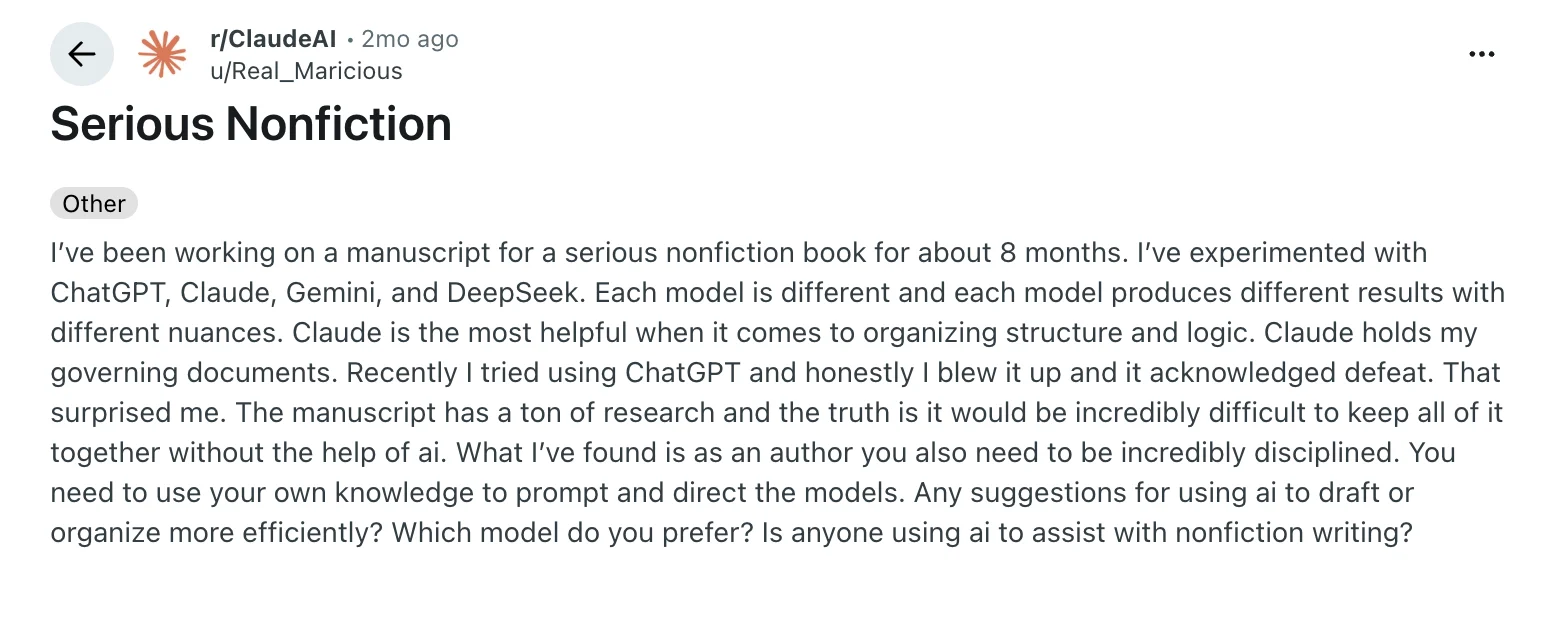
The lesson? Organize your knowledge before generating chapters.
Start with a research library containing verified studies, interview transcripts, presentations, case studies, and original notes.
Then prepare four reference documents:
Master outline: Your central argument, chapter sequence, and key ideas.
Source register: Verified references, publication details, and supporting evidence.
Terminology list: Approved definitions, frameworks, and industry-specific language.
Chapter research packets: Relevant sources and examples for individual chapters.
Separate firsthand business experience from externally verified claims. A successful consulting project can support a case study, but it doesn't prove that your approach works for every organization.
Remove confidential client information unless you have permission to publish it.
About Built&Written: Once your material is organized, Built&Written can help turn it into a structured manuscript. Wren works with existing notes, drafts, and transcripts to develop chapter outlines and draft content. Voice DNA uses samples of your writing to maintain your style. The important part: your research remains your responsibility. Built&Written helps organize and draft the book, but you still need to verify the evidence behind its claims.
How to draft nonfiction chapters with AI without losing accuracy
Draft an AI-assisted nonfiction book in manageable sections rather than generating an entire manuscript at once. Working in sections of 300 to 700 words makes it easier to check evidence, correct unsupported claims, preserve terminology, and prevent errors from spreading across chapters.
The longer the output, the more difficult it becomes to catch unsupported claims, repeated arguments, inconsistent terminology, and details that contradict earlier chapters. Even a 5,000-word chapter can contain errors buried inside otherwise convincing paragraphs.
A better approach is to draft in manageable sections, reviewing each one before moving forward.
Follow this sequence:
Create the chapter outline. Define the chapter's purpose, key arguments, and sections.
Provide relevant sources. Supply only the research, notes, and examples needed for the current section.
Generate a section draft. Aim for 300 to 700 words rather than an entire chapter.
Review the content. Check factual claims, missing context, repeated ideas, and whether the argument reflects your expertise.
Revise before continuing. Correct mistakes and update your instructions for subsequent sections.
You can use a prompt like this:
Draft a 500-word section explaining [topic] for a business nonfiction book. Use only the supplied documents for factual claims, statistics, and examples. Do not invent studies, citations, quotations, or results. If a claim lacks supporting evidence, mark it [SOURCE NEEDED] rather than filling the gap. Follow the provided outline and preserve my terminology.
This process won't eliminate every error. It makes errors easier to identify before they spread throughout the manuscript.
How to fact-check an AI-written nonfiction chapter
To fact-check an AI-written nonfiction chapter, identify factual claims, connect each claim to a credible source, read the original evidence, verify the details, and correct or remove unsupported statements. AI can flag possible problems, but authors must independently confirm the evidence.
Use this five-step verification process:
Identify factual claims. Highlight statistics, dates, quotations, research findings, company results, and statements about cause and effect. Pay particular attention to precise numbers and claims that sound unusually definitive.
Match claims to sources. Every factual statement should connect to a credible reference or clearly identified firsthand experience. If AI provides a citation, confirm that the publication actually exists.
Read the original source. Don't rely on AI-generated summaries. Open the study, report, or document and locate the passage supporting the statement.
Check the details. Compare numbers, dates, quotations, sample sizes, and conclusions. A study showing correlation doesn't necessarily prove causation. Check whether the research supports the specific claim you're making.
Correct unsupported statements. Rewrite exaggerated claims, add missing qualifications, or remove statements you cannot substantiate.
Keep a simple claim-tracking table as you review:
| Claim | Source | Status |
|---|---|---|
| Training improved satisfaction in one client team | Original client report | Verified |
| The approach works across all industries | No supporting study identified | Unsupported |
| Employee turnover decreased after implementation | Internal company records | Needs Review |
For business case studies, confirm that you have permission to publish sensitive information, even when the underlying numbers are accurate.
AI can help with the first verification pass. Ask it to flag questionable statistics, missing citations, and conclusions that extend beyond the supplied evidence.
But don't ask the same AI system to certify its own accuracy.
The final check belongs to you. Open the sources, examine the evidence, and approve each factual claim before including it in your nonfiction book.
How to keep AI-written nonfiction chapters consistent
A nonfiction book written over several weeks can develop contradictions that are easy to miss. You define a framework one way in Chapter 2, change its terminology in Chapter 5, and describe its results differently in Chapter 8.
To prevent this, maintain a manuscript reference document that includes:
Approved facts: Verified statistics, research findings, and their original sources.
Framework definitions: Your methodology, its components, and how each concept relates to the others.
Consistent terminology: Preferred industry terms, abbreviations, and definitions.
Editorial rules: Your intended audience, writing style, formatting preferences, and words to avoid.
Keep this document updated as the manuscript develops, and consult it when drafting or revising each chapter.
Remember that factual consistency and writing-style consistency are different problems. A book can sound like you while misrepresenting your research. It can also be factually accurate but read nothing like your usual writing.
About Built&Written: Built&Written addresses the writing-style side through Voice DNA, which uses samples of your existing writing to help maintain a recognizable voice across chapters. Wren can assist with developing and revising the manuscript.
The seven-step workflow for writing a factual nonfiction book with AI
You don't need a complicated collection of AI tools to write a credible nonfiction book. You need a repeatable process that keeps your expertise and evidence in control. The Source-First Nonfiction Method follows seven stages: research, organize, outline, draft, verify, edit, and final review.
Here's a seven-stage workflow:
Research: Gather credible studies, reports, and firsthand evidence. AI can help identify research questions, but you must evaluate the sources.
Organize: Build a source library and terminology list. Use AI to categorize documents and summarize their contents, then check those summaries.
Outline: Define your book's argument and chapter sequence. Let AI suggest structures, but decide what readers actually need to learn.
Draft: Generate one section at a time using approved materials. Review the arguments and examples before proceeding.
Verify: Check factual claims against original sources. AI can flag potential problems, but you approve the evidence.
Edit: Improve clarity, transitions, and consistency. Use AI for revision suggestions while preserving your voice.
Final review: Read the complete manuscript, check references, and confirm that every chapter supports your central argument.
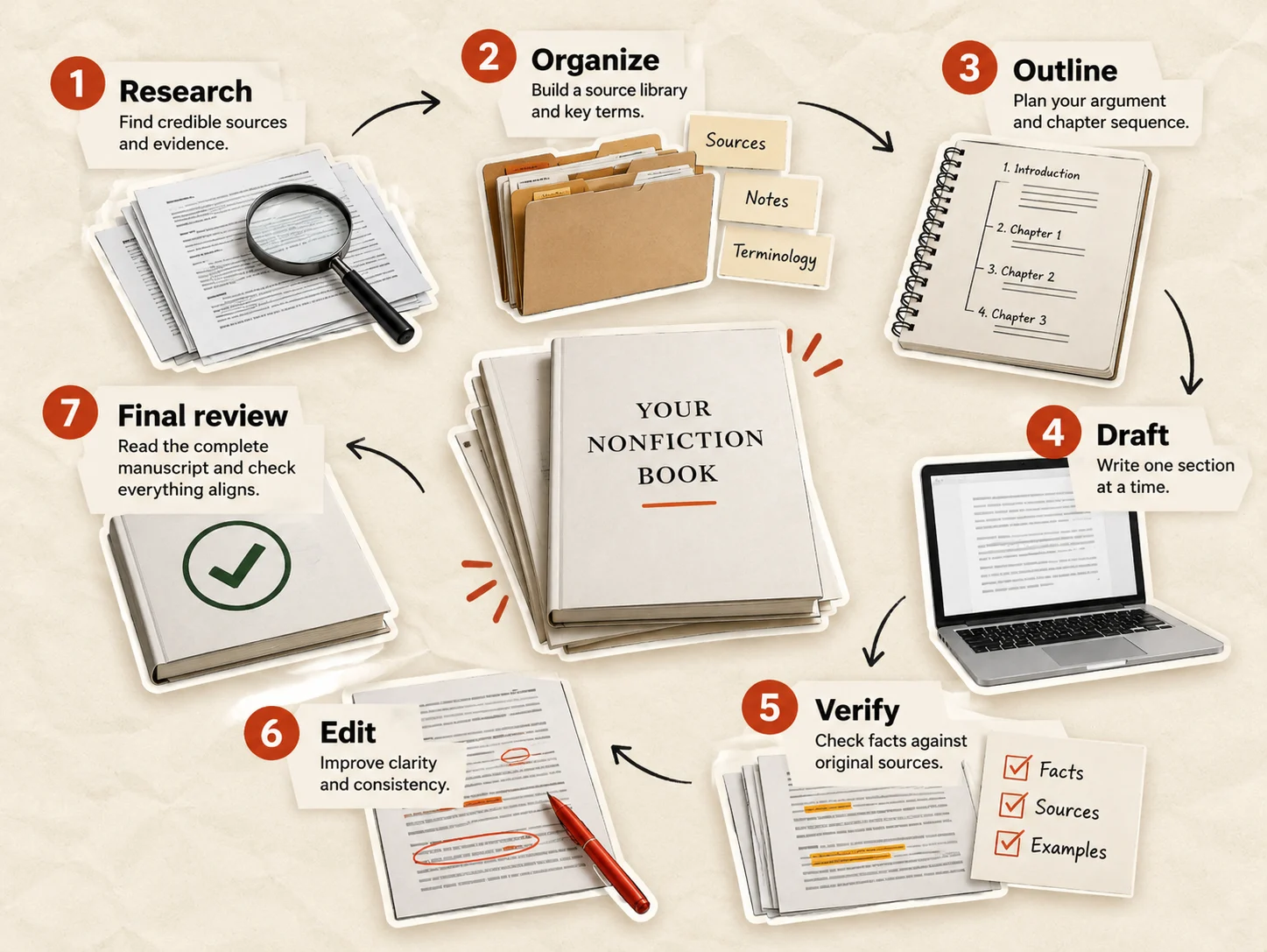
The principle stays the same: AI helps produce the manuscript. You remain responsible for its accuracy.
Frequently asked questions
Yes, AI can help produce an accurate nonfiction manuscript, but it cannot guarantee accuracy. Authors must verify research findings, statistics, quotations, and factual claims against reliable sources before publication.
ChatGPT, Claude, and Gemini are all options. The best choice depends on your research materials, workflow, and editing requirements. Test each model using the same documents and compare factual accuracy, citation quality, and consistency.
AI can identify real sources, especially when using research or web-search tools. However, it can also invent references or misrepresent findings. Always open the original source and confirm that it supports the cited claim.
Provide verified research, restrict factual claims to supplied materials, and instruct AI to flag missing evidence rather than invent details. Review each section before continuing.
No. AI can identify claims that need verification, search for potential sources, and compare passages with supplied documents. However, it can also misread research, overlook important qualifications, or produce incorrect citations. Authors should inspect the original evidence themselves and independently review consequential claims before publication.
Yes. Check every chapter for unsupported statistics, inaccurate quotations, misleading conclusions, and inconsistencies. Prioritize consequential claims, but don't assume ordinary-looking statements are correct.
Yes. Under [Amazon KDP's content guidelines](https://kdp.amazon.com/en_US/help/topic/G200672390), AI-assisted content does not require disclosure. However, AI-generated text must be disclosed, even if you substantially edit it afterward. Authors remain responsible for accuracy, intellectual property rights, and compliance with publishing requirements.
Sources & References
About the author

Polina Karlashchuk
More in informational
Ready to write your book?
Turn your expertise into a professional book with Built&Written.