
What This Year's Best Nonfiction Books Have in Common
The 25 nonfiction books on Publishers Weekly's Best Books of 2026 list share one pattern: a short main title and a subtitle that says what the book is about. We counted 24 of 25 with a subtitle, and 19 main titles with three words or fewer. The nine books whose print length we could confirm run from 208 to 496 pages, with a median of 368.
If you are writing your own nonfiction book, you make many choices early. What do you call it? What goes in the subtitle? How long should it be? It is hard to know what to aim for. So we looked at the books that editors picked for 2026 and counted what they have in common. There is no formula for a good book. What we have is a set of counts you can use as a starting point.
What do the best nonfiction books of 2026 have in common?
Three things showed up in our count. All three counts come from the Publishers Weekly list.
| Pattern | What we counted |
|---|---|
| A subtitle | 24 of 25 books have one |
| A short main title | 19 of 25 main titles have three words or fewer |
| Hardcover length | 9 books with a confirmed page count run from 208 to 496 pages, median 368 |
What each one means for you: a subtitle lets the main title stay short. A short main title is easier to remember and to say out loud. The page counts give you a rough idea of how long these nonfiction books are. They are a reference point, not a target for your own book.
How we looked at the lists
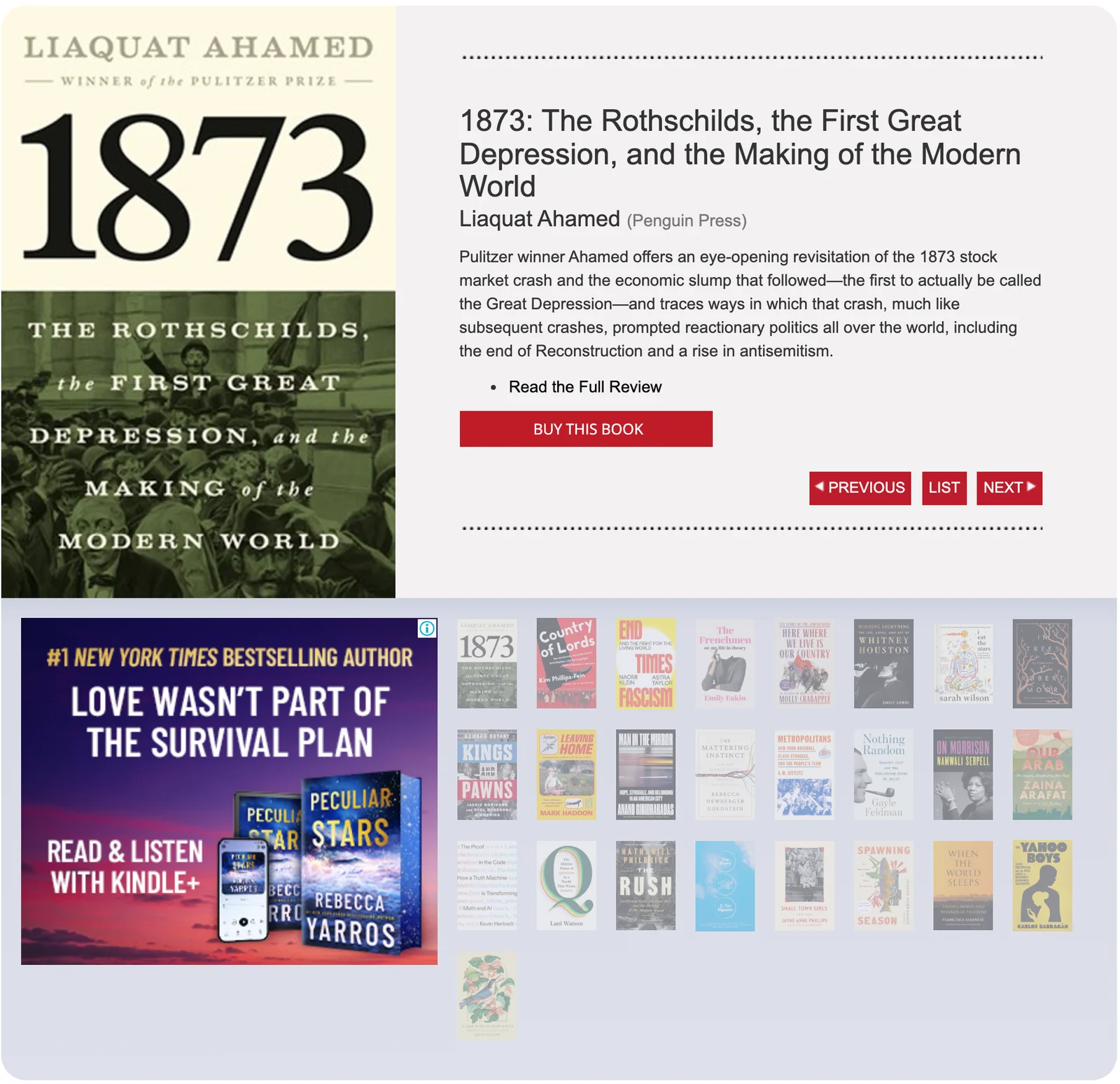
First we collected the titles from two lists. The nonfiction category of the Publishers Weekly Best Books 2026 list has 25 books. We copied every title and publisher from the page on November 20, 2026, and checked our copy against the page's own text.
The second list is the Amazon Editors' Best Books of 2026, published on November 12, 2026. It has a top 20, and four of those books are nonfiction, going by the editors' own descriptions: a true story, narrative nonfiction, a reported memoir and a divorce memoir. We used these four as a second check on the pattern. The two lists share no title.
Then we looked at how each title is built. We split it at the colon into a main title and a subtitle, and counted the words in each. We read all 25 subtitles and noted what each one promises.
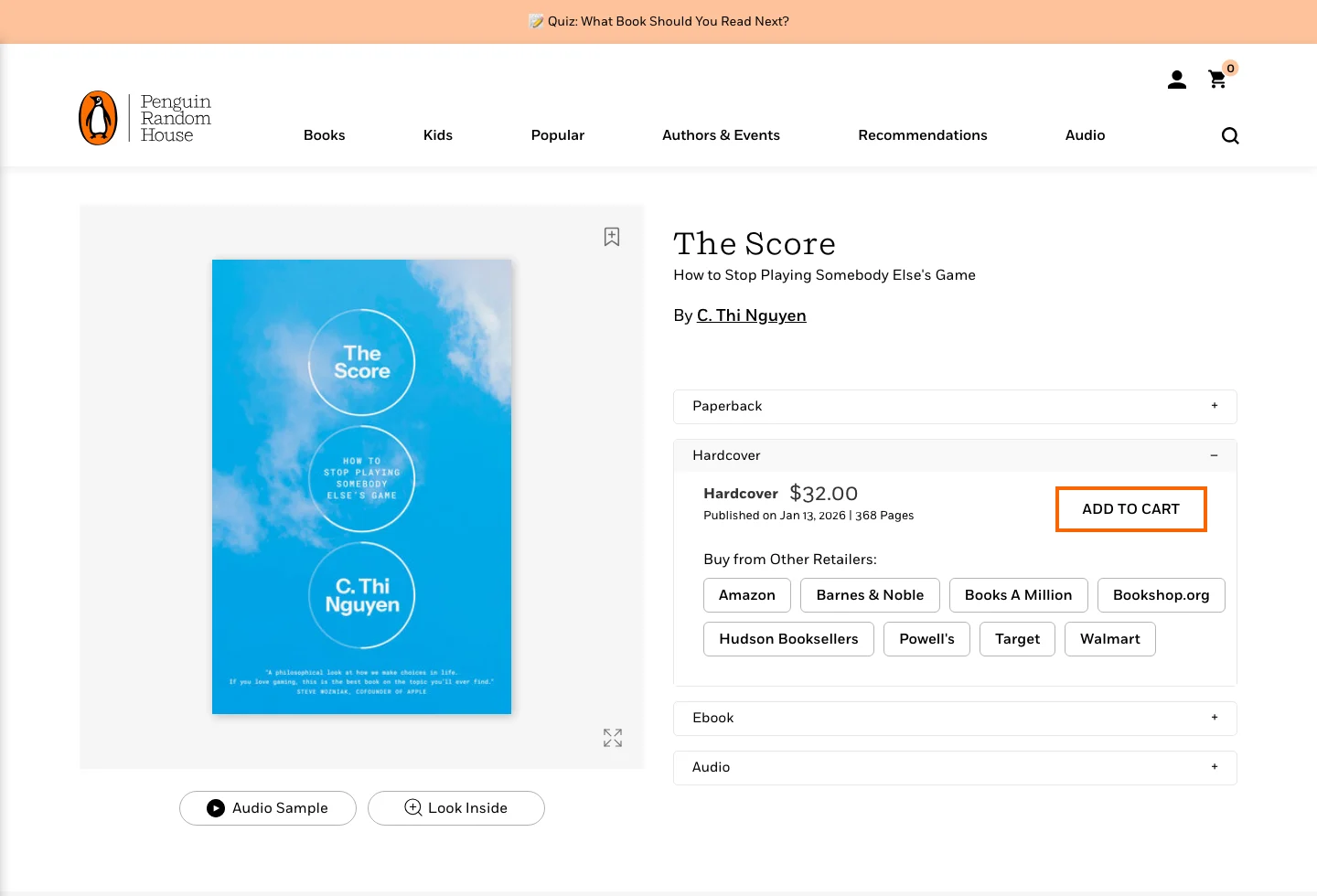
Last, we checked the page count on the publisher's own page, here Penguin Random House. We kept a count only when the page showed one clear hardcover number.
We did not study the whole book market. We looked at two editors' lists, and "best" here means what Publishers Weekly and Amazon's editors picked.
Why do the best nonfiction books have a short title and a long subtitle?
The two parts do different jobs. The main title gets attention and is easy to remember. The subtitle tells the reader what is inside.
Think about the problem each part solves alone. A catchy title can leave a stranger guessing what the book is about. A title that explains everything grows long and is hard to remember. A subtitle lets you split the job.
On the Publishers Weekly list, 24 of 25 books have a subtitle. The one book without it is On Morrison, with two words in total. The median main title is two words. The median subtitle is 7.5 words. The median full title is 10 words. Nineteen of the 25 main titles have three words or fewer.
Three examples from the page show how the split works:
- Q: The Hidden Power of Questions in a World That Wants Answers. A single letter says almost nothing. The subtitle tells you the subject is questions.
- The Score: How to Stop Playing Somebody Else's Game. The word "score" could mean many things. The subtitle turns it into a promise.
- In Trees: An Exploration. Both parts are short, and the subtitle tells you the kind of book it is.
The Amazon four follow the same shape. All four have a subtitle, and three of the four main titles have three words or fewer. Across both lists that makes 28 books with a subtitle out of 29, and 22 main titles with three words or fewer out of 29.
If you are choosing a title for your own book, our book title generator gives you title and subtitle pairs to compare with this shape. For the chapter level, see our guide to writing chapter titles with AI.
What do the subtitles promise?
We read all 25 subtitles and found four patterns. Each one makes a different promise to the reader.
1. A method. Four subtitles start with "How": I Eat the Stars, The Mattering Instinct, The Proof in the Code and The Score. Two of them say "How to". A subtitle that starts with "How" tells the reader the book explains how something works or how to reach a result. On this list, that is the choice of idea and science books.
2. A list of three or more. Nine subtitles name a list. Man in the Mirror promises "Hope, Struggle, and Belonging in an American City". The Yahoo Boys promises "Love, Deception, and the Real Lives of Nigeria's Romance Scammers". A list shows the reader which topics the book covers.
3. A person or a place. The subtitles of the history and biography books name who or where. Holding Lightning names Whitney Houston. Nothing Random names Bennett Cerf. Kings and Pawns names Jackie Robinson and Paul Robeson. When the World Sleeps names Palestine. The reader sees at once who or what the story is built around.
4. The Making of the Modern World. Two books end their subtitle with the same phrase: 1873 and The Rush. Both are history books, and the phrase promises a big claim about what the story changed.
Memoirs say so. Leaving Home is "A Memoir in Full Colour" and Small Town Girls is "A Writer's Memoir". The Amazon list adds Strangers: A Memoir of Marriage.
For your own subtitle, ask what you want to promise. You might explain one idea, tell one story, show a method or cover a few linked topics. Then pick the pattern that matches.
How long are the best nonfiction books of 2026?
Of the nine books where we could confirm a clear hardcover page count, the shortest has 208 pages and the longest has 496. The median is 368.
| Book | Hardcover pages | Source |
|---|---|---|
| Small Town Girls | 208 | Penguin Random House |
| Leaving Home | 320 | Penguin Random House |
| Q | 320 | Penguin Random House |
| I Eat the Stars | 336 | Penguin Random House |
| 1873 | 368 | Penguin Random House |
| The Score | 368 | Penguin Random House |
| Here Where We Live Is Our Country | 480 | Penguin Random House |
| Man in the Mirror | 480 | Penguin Random House |
| The Frenchmen | 496 | Penguin Random House |
Five of the nine sit between 320 and 368 pages. Three sit between 480 and 496. One is a short memoir at 208.
We left out the other 16 books. For some, no publisher page would open for us. For others, the page showed more than one page count, or an unclear edition. A count we could not read clearly is not in the table, and it is not in the median.
What does this mean if your book will have 150 pages, or 500? Both can be right. Length depends on your topic, how deep you go and how the book is laid out. Use the table as a reference point, not a rule. A page count also depends on trim size and type size, so to turn your own word count into pages, use our word count to pages tool. For how long the parts of a book run, see how many pages a chapter should be.
What these lists cannot tell you
They are a small sample. We counted two lists and nine page counts. A bigger study would add more lists and more books.
They are picked by editors. A book on an editors' list is a book the editors liked. It does not mean the book sold the most.
They cannot show what made a book good. We can see that many of these books have a short title and a subtitle. That does not prove the title is the reason they were picked.
They are books from publishing houses. Every one of the 25 Publishers Weekly picks is listed under a publisher. That says nothing about the quality of self-published books, which this count does not cover.
They do not show the inside of a book. We did not read the chapter lists, so we make no claim about structure. For that, see three frameworks for structuring a nonfiction book.
What can you do with this for your own book?
Take it in four small steps.
- Write what the book is about in one sentence. If you cannot say it in one sentence, the title will be hard too.
- Find a short title for that idea. Two or three words that are easy to say out loud.
- Write a subtitle that says what the book covers and who it is for. About seven or eight words is where this list sits. That is a count of 25 books, not a rule.
- Then think about length. Ask how much material the topic needs to be covered well.
What if you already have notes and posts?
Many authors do not start from a blank page. You may have years of posts, notes, talk transcripts or course material, kept in different places. Built&Written is a platform made for that starting point. You paste your material in, and it helps you find a structure. It proposes a chapter outline, then writes chapter by chapter, so you do not have to write the whole book at once.
Each step answers a problem. The outline shows how separate pieces can fit into one book. Working chapter by chapter keeps the job in small parts. And material you already have can be collected, organized and used as the base of the book, instead of staying scattered in different places. You can read more about writing a nonfiction book with the platform. For the two jobs in this article, there are two free tools: the title generator and the word count to pages tool.
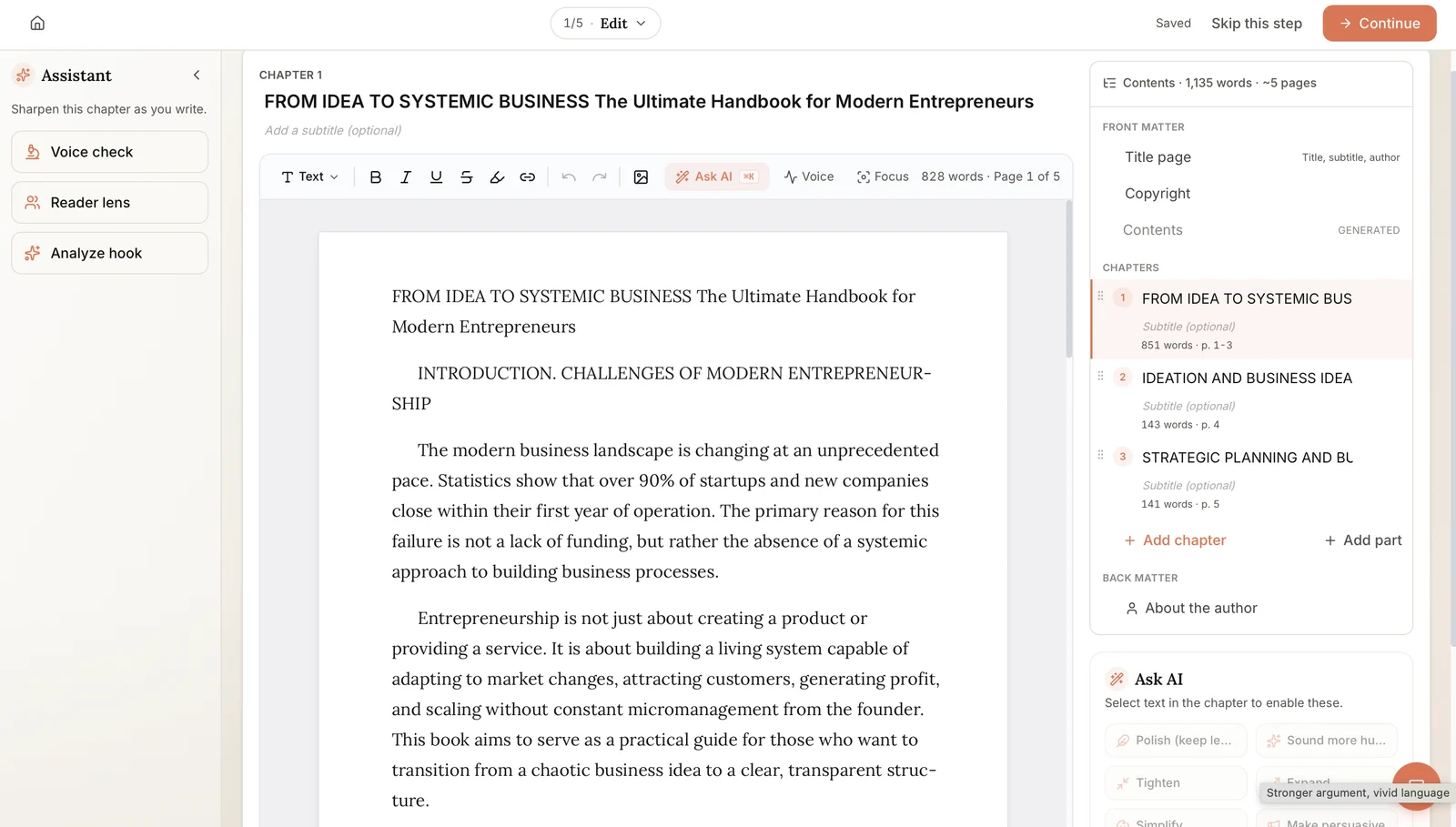
You choose the topic and the message, and you decide what goes into the book. The platform helps you structure the material and work on the text. When the book is ready, it exports the files for KDP, and you upload them yourself. It cannot place a book on any list.
Your next step
Write your one sentence, then write three possible titles for it. If your material already exists as posts or notes, see how to turn a blog into a book. For the books that teach the writing itself, see books on how to write a nonfiction book.
Frequently asked questions
There is no single best nonfiction book of 2026, because these are editors' picks and not an objective ranking. Publishers Weekly picked 25 nonfiction books for its 2026 list, and Amazon's editors named four in their top 20. The two editorial teams chose different books, and the lists share no title.
There is no set length. On the Publishers Weekly 2026 list, the median subtitle is 7.5 words, and 24 of the 25 books have one. That is a count of one list, so use it as a reference point for your own subtitle, not as a rule.
On the 2026 Publishers Weekly list, yes. All 25 books are listed under a publisher, such as Penguin Press, Norton and Knopf. We did not check whether any of them started as self-published books, so we draw no wider conclusion.
No. It is a list of editors' picks, not a sales ranking. The page shows titles, authors and publishers. It shows no sales figures, so our counts describe what editors picked, not what readers bought.
Sources & References
- Publishers Weekly Best Books 2026, Nonfiction, checked 2026-11-20
- The best books of 2026, according to the Amazon Editors, published 2026-11-12
- Small Town Girls, Penguin Random House, checked 2026-11-20
- Leaving Home, Penguin Random House, checked 2026-11-20
- Q, Penguin Random House, checked 2026-11-20
- I Eat the Stars, Penguin Random House, checked 2026-11-20
- 1873, Penguin Random House, checked 2026-11-20
- The Score, Penguin Random House, checked 2026-11-20
- Here Where We Live Is Our Country, Penguin Random House, checked 2026-11-20
- Man in the Mirror, Penguin Random House, checked 2026-11-20
- The Frenchmen, Penguin Random House, checked 2026-11-20
About the author