
The Books on Writing a Book That Nonfiction Authors Actually Need
Some books on how to write a book are made for novelists. They focus on made-up characters, plots and stories. If you want to write a business book, a how-to guide, a memoir or a book based on your experience, you need different advice. This list is for authors of nonfiction.
A quick word about us. Built&Written is a platform that helps nonfiction authors turn their own posts, notes and transcripts into a structured book. We show how it works after the list.
Key takeaways
- Books for novelists focus on made-up stories and characters. Nonfiction authors also need help with structure, clear writing and what their readers need.
- Draft No. 4, Storycraft and Write Useful Books fit a whole nonfiction book. The other five fix one problem each.
- No book on this list writes your chapters or takes you to a printed book.
Which books on how to write a book fit which problem?
| Your problem | Read | Why |
|---|---|---|
| Your book is long and you need to shape it | Draft No. 4 | A guide to writing long-form nonfiction |
| Your book tells true stories | Storycraft | A guide to narrative nonfiction |
| You want short tools you can use today | Writing Tools | 55 strategies in short chapters |
| Your sentences are unclear | The Sense of Style | A style guide built on research into how language works |
| Your drafts sound stiff | Several Short Sentences About Writing | Exercises that start at the sentence |
| The book feels too big to start | Bird by Bird | Advice on taking a big task in small pieces |
| You want to build your book around what readers need | Write Useful Books | A method for planning nonfiction around readers |
| You write website content and emails to promote your book | Everybody Writes | A guide to content marketing writing |
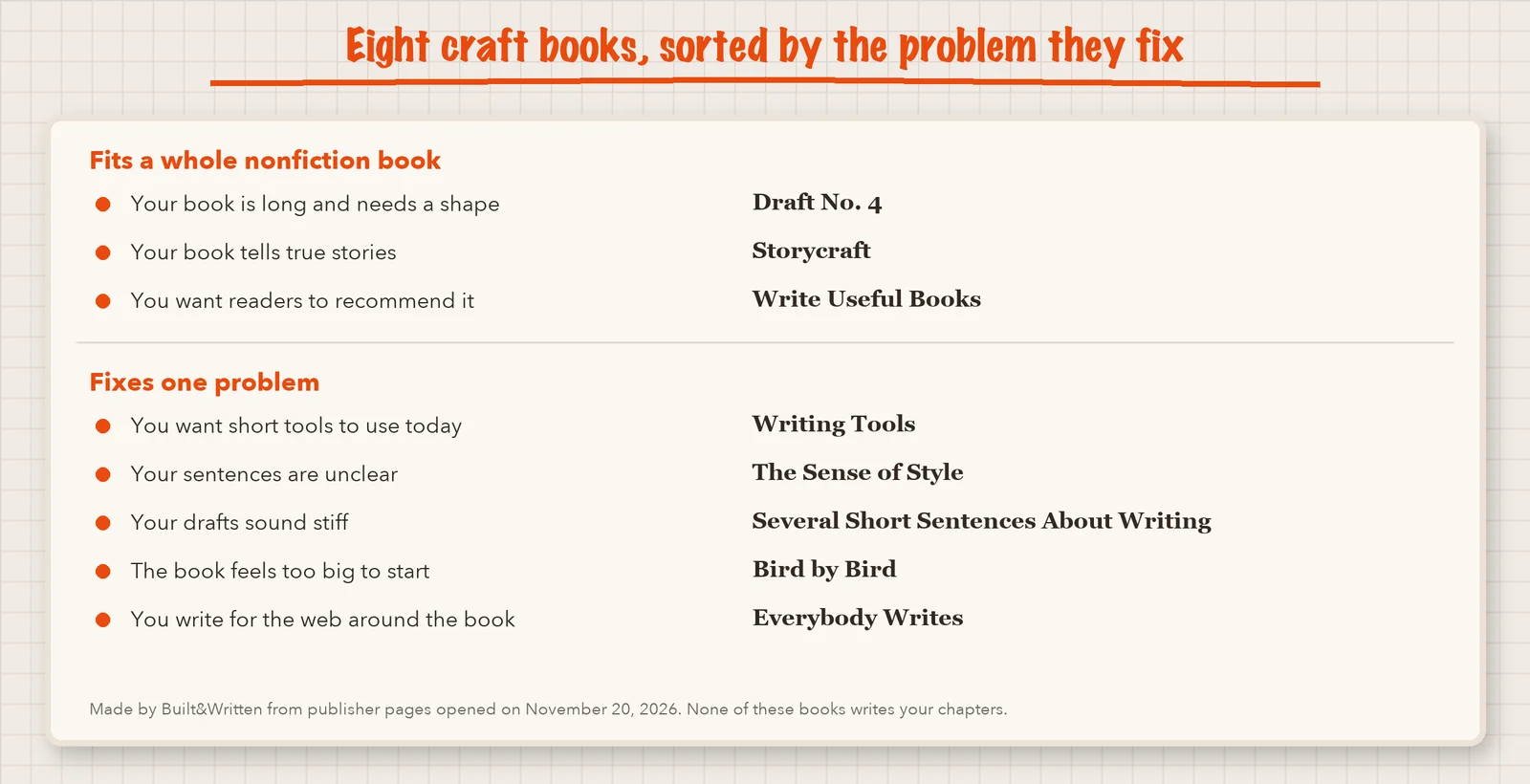
You do not need to read all eight. Choose the ones that match your problem today. If you are writing a business book from your experience, Write Useful Books and Draft No. 4 may help you more than a book about fiction plots. If your book is a memoir built on real events, Storycraft may fit better.
What if you already have the material for a book?
A craft book can teach you what good looks like. It cannot turn years of posts, notes and talk transcripts into chapters. If you already have the material, your next step may not be another book on writing. You may need a way to organize what you have and turn it into chapters.
That is the job of Built&Written. It proposes a chapter outline from your own material and drafts the chapters in your voice, and you stay in charge of every chapter. The steps are further down, after the books.
How we checked these books
We did not read eight books for this article. On November 20, 2026 we opened one primary page per book. Seven are publisher pages and one is the book's own website. Our picks rest on those descriptions, not on a full review of every book. The table near the end shows what each page says.
We also tried to check On Writing Well by William Zinsser and The Art of Memoir by Mary Karr. Their publisher's site would not load for us, so neither is on the list.
Which book teaches long-form nonfiction?
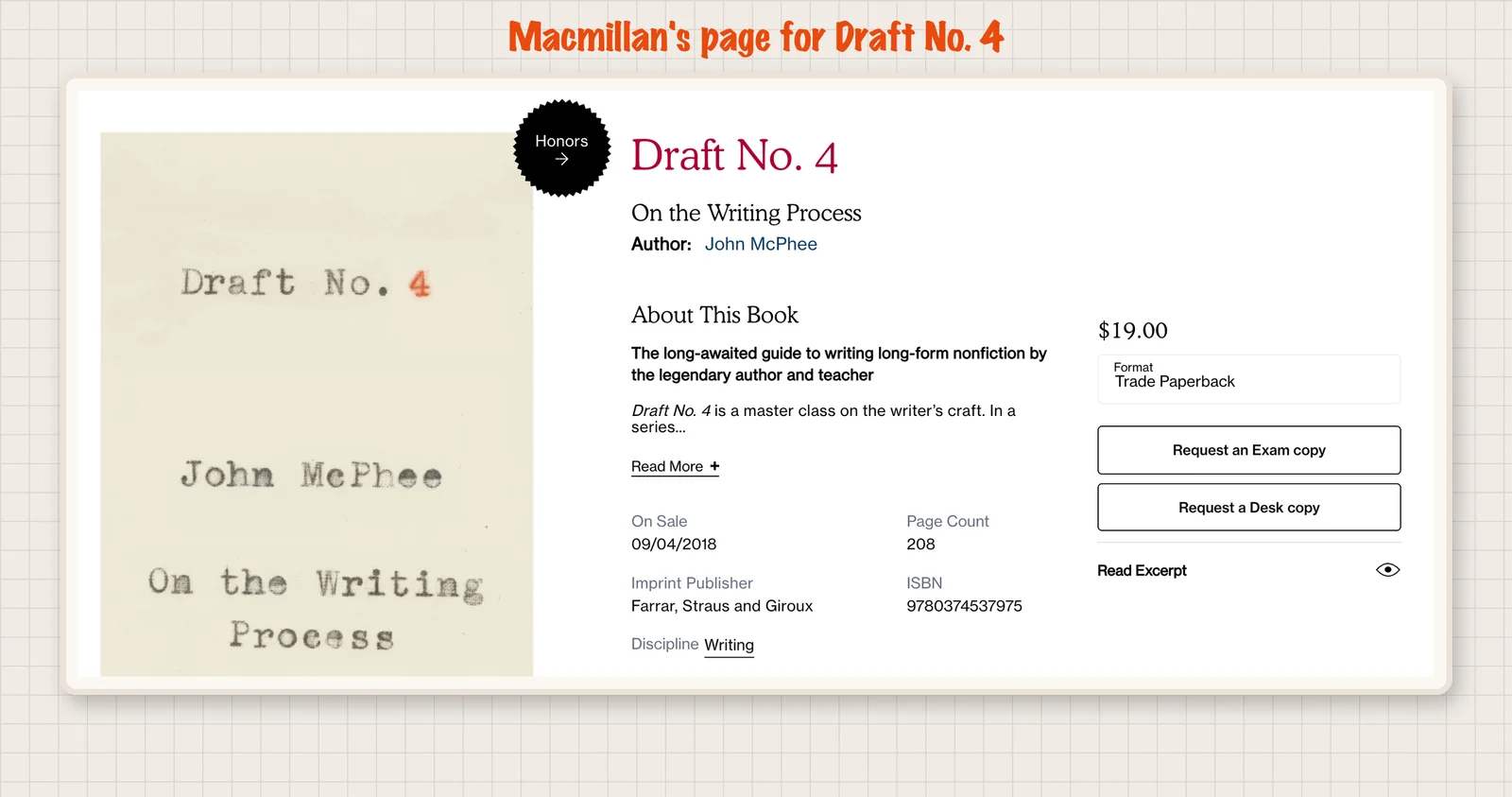
Start with Draft No. 4 by John McPhee. The Macmillan page for the Farrar, Straus and Giroux paperback calls it a guide to writing long-form nonfiction. It also calls it a master class on the writer's craft.
Which book teaches narrative nonfiction?
Storycraft by Jack Hart is the pick if your book tells true stories. Narrative nonfiction tells real events through scenes and people, not just a list of facts. The University of Chicago Press page for the second edition says it teaches storytelling as shown in the work of writers such as David Grann, Mary Roach, Tracy Kidder and John McPhee.
Which book plans a nonfiction book around the reader?
Write Useful Books by Rob Fitzpatrick. The book's own website describes a process for planning a nonfiction book around what readers need. You try your ideas on readers, learn what works and improve the book before you publish it. The site sells the book on Amazon.
Which books fix one writing problem?
Five more books each solve one problem. Pick the one that matches yours.
Writing Tools by Roy Peter Clark. The Hachette Book Group page for the 10th anniversary edition lists 55 strategies in four sections: Nuts and Bolts, Special Effects, Blueprints for Stories and Useful Habits. You can work on one writing problem at a time instead of reading it from start to finish. The page calls it useful for every type of writer, so it covers nonfiction without being built for a book.
The Sense of Style by Steven Pinker is for sentences that are hard to understand. The Penguin Random House page for the paperback describes a usage guide for the twenty-first century. It uses examples of good and bad modern prose and avoids the scolding tone of the classic manuals.
Several Short Sentences About Writing by Verlyn Klinkenborg is for writing that feels stiff. Its Penguin Random House page says most of what you think you know about writing is useless. It calls the book a set of first steps and experiments.
Bird by Bird by Anne Lamott is for the moment the book feels too big. The Penguin Random House page says the title comes from a story about Lamott's brother, who froze over a school report on birds. Their father told him to take it one bird at a time. The lesson applies to a book too: work on one small part instead of worrying about the whole. It is a book about writing and life, so it will not teach you nonfiction structure.
Everybody Writes by Ann Handley is for the writing around your book. The Wiley page for the second edition calls it a hands-on field guide to content that your audience loves. You may need website articles, emails and posts to introduce your book to readers. It is a content marketing book, so it will do less for your chapters.
Which books on fiction writing may not fit your nonfiction project?
Some books on fiction writing focus on plot structures made for novels. Save the Cat! Writes a Novel by Jessica Brody is an example. The Penguin Random House page describes a story-structure guide for novelists with 15 plot points and ten story genres. It may not be the best starting point for a practical guide or a business book. A memoir author may still borrow ideas about scenes and tension.
A book that teaches needs structure by lesson. Our guide to 3 proven frameworks for structuring a nonfiction book covers that, and our book outline template gives you one to fill in.
What comes after books on how to write a book?
Writing the manuscript (the full text of your book) and preparing it for self-publishing are two separate stages. Craft books teach the first. For the second, KDP (Kindle Direct Publishing, Amazon's self-publishing service) has its own help pages. For the step before you write, see how to write a book proposal. If you also want to know where AI fits, see the best books about AI for people who write nonfiction.
What each publisher page shows
| Book | Page we opened | What the page shows |
|---|---|---|
| Draft No. 4 | Macmillan | On sale 09/04/2018, 208 pages, $19.00 paperback |
| Storycraft, Second Edition | University of Chicago Press | 320 pages, copyright 2021, no price in the text we read |
| Writing Tools, 10th Anniversary Edition | Hachette Book Group | On sale Jan 10, 2008, 288 pages, $19.99 |
| The Sense of Style | Penguin Random House | Paperback Sep 22, 2015, 368 pages, $19.00 |
| Several Short Sentences About Writing | Penguin Random House | Paperback Apr 9, 2013, 224 pages, $19.00 |
| Bird by Bird | Penguin Random House | Paperback Sep 1, 1995, 256 pages, $20.00 |
| Write Useful Books | The book's own website | No date, page count or price |
| Everybody Writes, 2nd Edition | Wiley | October 2022, 432 pages, hardcover $28, ebook $17 |
If you cite a book, take the date from the copyright page of the edition you hold.
How does Built&Written turn your material into a book?
Built&Written is a platform for writing nonfiction books and preparing them for KDP. If you already have a finished manuscript, the book formatter prepares it for KDP. If you have loose material, such as posts, notes or transcripts, follow these steps.
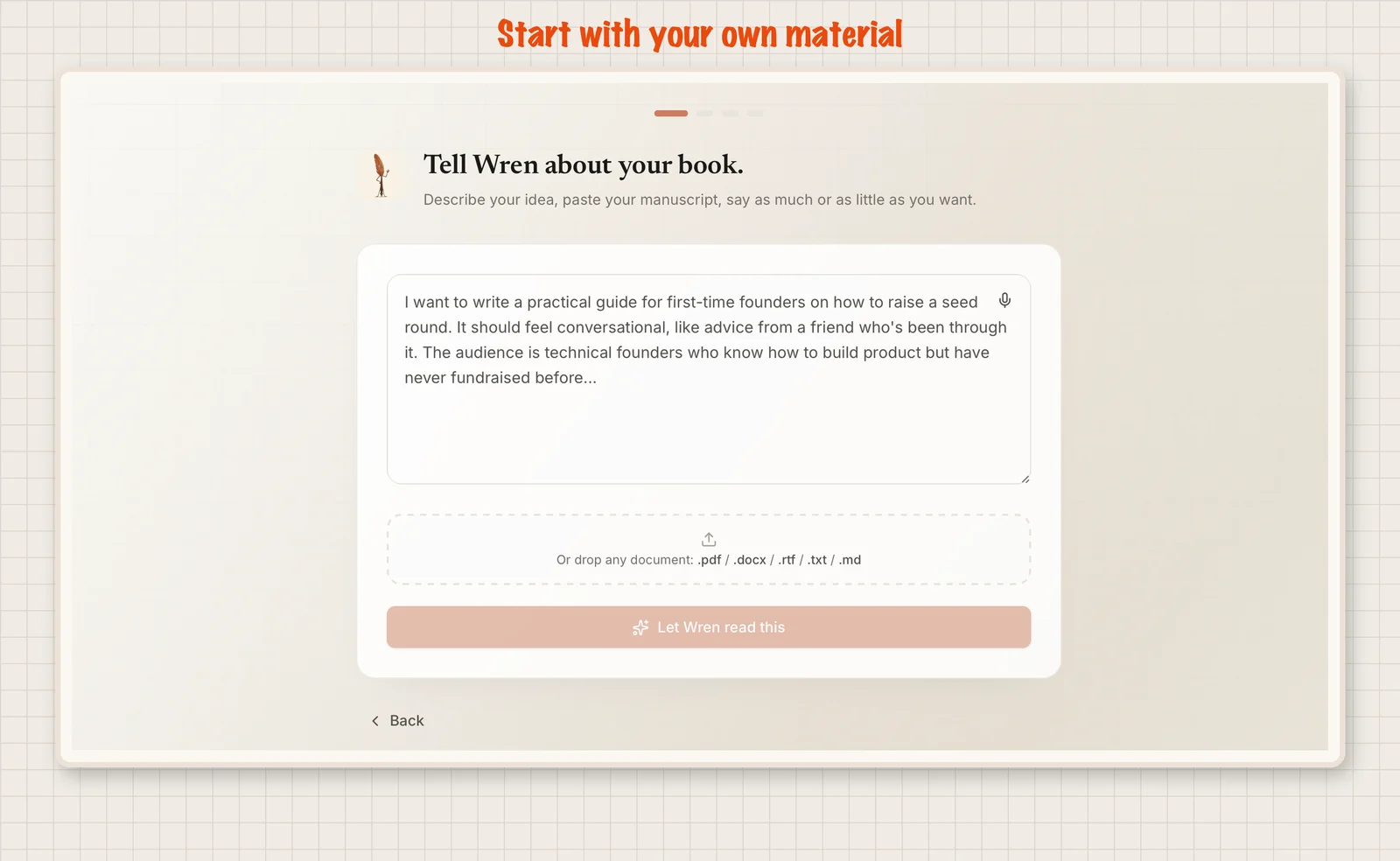
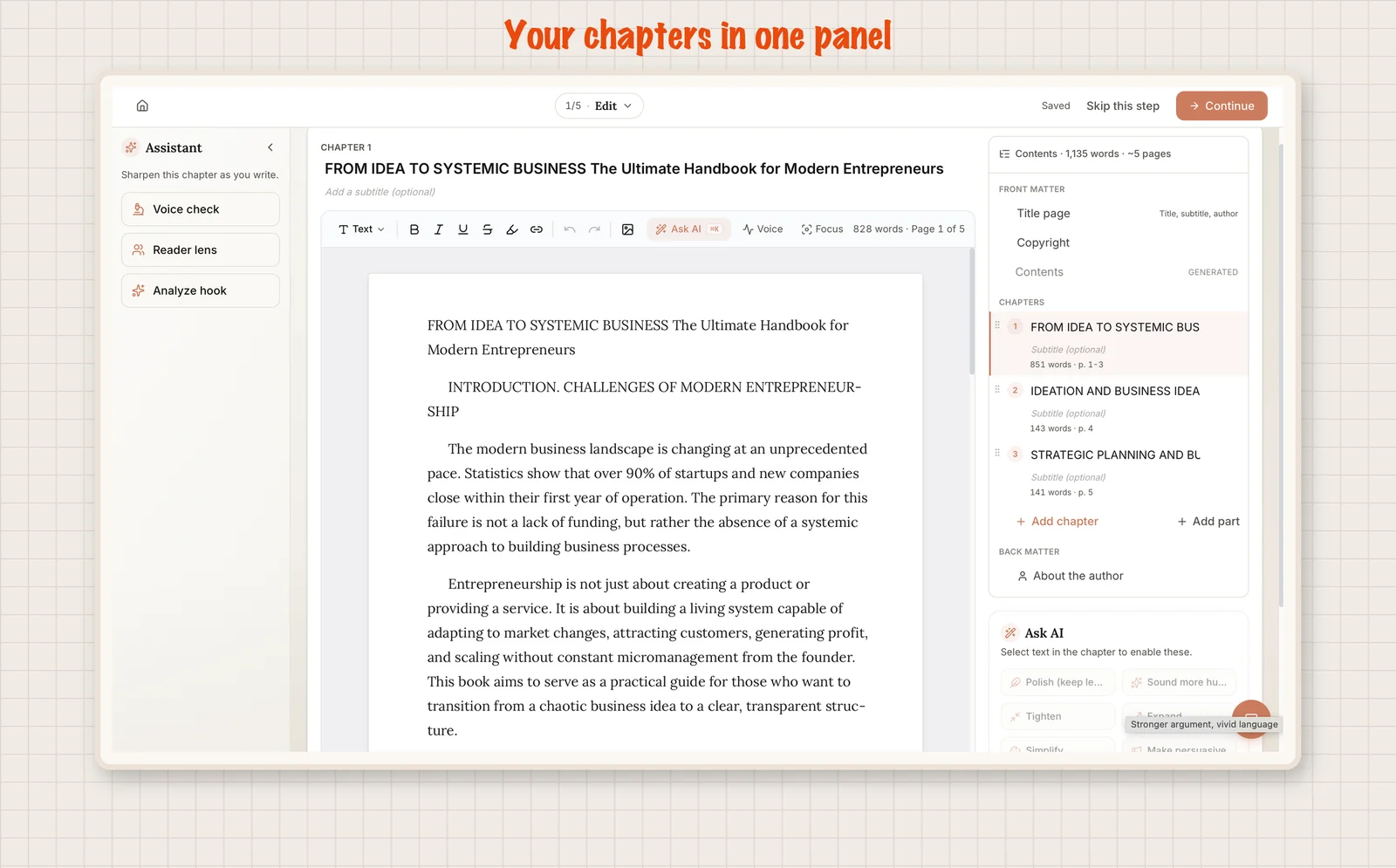
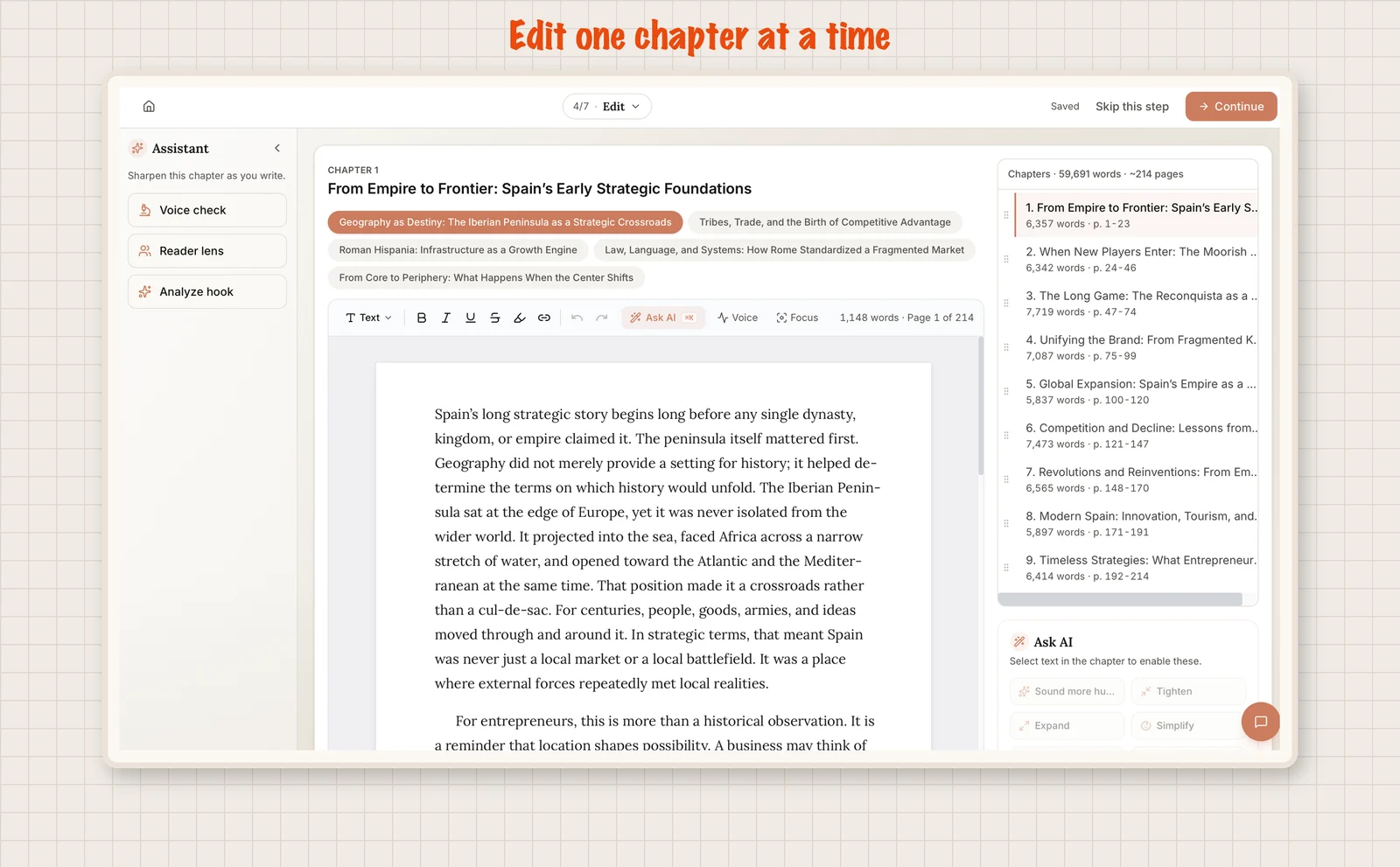
By the end, you have a structured manuscript built from your own material. You still decide what stays, what changes and what needs more work. If your material is mostly blog posts, read how to turn a blog into a book.
What it costs: downloading a book the platform wrote takes the Entrepreneur plan at $49/month. The Author plan, $19/month, exports your own manuscript. See the pricing page.
You check every fact. You edit the manuscript until it sounds like you. The platform does not replace a human editor, and it does not upload your book to KDP.
Final thoughts
Start with the writing problem you have today and choose a book that helps with it. When you are ready to turn your own material into a manuscript, a platform like Built&Written can help with the drafting while you remain the author.
Two things Built&Written gives you at that point:
- Free KDP tools, such as the royalty calculator, which shows what you earn per sale, and the spine width calculator.
- Monthly credits for the AI on every plan, and you see what a book will cost before it is written.
Frequently asked questions
No book is required. A craft book saves time on common nonfiction problems such as structure, unclear sentences and starting. Pick one for the problem you have today. If you are unsure, Draft No. 4 gives a view of long-form nonfiction, and Bird by Bird helps when the size of the task is the obstacle.
Everybody Writes, second edition, is the newest. Wiley lists it as October 2022. Storycraft, second edition, has a 2021 copyright on the University of Chicago Press page. Draft No. 4 is dated 09/04/2018 on the Macmillan page. The Write Useful Books site shows no date, so check the listing of the edition you buy.
Some of it can, but check the fit first. Save the Cat! Writes a Novel, for example, is described by its publisher as a plotting guide for novelists, with 15 plot points and ten story genres. A book that teaches has lessons instead of plot points. A general book such as Bird by Bird travels better than a plotting guide.
Sources & References
- Draft No. 4, Macmillan Academic, checked 2026-11-20
- Storycraft, Second Edition, University of Chicago Press, checked 2026-11-20
- Writing Tools (10th Anniversary Edition), Hachette Book Group, checked 2026-11-20
- The Sense of Style, Penguin Random House, checked 2026-11-20
- Several Short Sentences About Writing, Penguin Random House, checked 2026-11-20
- Bird by Bird, Penguin Random House, checked 2026-11-20
- Write Useful Books, Useful Books, checked 2026-11-20
- Everybody Writes, 2nd Edition, Wiley, checked 2026-11-20
- Save the Cat! Writes a Novel, Penguin Random House, checked 2026-11-20
About the author