
Does Barnes & Noble Accept Books Written With AI?
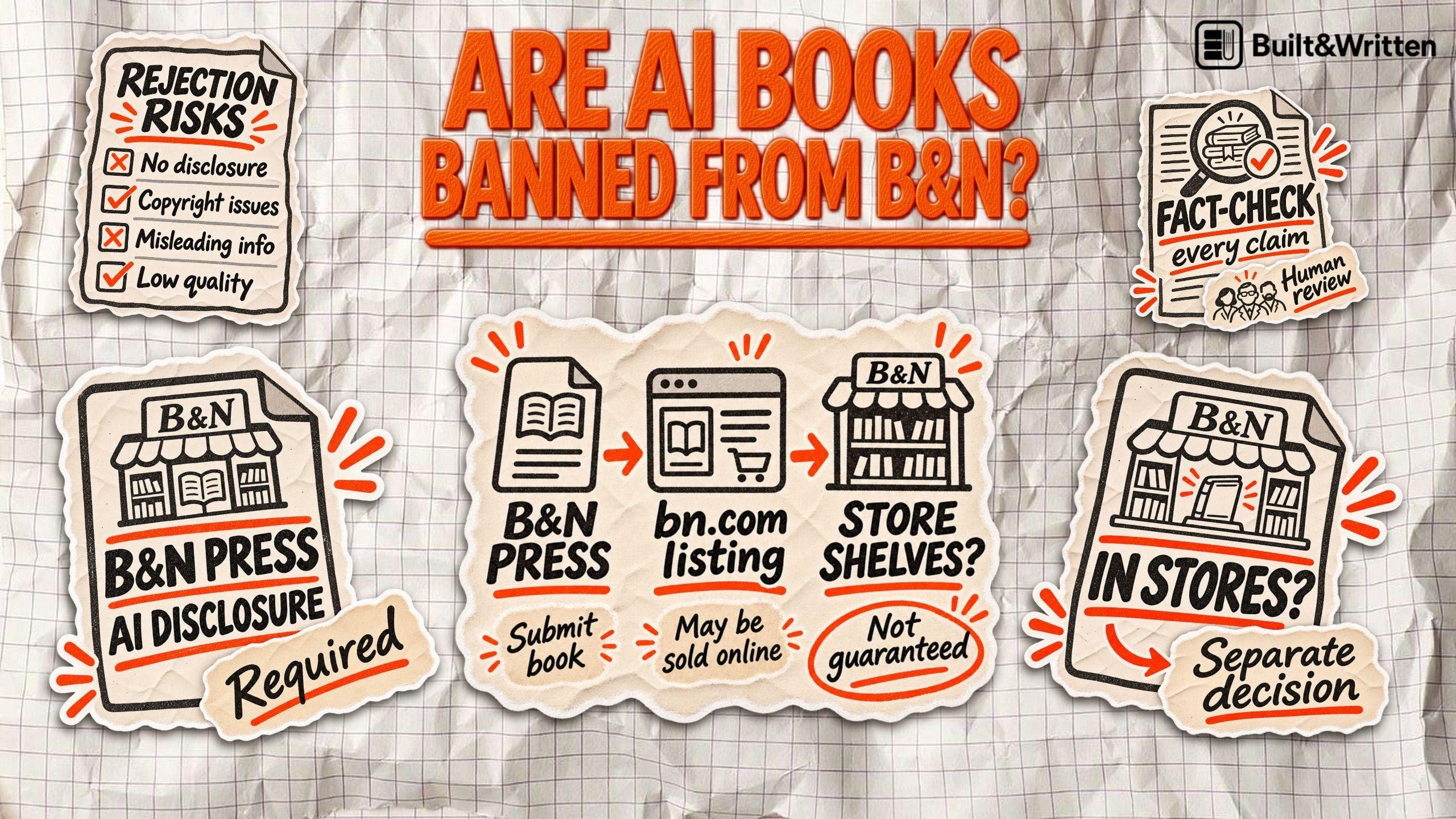
Yes, Barnes & Noble Press allows authors to submit AI-assisted and AI-created books, but acceptance is not guaranteed. Authors must disclose how generative AI was used in their manuscript, cover artwork, images, or translations. The publishing platform's disclosure rules are separate from Barnes & Noble's policies on which books it stocks in physical stores and offers online.
That distinction matters. A book you wrote and then edited with AI is classified differently from a manuscript originally generated by AI, even if you substantially rewrite it afterward.
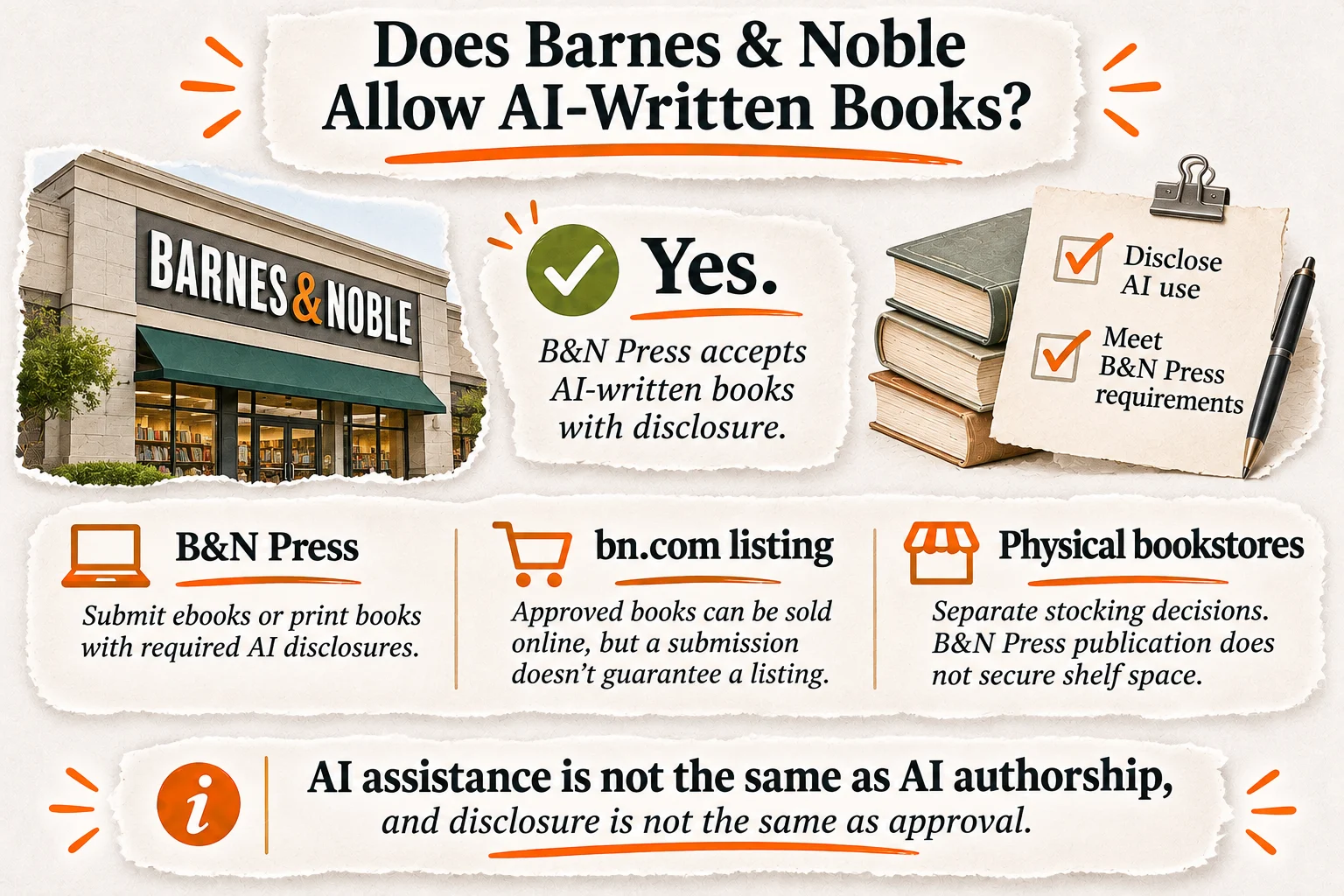
Does Barnes & Noble allow AI-written books?
Yes, B&N Press has a process for submitting AI-written books, but acceptance is not guaranteed. Its official policy requires publishers to disclose whether generative AI was used in their manuscript, artwork, cover, or translations. Every submission must also comply with the platform's content and intellectual property rules.
The distinction is how AI was used. B&N Press defines AI-Assisted content as material you created and then used AI to edit or expand. AI-Created content starts with AI, even if you rewrite or edit it afterward.
Barnes & Noble has two distinct decisions: whether a submitted book meets B&N Press publishing requirements, and whether the retailer will offer or stock the title. The first does not guarantee the second.
| Publishing route | What it means |
|---|---|
| B&N Press | Submit ebooks or print books with required AI disclosures. Approval is not automatic. |
| bn.com listing | Eligible, approved books can be sold online. A submission does not guarantee a listing. |
| Physical bookstores | Separate stocking decisions. B&N Press publication does not secure shelf space. |
Barnes & Noble has also stated that it actively excludes AI-generated titles from retail offerings, with limited exceptions for clearly labeled books from reputable publishers when customer demand exists.
For nonfiction experts, the practical distinction is clear: AI assistance is not the same as AI authorship, and disclosure is not the same as approval.
What is Barnes & Noble's official AI publishing policy?
Barnes & Noble Press requires publishers to disclose generative AI use, but it distinguishes between AI-Created and AI-Assisted content. The classification depends on who produced the original material, not how much editing happened afterward.
According to the official B&N Press AI disclosure policy:
- AI-Created: Text, artwork, or translations originally generated by AI. Editing, rewriting, or correcting that material afterward does not change its classification.
- AI-Assisted: Content you created yourself and then used AI to edit or expand.
For nonfiction publishers, the difference becomes clearer with practical examples:
| Your workflow | B&N Press classification |
|---|---|
| You write a chapter, then use AI to polish it | AI-Assisted |
| ChatGPT generates a chapter that you heavily rewrite | AI-Created |
| You create a framework, then use AI to expand your explanation | AI-Assisted |
| AI generates your book cover illustration | AI-Created |
| AI translates your manuscript into Spanish | AI-Created |
During the Build-a-Book process, B&N Press asks whether generative AI was used in your manuscript, cover artwork, images, or translations. If it was, you must identify whether the relevant content is AI-Assisted or AI-Created.
This disclosure is mandatory before publication. If the publishing option is unavailable after uploading a revised file, check the AI Disclosure under Book Details → Rights & Other Information.
Neither classification exempts you from Barnes & Noble's content policy. You remain responsible for ensuring your manuscript and visuals respect copyright and intellectual property rights.
Why did Barnes & Noble's CEO make headlines over AI books?
In May 2026, Barnes & Noble CEO James Daunt sparked controversy after suggesting the retailer would stock AI-written books, provided customers knew what they were buying.
During a May 18 interview on NBC's Today show, Daunt said he had no objection to selling AI-generated books if they were clearly labeled, did not misrepresent their authorship, and attracted genuine customer interest.
The comments triggered criticism on social media, including calls to boycott Barnes & Noble. Critics questioned whether selling AI-generated titles would undermine human authors and encourage low-quality, mass-produced books.
Two days later, Daunt clarified the company's position. Barnes & Noble does not intentionally sell AI-generated books and actively works to exclude them from its online catalog and physical stores.
However, he stopped short of announcing a blanket ban. The retailer could still sell clearly labeled AI-generated titles from reputable publishers if there were demonstrable customer demand.
As Publishers Weekly reported on May 21, 2026, this was a clarification of Barnes & Noble's retail policy, not an announcement of new B&N Press publishing rules.
For nonfiction publishers, the distinction matters: A retailer's stocking preferences and B&N Press's manuscript submission requirements are separate decisions.
What can get an AI-assisted book rejected by Barnes & Noble?
Using AI isn't the only concern. Violating Barnes & Noble's content policy can get your book rejected or removed from sale, regardless of who wrote it.
Barnes & Noble's Content Policy sets restrictions on submitted material. Combined with B&N Press's AI disclosure requirements, these rules make copyright compliance, accurate book descriptions, prohibited content, and correct AI declarations important checks before publication.
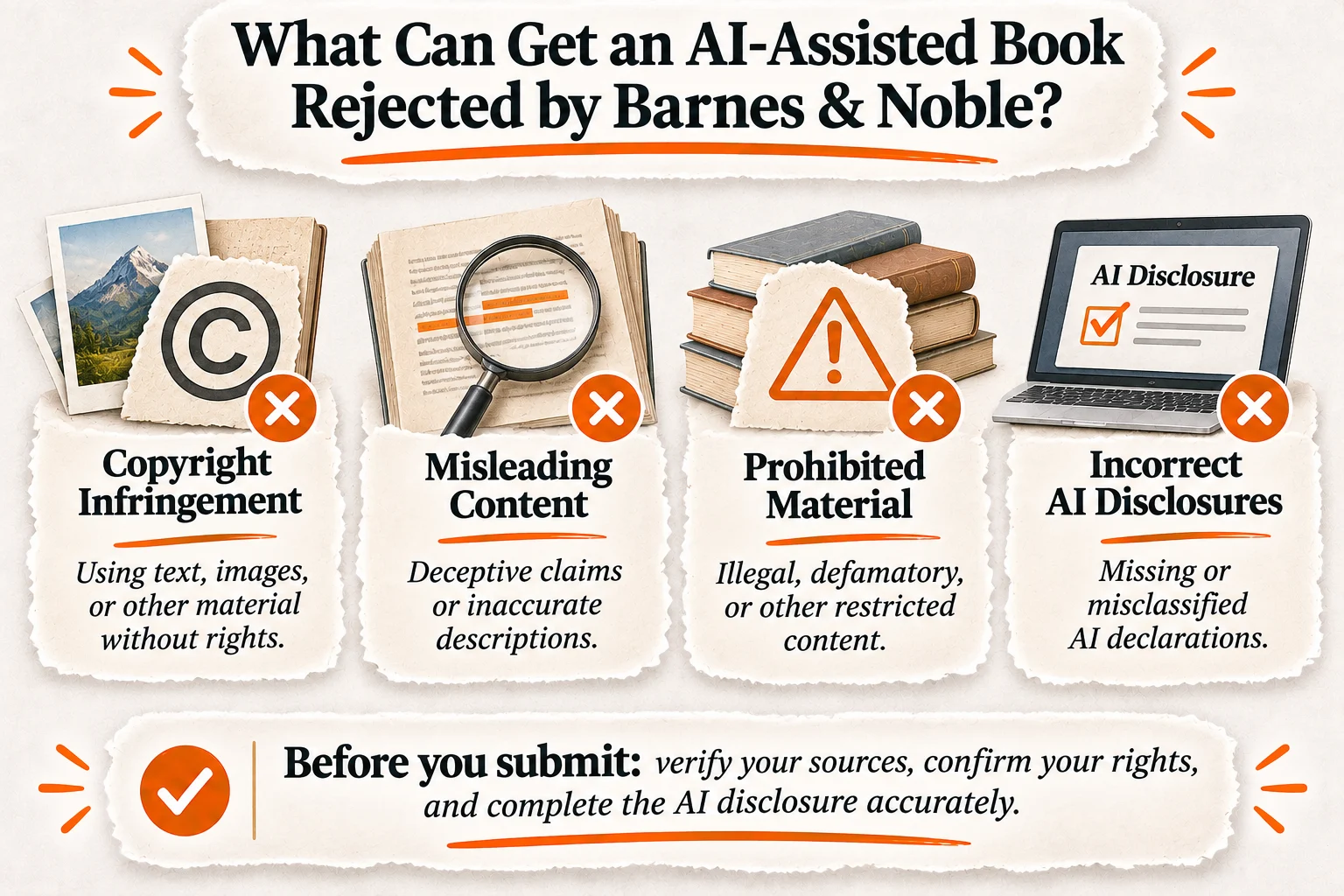
- Copyright infringement. Publishing text, illustrations, photographs, or graphics without the necessary rights or permissions.
- Misleading content. Deliberately misrepresenting your book's contents, making deceptive claims, or providing inaccurate descriptions.
- Prohibited material. Submitting illegal, defamatory, or other content that violates Barnes & Noble's published restrictions.
- Incorrect AI disclosures. Failing to complete the required AI declaration or misclassifying AI-generated material. B&N Press requires disclosure before publication.
For nonfiction experts, another risk deserves attention: AI-generated factual errors.
Imagine publishing a business book containing invented research, fabricated statistics, or quotations attributed to people who never said them. These errors damage credibility and could create compliance concerns if the material is deliberately misleading or defamatory.
However, Barnes & Noble does not identify every factual mistake as an automatic AI-related rejection reason.
The retailer retains broad discretion to determine whether submitted content meets its standards and may remove books it considers inappropriate for sale.
Before submitting, verify your sources, confirm ownership of every included asset, and complete the AI disclosure accurately.
How to disclose AI-assisted and AI-created content on B&N Press
B&N Press requires you to declare generative AI use before publishing. The disclosure is part of its Build-a-Book process and applies to both ebooks and print books.
Here's how to complete it:
- Identify where AI was used. Review your manuscript, cover artwork, illustrations, and translations. Note which elements you created yourself and which were generated by AI.
- Start your B&N Press project. Sign in to B&N Press and begin creating an ebook or print edition using the Build-a-Book workflow.
- Answer the AI disclosure questions. B&N Press asks whether generative AI contributed to your manuscript, cover, images, or translations.
- Classify the content correctly. Select AI-Assisted for material you originally created and then edited or expanded with AI. Select AI-Created for material generated by AI, even if you substantially revised it afterward.
- Complete the required disclosure. Under Book Details, open the Rights & Other Information tab. B&N Press specifically directs publishers here when an incomplete AI disclosure prevents them from publishing updates.
- Review before submitting. Check your declarations, confirm you have the necessary content rights, and verify that the uploaded files match your answers.
The official B&N Press disclosure instructions confirm that this step is required before publication. Completing it does not guarantee approval.
How to prepare an AI-assisted nonfiction book for Barnes & Noble
Your expertise should drive the book. AI should help you develop it, not become your source of facts.
Start with your original research, professional experience, frameworks, and real-world examples. Use AI to organize your material, structure chapters, develop drafts, or improve existing text.
Before submitting your manuscript to B&N Press, follow these five steps:
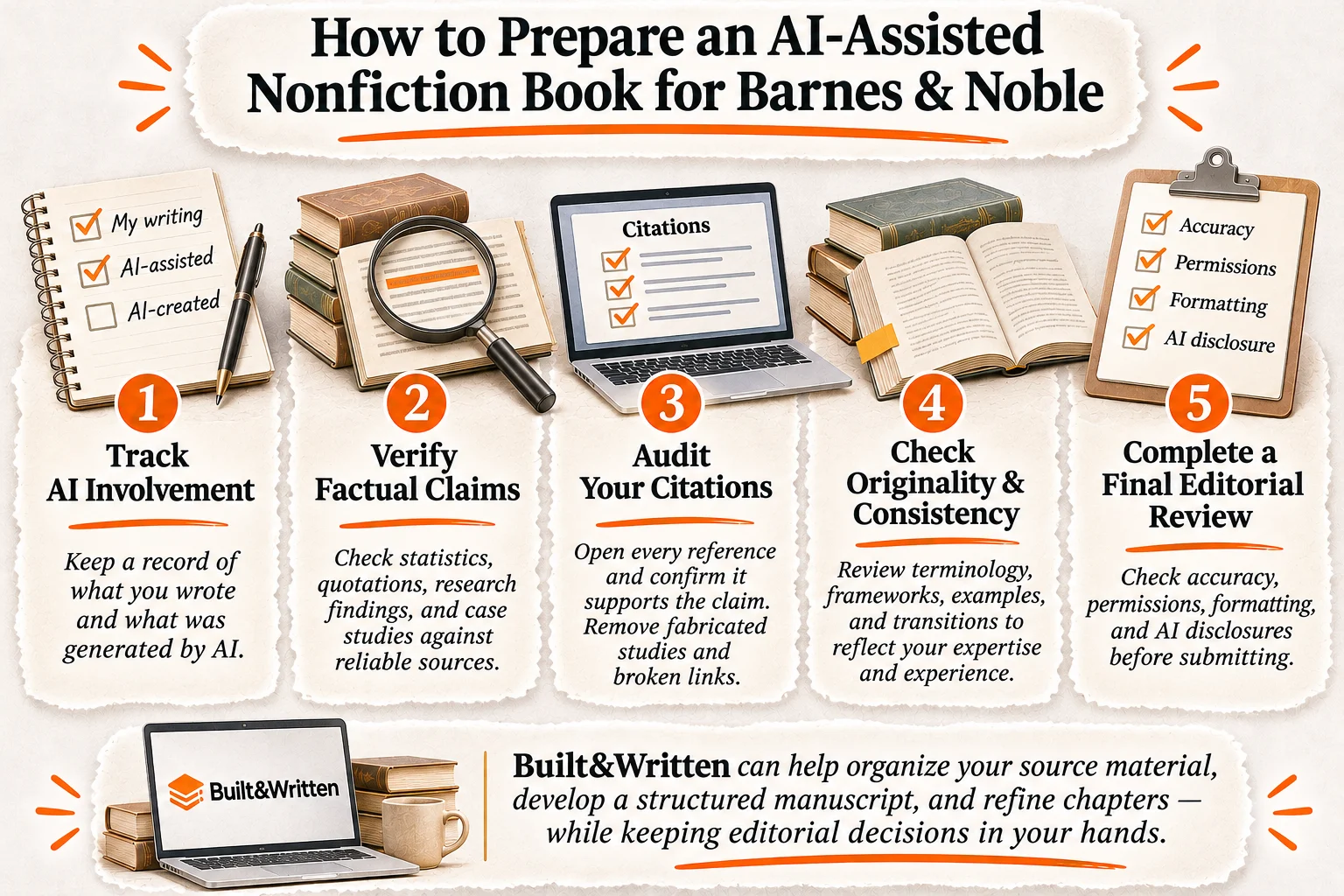
- Track AI involvement. Keep a record of which passages you wrote and which were generated by AI. B&N Press distinguishes AI-Created from AI-Assisted content, even when you substantially edit the output.
- Verify factual claims. Check statistics, quotations, research findings, and case studies against reliable primary sources. Never assume a confident AI response is accurate.
- Audit your citations. Open every reference and confirm it supports the claim. Remove fabricated studies, broken links, and unsupported quotations.
- Check originality and consistency. Review terminology, frameworks, examples, and chapter transitions. Make sure the manuscript accurately reflects your knowledge and professional experience.
- Complete a final editorial review. Check accuracy, permissions, formatting, and AI disclosures before submitting your book.
Built&Written can help organize your source material, develop a structured nonfiction manuscript, and refine chapters while keeping editorial decisions in your hands. It does not independently guarantee factual accuracy or B&N Press approval.
The goal is a book you can stand behind, with every important claim verified and every use of AI disclosed correctly.
Should you publish through B&N Press or try to get into Barnes & Noble stores?
If your goal is to sell your nonfiction book online, B&N Press is the more direct route. Getting your book onto physical bookstore shelves requires a separate process.
According to the official B&N Press publishing guidelines, eligible publishers can sell ebooks through bn.com, NOOK, and Barnes & Noble apps. Print editions are available through bn.com and the Barnes & Noble app.
But publishing through B&N Press does not guarantee bookstore placement. Physical stores make separate stocking decisions. B&N Press print books are produced on demand and are not returnable, although individual stores may consider carrying them or hosting consignment events.
B&N Press is also non-exclusive. You can distribute your book through other platforms, provided you meet their respective agreements and ISBN requirements.
Keep the 2026 restrictions in mind:
- Print books must retail for at least $14.99.
- Accounts are generally limited to 100 titles on sale.
- Public-domain titles are no longer accepted.
For independent nonfiction experts, start with online distribution. Treat physical bookstore placement as a separate opportunity requiring retailer interest, not an automatic benefit of self-publishing.
Final thoughts
Barnes & Noble Press allows submissions containing AI-generated content, but disclosure does not guarantee publication. Its publishing requirements are separate from the retailer's policies on stocking AI-written books.
For nonfiction experts, the strongest approach is to build your manuscript around original knowledge, verified research, and transparent AI use. Follow B&N Press's disclosure rules, confirm you own the necessary rights, and review your content before submitting.
If your goal is online distribution, start with B&N Press. Treat physical bookstore placement as a separate opportunity.
Frequently asked questions
B&N Press has a submission process for AI-generated content, but publication is not guaranteed. You must disclose AI use in your manuscript, artwork, or translations and comply with the platform's content requirements. Submission does not mean automatic approval.
Yes. B&N Press distinguishes AI-Created content, originally generated by AI, from AI-Assisted content, created by a person and subsequently edited or expanded using AI. Its publishing process requires disclosure of both categories.
Yes, acceptance is not guaranteed. B&N Press can reject noncompliant submissions, while Barnes & Noble separately decides which titles to sell or stock. Completing an AI disclosure does not guarantee either outcome.
You can submit a ChatGPT-generated manuscript through B&N Press, but approval is uncertain. The relevant distinction is whether AI created the original content or merely assisted with your work, not which AI platform you used.
Not automatically. In May 2026, CEO James Daunt clarified that Barnes & Noble actively excludes AI-generated books, with limited exceptions for clearly labeled titles from reputable publishers when genuine customer demand exists.
No. Both distinguish AI-generated from AI-assisted content, but their disclosure requirements differ. Amazon KDP requires disclosure of AI-generated content, not AI-assisted content. B&N Press asks about both. Check [Amazon KDP's official Content Guidelines](https://kdp.amazon.com/en_US/help/topic/G200672390) before publishing on either platform.
Sources & References
About the author

Polina Karlashchuk
More in Self-Publishing
Ready to write your book?
Turn your expertise into a professional book with Built&Written.