

Do Literary Agents Accept a Book Made With AI Assisted Writing?
Some do, many do not, and many do not say. There is no single rule. If you used AI assisted writing and want a literary agent (the person who sells your book to publishers), the answer depends on the agency and on what the AI did.
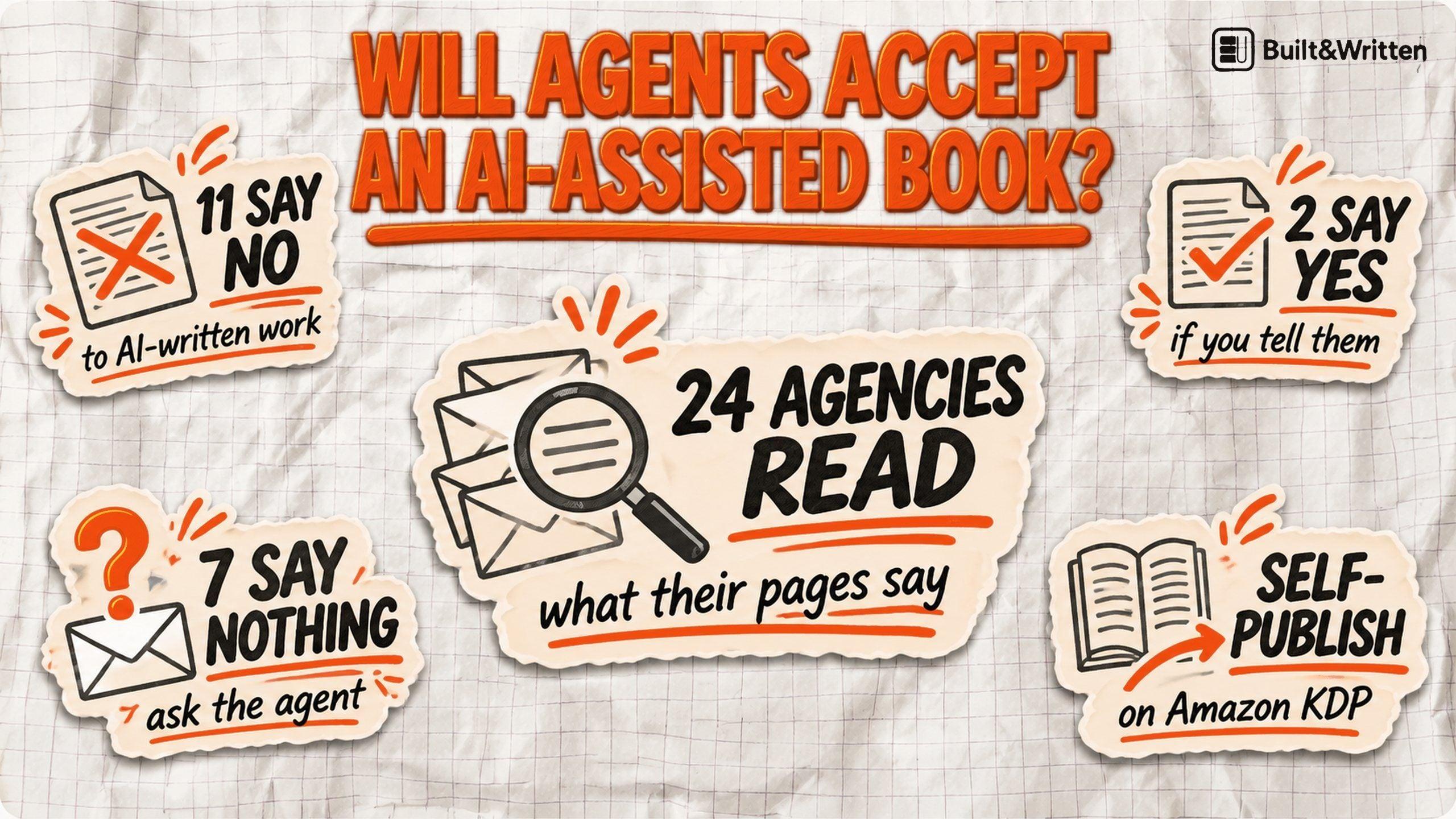
We read the submission pages of 24 literary agencies on November 8, 2026. A submission page tells authors what to send and how. Thirteen of the 24 mention AI. Eleven of those do not want AI-written work, and four of the eleven also rule out AI editing. Two accept AI use if you tell them. Seven pages say nothing about AI, and we could not read four.
A quick word about us. Built&Written is a platform for writing and publishing nonfiction books. Many authors come with material they already have: notes, old articles, transcripts of talks or an unfinished book. Others have a finished manuscript. Many of them ask us whether AI help closes the door to agents.
Key takeaways
- Agencies have different rules. Eleven of 24 do not want AI-written work, 2 accept AI use if you tell them, and 7 say nothing.
- Writing and editing are treated differently. Four agencies also rule out AI editing, and others only ask you to disclose it.
- A page that says nothing is not a yes. Check the page of the agent you plan to write to, and ask if it is unclear.
- A no from agents does not end your book. You can publish it yourself on Amazon KDP, Amazon's self-publishing service.
Do literary agents accept AI assisted writing?
It depends on the agency. The first picture shows all 24 agencies. The second one counts them.
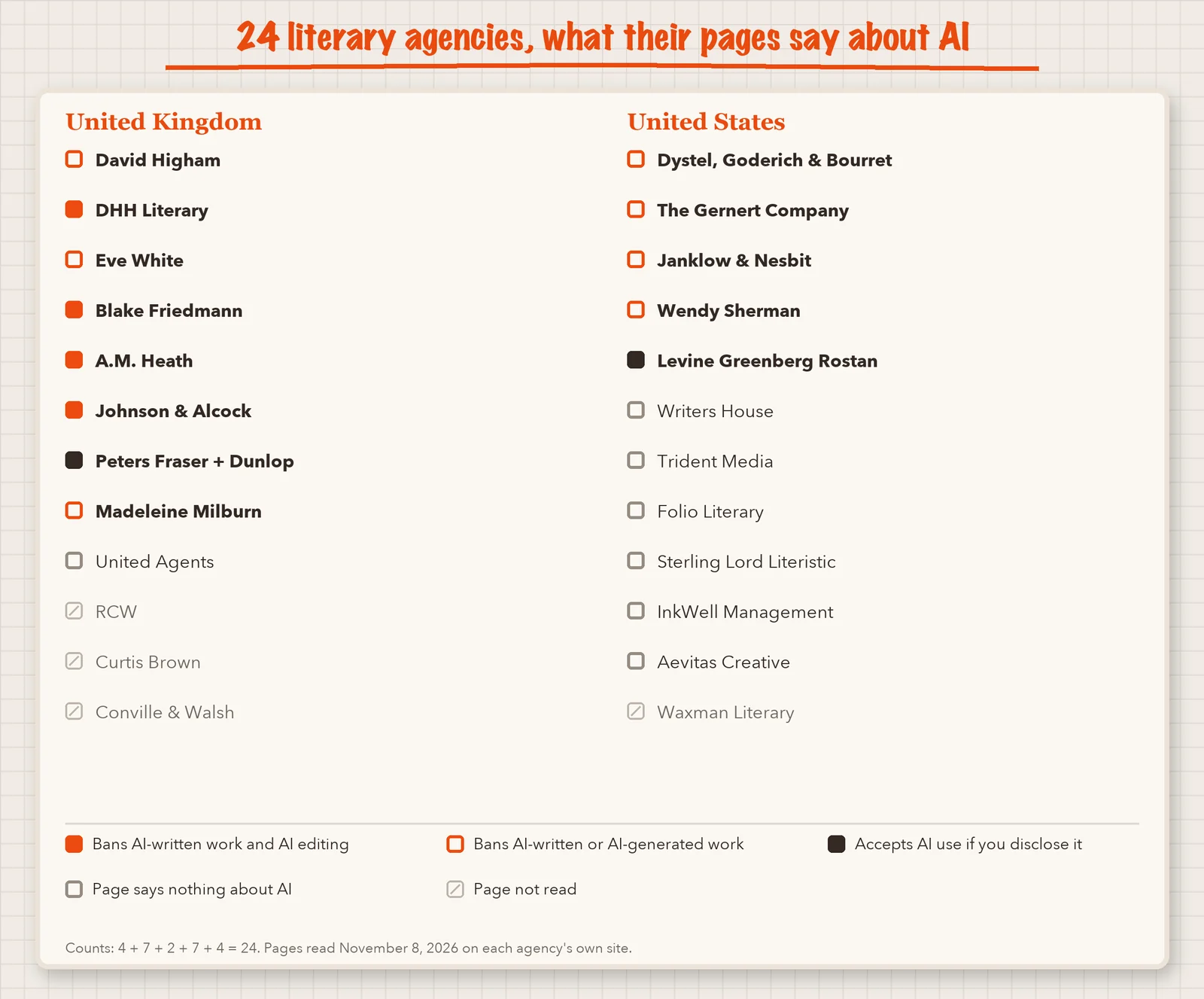
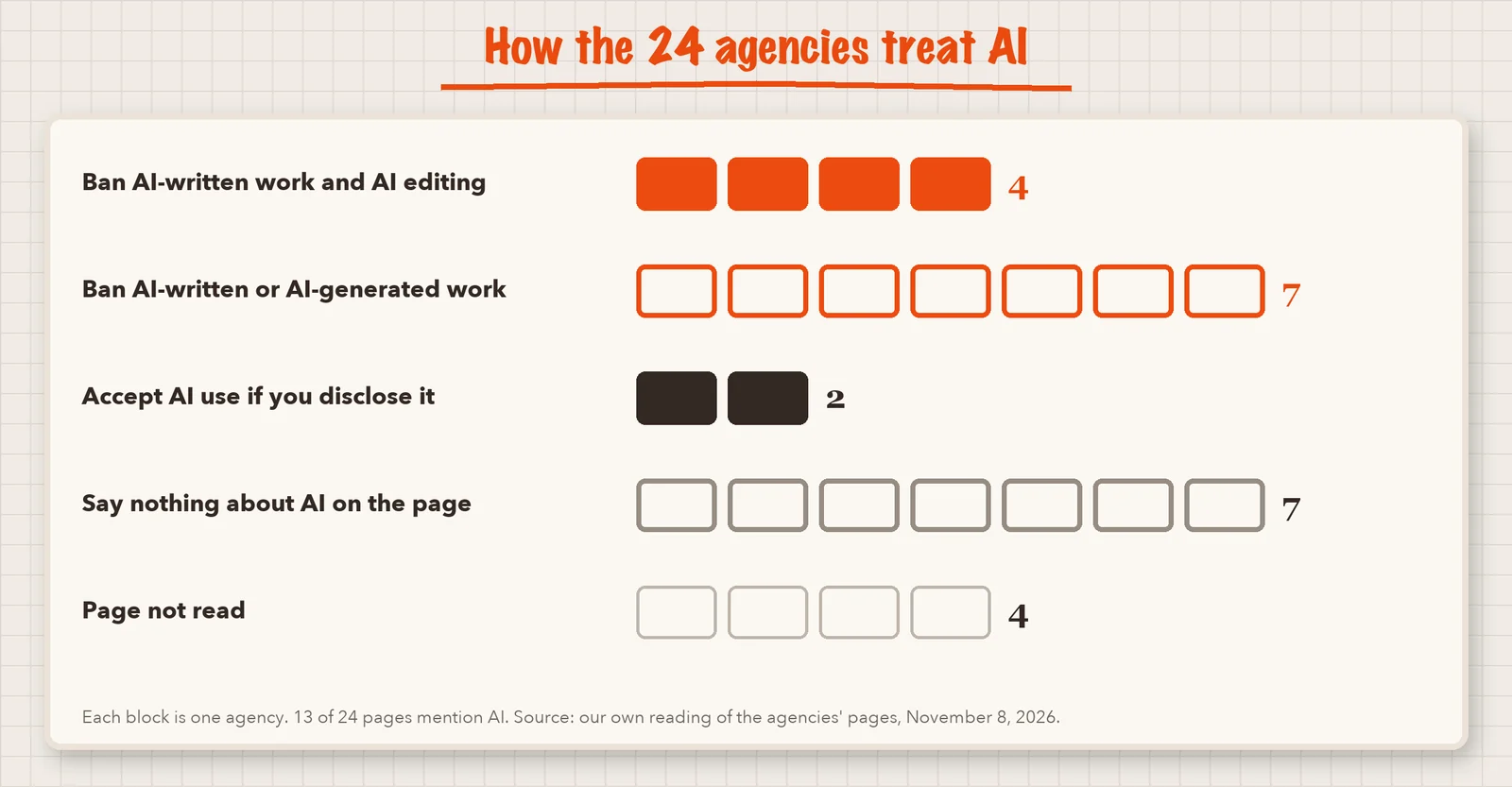
The 13 agencies that mention AI are in the table. We paraphrase what each page says.
| Agency | Country | What the page says about AI |
|---|---|---|
| DHH Literary Agency | UK | The work, covering letter and synopsis must be yours. No submissions generated, written, co-written or edited with AI. |
| Blake Friedmann | UK | No submissions originated, written or edited by AI. This includes the cover letter and synopsis. |
| A.M. Heath | UK | Original work only. Not generated, co-written or edited with AI. |
| Johnson & Alcock | UK | Same rule as A.M. Heath: not generated, co-written or edited with AI. |
| Eve White Literary Agency | UK | No covering letters, proposals, synopses or manuscripts written with generative AI. Staff read submissions without AI. |
| Madeleine Milburn | UK | No AI-generated material. |
| David Higham Associates | UK | Does not want work written with generative AI. If you used any, you must disclose it. Nonfiction proposals should not rely on AI research. |
| Peters Fraser + Dunlop | UK | Prefers your own voice. If AI helped in any part of the work, you must disclose it clearly. This covers manuscripts, proposals, synopses and covering letters. |
| Dystel, Goderich & Bourret | US | Clients' work must be wholly original, with no generative AI used to compose any part. Says AI text cannot be copyrighted. |
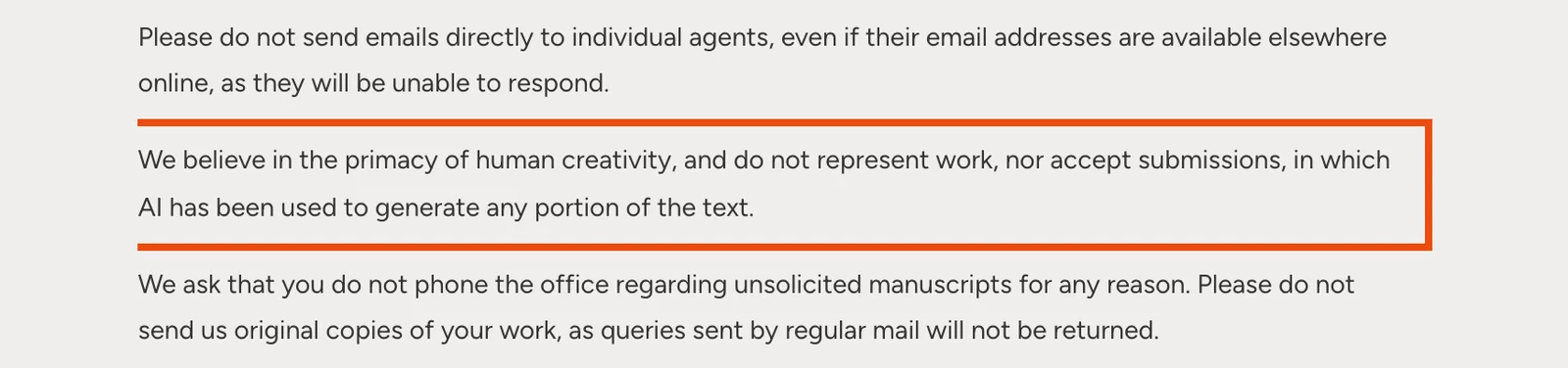
| The Gernert Company | US | Does not represent or accept work where AI generated any portion of the text. |
| Janklow & Nesbit | US | Does not accept submissions written with AI. |
| Wendy Sherman Associates | US | Submissions must be the author's original work, not generated or written with AI. |
| Levine Greenberg Rostan | US | Notes that AI-generated text may not qualify for US copyright. Asks you to say how you used AI if they request your material. |
Seven pages do not mention AI: United Agents, Writers House, Trident Media Group, Folio Literary Management, Sterling Lord Literistic, InkWell Management and Aevitas Creative Management (we read its contact page). Silence is not permission. It only means the page does not say. We could not read RCW, Curtis Brown, Conville & Walsh or Waxman Literary Agency. These four are a separate group. They are not agencies that ban AI.
What to do with this: read the page of the agency you plan to write to, on the day you send. If the rule is unclear, ask the agency. Do not assume AI help is allowed.
How did we check the 24 agencies?
We opened each agency's own submission page in a browser on November 8, 2026. We searched the full text, including expandable sections, for AI, artificial intelligence and generative. We did not contact any agency. An agent may have rules of their own, and pages change.
Does AI assisted writing count as AI-generated?
AI assisted writing means you write the book and use AI for help with tasks like editing, fixing errors or planning. AI-generated writing means the AI creates part of the text or whole chapters. Amazon KDP uses the same split. Text an AI tool created is AI-generated, even if you edit it afterwards. KDP does not ask you to report AI-assisted work.
Agents use other words: generated, written, co-written, edited. So the exact word on the agent's page matters more than the label you choose for your own work. Examples show the difference.
| What you did | KDP's term | What the 24 pages say |
|---|---|---|
| You wrote a chapter, and AI fixed the grammar | AI-assisted | 4 agencies rule out AI editing. Others ask you to disclose it. The pages do not mention plain spell and grammar checkers. |
| You wrote notes and bullet points and AI made them a chapter, or you gave a topic and AI wrote most of the text | AI-generated, because the AI created the sentences | 11 agencies do not want AI-written work. |
| AI wrote your query letter or synopsis | Not covered by KDP | Blake Friedmann, Eve White and DHH name these. Peters Fraser + Dunlop covers covering letters. |
| AI helped with ideas or research | AI-assisted | David Higham says nonfiction proposals (a short plan of your book that you send before the full text) should not rely on AI research. Levine Greenberg Rostan says such use may have implications and asks you to disclose it. |

Can you copyright a book written with AI?
Copyright is one reason agencies care about AI. The answer depends on the facts and on the country. The US Copyright Office said in January 2025 that using AI as a tool does not by itself stop a work from being protected. A prompt alone is not enough. A person's creative choices, such as arranging or changing AI output, can be protected. This is US law only and not legal advice. Our article on what the Copyright Office says about books written with AI explains it in plain words.
Do I have to tell a literary agent that I used AI?
Where the page asks, yes. David Higham, Peters Fraser + Dunlop and Levine Greenberg Rostan ask you to disclose it, which means to tell them. The other agencies that mention AI do not want AI-written work, so telling them would not change their answer.
Do not hide it. Dystel, Goderich & Bourret says that publishing contracts require work that can be copyrighted. Its statement adds that an author who uses AI for even a small part of a manuscript would break the promises in that contract. The Authors Guild says in its May 2026 guide that AI text may breach the originality promise in a book contract. It suggests you talk to your agent or publisher about it.

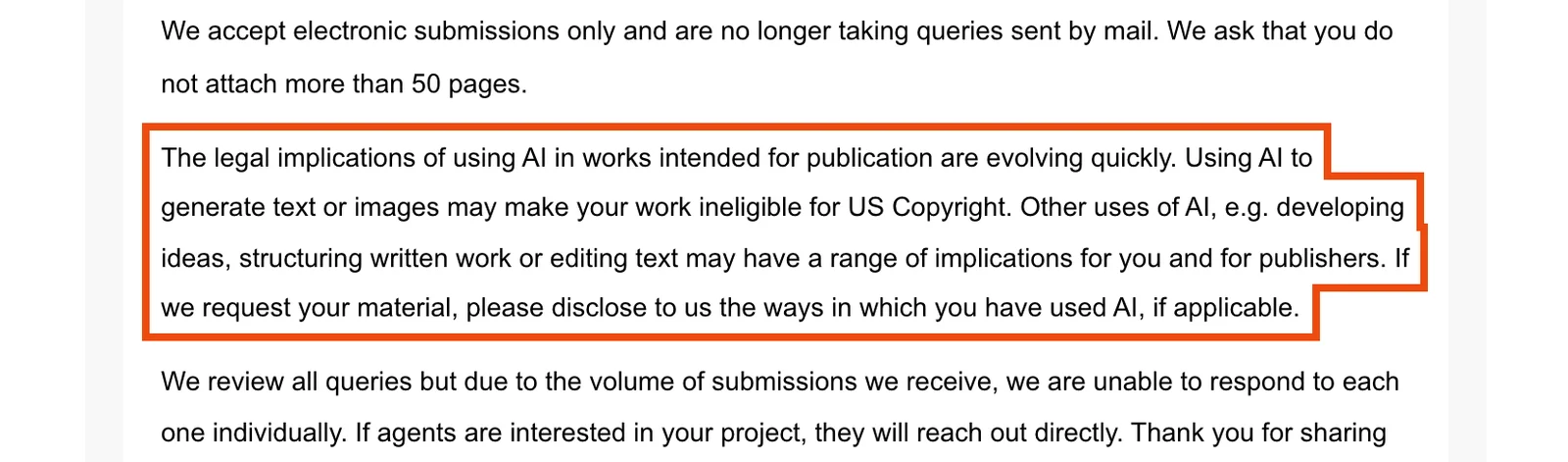
Can literary agents tell if a book was written with AI?
Sometimes. In March 2026 The Guardian reported that agent Kate Nash found an AI prompt left at the top of a query letter. Detection tools are weak. A big publisher in the same article says it runs work through several tools and calls them fallible. Treat a detector result as no proof either way.
A 2025 report from the Cambridge Minderoo Centre surveyed 332 UK novelists, fiction publishers and literary agents. Thirty-two were agents. Of those, 34% said they use generative AI, and 78% felt negative about using AI to filter submissions.
The risk is that an agent notices, or asks you, and you were not straight with them.
How do I query a literary agent if I used AI?
- Check the rules of each agency on the day you send. Do not use one package for every agency.
- Write your query letter and synopsis yourself. Several agencies name them.
- Disclose where the page asks. Say what the tool did and what you did.
- Rewrite any passage that AI wrote, or send it only to agencies that accept disclosure.
- Keep dated drafts and notes. They show your own work.
- Do not paste your whole manuscript into public AI tools. Our article on uploading a manuscript to an AI tool shows what each tool does with it.
What if a literary agent says no to my AI-assisted book?
A no from agents does not mean you must give up on your book. An agent is one road to a traditional publisher, not the only one.
Can I publish a book without a literary agent?
Yes. You can publish it yourself on Amazon KDP, Amazon's self-publishing service. You do not need an agent's approval. You prepare the book, upload it in your own KDP account and follow the platform's rules. KDP pays royalties (a payment per copy sold) on the copies it sells. Nobody can promise that a book will sell or earn money, and we do not. Our guides to self-publishing platforms and hybrid publishing compare the other routes.
Can I self-publish an AI-written book on Amazon KDP?
Yes. KDP asks you to report AI-generated text and images, but not AI-assisted work.
How can Built&Written help me publish my book?
Built&Written fits two situations. They are different, so we describe them apart.
I already wrote my book. Can I publish it without an agent?
You may have written the book yourself over months or years. Now you need a book that is ready to publish. You can upload your manuscript, and the platform keeps your words. It builds the page layout, the cover and the files that Amazon KDP needs. You do not have to rewrite anything, and no AI writes your text. This path suits an author who wants every word to stay their own.
I have notes and ideas but no book. Can AI help me write it?
You may have notes, old articles, blog posts or transcripts of talks. You know what you want to say, but not how to turn it into a book. Built&Written helps you organize that material, build the structure of the book and work on the chapters with AI. You do not start from an empty page, and you can edit the result. The platform also makes the cover and prepares the KDP files.
The two paths differ for the topic of this article. Under KDP's terms, text that the platform's AI writes is AI-generated. If you plan to query agents, follow each agency's rules, because many would not accept a book whose chapters an AI wrote. Built&Written does not promise that an agent will accept any book. If you choose to publish yourself, follow KDP's rules on reporting AI-generated content.
Final thoughts
Most agencies we read either rule out AI-written work or say nothing, and a few ask you to disclose it. Read the page and answer plainly. If agents say no, your book can still go on.
You do not need a literary agent to publish your book. If you have a manuscript, notes, articles, transcripts or ideas, you can use them to make a book of your own. Built&Written can help with the rest.
- Start with what you already have. Upload your own manuscript, notes, articles or transcripts.
- Shape the book. Work on the structure and the chapters, or keep your finished text as it is.
- Prepare the KDP files. Layout, cover and checks are done for you, and you upload the files to KDP in your own account.
Frequently asked questions
Yes. You can publish it yourself on Amazon KDP. You need an agent only to reach a traditional publisher.
Yes. KDP asks you to report AI-generated text and images, but not AI-assisted work.
Four agencies say no to AI editing, and some ask you to disclose it. The pages we read do not mention plain spell and grammar checkers. If you are unsure, ask the agent. The Authors Guild says in its guide for authors that spelling and grammar checkers are fine.
Not always. Detection tools are weak, and agents and publishers say so. Some agents notice the signs, and many ask you directly. Answer honestly.
Yes. Upload it, and the platform keeps your words and builds the layout, the cover and the KDP files around them. No AI writes your text on that path.
Yes. Start from notes, old articles, blog posts or transcripts of talks. The platform helps you organize them and work on the chapters, and you can edit the result. Text that its AI writes is AI-generated under KDP's terms.
Sources & References
- The Guardian: Soon publishers won't stand a chance (March 29, 2026)
- Cambridge Minderoo Centre: The Impact of Generative AI on the Novel (November 2025)
- Authors Guild: AI Best Practices for Authors (May 2026)
- US Copyright Office: Copyright and Artificial Intelligence
- Amazon KDP: AI-generated content
- Dystel, Goderich & Bourret: Statement on AI Policy
- Levine Greenberg Rostan: Submissions
- Blake Friedmann: Book department submission guidelines
About the author

Khrystyna Balushka
More in Self-Publishing
Ready to write your book?
Turn your expertise into a professional book with Built&Written.