
What the US Copyright Office Says About Books Written With AI
We write about this because we are Built&Written, a platform that helps people make nonfiction books from their own material. That can be notes, articles, interview transcripts, an old book or a finished manuscript (the full text of a book). We will show later how that fits the Office's rules.
Key takeaways
- Your own words can be protected. This includes your text that you can still see in the AI result.
- Creative edits and arrangement can be protected. The change has to be creative enough, so not every edit counts.
- AI text alone is not protected. A prompt alone is usually not enough to change that.
- The Office has ruled on one book so far. It is a comic called Zarya of the Dawn.
What has the US Copyright Office said about AI and books?
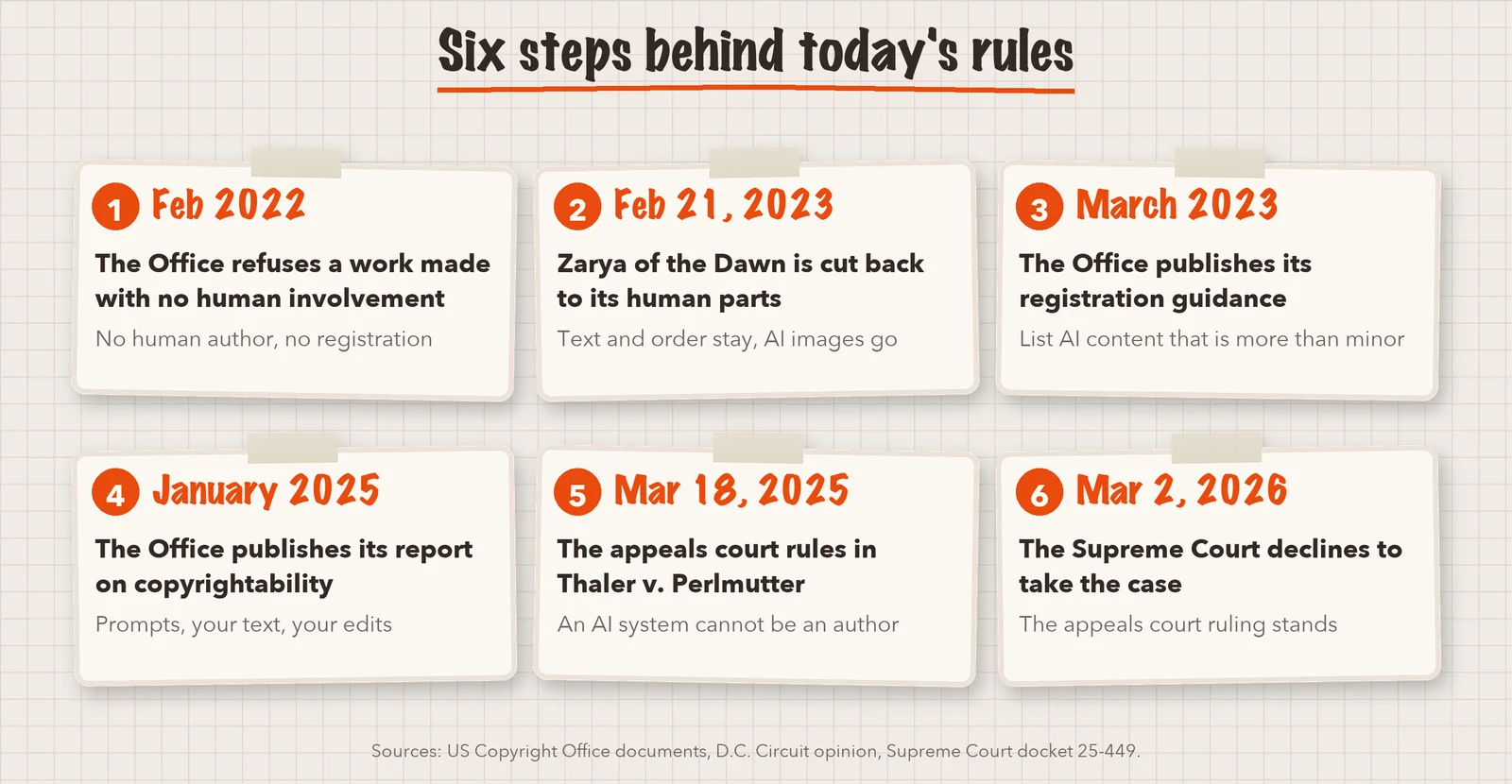
The Office is not a court. It decides what it will register, and courts decide the law. Here are the main steps so far.
| When | What happened |
|---|---|
| February 2022 | The Office's Review Board refused to register a work made with no human involvement |
| February 21, 2023 | The Office cut back the registration of the comic book Zarya of the Dawn |
| March 2023 | The Office published its registration guidance. It asks you to list AI content that is more than minor |
| January 2025 | The Office published its report on copyrightability |
| March 18, 2025 | An appeals court ruled in Thaler v. Perlmutter that an AI system cannot be an author |
| March 2, 2026 | The Supreme Court declined to hear the case |
Two notes on the last two rows. In that case the AI was named as the only author, so the court did not decide how much human help is enough. And when the Supreme Court declines a case, it does not say it agrees with everything the Office has written. The appeals court ruling simply stays in place.
What happened with Zarya of the Dawn?
Zarya of the Dawn is an 18 page comic. The author, Kristina Kashtanova, wrote the story and made the pictures with Midjourney. Her application did not mention AI. The Office registered it, then learned about Midjourney and wrote to her in February 2023.
Text in the image:
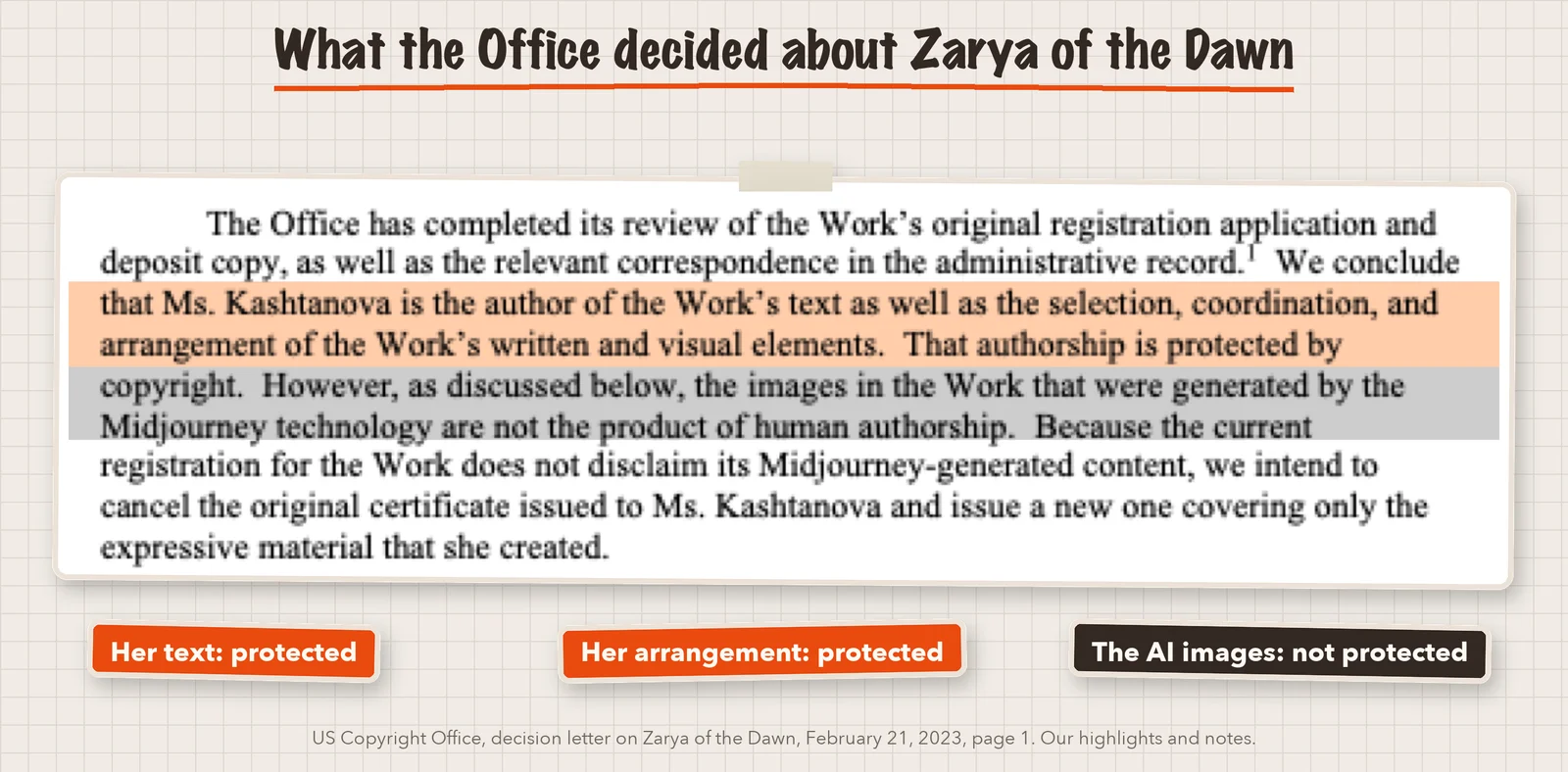
"We conclude that Ms. Kashtanova is the author of the Work's text as well as the selection, coordination, and arrangement of the Work's written and visual elements. That authorship is protected by copyright. However, ... the images in the Work that were generated by the Midjourney technology are not the product of human authorship."
The Office cancelled the first certificate and issued a new one for the human parts only. The lesson is short. A person's text and creative arrangement can be protected. AI images on their own are not. And if you register a work, tell the Office what AI made. Our guide to AI images in books covers the picture side.
How does the US Copyright Office treat different ways of using AI?
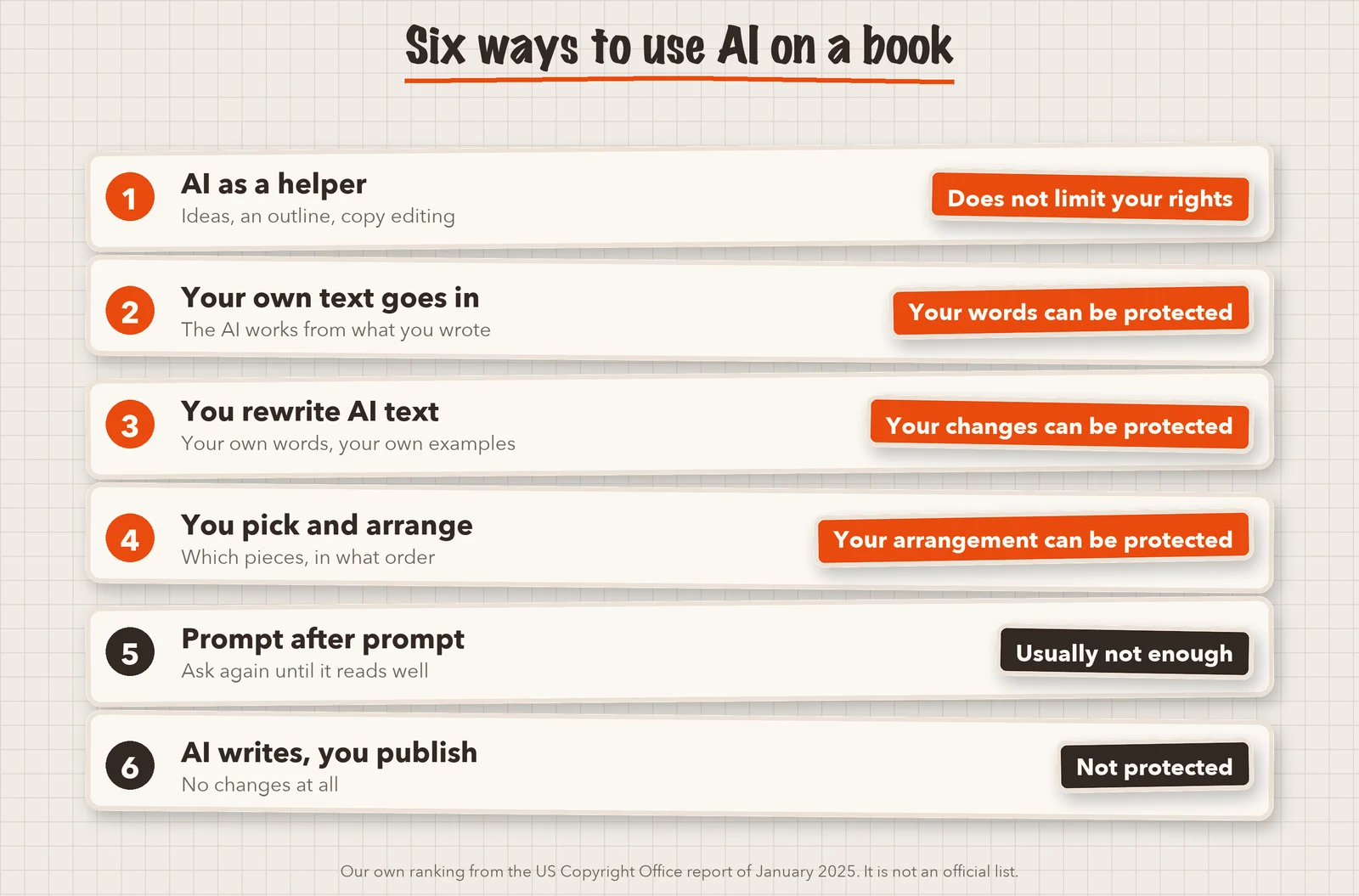
The Office does not publish a ranking. The one below is our own reading of its 2025 report, to make it easier to follow.
Text in the image:
1 AI as a helper: does not limit your rights. 2 Your own text goes in: your words can be protected. 3 You rewrite AI text: your changes can be protected. 4 You pick and arrange: your arrangement can be protected. 5 Prompt after prompt: usually not enough. 6 AI writes, you publish as it is: not protected.
| Way of using AI | What the Office says |
|---|---|
| 1. AI as a helper. Ideas, an outline, copy editing | The report says this generally does not limit your copyright in your own work |
| 2. Your own text goes in. For example, you ask AI to change your story from first person to third | Your own words that show in the result can be protected |
| 3. You rewrite AI text | Your changes can be protected if they are creative enough. The AI text under them is not |
| 4. You pick and arrange AI pieces | The whole can be protected as a compilation, meaning a collection arranged in a creative way, if the choices are creative, as with Zarya. The AI pieces alone are not |
| 5. You write prompt after prompt | Prompts alone are usually not enough |
| 6. AI writes, you publish it as it is | Not protected |
The Office judges each work on its own, and it says its view rests on how the tools work today. So nobody can tell you in advance how it will see a given book.
Why are prompts alone usually not enough?
Some people told the Office that rewriting a prompt again and again is creative work. The Office disagreed. It gave two reasons.
- Effort is not the test. Copyright looks at original authorship, not at how much time you spent.
- A new prompt is another try. The Office compares it to "re-rolling" the dice. You get a new result to choose from, but you do not control what is in it.
This does not make prompts useless. They are a good way to get ideas and first drafts. They just do not make the AI's text yours. Your authorship comes from what you write and what you change.
What can you do when you write your book?
Here are five habits that follow from the Office's reasoning. None of them guarantees a result.
- Start with your own material. Notes, articles and drafts are human writing. When the AI works from them, more of the book traces back to you.
- Rewrite what the AI gives you. Use your own words and add your own examples.
- Choose and order the chapters yourself. Creative selection and arrangement kept their protection in Zarya.
- Keep your drafts. Save your notes, the first AI version and your edited version.
- Be open when you register. List AI content that is more than minor and say what you wrote. Our guide to copyright for books written with AI shows the form step by step.
How does Built&Written help you write a book from your own material?
Built&Written has two ways to start. Pick the one that matches what you have.
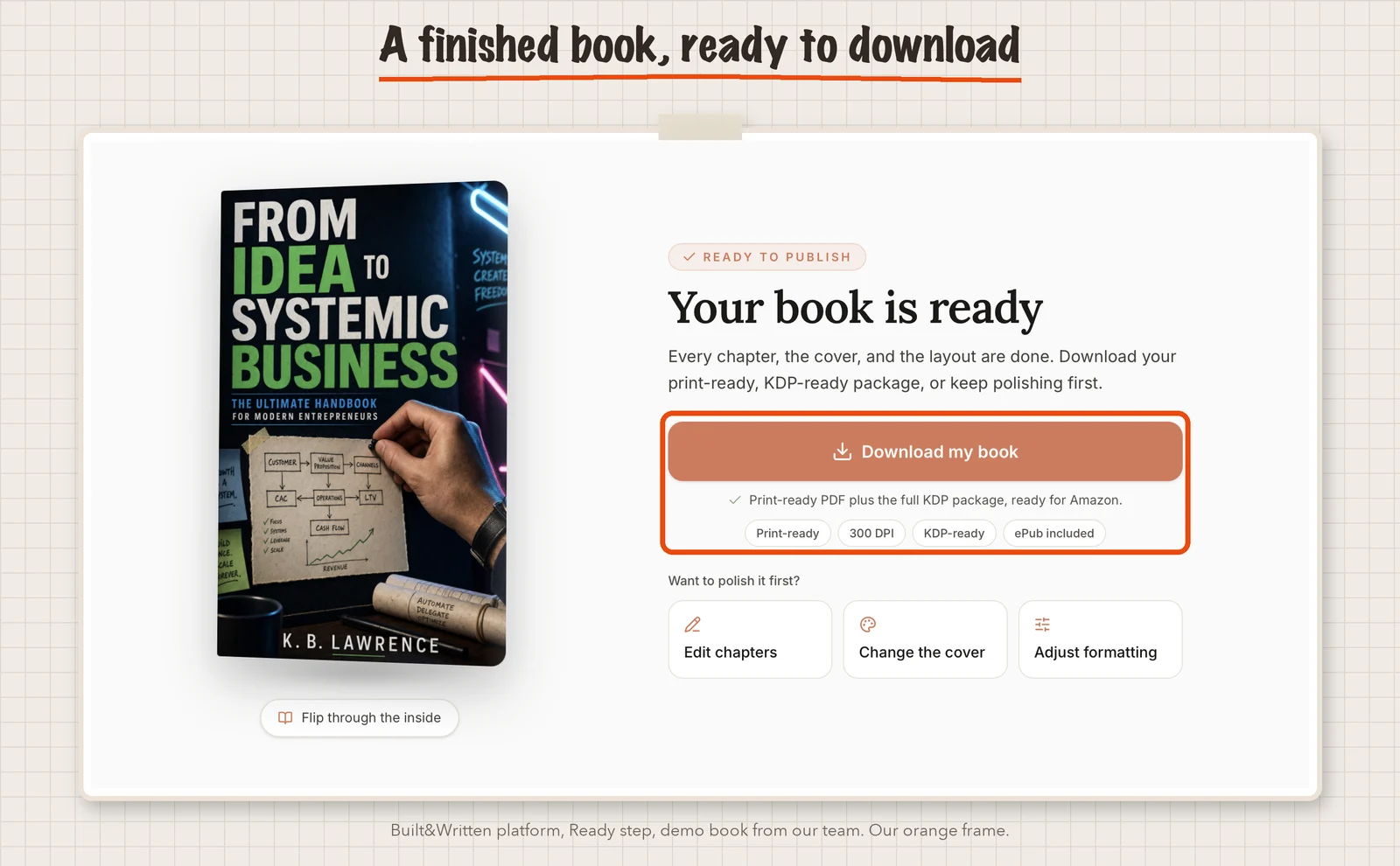
1. You have material but no book yet. This can be notes, articles, transcripts of talks or interviews, or an old book. Paste the text or upload a PDF, Word or text file, up to 50,000 words. The platform reads it and suggests a chapter plan. You approve the plan or change it. Then it writes a draft from your material, and you can edit every line. At the end you get a print-ready PDF and a KDP package, which is the set of files Amazon KDP (its self-publishing service) asks for. If you want a new book from an old one, use the old book as your material here.
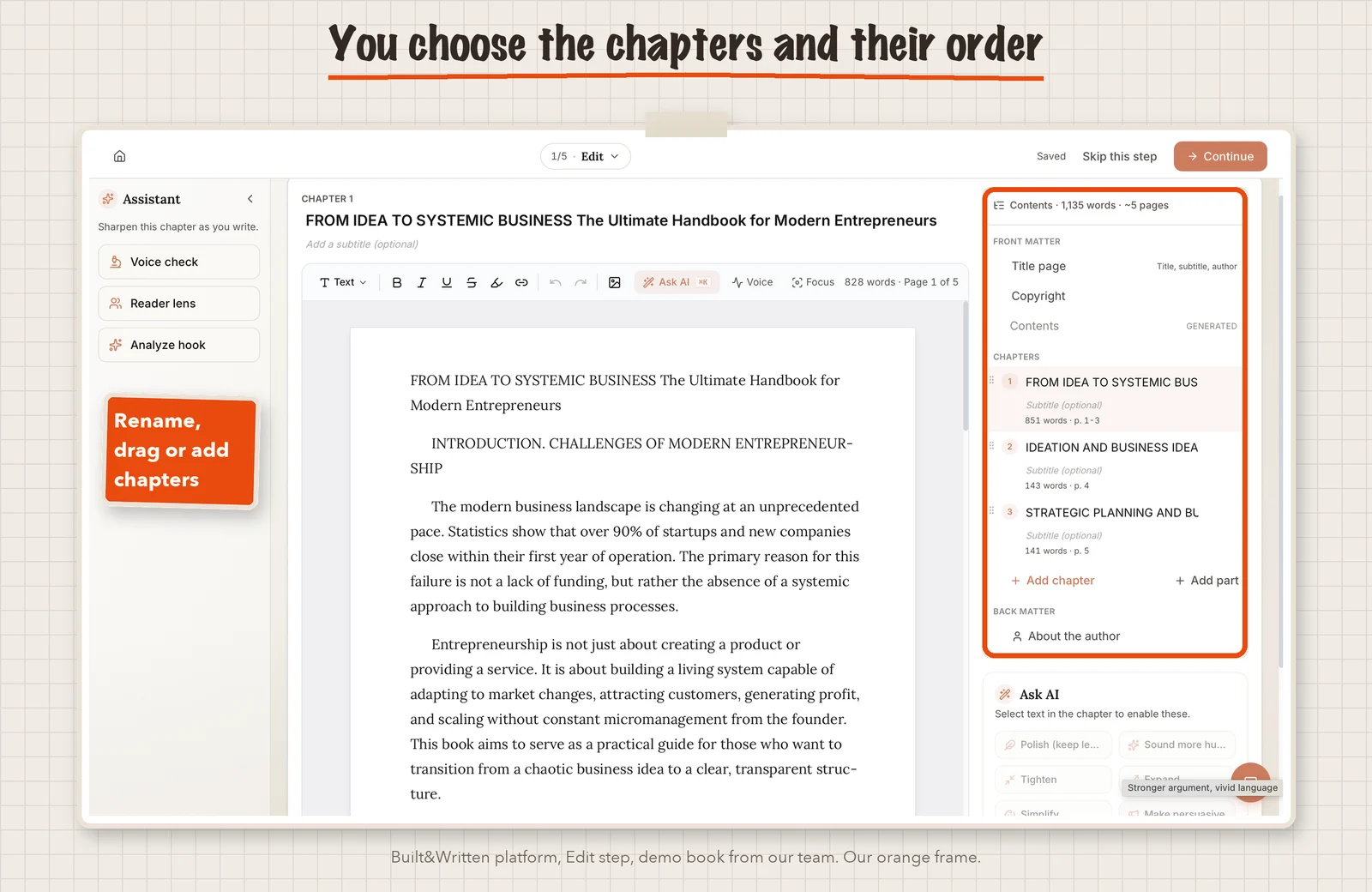
2. You already have a finished manuscript or book. Upload it, Word works best. The platform does not rewrite it. It writes nothing with AI, keeps your words as they are and builds the book layout around them. You can still edit the text, change the cover and adjust the formatting before you download.
Here is how this fits the Office's rules. In the first way, your own text goes in and you edit what comes out. In the second way, no AI text is added. Neither one guarantees a copyright result, and the platform does not decide it. The law and the Office do. The books you create stay yours, and the platform does not use your content to train AI models. You upload the files to Amazon KDP yourself, and some downloads need a paid plan, which the pricing page lists.
Final thoughts
The Office's message is steady. A person has to write the work or shape it in a creative way. AI text on its own is not protected, and a prompt alone is usually not enough.
If you already have notes, articles or a manuscript, Built&Written can turn them into a book. It helps you organize the chapters, edit the text and prepare the files for publishing. See how it works.
Frequently asked questions
It can register the human part. Since its 2023 guidance, the Office has registered hundreds of works that contain AI material, and each registration covers what the human author contributed.
You have to list AI-generated content that is more than minor and say what you wrote yourself. The 2025 report says that using AI to brainstorm or outline generally does not limit your copyright. If AI content is left out of an application, the Office can cancel the registration and issue a new one, as it did for Zarya of the Dawn.
A prompt alone is usually not enough. The Office says prompts do not give a person enough control over the result, and that rewriting a prompt many times does not change this.
It can be protected if your choices are creative enough. The Office protected the selection and arrangement of text and images in Zarya of the Dawn. This protects the whole, not the AI pieces inside it.
No. Registration and selling are separate. Amazon KDP has its own question about AI-generated text, and your answer there is private. Our guide to the KDP AI rules explains it.
Sources & References
- US Copyright Office: Copyright and Artificial Intelligence, Part 2 (January 2025)
- US Copyright Office: Registration Guidance for Works Containing AI-Generated Material (March 2023)
- US Copyright Office: Zarya of the Dawn decision letter (February 21, 2023)
- US Court of Appeals, D.C. Circuit: Thaler v. Perlmutter (March 18, 2025)
- US Supreme Court docket 25-449, Thaler v. Perlmutter
- Built&Written Terms of Service
About the author
Khrystyna Balushka
More in Self-Publishing
Ready to write your book?
Turn your expertise into a professional book with Built&Written.