

A Book Outline Template You Can Fill In This Afternoon
Key takeaways
- What goes in a nonfiction book outline? The reader, the promise, the parts, and for each chapter the problem, the idea, the proof and the action.
- How long does it take? About an afternoon, in four blocks, if you already have notes, posts or talks to work from.
- Do real business books plan their parts this way? Yes. Atomic Habits has 20 chapters in 6 parts, Deep Work has 3 chapters and 4 rules in 2 parts, and The Lean Startup has 12 chapters in 3 parts.
- When is the outline ready? When every chapter has one job and nothing repeats.
What is a book outline?
A book outline is the plan of a book: the order of its parts and chapters, and what each chapter has to do for the reader. In nonfiction it isn't a plot. It's your argument, broken into steps a reader can follow.
That difference matters when you look for an outline for a book. When we checked the top 10 Google results in the US for "book outline template" on November 13, 2026, seven were built for novels: plot formulas, story outlines and novel planners. A business or how-to book needs another shape, because the reader buys it to solve a problem, not to find out what happens next.
The book outline template
Copy this into a document and fill in the blanks. Repeat the chapter block as many times as you need.
THE BOOK
Working title:
Who it's for (one person, one situation):
The promise (after the last page, the reader can...):
Why you (the experience or material this comes from):

PART 1: [name of the stage, step or idea]
What this part settles for the reader:

  Chapter 1: [title as a claim, a question or a how-to]
  - Problem: what the reader gets wrong or can't do yet
  - Idea: your answer, in one sentence
  - Proof: a story, number or client example you already have, and where it is saved
  - Action: what the reader does after this chapter
  - Length: about ___ words

  Chapter 2: ...

PART 2: ...

THE END OF THE BOOK
Conclusion: how the promise is kept
Extras: checklist, worksheet or resource list
Three lines do most of the work.
- The promise keeps the book on one road. If a chapter doesn't move the reader toward it, it belongs in another book.
- The proof line, with where it is saved, ties every chapter to material you already own: a post, a talk transcript, a client folder. A chapter with an empty proof line is the one you'll get stuck on later.
- The action line turns a chapter into something the reader can use the same day, which is what a how-to book is bought for.
How to outline a book in one afternoon (with Built&Written)
Work in four blocks with short breaks between them. The times are a guide, not a rule.
Block 1: the reader and the promise (about 30 minutes). Fill in the first four lines of the template. Finish the sentence "After this book, the reader can..." with something you could check. If you can't finish it, stop here: the rest of the outline will drift without it.
Block 2: your material (about 45 minutes). List what you already have on the topic: posts, newsletters, talk transcripts, client notes, slide decks, frameworks you teach. One line each, with where it's saved. This list feeds the proof lines later.
Block 3: parts and chapters (about an hour). Group the material into 2 to 6 piles. Each pile is a part. Inside each part, write one chapter title per idea. Then pick the order: by stage (what the reader faces first), by step of your framework, or the argument first and the rules after. The next section shows all three in real books.
Block 4: the four lines (about 45 minutes). Fill in problem, idea, proof and action for every chapter. Don't write prose. Where a proof line stays empty, mark it.
The slow part is blocks 2 and 3. Your material sits in ten different places, from old posts and newsletters to talk transcripts and client notes, and gathering it into piles often takes longer than the rest of the outline.
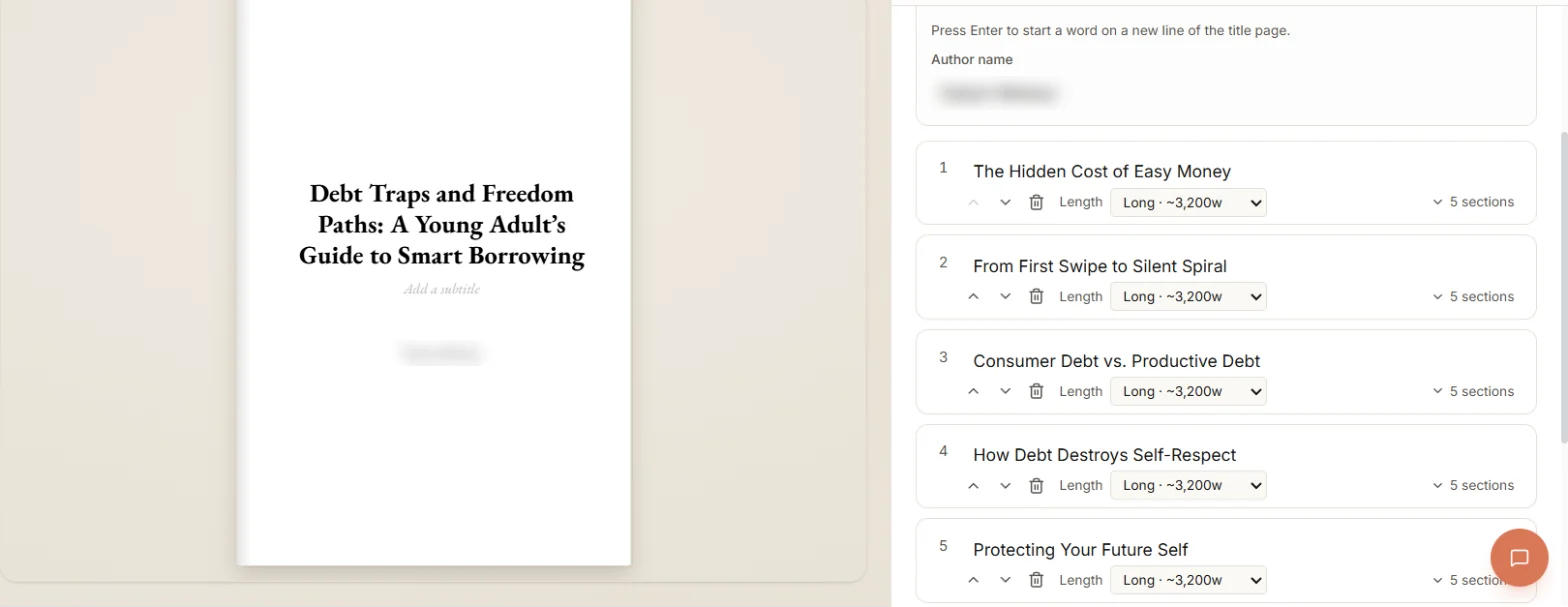
Built&Written starts from that pile. You paste or upload your posts, transcripts and notes, up to 50,000 words of them, and add your filled-in template so the plan starts from your structure. Built&Written proposes a chapter plan. You rename, reorder or delete chapters and set each chapter's target length, the same Length line as in your template.
Text in the image: Chapters: "1 The Hidden Cost of Easy Money", "2 From First Swipe to Silent Spiral", "3 Consumer Debt vs. Productive Debt", "4 How Debt Destroys Self-Respect", "5 Protecting Your Future Self", each with "Length: Long, about 3,200 words" and "5 sections".
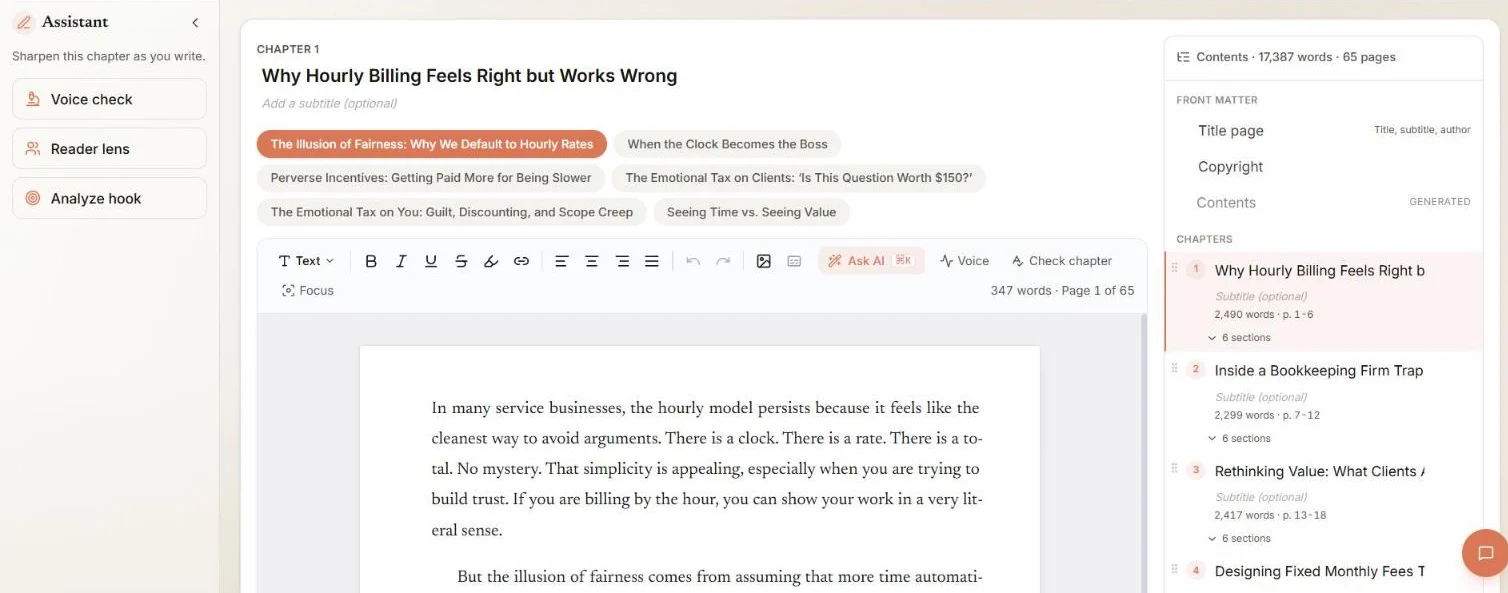
Then the AI writes each chapter in your voice from your own material, and you edit every line.
Text in the image: "Chapter 1. Why Hourly Billing Feels Right but Works Wrong." Sections: "The Illusion of Fairness: Why We Default to Hourly Rates", "When the Clock Becomes the Boss", "Perverse Incentives: Getting Paid More for Being Slower", "The Emotional Tax on Clients: 'Is This Question Worth $150?'", "The Emotional Tax on You: Guilt, Discounting, and Scope Creep", "Seeing Time vs. Seeing Value". Contents: "17,387 words, 65 pages"; "1 Why Hourly Billing Feels Right b..., 2,490 words, p. 1-6"; "2 Inside a Bookkeeping Firm Trap, 2,299 words, p. 7-12"; "3 Rethinking Value: What Clients A..., 2,417 words, p. 13-18".
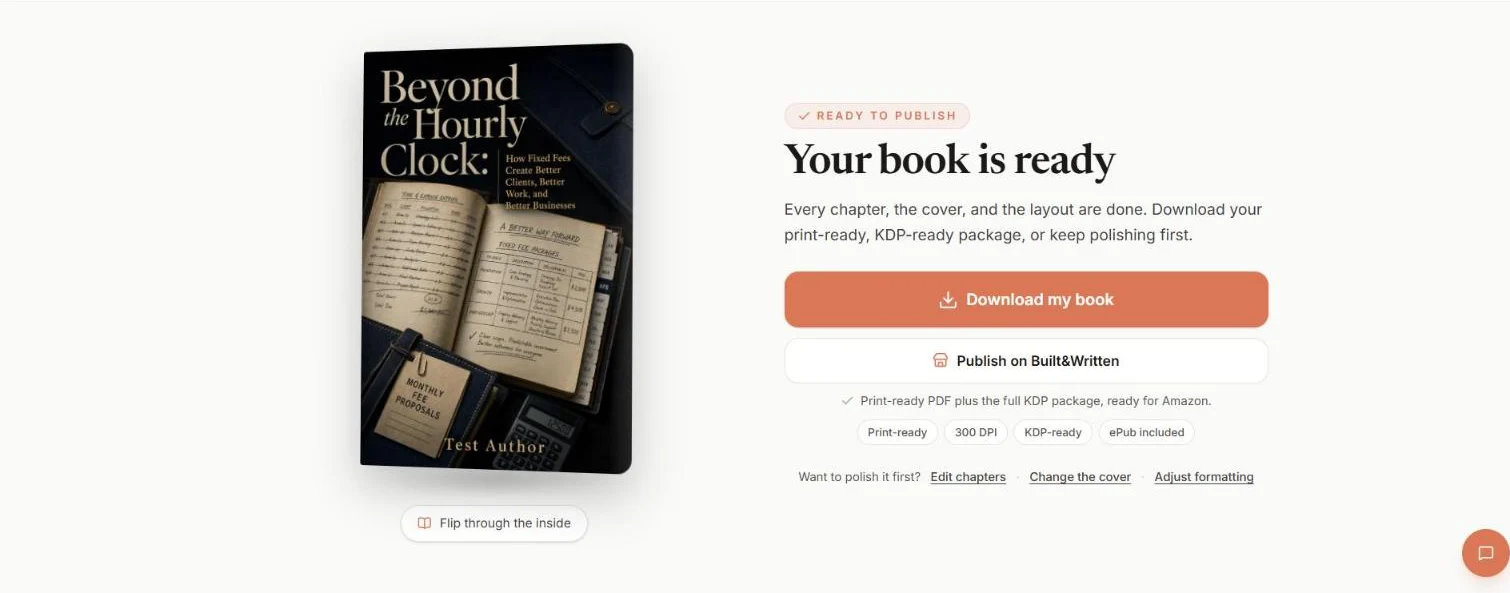
What you end up with is a finished book, laid out and with a cover, plus the files Amazon KDP (Kindle Direct Publishing, Amazon's service for selling your book) asks for. You download them and upload the book to KDP yourself. Block 1 stays yours, because only you know who the book is for and what it promises.
Text in the image: "Ready to publish." "Your book is ready." "Every chapter, the cover, and the layout are done. Download your print-ready, KDP-ready package, or keep polishing first." "Download my book." "Print-ready PDF plus the full KDP package, ready for Amazon." "Print-ready", "300 DPI", "KDP-ready", "ePub included". "Want to polish it first? Edit chapters, Change the cover, Adjust formatting."
We compared how three AI tools turn a pile of notes into a chapter plan in our AI outline generator article, and how it works shows every step in the app.
Book outline examples from three business books
Three well-known business books show three ways to order the same template. The contents below come from each book's catalog record, checked on November 13, 2026.
| Book | Parts | Chapters | How it's ordered |
|---|---|---|---|
| Atomic Habits, James Clear (2018) | 6: The Fundamentals, the 1st to 4th Law, Advanced Tactics | 20 | By step of the framework |
| Deep Work, Cal Newport (2016) | 2: The Idea, The Rules | 7 (3 chapters, 4 rules) | The argument first, then the rules |
| The Lean Startup, Eric Ries (2011) | 3: Vision, Steer, Accelerate | 12, plus an epilogue | By stage the reader is in |
The framework as the parts. In Atomic Habits, four of the six parts are the framework itself: "Make It Obvious", "Make It Attractive", "Make It Easy" and "Make It Satisfying". Many chapter titles are how-tos the reader can act on, like "The Best Way to Start a New Habit" and "How to Stop Procrastinating by Using the Two-Minute Rule". If you teach a method with named steps, this is the shape to copy.
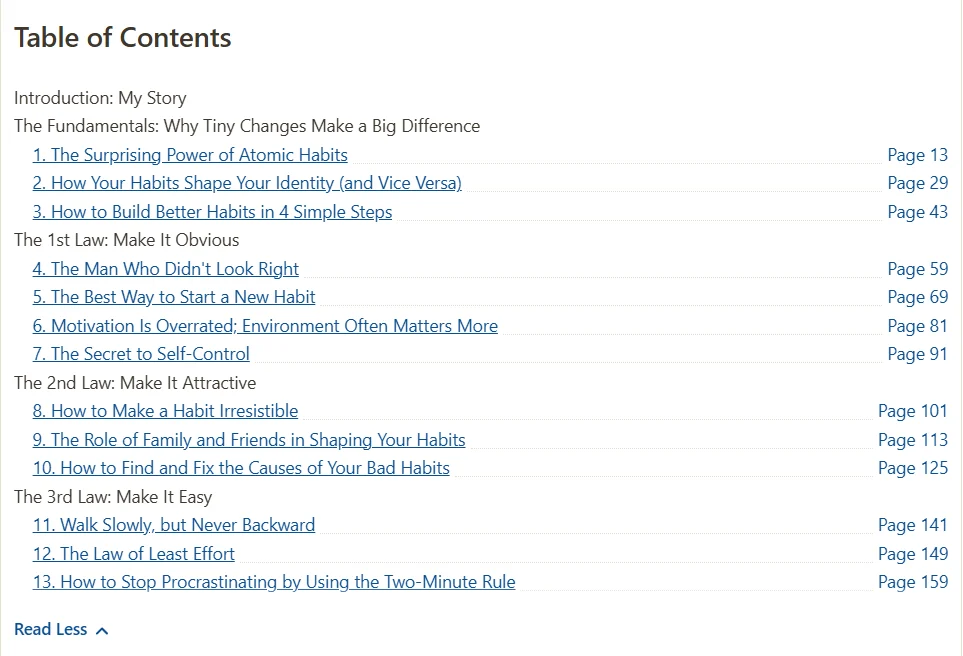
Text in the image: "Table of Contents." Parts: "The Fundamentals: Why Tiny Changes Make a Big Difference", "The 1st Law: Make It Obvious", "The 2nd Law: Make It Attractive", "The 3rd Law: Make It Easy". Under the 1st Law: "4. The Man Who Didn't Look Right", "5. The Best Way to Start a New Habit", "6. Motivation Is Overrated; Environment Often Matters More", "7. The Secret to Self-Control".
The argument, then the rules. Deep Work spends its first part on why the idea matters, in three chapters: "Deep Work Is Valuable", "Deep Work Is Rare" and "Deep Work Is Meaningful". The second part is four rules, starting with "Work Deeply" and "Embrace Boredom". Use this shape when readers first need convincing.
The stages, in order. The Lean Startup names its three parts Vision, Steer and Accelerate, and uses short one-word chapters such as "Test", "Measure" and "Pivot (or Persevere)". Use it when your reader moves through phases, like a launch or a career change.
Our guide to nonfiction book structure goes deeper into choosing between shapes like these.
How do you write a chapter outline?
Give each chapter the four lines from the template, and keep each line to a sentence or two. Here is one we made up for this article, for a consultant's book on pricing:
Chapter 3: Why your hourly rate caps your income
- Problem: the reader bills by the hour and can't earn more without working more.
- Idea: price the result the client gets, not the time it takes.
- Proof: the 2024 project where a fixed fee replaced hourly billing (proposal folder, "Client B").
- Action: rewrite one current proposal with a fixed price.
- Length: about 3,000 words.
Three rules keep chapter outlines useful:
- One idea per chapter. If the idea line needs "and", split the chapter.
- Proof you own. If two chapters use the same story, give it to the one where it proves more.
- An action the reader can do this week. "Think about pricing" isn't an action. "Rewrite one proposal" is.
To see how your chapter lengths add up, our word count to pages calculator turns the total into pages.
How do you check your outline before you write?
Run this check before you write the first chapter. It takes about 20 minutes and saves the rewrites that come from a weak plan.
- Read only the chapter titles, top to bottom. They should tell your argument in order. If one title surprises you, it's in the wrong place.
- Look at every proof line. An empty one means you find the material, merge the chapter into another, or cut it.
- Look for repeats. The same idea or story in two chapters means one of them goes.
- Check the end of each part. After every part, the reader should be able to do something they couldn't before.
- Check the last chapter against block 1. It should keep the promise you wrote first, in the same words.
- Add up the lengths. Compare the total with the book you want to publish, and cut or merge before you write, not after.
- Show it to one reader. Pick someone from your audience and ask which chapter they'd read first. If they can't choose, the titles aren't doing their job.
When the outline holds, the working title is often easier to settle. Our book title generator gives you options to test against your promise, and our guide on writing a book with AI that still sounds like you covers the drafting stage.
Final thoughts
The promise takes half an hour in block 1, and by the end of the afternoon the whole outline is on the page. Before you write a chapter, run the seven checks above, starting with the chapter titles read top to bottom. Most of what fills the proof lines is already in your posts, talks and notes, and Built&Written turns that material into a chapter plan you shape before a word is written. See how it works.
Frequently asked questions
Long enough that every chapter in the book outline template has its four lines, and no longer. For most nonfiction books that fits on a few pages. If your outline runs to dozens of pages, you've started writing the chapters, which is fine, but treat those pages as a draft and keep a short version for checking the order.
No. A table of contents is what the reader sees: part and chapter titles with page numbers. An outline is your working plan behind it, with the four lines for every chapter. When the book is done, the chapter titles from your outline usually become the table of contents.
Yes, and you probably will. Writing shows which chapters are thin and which ideas need more room. Update the outline when you move, merge or cut a chapter, so it stays a true map of the book.
Usually not. Outline the introduction first, with the reader, the problem and the promise, but write it last. By then you know what the chapters actually deliver, and the introduction can promise exactly that.
Sources & References
About the author

Michael Pavlovskyi
More in Writing
Ready to write your book?
Turn your expertise into a professional book with Built&Written.