

How to Write a Book Proposal That Gets a Publisher to Say Yes
A book proposal is the sales document a nonfiction author sends to agents and publishers before the book is written. Self-publishing on Amazon KDP needs no proposal: the KDP help pages we read describe a finished book going on sale, and none of them mention a proposal.
You have a book idea, and you have heard that a proposal comes first. For a traditional publisher, that is right. This guide shows what goes into one, how to write each part, and how to send it. It also shows the other road, for the moment a "no" or a long wait is not what you want.
What a book proposal is and who asks for one
A book proposal is a document that sells your nonfiction book before you write it. Jane Friedman says nonfiction authors "will sell a publisher on their book before they've written it". Novels work the other way: the finished manuscript comes first.
Where you send it depends on the publisher. Friedman says that to reach one of the big New York houses, you submit to literary agents. Scholarly books for university presses, and books for regional or independent presses, do not always need an agent. Taylor & Francis describes four steps on its author page: an initial review by a commissioning editor, an external peer review if the editor approves, a final approval by a publishing committee or editorial board, and then a contract. The page gives no timeline for any step.
Some authors pay a hybrid publisher instead. That is a different deal with its own costs, and it has its own article.
What goes in a book proposal
Friedman says the same parts appear in almost every proposal. Here they are, with what she asks for in each.
| Part | What it has to do | What Friedman asks for |
|---|---|---|
| Overview | Sells the whole idea in a few pages | Placed first, written last. Usually 2 to 3 pages |
| Target audience | Names who buys the book | One specific reader, not "women, business people, parents" |
| Comparable titles | Shows how your book fits into the existing market and how it differs from similar books | 5 to 10 recent books, with about 100 to 200 words on each |
| Marketing plan | Shows how the book will sell | Actions you can and will take without the publisher, with numbers |
| Author bio | Shows why you are qualified to write this book | An argument built on your experience, achievements and relevant work, not a copied CV |
| Chapter outline | Shows the shape of the book | No more than 3,000 words |
| Sample chapter | Shows that you can write it | One full chapter |
| Manuscript specs | Shows how much work remains to complete the book | About one page: word count, delivery date, images, permissions, research left |
Friedman says most proposals run 10 to 25 pages double-spaced, without the sample chapters.
Joanna Ebenstein's 2018 guide at The Creative Independent is a personal guide built on her own proposals and on talks with agents. It adds a header with your contact details, a list of people who might blurb the book, and a preliminary delivery schedule.
The two guides disagree on the sample chapter. Friedman wants the strongest chapter of the book and skips the introduction. Ebenstein suggests the introduction plus one or two chapters, and says some editors do not require a sample at all. Check the page of the publisher or agent you are writing to, and do what it says.
How to write a book proposal, step by step
These steps put the overview last, as Friedman advises, so the order is not the order of the finished document.
- Name one reader. A weak line says "business people." A stronger line says "managers at companies of 20 to 200 people who were promoted without any training." That second line is our own example, made up to show the difference. Yours should describe a real person you could find.
- Find 5 to 10 comparable titles. Pick books from the last few years. For each one, note the title, subtitle, author, publisher, year, page count and price, and write about 100 to 200 words on what it covers and who reads it. Friedman says to leave out sales numbers, Amazon rank and reviews. She also warns against comparing yourself to huge bestsellers, and against claiming that no similar book exists.
- Write a marketing plan with numbers. List what you can and will do without the publisher's help: your email list, talks, a podcast, a newsletter. Friedman says to drop soft wording like "I plan to" and "willing to."
- Write the bio as an argument. Say why you are the right person for this book, and show proof. A pasted CV does not do that.
- Write the chapter outline. Keep it under 3,000 words. Our guide to nonfiction book structure shows three ways to shape the chapters. If you still need a working title and subtitle, our book title generator gives options to start from.
- Write the sample chapter. Choose the chapter that shows your idea best, as Friedman advises.
- Write the overview last. Friedman puts it first in the document and says to write it after everything else. For the short query version you send to agents, she suggests 400 to 600 words.
Then assemble the document. Friedman's order is: cover page with your contact details, overview, about the author, target audience, competing titles, marketing plan, chapter overview, sample chapters, and any extra material.
Why proposals get rejected: author platform
Friedman calls "no author platform" the most common problem leading to rejection. Platform is your existing audience and reach. For a major publisher she says you typically need to be visible to tens of thousands of people, with influence you can verify. She also warns that social media by itself is not platform.
Expectations change with the size of the publisher. Friedman says big houses may want to sell as many as 20,000 copies in the first year, while smaller presses may be fine with a few thousand.
If you are aiming for a major publisher, building an audience may need to come before your proposal. But a large following is not the only way to show your value as an author. Smaller and university presses may place more weight on your expertise, research and credibility.
If you do not have that audience yet, the proposal road to a major publisher may be closed for now. The KDP help pages we read do not mention an author platform. The next sections cover that road.
How to send a book proposal to an agent or a publisher
Start with the publisher, and work backward. Ebenstein says to look at who publishes books like yours, and then try to reach a specific person there through someone you know. If that fails, send it through the publisher's website.
An agent is optional on her list. Her advantages: contacts at publishers, help with the proposal and better terms. Her disadvantage: they take a share of your earnings. To find one, she suggests reading the acknowledgements in books close to yours and looking for an agent's name.
Friedman says the materials are the same for an agent and for a publisher. The process does not really change.
The other road: publish on Amazon KDP with no proposal
Traditional publishing is not the only way to release a book. If you do not want to wait for a publisher's decision, or prefer to keep control over the process, you can publish it yourself through Amazon KDP.
Amazon KDP is Amazon's self-publishing service. The KDP help pages on royalties, pricing and timelines that we read on 14 November 2026 describe a finished book with a price and files, and none of them mention a proposal. KDP does check one thing. Its rights FAQ says KDP may ask for documents confirming that you hold the publishing rights before a book goes on sale.
| Proposal road | KDP road | |
|---|---|---|
| What you hand over first | A proposal and a sample chapter | A finished book, a price and files |
| Who decides | An editor or agent, then a committee at the publisher | You, within KDP's content guidelines |
| Who pays first | A publisher may invest in your book before you write it, on the terms of its contract | You prepare the book yourself, and earn royalties from sales |
| When readers can buy | After review, contract and production (Taylor & Francis gives no timeline) | For ebooks, KDP says the detail page can appear within 72 hours, and up to 5 days for a first-time publisher. Print book timelines vary by marketplace. KDP calls all of these estimates |
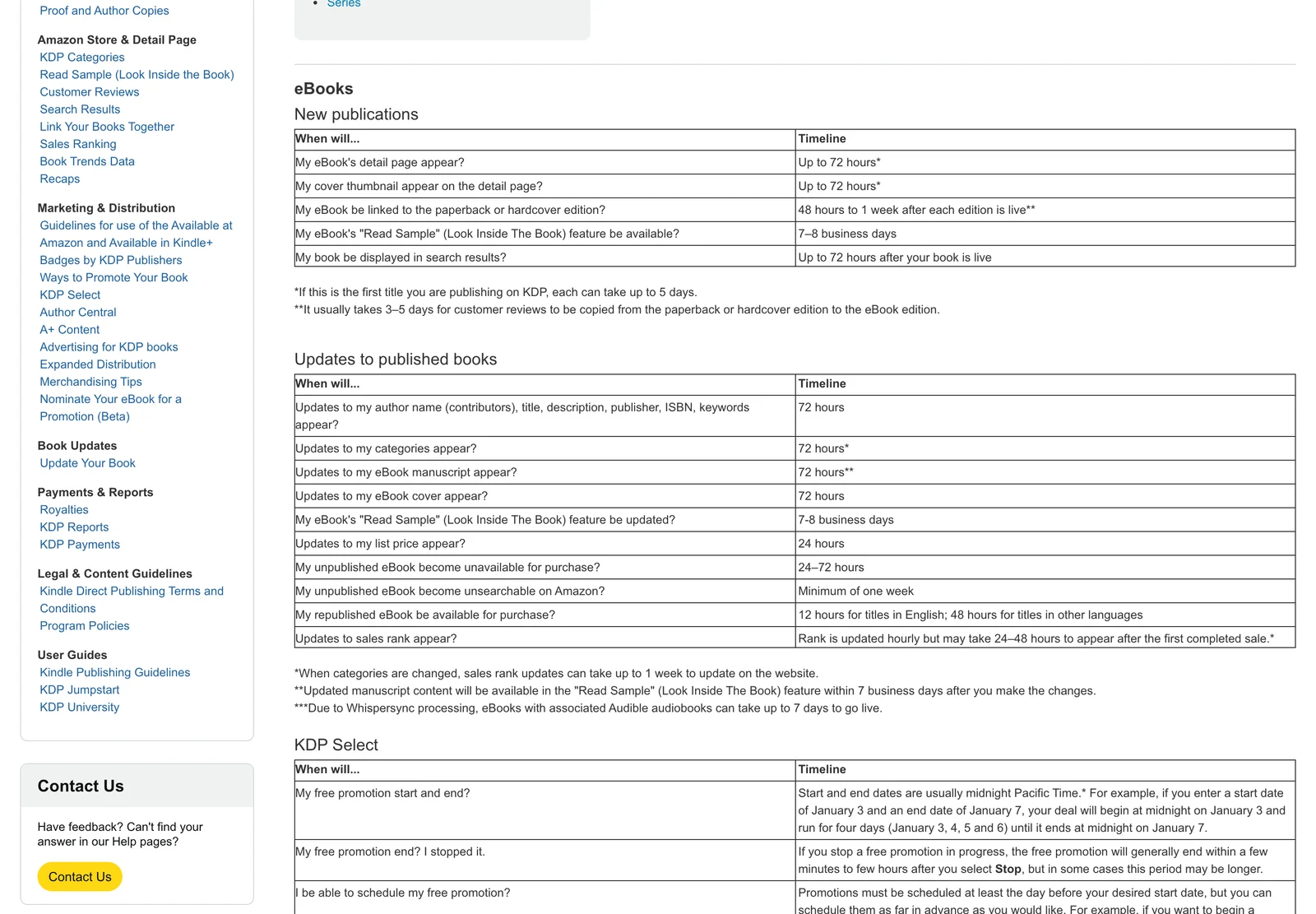
For ebooks, KDP's 70% royalty option needs a list price of $2.99 to $12.99 on Amazon.com. KDP's help page says that band applies from 7 July 2026, up from $2.99 to $9.99 before.
This road has a catch. You are responsible for preparing the finished manuscript, formatting the pages, creating the cover and writing the book description and other details for its Amazon sales page. Our guides to self-publishing platforms, publishing on Amazon KDP step by step and whether traditional publishing is dead help you weigh the two roads.
Where Built&Written fits
Most people who read a proposal guide have an idea, some notes or some posts, and no finished book. Some already have a manuscript they want to rework and format for KDP. Either way, the work between the material and the finished files is the hard part of the KDP road.
Built&Written is a platform for turning that material into a nonfiction book. You paste in notes, posts or transcripts, or upload a manuscript you already have.
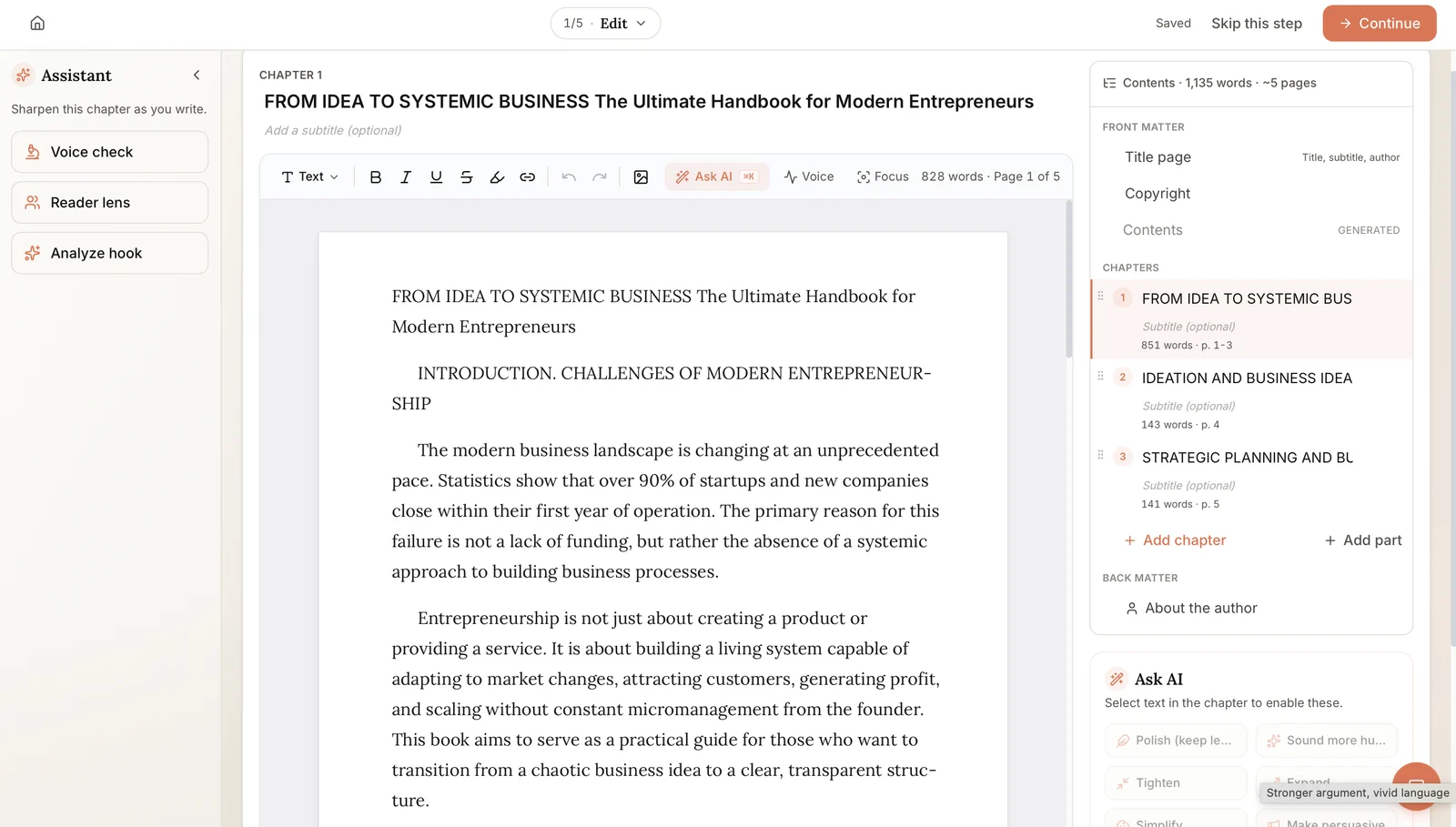
If you already have a manuscript, you can upload it (.docx, .txt and .md work best; .pdf and .rtf come in with less exact formatting), edit the chapters in the platform, then format it for KDP and export the files. This suits an older book you want to rework as well as a new one.
Its Voice DNA feature analyzes a few pages of your writing, about 300 to 1,000 words, to understand your writing style. The platform then uses this information when generating chapters, helping the new text stay closer to the way you naturally write.
Based on your materials, the platform proposes a chapter outline that you can review and edit before writing begins. Once the structure is ready, the AI helps you develop the book one chapter at a time. You can review the generated text and make changes as you work through the book.
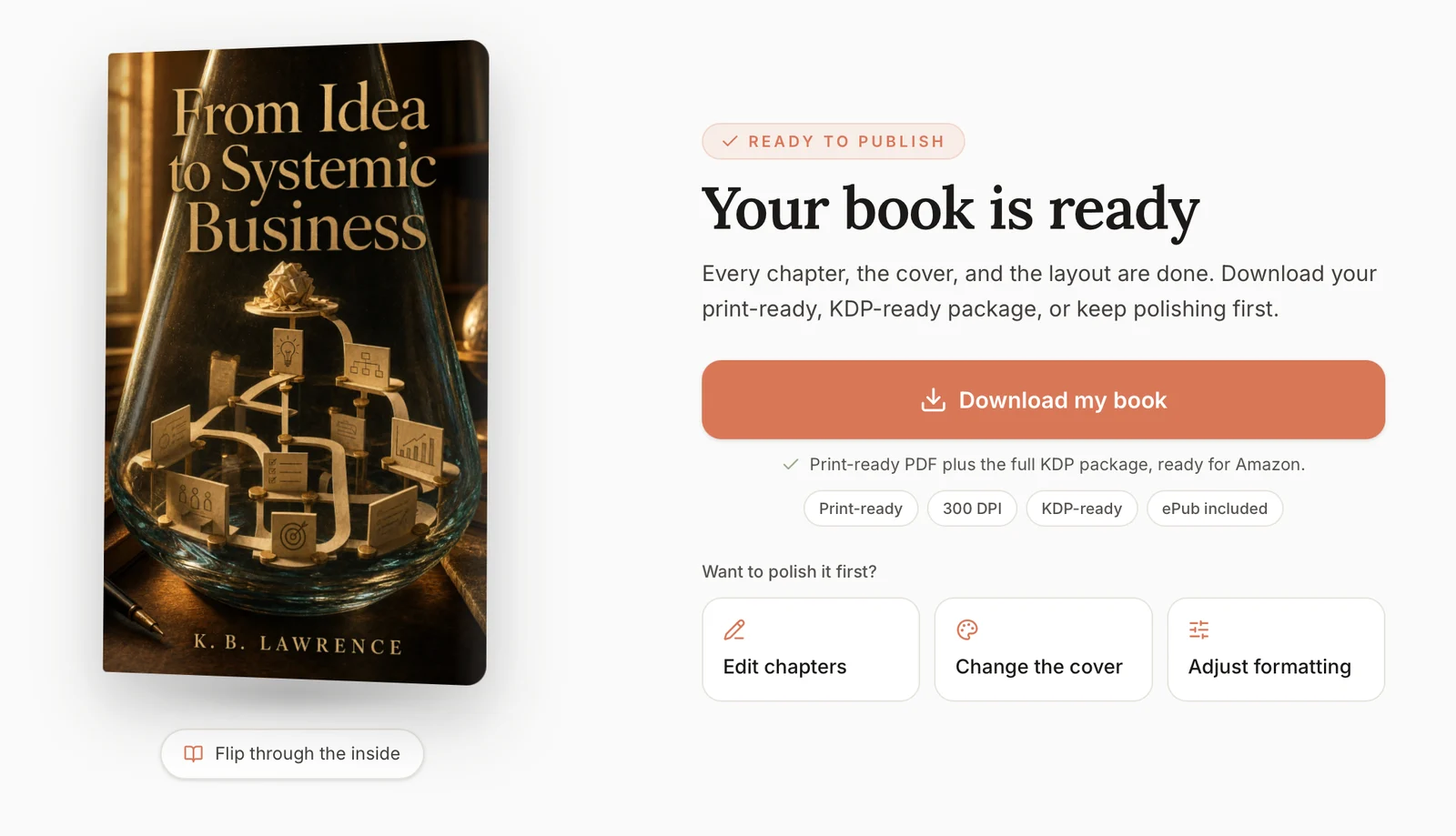
For every book, it designs the cover with the right spine width and formats the interior to KDP rules. Its KDP Launch Co-pilot drafts your title, subtitle, description, keywords and categories. If you also want a proposal, the outline is a place to start the chapter outline part.
It has limits. You upload the files to KDP yourself, because Built&Written exports them and does not publish for you. Built&Written does not include professional human editing or human ghostwriting. The AI helps create and revise the text, but you remain responsible for reviewing the final book. It cannot get you an agent or a publisher. Downloading an AI-written book needs the Entrepreneur plan or higher. The pricing page has the current plans.
The verdict
Pick the road by where you are today.
- You want a big publisher: write the proposal and build your author platform first. Friedman calls the lack of one the most common reason for rejection.
- You have notes, posts or talks and want a book on Amazon: Built&Written turns that material into a structured nonfiction book, using your writing samples to guide its style, and exports the files for KDP.
- Your manuscript is already written: Built&Written can import it, format it for KDP and build the cover.
Frequently asked questions
Yes, and you will still need the proposal. Jane Friedman says a finished manuscript does not remove the need for one. Submission rules vary: for memoir, she says some agents want only the proposal, some want the proposal plus a few chapters, and unpublished authors may be asked for the full manuscript. Check the rules of each agent or publisher before you send.
Its author page lists three points to think about before you submit: your unique selling point, the demand for the book, and your expertise. It describes a proposal as a detailed document that gives an initial overview of your book. Later, the commissioning editor supplies a proposal form specific to your subject area.
Joanna Ebenstein's guide mentions a few routes besides the standard proposal: self-publishing, crowdfunding through Kickstarter or UnBound, and having Lulu print a single copy of the book to show publishers in place of a proposal. She says Kickstarter works best if you have design, production and editing skills, and describes UnBound as a pre-order model.
KDP's rights FAQ says that if someone is the author of an original work, they typically own the copyright in that work. KDP and its content guidelines require that you hold the publishing rights to any content you upload for sale on Amazon, and KDP may ask for documents that confirm it. We could not read KDP's full terms, so check them before you publish.
Sources & References
- Jane Friedman, How to Write a Book Proposal
- Joanna Ebenstein, How to write a book proposal, The Creative Independent (2018)
- Taylor & Francis Author Services, Submit your book proposal
- Amazon KDP Help, eBook List Price Requirements
- Amazon KDP Help, Timelines
- Amazon KDP Help, Intellectual Property Rights FAQ
About the author

Khrystyna Balushka
More in Self-Publishing
Ready to write your book?
Turn your expertise into a professional book with Built&Written.