

How to Write Your Testimony and Grow It Into a Book
When Paul stood before King Agrippa in Acts 26, he did not preach a sermon. He told his story. Who he had been, what happened on the road to Damascus, and how his life had changed since.
The C.S. Lewis Institute points out that the whole account takes three or four minutes to read aloud. Two thousand years later, that is still the shape churches teach.
So if your pastor just asked you to share at a baptism, or your small group leader wants your story next week, you are in good company. And you do not need to be a writer to do this well.
Skip to the free testimony worksheet
What is a Christian testimony?
A Christian testimony is your own account of how you came to faith in Jesus and what He has changed in your life since. It is not a sermon or a theology lesson. It is a true story, told by the person it happened to.
Scripture gives two reasons to have it ready. Peter tells believers to always be prepared to give a reason for the hope they have (1 Peter 3:15). And Revelation 12:11 links overcoming to "the word of their testimony."
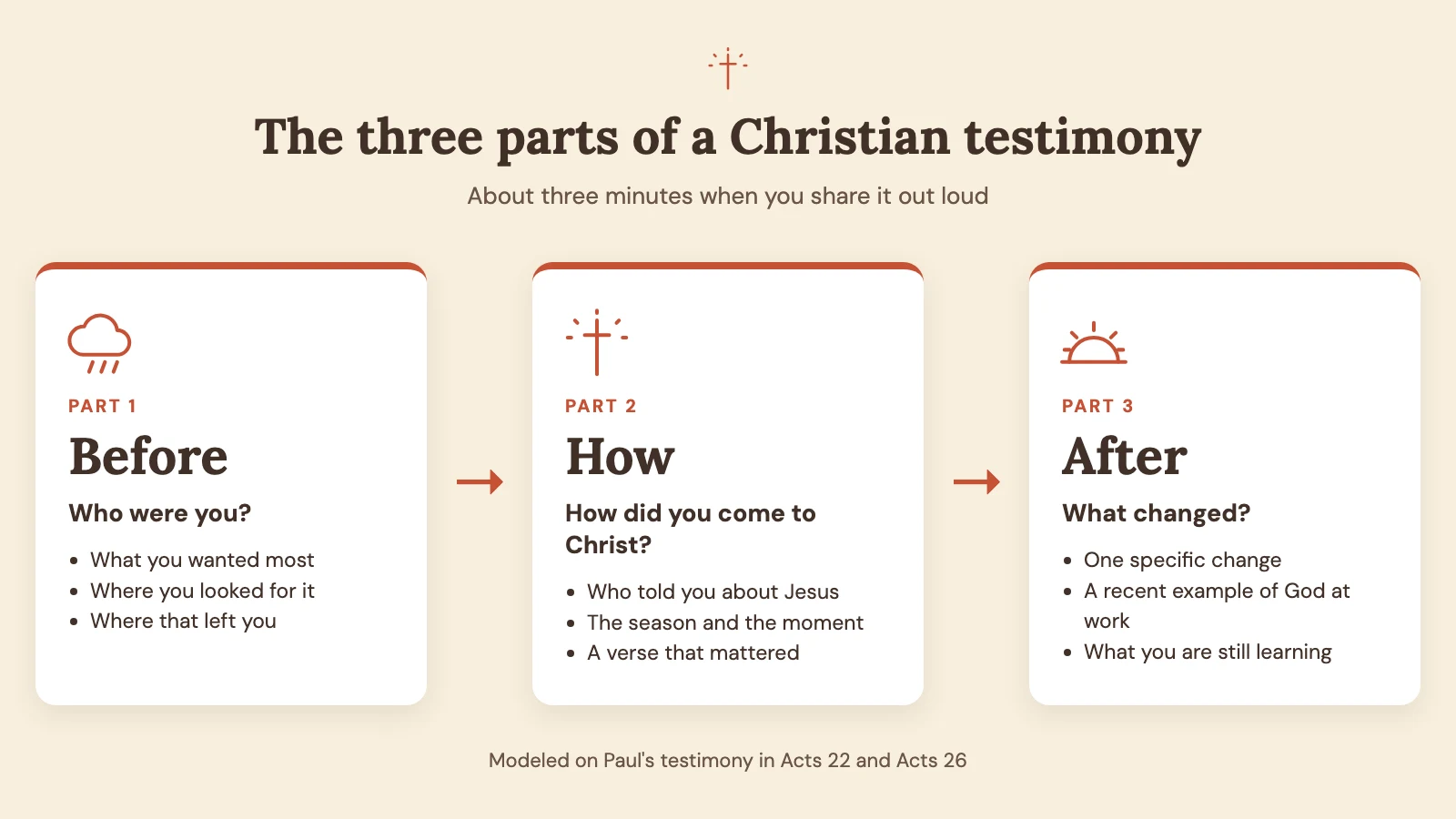
Cru builds its guide on Paul's testimony in Acts 22. The Navigators and the C.S. Lewis Institute work from Acts 26. Most guides land on the same three parts.
| Part | The question it answers | What goes in it |
|---|---|---|
| Before | Who were you? | What you were looking for, and what you tried that did not work |
| How | How did you come to Christ? | The people, events and moment that led you to trust Christ |
| After | What changed? | One specific change, and a recent example of God at work |
Some guides add an opening theme and a closing line that returns to it. Cru uses five parts this way. The middle three are always the same.
How to write your testimony in 4 steps
Set aside quiet time, pray, and write with a pen or a blank document. Do not edit yet. Just get it down.
Step 1. Write your before
Start with the part most people rush. The before is what makes the after mean something.
Answer three questions:
- What did you want most before you came to faith?
- Where did you look for it?
- Where did that leave you?
Be honest, but stay focused. Cru warns against dwelling on or bragging about past sins. Name what matters to the story and leave the rest out. One clear struggle is stronger than a list of five.
Step 2. Write how you came to Christ
This is the turning point. Write it in the order it happened.
GotQuestions suggests answering who told you about Jesus, what events led up to it, when and where you trusted Christ, and how faith has blessed you since. The Navigators add a verse that mattered to you in that season.
Keep the gospel clear. The Gospel Coalition says not to leave it out, and to explain any church words a guest might not know. "Saved," "born again" and "quiet time" mean little to someone who did not grow up in church.
Step 3. Write your after
This is where most testimonies go vague. "My life is so much better now" tells a listener nothing.
Pick one change and show it. A habit that broke. A marriage that was mended. A fear that stopped running your days. Then add something recent, as Cru suggests, and be honest that you still struggle.
A testimony that ends "and everything has been perfect since" is hard to believe. One that ends "and here is what God is still teaching me" is not.
Step 4. Read it aloud and trim it
Write the way you talk. Then read it out loud, more than once, with a timer.
The Navigators are clear that writing it down is not for reciting a script word for word. You write it so you know your story well enough to tell it naturally. Cut every sentence that does not serve your theme.
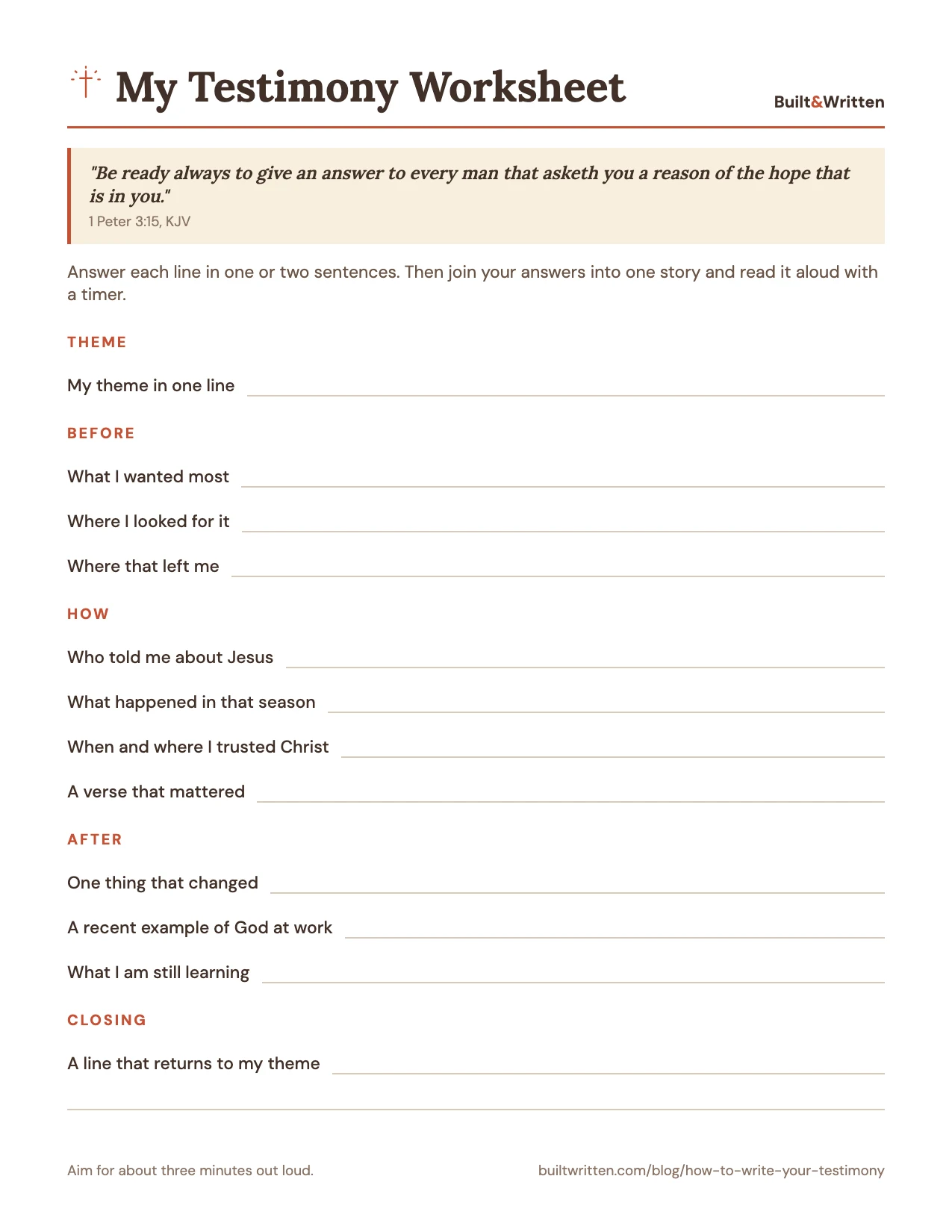
Free testimony worksheet
Print this page or copy it into a notebook. Answer each line in one or two sentences, then join your answers into a story.
A short Christian testimony example
Here is what the worksheet looks like once it is joined into a story. It is a short example written to show the shape, about two minutes read aloud.
Theme: I spent years trying to earn love.
Before. Growing up, I believed I was only worth what I achieved. Straight A's, the right college, the promotion at 29. Every win felt good for about a week. Then I needed the next one. By my thirties I was tired in a way sleep did not fix.
How. A coworker invited me to her church's Tuesday dinner. I went for the free meal. Over a few months, I heard the same idea again and again: grace is a gift, not a wage. One night I read Ephesians 2:8-9 on my own, and I could not argue with it anymore. I asked Jesus to forgive me and to be the Lord of my life.
After. I still work hard. But I no longer work to be loved. Last month I missed a big deadline, and for the first time in my life it did not wreck my week. I am still learning to rest. But I know whose I am.
Notice what it does. One theme. One clear turning point. One specific change, with a recent example. Nothing about it is dramatic, and it still works.
How long should your testimony be?
Three to five minutes, depending on who you ask. The Gospel Coalition calls three minutes a good target. GotQuestions aims for three minutes or less. Cru allows three to five.
The reason is simple. A testimony is usually shared in a conversation, a small group, or the few minutes before a baptism. Short stories get heard.
If you are sharing at church, ask your pastor how much time you have, and time yourself at home. Practice out loud a few times, as Cru and The Gospel Coalition both recommend, so it sounds like you and not like a page.
Mistakes that weaken a testimony
When your testimony is bigger than three minutes
Some stories do not fit in three minutes. Freedom from addiction. Coming back to faith after decades away. A ministry that grew out of the hardest year of your life. A parent's faith you want your grandchildren to be able to read.
The longer version is a spiritual memoir, a book-length testimony. The structure stays. It just gets room:
- Before becomes the first chapters: your family, your early years, the struggle.
- How becomes the turning-point chapters: the people and events, in order.
- After becomes the last chapters: what changed, what God is still teaching you, and what you want the reader to take from it.
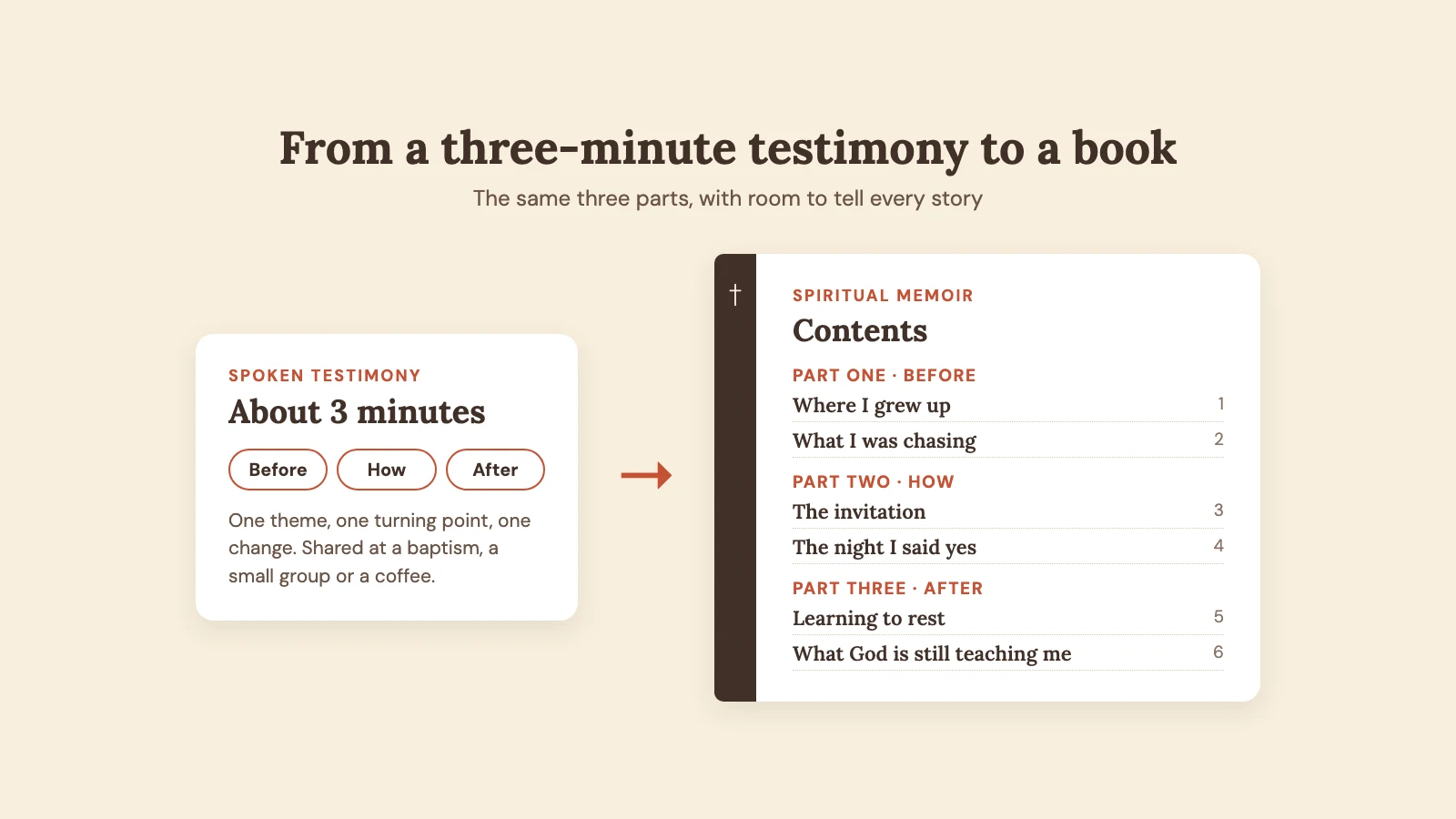
Your worksheet still works. Each line you filled in is now a chapter idea. Tell each one as a full story, by typing it or by recording it on your phone and getting a transcript.
Our guide on how to write a memoir goes deeper on the book side: building a timeline, writing scenes, and choosing which details to keep.
You would not be alone. Of the 147 faith books started on Built&Written by November 19, 2026, at least 21 have titles that read as a testimony or a life story.
How to turn your testimony into a book with Built&Written
Built&Written drafts a book from material you already have. For a testimony, that is your three-minute version, your filled-in worksheet, and the longer stories behind each line.
- Paste your testimony and stories into the first step, and pick Spirituality / Faith or Memoir as the book type.
- Add a few pages you wrote yourself, about 300 to 1,000 words, so Voice DNA learns how you sound.
- Wren, the writing assistant, proposes a chapter outline from your material. Put it in before, how and after order, and rename or cut chapters before a word is written.
- Wren writes the chapters in your voice. You read every one and change anything that did not happen that way.
- Design a cover and download print-ready files for Amazon KDP.
Starting from the life-story side? Our AI memoir writer page shows a real sample, from five told stories to a finished draft. For devotionals and Bible studies, see the AI non-fiction book writer.
Check every verse yourself. An AI can misquote a verse or attach the wrong reference. Quote Scripture from your own Bible and confirm every reference before you publish.
Bible translations have rules too. Crossway's permission page allows up to 500 ESV verses in a book without written permission, as long as they make up less than 25% of the book, and asks for a set notice on the copyright page. Other translations set their own limits, so check the publisher's page for the one you quote.
What it costs: the free plan lets you write and preview with Wren. Writing and downloading an AI-written book is $49/month ($19/month for your own manuscript). Every plan comes with monthly credits for the AI, and you see what a book will cost before Wren writes it. The details are on our pricing page.
When the book is ready, our step-by-step guide to publishing on Amazon KDP walks you through the upload. Worried an AI draft will not sound like you? Read how Christian authors can use AI without losing their voice.
Sources & References
- C.S. Lewis Institute, How to Share Your Testimony: https://www.cslewisinstitute.org/resources/how-to-share-your-testimony/
- Cru, What Is a Christian Testimony?: https://www.cru.org/us/en/train-and-grow/share-the-gospel/what-is-a-christian-testimony.html
- The Navigators, How to Prepare Your Personal Testimony: https://www.navigators.org/resource/how-to-prepare-your-personal-testimony/
- The Gospel Coalition, 6 Principles for Sharing Your Testimony: https://www.thegospelcoalition.org/article/sharing-your-testimony/
- GotQuestions, How do I share my Christian testimony?: https://www.gotquestions.org/share-testimony.html
- Crossway, ESV permissions: https://www.crossway.org/permissions/
Frequently asked questions
Many guides suggest it. The Navigators ask for a favorite verse from the season you came to faith, Cru suggests an optional verse in the closing, and GotQuestions lists verses such as Romans 3:23 and Romans 6:23 that explain the gospel. One or two well-chosen verses are enough for a three-minute testimony.
You can use AI to organize and draft from what you have written or told, but the story has to be yours. Read every line and change anything that did not happen that way, and check every Bible reference against your own Bible, because AI tools can misquote verses.
A testimony is a short account of how you came to faith and what changed, usually told in three to five minutes. A spiritual memoir is the book-length version: the same before, how and after, told across chapters with full scenes, people and dates. Many memoirs start as a written testimony.
It does not need to be. The structure is the same for a quiet story as for a dramatic one: what you were looking for, how you came to trust Christ, and one specific change since. Cru suggests adding a recent example of God at work and being honest about what you still struggle with.
Sources & References
About the author