

How pastors can turn a year of sermons into a book with AI
AI for pastors can help turn sermons into a book, but a whole year is too long for one book. Pick the sermons that answer one question, change the spoken words into written ones, and check every line the AI touches. This guide uses numbers from our own measurement of 52 sermons.
Your old sermons are a good starting point for a book. This article shows how big it really is and what has to change before it becomes a book. It also covers the rules on Scripture.
Key takeaways
- 52 sermons are too long for one book. At 6 by 9 inches our test set ran to 783 pages. At 5 by 8 inches it ran to 1,147 pages.
- Every sermon had spoken phrases such as "this morning" and "beloved". They have to be rewritten for a reader.
- In our run, the platform turned seven sermons into a book with no spoken phrases and sentences about 40 percent shorter. You still read every chapter and check every verse.
How common is AI for pastors?
Many do, and most are careful. Barna surveyed 442 U.S. Protestant pastors online in December 2025 and published the results on June 15, 2026. Only 13 percent do not use AI at all. Half use it for brainstorming, and 24 percent write or edit sermons with it. 71 percent describe themselves as cautious.
How did we test it?
We wanted real numbers, so we measured real sermons. We used C. H. Spurgeon's sermons as an example, because we did not have permission to use a living pastor's sermons.
How we tested, November 19, 2026.
- The material. 52 sermons by C. H. Spurgeon, taken from two printed volumes of the 1850s: volume III and volume V of his collected sermons, scanned on the Internet Archive. We treated them as one sermon per week for one year.
- The cleaning. We split the scans into single sermons and removed page headers and broken line endings.
- The counts. We counted words, sentences and spoken-only phrases with a short script. We ran the word total through our free word count to page count calculator at 6 by 9 inches, 11 pt and line spacing 1.3.
- The platform run. We gave seven of the sermons to the Built&Written platform, let it write the book, and ran the same counts on its text.
- The limits. This is one preacher in 1850s English. He preached longer sermons than most pastors do today. The scans contain reading errors, so each count can be off by a few percent. We read only the part of each chapter that the editor shows, about 16 percent of the written book, and we did not check it line by line.
How big is a year of sermons?
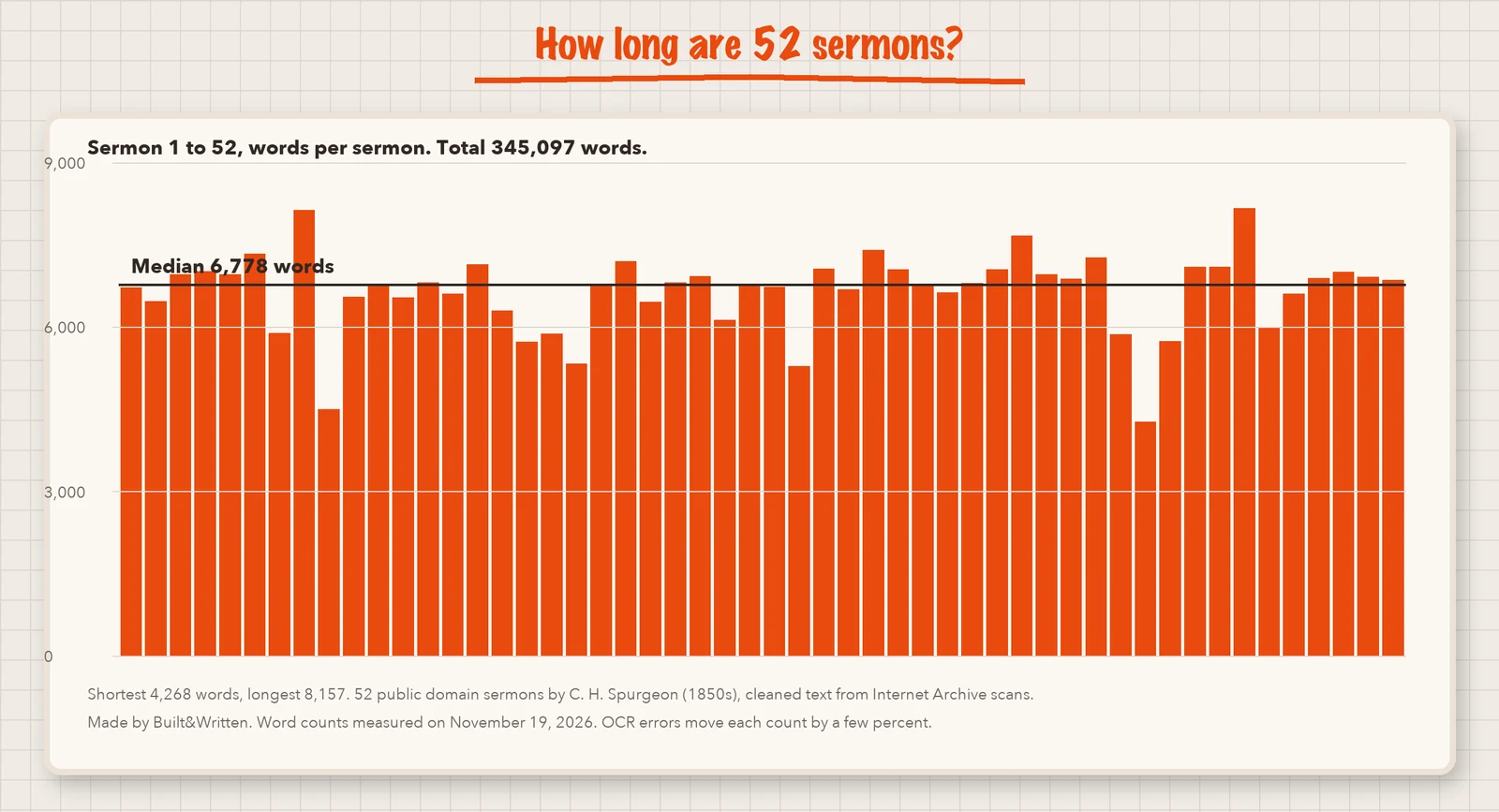
Bigger than most pastors expect. Our 52 sermons came to 345,097 words. The shortest had 4,268 words, the longest 8,157, and the middle one 6,778.
A modern sermon is shorter. To show the size of the job, we also ran an example of 52 sermons at 3,500 words each. That is 182,000 words. This second case is arithmetic and not a measurement.
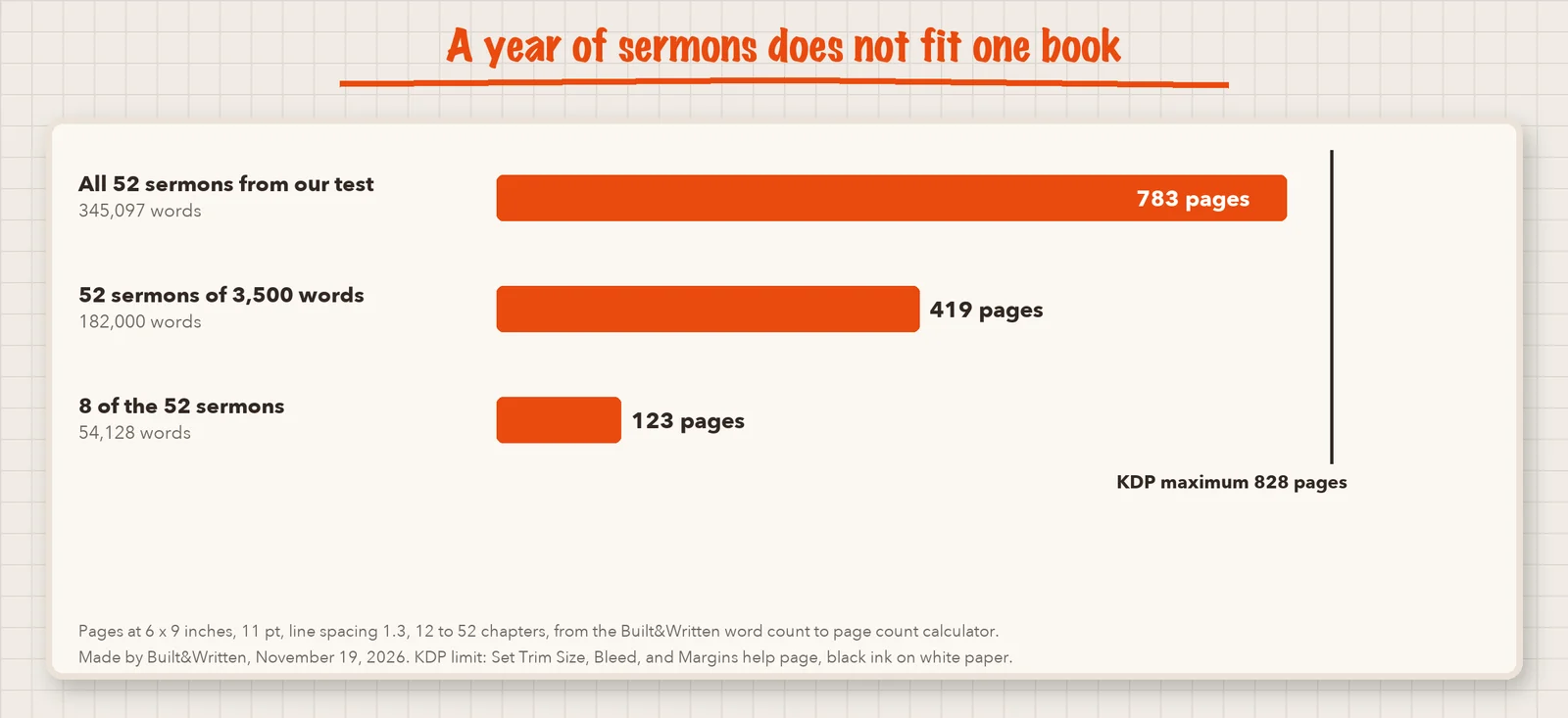
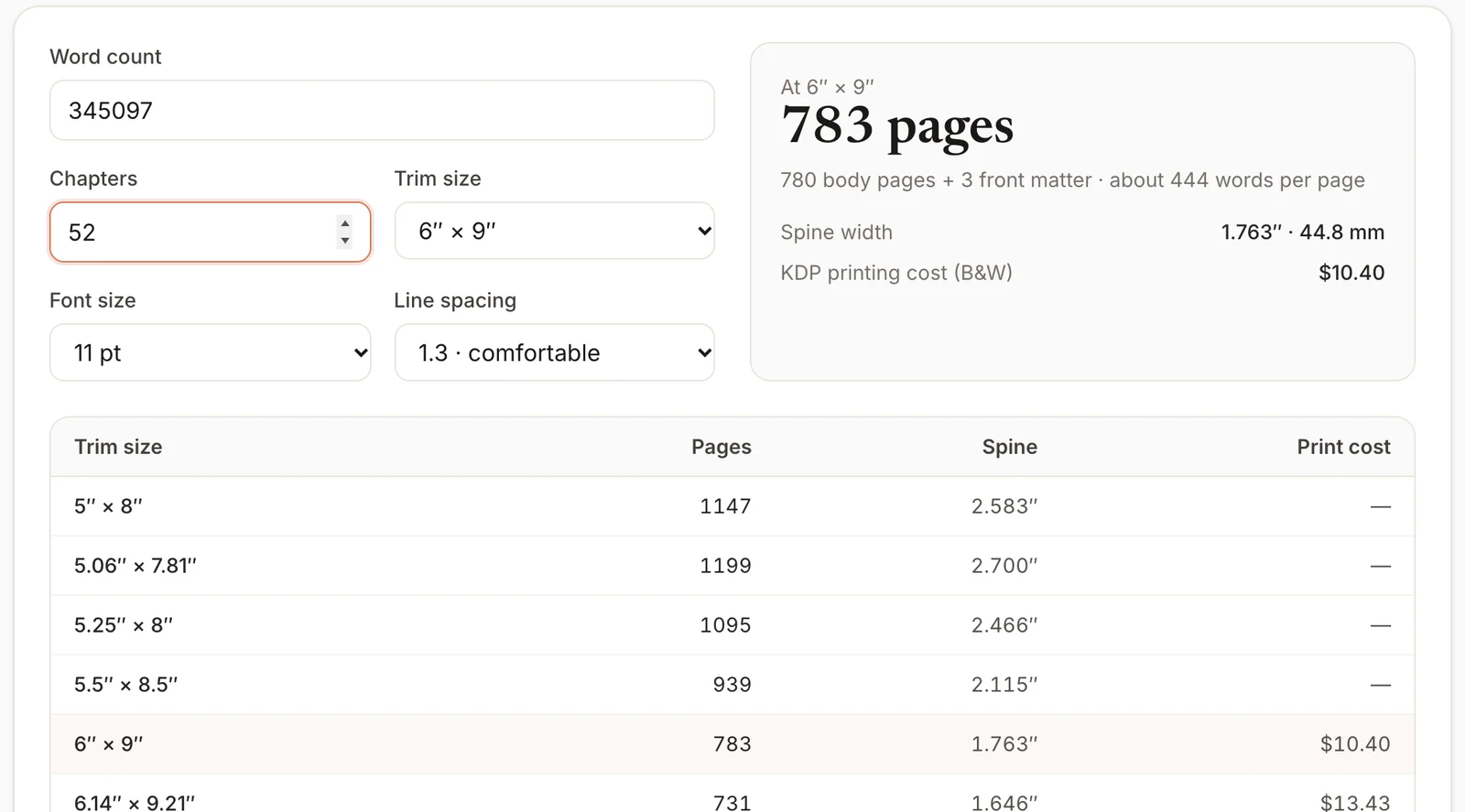
This matters because Amazon sets a limit. Its self-publishing service, Kindle Direct Publishing (KDP), has a table of trim sizes. A trim size is the final page size of a printed book. For a black and white paperback on white paper at 6 by 9 inches, the table lists 24 to 828 pages. A few sizes have lower maximums. At 5 by 8 inches, our 345,097 words ran to 1,147 pages in the calculator, so that book could not be printed as one volume.
Eight of our 52 sermons, about 54,100 words, made a book of 123 pages. That is a size a reader can finish. The lesson is to keep a part of the year and not all of it.
What changes when a sermon becomes a page?
The words that worked in the room now confuse the reader. We searched the 52 sermons for 22 phrases that only work when someone is speaking, such as "this morning", "beloved" and "my hearers".
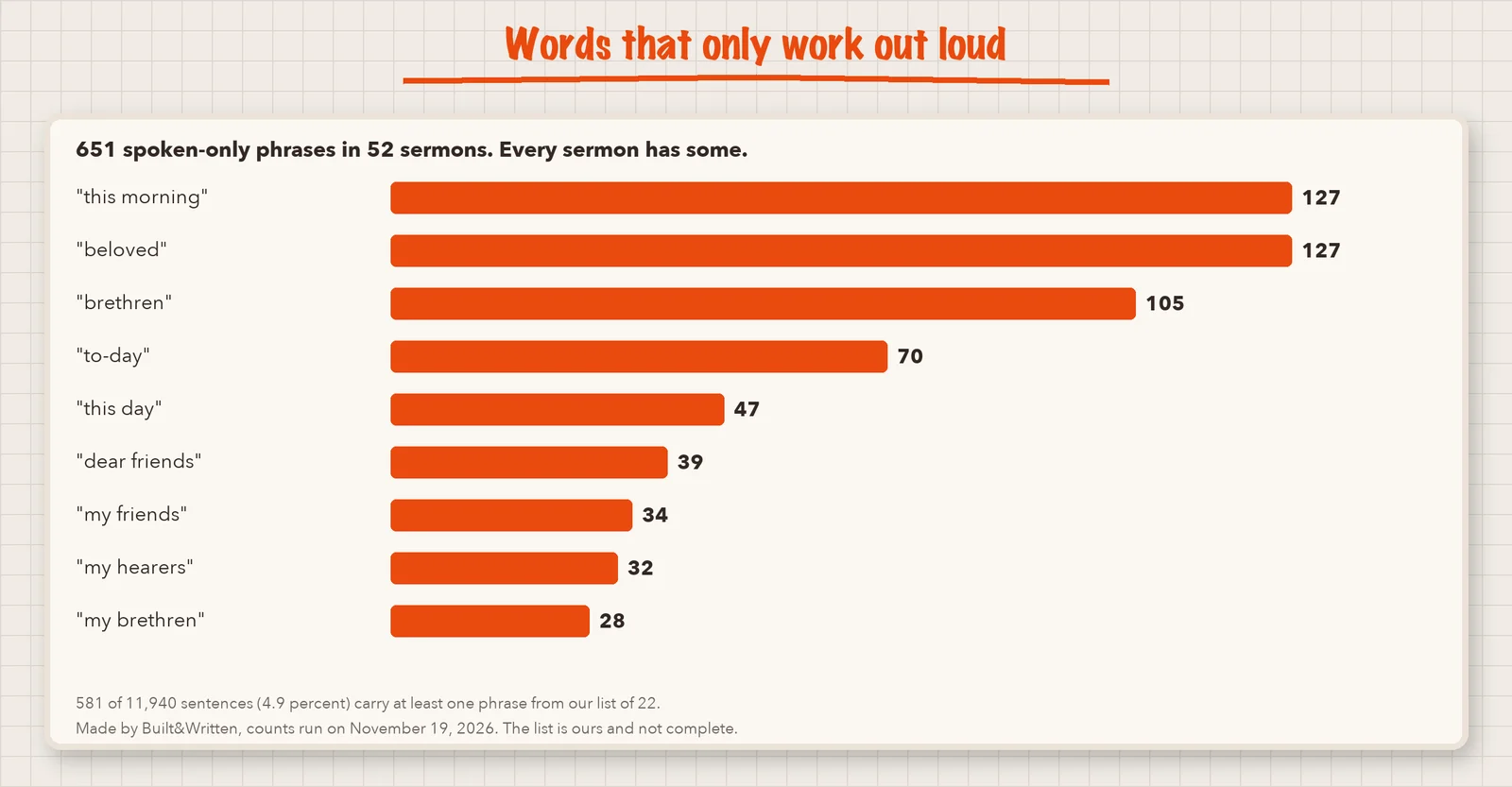
We found 651 of them. All 52 sermons had at least one. In total, 581 of 11,940 sentences (4.9 percent) held one of our phrases. A reader who opens the book at home has no "this morning". Each of those sentences needs a small rewrite.
Sentence length is the second change. Our sermons averaged 28.8 words per sentence, and the middle sentence had 21 words. 27.5 percent of the sentences ran past 35 words. Our rough reading level estimate was grade 10.4. Long sentences are easy to follow when a voice carries them and hard to follow on paper. Splitting them is the biggest edit most sermon books need.
We also tried to let a computer group the sermons by theme. It sorted them by shared words into six groups. The result was weak. Sermons placed in one group were hardly more alike than sermons picked at random. The computer could not tell which sermons belong together, because one preacher uses the same words all year. So you decide what your book is about.
How do you choose the sermons for the book?
Start with the reader and not the calendar. Here are six steps.
- Write one sentence about the reader. For example, "A man who lost his job and wonders if God sees him."
- List every sermon title with its Bible passage. One page is enough for a year.
- Mark the sermons that help that reader. Keep the ones you mark. A book works when it keeps one promise.
- Put the kept sermons in the order a reader needs them. The order of the calendar is not the order of a reader's questions.
- Count the words. Use the calculator above to see the page count before you edit.
- Edit one sermon into one chapter. Remove the spoken phrases, split long sentences and add a short opening and a closing line.
For help with structure, see our book outline template. The same steps work for other material, such as journals and blog posts.
What rules apply to Scripture and AI for pastors?
Sermons quote the Bible, and a book that you sell has rules for quotes. Crossway, the ESV publisher, says on its permissions page that you may quote up to 500 verses without written permission. The verses must not be more than half of any one book of the Bible. They must also stay under 25 percent of your whole work. The page also asks for a copyright notice on the title page or copyright page.
The same page has a rule on AI. Under its digital section, Crossway says the ESV may not be used, accessed or processed by any AI system. So do not paste ESV verses into an AI tool unless Crossway has given you permission. Paste the sermon with a placeholder such as "[John 3:16]" and add the verse yourself afterwards.
We could not open the NIV page from Biblica, so we say nothing about it. Read your own translation's page before you print a verse.
For a longer guide on this topic, read how to write a Bible study book with AI. Read how Christian authors can use AI without losing their voice for voice and doctrine, and can you publish an AI-written book on KDP for the Amazon rules.
What happened when we gave seven sermons to the platform?
We started a new book on November 19, 2026 and uploaded the sermons as one text file. Wren is Built&Written's AI writer, and its name shows in the screenshots.
The first try failed. We uploaded eight sermons, 54,174 words. The platform answered that a new book can start from 50,000 words at most. It offered to import a finished manuscript, which is the full text of a book, word for word instead.
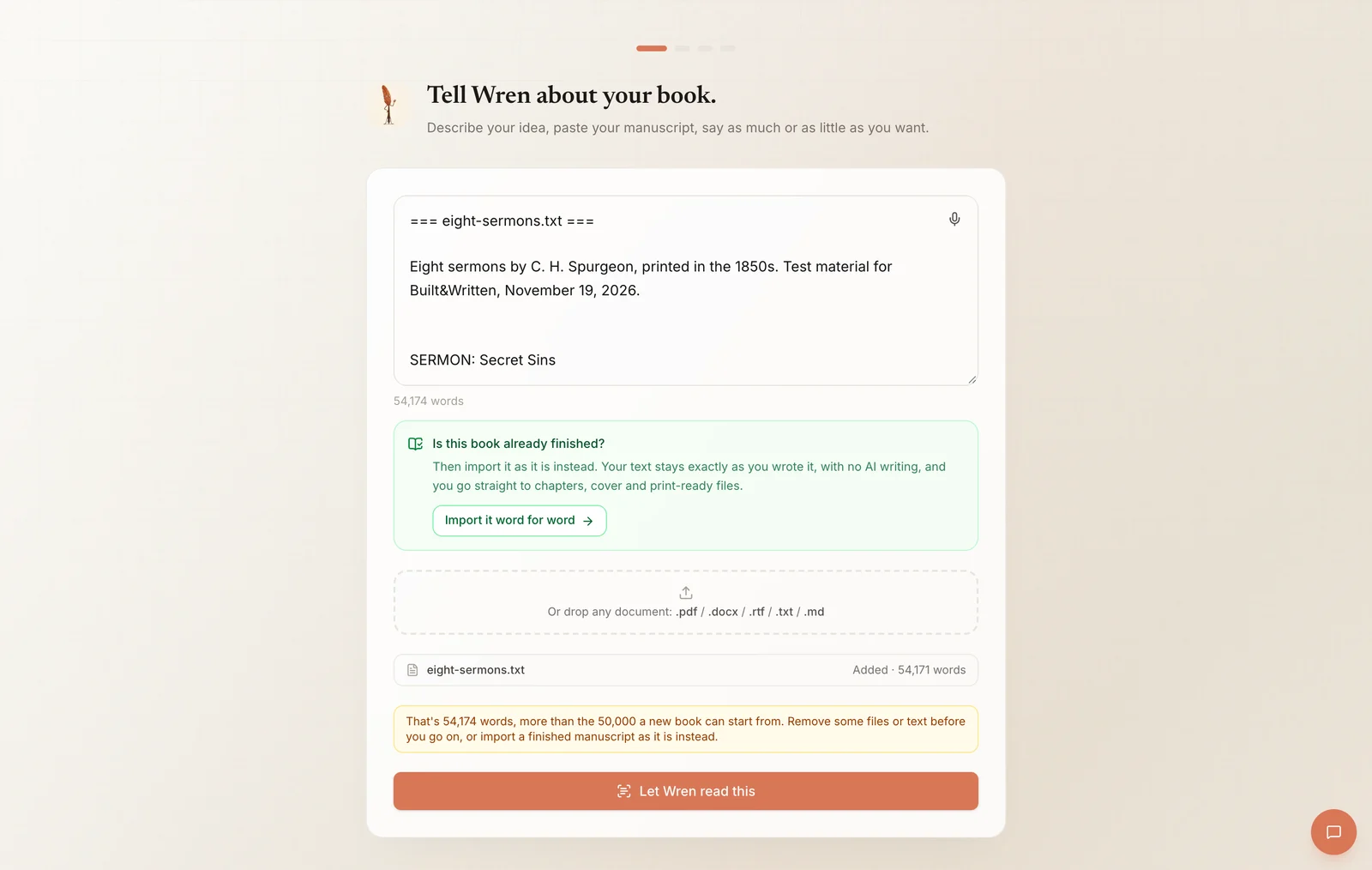
Our sermons average about 6,700 words. So seven fit, and eight do not. A pastor with 3,500-word sermons could start from about 14 (50,000 divided by 3,500). That is arithmetic and not a test.
The second try worked. We removed one sermon, leaving 47,115 words. The platform read them and filled in the book for us.
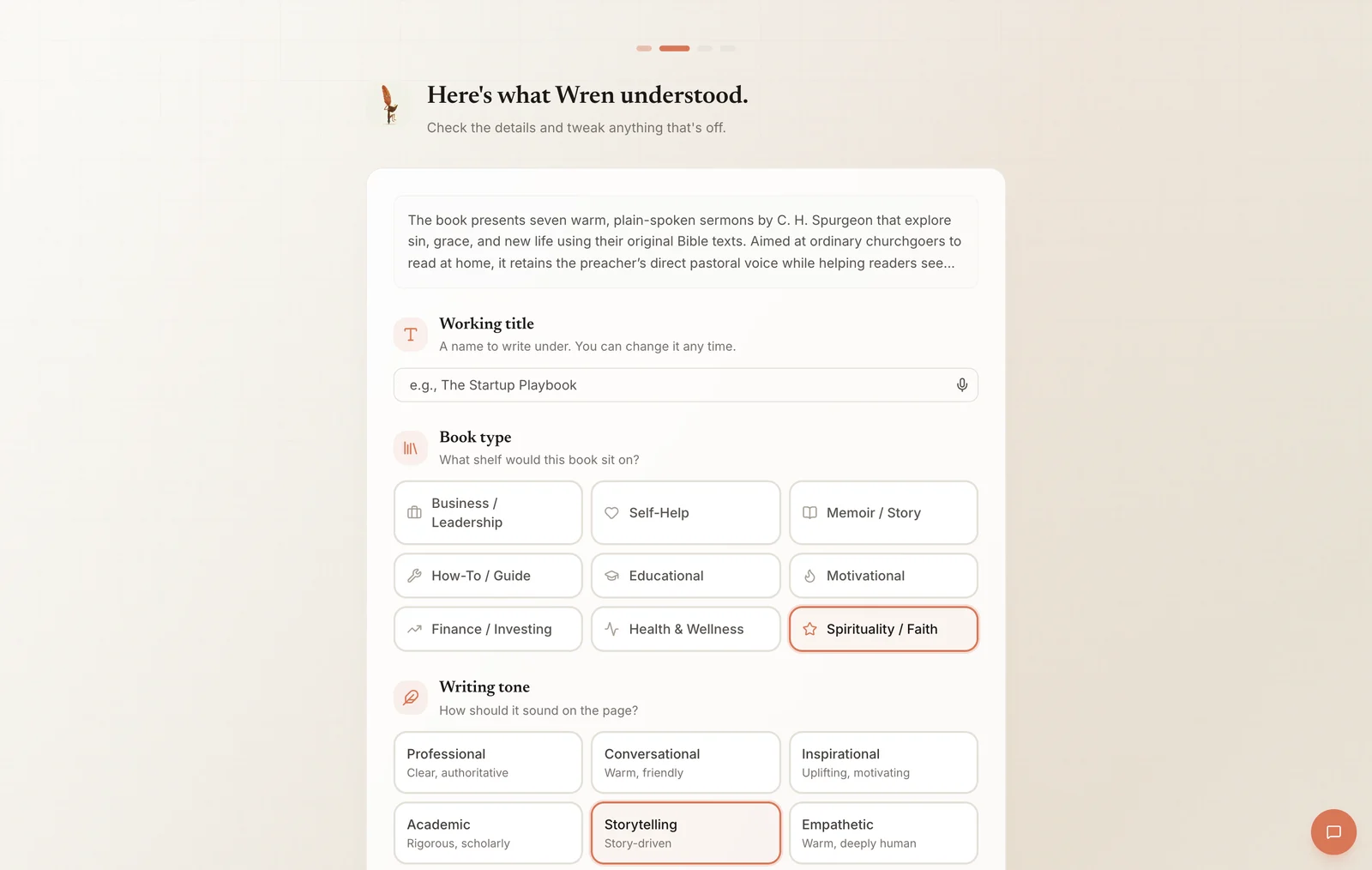
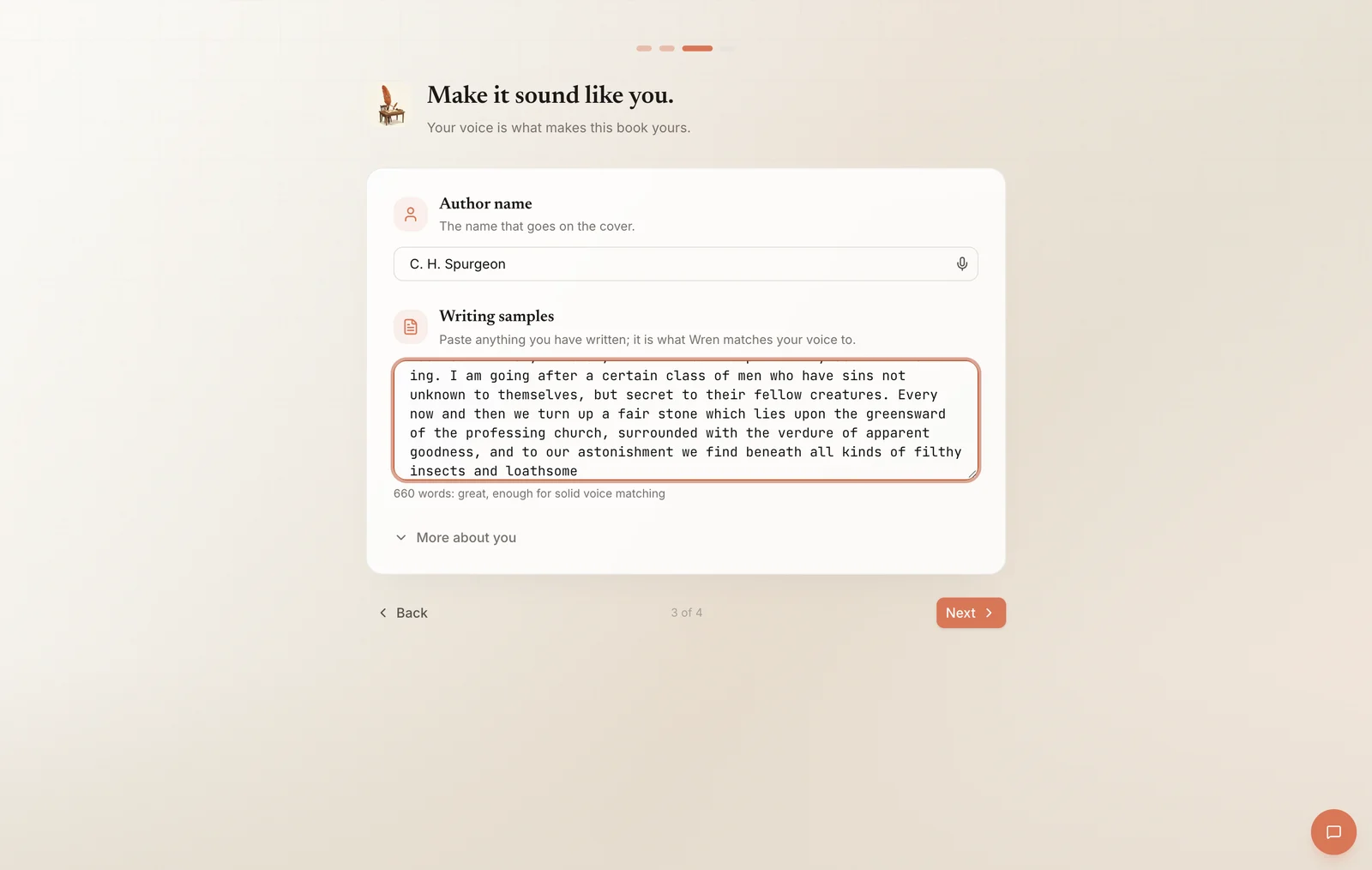
It picked Spirituality and Faith as the book type, Storytelling as the tone, and "Christians in local churches" among the readers. We could change each choice. We then pasted 660 words of one sermon as a voice sample. The platform called that enough for solid voice matching.
The outline had nine chapters. The platform proposed its own title, "Mighty to Save: Seven Sermons on Sin, Grace, and New Life". It gave each of the seven sermons a chapter, in the order we uploaded them. It added an opening chapter and a closing chapter.
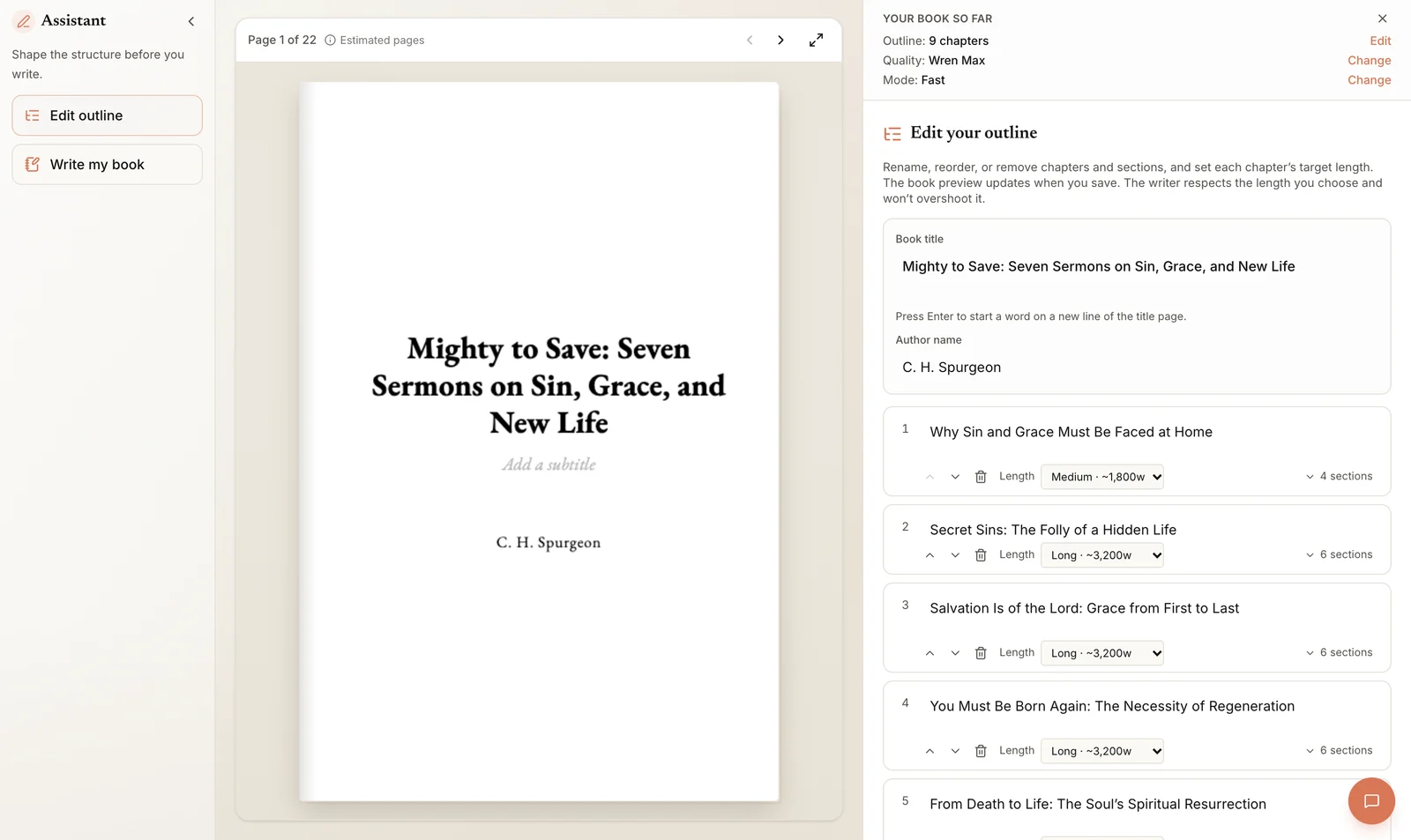
Each chapter has a target length of about 900, 1,800 or 3,200 words. We kept the settings the platform proposed and chose the Wren Pro writer in the quick Fast mode. The platform wrote all nine chapters in under two minutes.
The written book was shorter and plainer. It came to 41,834 words, which is 89 percent of the 47,115 words we uploaded. The three sermon chapters we saw set to about 3,200 words came out at 4,850, 5,014 and 4,995 words. So the length you set is a rough target and not a limit. Plan for longer chapters than the label says. In the editor the book ran to 120 pages, and in the format preview to 119 pages.
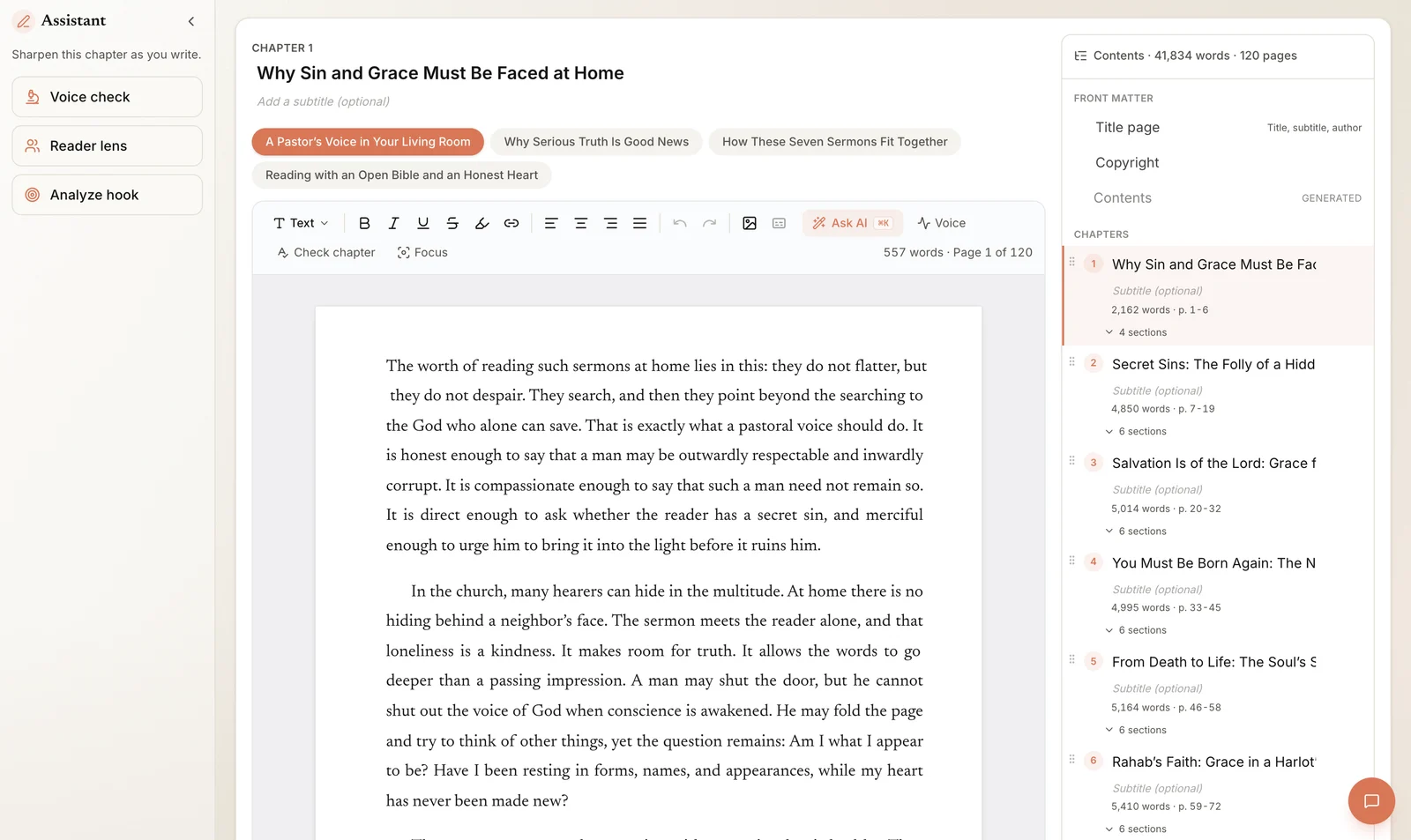
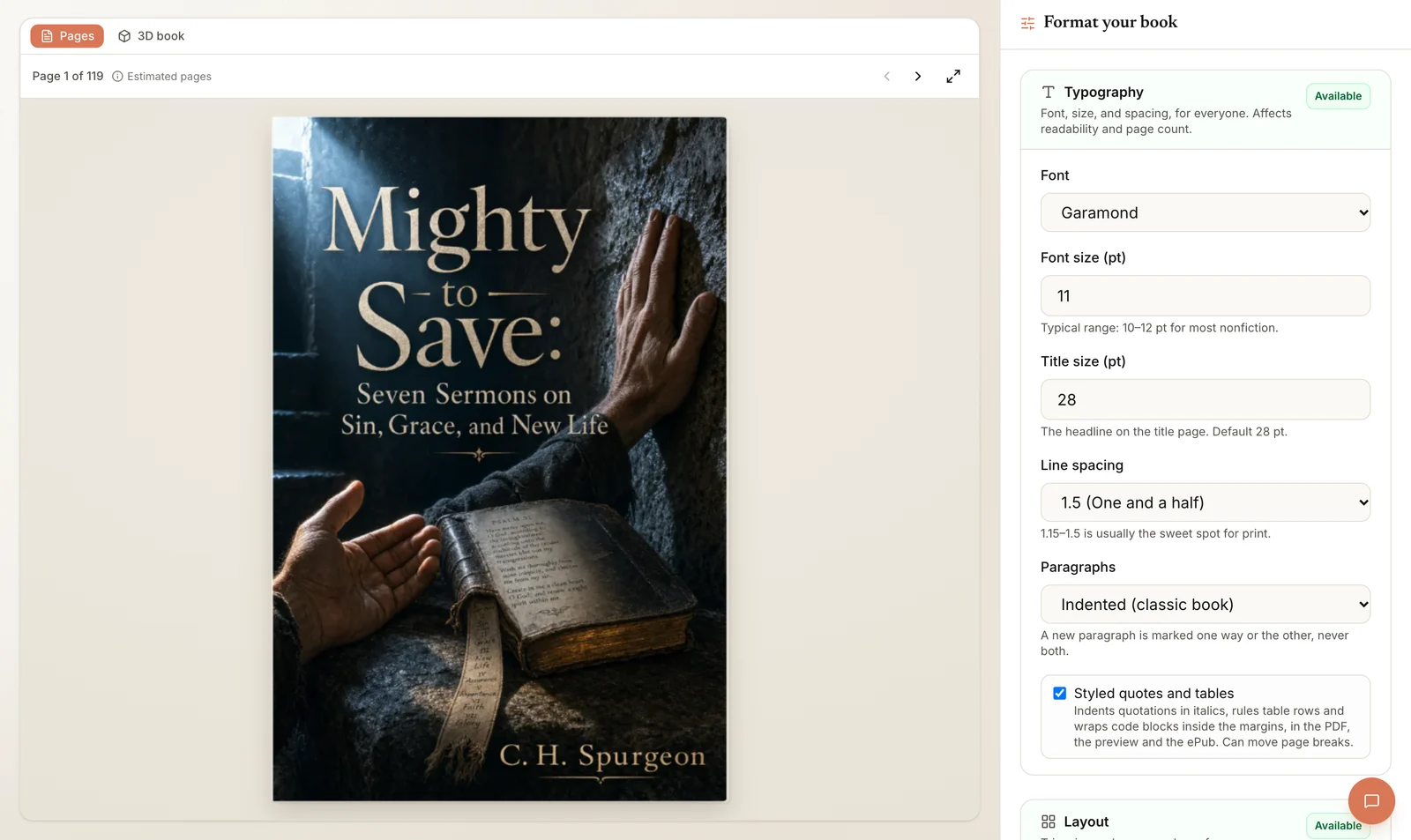
We then ran our own counts on the text. The editor shows about 700 words of each chapter at a time. So we read the shown part of all nine chapters, 6,570 words, which is about 16 percent of the book.
- Spoken phrases. We found none of our 22 phrases in those 6,570 words. In the seven sermons they appeared 85 times in about 47,100 words, which is 1.8 per 1,000 words.
- Sentence length. The written text averaged 16.8 words a sentence, against 28.1 in the seven sermons. Only 3.8 percent of the written sentences ran past 35 words, against 26.6 percent in the sermons.
Those are the two edits we said a sermon book needs, and the platform made them for us. It does more than shorten your sermons. It uses them to write new chapters.
Here is what this check shows and what it does not. It shows that the part we read had no spoken phrases and much shorter sentences. It does not show that every chapter is accurate, that it follows each sermon closely, or that it is ready to publish. We did not compare each line with the sermons. Read every chapter yourself and check every verse.
Where does Built&Written fit?
Built&Written is a platform for writing nonfiction books and preparing them for Amazon KDP. It works from your own material, so it suits a pastor with a stack of sermons. You do not need to know how a book is built. The platform proposes the first outline, and you change it.
Why use a book platform and not a general chat tool? You can try this in a general AI chat too. The platform keeps the whole job in one place. You start from your sermons, get an outline you can reorder, set the length of each chapter, watch the chapters get written, edit them in one editor and set up the print pages. You have spent years on these sermons. The platform helps carry that work to a first draft of a book, and you then edit it, format it and publish it yourself.
If your sermons are loose pages. You paste or upload the typed text into the book generator. As shown above, the platform proposes a chapter outline from your material, and you change it. It then writes the book chapter by chapter, and you read and edit every chapter in the editor. The platform does not turn audio into text, so recordings must be typed out first, by you or by a transcription service you choose.
If you already edited the manuscript. You upload the manuscript, which is the full text of your book, as a .docx, .epub, .md or .txt file and keep every word. The book formatter sets trim size, margins and chapter openings for KDP, and the cover designer works out the spine width from your page count. You download the print PDF and the KDP files, and you upload them to KDP yourself. Our pricing page shows which plan includes which export.
To keep your voice, Voice DNA learns from a few pages of your writing, about 300 to 1,000 words. Put your strongest sermon first.
The platform cannot promise sales, a rank or an approval from Amazon. It does not check your Bible quotes against a translation. That check is yours. Read KDP's rules on AI-generated content in the FAQ below.
Final thoughts
You do not need to turn the whole year into one book. Pick one reader, keep the sermons that help that reader, and check every chapter before it goes out. Seven of our sermons became a 120 page book in two minutes. Your sermons can become a book that readers keep, share and buy, long after the Sunday they were preached.
Frequently asked questions
KDP's content guidelines separate two cases. You must tell KDP about AI-generated content, which means text an AI tool created, even if you edited it afterwards. You do not have to tell KDP about AI-assisted content, which means your own text that AI helped edit or improve. The publisher is responsible for checking rights in both cases. Our article on disclosing AI in your book explains the wording.
Built&Written does not turn audio into text. Type the sermon, or use a transcription service you trust, and then read the result against what you preached. Names, Bible references and quotes are where transcripts go wrong most often. Paste the corrected text into the platform. Check every verse reference by hand before the text goes into a book.
Each translation has its own publisher, limit and notice. Crossway's page covers the ESV. Other publishers set different limits, and we have not checked them for this article. Make a list of every translation your sermons quote, open each publisher's permissions page, and put each required notice on your copyright page. If your preaching mixes translations, choose one for the book.
It can, if you give the platform your own writing. Give it a sample of 300 to 1,000 words. It reads only about the first 1,300 words, so more pages do not improve the match. Choose your best written pages and put them first. Then read each chapter aloud. A sentence you would never say needs a rewrite, and the final voice check is your ear.
Sources & References
- Pastors Are Using AI More Than You Think, Barna, June 15, 2026
- Set Trim Size, Bleed, and Margins, KDP Help, read November 19, 2026
- Content Guidelines, KDP Help, read November 19, 2026
- ESV permissions, Crossway, read November 19, 2026
- Sermons of Rev. C. H. Spurgeon of London, volume III, Internet Archive
- Sermons of Rev. C. H. Spurgeon of London, volume V, Internet Archive
- Word Count to Page Count Calculator, Built&Written, run November 19, 2026
About the author