


How to Write a Memoir When You Have Never Written a Book
Key takeaways
- Where do you start? With one stretch of your life, not with your birth.
- What comes before writing? A long list of memories, sorted into groups.
- How long should it be? Guides for writers put memoirs at 80,000 to 100,000 words; a self-published memoir can be shorter.
- What about the people in it? Check your facts, change details where it helps, and ask for consent where you can.
What is a memoir?
A memoir is a true story from your own life, told around one theme, period or question. It doesn't try to cover everything. An autobiography usually tells a whole life in order, from childhood to now. A memoir picks the part that matters and leaves the rest out.
That choice makes memoir writing easier if you have never written a book. You don't need a famous life or a complete record. You need one stretch of your life that changed you, and the honesty to show how.
How to start a memoir when you've never written a book
Start with three decisions on one page. They take an hour, and they stop most first memoirs from turning into a diary.
- The slice. Which years, place or relationship is the book about? "The two years I ran my father's shop" is a memoir. "My life" is not yet.
- The question. What does that slice answer? "Why did I stay so long?" or "How do you rebuild after a business fails?" Every chapter should move toward the answer.
- The reader. Who needs this story? Someone in the same situation, your family, or readers who love a certain kind of life. Write the book for that one person.
If you can't name the question, write a few memories first and look for what keeps coming back. The question is often already in them. And if you doubt you can write a book at all, our guide on writing a book when you're not a writer is a good place to start.
How to write a memoir in 6 steps
1. Make a big list of memories. Before you write a single chapter, list every memory from your slice: a line each, as fast as you can. Cyndy Etler, writing on Jane Friedman's site about her own memoir, starts the same way, with "a big list of memories". Don't judge them yet. Small moments often carry more feeling than big events.
2. Sort them into groups. Etler sorts her memories by life category; for her, that meant the places she lived. Yours might be places, jobs, relationships or years. Each group can become a part or a chapter.
3. Choose a structure. The three common shapes are explained below. Pick the one that fits your story best, not the one that feels most literary, and turn your groups into a memoir outline: one line per chapter.
4. Draft in scenes. A scene is one moment told as it happened: where you were, who spoke, what you saw. Readers remember scenes, not summaries. Between scenes, a few lines of reflection say what the moment meant to you then, and what it means now. If you stall on a hard scene, skip it and come back; our article on writer's block has more ways to keep going.
5. Revise for truth. Read the draft against your notes, letters, photos and dates. Where memory is uncertain, say so in the text ("as I remember it"). A memoir doesn't need to be complete, but it shouldn't contain things you know are wrong.
6. Handle the people in it. Before anyone else reads the book, mark every passage about a real person and check it against the list in the section on real people below.
How does Built&Written help you write a memoir?
Most first-time memoirists already have more material than they think. It sits in journals, old letters, emails and social posts written over the years. The hard part is gathering it from all those places and turning it into chapters.
Built&Written starts from that pile. Here is how it works:
- Add your material. Paste or upload what you've already written: journal entries you typed up, letters, posts, essays or a rough draft. It works from text, so transcribe voice memos first.
- Get a chapter plan. Built&Written reads your material and proposes chapters. You rename, reorder or remove them and set each chapter's length before anything is written.
- Let the AI draft from your words. It writes each chapter in your voice from the memories you gave it, and you edit every line.
- Download your book. The layout and the cover are made in the app. You download the files and upload them to Amazon yourself.
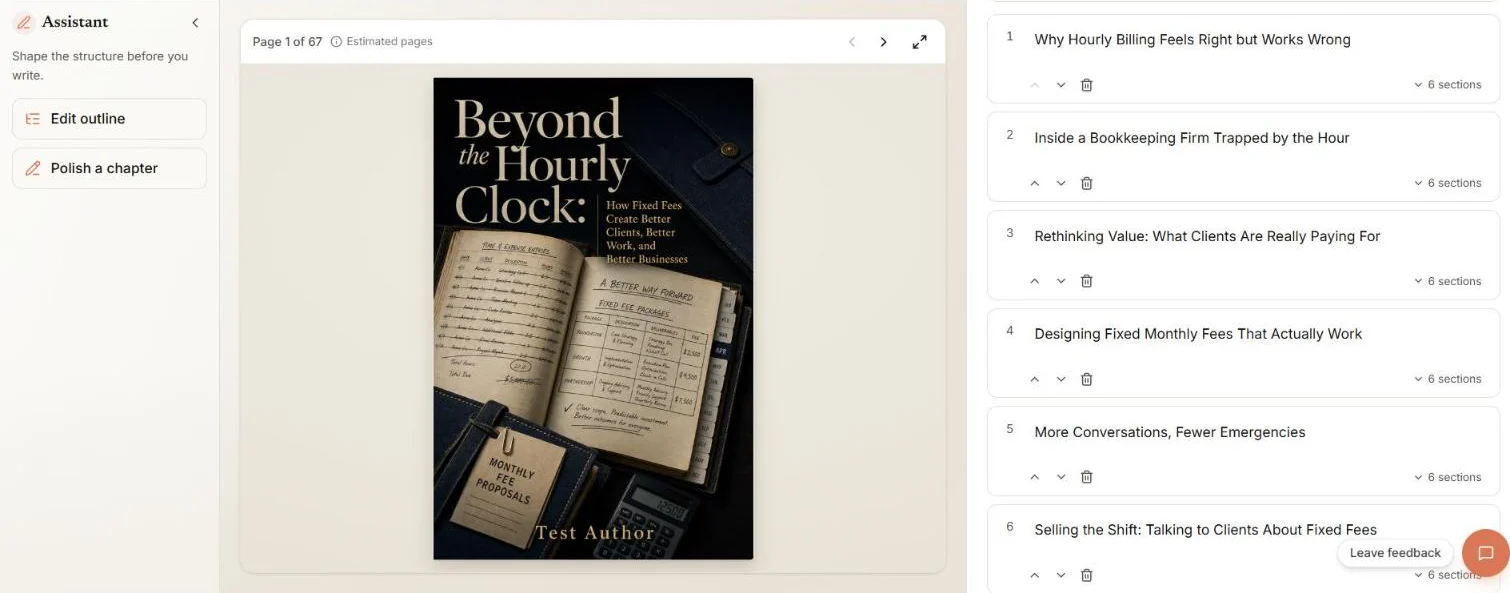
Text in the image: Chapters: "1 Why Hourly Billing Feels Right but Works Wrong", "2 Inside a Bookkeeping Firm Trapped by the Hour", "3 Rethinking Value: What Clients Are Really Paying For", "4 Designing Fixed Monthly Fees That Actually Work", "5 More Conversations, Fewer Emergencies", "6 Selling the Shift: Talking to Clients About Fixed Fees", each with "6 sections". Left: "Edit outline", "Polish a chapter".
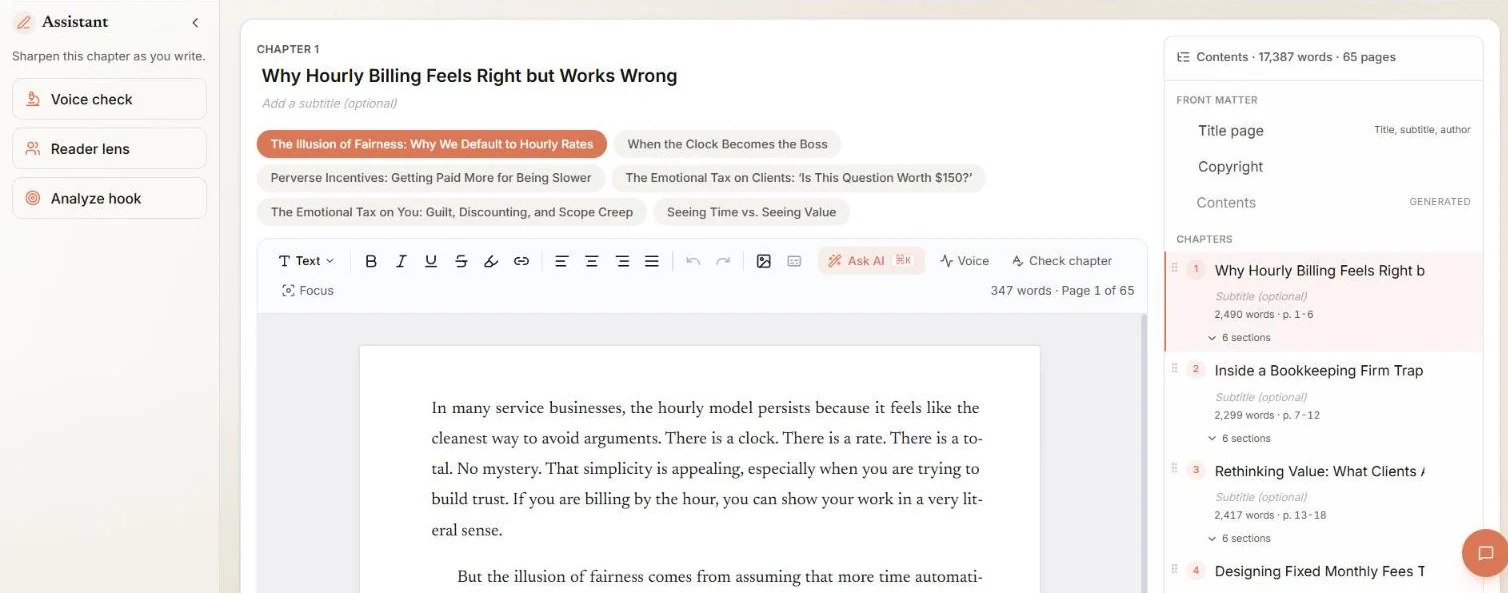
Text in the image: "Chapter 1. Why Hourly Billing Feels Right but Works Wrong." Toolbar: "Ask AI", "Voice", "Check chapter", "Focus". Left: "Voice check", "Reader lens", "Analyze hook". Contents: "17,387 words, 65 pages".
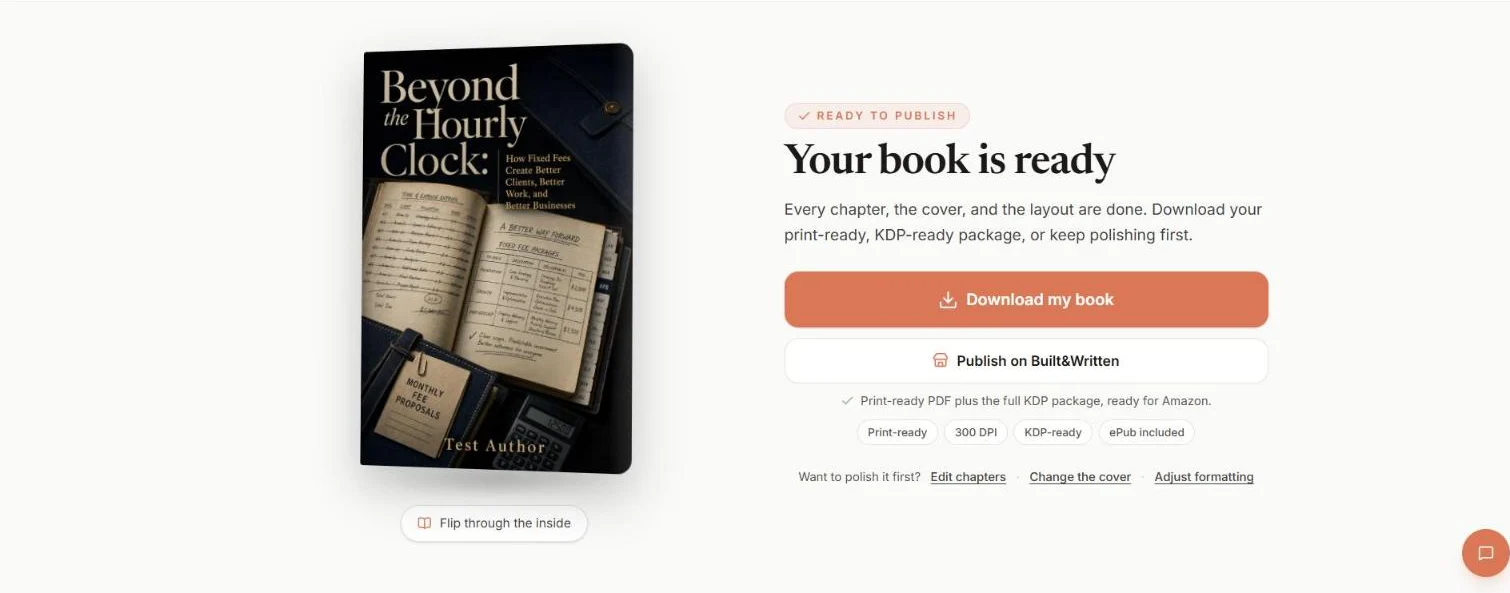
Text in the image: "Ready to publish." "Your book is ready." "Every chapter, the cover, and the layout are done. Download your print-ready, KDP-ready package, or keep polishing first." "Download my book." "Print-ready PDF plus the full KDP package, ready for Amazon." "Want to polish it first? Edit chapters, Change the cover, Adjust formatting."
If you'd rather write every word yourself, Built&Written also formats your finished manuscript (the full text of your book) without changing a word.
Is a memoir written with AI okay?
Yes, as long as you follow each store's rules. Amazon KDP (Kindle Direct Publishing, Amazon's service for selling your book) accepts AI-generated text if you disclose it when you publish, and our guide to KDP's AI disclosure shows how. IngramSpark, which sends books to bookstores and libraries, accepts it when a person seriously edits the text, and other stores set their own rules, which our article on publishing a book written with AI compares. A memoir starts with an advantage here: the stories come from your own journals and letters and you edit every line, which is how most published authors use AI too, as help rather than as the writer.
How do you structure a memoir?
Most memoirs use one of three shapes.
| Structure | How it works | Good for |
|---|---|---|
| Chronological | Events in the order they happened | A clear arc: a business, a move, an illness, a recovery |
| Thematic | Chapters by theme, place or person | Lives where the meaning isn't in the order, such as lessons, relationships, places |
| Frame | Opens in the present, then goes back to explain how you got there | Stories with a turning point the reader needs to see first |
Chronological is the easiest to write and to follow. Its risk is the "and then" problem: every year gets a chapter, whether or not something happened. Cut the years where nothing changes.
Thematic suits a life that changed in many small ways rather than one big one. Each chapter needs its own small arc, or the book reads like a collection of essays.
Frame pulls the reader in fast. Use it when the present moment is the reason the book exists, and keep the frame short: one opening scene and one closing scene are often enough.
If you're unsure, start chronological. You can reorder chapters later, but it's hard to write anything until you know what happened when. Our guide to nonfiction book structure shows how to test a structure before you commit.
How long is a memoir?
Guides for writers give memoirs 80,000 to 100,000 words. Good Story Company, the editorial service run by Mary Kole, gives that range for memoir and advises staying inside it if you want to publish.
If you're self-publishing, you have more room. A shorter memoir that says everything it needs to is better than a long one padded to hit a number. To see what your word count means in pages, use our word count to pages calculator.
How do you write about real people in a memoir?
Every memoir is full of other people, and they didn't choose to be in your book. Authors Alliance, an organization for authors, published a legal guide to writing about real people in December 2023. It covers defamation (false statements that harm someone's reputation), privacy claims such as disclosing private facts, and the right of publicity, which covers using someone's identity without permission.
Its practical advice comes down to three habits: use reliable research methods and sources, get consent from the people you write about where that's practical, and document your research and sources.
A checklist before anyone else reads your draft:
- Check every fact about another person against something other than your memory: a letter, a message, a date, a second witness.
- Separate fact from feeling. "I felt abandoned" is yours to say. "He abandoned us for money" is a claim about him.
- Ask yourself if a private detail is needed. If a health, money or relationship detail doesn't serve the story, leave it out.
- Change names and identifying details for people who aren't central to the story, and say in an author's note that you did.
- Show sensitive passages to the people in them, where you can, before publication.
- Keep your sources: notes, emails and photos you relied on, in one folder.
This is general guidance, not legal advice. If your memoir accuses someone of something serious, talk to a publishing lawyer before you publish.
Final thoughts
Give yourself one afternoon for the list of memories and one evening for the shape; after that, a memoir is written one scene at a time. If those memories already live in journals, posts and letters, Built&Written turns them into a chapter plan you edit first. See how it works.
Frequently asked questions
Yes. Readers pick up a memoir for the experience and the question it answers, not only for the name on the cover. A first-time memoirist with a clear slice of life, honest scenes and an honest reason to tell it has what the book needs. Fame helps sell copies, but it doesn't make the book good.
Usually, yes, at least the people who appear in hard scenes. Hearing about a painful chapter from a stranger or a review is usually harder than a conversation before publication. You don't have to change your story because someone objects, but listening first can catch a fact you got wrong or a detail that doesn't need to be there.
Almost always. A memoir is your view of what happened, and "I" makes that clear to the reader. Some writers use second person ("you") for a chapter about a moment they can't face directly, but most memoirs keep to first person throughout, which is the easiest voice to sustain for a whole book.
There's no standard time: it depends on how many hours a week you give it and how much you've already written. Plan for short, regular sessions rather than rare long ones, and expect revision to take about as long as the first draft. Starting from journals, letters or posts you already have shortens the drafting, because some scenes are already on the page.
Sources & References
About the author

Michael Pavlovskyi
More in Writing
Ready to write your book?
Turn your expertise into a professional book with Built&Written.