

How Christian authors can use AI without losing their voice
Christian authors can use AI to outline, draft and tighten their own material and still sound like themselves. The stories, the Scripture and the theology have to stay yours. Give the AI a few pages of your own writing, draft one chapter at a time, and check every chapter for voice, for verses and for doctrine before it goes in the book.
This guide is for pastors, teachers, devotional writers and anyone with a faith message who wants a finished book on Amazon. It covers what "your voice" means in a Christian book, where AI helps, a method that keeps the book yours, and the Bible and Amazon rules to check before you publish.
Are Christian authors already using AI?
Many are, and most are careful. Barna surveyed 442 U.S. Protestant pastors in December 2025. In its June 15, 2026 report, 13 percent of pastors said they do not use AI at all. Half use it for brainstorming, 24 percent use it to write or edit sermons, and 71 percent describe themselves as cautious.
The worry is about truth as much as style. A Barna report from May 19, 2026 asked about AI and Scripture. 94 percent of pastors said they worry that AI could misinterpret it. So did 83 percent of practicing Christians and 74 percent of U.S. adults. Barna asked 1,514 adults in November 2025 and the pastors in December 2025. It does not say how many practicing Christians answered. Read that figure as a direction, not an exact number.
That caution is a good place to start a book. It tells you what to protect.
What does "your voice" mean in a Christian book?
Readers of faith books come for a person, not only for information. Four things make a Christian author recognizable:
- How you sound. Your sentence length, the words you reach for, and whether you teach, tell or plead.
- How you handle Scripture. Which translation you use, how much you quote, and whether you explain a verse or let it stand.
- What you believe. Your tradition's words and convictions. Another tradition may describe the same truth differently.
- What happened to you. Your testimony, your church, your family, your failures.
A draft written from a short prompt has none of the four to work from. It fills the gap with common phrasing, and common phrasing sounds like everyone.
We saw a version of this in our own comparison of three AI prayer generators on November 17, 2026. One tool repeated the same five sentences in all three of its runs, and all three tools added facts we never gave them. Our write-up of the AI prayer generator comparison has the details. A prayer is short, but the same thing can happen over a whole chapter.
Where can AI help, and where should it stay out?
This table is our recommendation. No publisher or platform sets these rules.
| Part of the book | Let AI help? | What you keep |
|---|---|---|
| Chapter outline | Yes | You decide the order and the message |
| First draft of a chapter from your own sermons or notes | Yes | You read every line against your own words |
| Tightening, shortening, fixing grammar | Yes | You approve each change |
| Discussion questions | Yes | You check each one against the passage |
| Your testimony and personal stories | No | You tell them. AI may only sort your own notes |
| Bible quotes | No | You add them from your own copy of the translation |
| What a passage means | Draft only | You check it against what your church teaches |
| The final read | No | You read the whole book aloud |
The two "No" rows on stories and quotes matter most. If a draft contains a story you never told, delete it. If it contains a verse you did not paste in, check it word for word or remove it.
How does Built&Written fit into this?
The risk with most AI writing is a draft by someone who has never heard you preach. The Built&Written platform starts from your own material instead. It is made for turning notes, sermons, posts and older chapters into a nonfiction book.
Here is how it could go with a pastor who has two years of sermons typed out:
- You paste or upload your material. The platform does not turn audio into text, so recordings have to be typed out first. If your sermons quote the ESV or another translation that bans AI use, take those verses out before you upload and add them yourself later (see the Bible section below).
- You give it a few pages of your own writing. Voice DNA uses them to follow your sentence rhythm, your vocabulary and the way you explain an idea. It does not promise an exact match, so you still review every chapter.
- You review the chapter outline. The platform proposes one. You rename, reorder or remove chapters before any writing starts.
- The platform writes chapter by chapter. You open each chapter in the editor and change any sentence yourself.
- You format and export. The book formatter sets the interior for KDP and exports the print PDF and the KDP files. You upload them to KDP yourself.
What you end up with. You start with sermons and notes scattered across many files. You finish with one manuscript you can edit, a formatted interior and the files KDP needs, all in one place. You do not have to move text between a chat window, a word processor and a layout tool.
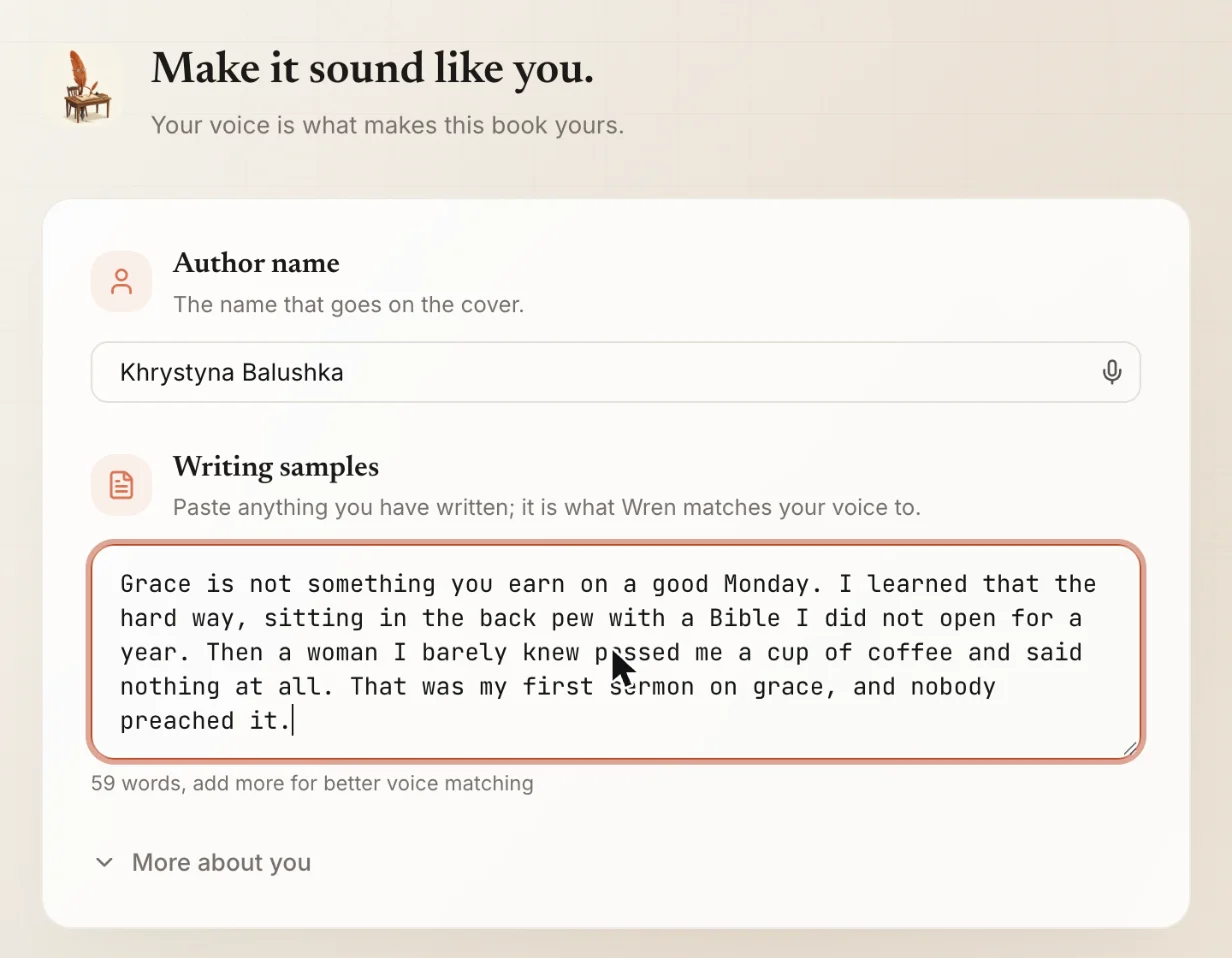
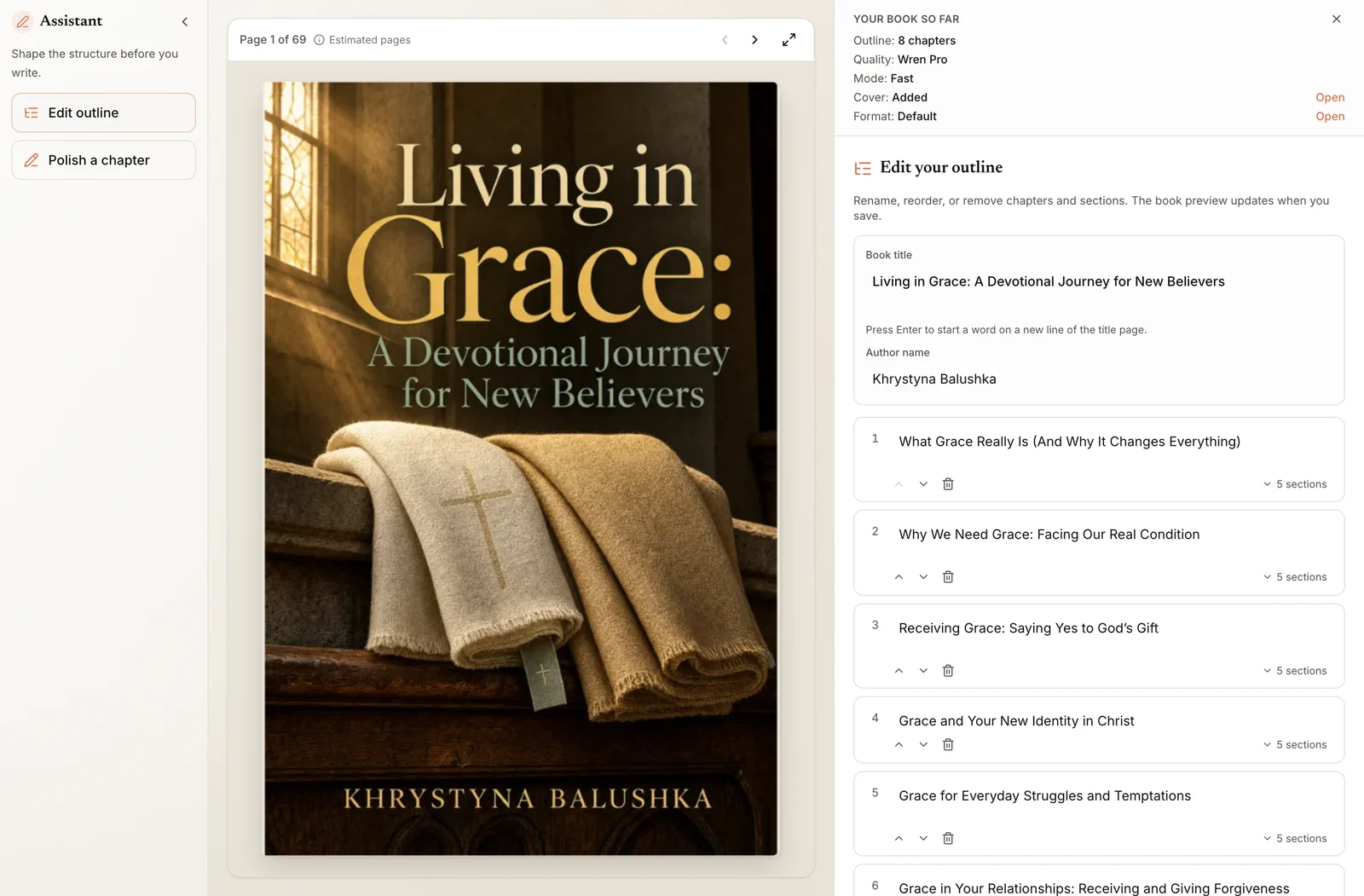
What stays with you. The platform does not check your Bible quotes against a translation, and it does not know what your church believes. Its AI writes the chapter text, so on KDP you answer Yes to the AI question (see below). It does not promise sales or Amazon's approval.
Price. $49/month for AI-written books ($19/month for your own manuscript). The pricing page lists what each plan includes. You pay for one workflow, not only for generated text: your own material, a chapter outline, chapter by chapter writing, an editor and the files for KDP. Every plan comes with monthly credits for the AI, and you see what a book will cost before the platform writes it.
What is a method that keeps the book in your voice?
This method works with any tool. It is our recommendation, built from the checks above.
- Start from what you already wrote. Sermons, devotionals, blog posts and journal pages carry your voice. A blank prompt carries none.
- Choose your samples with care. Pick a few pieces where you sound most like yourself, not the ones that are most polished. Put the strongest first.
- Write a short voice sheet before you draft. List the words you use often, the words you avoid, your translation, your tradition's key terms and how you address the reader. Check every draft against it.
- Draft one chapter, then stop. Put it next to a page you wrote yourself. If the two do not sound like the same person, change the samples or the instructions before you write more.
- Edit in three passes. First the voice pass: read the chapter aloud and mark every sentence you would never say. Then the Scripture pass: compare every verse with your own copy of the translation, word for word. Last the teaching pass: check each sentence about God against what your church believes, and ask your pastor or a trusted reader to look at it too.
- Keep your stories yours. Tell your testimony in your own words, even roughly. AI can sort your notes into an order. It should not add scenes. Our guide to writing a memoir shows how to get a story down when writing is new to you.
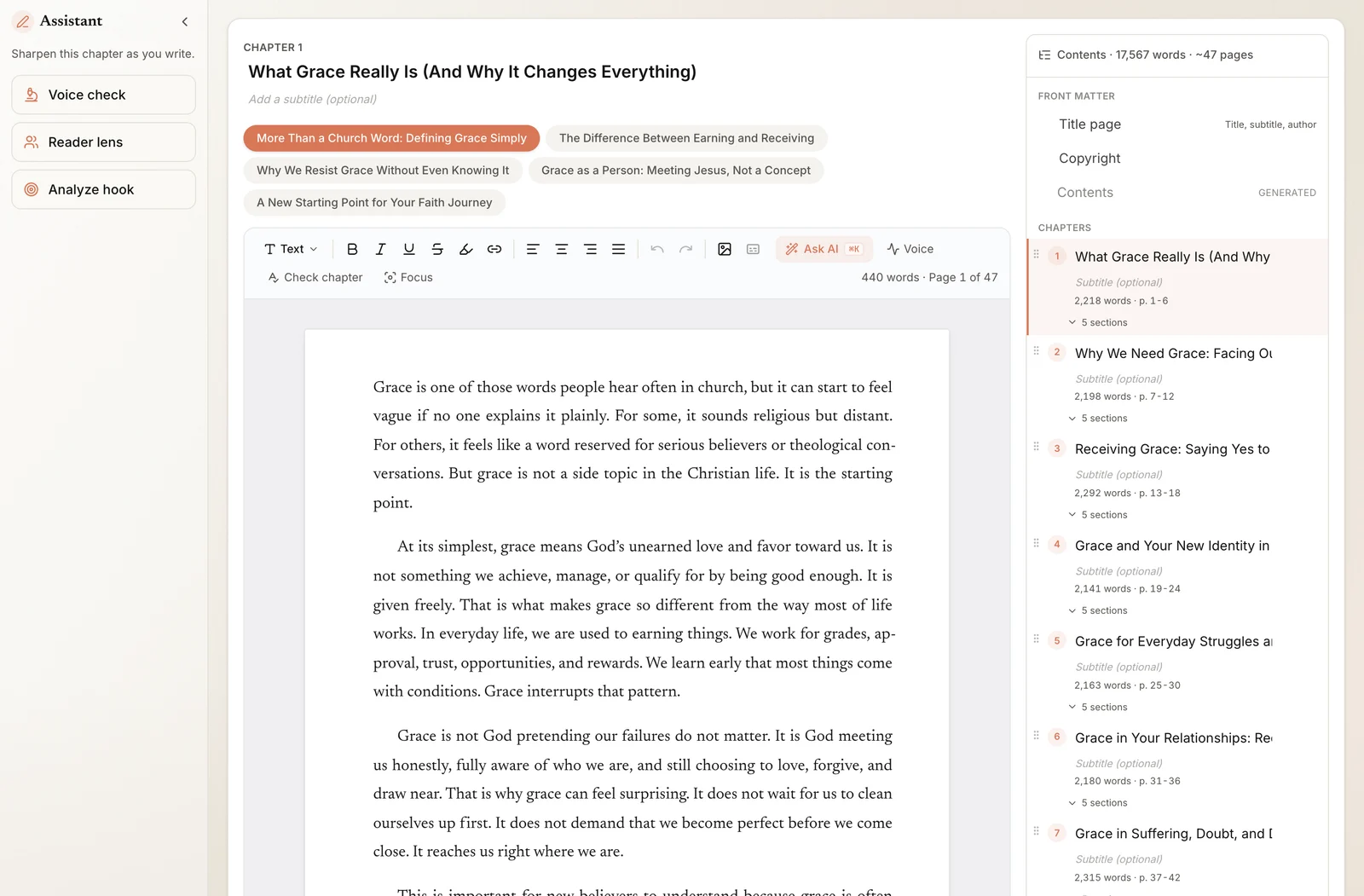
Our article on what Voice DNA is explains how the voice step works, if you want more before you try it.
Can you give Bible text to an AI tool?
Check the publisher first. Crossway, the publisher of the ESV, says on its permissions page that the ESV text "may not be used, accessed, or processed by any artificial intelligence (AI) system". The sentence sits in the Digital section, under "Requests Outside Standard Use Guidelines". We read it on November 18, 2026, and the page shows no update date.
So keep ESV verses out of any AI tool, including the platform's editor, and add them yourself after the draft is done. Other translations have their own rules, and they change. Our guide to writing a Bible study book with AI has a table of the main translations and what each publisher says.
What does Amazon ask about AI text?
Amazon KDP splits AI use into two groups in its content guidelines. Text created by an AI-based tool counts as AI-generated, even if you edited it heavily afterwards. You have to tell KDP about it when you publish. Text you wrote yourself counts as AI-assisted when AI only helped you edit, refine, error-check or brainstorm. You do not have to tell KDP about that. KDP also says you are responsible for checking that both kinds follow its content guidelines.
For a Christian book that means a plain test. If the platform or any other tool drafted your chapters, answer Yes. If you wrote the book and used AI for grammar and discussion questions, you do not report it. Our guides explain what KDP lets you publish and how the disclosure works.
Start with one chapter
AI can build the frame of a faith book. The voice, the verses and the convictions stay yours. Draft one chapter from your own material, read it aloud, and go on only if it sounds like you.
Frequently asked questions
Christians and churches disagree, and no single rule covers every tradition. Barna's 2026 surveys show many pastors using AI while most describe themselves as cautious. Ask your pastor or your denomination, then decide what you would be comfortable telling your readers. The choice, and the responsibility for what the book says, stay with you.
Yes. Sites built for Christian questions exist, and some rank for this search. Whether one suits writing a book is a separate question. Check its terms for selling a book and find out where its Bible text comes from before you put any of its output in a book. Terms differ from tool to tool, and some require written permission if you sell what the tool writes.
You own the writing you did yourself. In a report released on January 29, 2025, the US Copyright Office said that AI output is protected only where a human decided enough of the creative content. Text an AI produced from short prompts alone may not be protected. This is our reading of a US report, not legal advice, so ask a lawyer about your own case.
It should not. A testimony is your own account, and AI has no way to know what happened. If a draft adds a scene, a name or a feeling you did not give it, delete it. Use AI to sort your own notes into an order or to ask you questions, then write the story yourself.
A few pages of your own writing, about 300 to 1,000 words. Voice DNA reads about the first 1,300 words, so put your strongest pieces first. Choose the pieces where you sound most like yourself, because the match is built from what you give it.
Sources & References
- New Research: Pastors Are Using AI More Than You Think, Barna, June 15, 2026
- AI is Becoming a Spiritual Authority, Even Among Practicing Christians, Barna, May 19, 2026
- ESV Bible permissions (Digital, Requests Outside Standard Use Guidelines), Crossway, checked 2026-11-18
- Content Guidelines, Artificial intelligence (AI) content, KDP Help, checked 2026-11-18
- Copyright Office Releases Part 2 of Artificial Intelligence Report, U.S. Copyright Office, January 29, 2025
About the author

Khrystyna Balushka
More in Writing
Ready to write your book?
Turn your expertise into a professional book with Built&Written.