
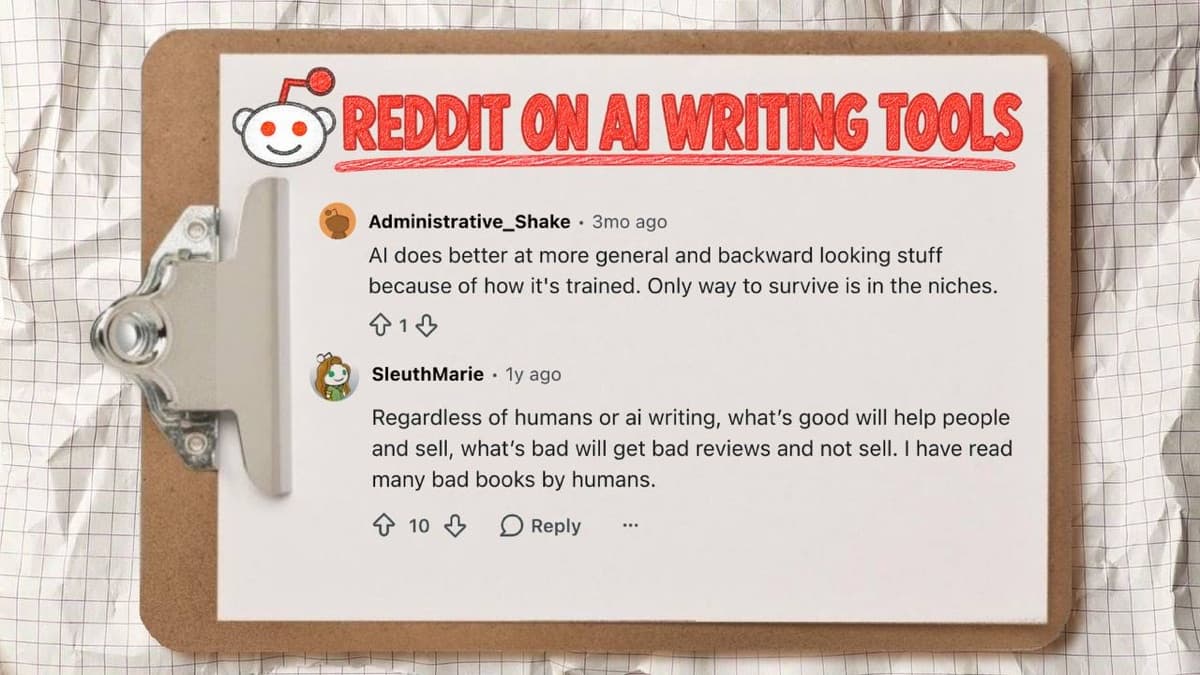

What Reddit Actually Says About AI Book Writing Tools
Reddit tends to trust AI most when the writer stays in charge.
Reddit's view of AI book writing tools is more nuanced than "AI is good" or "AI is bad." They draw a line between using AI to help write a book and asking AI to write the book for you. People praise these tools for brainstorming, outlining, editing, organizing complicated projects and getting past creative blocks. The criticism gets much stronger when AI takes over the prose itself.
The recurring pattern
AI gets the warmest reception when it helps with the work around writing: structure, editing, research, organization and momentum. Reddit becomes much more skeptical when the tool starts replacing the author's voice, judgment or control.
This article follows four recurring complaints across the Reddit discussions: authorship, voice, long-project context and workflow. The screenshots are preserved from the source document so the evidence remains visible alongside the analysis.
Key takeaways
- Reddit users are generally more positive about AI for brainstorming, outlining, editing, and organization than for generating a finished book.
- Writers repeatedly complain that AI-written prose can feel generic, flat, or unlike the author.
- Users report lost context, forgotten details, and instructions being ignored across longer projects.
- Sudowrite is often praised for ease of use, Novelcrafter for control, and ChatGPT or Claude for flexibility, but none escapes criticism.
- The more the writer keeps ownership of ideas, judgment, and final wording, the more positive Reddit sentiment tends to be.
There is no obvious Reddit favorite. The preferred tool depends on how much control the writer wants to keep.
About Built&Written: Wren is designed around the same problems Reddit users keep raising. Instead of starting from a blank prompt, Wren works from the author's existing material, while Voice DNA learns their sentence rhythm, vocabulary and writing habits to reduce the risk of generic prose. It also keeps the book structured as a single project, with an editable outline, chapters and source material in one workflow, so the author stays in control rather than handing the entire book over to the AI.
1. Reddit likes AI assistance more than AI authorship
Writers are much more positive about AI for brainstorming, outlining, editing, research, and organizing material than for generating a finished book with minimal human involvement. A discussion in r/KDP captures this distinction clearly: users criticize low-effort generated books while acknowledging that AI can be useful when the author still supplies the judgment and voice.
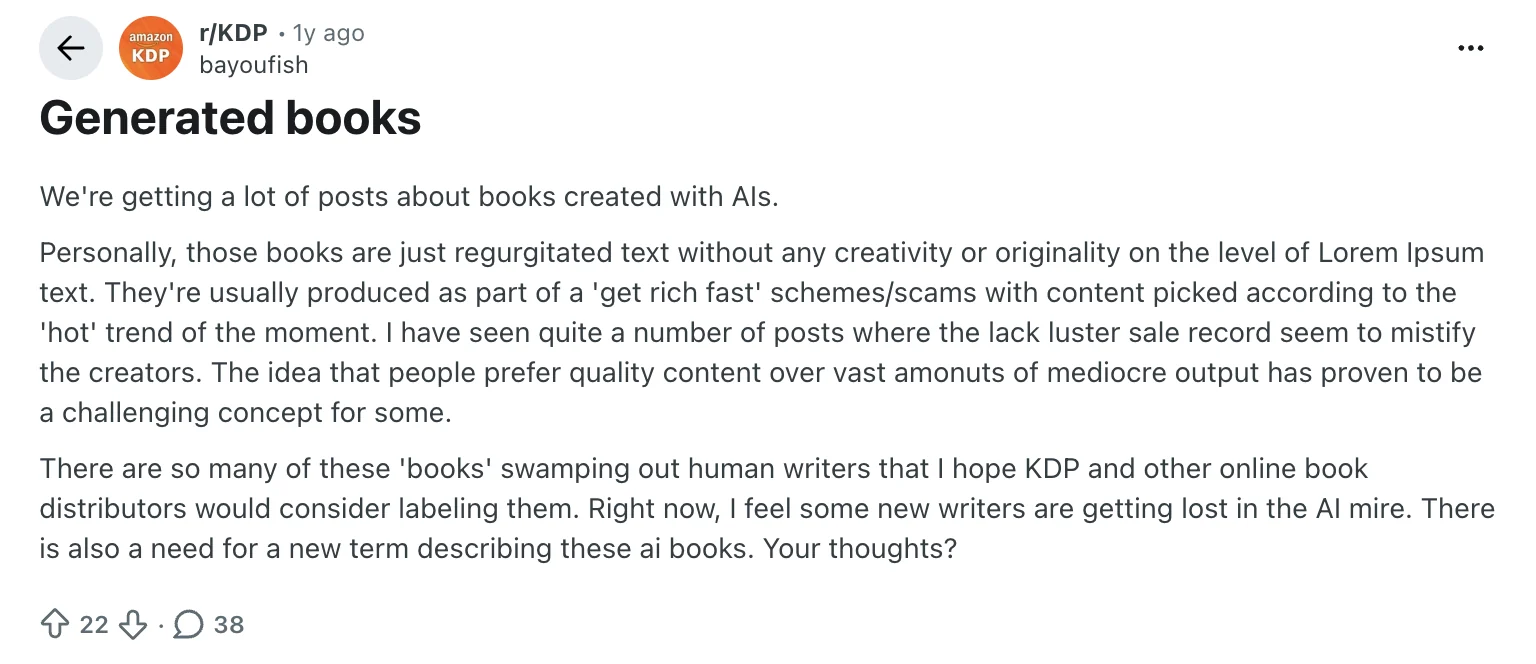
The problem, and how Wren solves it: Wren addresses this by treating AI as a co-writer built around the author's existing material, not as a blank-prompt book generator. Users bring their own notes, posts, transcripts, voice memos or draft chapters, and Wren turns that material into an editable book.
2. The biggest problem is losing the author's voice
Writers repeatedly report that AI can follow their style for a while, then gradually drift toward generic prose. In one recent r/WritingWithAI discussion, the author says the writing becomes too polished or emotionally flat, sentence rhythms become repetitive even after the AI has been given writing samples and a detailed style guide.
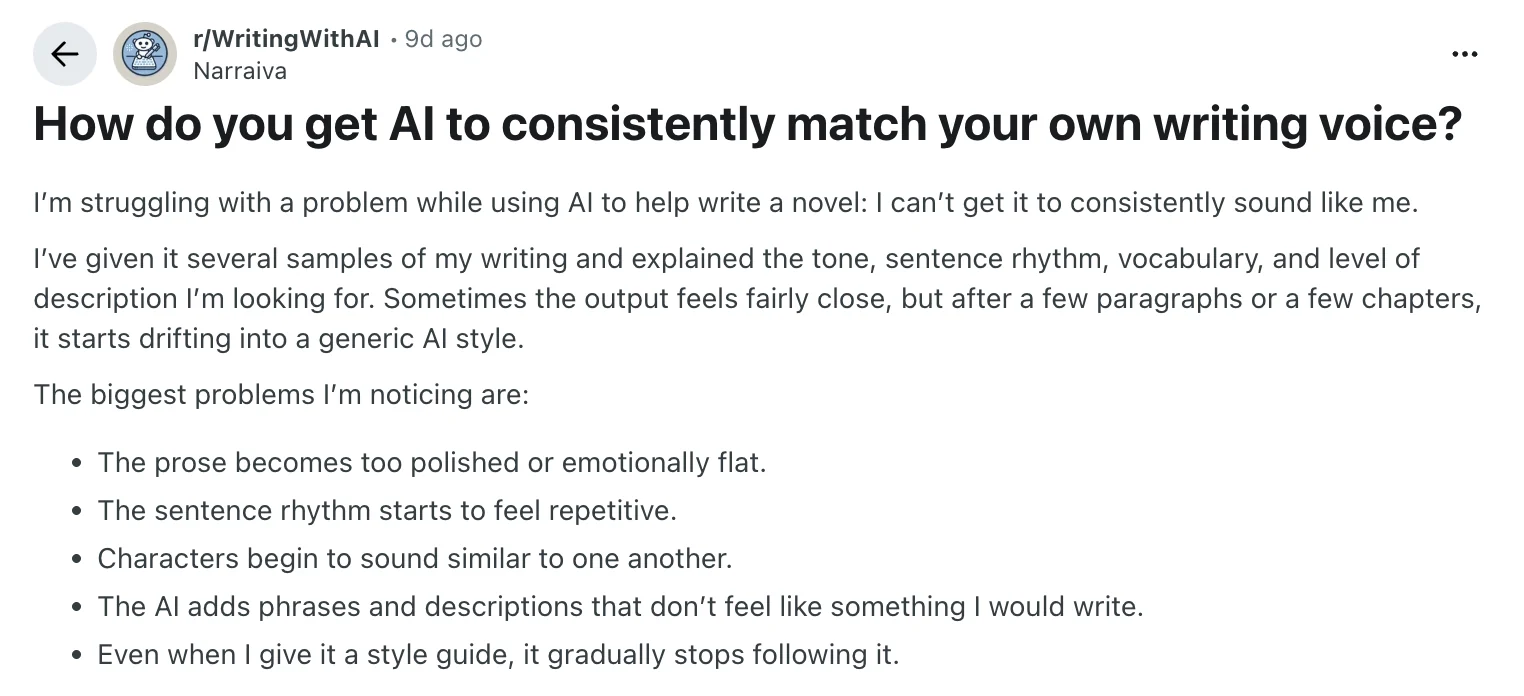
The problem, and how Wren solves it: Wren addresses this with Voice DNA, which learns from 5 to 50 pages of the author's existing writing. It looks at sentence rhythm, vocabulary and recurring writing habits, then uses that profile when drafting the book. The goal is to keep it closer to the author's natural voice instead of defaulting to generic AI prose.
3. Long projects are difficult for AI to manage as a whole
AI can work well on individual passages, but a book creates a different problem: understanding how ideas connect across hundreds of pages. In this r/WritingWithAI discussion, the author of a roughly 300-page business book wanted AI to identify repetition and reorganize material across chapters without simply rewriting the manuscript. The tools they tried struggled to make those whole-book decisions while preserving the work already there.
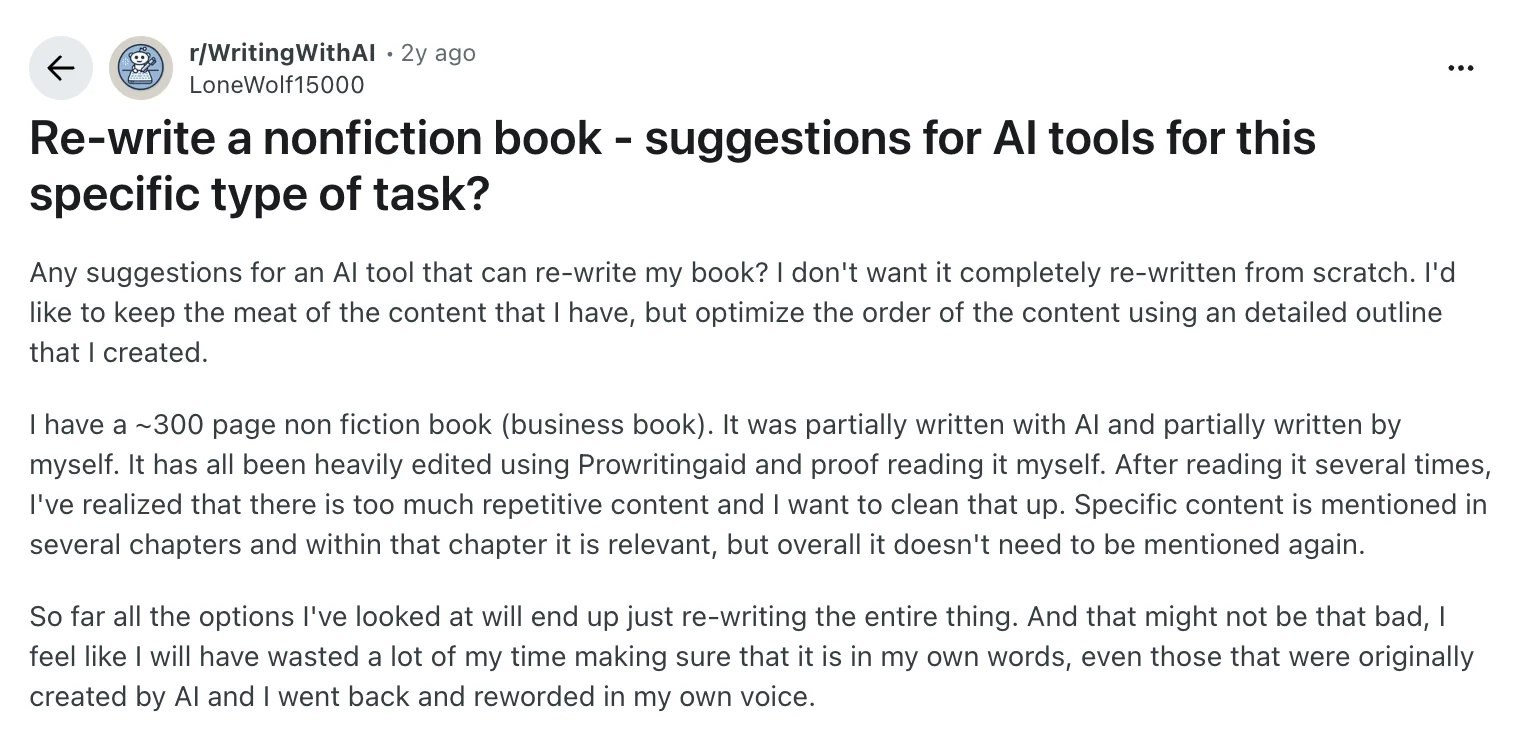
The problem, and how Wren solves it: Wren approaches this by treating the book as one structured project, rather than a series of disconnected prompts. It starts from the author's existing material, builds an editable outline, and develops chapters around that structure.
4. The workflow matters as much as the AI model
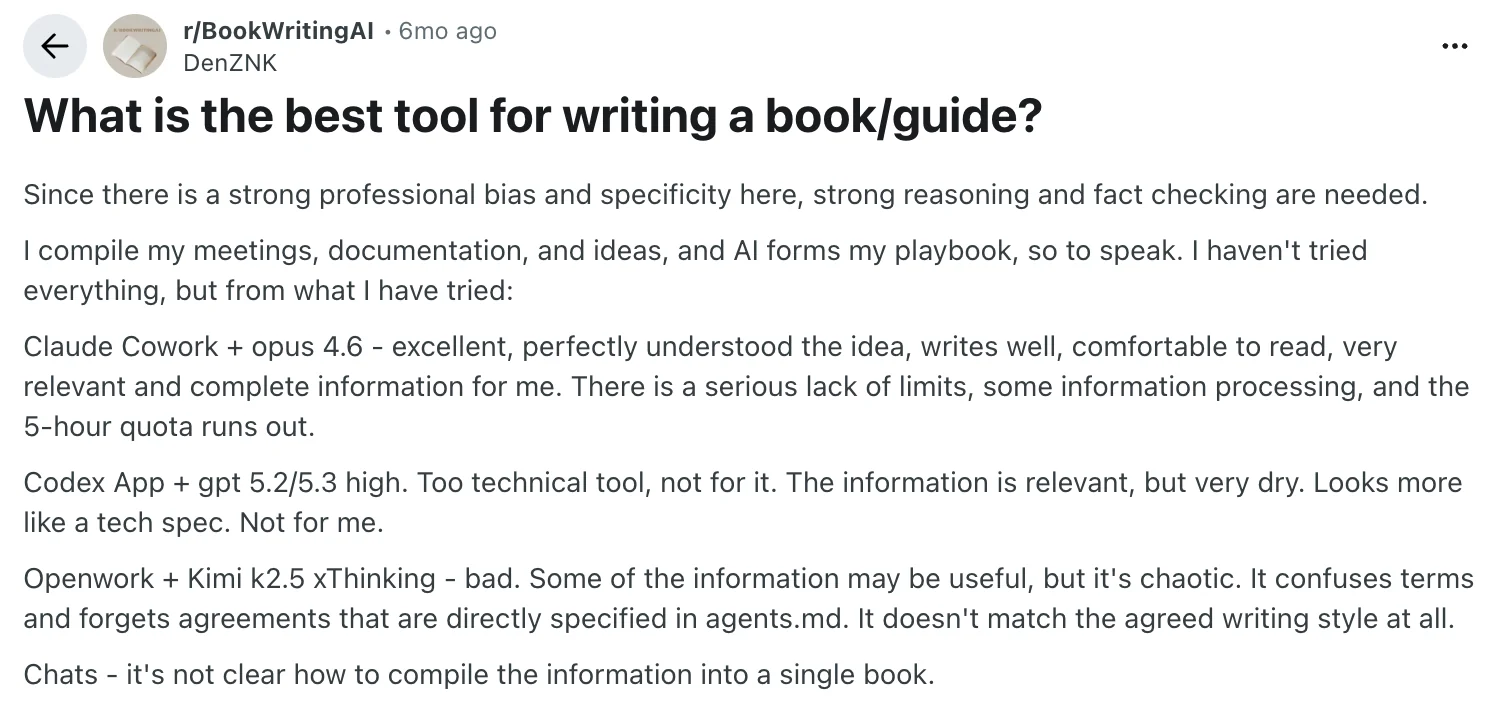
For writers, Reddit discussions suggest that the challenge is often not finding an AI that can produce good prose. It is finding a workflow that can turn existing expertise, notes, meetings, courses, or source documents into one coherent book without constant copying, re-prompting, and reorganizing. In this r/BookWritingAI discussion, a user creating a professional guide from meetings, documentation, and ideas praised Claude's writing quality but complained about usage limits, found other tools too technical or inconsistent, and said ordinary chat interfaces made it unclear how to compile everything into a single book.
The problem, and how Wren solves it: Wren addresses this workflow problem by keeping the source material, outline, drafting, editing, cover creation, and export inside one book project. The point is not just generating prose, but reducing the constant copy-paste and re-prompting that happens when a nonfiction book is built across separate tools.
Final thoughts
Reddit's position is fairly consistent: AI is useful when it helps writers move faster without taking control away from them. The biggest problems appear when tools flatten the author's voice, lose track of context, struggle with long nonfiction projects, or force the writer into a fragmented workflow.
That makes the real question less about which AI tool can generate the most text and more about which one can support a complete book while keeping the author's ideas, voice, and judgment intact. For nonfiction writers, the strongest tools are the ones that assist the process without making the book feel less like theirs.
The pattern Reddit keeps returning to
Use AI to reduce friction, not to erase authorship. The strongest workflows keep the writer's source material, voice and judgment at the center of the book.
Frequently asked questions
There is no clear Reddit favorite. Different writers value different things, such as ease of use, control, flexibility, or the ability to manage a long project.
It can generate long-form content, but Reddit users frequently point to problems that become more obvious across a full manuscript, including lost context, repeated ideas, inconsistent instructions, and generic prose.
Based on the Reddit discussions covered here, users are generally more comfortable using AI for brainstorming, outlining, editing, research, and organization. The criticism becomes stronger when AI is expected to generate most of the finished book with little human involvement.
This remains a challenge. Writers struggle to get AI tools to understand repetition and structure across the book without rewriting too much of the existing material.
Not necessarily. Reddit discussions suggest that workflow can be just as important as raw writing quality. Writers also care about how easily they can organize source material, maintain context, edit chapters, and turn everything into one coherent manuscript.
Wren starts with the author's existing material rather than a blank prompt. It keeps the source material, outline, chapters, editing, cover creation, and export inside one project. Voice DNA also learns from the author's existing writing to help keep the generated manuscript closer to their natural style.
Sources & References
About the author

Khrystyna Balushka
More in AI Book Tools
Ready to write your book?
Turn your expertise into a professional book with Built&Written.