
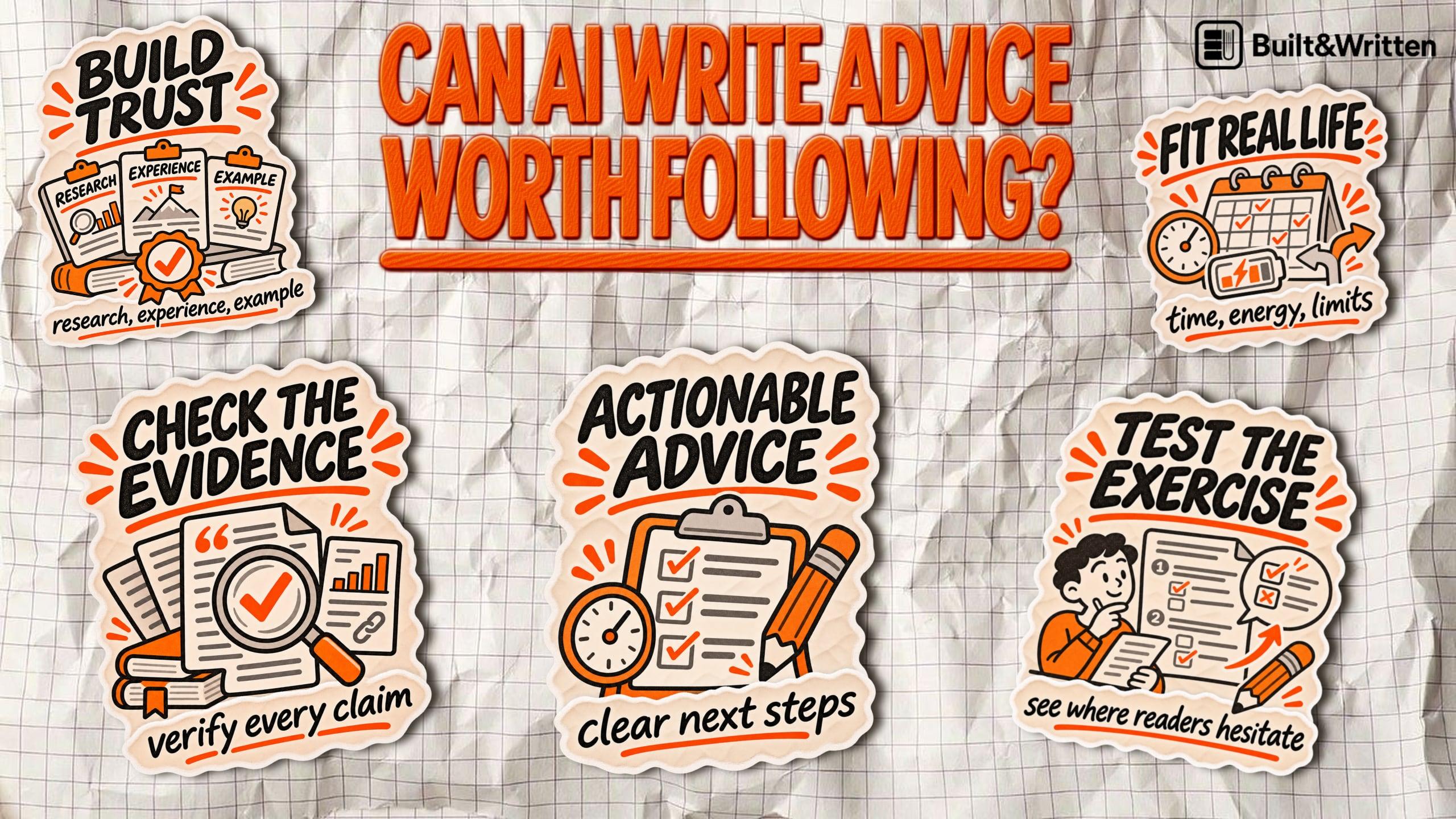

Can AI Give Self-Help Advice People Actually Follow?
AI can suggest ways to build habits, manage time, and work toward personal goals in seconds. Yet recognizing a good idea is different from putting it into practice. For self-help authors, that gap raises a more useful question than whether AI can produce advice: can it help make a recommendation something readers can realistically try?
Can AI Actually Give Useful Self-Help Advice?
Yes. AI can explain concepts, offer alternative approaches, and translate broad goals into draft action plans. A reader who asks for time-management advice might receive a proposed routine based on a work schedule and other details they provide.
That output can be a starting point, not proof that a strategy will help. A language model can generate plausible instructions without establishing that the recommendation fits an individual or produces the desired outcome. Authors should treat suggested strategies as material to evaluate, not as independent evidence.
What Makes Self-Help Advice Actionable?
Actionable self-help advice is guidance that gives readers a specific, realistic next step toward a personal goal. It explains what to do, when to begin, and how to recognize progress rather than relying on encouragement alone.
Use five editorial checks: specific enough to act on; realistic about time and resources; relevant to the stated problem; observable enough to review progress; and flexible when the original approach does not fit.
| Generic recommendation | More actionable alternative |
|---|---|
| Practice gratitude every day. | Write down one thing that went well after dinner for seven days. |
| Improve your productivity. | Before opening email, choose one task you want to finish today. |
| Build better habits. | Choose one two-minute action to repeat after an existing routine. |
| Be more confident. | Prepare one question before your next meeting. |
| Stop procrastinating. | Set a five-minute timer and begin the first step of one avoided task. |
These rewrites illustrate clearer instructions; they are not validated interventions. Research on habit formation supports the relevance of repeating a behavior in a consistent context, but it also shows substantial variation between individuals. In a 12-week observational study, the time required to approach a plateau in automaticity varied widely.
A Worked Example of Improving AI Advice
Imagine AI suggests: “Create a morning routine to boost productivity.” The author revises it to: “For the next five workdays, take three minutes before checking email to select one priority.”
The revision specifies a cue, a duration, and a concrete action. Yet a careful author would also add an alternative for shift workers or readers whose jobs require checking urgent messages first. This is a constructed editorial illustration, not a user test or a claim that the exercise works for everyone.
Why Do Readers Struggle to Follow Self-Help Advice?
Generic Advice Leaves Too Much Unexplained
“Believe in yourself” describes an ambition but provides no way to begin. A reader anxious about speaking in meetings may need an example of what to prepare, when to speak, and how to approach a first attempt.
Idealized Routines Ignore Everyday Constraints
Suggestions to wake up early or overhaul multiple habits at once may overlook care responsibilities, health, working hours, and limited resources. An author can offer a smaller option or an alternative schedule instead of treating one routine as universal.
Readers Need a Reason to Trust the Recommendation
When guidance makes claims about psychology or behavior, readers should be able to tell whether the claim comes from research, experience, or an illustrative exercise. Showing that distinction allows them to assess the advice instead of relying on confident wording.
Where Does AI-Generated Self-Help Advice Fall Short?
Confident Wording Can Hide Errors
AI output may contain inaccurate explanations or citations that require verification. Do not copy a study title or statistic from an AI response into a manuscript without finding and reading the underlying source. A recommendation becomes more credible when the author can explain exactly what the evidence does and does not establish.
AI Does Not Supply Lived Experience
A model can write about disappointment, procrastination, and confidence without personally experiencing them. Its fluency cannot replace an author’s firsthand examples, interviews, or subject-matter expertise. If an anecdote is invented to illustrate a point, identify it as hypothetical rather than presenting it as a real event.
Sensitive Topics Require Boundaries
A generic stress-management suggestion may be unsuitable for someone facing serious psychological distress. Avoid presenting general advice as a diagnosis or a substitute for individualized professional care. Authors should scope their claims carefully and seek qualified review where the topic calls for it.
How Can Self-Help Authors Use AI to Create Advice Readers Will Follow?
Step 1: Define the Reader’s Problem
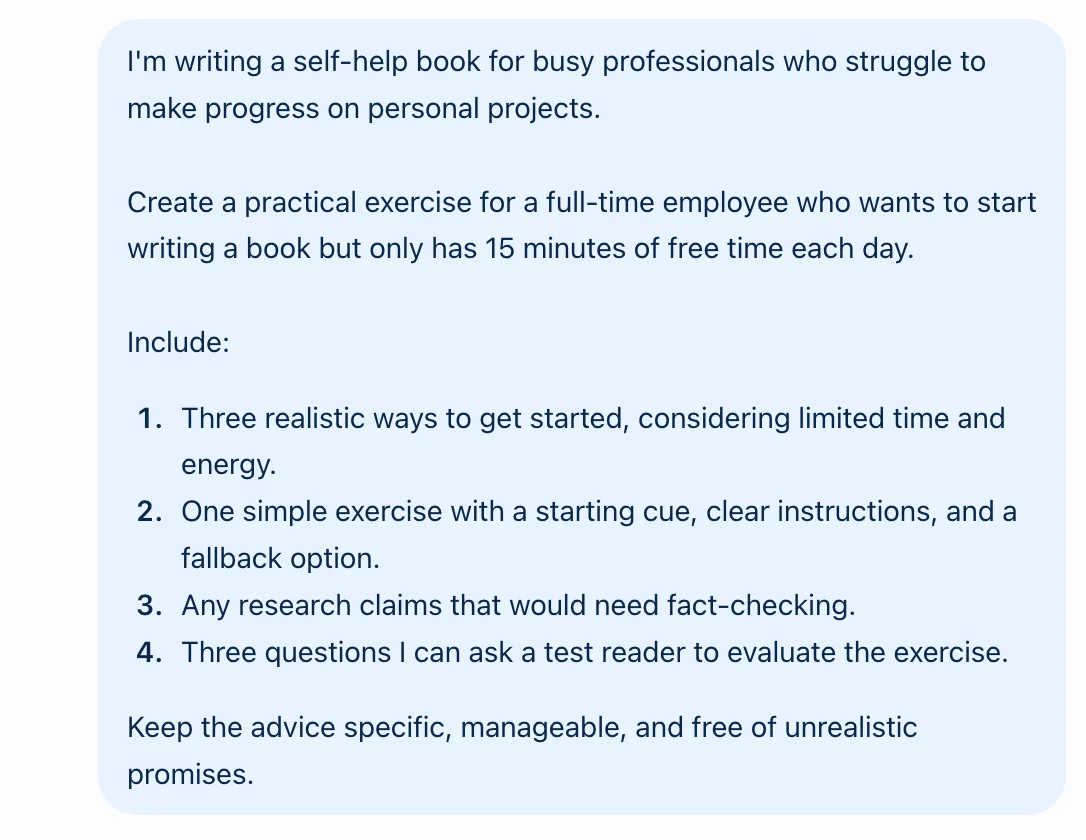
Start with a recognizable scenario, not a request to “write about productivity.” Example prompt: “Create a practical exercise for a full-time employee who wants to start writing a book but only has 15 minutes of free time each day.” Ask for three realistic ways to start, and evaluate them before choosing one.
Step 2: Draft the Exercise
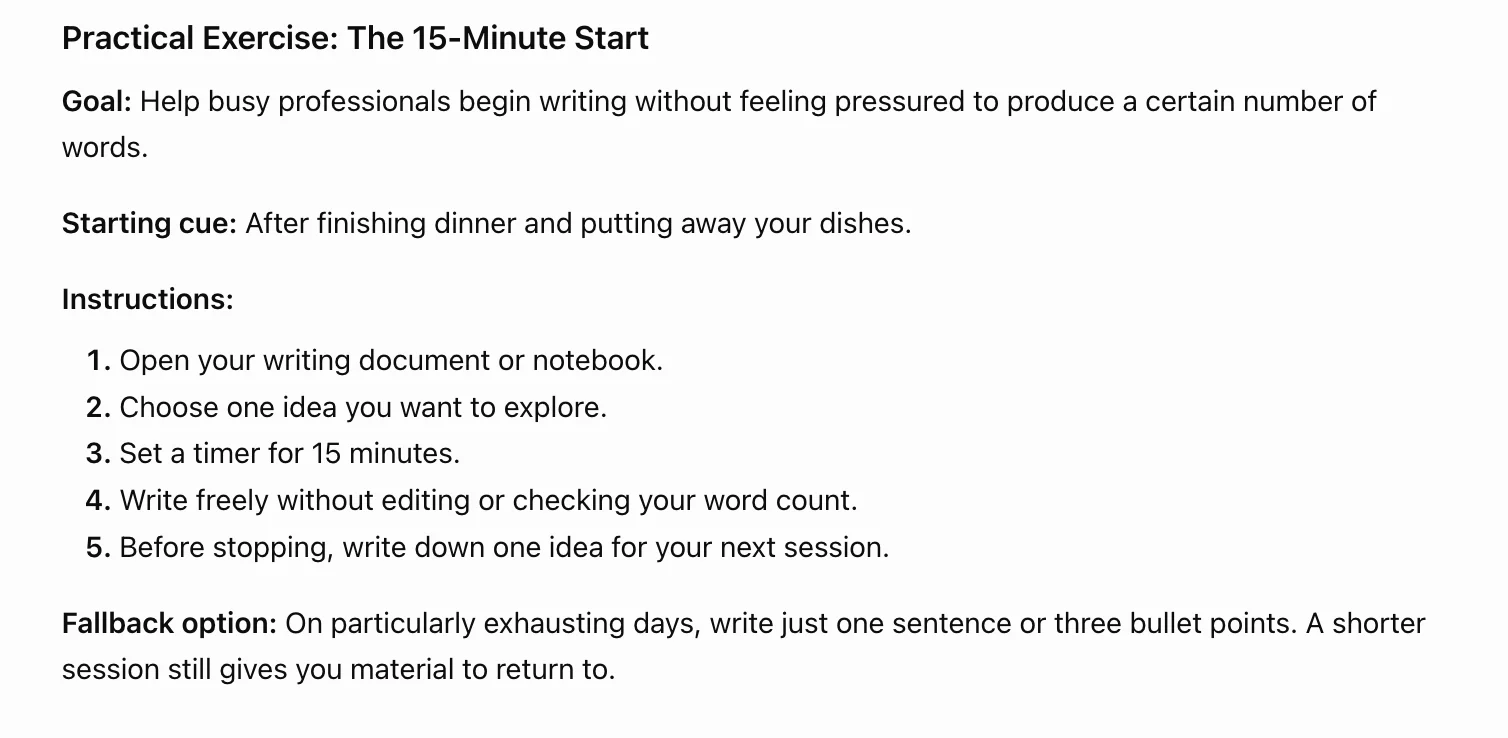
Ask AI to convert a selected idea into a short sequence with a starting cue, a modest time commitment, and a fallback option. If the book uses reflection questions or worksheets, make each one serve a clear purpose.
Step 3: Check the Evidence
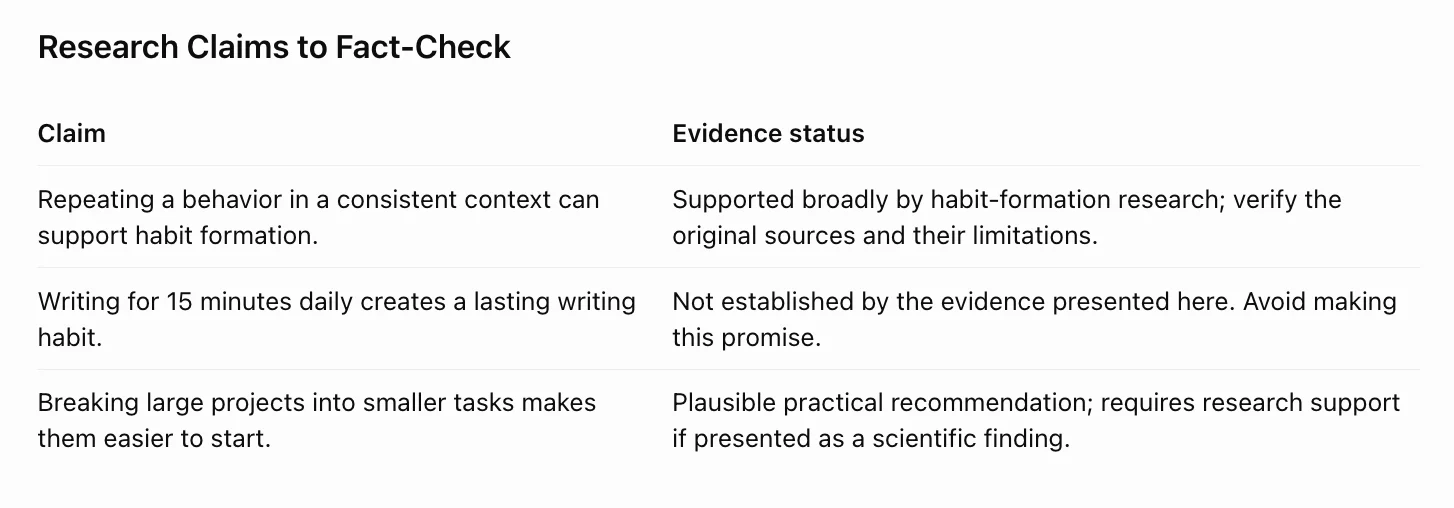
Label the status of every substantive claim: research finding, expert opinion, personal experience, or example. Locate original studies, examine their scope, and remove claims that cannot be supported. A 2012 review of habit-formation research discusses repeating behaviors in consistent contexts, but it should not be stretched into a promise about any particular self-help exercise.
Step 4: Have Someone Try the Instructions
Give a sample activity to an appropriate reader without explaining it aloud. Ask what seemed unclear, which step was hard to start, and what they would change. This is a practical editorial review, not a controlled efficacy test. Revise the wording and constraints based on the feedback you actually receive.
Can AI Help You Write a Better Self-Help Book?
AI-assisted writing can help authors turn existing material into a coherent nonfiction manuscript. Built&Written’s workflow includes editable outlines, chapter-by-chapter drafting, an integrated editor, and KDP-ready formatting and export.
For authors with notes, posts, or previous drafts, Built&Written’s AI book generator is intended to help assemble material into a book. Its AI book editor supports manuscript refinement, while Voice DNA learns the author’s writing style from 5 to 50 pages of their own writing. Exports include a print PDF and the KDP files, plus ePub and DOCX from the Entrepreneur plan, which is also the plan needed to download an AI-written book.
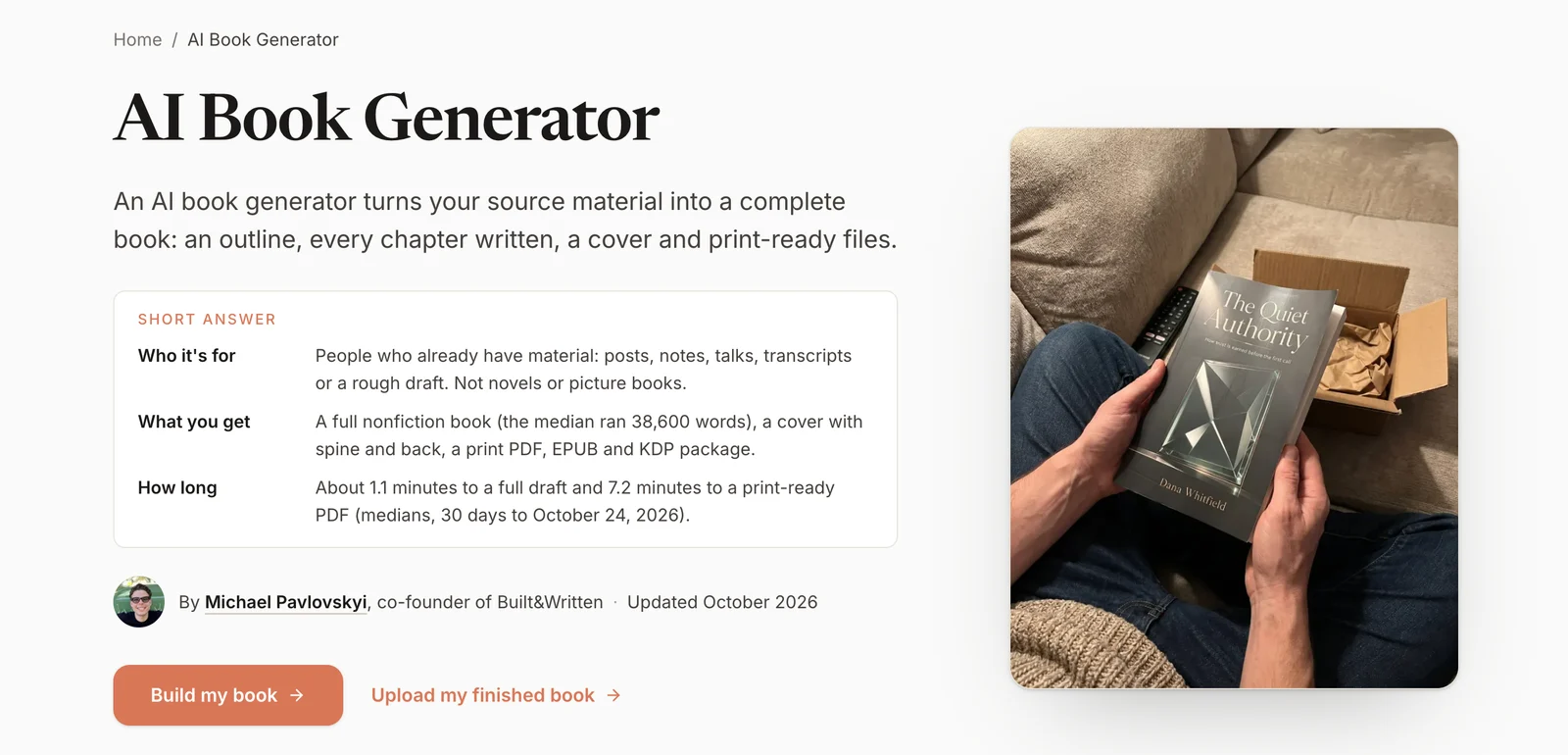
These are writing and production capabilities, not evidence that the book’s recommendations are accurate. Authors still have to review the claims, exercises, examples, and final reader experience.
Will Readers Actually Follow AI-Generated Self-Help Advice?
Some readers may act on clear, well-supported guidance, but no writing process can promise behavior change. The practical standard for authors is narrower and more useful: does each recommendation give the intended reader a credible, realistic opportunity to begin?
Frequently asked questions
Give the activity to a reader who has not seen the surrounding chapter. Ask them to identify the first action and try it without extra instructions. Note where they hesitate, make assumptions, or need help. This review can uncover confusing wording or unrealistic prerequisites, although it does not prove the exercise will change behavior.
AI can propose variations for people with different schedules, experience levels, and everyday constraints. An author could request a shorter version of an exercise or a different example for someone who works irregular hours. Each adaptation still needs human review, because a relevant-sounding response can miss details that matter in practice.
Include them when they help readers apply a specific chapter idea. A short planning worksheet might turn a general goal into a chosen action, while a reflection question can help a reader recognize an obstacle. Avoid adding exercises just to make the book look interactive; each activity should have a clear purpose and understandable instructions.
Authors should check the policies of their publisher and distribution platforms, because requirements differ and can change. They should also distinguish AI-assisted editing from AI-generated text when a policy asks them to do so. Whatever the disclosure approach, the author remains responsible for checking claims and ensuring the content is original and appropriate for readers.
Sources & References
- Lally et al., “How are habits formed: Modelling habit formation in the real world,” European Journal of Social Psychology (2010)
- Gardner, Lally, and Wardle, “Making health habitual: the psychology of habit-formation and general practice,” British Journal of General Practice (2012)
- Walters and Wilder, “Fabrication and errors in the bibliographic citations generated by ChatGPT,” Scientific Reports (2023)
- National Institute of Mental Health, “Help for Mental Illnesses”
About the author