
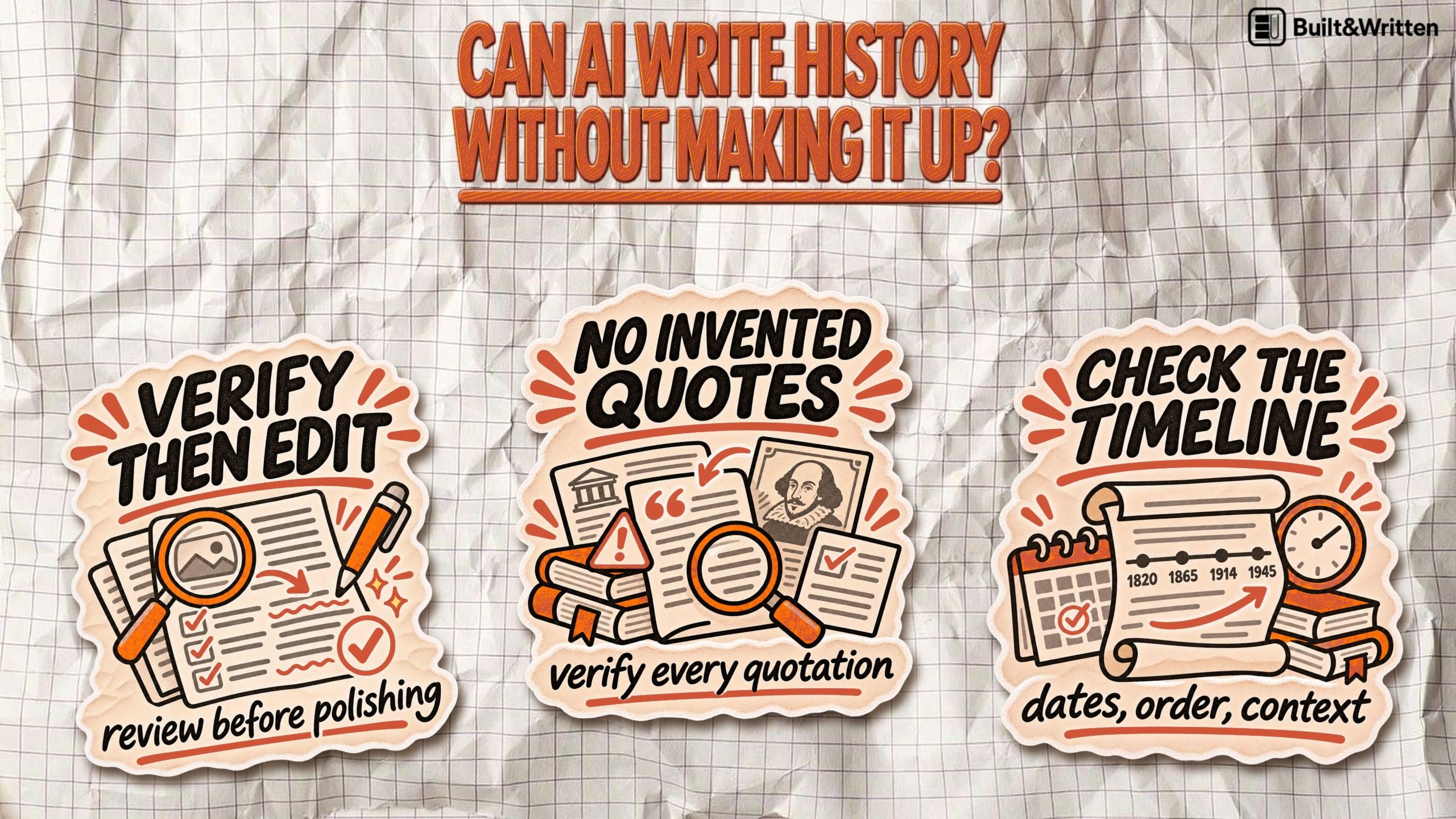

Can AI Write a History Book Without Inventing the Facts?
You ask AI to write a chapter about a historical event. It gives you a convincing account, complete with dates, names, and quotations. Everything sounds credible. But when you try to find the source of one quotation, it does not exist.
That is the problem with using AI to write history. It can turn research into readable chapters, but it can also invent details, confuse timelines, or present disputed events as established facts. Those mistakes are not always easy to spot.
If you are writing a history book, historical biography, or family history, the question is not simply whether AI can write. It is how to keep evidence in charge of what the book says. For a broader nonfiction approach, see our guide to AI hallucinations in nonfiction.
Can AI write an accurate history book?
Yes, AI can help produce a historically accurate book, but the accuracy comes from the research and review behind the manuscript, not from the model alone.
AI can organize notes, group events, suggest chapter structures, and refine prose. It is less reliable when asked to supply historical evidence from memory, resolve disputes without sources, or invent connective details that make a chapter read smoothly.
A history book must distinguish documented events from interpretations. Two historians might agree that an event occurred but disagree about its causes. A polished AI paragraph can flatten that disagreement into a single confident explanation.
| Task | Useful role for AI | Author's responsibility |
|---|---|---|
| Organize research | Group supplied notes and documents | Decide which material is relevant |
| Build a timeline | Arrange sourced events | Confirm dates and sequence |
| Outline and draft | Structure chapters from notes | Keep unsupported details out |
| Edit prose | Improve clarity and flow | Protect the meaning of evidence |
| Format citations | Apply a consistent style | Check each source and cited passage |
For a fuller comparison of drafting capabilities and limitations, read Can AI Write a Whole Book? We Ran It End to End.
Why does AI invent historical facts?
An AI hallucination is a response that sounds credible but is inaccurate or fabricated. A language model predicts plausible text from learned patterns and the materials available in its current context; it does not inherently check every statement against an archive. The American Historical Association's guidance uses this same distinction between plausible output and reliable historical thinking.
Invented events. The model describes a meeting, conversation, or episode for which no surviving evidence has been established.
Mixed-up chronology. A real person is placed at the wrong event or the correct events are told in the wrong sequence.
Fabricated quotations. Attractive words are assigned to a historical figure without an identifiable original text.
Nonexistent references. The model supplies a convincing book title, document description, page number, or archival call number that leads nowhere.
False certainty. A debated explanation is presented as an agreed historical fact.
Sometimes the underlying names, documents, and events are real, but the connection between them is not. That makes historical errors harder to catch than an obviously fictional statement.
Real examples of AI getting history wrong
A computing-history case: Percy Ludgate
In 2023, researchers Brian Randell and Brian Coghlan described an investigation of ChatGPT's responses about Percy Ludgate, the Irish computer pioneer. In 12 answers totaling 2,086 words, they counted 1,007 words (48%) as fabricated. That figure applies to this particular experiment, not to ChatGPT responses generally. The account appeared in IEEE Annals of the History of Computing.
The lesson for a history author is specific: a little-documented subject can invite a surprisingly detailed response, even when the model lacks sufficient dependable evidence.
Invented archival references: the Red Cross warning
In December 2025, the International Committee of the Red Cross warned researchers that chatbot-supplied archival identifiers, legal references, and document descriptions may be inaccurate. It directs researchers to its official catalogue and established scholarly work rather than trusting plausible-looking citations.
A correct-looking call number is not itself proof that an archive holds the document or that it says what an author claims.
A genuine source with the wrong date
The scholarly article Artificial history? Inquiring ChatGPT on historiography describes a case in which ChatGPT assigned the year 1993 to a work whose original paper appeared in 1989 and a related book chapter in 2004. This is a different failure from inventing an entire reference: real scholarship can still be described incorrectly.
How to write a history book with AI without making up facts
Build the book from a research file you control. Use AI to help process that file, rather than asking it to supply an entire account without evidence.
1. Define your question and boundaries
Choose the period, places, people, and question. "How did factory working conditions change in nineteenth-century Britain?" is easier to research than "Write the history of the Industrial Revolution."
2. Collect historical evidence
Gather archival records, contemporary accounts, scholarly books, and relevant studies. Save full source details and exact page or folder references alongside your notes.
3. Build a source-backed chronology
Record the major events and attach an evidence reference to each. Mark disputed dates instead of silently picking one.
4. Outline from what you can support
Ask AI to group your findings into chronological or thematic chapters. Remove proposed scenes or claims that the research does not substantiate.
5. Draft with bounded instructions
Supply the relevant notes for one chapter. For example: "Use only these notes for historical claims. Do not invent quotations or dialogue. Mark missing information as a research question." Treat that instruction as a guardrail, not a guarantee.
6. Run a claim-by-claim review
Separate prose edits from evidence checks. Put unsupported, disputed, and corrected claims into a research log; check quotations against the relevant editions.
7. Edit the manuscript and obtain a second review
Improve pacing and transitions only after checking the evidence. Recheck factual assertions added during revision, and consider a specialist reader for difficult subjects.
Workflow: Define → Collect → Chronology → Outline → Draft → Verify → Edit. Each stage should leave a record that the next stage can use.
A worked example: checking a historical AI claim
Here is a documented claim, not a new experiment or an invented chatbot transcript. Suppose a draft says: "An investigation found that 48% of ChatGPT's historical writing was fabricated." The sentence sounds meaningful, but it overstates what the original researchers measured.
| Verification stage | What the source supports |
|---|---|
| Draft claim | "48% of ChatGPT's historical writing was fabricated." |
| Locate the study | Find Randell and Coghlan's 2023 IEEE account on Percy Ludgate. |
| Check the actual scope | The researchers asked 12 questions about Ludgate; the responses totaled 2,086 words. |
| Confirm the measure | They classified 1,007 words (48%) in that set of answers as fake. |
| Editorial correction | "In one 2023 investigation about Percy Ludgate, researchers classified 1,007 of 2,086 words across 12 ChatGPT answers as fabricated." |
The corrected statement tells readers who was studied, what was measured, and what the number does not establish. This is how source verification improves a history book beyond merely checking whether a citation exists.
How to fact-check AI-generated historical writing
Review claims individually. First highlight dates, people, places, quotations, numbers, and statements about why something happened. For each statement, record the evidence you examined and the decision you made.
| Claim type | Verification target |
|---|---|
| Date or chronology | Dated document or established scholarly timeline |
| Named person or place | Identity, spelling, office, and historical context |
| Direct quotation | Exact wording, speaker, edition, and page |
| Event description | Evidence that the event occurred as described |
| Cause or interpretation | Reasoning in the cited scholarship and credible alternatives |
| Archival citation | Real collection, identifier, document, and relevant passage |
Consider a claim that a nineteenth-century newspaper reported a particular protest. Finding the newspaper title does not verify the claim. Check the issue, date, page, and actual article. If the specific report cannot be located, downgrade or remove the statement.
A simple research log has four columns: claim, source and location, status, and action. Mark a claim "verified," "needs correction," or "unresolved." Record an unresolved dispute instead of turning it into an invented certainty.
Which historical sources should you trust?
Primary sources are materials produced in the period or by people involved: letters, diaries, official documents, photographs, and contemporary newspapers. Secondary sources analyze historical material, including scholarly monographs and peer-reviewed studies.
Neither category is automatically correct. A contemporary report can be partisan or mistaken; a later scholarly account may make stronger sense of multiple sources but still contain a contested interpretation. Ask who created the source, when, for whom, and what other evidence supports it.
Starting points include the Library of Congress, the US National Archives research pages, and university libraries. For help reading original materials critically, see the Library of Congress guide to primary sources.
Can AI help write history without replacing the historian?
Historical judgment is not simply a matter of choosing the most fluent summary. One account may come from an eyewitness; another may be a memoir written decades later. Each has a different vantage point and purpose. AI can help compare passages, but a defensible conclusion requires examining provenance, context, and competing explanations.
The American Historical Association emphasizes active historical thinking and the ability to evaluate AI output rather than accepting it uncritically. A sound manuscript should make clear where the record establishes a fact, where scholars disagree, and where evidence is missing.
A good history book does not need to supply an answer to every gap. It needs to tell the reader exactly how much the evidence lets us know.
How Built&Written fits into a source-first history book workflow
Built&Written's AI Book Writer helps authors develop nonfiction manuscripts from their own material. You can paste notes, upload draft files, or provide a public web page; the platform can propose a chapter structure and support chapter-by-chapter writing. Its Voice DNA feature uses samples of your own prose to help preserve your writing style.
You can review and revise chapters using the Built&Written AI Book Editor. Depending on the plan, the platform supports print-PDF, EPUB, and DOCX exports. Authors still handle submission to Amazon KDP themselves.
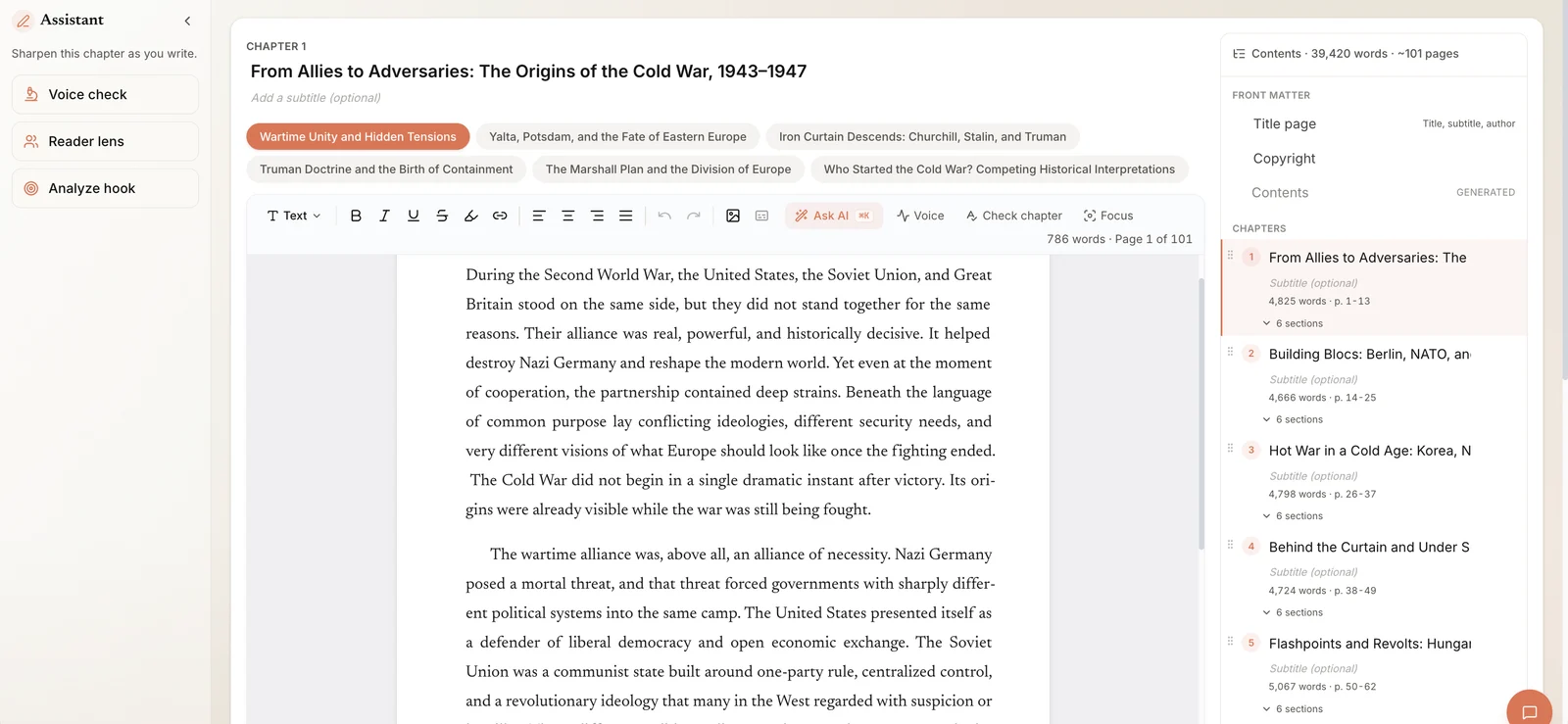
These are writing, editing, and formatting capabilities, not historical verification. Authors must still confirm what the records say, maintain source notes, and decide which claims belong in the finished book.
For publishing requirements beyond historical accuracy, see Getting a Book Published When You Write It With AI.
Frequently asked questions
AI can help produce a first-pass translation or reading aid, but older spelling, specialized terms, damaged text, and changing word meanings can alter the interpretation. Where the exact wording matters, compare the output with the original and consult a reliable edition or qualified translator. Do not present an unverified AI translation as a direct historical quotation.
AI may suggest relevant libraries, collection names, and research questions, but it cannot directly inspect undigitized records without access to those materials. Search institutional catalogues and finding aids, then contact the archive for help with collections that are available only on site. Start with the National Archives research guide if you are working with US federal records.
Yes, provided it meets KDP's content and intellectual-property requirements. KDP requires authors to disclose AI-generated text, images, or translations when publishing or republishing. It also says authors are responsible for the content they submit. Review the current KDP Content Guidelines before uploading your files.
Under Amazon's current distinction, AI-assisted editing, refinement, error-checking, and brainstorming do not require disclosure when the author created the content. When AI generated the actual text or image, KDP treats it as AI-generated even if the author substantially edited it afterward. Other publishers and institutions may set different policies; check those separately.
Sources & References
- Randell and Coghlan, IEEE Annals of the History of Computing (2023)
- ICRC, Important notice on AI-generated archival and legal references (3 December 2025)
- Leme Lopes, Artificial history? Inquiring ChatGPT on historiography, Rethinking History 27(4), 2023
- American Historical Association, Guiding Principles for AI in History Education
- Amazon KDP Content Guidelines
- Library of Congress, Getting Started with Primary Sources
- US National Archives, Research
About the author