

Will AI Replace Writers and Ghostwriters of Business Books?
What is Built&Written? Built&Written is a platform for writing nonfiction books and preparing them for publishing. Its AI writes a book from material you already have, like notes, posts and talk transcripts, in your voice. It also formats a book you've already written without changing a word. You get a print PDF and files for KDP (Kindle Direct Publishing, Amazon's self-publishing service) and publish the book yourself.
Key takeaways
- Will AI replace writers? Not the ones who write books. Built&Written uses AI for the drafting and leaves the book's ideas to you.
- Has AI already cut writing work? Yes, for short freelance jobs. Job posts for writing and coding work dropped within months of ChatGPT's launch.
- Will AI replace ghostwriters? Not so far. In a 2025 survey, book ghostwriters earned more than writing professionals overall.
- What can't AI do for a business book? Name your idea, supply your stories and stand behind every claim. Those come from you.
Will AI replace writers in 2026?
Some writers, for some work. The jobs that shrank are short, generic pieces a tool can draft in one pass: blog posts, product copy, simple articles. The writers business authors hire for books are holding up so far.
Four sources carry most of the evidence. Each measured something different, so read them side by side:
| Study | Who it measured | What it found |
|---|---|---|
| Demirci, Hannane and Zhu, Management Science, 2025 | 1.4 million freelance job posts, July 2021 to July 2023 | 21% fewer posts for writing and coding jobs within 8 months of ChatGPT |
| Hui, Reshef and Zhou, Organization Science, 2024 | Writing freelancers on Upwork | 2% fewer jobs a month and 5.2% lower monthly earnings |
| Gotham Ghostwriters survey, fall 2025 | 1,481 writers, 115 of them book ghostwriters | Book ghostwriters earn more than writers overall |
| Bureau of Labor Statistics, May 2025 | Writers and authors in the US | Median pay $76,910, with little or no change in jobs expected by 2035 |
Novelists are more worried. In a University of Cambridge survey of 258 UK novelists, published November 20, 2025, 51% said AI is likely to replace their work entirely. That study covers fiction only. The rest of this article is about the writers who help experts and founders write nonfiction.
Did AI already shrink freelance writing work?
Yes. Two peer-reviewed studies measured it on freelance platforms, where clients post jobs and writers bid on them.
The first, by Xiang Hui and Oren Reshef of Washington University in St. Louis and Luofeng Zhou of NYU, followed writing freelancers on Upwork after ChatGPT launched in November 2022. Their monthly jobs fell 2%, and their monthly earnings fell 5.2%. The paper appeared in Organization Science in 2024. The authors found that more skilled freelancers lost more, and they call that part suggestive and not yet confirmed.
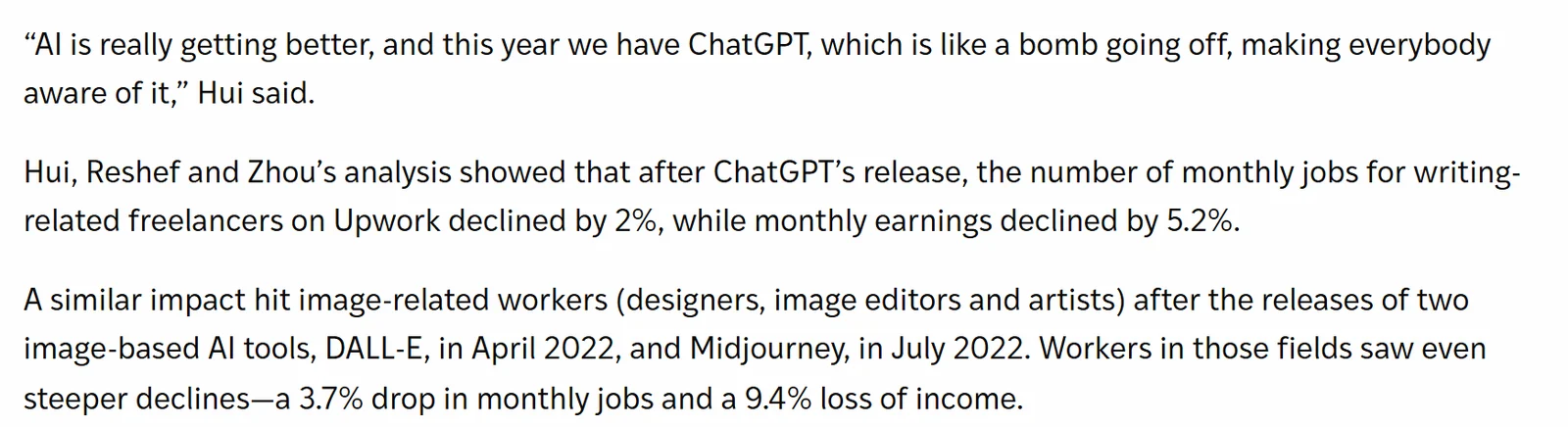
Text in the image: Hui, Reshef and Zhou's analysis showed that after ChatGPT's release, the number of monthly jobs for writing-related freelancers on Upwork declined by 2%, while monthly earnings declined by 5.2%. A similar impact hit image-related workers (designers, image editors and artists) after the releases of two image-based AI tools, DALL-E, in April 2022, and Midjourney, in July 2022. Workers in those fields saw even steeper declines: a 3.7% drop in monthly jobs and a 9.4% loss of income.
The second study is larger. Ozge Demirci, Jonas Hannane and Xinrong Zhu looked at 1.4 million job posts from July 2021 to July 2023. Posts for jobs that AI can automate, such as writing and coding, fell 21% within 8 months of ChatGPT's release. Posts for image creation fell 17%. The paper was published in Management Science in 2025.
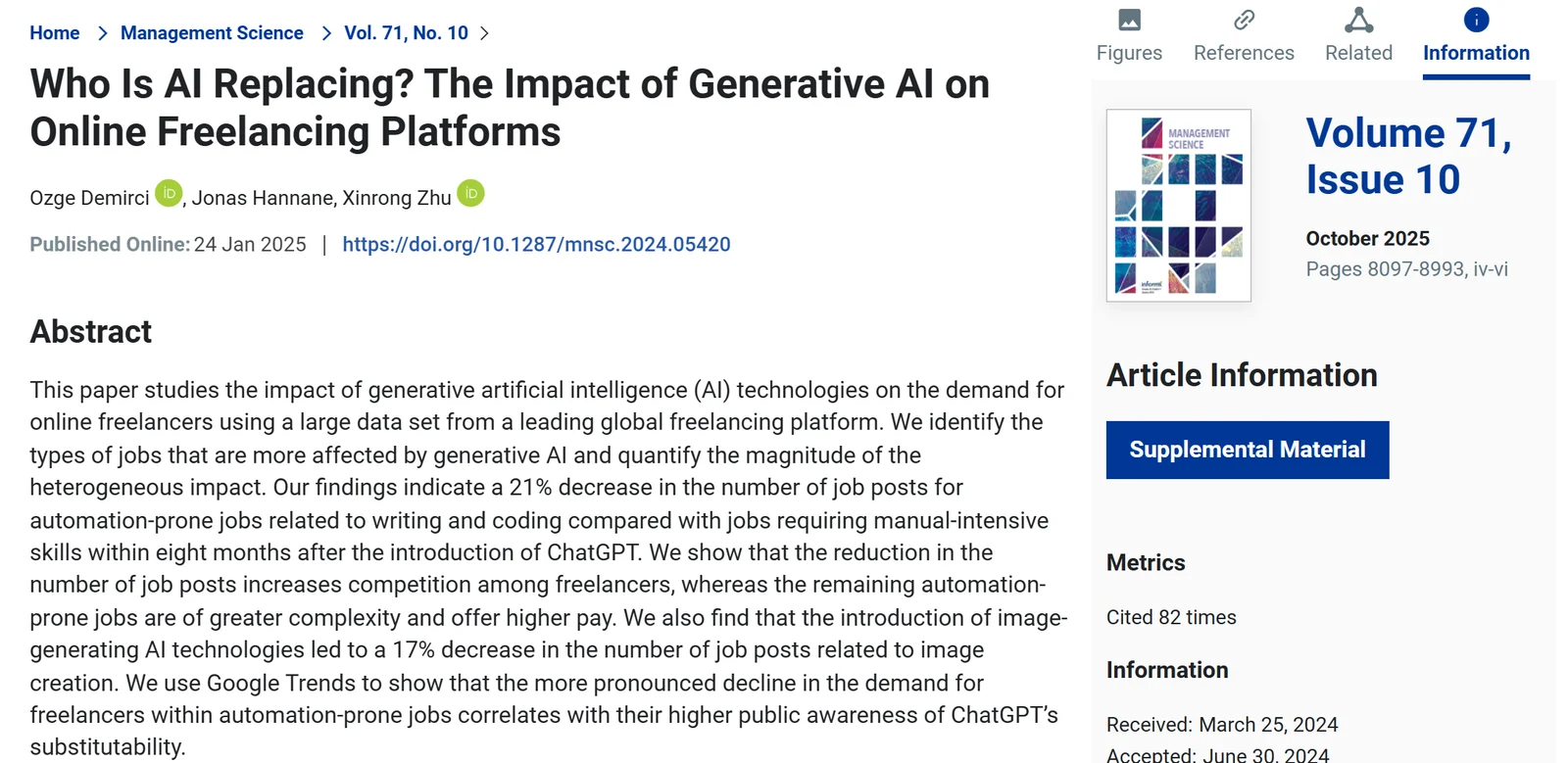
Text in the image: Management Science. Who Is AI Replacing? The Impact of Generative AI on Online Freelancing Platforms. Ozge Demirci, Jonas Hannane, Xinrong Zhu. Published Online: 24 Jan 2025. Volume 71, Issue 10, October 2025. Abstract: This paper studies the impact of generative artificial intelligence (AI) technologies on the demand for online freelancers using a large data set from a leading global freelancing platform. Our findings indicate a 21% decrease in the number of job posts for automation-prone jobs related to writing and coding compared with jobs requiring manual-intensive skills within eight months after the introduction of ChatGPT. We show that the reduction in the number of job posts increases competition among freelancers, whereas the remaining automation-prone jobs are of greater complexity and offer higher pay. We also find that the introduction of image-generating AI technologies led to a 17% decrease in the number of job posts related to image creation.
Writers feel it too. In the Gotham Ghostwriters survey, 806 freelancers and small-agency writers answered two questions about AI. 45% said AI has reduced demand for their work, and 40% said it has reduced their income. Only 6% and 7% reported an increase.
Will AI replace ghostwriters of business books?
Not so far. The same survey shows book ghostwriters doing better than writers overall.
The survey ran in August and September 2025. It reached 1,481 writers, and 115 of them work mainly as ghostwriters. Here is how they compare with all writing professionals in the survey, as Josh Bernoff, who analyzed it, reported on November 10, 2025:
| Book ghostwriters | All writing professionals | |
|---|---|---|
| Median income | $112,100 | $91,200 |
| Use AI at least sometimes | 68% | 61% |
| Report no decline in demand or income due to AI | 8 in 10 | not reported |
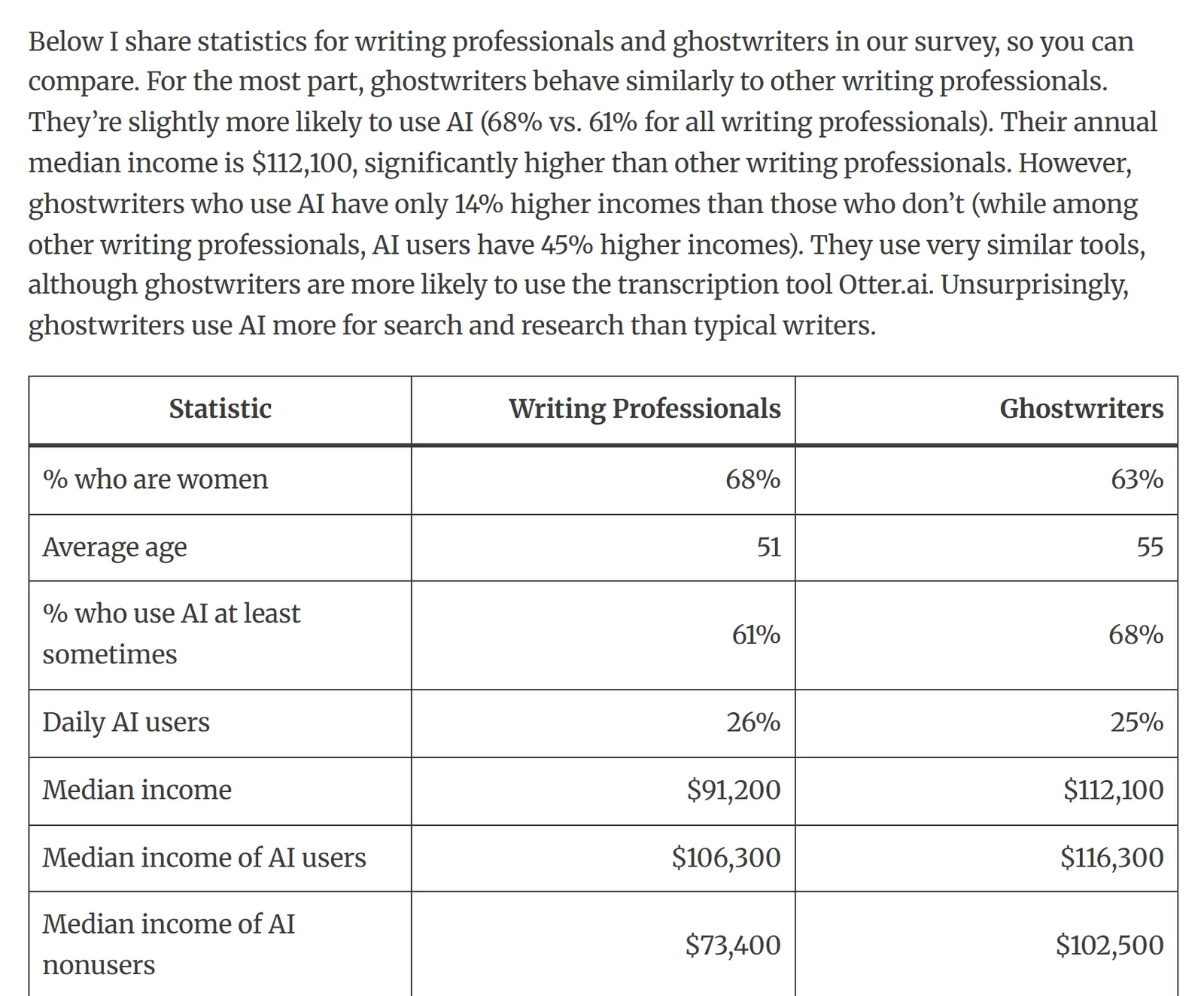
Text in the image: Statistic, Writing Professionals, Ghostwriters. % who are women: 68%, 63%. Average age: 51, 55. % who use AI at least sometimes: 61%, 68%. Daily AI users: 26%, 25%. Median income: $91,200, $112,100. Median income of AI users: $106,300, $116,300. Median income of AI nonusers: $73,400, $102,500. % difference in income, AI users vs. nonusers: 45% higher, 14% higher.
Ghostwriters are less than half as likely as other writers to say AI reduced demand for their work. They are only half as likely to report lower income. Using AI doesn't explain the gap: ghostwriters who use it earn only 14% more than those who don't.
One caution. Gotham Ghostwriters is a ghostwriting agency, so it has a stake in the answer. The ghostwriter group is small, 115 people, and even in that group more people reported a decline than an increase. So read it as a signal, not a promise. The numbers are what writers reported about themselves. Still, they fit the freelance studies above.
A book ghostwriter is hired for something else. They spend months turning one person's experience into a book, chapter by chapter. Read our comparison of a book coach and a ghostwriter to see how that job is split, and our ghostwriter cost breakdown for what it costs.
Will AI replace authors?
The government's data doesn't show it yet. The Bureau of Labor Statistics counted about 140,300 writer and author jobs in 2025. It expects little or no change in that number from 2025 to 2035, with about 11,900 openings a year as people retire or switch jobs.
The median annual wage for writers and authors was $76,910 in May 2025. That figure counts only writers on a payroll. The same page shows that 65% of writers and authors are self-employed.
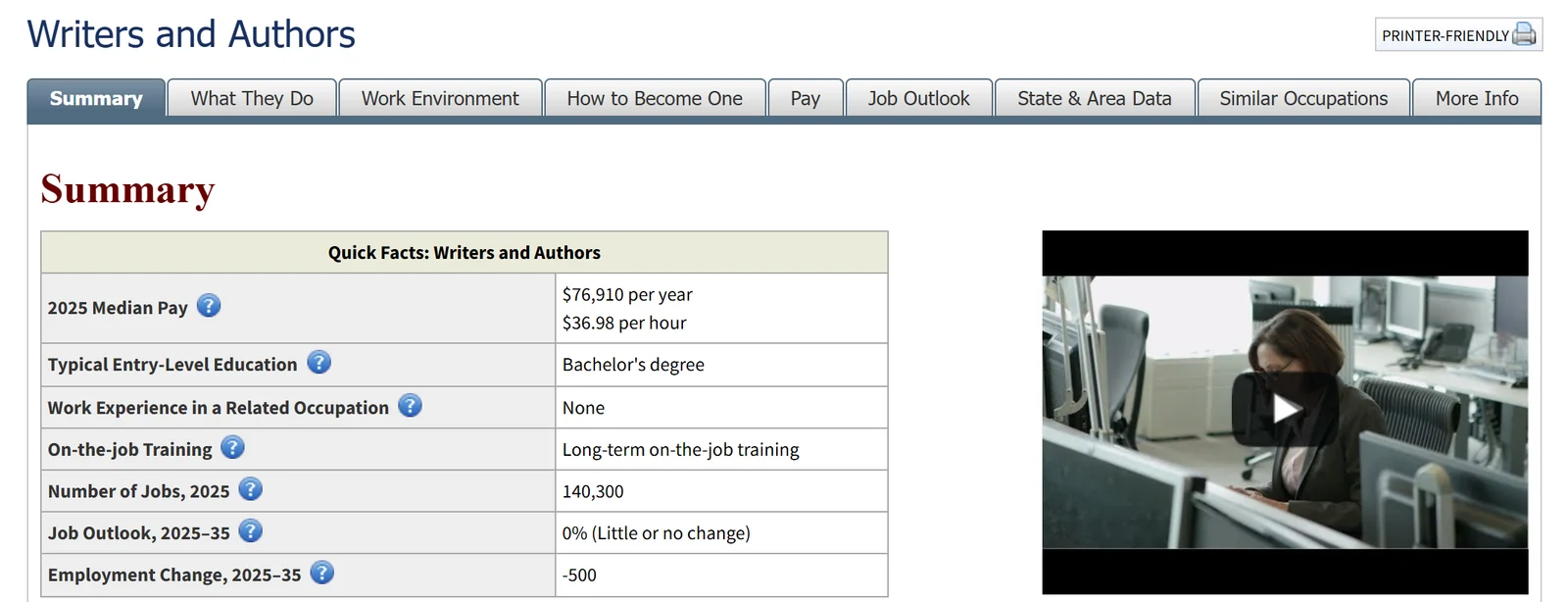
Text in the image: Writers and Authors. Quick Facts: Writers and Authors. 2025 Median Pay: $76,910 per year, $36.98 per hour. Typical Entry-Level Education: Bachelor's degree. Work Experience in a Related Occupation: None. On-the-job Training: Long-term on-the-job training. Number of Jobs, 2025: 140,300. Job Outlook, 2025 to 35: 0% (Little or no change). Employment Change, 2025 to 35: -500.
What changes is the kind of writing people pay for.
How do you write a business book AI can't replace?
Build it from what only you know, and use AI for the drafting. Four habits that follow from the data above:
- Start from your own stories. The client you turned around and the mistake you made early on are facts about your life. AI can help you tell them clearly, but it can't know them.
- Name your idea before you write. Most business books are built around one idea the author is known for: a method, a framework, a term they coined. Ghostwriters are paid for shaping that thinking into a book. Do that part yourself: write "I call this the X method" in your plan.
- Decide the structure first. Choose the chapters, their order and what each one proves before any text exists. A proven nonfiction structure helps.
- Check every number yourself. Every number, case and piece of advice carries your name on the cover. If a figure is wrong, readers blame the author, so every figure needs a source you have opened.
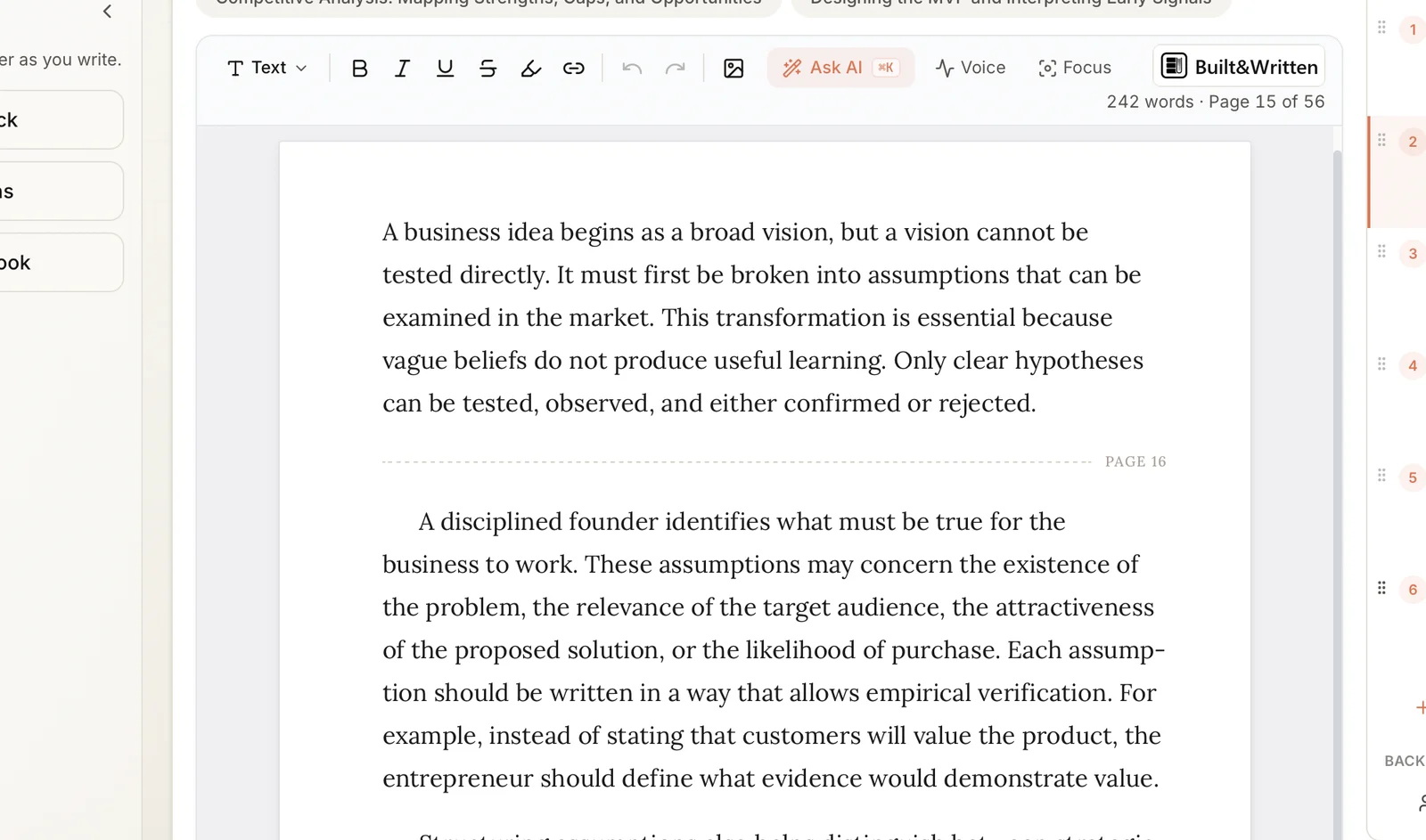
With Built&Written, the material you already have takes the place of a ghostwriter's interviews: posts, talks and client notes. It suggests a chapter plan, and you rename, reorder or cut chapters before anything is written. Then the AI drafts each chapter in your voice, from your own stories and numbers, and you edit every line.
So the hard part, deciding what the book says, stays with you. The slow part, drafting 200 pages, doesn't.
| Step | With Built&Written | With a human ghostwriter |
|---|---|---|
| Where the ideas come from | Your posts, notes and transcripts | Interviews with you over weeks |
| Who approves the plan | You, before any chapter is written | You, after the ghostwriter drafts it |
| How it sounds like you | Voice DNA learns your style from a few pages of your writing | The ghostwriter studies your interviews |
| Who edits the text | You, every chapter, as soon as it's written | You, in rounds, as drafts arrive |
Text in the image: Text. Ask AI. Voice. Focus. 242 words. Page 15 of 56. A business idea begins as a broad vision, but a vision cannot be tested directly. It must first be broken into assumptions that can be examined in the market.
Our guide on writing a book with AI that still sounds like you goes deeper. If you have a folder of posts or notes, try it with those.
Final thoughts
AI is taking the writing that anyone could have written. It hasn't taken the books that only one person could have written. So build your book on your own idea, your own stories and numbers you have checked.
If you already have posts, notes or talks, you already have most of the book. Built&Written turns that material into a book in your voice. See how it works.
- Your idea, named by you. You edit the outline and its chapter titles before any chapter is written.
- Your voice, kept. Voice DNA learns your style from a few pages of your writing.
- Your stories, not invented ones. The chapters are written from the material you add, so the examples are yours.
- Start with what you have. You don't need a manuscript, only notes, posts or talk transcripts. AI writing starts on the Entrepreneur plan; plans are on the pricing page.
Frequently asked questions
Short freelance jobs, yes: they fell after ChatGPT. Book ghostwriting held up so far, and 8 in 10 book ghostwriters in a 2025 survey reported no decline due to AI.
No, according to US job data. The Bureau of Labor Statistics expects little or no change in writer and author jobs from 2025 to 2035.
Yes, if you have little written material and a budget for months of interviews. If you already have written material, you can turn your expertise into a book without a ghostwriter.
Yes, if you start from your own material and decide the plan yourself. Built&Written writes the chapters in your voice from your notes and posts, and you edit every chapter.
Sources & References
- Demirci, Hannane and Zhu, Who Is AI Replacing? The Impact of Generative AI on Online Freelancing Platforms, Management Science, 2025
- Hui, Reshef and Zhou, The Short-Term Effects of Generative Artificial Intelligence on Employment, Organization Science, 2024
- WashU Olin Business School, Study: AI tools cause a decline in freelance work and income, August 24, 2023
- Gotham Ghostwriters, AI and the Writing Profession Survey, 2025
- Josh Bernoff, How ghostwriters use AI and why they're less threatened by it, November 10, 2025
- U.S. Bureau of Labor Statistics, Occupational Outlook Handbook: Writers and Authors
- University of Cambridge, Half of UK novelists believe AI is likely to replace their work entirely, November 20, 2025
About the author

Michael Pavlovskyi
More in informational
Ready to write your book?
Turn your expertise into a professional book with Built&Written.