

These Business Authors Use AI. Here Is What They Let It Do
Key takeaways
- Do well-known authors use AI on their books? Yes. Reid Hoffman, Ethan Mollick, Charlene Li, Katia Walsh and Steven Rosenbaum have all said so in public.
- What do they use it for? Mostly research, structure, fact checks and feedback. Hoffman also put AI text in the book itself.
- What went wrong? Output nobody checked. Fact-checkers found 26 quotes in Rosenbaum's book that did not hold up.
- How should you use AI on your book? Give it your own material, ask it for feedback and checks, write down what it may do, check every quote, and declare AI text.
Which famous authors use AI?
Authors using AI include some of the best-known names in business and tech nonfiction. Our guide to what published authors use AI for covers the surveys. This article names names, each with the author's own words and a dated source.
| Author | Book | What AI did | What the author did | Source |
|---|---|---|---|---|
| Reid Hoffman | Impromptu (2023) | Wrote 800+ pages of answers to his prompts | Picked and edited the best into a book | Hoffman's thread, March 15, 2023 |
| Ethan Mollick | Co-Intelligence (2024), Co-Existence (2026) | Rewrites when stuck, feedback on each chapter, fact checks | Wrote every chapter draft | oneusefulthing.org, June 4, 2026 |
| Charlene Li and Katia Walsh | Winning with AI (2026) | Structure, research, search of four years of their own work | Wrote the prose | bernoff.com, March 26, 2026 |
| Steven Rosenbaum | The Future of Truth (2026) | Organized research, summaries, language | Wrote the book, disclosed AI in the acknowledgments | Fortune, October 6, 2026 |
Most of these authors gave AI the work around the writing: finding, sorting, checking. Ethan Mollick, a professor who writes the One Useful Thing newsletter on AI, put it plainly about Co-Existence: "I wrote every chapter draft myself." AI readers went through each chapter, and several AI models checked his facts, though he still read every paper himself.
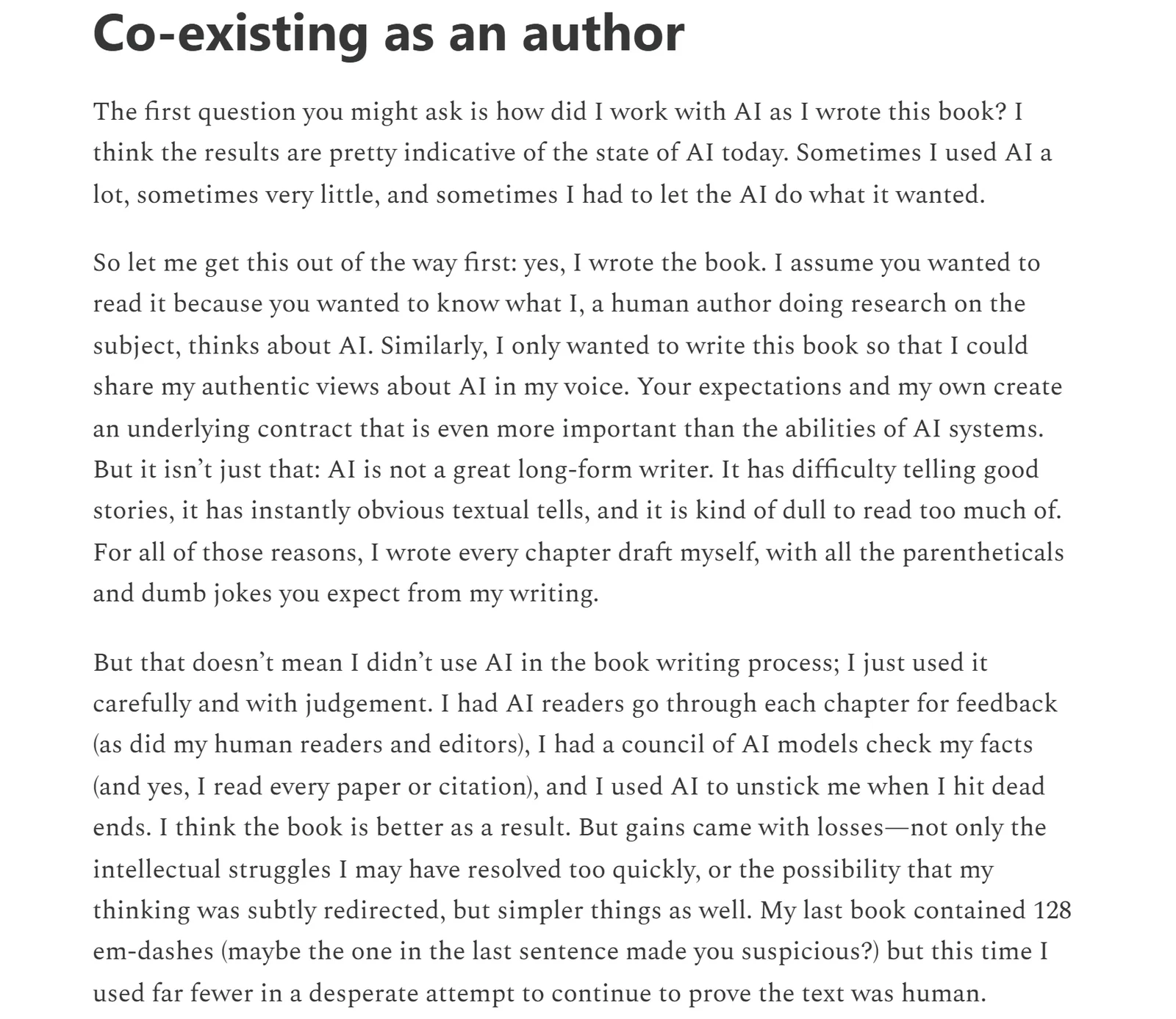
Text in the image: Co-existing as an author. For all of those reasons, I wrote every chapter draft myself... I had AI readers go through each chapter for feedback... I had a council of AI models check my facts (and yes, I read every paper or citation).
Which authors using AI let it write part of the book?
A few authors put AI text in the book on purpose, and they said so up front.
Reid Hoffman, the LinkedIn cofounder, wrote Impromptu with GPT-4 starting in 2022, months before OpenAI released the model on March 14, 2023. In his own announcement he counted "over 1,000 prompts" and "800+ pages of outputs" in the first few months. In a Fortune interview he called it "the first book about A.I. with A.I. as a co-author."
Vauhini Vara took it further in Searches (2025): she shared her chapters with ChatGPT and the exchanges became part of the book, as she told Electric Literature.
Fiction went public too. Rie Kudan won Japan's Akutagawa Prize in 2024 and said about 5% of her novel came straight from generative AI, as Vice reported. Business authors use AI in a different way from novelists, as our guide on how business authors use AI shows.
What went wrong for authors using AI?
AI makes things up with confidence, and a printed book can't be patched like a web page.
Steven Rosenbaum spent four years on The Future of Truth (2026). He used ChatGPT, Claude and other tools to organize research, summarize documents and refine language, and said so in the acknowledgments. After publication, a reporter checked some of the book's quotes. His publisher, BenBella Books, then had two fact-checkers go through the manuscript line by line, and they found 26 quotes that didn't hold up. A revised edition came out October 6, 2026. He wrote in Fortune: "AI didn't write the book, I did."
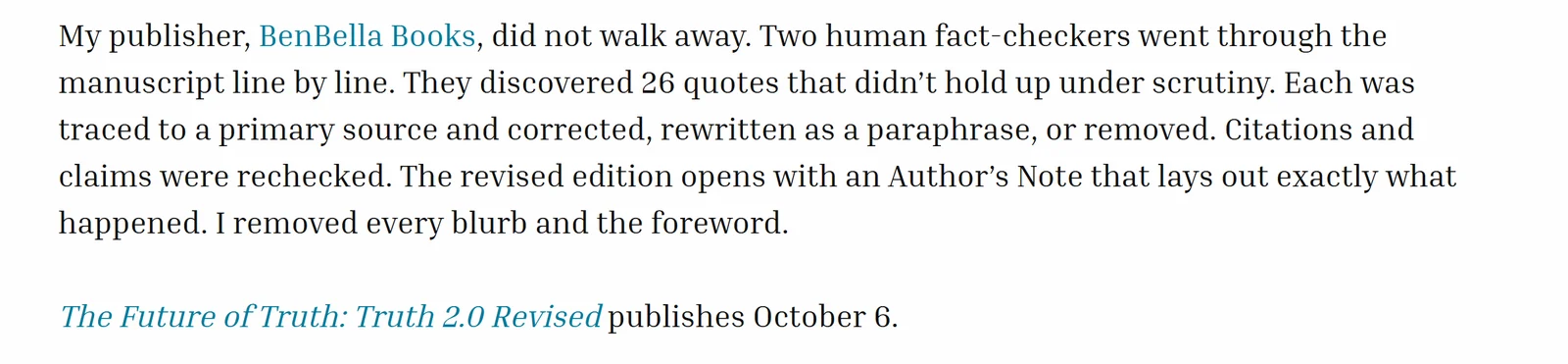
Text in the image: Two human fact-checkers went through the manuscript line by line. They discovered 26 quotes that didn't hold up under scrutiny. Each was traced to a primary source and corrected, rewritten as a paraphrase, or removed.
Reid Hoffman sent out personalized copies of Impromptu with AI-written extras. He told Fortune he didn't cross-check one of them, and the music list it made had three songs that don't exist.
Charlene Li admitted a quieter problem in her newsletter: under time pressure, "I relied overly on AI, which made my writing less sharp."
How do you give AI your book?
The authors above answer five questions every author faces. Here is what they did, and what it means for you.
1. What to give AI. Li and Walsh gave AI four years of their own work through a custom ChatGPT model, and used Claude to structure the content, Perplexity for research and Gemini to search their interview transcripts, as Bernoff's review of their Appendix C describes. For you, that means your posts, notes, talk transcripts and any rough draft. The more of your own material the AI works from, the more the book stays yours.
2. What to ask for. Mollick asked for structure, feedback on each chapter, fact checks and a rewrite when he was stuck. Don't ask AI to write what has to be yours: your ideas and your stories. Marketing author Mark Schaefer quit an AI-assisted rewrite of his bestseller after about a day, writing on his blog that "the best average answer from the past creates a lousy book."
3. What to keep for yourself, in writing. Josh Bernoff, a book coach, publishes an AI disclosure form you can copy:
- Yes: research, summaries, interview transcripts, brainstorming, title ideas, outlines, finding errors in drafts.
- No: first drafts, anything meant for publication, citations, final graphics.
4. What to check. Every quote and every number, against its source. Rosenbaum's 26 quotes are what skipping that step costs.
5. What to declare. KDP asks you to declare AI-generated text, images or translations when you publish. Our guide to book disclaimer examples shows how to word a note for readers.
The hard part is step 1. Li and Walsh used four AI tools and a custom GPT to keep their own material in reach. Built&Written keeps it in one place: you add your posts, notes and transcripts, approve a chapter plan, and the AI writes each chapter in your voice from that material. You read and edit every line. It doesn't promise sales, awards or Amazon's approval, and it doesn't publish for you: you upload the files yourself.
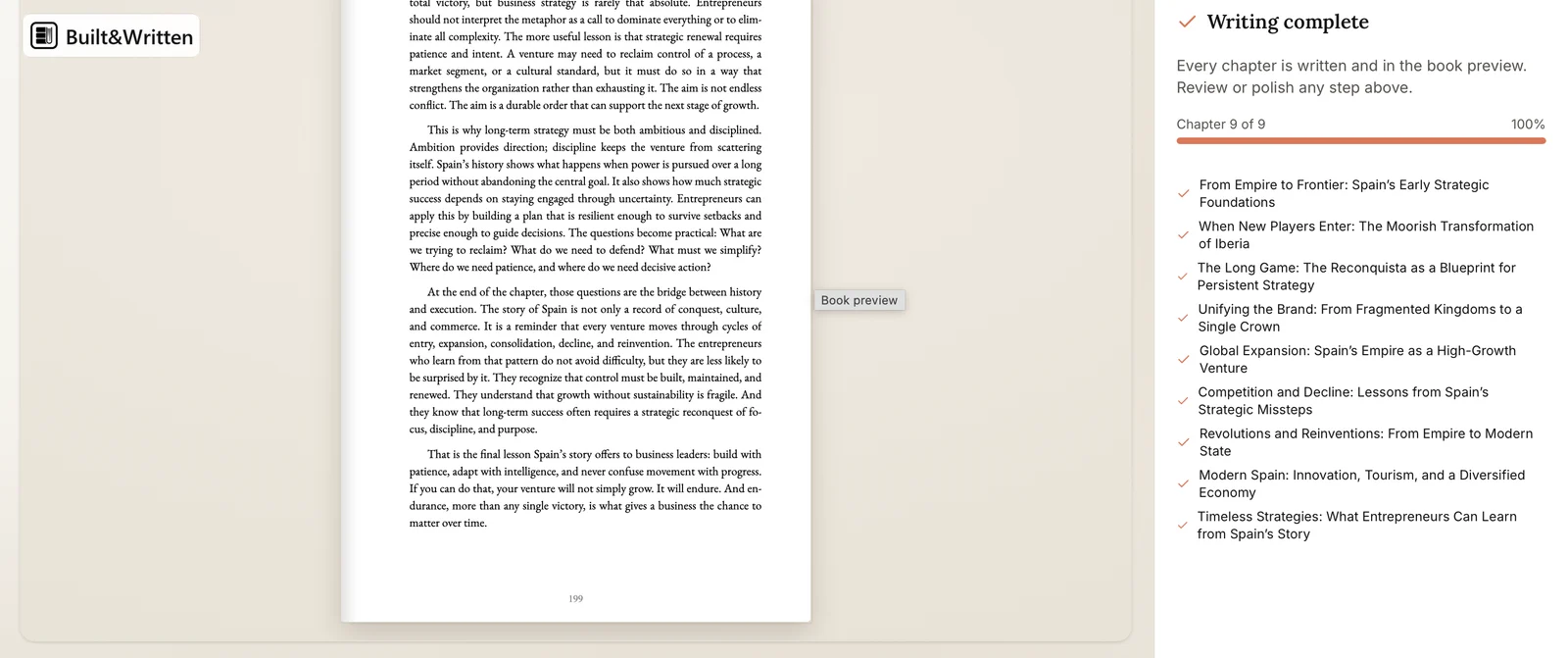
Text in the image: Writing complete. Every chapter is written and in the book preview. Review or polish any step above. Chapter 9 of 9, 100%.
Our guide on writing a book with AI that still sounds like you goes deeper.
Final thoughts
AI already helps write serious books, and the ones that held up have one thing in common: the ideas came from the author, and someone checked the rest. If you have posts, notes or talks, you already have most of a book. See how it works.
Frequently asked questions
No. KDP counts text an AI tool created as AI-generated "even if you applied substantial edits afterwards." AI-assisted means you created the content yourself and used AI to edit, refine or error-check it. So a chapter an AI drafted and you rewrote is still declared as AI-generated. A chapter you wrote and polished with AI needs no disclosure.
It depends on the house. The literary agency P.S. Literary says it cannot consider manuscripts written, revised or edited with AI tools, even for proofreading or translation. Steven Rosenbaum's publisher, BenBella Books, stayed with his AI-assisted book: it paid for two fact-checkers and released a revised edition. Read each agent's or publisher's submission page before you pitch.
Sources & References
- Reid Hoffman, thread announcing Impromptu, March 15, 2023
- Fortune, Reid Hoffman interview, May 25, 2023
- Ethan Mollick, Co-Existence and the end of Co-Intelligence, June 4, 2026
- Electric Literature, Why Vauhini Vara Used ChatGPT to Write a Book About Big Tech and Herself, April 9, 2025
- Josh Bernoff, AI Disclosure, checked November 12, 2026
- Josh Bernoff, Charlene Li and Katia Walsh demonstrate the right way to build a book with AI help, March 26, 2026
- Charlene Li, The truth about writing a book on AI, checked November 12, 2026
- Steven Rosenbaum, Fortune commentary on The Future of Truth, October 6, 2026
- Mark Schaefer, AI-assisted book attempt, April 22, 2024
- Vice, Rie Kudan and the Akutagawa Prize, January 19, 2024
- Amazon KDP, Content Guidelines on AI content, checked November 12, 2026
- P.S. Literary Agency, Submissions, checked November 12, 2026
- OpenAI, GPT-4, March 14, 2023
About the author

Michael Pavlovskyi
More in informational
Ready to write your book?
Turn your expertise into a professional book with Built&Written.