

What Do Published Authors Actually Use AI For?
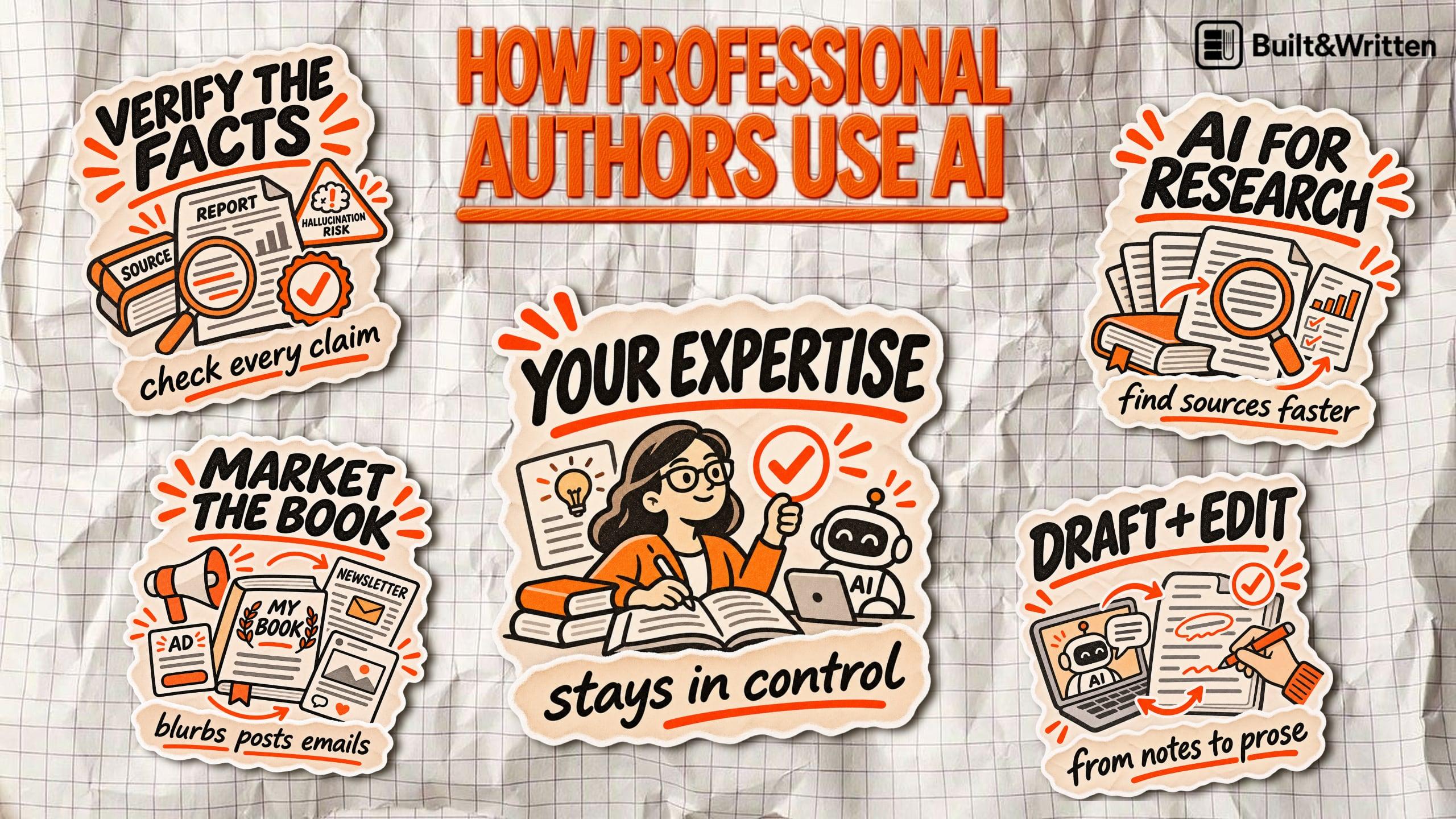
The debate over AI-written books often assumes authors are handing entire manuscripts to ChatGPT. The reality is more practical.
Published authors use AI to research topics, brainstorm ideas, organize chapters, refine drafts, and market their books. In BookBub's 2025 survey of more than 1,200 authors, 81% of those using generative AI reported using it for research. Marketing and outlining were also leading applications.
For entrepreneurs, consultants, and experts publishing nonfiction, the distinction matters. AI can help turn existing knowledge into a structured book without becoming the source of that knowledge.
How Many Published Authors Actually Use AI?
AI adoption among published authors is growing, but the numbers depend on who's being surveyed.
| Research | Sample | Main finding |
|---|---|---|
| BookBub, 2025 | 1,229 authors, mostly self-published | 45% used generative AI |
| Gotham/Bernoff, 2025 | Nonfiction-author subgroup within a 1,481-person survey | 58% used AI at least sometimes |
| Gotham/Bernoff, 2025 | 291 fiction authors | 42% used AI at least sometimes |
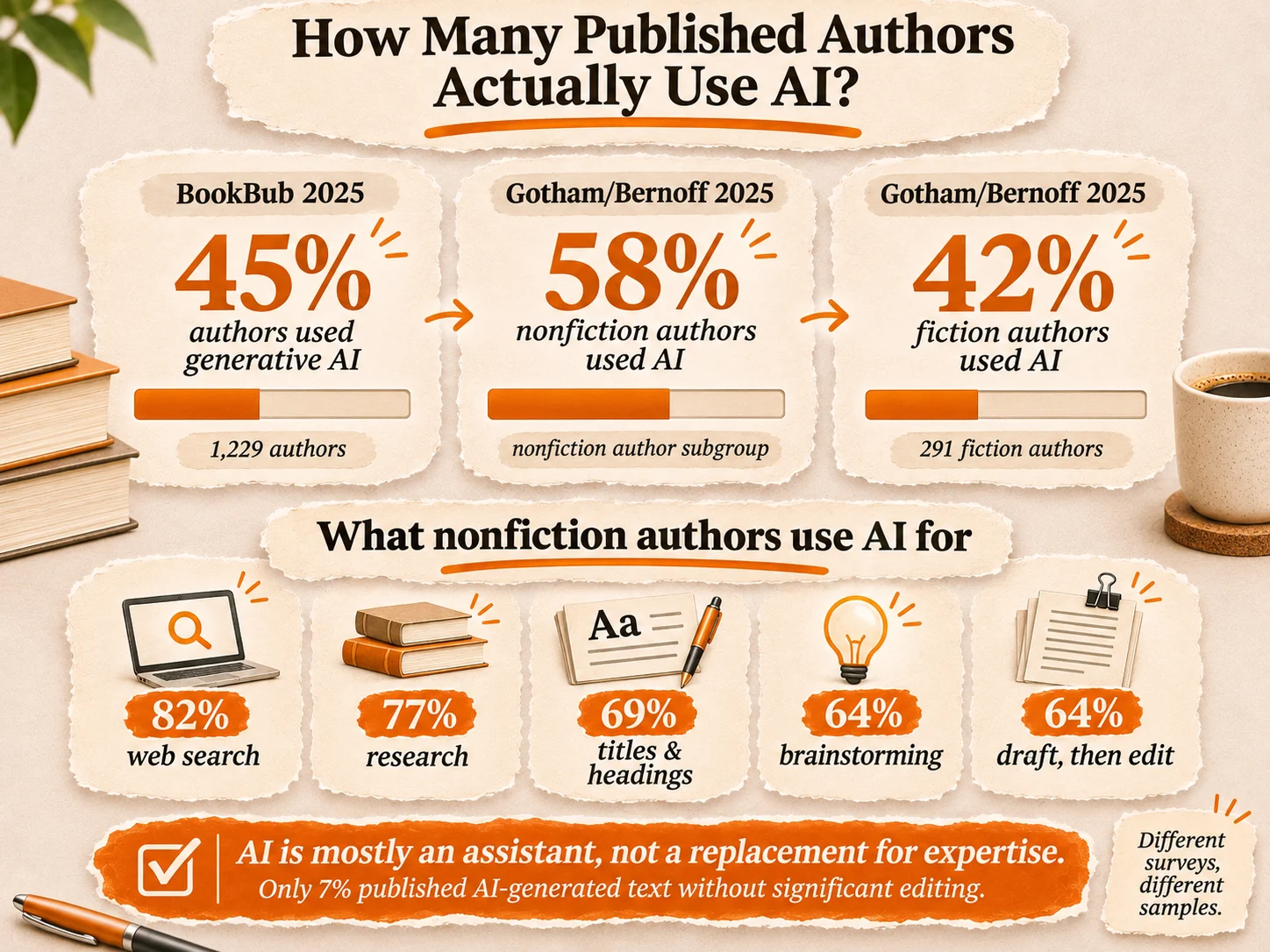
A 2025 study by Gotham Ghostwriters and Josh Bernoff surveyed 1,481 respondents across writing professions. It found that 58% of nonfiction authors used AI at least sometimes, compared with 42% of fiction authors.
The broader group of nonfiction writing professionals reported 61% adoption. That group included journalists, ghostwriters, editors, and content marketers, not just published book authors.
Meanwhile, BookBub's 2025 survey gathered responses from 1,229 authors, primarily self-published. About 45% reported using generative AI, with 81% of those users applying it to research. Marketing materials and outlining were other leading applications.
The difference isn't necessarily contradictory. BookBub's respondents were predominantly fiction authors, while the Gotham study covered a wider range of professional work.
The tasks reveal what nonfiction authors actually delegate to AI. Among nonfiction authors using AI in the Gotham study, 82% used it as a replacement for web search, 77% for other research, 69% for suggesting titles and headings, and 64% for brainstorming. Another 64% used AI to generate text they subsequently edited.
These findings suggest that AI-assisted authorship covers several stages of the writing process, from finding information to developing prose. They do not show that most authors publish AI-generated manuscripts unchanged.
Across AI-using writing professionals in the same study, only 7% reported generating text that was published without significant editing. That distinction matters: using AI to help produce an editable draft is not the same as publishing its output largely unchanged.
For nonfiction authors, the evidence points toward AI as a practical assistant, not a replacement for original expertise.
How Do Published Authors Use AI for Research?
Research is one of the most common ways published authors use AI. In BookBub's 2025 survey, 81% of authors who used generative AI reported using it for research. The appeal is straightforward: AI helps authors explore unfamiliar subjects without starting every search from scratch.
For nonfiction authors, that can mean identifying relevant studies, understanding industry terminology, or developing questions worth investigating. AI can suggest search terms, point toward potential sources, and highlight areas where more evidence is needed.
It also helps organize material authors already have. Uploading interview transcripts, reports, or research notes allows AI to produce summaries, extract recurring themes, and compare claims across documents.
Consider a management consultant writing a book about remote work. Instead of manually reviewing dozens of industry reports, they could use AI to identify recurring productivity metrics, summarize competing viewpoints, and flag contradictory findings. The consultant would still need to check the original reports before using those findings in the manuscript.
That distinction matters. In a 2026 analysis of AI-assisted research, nonfiction author Josh Bernoff recommends using AI to discover and understand sources, not treating its answers as verified evidence.
AI can invent studies, misrepresent statistics, and attribute quotations to the wrong people.
The practical rule: Use AI to find research directions, summarize documents, and organize evidence. Then open the original sources, verify important claims, and cite the publications themselves.
AI can make research faster. It cannot make an unsupported claim trustworthy.
How Do Authors Use AI to Organize Ideas and Outline Books?
Having expertise doesn't automatically mean knowing how to structure a book. Many nonfiction authors already have years of presentations, client discussions, research notes, and professional insights. The challenge is turning that material into a manuscript readers can follow.
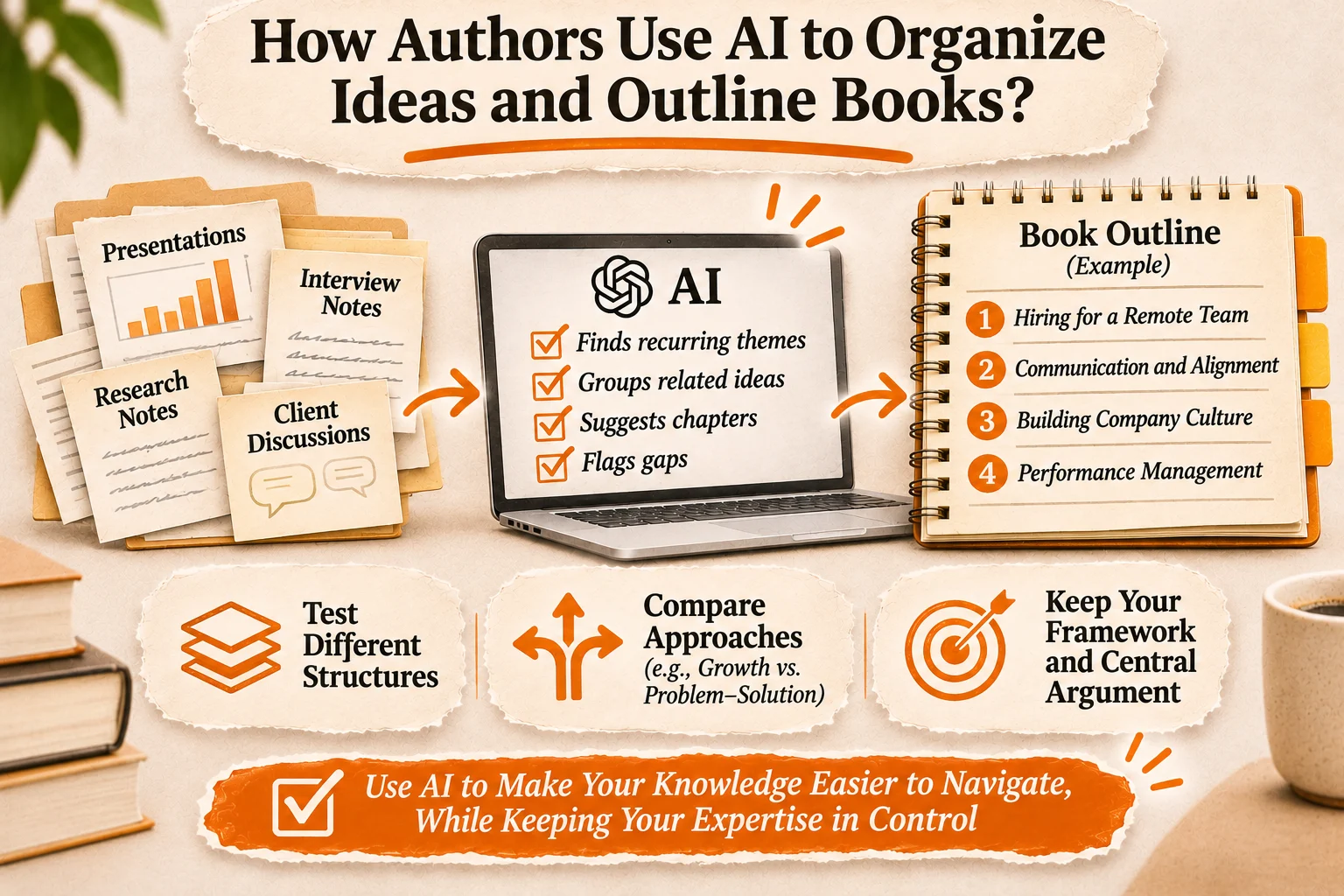
AI can help by converting scattered materials into a topic inventory. Authors can upload meeting notes, interview transcripts, or presentation slides and ask AI to identify recurring themes, group related ideas, and suggest potential chapters.
Consider a startup founder writing a book about building a remote-first company. Over five years, they've collected investor presentations, internal documents, leadership lessons, and conference talks.
AI could organize that material into chapters covering hiring, communication, company culture, and performance management. It might also identify repeated arguments or reveal that the proposed chapter on employee retention lacks supporting examples.
Authors can then test different structures. Should the book follow the company's growth chronologically? Or would readers benefit more from a problem-and-solution format?
AI can compare these approaches and suggest chapter sequences based on the book's intended audience.
But organization is not the same as authorship. AI might recommend familiar business-book frameworks that dilute what makes an author's expertise distinctive.
The founder still needs to decide which experiences matter, which arguments deserve emphasis, and what readers should learn.
The best use of AI here is to make existing knowledge easier to navigate, while keeping the author's original framework and central argument in control.
Do Published Authors Use AI to Write and Edit Their Books?
Yes, but using AI to improve a manuscript is different from asking it to write the book.
Published authors can use AI to develop rough passages from their notes, rephrase confusing explanations, and experiment with different ways to communicate an idea. For nonfiction authors, this can be particularly useful when turning technical knowledge into accessible language.
Editing offers another practical application. AI can identify repetitive sentences, suggest clearer wording, correct grammar, and flag inconsistent terminology across chapters. It can also highlight sections where an argument feels incomplete or a transition needs work.
But polished prose isn't necessarily good nonfiction.
An AI-generated chapter about leadership might sound convincing while offering generic advice, invented examples, or conclusions unsupported by the author's experience. A consultant's real client work, original frameworks, and professional judgment are what give the book substance.
Amazon KDP distinguishes between AI-assisted and AI-generated content. When authors create their own material and use AI to edit, refine, or improve it, KDP classifies the result as AI-assisted and does not require disclosure.
When AI creates the actual text, images, or translations, KDP classifies that content as AI-generated and requires disclosure, even if the author substantially edits it afterward. AI-generated passages drafted from an author's notes can fall into this category because the tool produced the text itself.
For entrepreneurs and experts, the stronger approach is to write from personal knowledge and use AI as an editorial assistant.
Let it question unclear arguments, identify repetition, and improve readability. Keep the examples, conclusions, and final wording under human control.
AI can improve how expertise is communicated. It cannot supply the expertise itself.
How Do Authors Use AI Without Introducing False Information?
AI can speed up nonfiction research, but it can also introduce mistakes that look convincing. Fabricated statistics, nonexistent studies, misattributed quotations, and invented citations are serious risks when publishing a book built on professional expertise.
The solution isn't avoiding AI entirely. It's keeping a clear boundary between AI-generated suggestions and verified evidence.
Nonfiction author Josh Bernoff makes this distinction in his 2026 guide to AI-assisted research. AI can help locate sources and summarize information, but authors remain responsible for checking what those sources actually say.
A practical approach starts with original documents. Before including a statistic, quotation, or research finding, open the source and confirm its accuracy. Check the publication date, methodology, and context. A real citation doesn't automatically mean the claim is supported.
Authors should also maintain a manuscript reference document containing approved facts, source links, important definitions, and consistent terminology. This helps prevent contradictory claims or changing definitions across chapters.
During editing, review each chapter for unsupported statements. Ask AI to flag claims that might need verification, but don't rely on it to certify their accuracy.
The rule is simple: AI can suggest what to investigate, but the author must decide what is true.
For entrepreneurs and experts, that responsibility is particularly important. Readers aren't just evaluating the book. They're evaluating the credibility of the person behind it.
How Do Published Authors Use AI to Market Their Books?
Publishing a nonfiction book is only part of the job. Authors also need to get it in front of the right audience, and AI can help with that process.
In BookBub's 2025 author survey, creating marketing materials was among the most common AI applications. Respondents described using it for advertising copy, book blurbs, taglines, newsletters, and social media content.
For entrepreneurs and consultants, these applications extend beyond selling copies. A business book can introduce their expertise to potential clients, event organizers, and industry partners.
AI can help develop alternative titles, subtitles, and positioning statements. It can also turn a book's central ideas into LinkedIn posts, newsletter drafts, or short video scripts without rebuilding each piece from scratch.
Consider a consultant publishing a book about organizational change. They could use AI to turn one chapter into five LinkedIn posts, prepare podcast interview questions, and brainstorm a launch campaign aimed at business leaders.
But the output still needs editorial judgment. AI-generated promotional copy can exaggerate results, invent endorsements, or make the author's expertise sound generic.
Every claim should match the book, and every promotional message should reflect the author's actual experience.
The goal isn't to produce more marketing content for its own sake. It's to communicate the book's strongest ideas consistently and reach people who could benefit from the author's knowledge.
What Is a Practical AI Workflow for a Nonfiction Author?
The most effective approach is to give AI specific tasks at each stage of publishing, while keeping the author's knowledge and judgment at the center.
Here's a seven-stage workflow for entrepreneurs and experts:
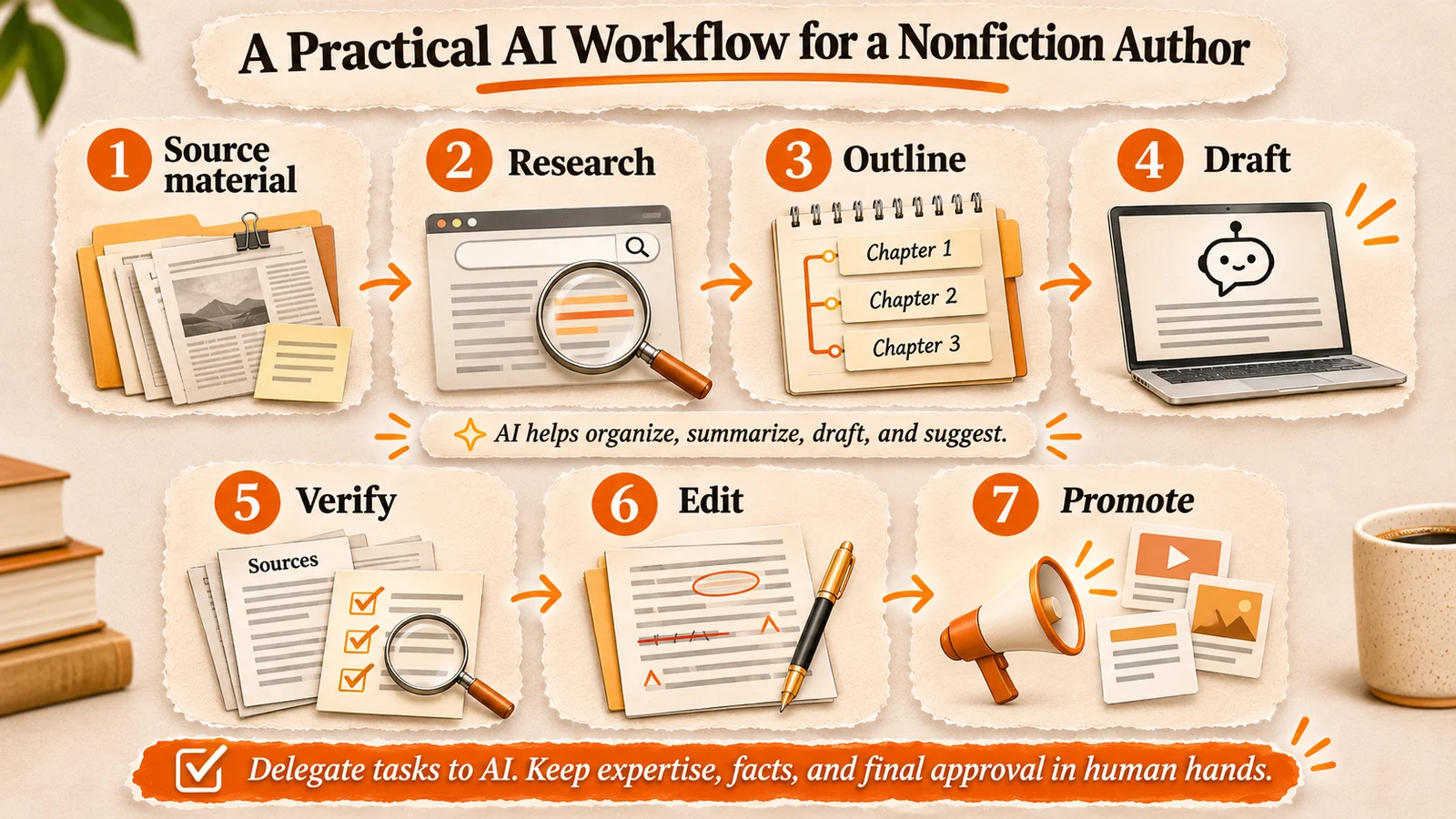
- Source material: Collect presentations, articles, interviews, and professional notes. AI can identify recurring themes, but the author decides which ideas represent their expertise.
- Research: Use AI to explore questions, identify potential sources, and summarize documents. Verify every important claim against original evidence.
- Outline: Ask AI to group ideas into chapters and suggest a logical sequence. Review the structure to protect your central argument.
- Draft: Develop chapters from existing material. AI can assist with drafting, but the author must approve the content and supply original insights.
- Verify: Check statistics, quotations, references, and factual claims. Never treat AI-generated citations as proof.
- Edit: Use AI to identify unclear passages, repetition, and inconsistent terminology. Make the final editorial decisions yourself.
- Promote: Generate marketing ideas, book descriptions, and social posts. Review everything before publication.
Built&Written can support this process by organizing source content, proposing chapter structures, and developing manuscripts with AI assistance while keeping authors in control.
The verdict: Delegate organization, repetitive tasks, and editorial suggestions to AI. Keep factual accuracy, original expertise, and final approval firmly in human hands.
Frequently asked questions
It depends on the audience surveyed. A 2025 Gotham Ghostwriters and Josh Bernoff study found that 58% of nonfiction authors used AI at least sometimes. BookBub's 2025 survey reported approximately 45% adoption among its predominantly fiction-author respondents. Neither figure represents every published author.
Yes, although not necessarily to generate entire manuscripts. Authors use ChatGPT for research, brainstorming, outlining, drafting, and editing. In BookBub's survey, 85% of AI-using respondents reported using ChatGPT.
Research, brainstorming, suggesting titles, organizing material, drafting, and editing are common applications. Authors also use AI to create promotional content. The specific priorities depend on the author's publishing process and professional goals.
Yes. Amazon KDP permits AI-assisted content without requiring AI-use disclosure. However, authors must disclose AI-generated text, images, or translations, even when substantially edited. All books must comply with KDP's content guidelines.
AI can assist with research, organization, proofreading, and editorial suggestions. But it cannot independently establish an author's professional experience, verify every claim, or reliably assess a manuscript's argument. Human expertise and editorial judgment remain essential.
Yes. AI can compare chapters for changes in tone, terminology, and writing style. Authors can provide samples of their own work and a reference document containing preferred language, definitions, and editorial rules. However, AI suggestions still need human review to preserve the author's distinctive voice and professional perspective.
The biggest risks include fabricated facts, unreliable citations, generic explanations, and losing the author's original perspective. AI can also misinterpret research or introduce claims unsupported by the source material. Authors should verify important information, review every AI-assisted passage, and ensure the final manuscript reflects their actual expertise.
Sources & References
- How Authors Are Thinking About AI (BookBub, 2025)
- The emerging divide between AI users and nonusers (Gotham Ghostwriters, 2025)
- AI Writing Survey report (Gotham Ghostwriters and Josh Bernoff, 2025)
- The rules: using AI to do research (Josh Bernoff)
- Content Guidelines: Artificial Intelligence (Amazon KDP)
About the author

Polina Karlashchuk
More in informational
Ready to write your book?
Turn your expertise into a professional book with Built&Written.