

Should You Let AI Write the Last Chapter of Your Book?
Yes. An AI conclusion generator can write the last chapter of your book in one answer, and the draft usually reads well.
On November 10, 2026 we tried it three ways with the same four short chapters: on Built&Written, ChatGPT and Gemini. Below you see what each one wrote and what to check before you publish.
What is Built&Written?
Built&Written is a platform for writing nonfiction books and preparing them for publishing. Its AI writes a book from material you already have, like notes, posts and talk transcripts (the typed text of a talk), in your voice. It also formats a book you've already written without changing a word. You get a print PDF and files for KDP (Kindle Direct Publishing, Amazon's self-publishing service) and publish the book yourself.
Key takeaways
- The last chapter can be written with the rest of the book. We pasted four short chapters into Built&Written and got an outline of 7 chapters, with a closing chapter at the end.
- An AI assistant writes a conclusion in one answer. It only knows what you paste in, so check every detail.
- KDP wants to know about AI text. It counts text that AI created as "AI-generated", even after you edit it.
What does the last chapter of a nonfiction book have to do?
The last chapter of a nonfiction book is the conclusion. Its job is to send the reader away knowing what the book gave them and what to do next. It does three things:
- It pulls your main points together. Briefly, in the order the reader met them.
- It gives one next step. One clear thing the reader can do today.
- It leaves a last thought. Why all this matters for the reader.
It should not stop at a short recap, repeat your introduction or add new ideas. Book editor C.K. Bush, writing on Write Nonfiction NOW (2017), says a bare summary wastes the reader's last chapter. The article suggests a list of practical steps for how-to books, and a look at the bigger picture for books about ideas.
Most business books can end with a conclusion and skip the epilogue. Our guide on prologue vs epilogue explains when a book needs an epilogue.
Can an AI conclusion generator write the last chapter of your book?
It can. Search for "ai conclusion generator" and most results are tools made for school essays. Two examples are Grammarly and Hypotenuse AI (checked November 10, 2026).
For a book you have two routes. In the first, an AI assistant writes only the conclusion, from chapters you paste in. You need a finished book body first. In the second, a platform writes the whole book from your notes, and the last chapter is part of that book. You do not need the body first.
How does Built&Written write the last chapter with the rest of your book?
On Built&Written the ending is not a separate job. It is the last chapter of an outline that you can see and change before anything is written.
- Paste your material. We pasted the four test chapters, 317 words about following up on sales proposals. You can also upload a file (.pdf, .docx, .rtf, .txt or .md).
- Answer a few short questions. Book type, tone, audience and length. We kept the suggested answers.
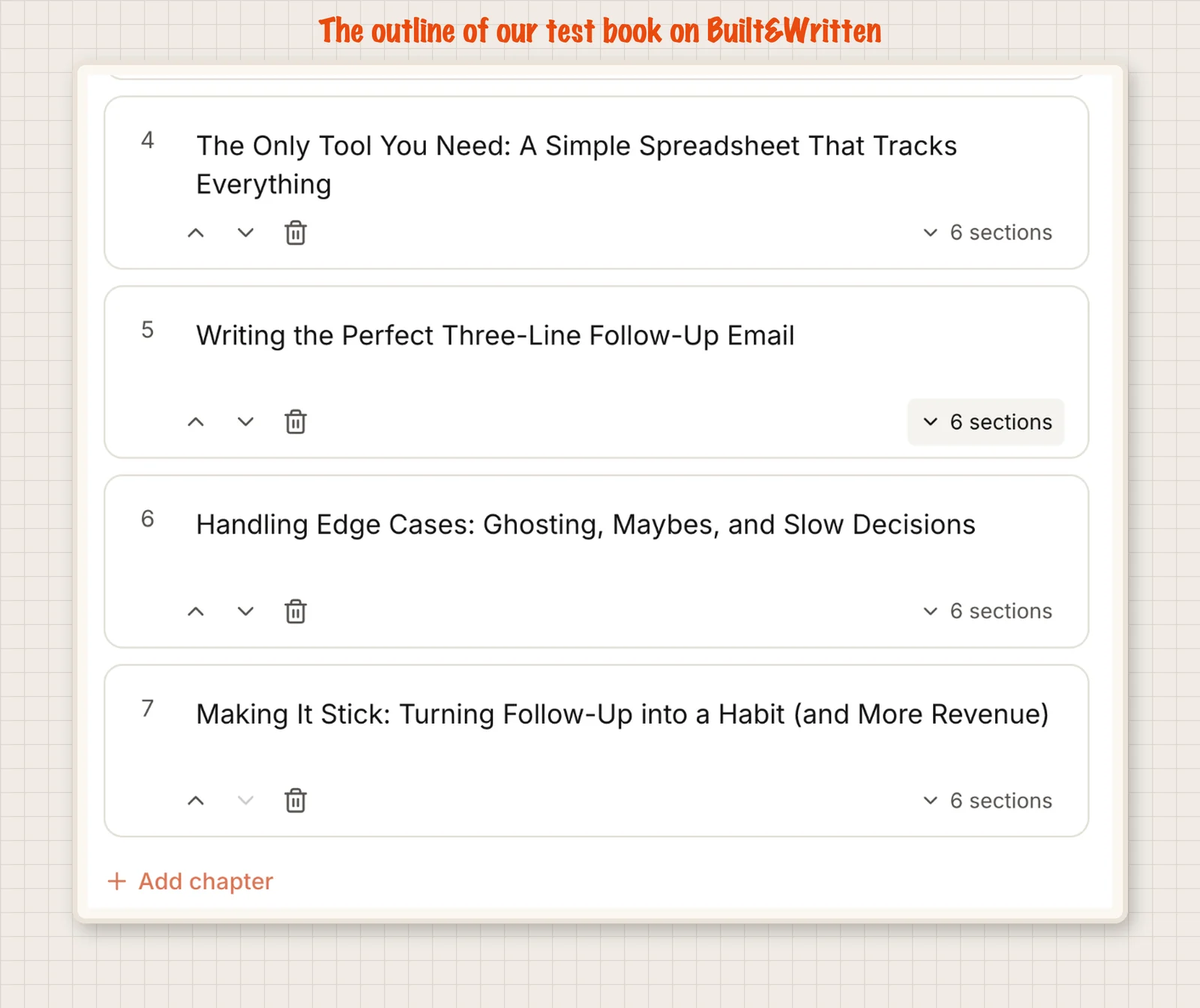
- Look at the outline. It appeared in under a minute: 7 chapters. The last one, "Making It Stick", is the closing chapter. You can rename, move or delete any chapter, and add your own. You see how your ideas fall into chapters before the book is written.
- Press write. In the fast mode (the quick one) all 7 chapters were written in under two minutes. A cover was added in the background.
- Read and edit. Open any chapter and change it. You can select a passage and use Ask AI, a menu of quick fixes for the text you select: Sound more human, Tighten, Expand, Simplify and a few more. Or edit by hand. You do not have to accept every AI choice.
- Download the files. They are KDP-ready: made to meet the requirements of Amazon KDP. You upload them to KDP yourself, in your own account.
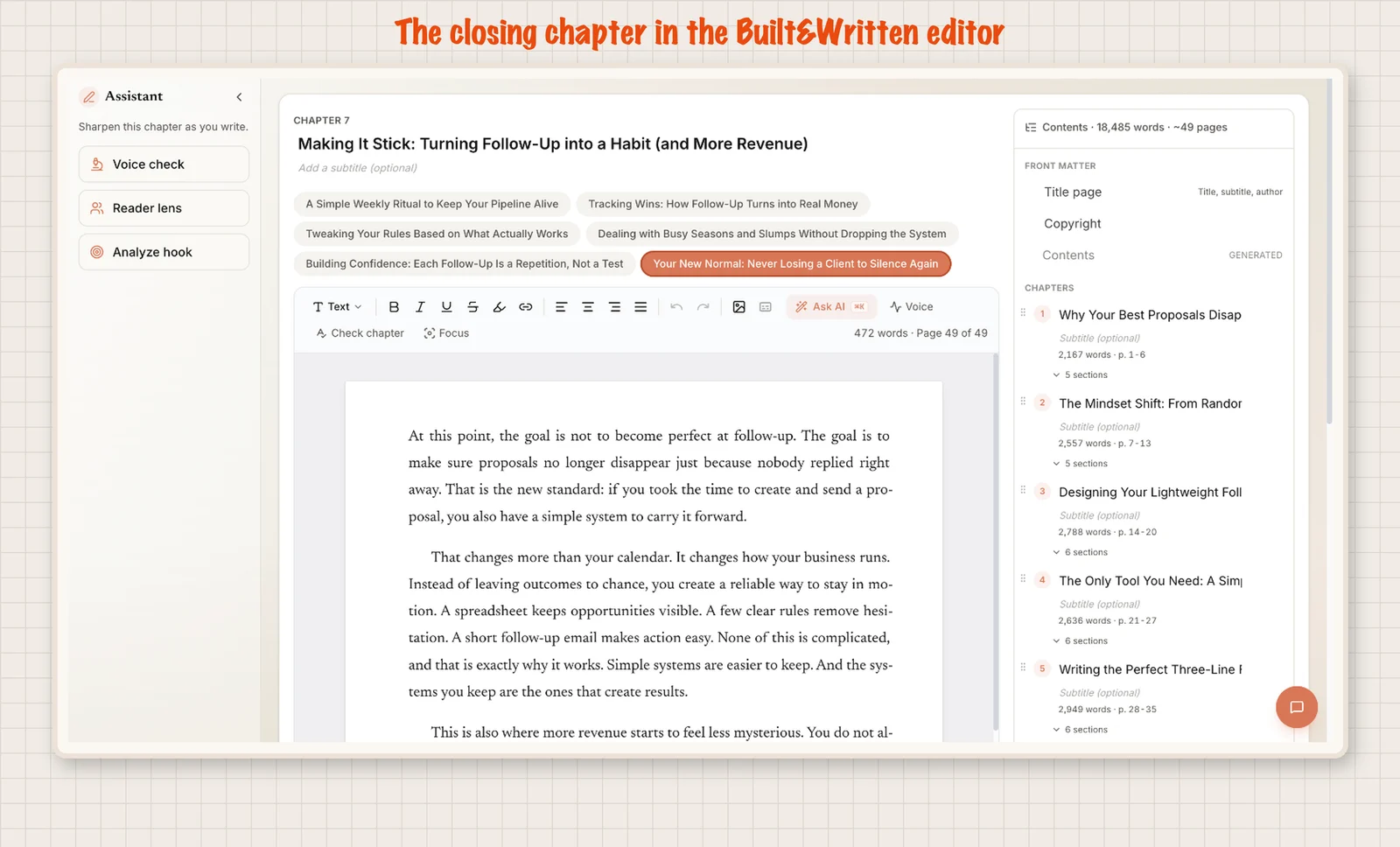
We read the closing section. It added no new people and no results, and it said a system does not guarantee a yes every time.
Note: In this test we gave the platform only 317 words, so it shows the process, not the quality of your book. With your own posts, notes and transcripts, the chapters come from your material.
Voice DNA is our feature that learns your writing style from samples of your own writing. It helps the chapters sound like you.
You already have a finished manuscript? A manuscript is the full text of your book. Upload it as a Word file. The platform keeps your words exactly and does not rewrite them. It finds a closing section called Conclusion and puts it at the end, without a chapter number. The layout is rebuilt from the platform's print templates, so your fonts and margins do not carry over.
Free tools help once the book is ready: the Book Blurb Generator drafts your Amazon description, the Book Description Grader scores it and the Book Title Generator gives title ideas.
How did we test the AI conclusion generators?
The two assistants got the same four chapters of a short book we made up, The Quiet Pipeline. It is a guide for freelance consultants who lose leads because they do not follow up. A made-up consultant named Dana appears in three chapters.
We gave both tools the same prompt: "Write the conclusion chapter for my nonfiction book", plus a short description and the four chapters. We used ChatGPT on the free plan and Gemini with the Flash model.
We checked each conclusion in four ways. Do the facts match? Does it add anything new? Does it cover the main lessons? Could its last paragraph end any book?
This is one run per tool and one made-up book. The same prompt can give another answer tomorrow.
What did ChatGPT write?
ChatGPT wrote 368 words.
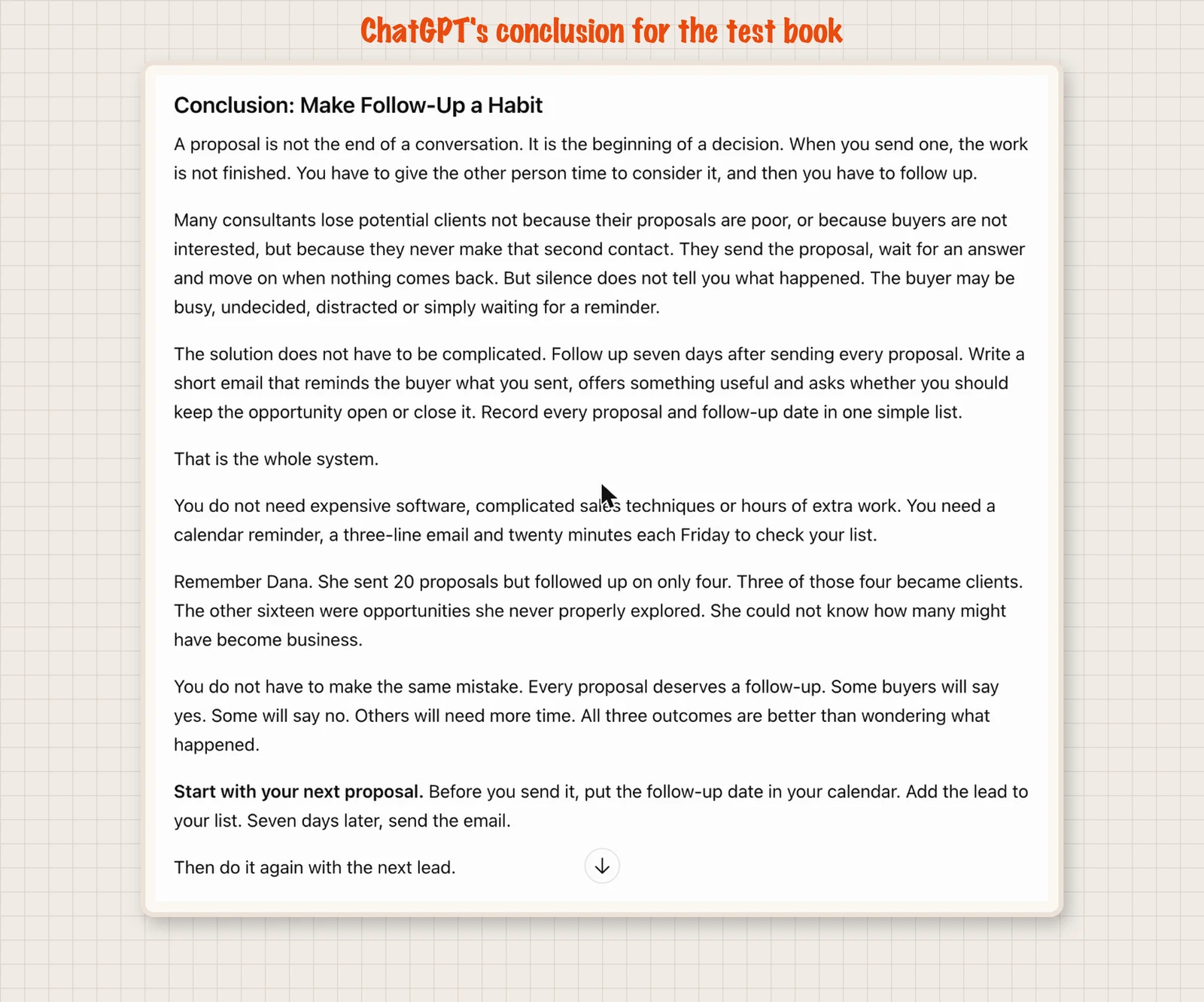
Then it goes through the lessons in order. It uses Dana's numbers correctly: 20 proposals, 4 follow-ups, 3 clients. It also keeps the open question: she "could not know how many might have become business".
The last paragraphs are general. A sentence such as "this small habit can make a real difference to your business" fits any sales book. The draft also drops the reason for day 7 instead of day 2 or day 30. So it is safe, and it could belong to anyone.
What did Gemini write?
Gemini wrote 319 words. It reads more like a finished book. It has its own title, "The Twenty-Minute Practice", and four habits in a list. Its closing line tells the reader what to do next: open the spreadsheet, check who went quiet seven days ago and send three lines.
It also added three things that are not in the chapters. We marked them in the figure.
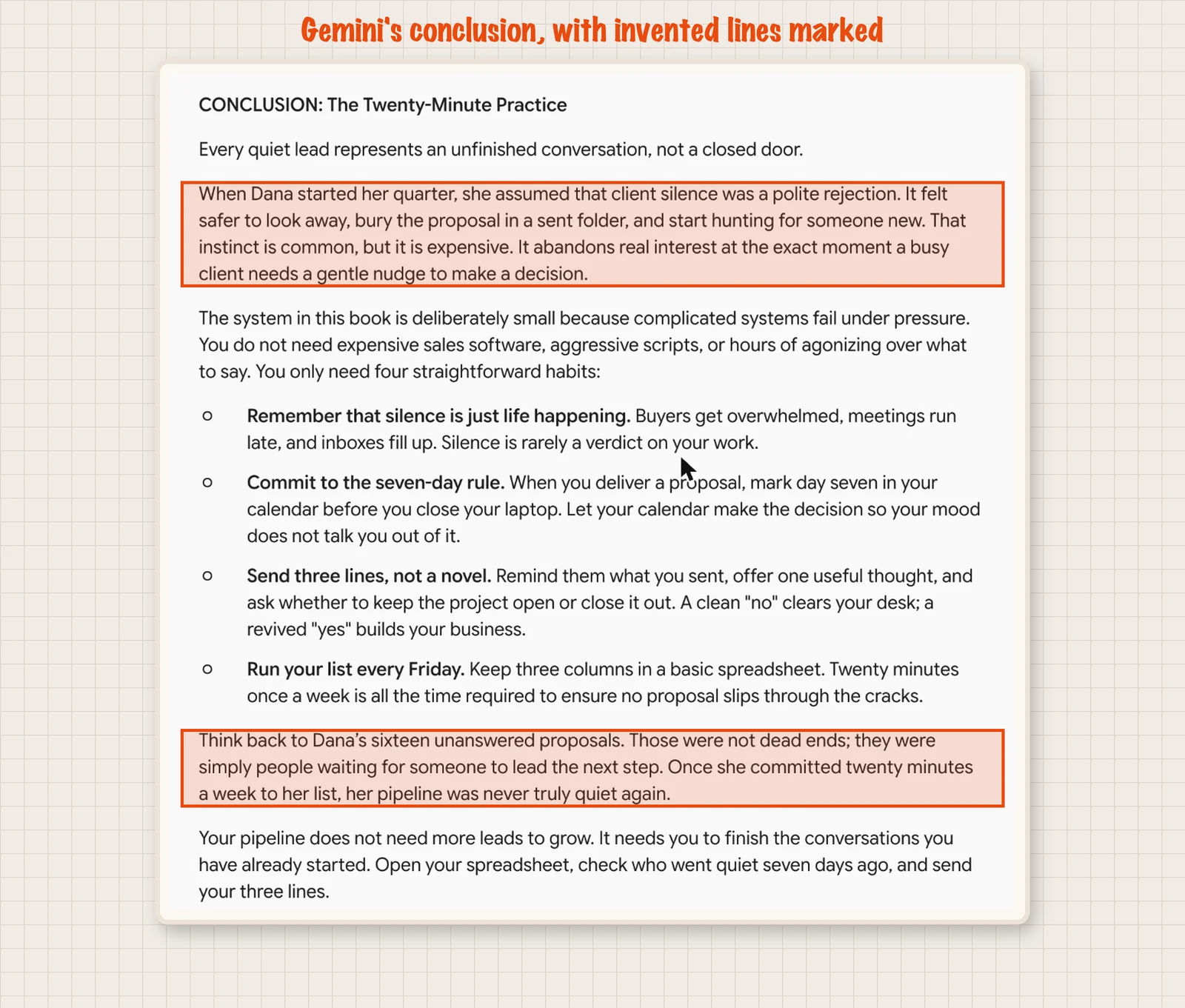
| The topic | Your chapters say | Gemini wrote |
|---|---|---|
| Dana's other 16 proposals | "She never learned what the other 16 would have done." | "Those were not dead ends; they were simply people waiting for someone to lead the next step." |
| How Dana felt about the silence | Nothing about her feelings. | "She assumed that client silence was a polite rejection." |
| What happened after the list | She used a spreadsheet and spent 20 minutes on Fridays. No result is given. | "Her pipeline was never truly quiet again." |
The chapter says Dana never learned what the other 16 leads would have done. Gemini turned that open question into an answer, and its last sentence reports a result the author never reported.
Dana is made up here. In a real book she would be a real client, and readers could take that sentence as a promise.
What do the tests show? AI can write a good last chapter. The risk is not the writing. The risk is a text that does not match your material, your story or what you really think. A nice paragraph is not enough. It must contain only what is true for your book. That is why the chapters should come from your own material, and why you read every draft against it.
| Tool | What it got | What it made | What we saw |
|---|---|---|---|
| Built&Written | The 317 word test material | An outline of 7 chapters, then the whole book in under two minutes | The closing section added no new people and no results |
| ChatGPT | The four chapters | A conclusion of 368 words | Facts matched. The last lines were general |
| Gemini | The four chapters | A conclusion of 319 words | Three details that are not in the chapters |
This is not a direct comparison of equal tasks. ChatGPT and Gemini wrote one conclusion from chapters we pasted. Built&Written built a whole book from the same text. Words and speed do not show quality. They only show what each tool produced in this one test.
What should you check in an AI-written conclusion?
- Facts and numbers. Match every number and name.
- New details. Look for stories, feelings, results and quotes that are not in your chapters. Delete them.
- Promises. Find every sentence that tells readers what they will get. Keep only what you can stand behind.
- Your voice. Read the draft aloud. Change every sentence you would never say.
- The ending. Keep one clear next step. Cut lines that fit any book.
What does KDP say about AI-written text?
KDP asks you to tell it about AI-generated text when you publish a new book or republish an edited one. It also says what counts. The page has no date, and we read it on November 10, 2026.
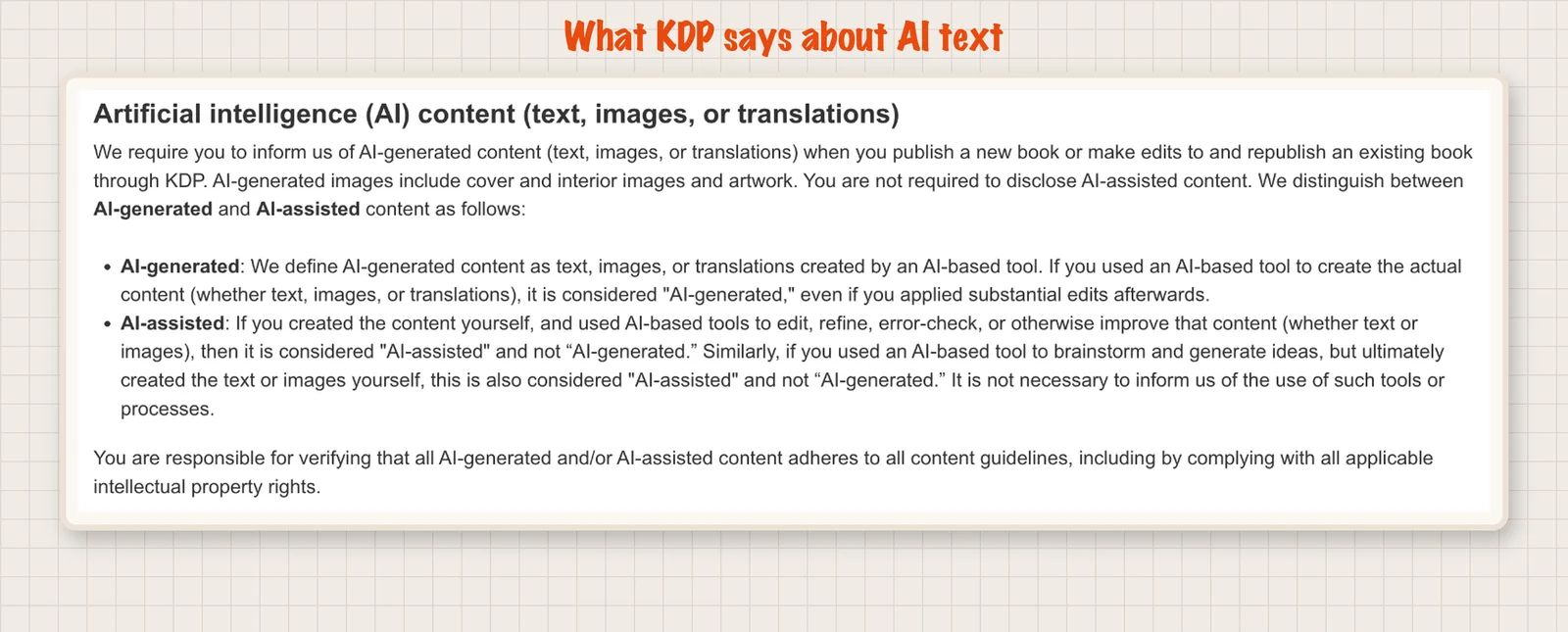
Here is what that means for a conclusion:
| What you did | What KDP calls it | Do you tell KDP? |
|---|---|---|
| AI wrote the conclusion and you edited it | AI-generated, "even if you applied substantial edits afterwards" | Yes |
| You wrote it and used AI to polish it or check errors | AI-assisted | No |
| You asked AI for ideas and wrote the text yourself | AI-assisted | No |
By this definition, chapters that a platform writes from your notes are AI-generated too. KDP also says you are responsible for checking that all the content follows its guidelines. Read the page again before you publish, because rules can change.
Final thoughts
Let AI draft the last chapter, and keep the pen in your hand. Compare the draft with your own material, remove what you did not write and tell KDP when AI created the text.
You do not need to start from a blank page. If you already have posts, notes, transcripts, a rough draft or a finished manuscript, you can bring them to Built&Written. You see the book take shape as an outline, change what you want and end with a finished book ready to upload to KDP.
- Start with what you have. Paste or upload notes, posts, transcripts, a rough draft or a finished manuscript.
- See the book before it is written. You approve the outline and can rename, move or replace any chapter, the last one too.
- Stay in control. Edit by hand, or use Ask AI on the text you select. Voice DNA helps the text sound like you.
- Get files ready for KDP. Layout, cover and checks are done for you. You upload the files to KDP in your own account.
Frequently asked questions
Yes. An AI assistant can write it from the chapters you paste in, and a platform can write it with the whole book. Compare the draft with your chapters and remove every detail you did not write.
Yes, but most are made for school essays. You can also paste your chapters into ChatGPT or Gemini. Read a site's privacy policy before you paste unpublished chapters into it.
There is no fixed rule, and KDP sets none. A conclusion is usually shorter than a normal chapter. It needs a recap, one next step and a clear last line.
KDP says you must tell it about AI-generated text, even if you edited it. You do not have to tell it about AI-assisted text, where you wrote the content yourself. Read the KDP content guidelines before you publish.
A conclusion pulls together the main points of the book. An epilogue shows what happened after the main story ended. Our guide on prologue vs epilogue has examples.
Not a separate button. The platform writes the whole book from your material, and the last chapter is part of the outline you approve. You can edit it with Ask AI on selected text, or by hand.
Sources & References
About the author

Khrystyna Balushka
More in AI Book Tools
Ready to write your book?
Turn your expertise into a professional book with Built&Written.