

How to Create Thought Leadership Content With AI
What happens when you create thought leadership content with AI?
Thought leadership means sharing ideas from your own work, so people see you as someone who knows the topic. Authority is the result: a buyer trusts your knowledge before you ever speak. (Some people use "AI thought leadership" to mean experts who talk about AI. This article is about experts who write with AI.)
Think about the person who might hire you. They read your posts, then the posts of three other experts. If all four posts open the same way and give the same advice, nothing tells the buyer who to call. Posts are quick to make now, and that is the risk. We covered how well AI can copy a writing style in our voice test, including the research on AI and similar writing. This article asks a different question: what can still set you apart?
How we tested how alike AI posts are
On November 11, 2026, we gave ChatGPT and Claude the same prompt three times each, in fresh chats with no memory and no retries: "Write a LinkedIn post of about 200 words for an independent consultant who helps small companies. Topic: why most small companies fail at hiring their first sales person." Then we read all six posts the way a buyer would and marked what repeats.
This is one prompt, one made-up topic and six runs on one day. Other prompts or tools may differ, and we do not say all AI posts look alike.
What did six AI thought leadership posts have in common?
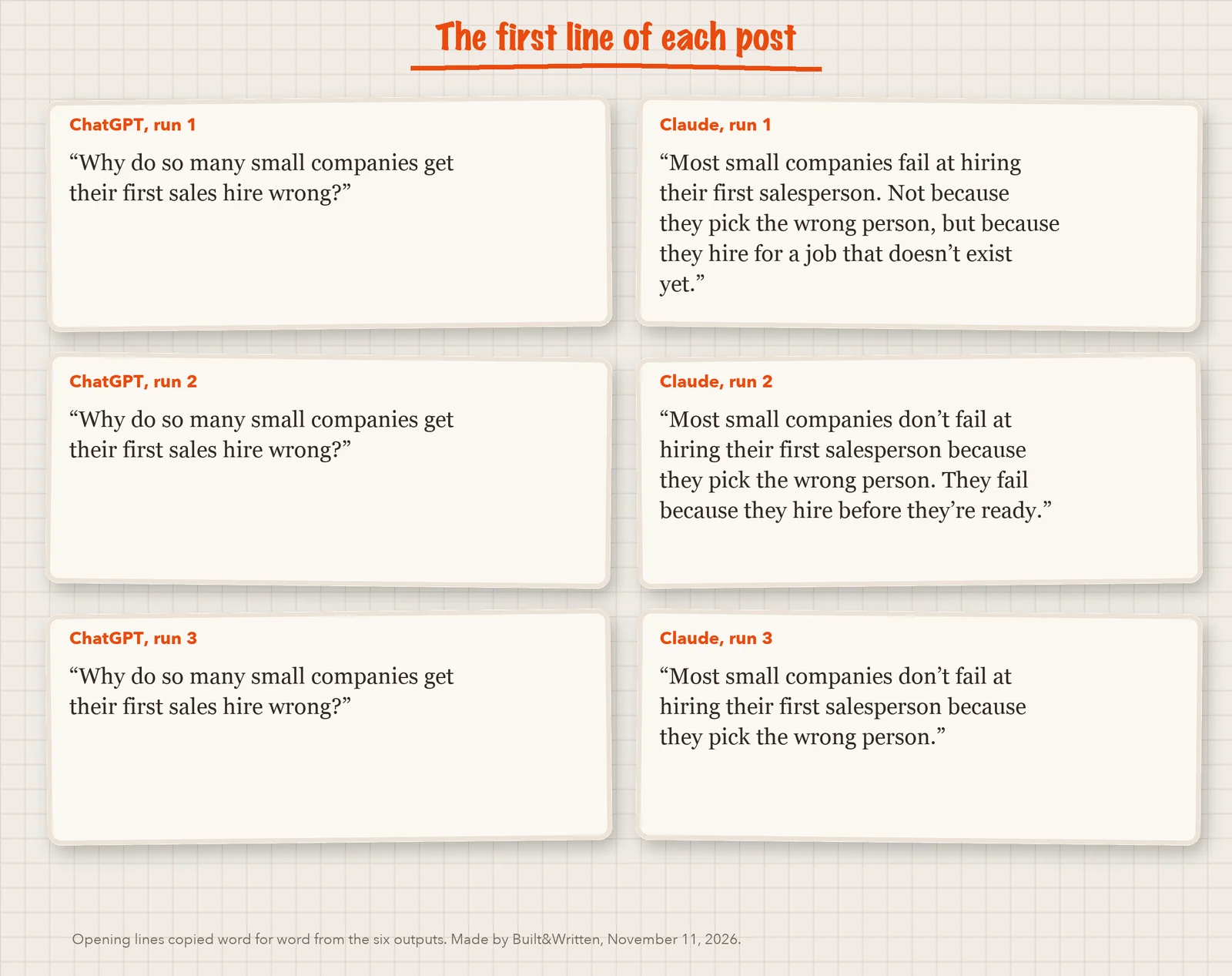
A lot. The three ChatGPT posts opened with the same question, word for word. The three Claude posts all began with "Most small companies" and "their first salesperson".
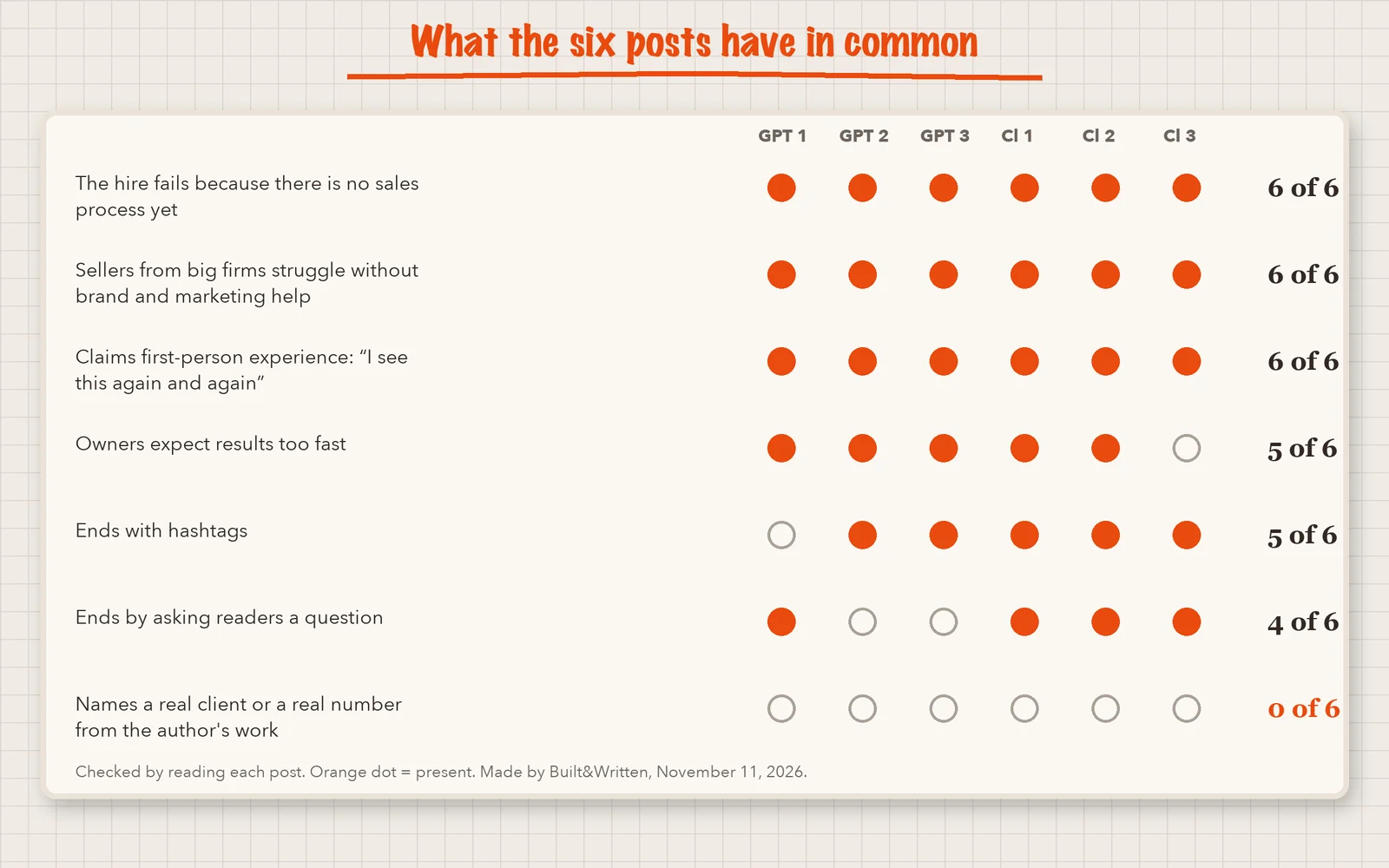
- Same story. All six said the first hire fails because the firm has no sales process yet, and that a seller from a big firm struggles without brand and marketing help.
- Same borrowed experience. All six wrote as if the author had seen this many times ("I see this again and again"). The consultant in the prompt is made up.
- No proof. Not one post named a client or gave a real figure from the author's work. One Claude post said first hires "need 6 to 9 months to ramp up" (to reach full speed), with no source.
What this means for you: a post that could carry a competitor's name helps people notice you, and does little to show what you know.
How do you turn your posts and notes into a book full of your own stories?
Picture a consultant. They have about 40 LinkedIn posts, a folder of call notes, a talk they gave last spring and a few client emails. All of it is real, and all of it is scattered. A new client cannot see the whole of their thinking in it. (This is an example, not a real customer.)
Built&Written is a platform for writing nonfiction books and getting them ready to publish. It is made for people like this consultant: experts, consultants and founders who have material and want a book without a blank page. It solves one problem. Your knowledge sits in many small pieces. You bring the pieces, and the platform helps you shape them into one book. The facts, cases and numbers in the book stay yours. If you already wrote a book, you can upload it and the platform formats it and keeps every word.
Here is what it looks like for our consultant. The screenshots show a team demo book.
1. Add what you have. Paste the posts, the call notes and the talk transcript (the typed text of a talk), up to 50,000 words. Choose a tone and add a few pages of your own writing. This is called Voice DNA: the platform reads your samples to bring the text closer to your style. Result: all the pieces are in one place.
2. Approve the plan. The platform builds an outline and shows it before it writes anything. You can rename chapters, add chapters and change the order. Result: you decide what the book argues, and each chapter has one job.
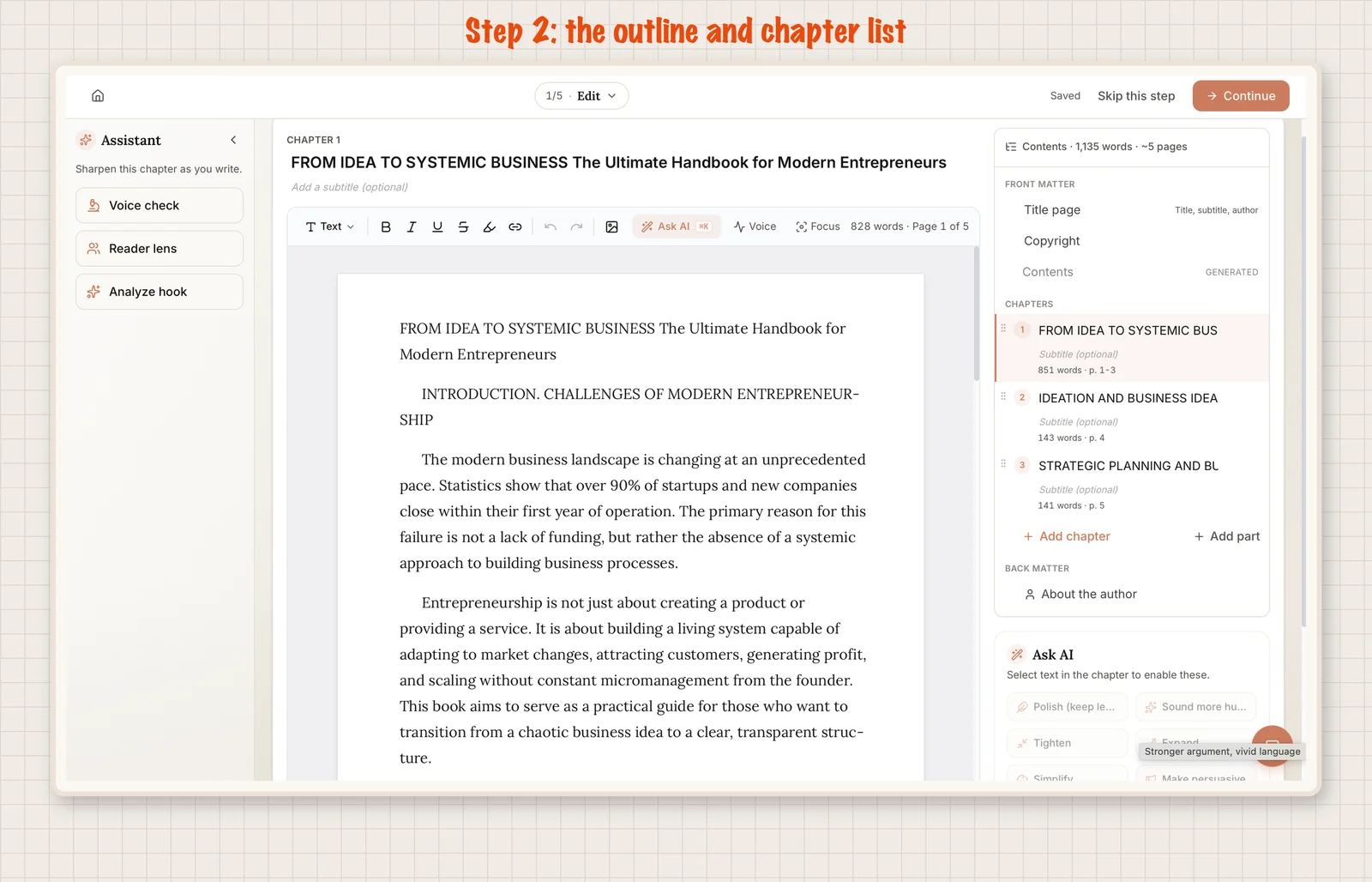
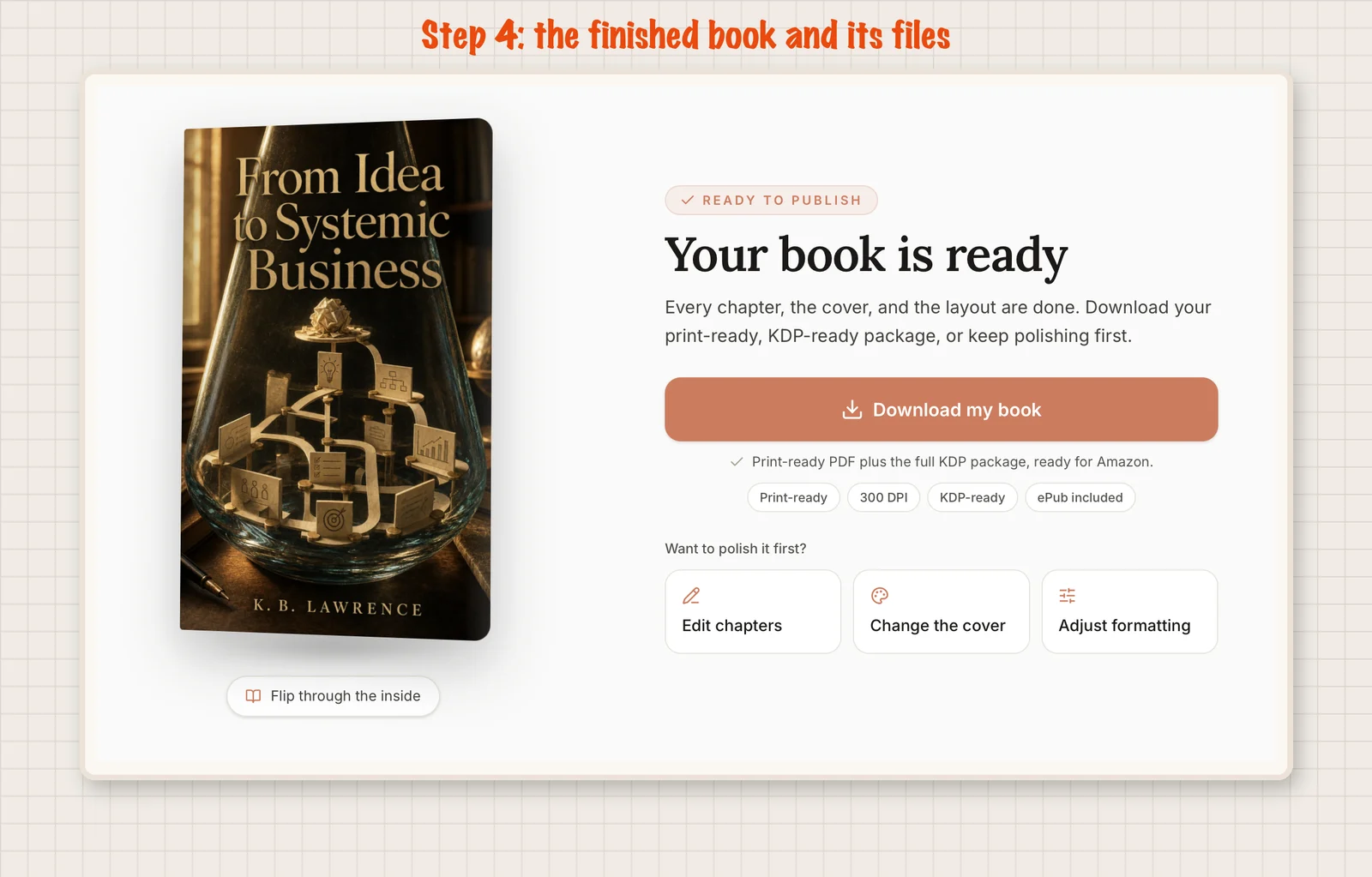
3. Check the chapters. The platform writes the chapters from your material. You read each one, correct it and add your own cases and numbers. Result: a full draft where your stories sit in order. Details you did not give stay general, so add them now.
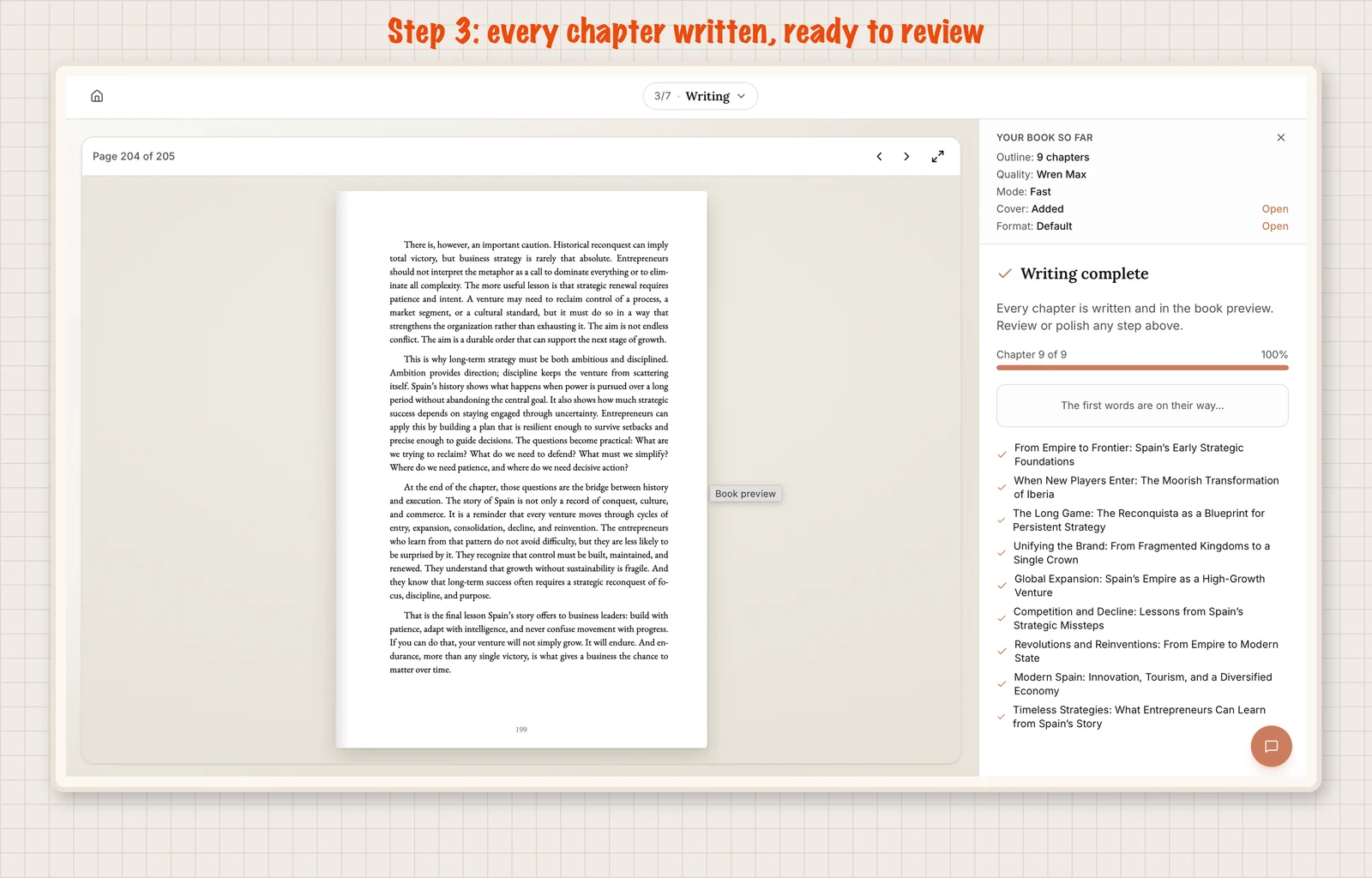
4. Download the files. The platform sets up the pages for print and makes a cover. It also checks that your files meet the requirements of KDP (Kindle Direct Publishing, Amazon's service for selling your book). You can still edit chapters, change the cover or adjust the formatting. Result: a finished book and the files to upload to Amazon.
| Step | By hand | With Built&Written |
|---|---|---|
| Collect material | Search old posts and files | Paste or upload it in one place |
| Plan the chapters | Outline in a document | Outline you approve first |
| Write the text | Draft every chapter yourself | Chapters drafted from your material, then you edit |
| Pages and cover | Set page size, fonts and margins, then design or order a cover | Print pages set up and a cover made for you, which you can change |
| KDP files | Export a PDF and check it against KDP's rules | Print PDF and KDP files prepared and checked for you |
You may ask why you should not paste your notes into a general chatbot and ask for a book. You can try, and you will get text. A book needs more than text: your material gathered in one place, a plan you approve, your own writing samples to guide the tone, chapters you check one by one, and print files set up and checked against KDP's rules. Built&Written puts these steps in one place, so you do not have to join them yourself.
Some honest notes. You upload the files to KDP yourself, because the platform does not publish for you. We cannot promise sales. You must read the text and add your own facts, because the platform writes from what you give it. Some downloads need a higher plan, so see pricing.
Free tools help with the parts around the book:
- The book title generator gives title ideas to test.
- The book blurb generator drafts the back cover text.
- The book description scorer checks your Amazon description.
Where does a book fit when you create thought leadership content with AI?
A book fits in the place where AI posts fall short. It works if it goes deeper than a post and holds your own proof.
A book has three things a post does not:
- Room. A post has about 200 words. A chapter can tell a client case from the first call to the result.
- One line of thought. A book can follow one main idea from the first page to the last, so a reader sees how your thinking fits together.
- A place of its own. A book has its own page on Amazon, where people can find it by its title or by your name.
A buyer who opens a book can check things: the case, the number, the choice you made. A buyer who scrolls posts cannot. We found no study that compares a book with posts for winning clients, so we give no numbers. We can show the gap in the six posts: the proof was missing. A book has space to add it.
AI can help you write the book. It cannot supply the proof. Amazon draws the same line. On its content guidelines page, KDP says you must tell it about AI-generated text, images or translations when you publish. You do not have to disclose AI-assisted content, where you wrote the text and used AI to edit or improve it. Text that an AI tool created counts as AI-generated, even if you edited it a lot. (We read that page on November 11, 2026. It shows no update date, so check it before you publish.) Our article on KDP's AI disclosure rules has the steps.
What should you collect before you create thought leadership content with AI?
Start with a short list. Gather these before you open any tool:
- Your best posts and articles. Pick the ones that got real replies.
- Notes from client work. Call notes, emails, lessons you wrote down.
- Talks and recordings. A typed transcript works well.
- Your main topic in one sentence. For example: "Small firms hire a salesperson too early." Everything in the book should support that sentence.
- Three to five real examples. One case, one number, one mistake.
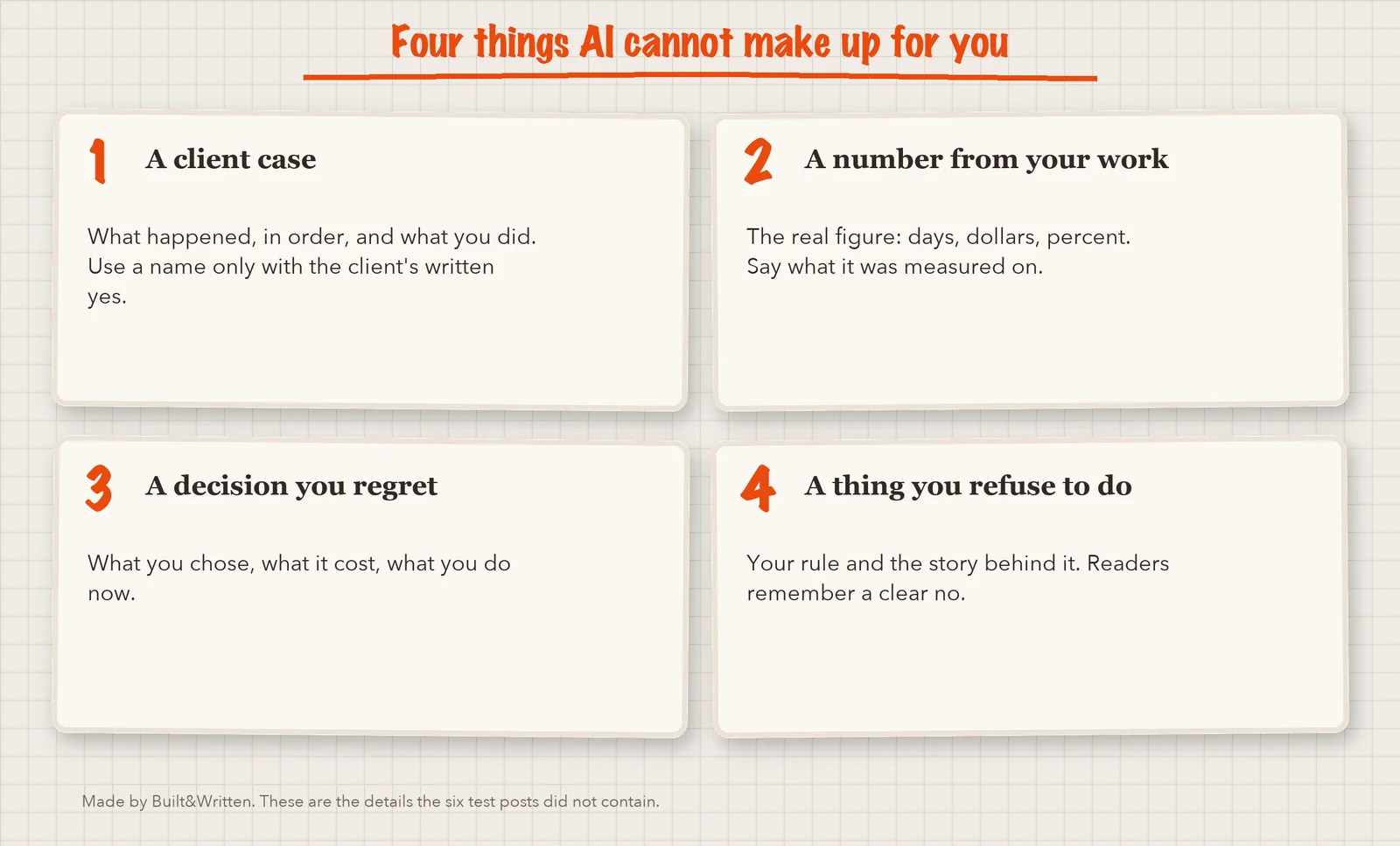
Then put four kinds of proof into the chapters. These are the things the six test posts did not contain.
Check each chapter before you call it done:
- Does it name one real case? Use a client's name only with their written yes. Otherwise say "a retail client with 12 staff", but only if that is true.
- Is there one number you can explain? Say what it counts and when.
- Does it show one choice you got wrong? Readers trust people who say what went badly.
- Could a rival have written this page? If yes, add a case or cut the page.
Never let an AI invent a fact for you. The tool writes from what you give it, and with no details the text stays general. Our guides on turning blog posts into a book and turning expertise into a book without a ghostwriter go deeper.
Final thoughts
Can you create thought leadership content with AI? Yes, and it is quick. Posts show you are active, but alone they can make you look like everyone else. A book shows what you know, if it holds your cases, numbers and decisions. AI can help you write it, but it cannot invent your proof, and our six posts show what happens when you ask it to.
You do not need a blank page. Start with the posts, notes and talks you already have. Built&Written helps you turn them into a finished book, and you decide what goes in it:
- You bring your own material and approve the plan before any chapter is written.
- You check every chapter and add your own cases and numbers.
- You get a finished book and KDP files, and you upload them to Amazon yourself.
Frequently asked questions
Yes, if it holds your own proof: real cases, numbers and decisions. We found no study that measures how much a book helps compared with posts, so we do not promise a result. In our test, six AI posts held no real client and no real figure.
It has more room, one line of thought and a place on Amazon. We found no data that ranks one above the other. Posts help people notice you. A book helps a buyer see how you think. Many experts use both.
KDP says you must disclose AI-generated text, images or translations. It says you need not disclose AI-assisted content, where you wrote the text and used AI to improve it. We read its content guidelines on November 11, 2026. Check the page again before you publish.
It depends on what the book holds. A book with your real cases and numbers gives readers something to check. We found no study on how buyers judge AI-assisted business books, so we make no promise. KDP asks you to disclose AI-generated text, so follow its rules.
Give the tool real facts and one true story, and say "use only these facts". Cut openers you would never say. Check every scene it adds. Our voice test shows how far a writing sample goes.
Yes. Collect your best posts, notes and talk transcripts, and shape them into chapters around one idea. Built&Written can build the outline and chapters from that material, and you edit them before you publish on KDP.
Sources & References
About the author

Khrystyna Balushka
More in AI Book Tools
Ready to write your book?
Turn your expertise into a professional book with Built&Written.