
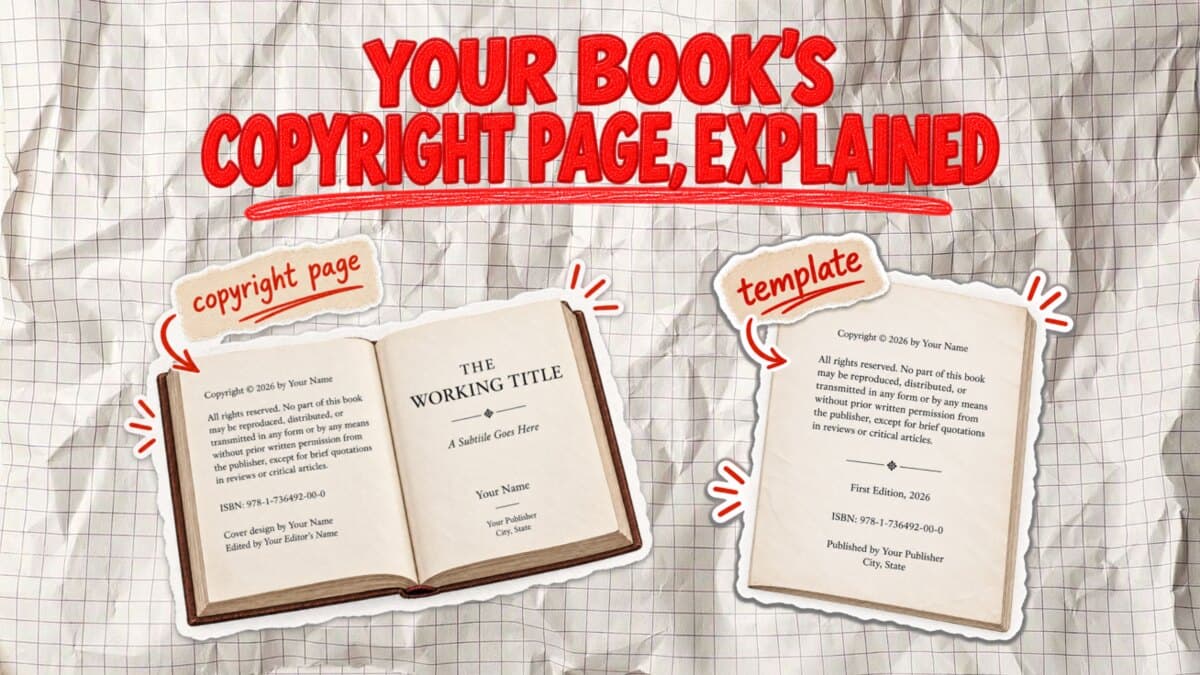

The Copyright Page, Line by Line, With a Template You Can Copy
If you're wondering how to write a copyright page for a book, the answer is simpler than most examples make it look. A self-published nonfiction copyright page usually includes a copyright notice, publication details, ISBN, and only the extra legal or production information that actually applies.
A copyright page can look like a block of legal fine print, but a self-published nonfiction book usually needs much less.
What goes on a copyright page?
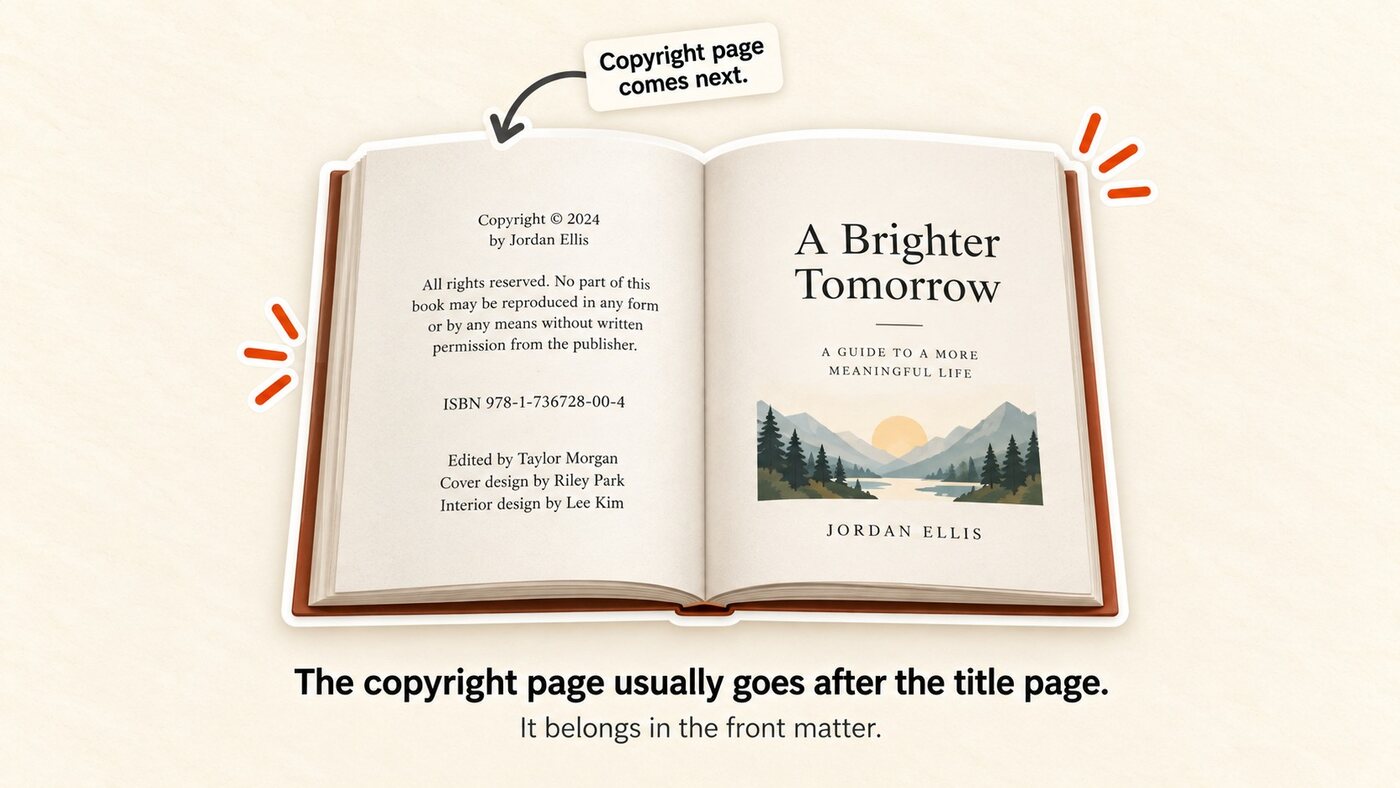
A book copyright page is part of the front matter, usually placed immediately after the title page. For print books, KDP recommends placing it on the first left-facing page after the title page.
For a self-published nonfiction book, the page may include:
- Copyright notice: the copyright symbol, year, and name of the copyright owner.
- Rights statement: commonly “All rights reserved.”
- Edition information: such as “First edition, 2026.”
- ISBN: useful for identifying the specific print edition.
- Publisher or imprint: if you publish under a business or imprint name.
- Disclaimer: when the subject matter makes one appropriate.
- Credits: for editors, designers, illustrators, photographers, or other contributors.
- Printer’s key or printing information: common in traditional publishing, but usually unnecessary for a simple print-on-demand book.
Amazon KDP treats the copyright page as optional. Its formatting guidance explains where to place one if you include it, and its manuscript template provides a simple three-line example rather than requiring a full legal page.
Copyright page template for a self-published nonfiction book
Here is a simple copyright page template you can copy and adapt for most self-published nonfiction books:
Copyright © 2026 [Author Name]

All rights reserved.

First edition, 2026

ISBN: [ISBN]

Published by [Author Name or Imprint]

[Optional disclaimer]

Cover design by [Name]
Interior design by [Name]
Edited by [Name]

Printed in [Country, if applicable]
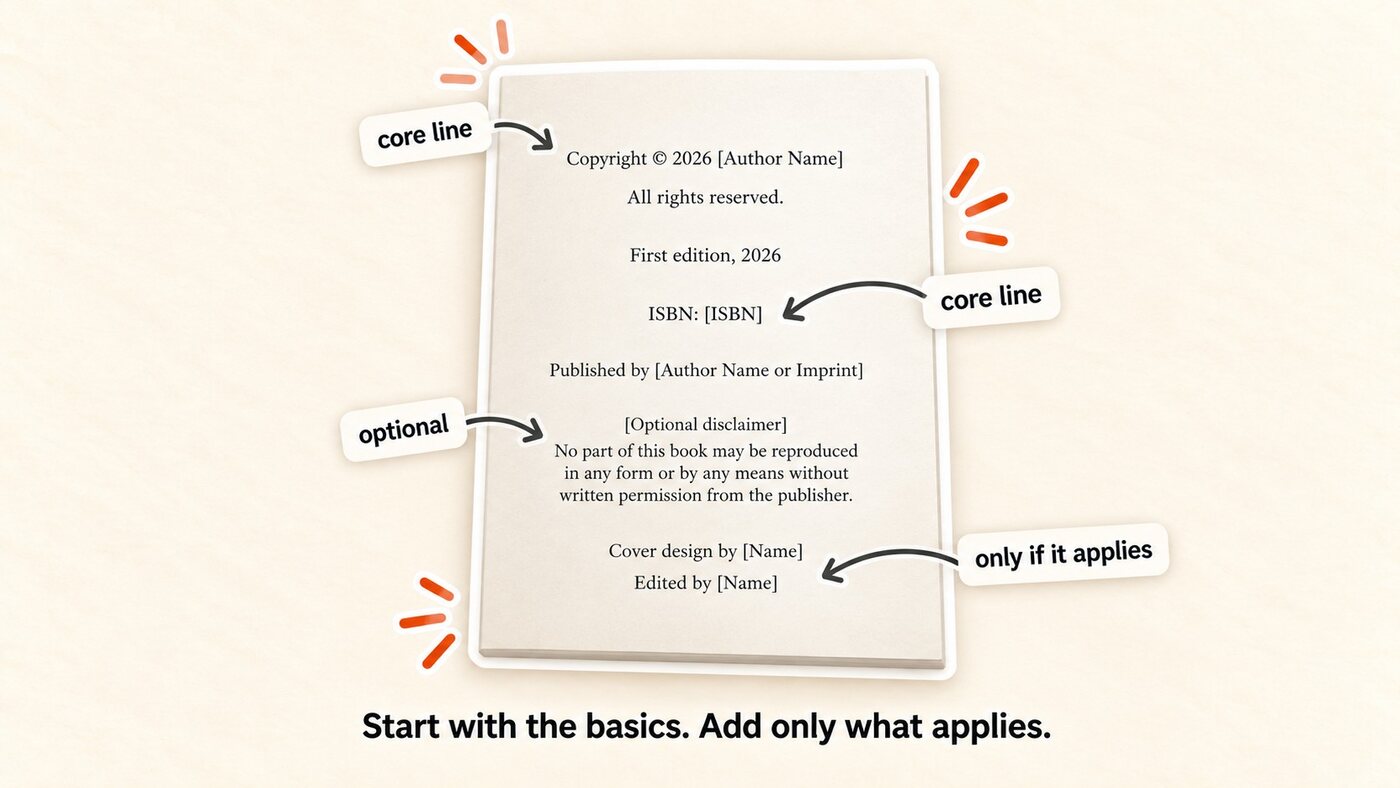
Replace the bracketed text with your own details and delete any lines that do not apply. You do not need to fill the page just because traditionally published books often do.
For a simpler book, your copyright page could be as short as:
Copyright © 2026 [Author Name]

All rights reserved.

ISBN: [ISBN]
Amazon KDP itself uses a similarly minimal copyright-page example, so there is no need to add boilerplate you do not understand or need.
The exact wording can vary. What matters is that the information is accurate and matches the edition you are publishing.
What does each line on a copyright page mean?
A copyright page can contain a surprising amount of information, but every line has a different job. Here is what the most common elements actually mean.
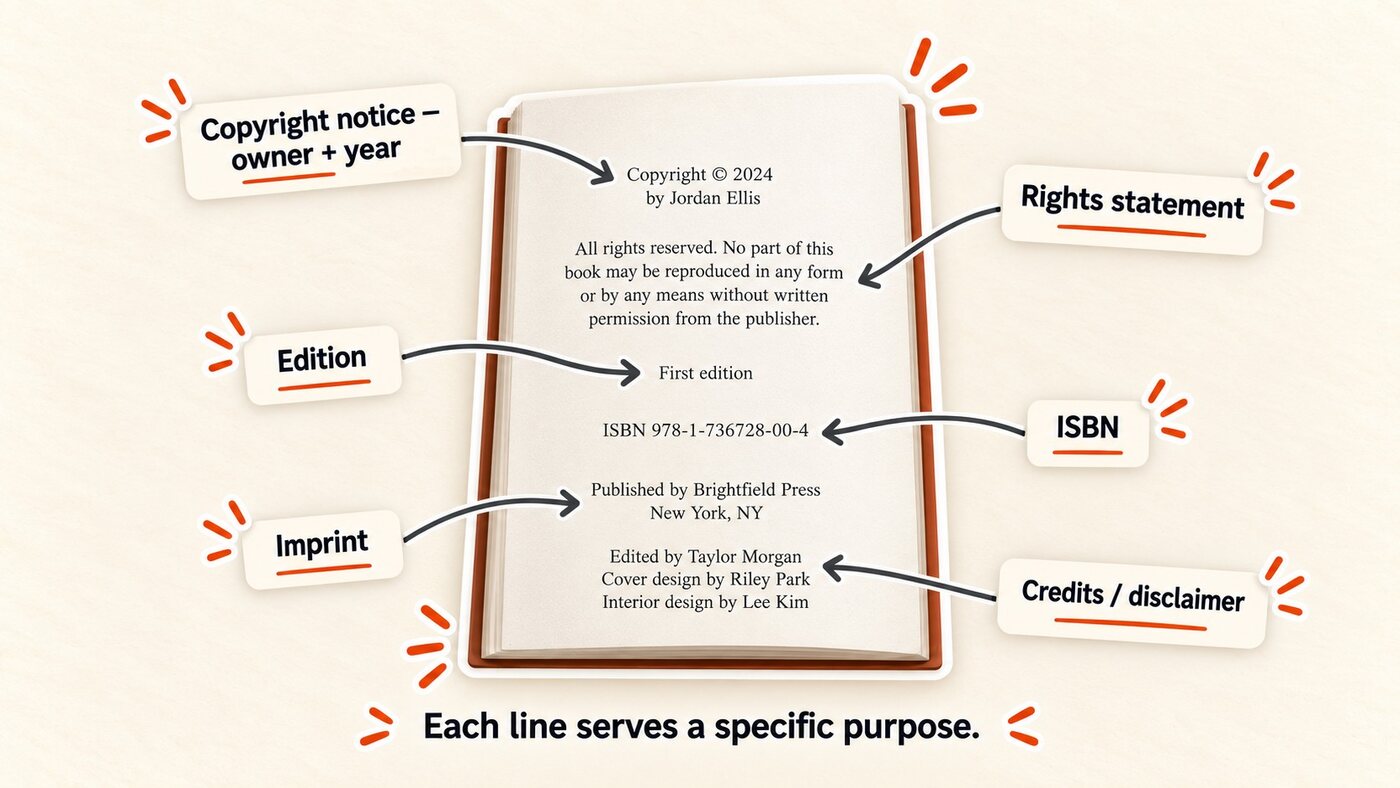
Copyright notice
Copyright © 2026 Jane Smith
This identifies the copyright owner and the year of first publication. A standard U.S. copyright notice contains three elements: the © symbol, the year of first publication, and the name of the copyright owner.
The notice is useful because it makes ownership clear, but it is not what creates copyright. In countries covered by the Berne Convention, copyright protection generally arises automatically without registration or another formality.
For most self-published authors, the rights holder will simply be the author's name. If rights are owned by a company or another entity, the appropriate rights holder may appear instead.
Rights statement
All rights reserved.
This is one of the most familiar lines on a copyright page. It signals that the copyright owner has not broadly granted others permission to reproduce, distribute, adapt, or otherwise use the work.
It is traditional and still commonly included, but it is not required to create copyright protection. For a simple nonfiction copyright page, there is little harm in keeping it.
Edition statement
First edition, 2026
The edition statement tells readers which version of the book they have.
A first edition is the original published version. If you later make substantial changes, such as rewriting chapters, adding major new material, or restructuring the book, you may publish it as a second edition. Fixing a handful of typos usually does not justify a new edition.
For books that may be updated over time, including business or instructional nonfiction, adding the edition can make different versions easier to distinguish.
ISBN
ISBN: 978-X-XXXXXX-XX-X
An ISBN identifies a specific book format and edition. KDP requires an ISBN for most paperback and hardcover books, while Kindle eBooks do not need one.
If you publish a paperback and hardcover, each needs its own ISBN. Make sure the ISBN printed inside the book matches the ISBN assigned to that edition during publishing.
Publisher or imprint
Published by North Street Press
Self-published authors sometimes include their own name here, while others create an imprint name for their books.
This line is optional. An imprint can make your publishing information more consistent across several books, but you do not need to invent a publishing company just to complete the copyright page.
Disclaimer
This book is provided for informational purposes only...
Not every nonfiction book needs a disclaimer.
Whether one is appropriate depends heavily on the subject. Books discussing areas such as health, law, finance, professional advice, or potentially risky activities may need more careful wording than general business or personal-development books.
Avoid copying a disclaimer from another book simply because it sounds legal. The wording should match what your book actually contains, and higher-risk material may justify professional legal advice.
Contributor credits
Cover design by Jane Doe
Edited by John Smith
The copyright page is also a convenient place to credit people who helped produce the book, such as cover designers, editors, illustrators, photographers, interior designers or formatters.
These credits are generally optional unless your agreement with a contributor requires attribution. Include the roles that are relevant to your book rather than creating a long production list for the sake of convention.
Printer line and number line
You may also see lines such as:
Printed in the United States of America
or a sequence like:
10 9 8 7 6 5 4 3 2 1
The first identifies where a particular copy was printed. The second is called a printer's key or number line, traditionally used by publishers to indicate the printing of an edition. When the lowest number is 1, for example, it generally indicates a first printing.
For a typical self-published print-on-demand book, neither line is essential. They are publishing conventions you may encounter in traditionally produced books, not information you need to copy automatically.
The best rule for a self-published copyright page is simple: include information because it serves a purpose, not because another book included it.
What does Amazon KDP actually require on a copyright page?
Very little. In fact, Amazon KDP does not require you to include a copyright page at all. If you choose to have one, you add it as part of your manuscript. KDP's own sample uses just three elements: a copyright notice, “All rights reserved,” and an ISBN field.
That does not mean every item below is required by Amazon. Most are simply useful publishing conventions.
| Copyright page element | Required by KDP on the page? | Should you include it? |
|---|---|---|
| Copyright notice | No | Recommended |
| “All rights reserved” | No | Common, but optional |
| ISBN | No | Useful for print editions |
| Edition statement | No | Useful if the book may be revised |
| Publisher or imprint | No | Optional |
| Disclaimer | No general requirement | Only when relevant |
| Contributor credits | No | Include when appropriate |
| Printer's key | No | Usually unnecessary for print-on-demand |
There is one important distinction with the ISBN. KDP requires an ISBN to publish most paperbacks and hardcovers, but it does not require you to print that ISBN on the copyright page. If you do include an ISBN in the manuscript, it must match the ISBN assigned to that edition. Kindle eBooks do not require an ISBN.
For print books, KDP recommends placing the copyright page on the first left-facing page after the title page. It should not carry a page number or running header.
Do you need to register copyright before publishing?
Usually, no. Copyright protection generally exists automatically once an original work is created, without registration or another formality. WIPO confirms that this is the standard approach in countries covered by the Berne Convention.
Registration is a separate step and its benefits depend on the country. In the U.S., for example, registration is voluntary for copyright protection, but it can create a public record and provide important advantages if you later need to enforce your rights.
Note: This is general publishing information, not legal advice.
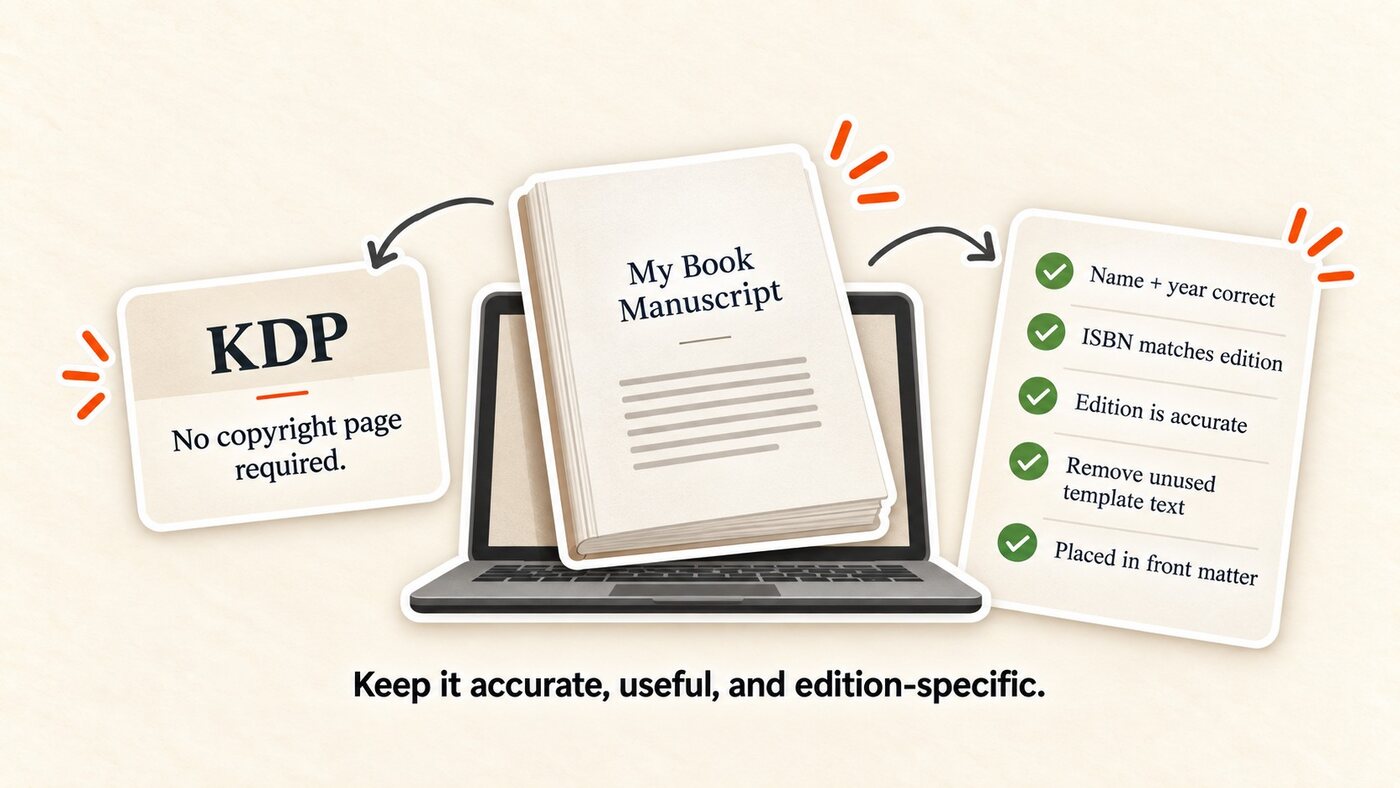
Final copyright-page checklist
Before you upload your manuscript, check that:
- the copyright owner’s name and year are correct;
- the edition information is accurate;
- any ISBN shown on the page matches the ISBN assigned to that edition;
- your disclaimer, if you use one, actually fits the book;
- contributor credits are complete where needed;
- you have removed any template text that does not apply;
- the copyright page appears in the front matter, typically on the first left-facing page after the title page.
KDP also notes that adding an ISBN to the copyright page is optional, but if you include one, it should match the ISBN assigned to the book.
The goal is not to make the page look legally complicated. It is to make every line accurate, useful, and relevant to the book you are publishing.
Frequently asked questions
Start with ©, the year of first publication, and the copyright owner's name. Add the ISBN, edition, imprint, disclaimer, and credits only when they apply.
Usually the year the work was first published. For a substantially revised edition, the copyright information may also reflect the new edition.
In the front matter, usually on the first left-facing page after the title page.
No. KDP does not require one, but it is still useful for recording ownership and publication details.
No. If you include one, it must match the ISBN assigned to that edition.
No. It is a traditional rights statement, not a requirement for copyright protection.
Usually not. Copyright generally exists automatically; registration is a separate process with country-specific benefits.
Sources & References
About the author

Polina Karlashchuk
More in Book Formatting
Ready to write your book?
Turn your expertise into a professional book with Built&Written.