
Should Nonfiction Authors Worry About AI Book Summarizers?
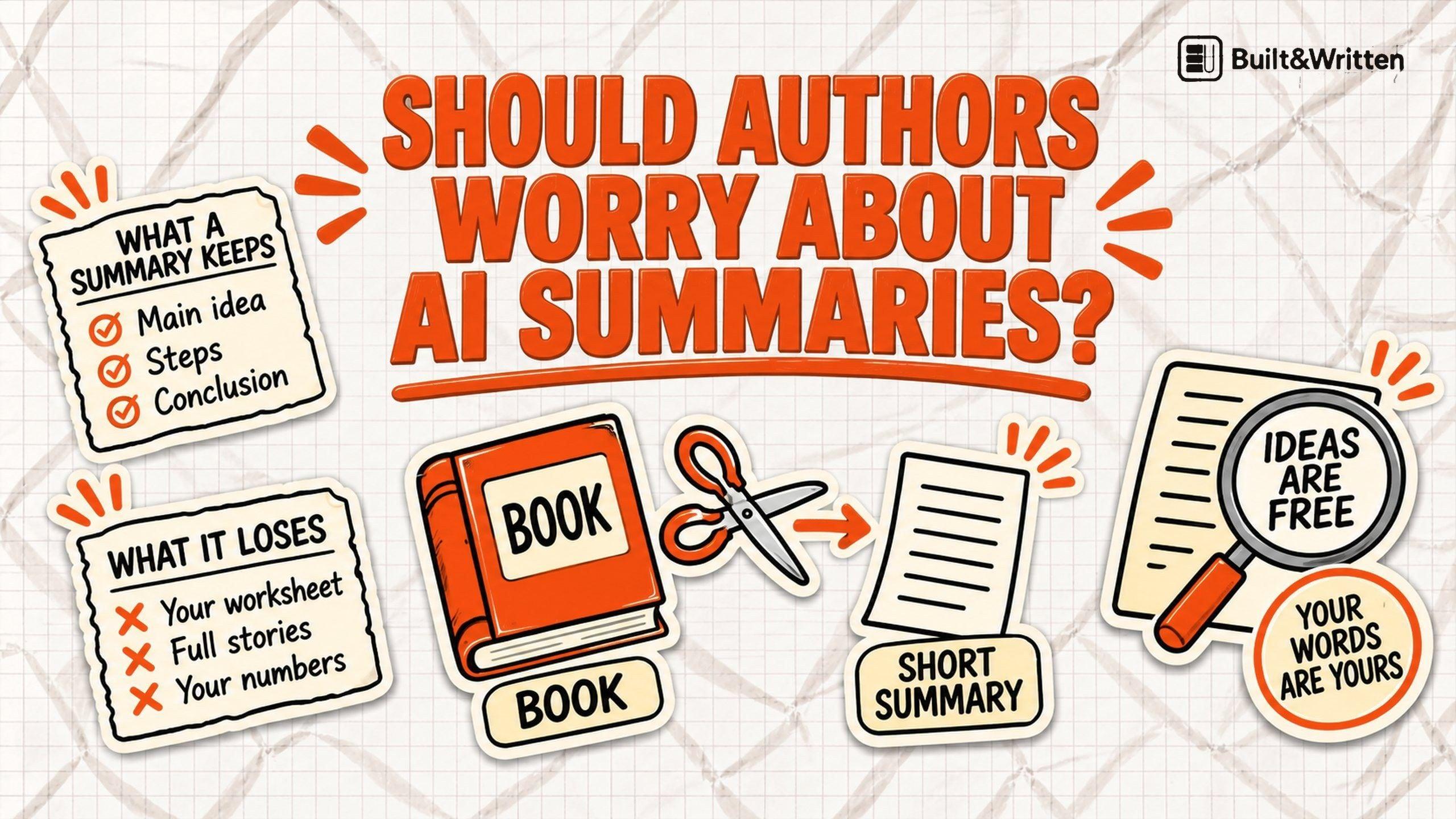
Nonfiction authors should worry a little about an AI book summarizer, but only about the parts of a book that fit in a summary. In our test, a chatbot kept 8 of the 10 main parts of a 2,454-word chapter in a summary of 653 words. A free summarizer kept 6 of 10. This is one chapter and two tools, so it shows what can happen, not what always happens.
We did not guess. We ran one real chapter through two tools on November 19, 2026, and counted what survived.
What is Built&Written?
Built&Written is a platform for writing nonfiction books and preparing them for publishing. It turns material you already have, like notes, posts and talk transcripts, into a book in your voice. It also formats a book you have already written without changing a word. You get a print PDF and files for KDP (Kindle Direct Publishing, Amazon's service for selling your book), and you upload them yourself.
Key takeaways
- The worry is real but small. In our test, ChatGPT kept 8 of 10 parts of a chapter and Decopy, a free summarizer, kept 6 of 10. Both missed the exact page you would print and use.
- Ideas are free to summarize. Your words are yours. The U.S. Copyright Office says copyright does not protect facts, ideas, systems or methods of operation. It may protect the way they are written, so a summary that copies your wording is a different question.
- Write what a summary cannot hold. That means a worksheet a reader can use, a story with real detail, your own numbers and your voice. Built&Written builds the book from your own material, so those parts come from you.
Can an AI book summarizer copy what is in your book?
Yes, most of the structure. A summarizer is a tool that shortens a long text into a short one. Some tools read text you paste in. Others work from a book title alone.
The first kind works on any book whose text a reader can paste in. Decopy says on its page that it needs no login and accepts up to 200,000 characters of text. At the ratio of our test text, that is about 33,000 words in one paste.
The second kind works from the title. It writes the summary from what the AI already knows about that book, so the result depends on how well the book is known. The title-only tool 5tldr says its AI works best with well-known titles and will say so when it does not know a book. It asks you to sign in for the free plan, which it says allows 10 summaries a day. So a lesser-known book is less exposed to title-only tools. A tool that takes pasted text can handle even a small book, as long as the text fits the tool's limit.
How did we test AI book summarizers?
We wanted a text with three things a nonfiction author sells: a framework (a set of steps or rules), a worksheet and a story. We chose a public-domain one, so we did not use any living author's work.
How we tested, November 19, 2026.
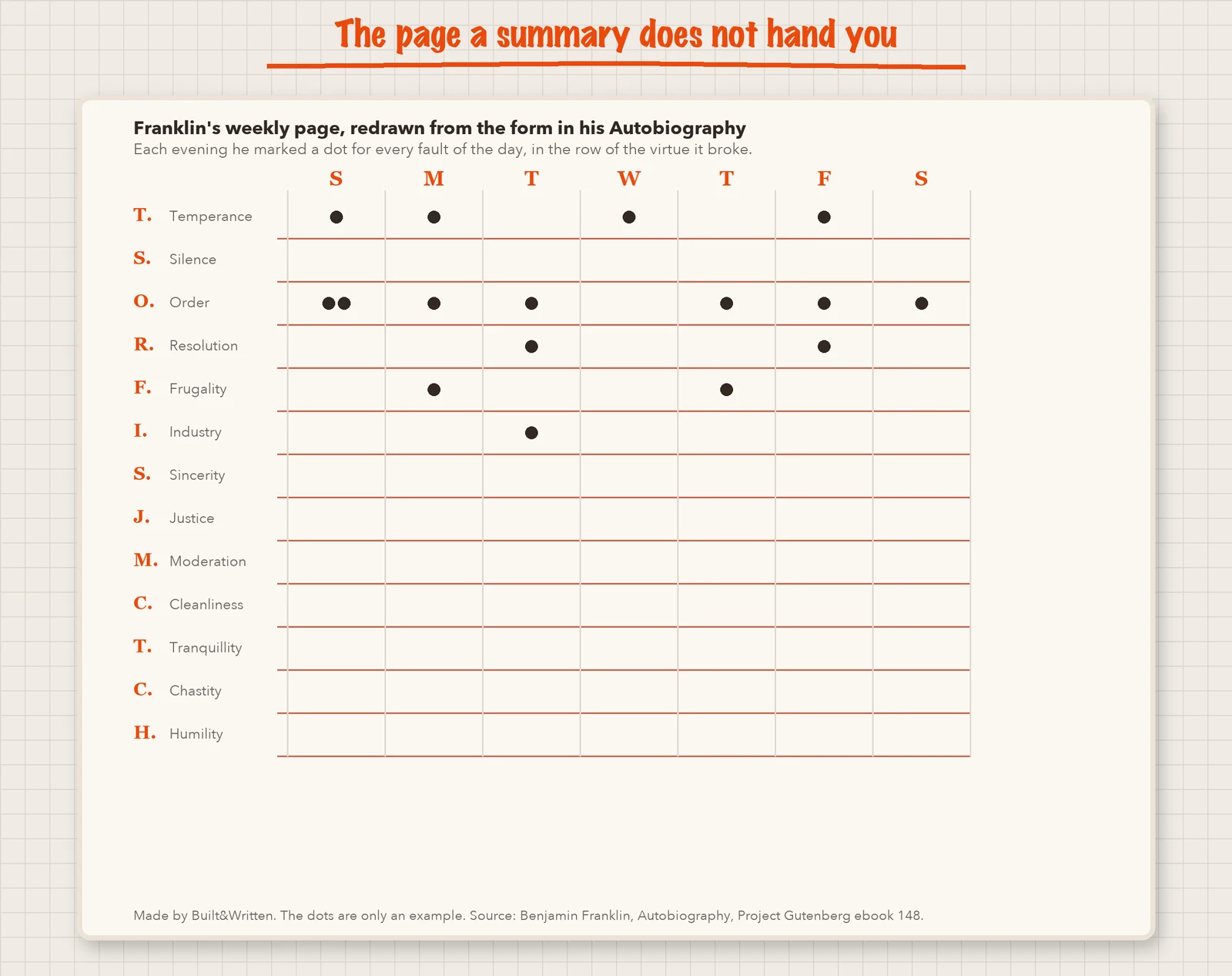
- The text. 2,454 words (14,870 characters) from Benjamin Franklin's Autobiography, the passage that begins with his "bold and arduous project" of becoming morally perfect. It holds his 13 virtues and his weekly tracking page. We took it from the Project Gutenberg text of ebook 148. Public domain means the copyright has ended, so anyone may copy it.
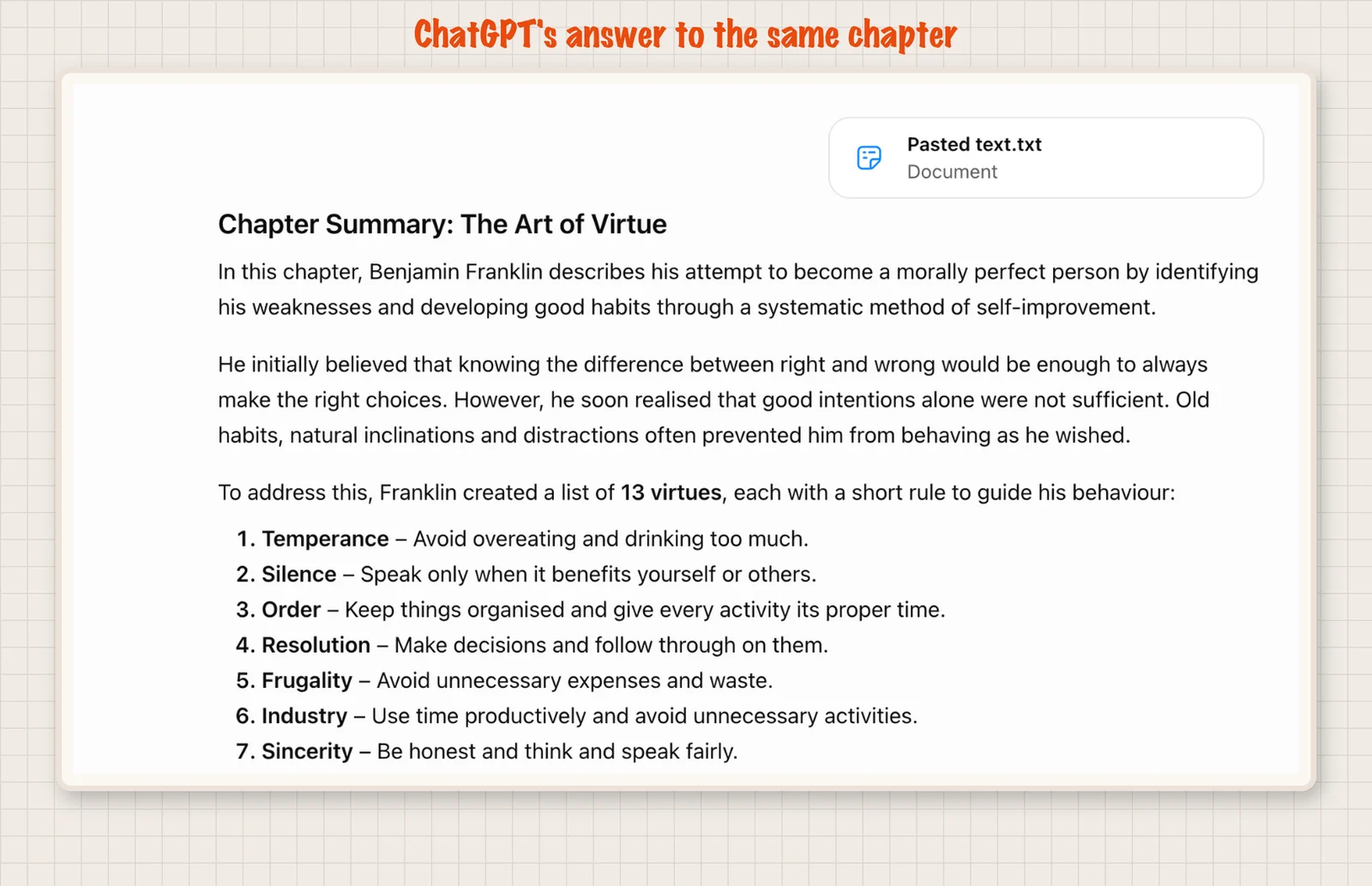
- The tools. Decopy, a free web summarizer with no login, on its default Summary setting. And ChatGPT on a free account, with the same text and the one line "Summarize this chapter of a nonfiction book."
- The checklist. Before reading any summary, we listed 10 parts of the chapter. Then we marked each part in each summary as kept, partly kept or missing. Only "kept" counts in the totals. "Partly kept" is not counted, so ChatGPT's score is 8 kept, 1 partly and 1 missing.
- The limits. One chapter, one run per tool, one day. AI answers change from run to run. Franklin is famous, which may help a tool. We tested two tools, not all of them. We kept both full outputs.
What did the summaries keep and what did they lose?
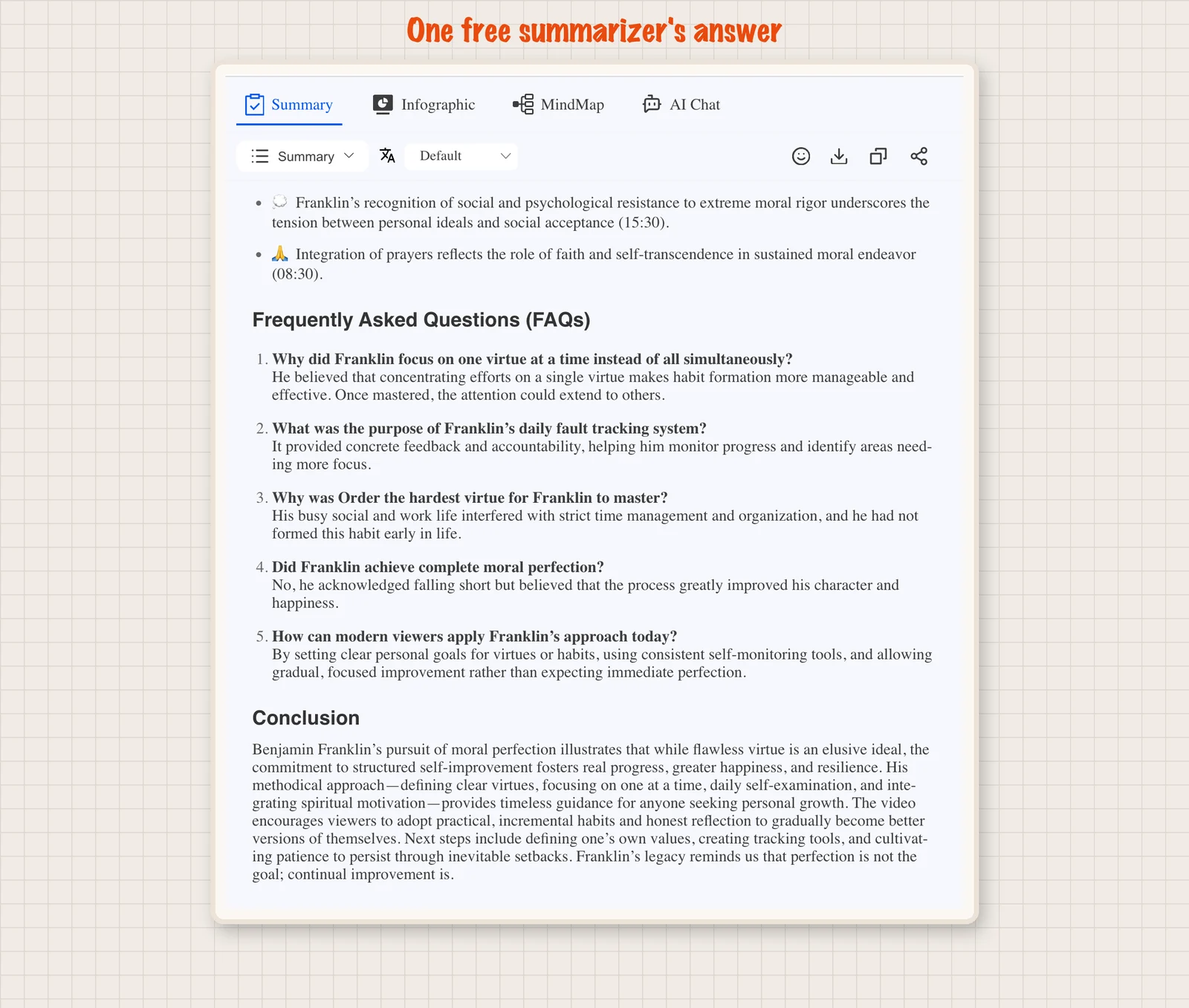
The ChatGPT summary ran 653 words, about a quarter of the chapter. The Decopy summary ran 1,017 words with its timeline, key points and questions. Here is what each kept.
| Part of the chapter | Decopy | ChatGPT |
|---|---|---|
| 1. The names of all 13 virtues | Kept | Kept |
| 2. The one-line rule for each virtue | Missing | Kept (reworded) |
| 3. One virtue a week, in a set order | Kept | Kept |
| 4. A 13-week course, four times a year | Missing | Kept |
| 5. The ruled page: days across, virtues down, a dot for each fault | Kept (as a description) | Partly (a dot, no day grid) |
| 6. The two daily questions | Kept | Kept |
| 7. The speckled axe story and its point | Point reversed | Kept |
| 8. Order was the hardest virtue and he never mastered it | Kept | Kept |
| 9. He was "a better and a happier man" for trying | Kept | Kept |
| 10. His plan to write a book called The Art of Virtue | Missing | Missing |
Three results matter for an author.
The framework travelled. Both tools kept the 13 virtues, the one-at-a-time method and the daily questions. A reader who wanted the idea got it in two minutes.
The details are where the tools differed. Decopy left out the 13 rules and the 13-week plan. It also told the axe story the wrong way round. In the chapter, a man gives up grinding his axe bright and says he likes it speckled, and Franklin says many people quit this way. Decopy said the story stressed steady commitment. If a reader trusts that line, they learn the opposite of your point.
The usable part stayed behind. Decopy described the chart in words, and ChatGPT mentioned the dots. Neither gave the reader a page to print and fill in. The chart is the part a reader would use every evening for 13 weeks. Our own figure below shows it redrawn from the form in the book.
Does copyright protect the ideas in your book?
No. Copyright protects the way you write something down, and it does not protect the idea behind it. The U.S. Copyright Office answers this in its FAQ on what copyright protects. It says: "Copyright does not protect facts, ideas, systems, or methods of operation." It adds that copyright may protect the way these things are expressed.
The law text says the same. Section 102(b) of the U.S. Copyright Act says protection does not extend to any idea, procedure, process, system or method, however it is described or illustrated.
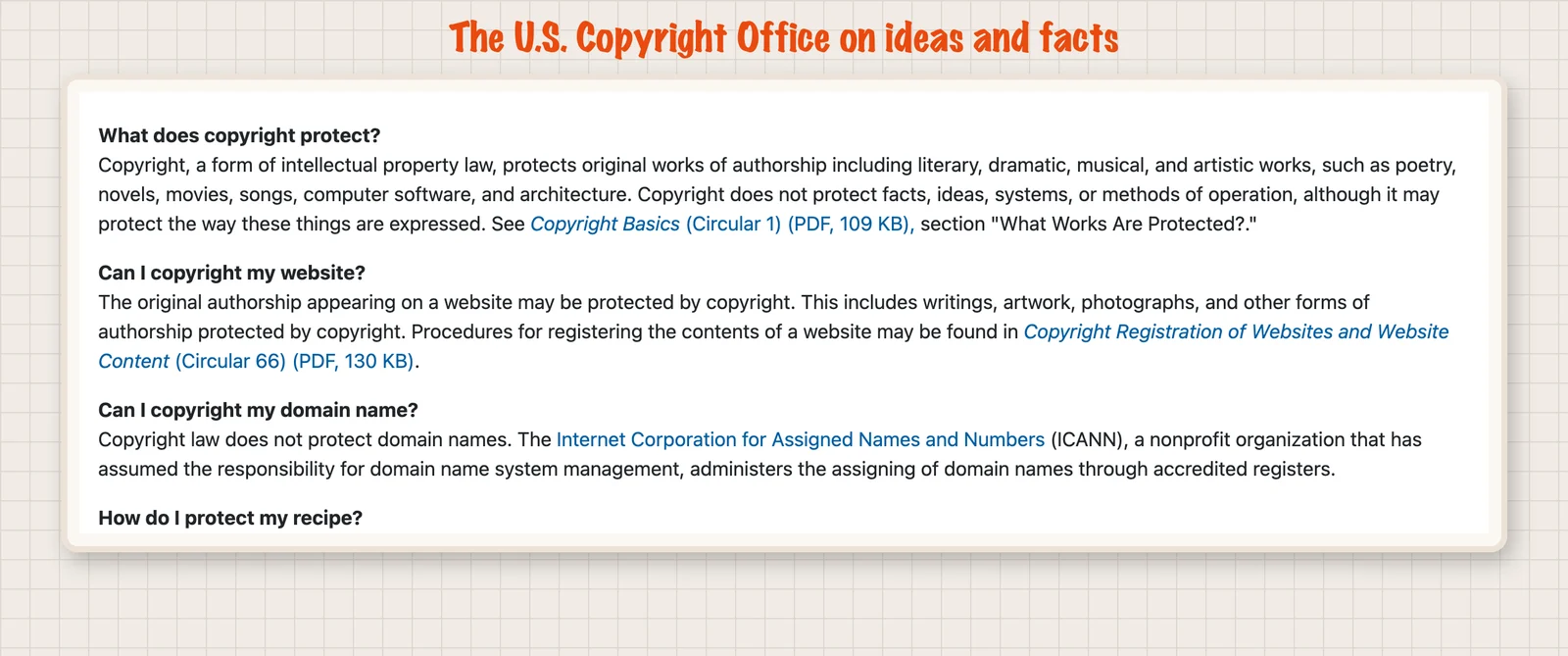
Summaries are not named on either page. The same law page defines a derivative work as a new work based on an old one. Its list includes "abridgment" and "condensation". So the idea itself is free, but a summary that copies your wording closely is a different question. Whether a given summary crosses that line is a question for a lawyer, and we are not giving legal advice.
Where are authors actually losing control?
On Kindle. In December 2025, Amazon added an AI feature called Ask this Book to its Kindle app. The Authors Guild, a U.S. writers' group, wrote on December 23, 2025 that publishers and authors cannot opt their books out. It said the feature is not licensed and that it was looking into whether it infringes authors' rights. Amazon told the Guild no license is required.
We cover the feature, the opt-out rules and what to check in our guide to Kindle's new AI features and what they mean for your book. We also looked at whether Kindle's AI changes how people read business books.
How do you write a book that a summary cannot replace?
Look at what our test lost, and put more of that in your book. Five checks:
- Give the reader a tool. A worksheet, a checklist, a tracking page or a template. Franklin's chart survived only as a sentence. Yours should be a page the reader can use.
- Tell stories with detail. Names, places, numbers and what went wrong. A summary reduces a story to one line, and sometimes gets the point wrong.
- Put your own results in. What you measured, with dates. An AI cannot know your real results unless you give them to it, and it may guess numbers that are wrong.
- Keep your voice. The reader who wants to hear you will not get you from a shortened copy. Our guide to writing a self-help book with AI that sounds real shows how to keep it.
- Make the steps work in order. Our guide to three proven frameworks for structuring a nonfiction book can help. Franklin's 13-week plan is a course that builds week by week. A reader who follows a course needs the whole book.
A good test: paste one of your chapters into ChatGPT or Decopy. Whatever the summary drops is what your full book adds. Check it for mistakes too, because a wrong summary still points at your name.
How do you write that book with Built&Written?
The five checks above all need your own material: your tools, your stories, your numbers and your voice. Built&Written is made to start from that material and turn it into chapters.
Start from what you have. There are two paths, and both end with files you upload to KDP yourself.
You have loose material. Paste notes, blog posts or talk transcripts. The platform proposes a chapter outline, and you approve it. It then writes the chapters. Voice DNA learns your voice from a few pages of your writing, about 300 to 1,000 words, so put your strongest pages first. The chapters it writes then follow your usual style. You read and edit each chapter by hand. You can place images inside chapters, so a worksheet saved as a PNG, JPG or WebP file can sit in the chapter where the reader needs it. Our page on turning blog posts into a book shows this path in more detail.
You have a finished manuscript (the book you already wrote). Upload a .docx file and the platform formats it for print without changing a word.
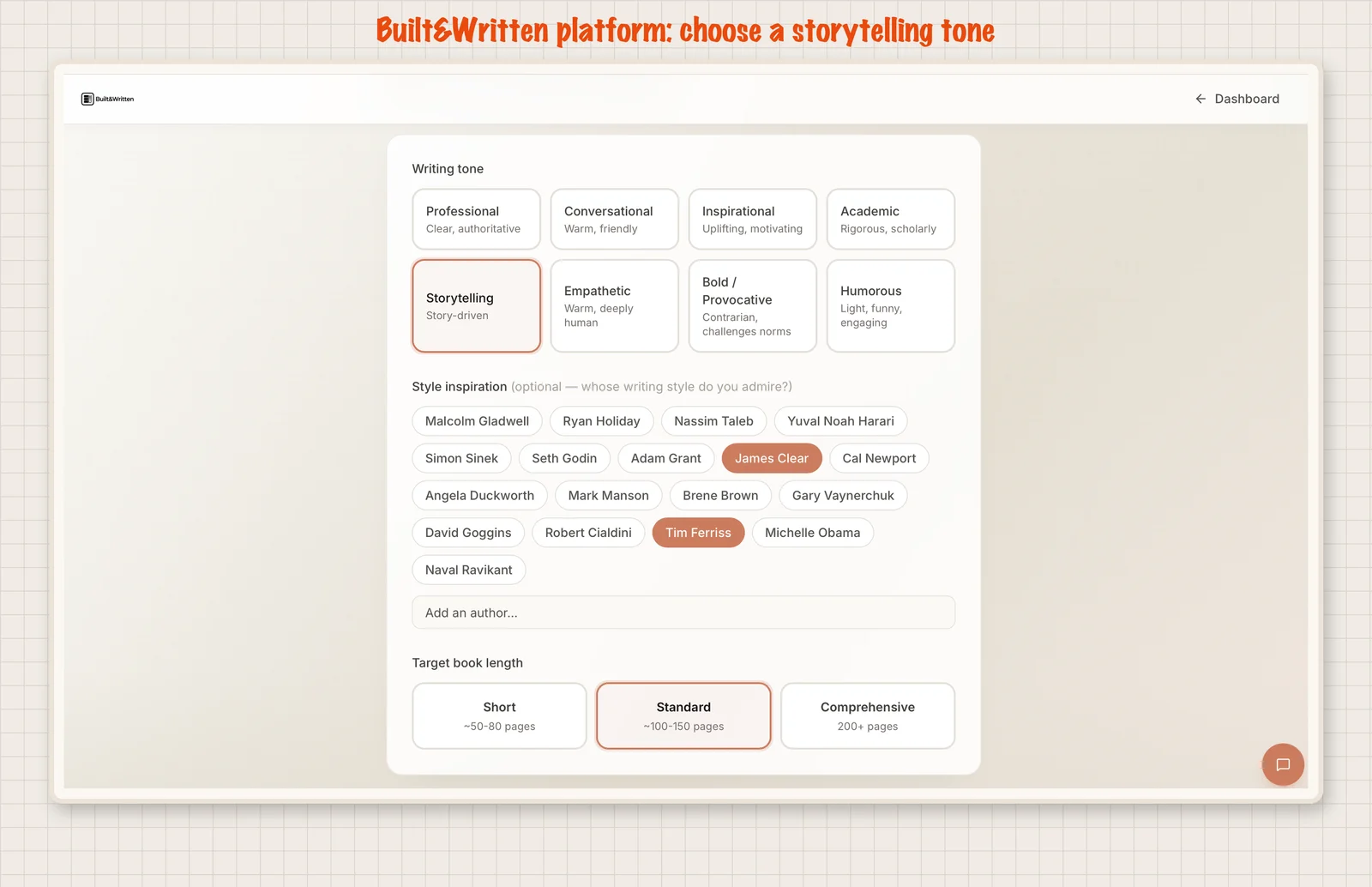
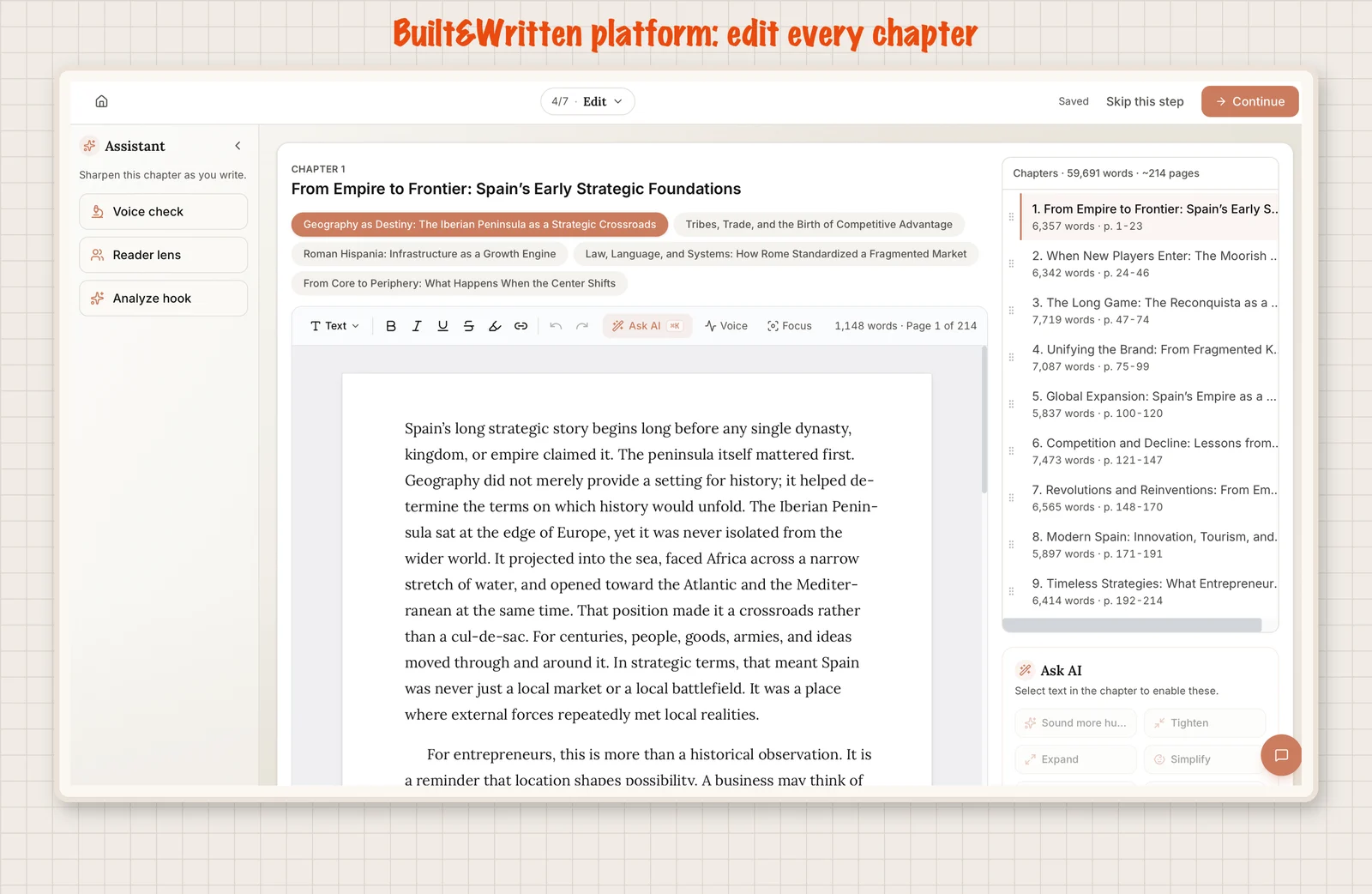
At the end you get a print PDF and the KDP files, and you upload them to KDP yourself. The ePub file (the ebook file for Kindle and other readers) needs the Entrepreneur plan or higher. See the pricing page for plans. Three free tools help with the page that sells the book: the book description scorer, the KDP keywords generator and the book blurb generator.
Final thoughts
So, should you worry? A little. A summary can carry your ideas to people who never buy the book, and the law protects your wording more than your ideas. Our test shows what it cannot carry: the page a reader prints, the story told in full, your numbers and your voice. Build the book around those.
Built&Written turns the material you already have into a finished book. In short:
- You start from your own notes, posts or transcripts, so the stories and numbers are yours.
- You approve the outline and edit every chapter, and chapters follow your style through Voice DNA.
- You add your worksheets as images, so the reader gets the page to use.
- You get a print PDF and KDP files, and you upload them to KDP yourself.
Frequently asked questions
Yes, if the tool can take the text. In our test, a chatbot summarized a 2,454-word chapter in 653 words. Decopy accepts up to 200,000 characters in one paste, about 33,000 words at our test ratio, so a longer book must go in parts. Title-only tools like 5tldr work from memory and do best on well-known books.
We cannot give legal advice. The U.S. Copyright Office says copyright does not protect facts, ideas, systems or methods, though it may protect how they are expressed. Its pages do not name summaries. The law's list of derivative works includes "abridgment" and "condensation", so ask a lawyer about a specific case.
Not fully. You cannot control what a reader pastes into a tool. On Kindle, the Authors Guild wrote on December 23, 2025 that authors and publishers cannot opt their books out of Ask this Book. Our guide to Kindle's AI features explains what you can still do.
We found no sales study in the sources we read for this article, so we will not give a number. What we measured is smaller: in one chapter, a summary kept 6 to 8 of 10 parts and left out the printable worksheet. That is a reason to put tools, stories and numbers in your book.
Sources & References
- What Does Copyright Protect? (FAQ), U.S. Copyright Office, checked 2026-11-19
- Title 17, Chapter 1, sections 101 and 102(b), U.S. Copyright Office, checked 2026-11-19
- Authors Guild Raises Concerns About Kindle's New Ask This Book AI Feature, December 23, 2025
- Decopy free AI summarizer page, checked 2026-11-19
- 5tldr AI book summarizer page, checked 2026-11-19
- The Autobiography of Benjamin Franklin, Project Gutenberg ebook 148, text file
About the author