

Will Kindle's AI Change How People Read Business Books?
What is Built&Written? Built&Written is a platform for writing nonfiction books and preparing them for publishing. Its AI writes a book from material you already have, like notes, posts and talk transcripts, in your voice. It also formats a book you've already written without changing a word. You get a print PDF and files for KDP (Kindle Direct Publishing, Amazon's self-publishing service) and publish the book yourself.
Key takeaways
- Do people still read books? Yes. In a Pew survey of 8,046 US adults, 75% had read all or part of a book in the past 12 months. Built&Written helps you write a book for those readers from material you already have.
- Are people reading less? For pleasure, yes. The share of adults who read a book for pleasure fell from 54.6% in 2012 to 48.5% in 2022.
- What does an AI summary of a business book keep? The named idea. In our test, ChatGPT and Claude both kept the chapter's term and its 3 stages, and dropped most of the numbers.
- What does Built&Written add? An outline you edit before writing starts, so the ideas you name are the ones readers carry away.
Do people still read books in 2026?
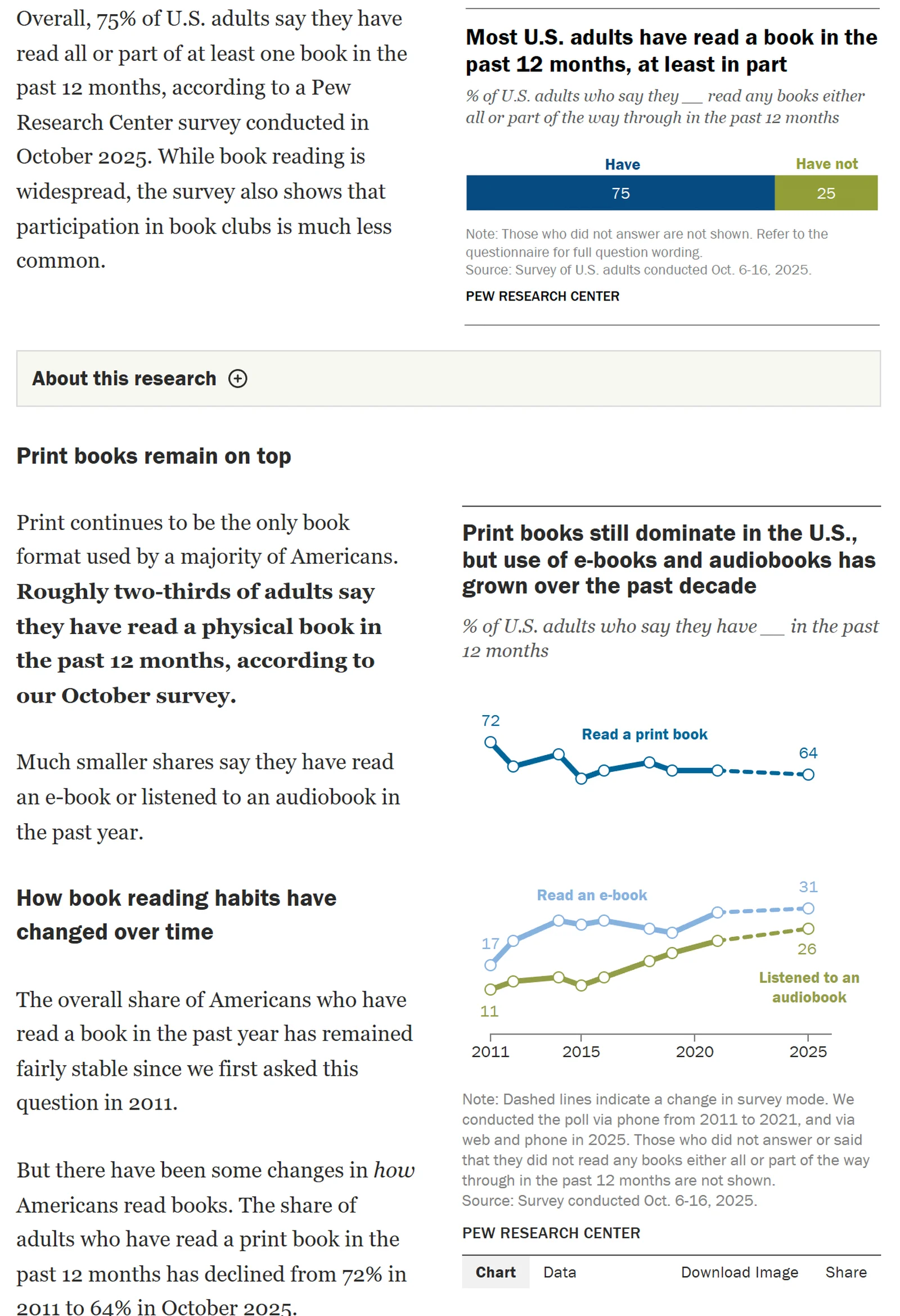
Yes. Three in four American adults read at least part of a book last year. That figure comes from the Pew Research Center, which surveyed 8,046 adults from October 6 to 16, 2025. Pew published the results on April 9, 2026.
Pew has asked the same question since 2011, and the total has barely moved. What moved is the format:
| Format | 2011 | 2025 |
|---|---|---|
| Print book | 72% | 64% |
| Ebook | 17% | 31% |
| Audiobook | 11% | 26% |
Print is still the format most people choose. Ebooks almost doubled, and audiobooks more than doubled. Younger readers lean digital: 41% of adults under 30 read an ebook.
Readers with more education read more. Pew found that 88% of college graduates read a book in the past year, against 60% of adults with a high school education or less.
Text in the image: Overall, 75% of U.S. adults say they have read all or part of at least one book in the past 12 months, according to a Pew Research Center survey conducted in October 2025. Most U.S. adults have read a book in the past 12 months, at least in part. Have: 75. Have not: 25. Print books remain on top. Print books still dominate in the U.S., but use of e-books and audiobooks has grown over the past decade. Read a print book: 72 in 2011, 64 in 2025. Read an e-book: 17 in 2011, 31 in 2025. Listened to an audiobook: 11 in 2011, 26 in 2025. The overall share of Americans who have read a book in the past year has remained fairly stable since we first asked this question in 2011.
Do people still read books for pleasure, or just differently?
Both. Fewer people read for fun, and the ones who read use more formats.
The National Endowment for the Arts tracks reading for pleasure. In its survey, 54.6% of adults read at least one such book in 2012. That fell to 52.7% in 2017 and 48.5% in 2022.
So Pew's 75% and the NEA's 48.5% don't contradict each other. Pew counts any book, including the ones people read for work.
The newer change is who does the reading. A reader can now paste a chapter into ChatGPT, or any AI book summarizer, and get five bullet points back. On Kindle, Amazon's Ask this Book answers questions about best-selling English-language ebooks in the Kindle app for iPhone in the US. Since November 2026 it has reached some new Kindle e-readers too. In both cases, the reader meets your ideas through an AI's retelling before, or instead of, your own sentences.
How Built&Written helps you write a book that survives a summary
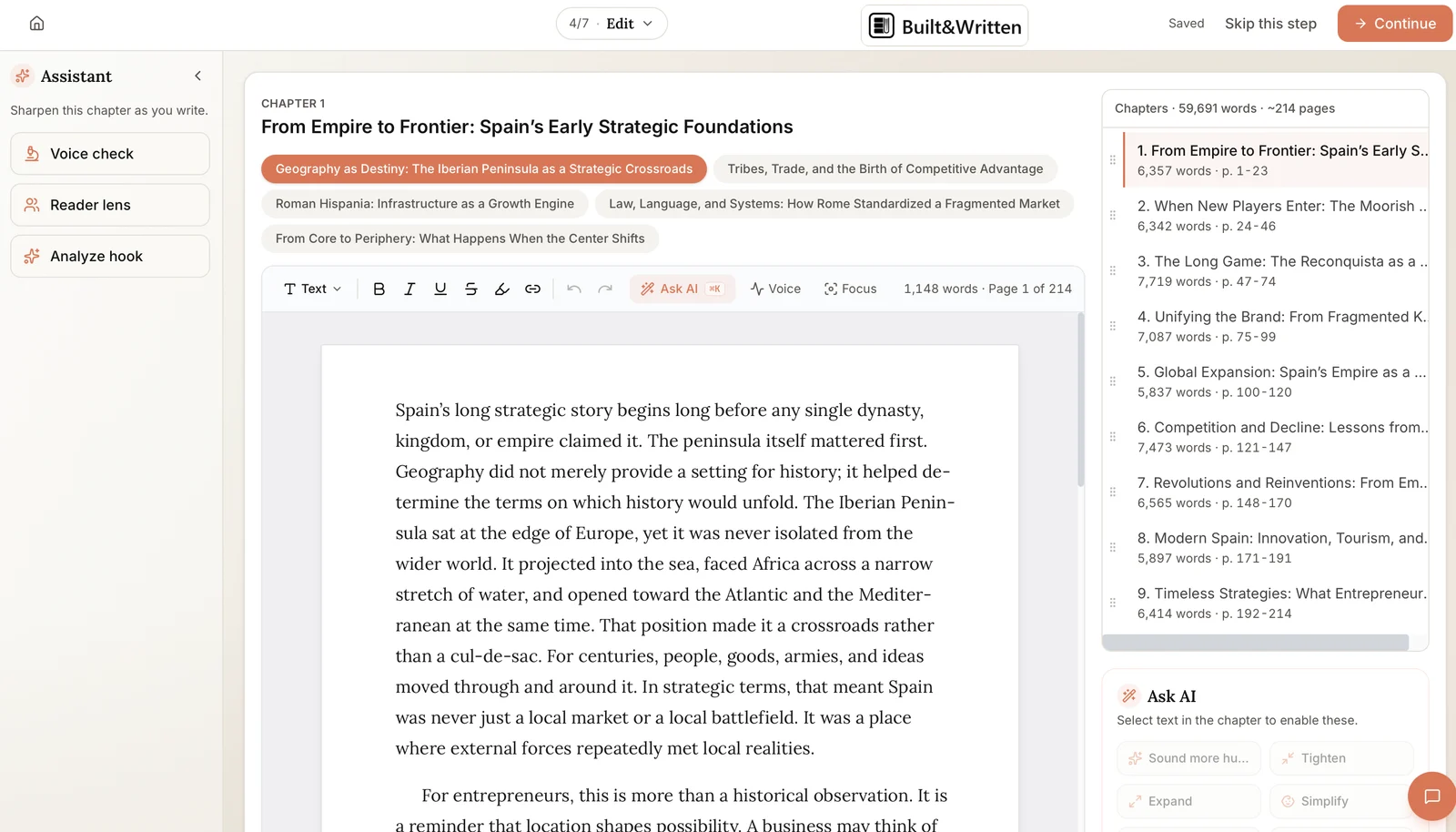
Built&Written writes your book from the material you already have. You shape what a summary will grab: the outline, the chapter titles and the names of your ideas.
| What a summary picks up | With Built&Written | By hand |
|---|---|---|
| The names of your ideas | Your outline is built from your material, and you edit it, chapter titles included, before writing starts | You coin them and keep them consistent across chapters |
| Your voice | Voice DNA learns it from a few pages of your writing | Hard to keep across 200 pages |
| A strong chapter opening | The Analyze hook tool rates each chapter opening, on every plan | Rewritten by feel |
| How a reader sees the chapter | Reader lens notes from simulated readers, on Entrepreneur and up | A beta reader, weeks later |
Text in the image: Edit. Built&Written. Assistant. Voice check. Reader lens. Analyze hook. Chapter 1. From Empire to Frontier: Spain's Early Strategic Foundations. Geography as Destiny: The Iberian Peninsula as a Strategic Crossroads. Tribes, Trade, and the Birth of Competitive Advantage. Roman Hispania: Infrastructure as a Growth Engine. Law, Language, and Systems: How Rome Standardized a Fragmented Market. From Core to Periphery: What Happens When the Center Shifts. Ask AI. Voice. Focus. 1,148 words. Page 1 of 214. Chapters: 59,691 words, about 214 pages.
What happens when AI summarizes a business book?
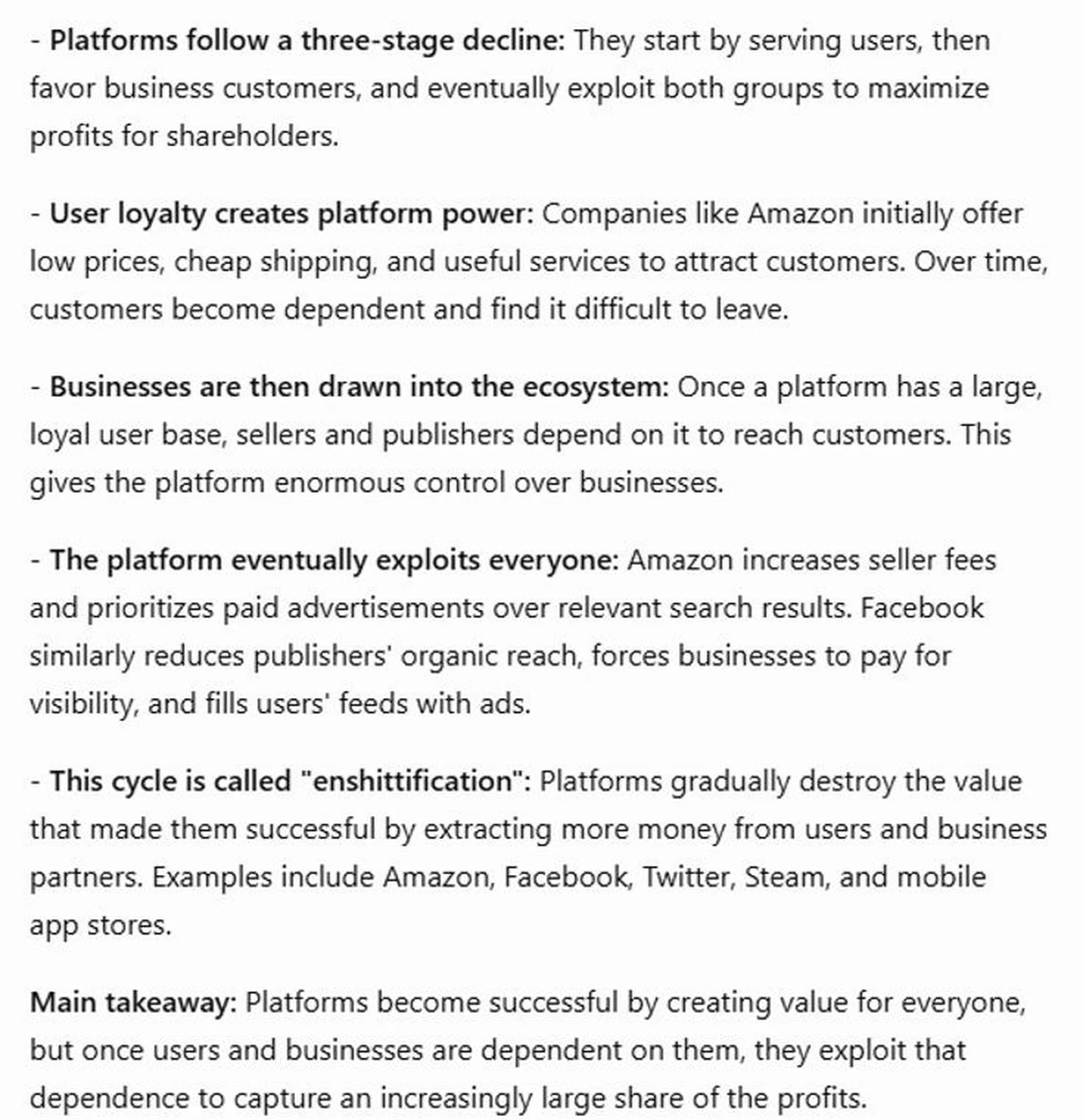
Readers often see a summary before the book itself, so we checked what a summary keeps. The named idea survives. The numbers mostly don't.
We gave ChatGPT and Claude the same 1,098-word chapter and asked each one for 5 bullet points. The chapter is part of Cory Doctorow's essay "Tiktok's enshittification", which explains how platforms like Amazon and Facebook decline in 3 stages. It reads like a business book chapter: one named idea, 4 numbers and 3 specific stories.
| What we counted | ChatGPT (free) | Claude (paid) |
|---|---|---|
| The named idea, "enshittification" | Kept | Kept |
| Its 3 stages | Kept | Kept |
| Numbers kept, of 4 (90%, 45%, $31b, 50%) | 0 | 1 (45%) |
| Specific stories kept, of 3 | 0 | 2 ("pivot to video", Jedi Blue) |
| Author named | No | No ("the author") |
| Claims not in the chapter | 0 | 0 |
| Followed "5 bullet points" | Added a sixth "Main takeaway" line | Yes |
Text in the image (first line of each point): Platforms follow a three-stage decline: They start by serving users, then favor business customers, and eventually exploit both groups to maximize profits for shareholders. User loyalty creates platform power. Businesses are then drawn into the ecosystem. The platform eventually exploits everyone: Amazon increases seller fees and prioritizes paid advertisements over relevant search results. This cycle is called "enshittification". Main takeaway: Platforms become successful by creating value for everyone, but once users and businesses are dependent on them, they exploit that dependence.
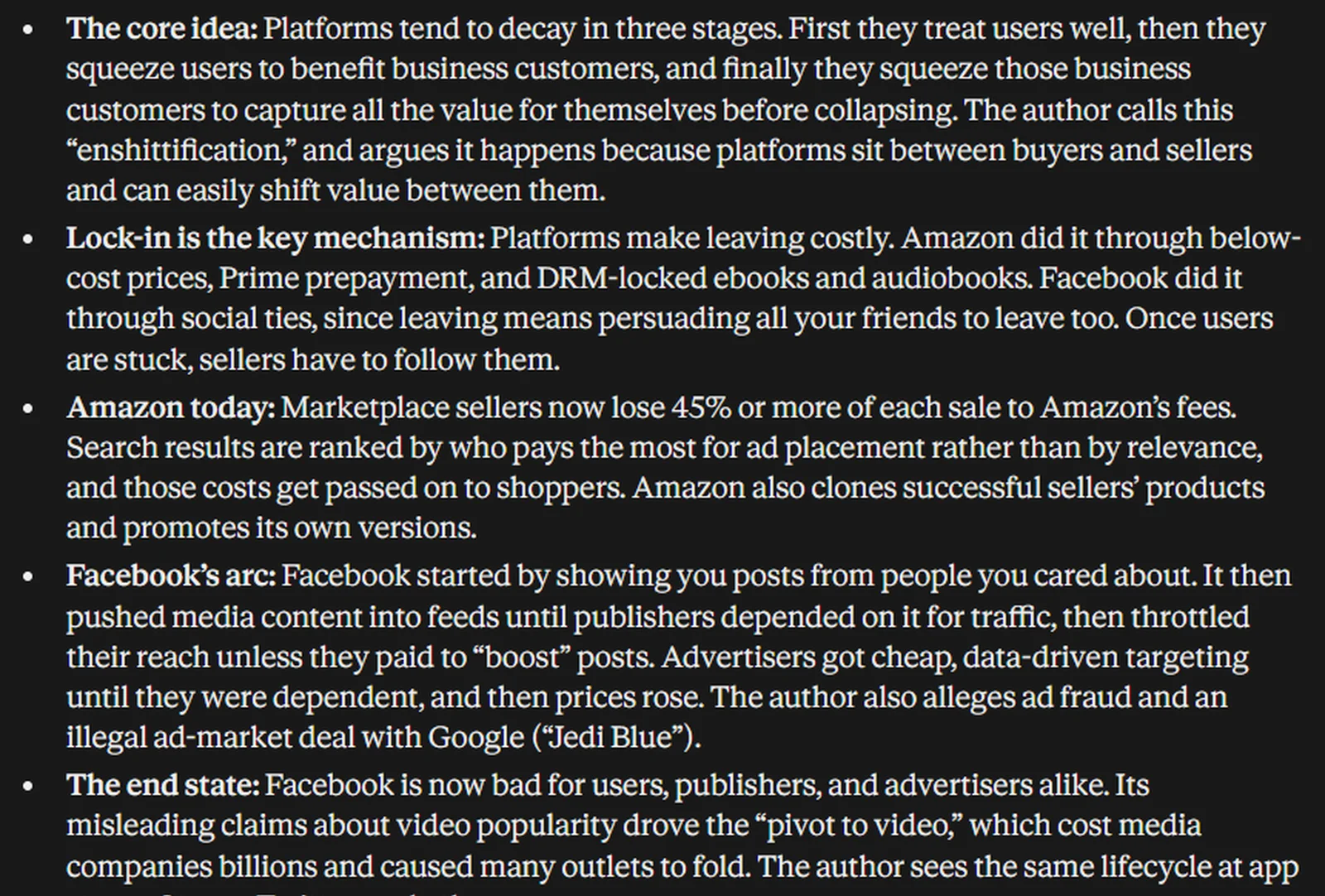
Text in the image (first line of each point): The core idea: Platforms tend to decay in three stages. Lock-in is the key mechanism: Platforms make leaving costly. Amazon today: Marketplace sellers now lose 45% or more of each sale to Amazon's fees. Facebook's arc: The author also alleges ad fraud and an illegal ad-market deal with Google ("Jedi Blue"). The end state: Its misleading claims about video popularity drove the "pivot to video," which cost media companies billions.
Neither tool invented anything. But a busy reader who stops at the summary walks away with the idea and the stages, and almost none of the evidence. The "cat beds" example, where the first screen of Amazon results is all ads, vanished from both. Claude kept more detail, and it ran on a paid plan, so part of that gap may come from the plan.
Neither summary named the author either. The chapter itself never says "Cory Doctorow". It only says "I call this enshittification", so the term traveled and the name didn't. For an author, the lesson is simple: give the idea a name, and make the proof easy to find.
How we tested
- Date: November 10, 2026.
- Text: the Amazon and Facebook part of Cory Doctorow's "Tiktok's enshittification" (Pluralistic, January 21, 2023), 1,098 words, under a CC BY 4.0 license. We cut the link lines and stopped before the section on Meta.
- Prompt: "Summarize this chapter in 5 bullet points for a busy reader."
- ChatGPT: the free version, logged out.
- Claude: a paid plan with Opus 5.5, so the two runs aren't on equal plans. Read the table as one run per tool.
Will Kindle's AI change how people read business books?
It changes how readers move through a book. Pew's numbers show the habit itself holding steady since 2011. What AI adds is a shortcut: a reader can ask what a chapter means, get a summary first, and decide whether to read the rest.
Ask this Book also answers from your text, so a wrong number in a chapter becomes a wrong answer on a reader's screen. Kindle's other AI features, and which ones authors can switch off, get their own guide on our blog.
Other authors already use AI on their own books. See how business authors use AI differently from novelists and our guide to AI beta readers.
How do you write a business book people want to read?
Write it so the summary sends readers to the book, and the book rewards them for coming. Six habits, each backed by the test above:
- Start with the reader. Open each chapter with your reader's problem, in their words. A summary keeps the main idea, so make that idea about them.
- Give each chapter one idea with a name. Both tools kept "enshittification" and its 3 stages. Write "I call this the X method" early and use the same name in your own posts, so the idea stays tied to you.
- Put the number next to the claim, and repeat it. The one number Claude kept, 45%, is the only one the chapter states twice.
- Tell your stories in full. Summaries cut stories first, and the "cat beds" example vanished from both. A full story is the reason to read the chapter itself.
- Use section titles that state the point. A title like "Geography as Destiny" tells a skimmer, and an AI, what the section argues.
- End each chapter with a short recap. Three or four sentences in your own words give a summary something accurate to copy.
This is easier when you don't start from a blank page. Built&Written starts from what you already have: posts, talk transcripts, notes about clients. It proposes a plan for the book, and you rename chapters, reorder them and cut what doesn't fit. Only then does the AI write the chapters in your voice, from your own stories and numbers. You edit every line.
That's why writing a book with us isn't hard. The ideas, the names and the examples come from your own material, and you decide the structure first. Our guides on writing a book with AI that still sounds like you and choosing a nonfiction book structure go deeper. If you have a folder of posts or notes, try it with those.
Final thoughts
An AI summary keeps the name of your idea and loses the proof. So name your ideas, repeat your key numbers and tell your stories in full. Then the summary becomes a reason to open the book.
If you already have posts, notes or talks, you already have most of the book. Built&Written turns that material into a book in your voice, with the plan in your hands before a word is written. See how it works.
- Ideas with names. You edit the outline and its chapter titles before writing starts, so your framework is named before the chapters are written.
- Your voice, kept. Voice DNA learns your style from a few pages of your writing.
- Stronger chapter openings. The Analyze hook tool rates each opening on every plan, and Reader lens shows simulated reader notes on Entrepreneur and up. Plans are on the pricing page.
- Start with what you have. You don't need a manuscript, only notes, posts or talk transcripts.
Frequently asked questions
Yes. 75% of US adults read all or part of a book in the past 12 months, according to Pew's survey of October 2025. Print is still the most common format, at 64%.
Yes, for pleasure. The NEA found 48.5% of adults read a book for pleasure in 2022, down from 54.6% in 2012. Total reading, including books for work and school, has been fairly stable since 2011, according to Pew.
Mostly, for the main idea. Use an AI book summary to see what a chapter argues, then read the chapter for the proof.
No, not on current evidence. Ebooks and audiobooks grew while total reading held steady, and summaries skip the stories and proof that make a business book persuasive.
Sources & References
- Pew Research Center: Do Americans read print books, e-books or audiobooks more? (April 9, 2026)
- National Endowment for the Arts: Federal Data on Reading for Pleasure: All Signs Show a Slump (October 3, 2024)
- Amazon: How to make reading easier and more enjoyable with these Kindle features (updated July 2, 2026)
- Cory Doctorow, Pluralistic: Tiktok's enshittification (January 21, 2023), CC BY 4.0
- Creative Commons Attribution 4.0 International
About the author

Michael Pavlovskyi
More in Book Marketing
Ready to write your book?
Turn your expertise into a professional book with Built&Written.