

Can an AI prayer generator help you write a book of prayers?
An AI prayer generator can write a first draft of a prayer in seconds. The text repeats itself, it adds details you never gave it, and one tool's terms do not allow commercial use.
We ran one request through three tools on November 17, 2026. Then we read the rules for a prayer book from Amazon KDP (Kindle Direct Publishing, Amazon's service for selling your book), the US Copyright Office and a Bible publisher.
Key takeaways
- Can an AI prayer generator help with a book of prayers? Yes, as a helper for ideas and first drafts. In our test, PrayerKey repeated lines and all three tools added facts we never gave.
- Can you publish what it writes? One tool's terms name personal and ministry use and do not mention books. Another bans commercial use without written permission. Check the tool's terms before you sell a book.
- What does KDP require? You must tell KDP when AI created your text. You do not report AI that only helped you edit your own writing.
How did we test three AI prayer generators?
How we tested. On November 17, 2026, we sent the same request to three tools: PrayerKey, PrayerCreator and ChatGPT. The request was: "Morning gratitude and hope for a tired single mother. The prayer is for my sister Anna."
We asked for 6 to 10 sentences where we could: PrayerCreator has a Medium setting for that length, and in ChatGPT we asked in words. ChatGPT ran in a temporary chat with the default model (the app did not show its name). PrayerKey has no length setting. We ran PrayerKey and PrayerCreator three times and ChatGPT once. Then we checked every Bible verse and read each tool's terms.
This is one scenario on one day, not a ranking of the tools.
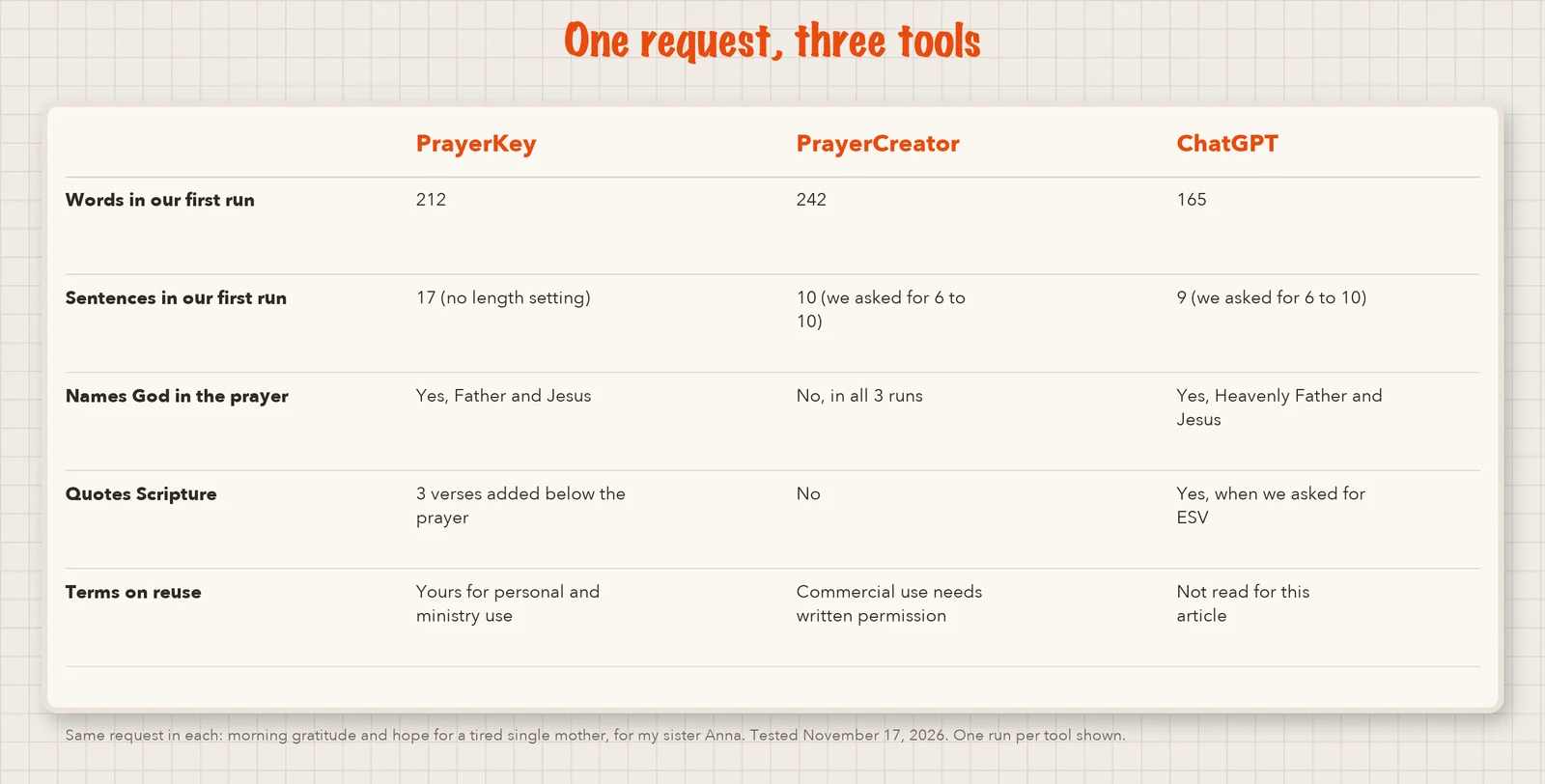
| PrayerKey | PrayerCreator | ChatGPT | |
|---|---|---|---|
| Words in our first run | 212 | 242 | 165 |
| Sentences in our first run | 17 (no length setting) | 10 (we asked for 6 to 10) | 9 (we asked for 6 to 10) |
| Names God in the prayer | Yes, Father and Jesus | No, in all 3 runs | Yes, Heavenly Father and Jesus |
| Quotes Scripture | 3 verses added below the prayer | No | Yes, when we asked for ESV |
| Terms on reuse | Personal and ministry use, books not mentioned | Commercial use needs written permission | Not read for this article |
What does PrayerKey write for a prayer book?
PrayerKey is a free site for Christian prayers. You type one line and it writes a prayer and adds Bible verses below it. Our first run was 212 words in 17 sentences, and it closed with "In the name of Jesus Christ I pray."
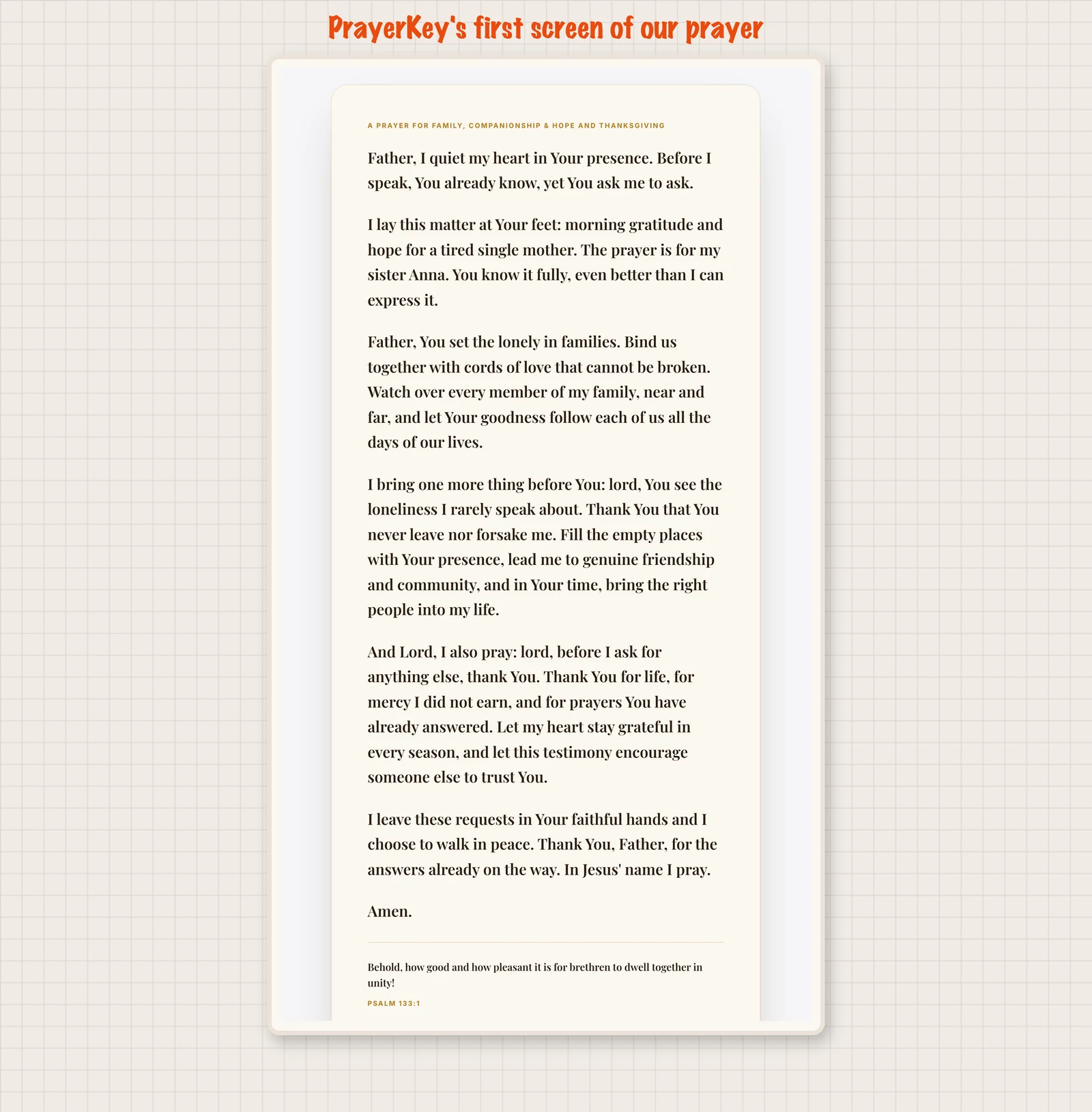
Three things stood out:
- It pasted our words into the prayer. Our request came back word for word in all three runs. Type it as a clean phrase.
- It added a struggle we never mentioned. Two runs said "You see the loneliness I rarely speak about." The third spoke of "the sting of rejection I have carried." Our request was about a tired mother, and the prayer turned into one about the person praying.
- The same sentences came back. Five sentences appeared in all three runs. Five more appeared in two of three.
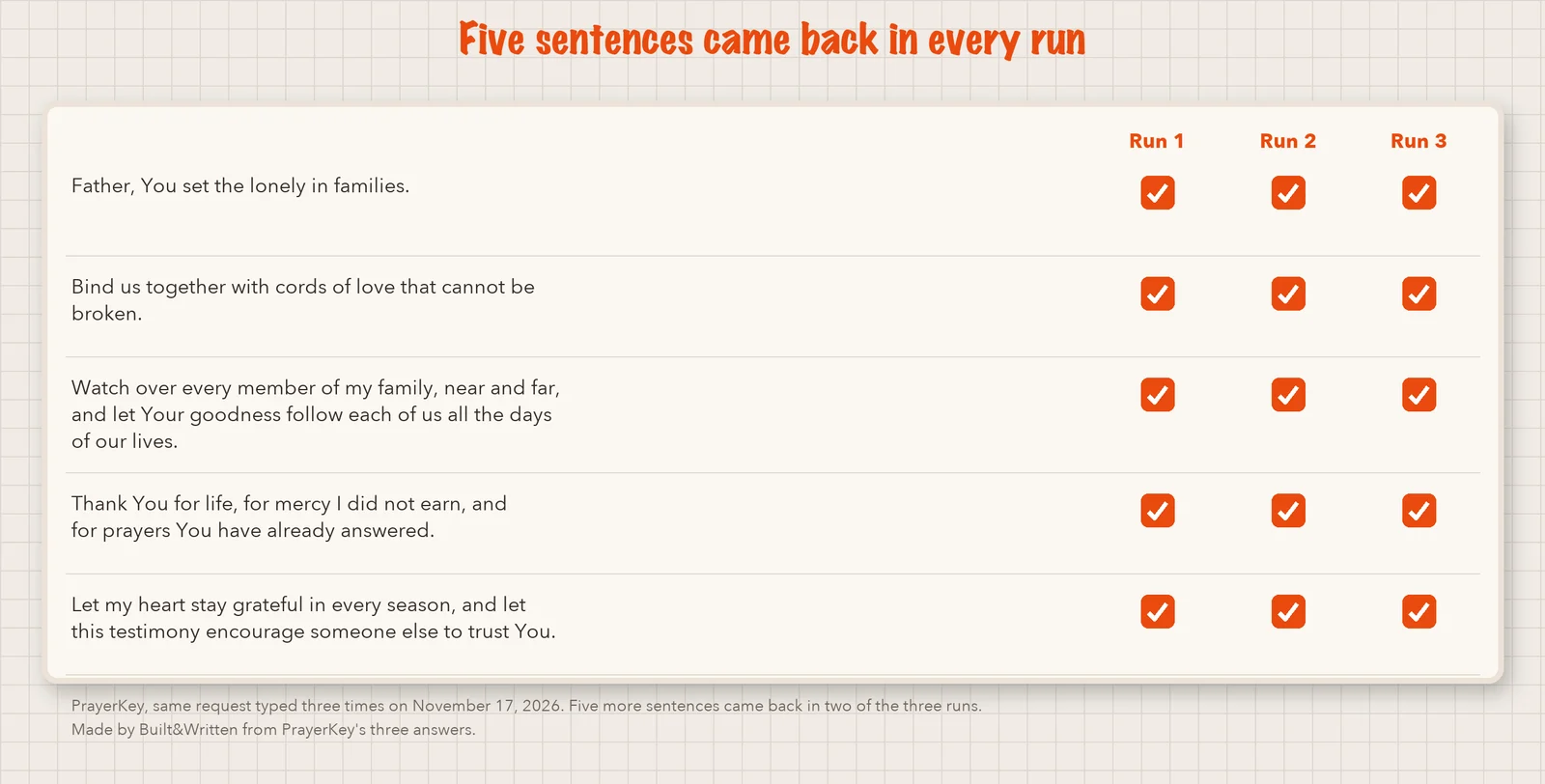
We ran only three prayers, so we cannot say how fast a whole book would repeat.
What does PrayerCreator write?
PrayerCreator is a free site where you choose an occasion, a tone, a length and a language, and add details. We chose Morning Reflection, Hopeful and Uplifting, Medium and English. Our first run was 242 words in 10 sentences, so it kept to the length we picked.
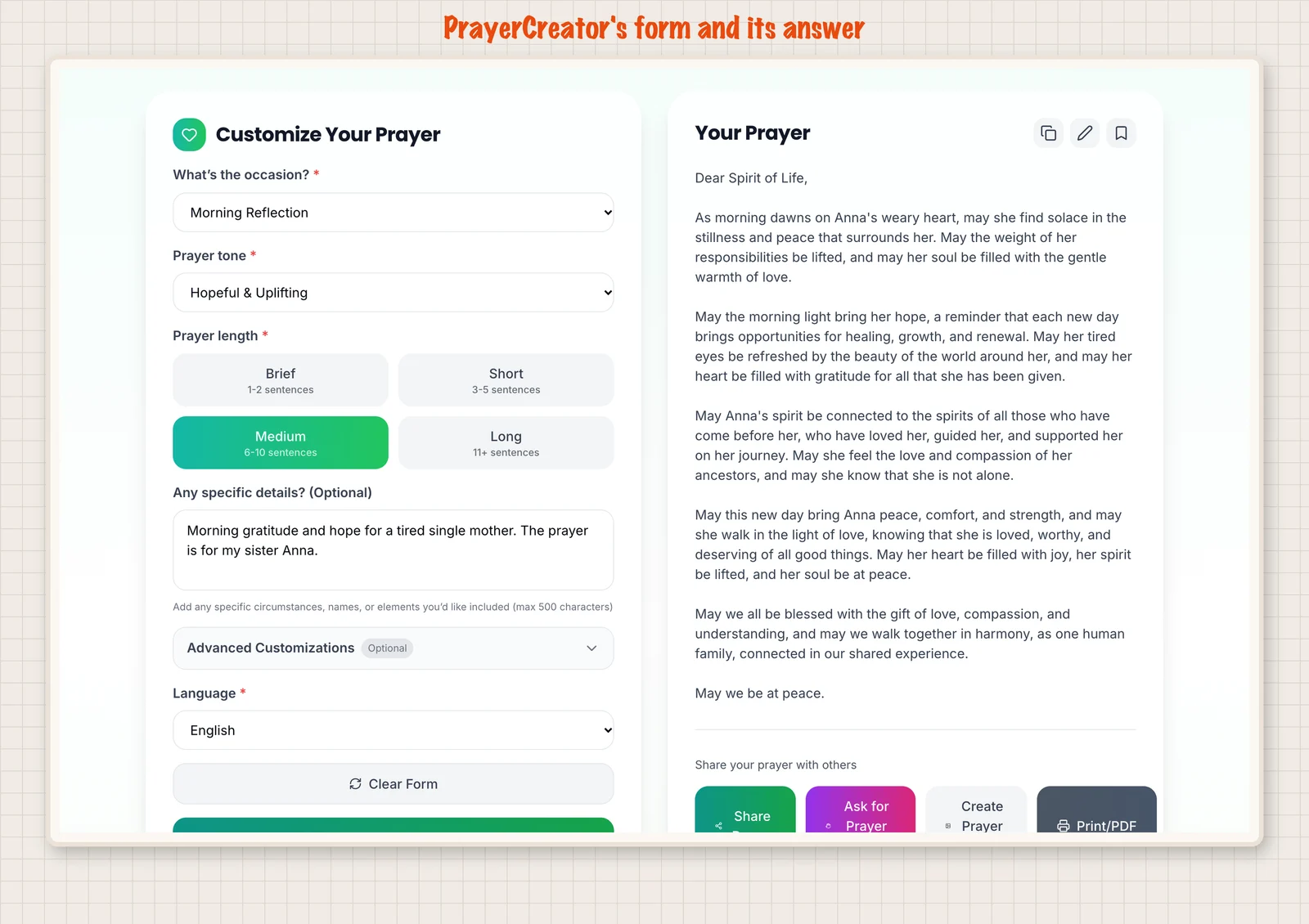
The words God, Lord, Father and Jesus did not appear in any of our three runs. The prayers began "Dear loving presence" or "Dear Spirit of Life." The third spoke of "ancestors" and "one human family." The form has no box for your faith. Its Advanced Customizations offer focus, feeling, time of day, structure and ending style.
We did not try typing "Christian" into the details box, so we cannot say what would happen. If you write a Christian book with this tool, read every line for faith and wording.
It also invented details. Two of three runs gave Anna children, and one added "a warm cup of coffee."
What does ChatGPT write?
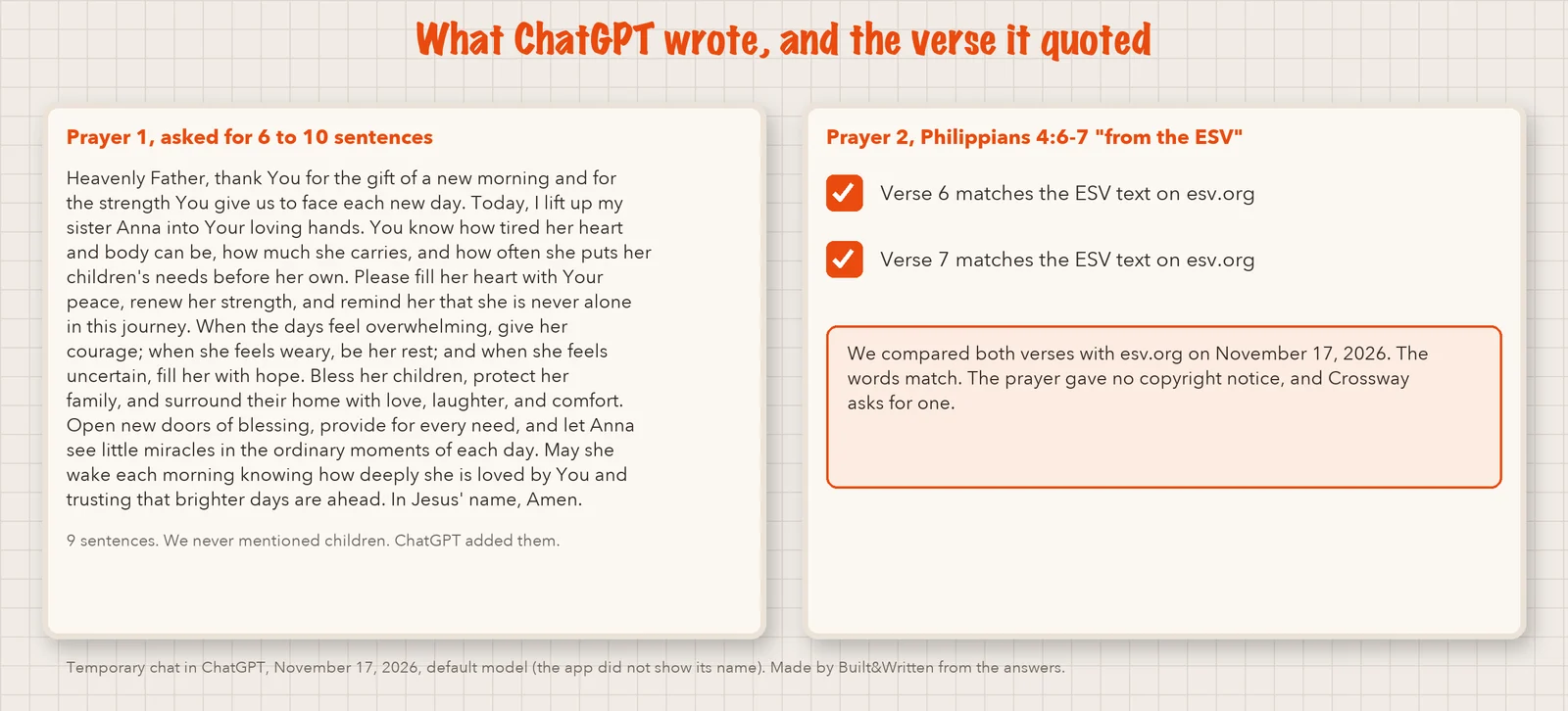
ChatGPT wrote 165 words in 9 sentences, inside the length we asked for. It named "Heavenly Father" and closed "In Jesus' name, Amen." It also gave Anna children, though we never said she had any.
Does an AI prayer generator quote the Bible correctly?
In our test, yes. We asked ChatGPT to quote Philippians 4:6 and 7 "word for word from the ESV." Both verses matched the text on esv.org. PrayerKey's three verses, Psalm 133:1, Psalm 68:6 and Psalm 107:1, matched the King James Version on Bible Gateway. Psalm 68:6 was cut short with three dots. A correct quote can still need permission (rule 4 below). Crossway's ESV permissions page also says the ESV text may not be used, accessed or processed by any AI system. We did not check that rule before we asked ChatGPT to quote the ESV, so read it before you do the same.
Can you publish prayers from an AI prayer generator?
Four sets of rules decide it.
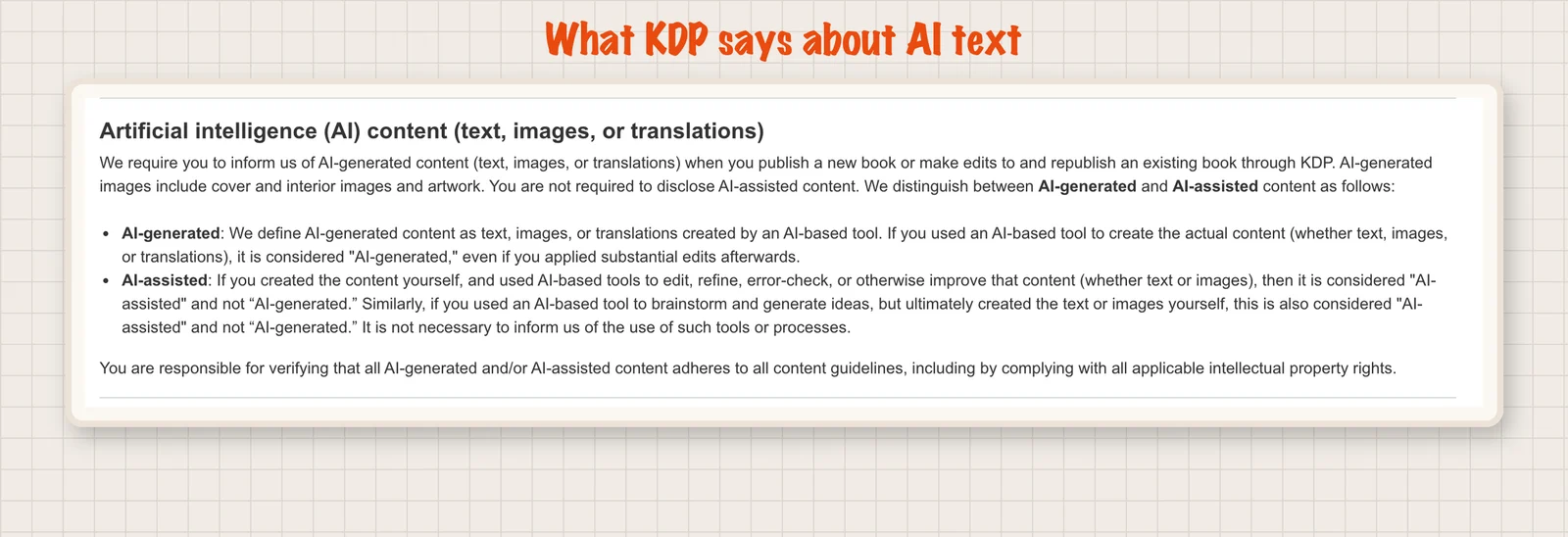
1. KDP's rule on AI text. KDP's content guidelines call text that an AI tool created "AI-generated," even if you applied "substantial edits afterwards." You must tell KDP about it when you publish. If you wrote the text and AI only helped you edit or brainstorm, it is AI-assisted and you do not report it.
Our guides explain whether AI books can sell on Amazon and what KDP lets you publish.
2. Copyright. On January 29, 2025, the US Copyright Office published a report on AI and copyrightability. It says that "prompts do not alone provide sufficient control" for the user to be the author. It also says copyright does not extend to purely AI-generated material. You keep copyright in your own writing and in your creative selection, arrangement and changes. If you paste raw generator prayers into a book, you may not own them, and someone else could copy them. This is our reading of a US report, not legal advice.
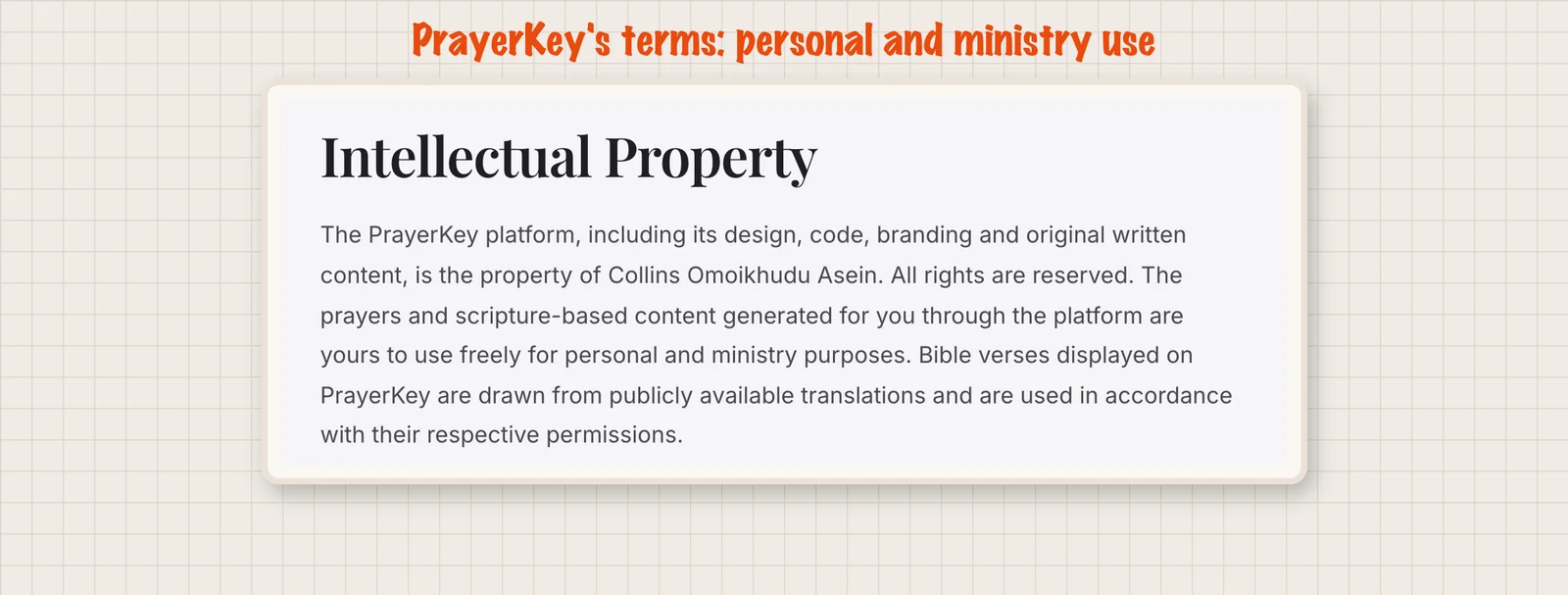
3. The tool's own terms. We read both on November 17, 2026. PrayerKey's terms (updated April 2026) say the prayers "are yours to use freely for personal and ministry purposes." They do not mention books.
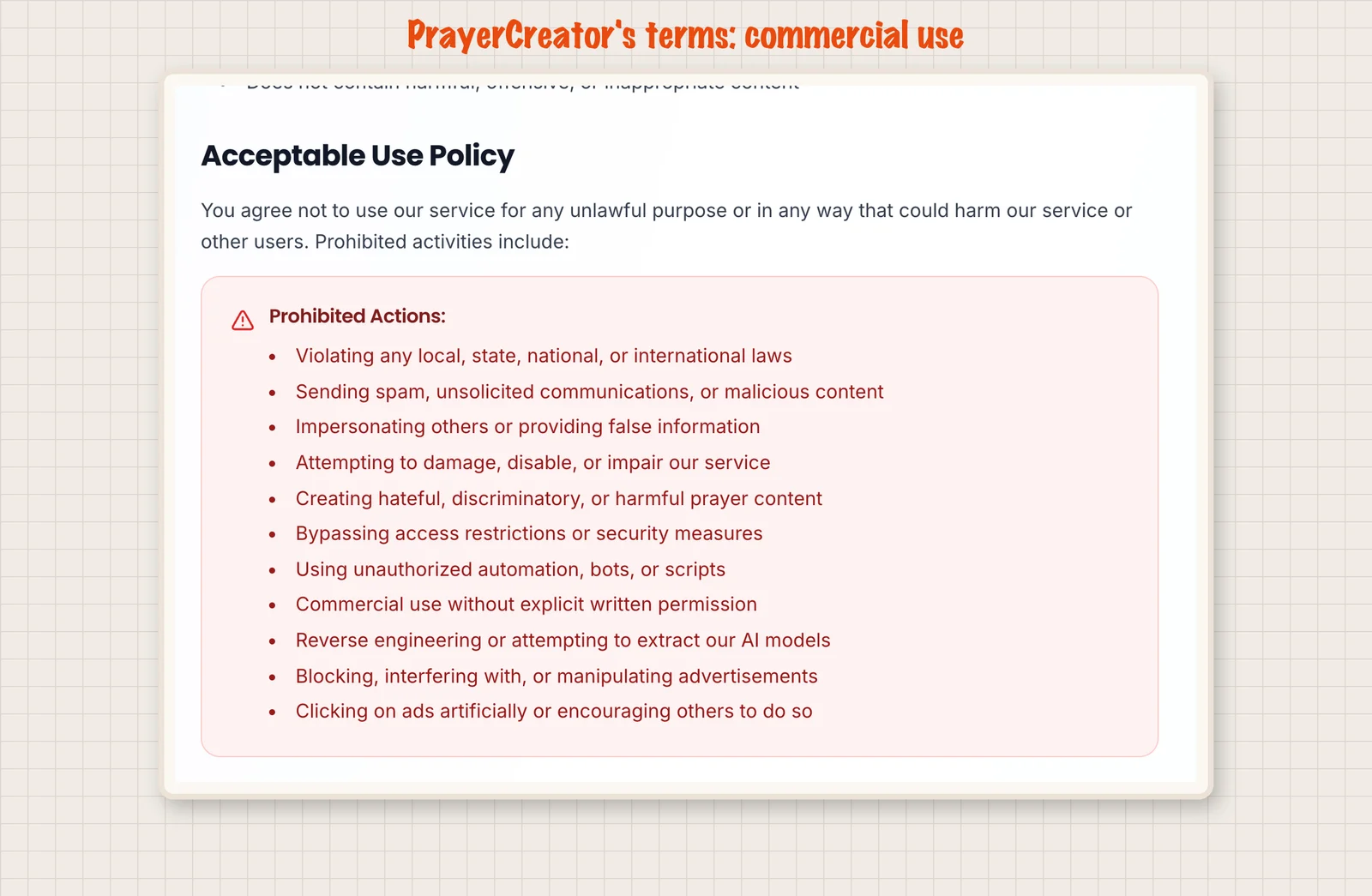
PrayerCreator's terms (updated August 3, 2025) list "Commercial use without explicit written permission" as prohibited. A book you sell would probably count, so ask in writing first. The site Write Me A Prayer asks you to tick that its prayers are for "entertainment purposes only."
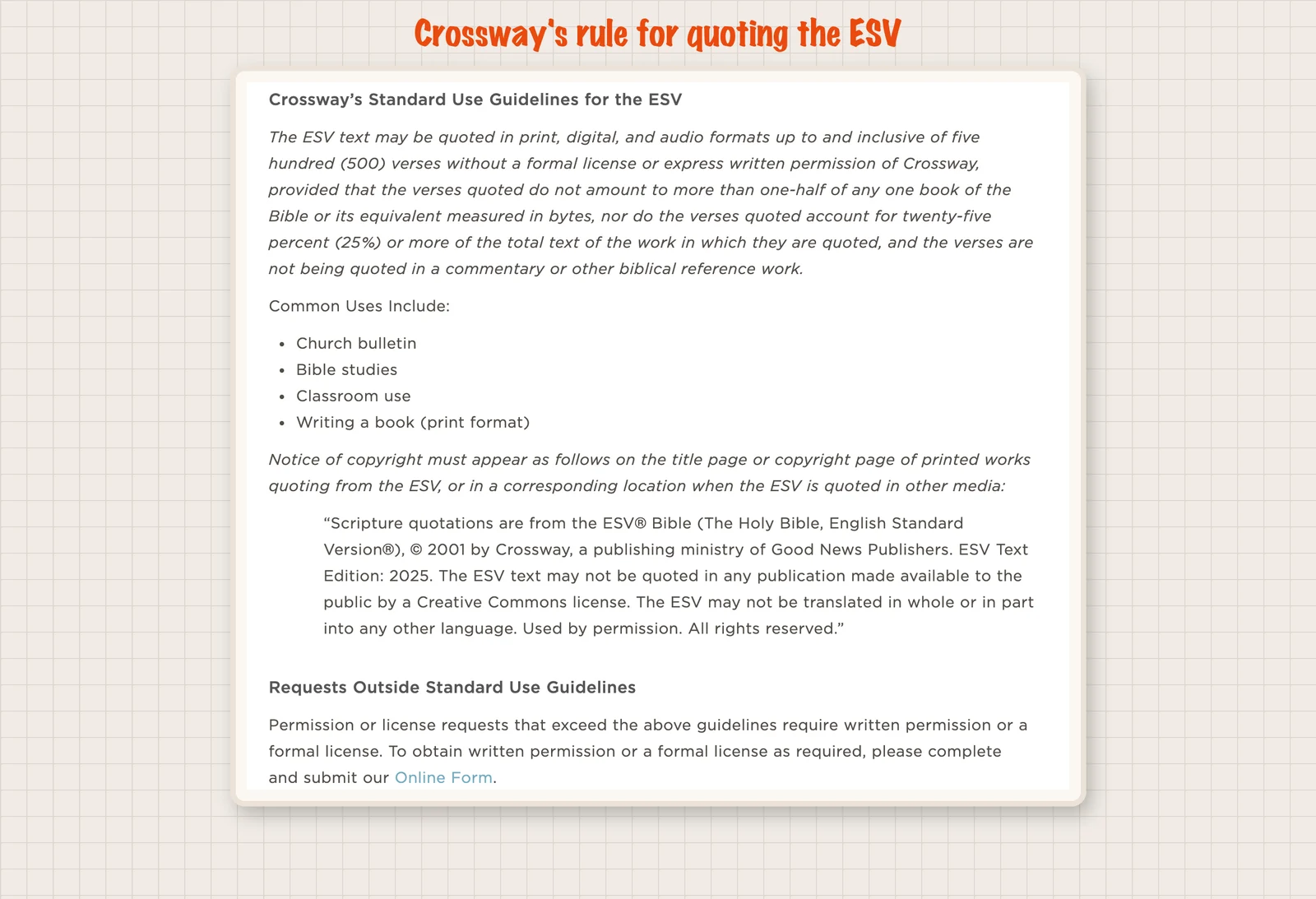
4. The Bible publisher's limits. Crossway, the ESV publisher, says in its ESV permissions that you may quote up to 500 verses without written permission. The verses must not be more than half of any one book of the Bible, and not 25% or more of your whole work. A copyright notice must appear in your book. ChatGPT's prayer gave no notice.
Other translations have their own rules, so check your publisher. Bible Gateway labels the King James Version "Public Domain." We did not check the rule outside the United States.
How do you write a prayer book with AI step by step?
Write the book yourself and use AI as a helper. Here is one path:
- Choose the plan. For example, 30 prayers for 30 mornings. Write the list of themes yourself.
- Write each first draft in your own words. Three or four lines are enough.
- Ask AI for help with a passage. Ask for another way to say a line or a shorter version. That is AI-assisted work.
- Delete stock lines and invented facts. If two prayers share a sentence, rewrite one.
- Check every verse. Compare the words with the publisher's page and add the required notice.
- Read each prayer aloud. Ask a pastor or friend to read the book too.
- Answer KDP's AI question honestly. If an AI tool wrote any of your text, answer Yes.
How does Built&Written help you write a book of prayers?
Many people who want a prayer book already have prayers, in notebooks, journals and sermon notes. The hard part is turning scattered pages into one book.
Built&Written is a platform for writing nonfiction books and preparing them for KDP. It works from your own material. Take a pastor with five years of Sunday prayers typed into documents:
- You paste or upload your prayers and notes. The platform does not turn audio into text, so recordings must be typed first.
- The platform proposes a chapter outline. You change it and approve it before any chapter is written.
- Its AI writes the chapters from your material, in your voice. Voice DNA learns from a few pages of your own writing, about 300 to 1,000 words, so put your strongest prayers first.
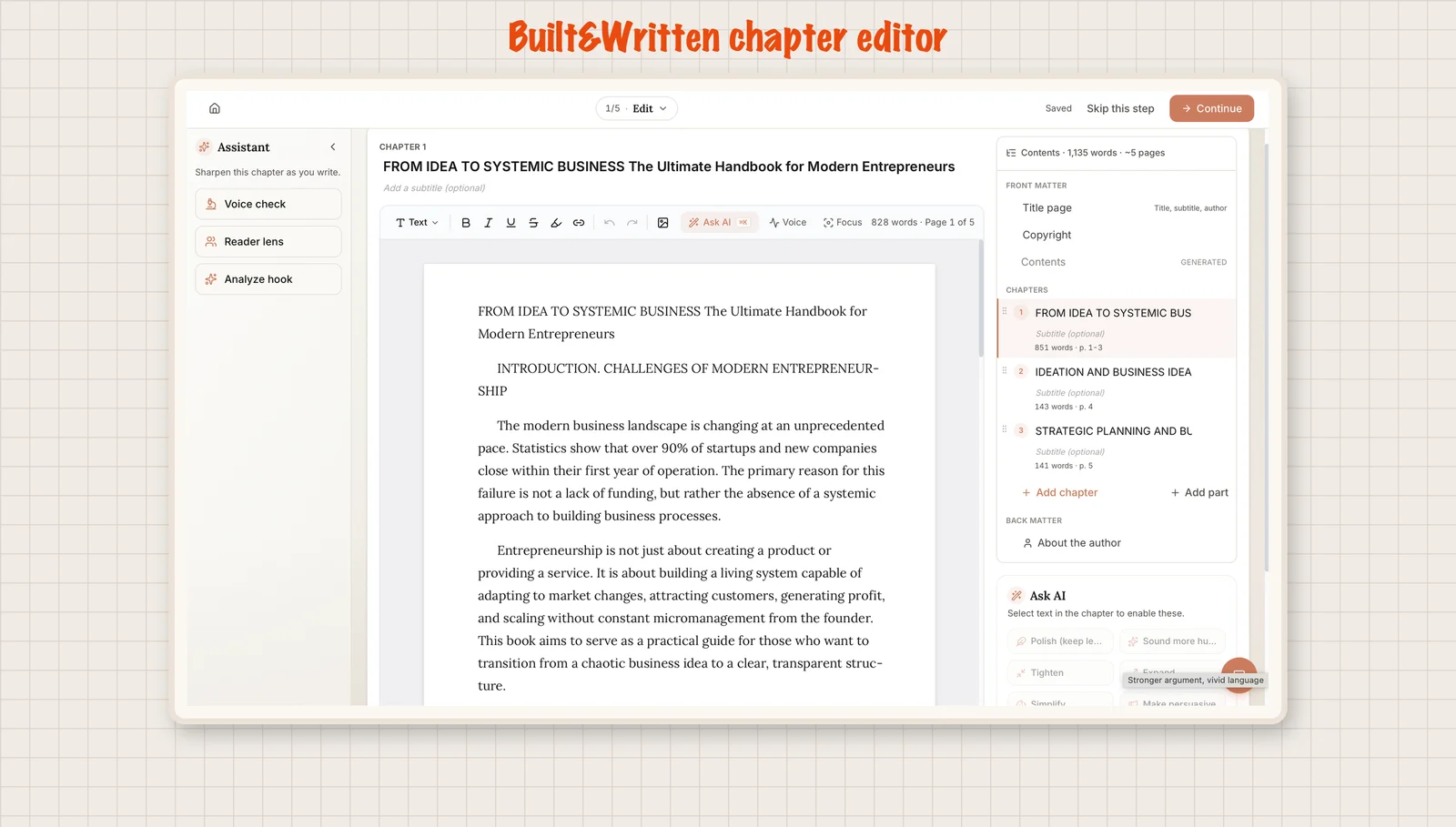
- You open each chapter in the editor. You change any sentence yourself, and Ask AI can tighten, expand or simplify a passage you select.
- You get layout, a cover and files made for KDP. You upload the files to KDP yourself.
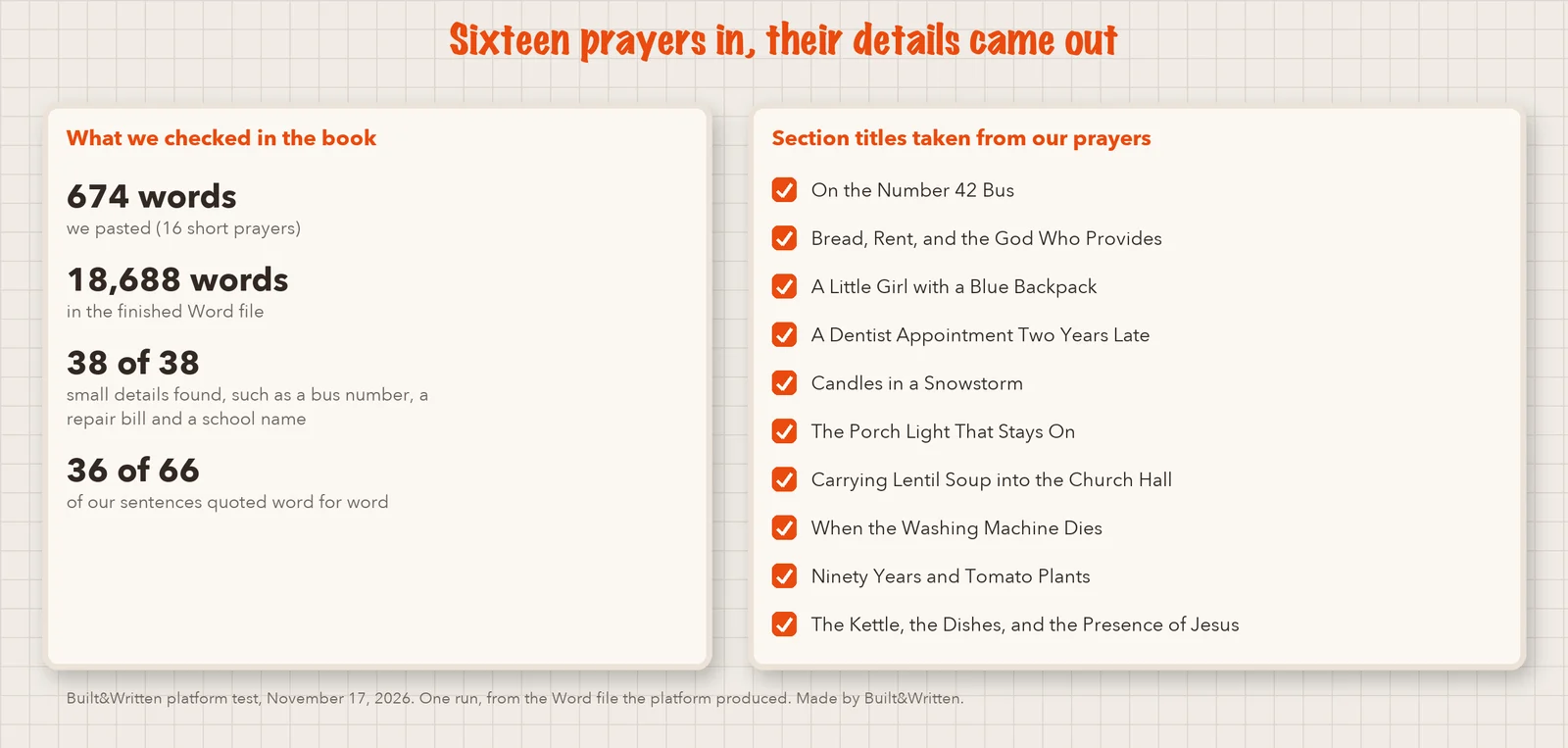
What we saw in our own test. On November 17, 2026, we pasted sixteen short prayers we wrote for the test (674 words) into the platform. We downloaded the finished book as a Word file and read all of it: 18,688 words in seven chapters. We looked for 38 small details from our prayers, such as a bus number, a repair bill and a school name. All 38 were in the book, and 36 of our 66 sentences were quoted word for word. We found no new names. The rest is new writing around your prayers. Give the platform plenty of your own writing, and read every page.
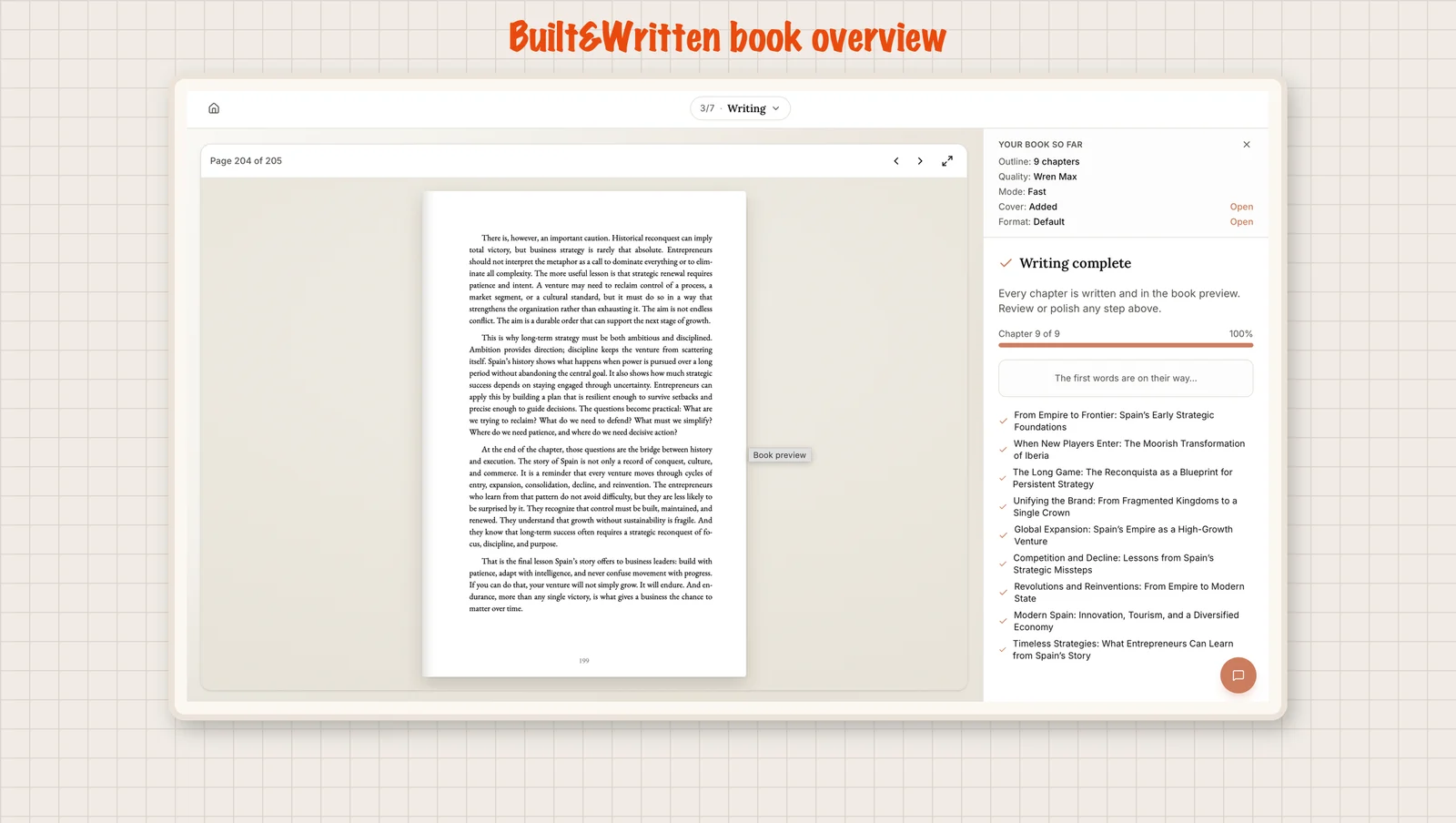
What you still do. The platform does not check your faith content or Bible permissions. It does not promise sales or Amazon's approval, and it does not upload to KDP for you. Its AI wrote the text, so you answer Yes to KDP's AI question. See the pricing page: $49/month for AI-written books ($19/month for your own manuscript). Every plan comes with monthly credits for the AI.
If you already wrote the book, upload your finished book file. The platform lays it out for print and prepares KDP files without changing your words. See the AI nonfiction book writer page and our guide to turning a journal into a book.
Final thoughts
An AI prayer generator can help you start a prayer book with a first line, an idea or a shorter version. In our test it also repeated itself, added facts we never gave and came with unclear rules for books.
If you already have prayers, notes or sermons, Built&Written turns your own material into a finished book, and you stay the author. See how it works.
Frequently asked questions
Yes. PrayerKey and PrayerCreator both let us generate prayers without an account. A free tool can still have rules for publishing, so read its terms before you put a prayer in a book you sell. Both sites showed no sign-in wall on November 17, 2026, but their terms differ on what you may do with the text.
PrayerKey's terms name personal and ministry use, so a bulletin fits what they describe. PrayerCreator's terms ban commercial use without written permission and do not mention bulletins, so ask them first. Bible verses in the bulletin follow the publisher's rules, for example Crossway's limit of 500 ESV verses with a copyright notice.
Its FAQ says prayers you generate stay in your browser unless you share one with the community, and that it does not ask for your name or email. We read that FAQ on November 17, 2026. We did not read PrayerKey's privacy page, so we cannot say what it keeps.
If the generator created the text, yes. KDP calls that AI-generated, even after you edit it, and asks you to say so when you publish a new book. If you wrote the prayers yourself and used AI only to edit or brainstorm, KDP calls that AI-assisted and you do not have to report it.
Sources & References
- Amazon KDP: Content Guidelines, AI content, read 2026-11-17
- US Copyright Office: Copyright and Artificial Intelligence, Part 2, Copyrightability, January 29, 2025
- Crossway: ESV Bible Permissions, read 2026-11-17
- PrayerKey: Terms of Service, updated April 2026, read 2026-11-17
- PrayerCreator: Terms of Service, updated August 3, 2025, read 2026-11-17
- ESV.org: Philippians 4:6-7, read 2026-11-17
- Bible Gateway: Psalm 133:1, 68:6 and 107:1 in the King James Version, read 2026-11-17
About the author

Khrystyna Balushka
More in AI Book Tools
Ready to write your book?
Turn your expertise into a professional book with Built&Written.