

How to Write a Self-Help Book With AI That Sounds Real
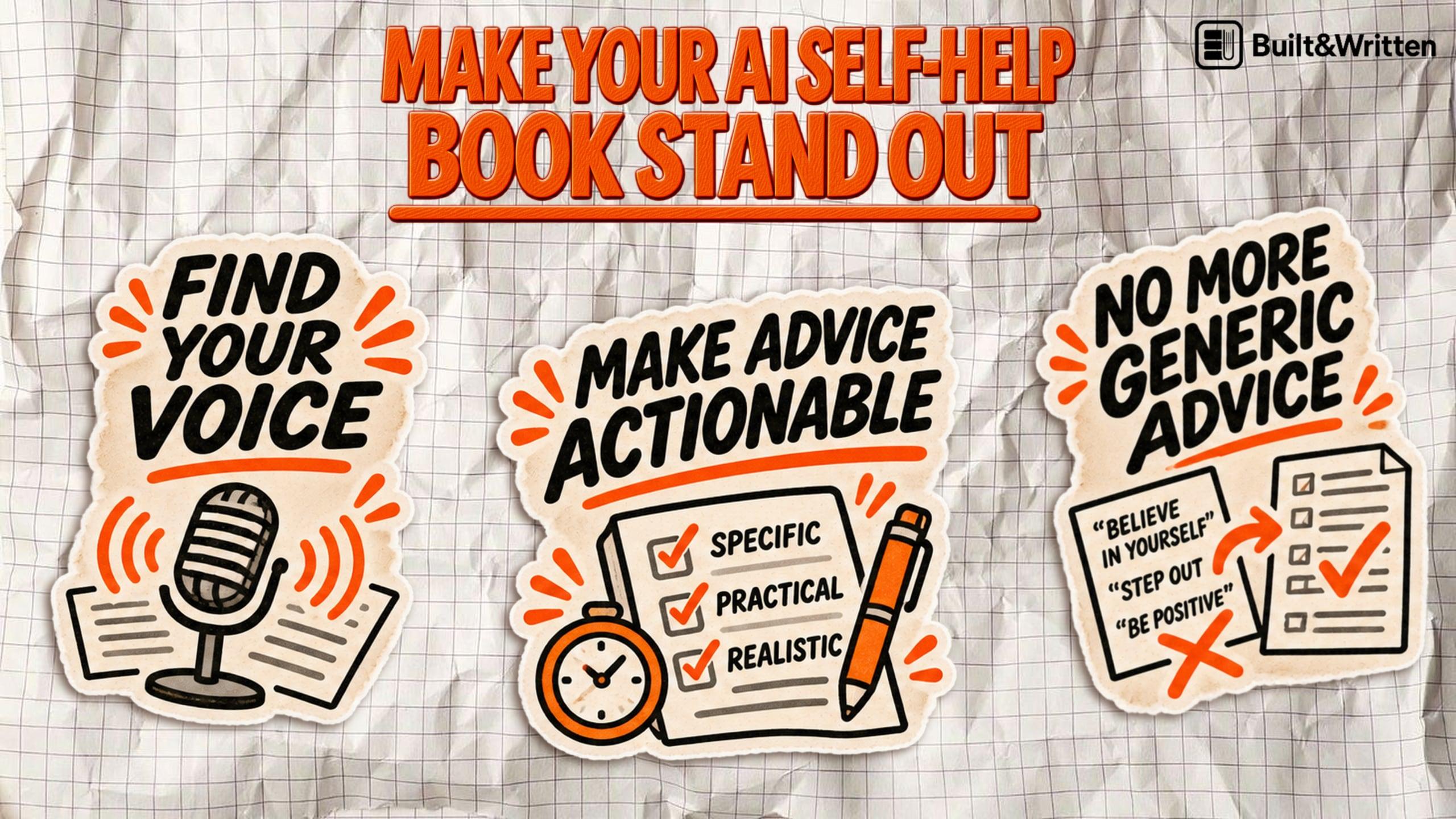
AI can help you write a self-help book faster, but the results can feel painfully familiar. Ask it for a chapter about building confidence, and you might get another variation of “believe in yourself, embrace challenges, and step outside your comfort zone.”
The sentences sound polished, yet readers could find the same advice in hundreds of other books. A memorable self-help book needs recognizable experiences, useful methods, and a writing style that reflects the person behind the advice. Here is a practical process for developing one with AI.
Can AI help you write a self-help book?
Yes. AI can assist with nearly every stage of developing a self-help manuscript, from organizing early ideas to preparing chapters for editorial review. It can suggest structures, expand rough notes into readable explanations, develop transitions between topics, and help explore different ways to present complex material.
Self-help books are well suited to a structured writing process. They often guide readers through a challenge, introducing ideas and activities that build toward a desired outcome. An author writing about managing workplace stress, for example, could organize existing material into chapters covering common stressors, everyday routines, communication habits, and coping strategies.
The author would still decide which recommendations are appropriate for the intended audience. AI-generated explanations can contain inaccurate claims, unsuitable advice, or unsupported assumptions. An earlier Built&Written experiment with an AI-generated nonfiction book also illustrates why a complete draft can require substantial structural and editorial work.
Why do AI-written self-help books sound generic?
AI-generated self-help writing often relies on familiar motivational language. Phrases such as “unlock your potential,” “embrace the journey,” and “take control of your future” sound encouraging, but they provide little information on their own.
Building confidence is a journey that begins with believing in yourself. By stepping outside your comfort zone, embracing challenges, and maintaining a positive mindset, you can unlock your true potential and become the best version of yourself.
This invented sample could appear in a book about confidence, career development, relationships, or personal growth. Nothing identifies a particular audience, situation, or method. Watch for these patterns:
- Vague recommendations: Readers are urged to improve without receiving clear direction.
- Recycled phrases: Familiar expressions recur with slight changes in wording.
- Predictable openings: Sections begin with broad observations that contribute little.
- Unnecessary encouragement: Motivational sentences crowd out useful explanations.
- Missing perspective: The material offers few insights that could identify its author.
These habits become especially noticeable across a full manuscript. Learning to spot them early helps you judge drafts on their usefulness rather than their fluency.
How to develop your self-help book ideas before using AI
Before asking AI to build an outline, gather the knowledge and experiences you want your book to share. Useful material can come from professional work, personal challenges, conversations you have permission to describe, or approaches you developed over time. Start with four questions:
- What problem do you understand particularly well? Find situations you can describe with detail.
- What have you learned? Consider mistakes, discoveries, and changes in your approach.
- Where does your perspective differ from familiar advice? Identify assumptions you question.
- What result can readers realistically work toward? Choose an outcome suited to your subject and experience.
“Building confidence” is a broad topic. A book about speaking confidently at work could instead focus on participating in meetings, responding to criticism, and asking for opportunities. That gives the book a recognizable audience and a manageable scope.
Collect your answers in a reference document with stories, observations, terminology, and descriptions of your methods. Keep the distinction between personal experience and research clear so you can support each kind of claim appropriately.
How to create a self-help book outline with AI
A clear outline helps readers understand how individual chapters contribute to their progress. Begin with the problem they want to address, identify the skills they will need, and arrange the topics in a logical order.
A book about confidence at work could follow this sequence:
- Recognizing confidence triggers: Identify situations that create hesitation.
- Participating in meetings: Practice contributing ideas and asking questions.
- Responding to criticism: Explore ways to evaluate feedback.
- Setting professional boundaries: Learn to communicate needs and limits.
- Building consistent habits: Plan regular opportunities to practice.
Ask AI to turn your sequence into a chapter-by-chapter outline with learning objectives, supporting topics, and estimated word counts. Review it for unnecessary chapters, missing prerequisites, and changes in scope. Give each chapter a brief statement of what the reader should understand or be able to attempt by the end.
How to write self-help chapters with AI without generic advice
Good chapter prompts specify the reader, the chapter objective, the material to use, and the intended level of detail. Compare these two requests.
Vague prompt
Write a chapter about overcoming procrastination. Make it motivational and engaging.
More focused prompt
Write a chapter about procrastination among freelancers who struggle to begin large client projects. Explain how uncertainty about the first step can lead to avoidance. Use my notes on breaking projects into 20-minute starting tasks. Include a hypothetical freelance designer preparing a proposal, followed by a practical exercise. Use a direct, conversational tone and avoid motivational clichés.
The second prompt establishes an audience, a specific problem, material to incorporate, and a practical application. Its scenario is explicitly hypothetical. Stories presented as autobiographical in a finished book must come from the author’s actual experiences.
You can also specify the target length, concepts needing careful explanation, and subjects reserved for later chapters. Generate a manageable draft and review its organization before expanding it. If an important idea moves too quickly, request a fuller explanation. If a passage wanders into another chapter’s territory, revise the brief or cut it. The Built&Written nonfiction book writer supports an editable outline and chapter-by-chapter development from supplied material.
How to make AI-written chapters sound like you
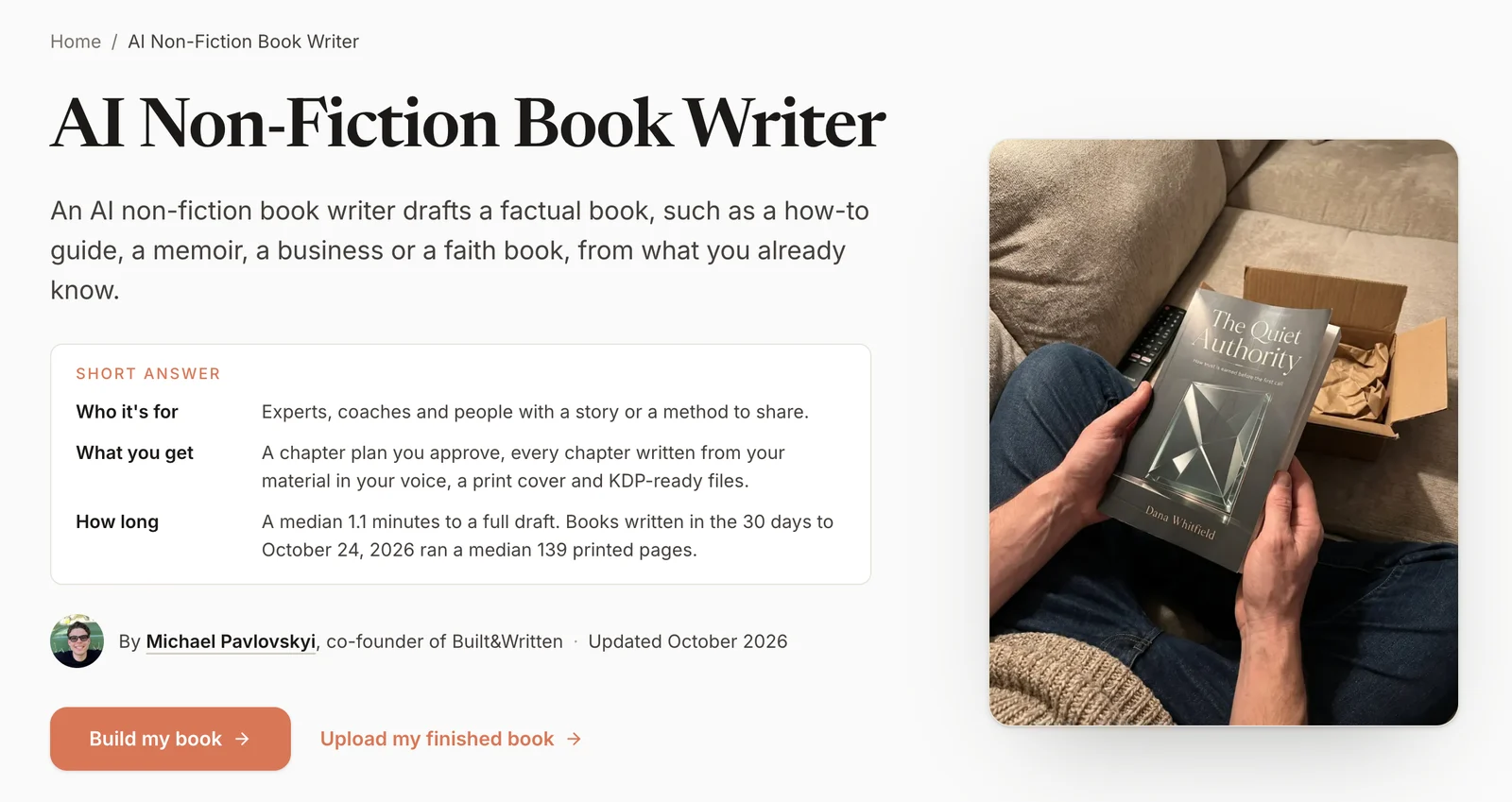
Your writing voice develops through vocabulary, sentence rhythm, humor, and the way you introduce ideas. Some self-help authors prefer concise instructions; others use reflective questions or longer explanations. General prompts such as “make it friendly and engaging” rarely capture those differences.
Provide representative samples of your own blog posts, newsletters, essays, or other writing. Choose pieces that reflect how you want to speak to this book’s audience, then look for recurring features:
- Vocabulary: Your usual words, phrases, and domain-specific language.
- Sentence rhythm: How you vary sentence and paragraph length.
- Tone: Your preferred degree of directness, warmth, humor, and formality.
- Explanation style: How you introduce concepts and make them understandable.
Built&Written’s Voice DNA helps preserve those stylistic characteristics during AI-assisted chapter generation. It needs only a few pages of the author’s writing, about 300 to 1,000 words. Put the strongest, most representative material first. The resulting chapters still deserve a careful read for places where language or explanation drifts away from your style.
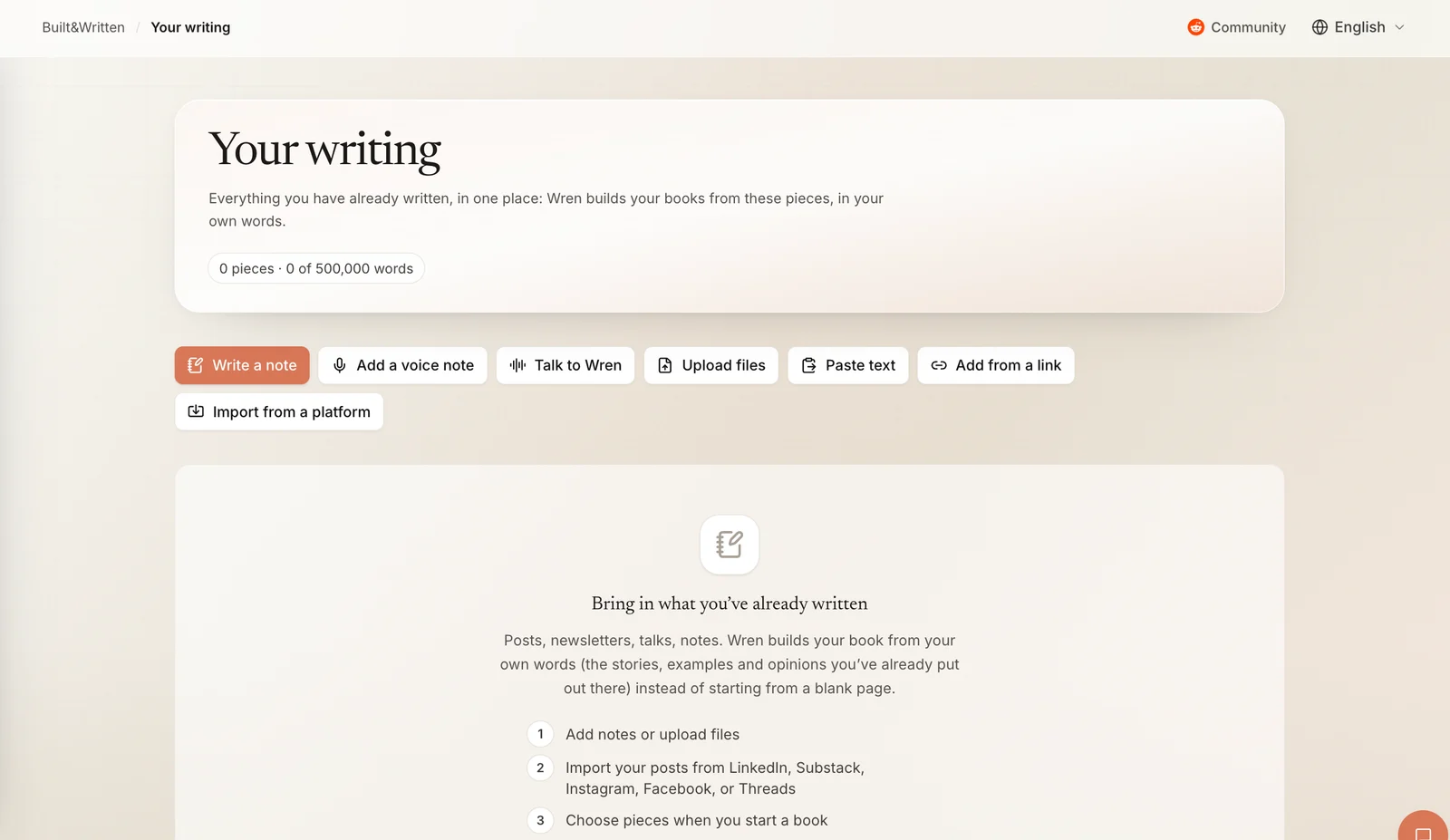
For a concrete illustration of how a writing sample can inform a voice profile, Built&Written also publishes a sample on its AI Book Writer page. That example is product material, rather than an independent test conducted for this article.
How to turn generic self-help advice into useful writing
When revising an AI-generated chapter, ask how much information a reader can act on. Consider this invented before-and-after example from a chapter about workplace confidence.
Generic version
Confidence begins when you believe in your abilities. Challenge yourself to step outside your comfort zone, embrace new opportunities, and remember that every small victory brings you closer to becoming your best self.
Specific version
Before your next team meeting, write down one question you want to ask. Choose something relevant to the discussion, even if you worry the answer will seem obvious. Ask it during the first ten minutes. Afterward, record what happened and compare it with what you expected.
The revision offers a recognizable situation, a manageable action, and a way to evaluate what happened. It also limits the scope of the advice. Readers can try the task without committing to a sweeping personal transformation.
When improving a passage, ask three questions: What should readers do? When or where can they try it? How could they recognize the result? If your advice depends on particular circumstances or has important limits, explain those too.
AI self-help chapter quality checklist
Use this quick editorial check before approving a chapter:
- The chapter teaches one clearly defined lesson.
- It includes a distinctive observation, method, or example.
- The instructions are specific enough to follow.
- Real experiences and quotations have been checked against source material.
- The language reflects the author’s writing voice.
- Research-based or consequential claims have credible support.
A chapter that fails several checks may need more original material before another round of AI revision.
How to create self-help exercises readers can actually use
Exercises help readers apply concepts through reflection questions, checklists, worksheets, or short challenges. Start with the skill the chapter teaches and create an activity that lets readers practice it in a realistic setting.
A vague exercise about boundaries might ask readers to “reflect on situations where you struggle to say no.” A clearer version could lead them through five steps:
- Identify one recurring situation where refusing a request feels difficult.
- Write down the request you typically receive.
- Draft a brief response that communicates your limit.
- Practice it in a situation where doing so is safe.
- Record what happened and what you would adjust next time.
AI can help format your method as a worksheet or suggest versions for readers with different levels of experience. Review the difficulty, time commitment, and possible sensitivities of each activity. A short practice task may fit within a chapter, while a more involved assignment may work best at the end.
How to edit an AI-assisted self-help book before publishing
Read the complete manuscript before moving into line editing. Check whether the central argument remains clear, chapters cover their intended subjects, and individual ideas receive enough attention. Then review these specific issues:
- Repetition: Remove chapters or passages that make substantially the same point.
- Terminology: Use consistent names for important concepts and methods.
- Transitions: Check that readers can follow the progression between chapters.
- Evidence: Verify research findings, statistics, quotations, and psychological claims against the original sources.
- Sensitive advice: Seek qualified review where material involves mental health, trauma, medical conditions, or specialist treatment.
- Proofreading: Correct awkward sentences, grammar, and formatting.
AI can produce plausible-looking references that do not support the accompanying claims. For a detailed process, see Built&Written’s source-first guide to writing nonfiction with AI. Avoid promising that an exercise will produce a guaranteed outcome. Reading passages aloud can also reveal sentence patterns and transitions that feel unnatural.
A practical workflow for writing a self-help book with AI
Use this sequence as a final project checklist:
- Collect material: Assemble your notes, experience, methods, and examples.
- Define the reader: Choose the problem and realistic outcome.
- Outline: Set distinct goals for each chapter.
- Draft: Work from a focused chapter brief and source material.
- Match voice: Guide the language with your own writing samples.
- Build resources: Add exercises where they improve understanding.
- Review: Check structure, claims, clarity, and consistency.
- Prepare files: Format the manuscript and inspect the export.
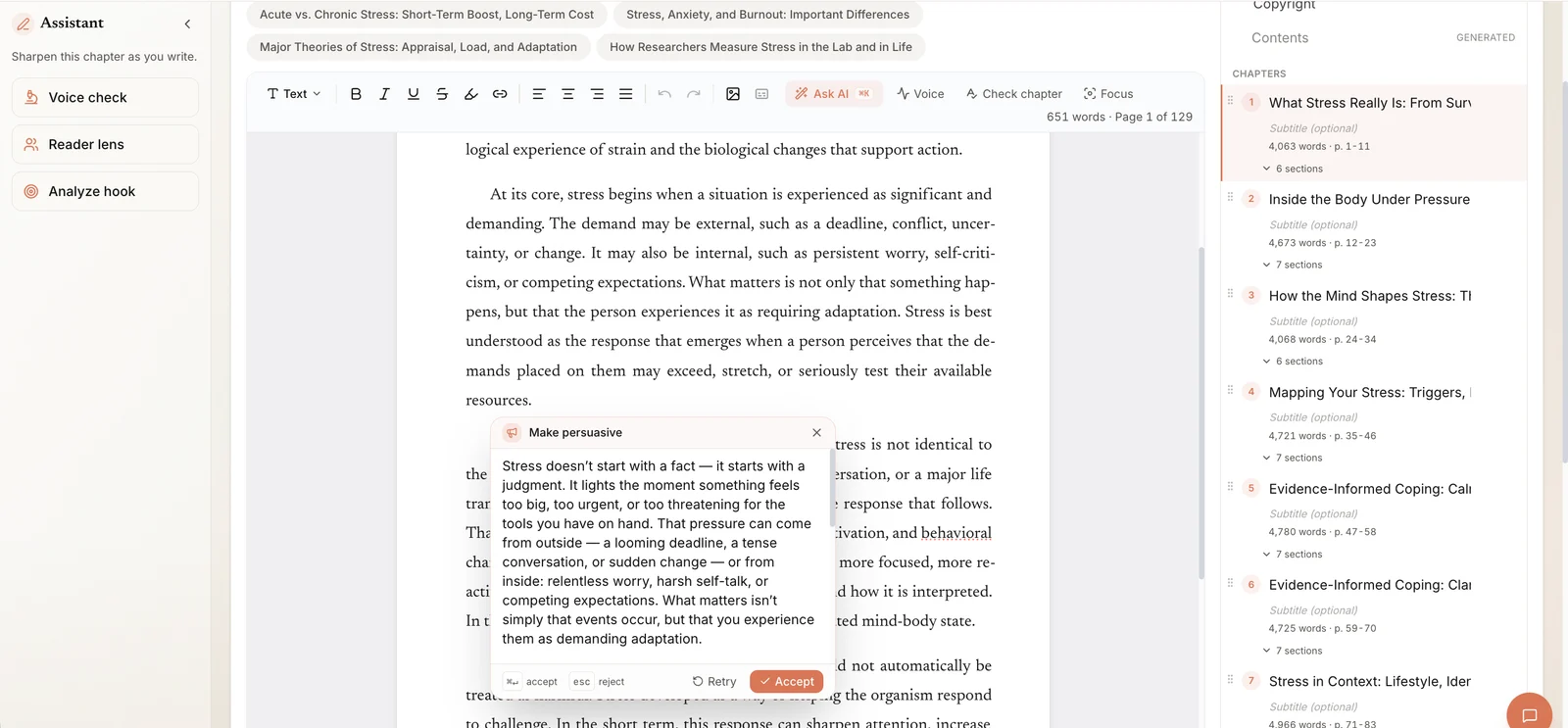
Built&Written brings source material, editable outlines, chapter generation, voice guidance, and manuscript editing into one workflow. Export options include print PDF, EPUB, and DOCX, with availability depending on the plan. For early reader feedback before publication, the Built&Written guide to advance reader copies explains how to prepare and distribute a review edition.
Frequently asked questions
Yes. Amazon KDP’s content guidelines permit AI-generated content that meets their requirements. Amazon requires disclosure when AI creates the actual text, images, or translations, even if you substantially edit them later. If you write the content yourself and use AI for editing, refinement, or brainstorming, Amazon classifies that use as AI-assisted and does not require disclosure. Authors are responsible for compliance and intellectual property rights.
There is no single qualification that every self-help author must hold. The level of expertise needed depends on the subject and the claims being made. If you describe professional methods, explain the relevant experience and limitations. Material involving diagnosis, treatment, or other specialized advice deserves particularly careful evidence review and input from suitably qualified professionals.
The right length depends on the scope of the promise, the audience, and the depth of instruction. A focused guide to one skill may be far shorter than a broad personal-development book. Draft the necessary chapters first, assess whether each lesson is supported with examples and exercises, and remove duplication before committing to a word count.
Yes. AI can turn an author’s existing method into worksheet drafts, prompts, short activities, and reflection questions. Provide the learning objective and the intended reader for each activity. Then check that instructions are understandable, exercises are safe for the intended audience, and the final layout gives readers enough room to complete the work.
Copyright rules vary by country. In the United States, protection generally depends on human authorship, and the U.S. Copyright Office evaluates AI-containing works based on the human contribution. Authors should retain drafts and evidence of their original writing, selection, organization, and edits. For registration guidance, consult the U.S. Copyright Office’s AI initiative and seek legal advice when ownership is consequential.
Sources & References
- Amazon KDP, Content Guidelines
- U.S. Copyright Office, Artificial Intelligence initiative
- Walters and Wilder, Fabrication and errors in the bibliographic citations generated by ChatGPT, Scientific Reports (2023)
- Built&Written, Voice DNA
- Built&Written, AI Non-Fiction Book Writer
- Built&Written, Can AI Write a Whole Book?
- Built&Written, How to Write a Nonfiction Book With AI Without Making Up Facts
- Built&Written, What an Advance Reader Copy Is
- Built&Written, Do You Have to Disclose AI in Your Book? KDP's 2026 Rules
- Built&Written, Who Owns a Book You Wrote With AI, and Can You Copyright It?
- Built&Written, How Many Words in a Business Book
About the author

Polina Karlashchuk
More in AI Book Tools
Ready to write your book?
Turn your expertise into a professional book with Built&Written.