

Which AI Chapter Generator Actually Sounds Like You?
Key takeaways
- Does an AI chapter generator sound like you? Not quite. With a 671-word writing sample, the three chat tools still wrote shorter, punchier sentences than the author: 10.7 to 16.2 words on average against his 25.8.
- Do AI chapter generators make things up? The chat tools kept all 12 facts. Easy-Peasy.AI added claims that weren't in the notes, like a 31st book and "even for personal use."
- Which chapter did our writer prefer in a blind read? The Built&Written chapter, built in its "Keep my wording" mode from the notes' own sentences. It sounded like a person because a person wrote every line.
- Is there a free AI chapter generator? Yes. Easy-Peasy.AI gave us one free chapter a day without an account, and free ChatGPT wrote a full chapter without signing in (both checked October 31, 2026).
What does an AI chapter generator actually do?
An AI chapter generator, also called an AI chapter writer, is a tool that turns your notes, an outline or a topic into a finished book chapter. You give it the raw material, and it writes the prose.
Most tools with that name are built for fiction. The top Google results for "ai chapter generator" include story tools such as Toolsaday and Squibler. Easy-Peasy.AI, the second result, asks for a genre, a chapter mood and a tone, but has no field for a sample of your writing.
For a nonfiction book, "sounds like you" means three things:
- Rhythm. How long your sentences run and how often you break them up.
- Words. Whether you say "I" or hide behind "one," and whether you write "don't" or "do not."
- Material. Your stories and numbers, not generic examples the tool made up.
How we tested four AI chapter generators
We needed a real author with a strong voice whose text we were allowed to reuse. We picked Cory Doctorow, who publishes his blog Pluralistic under a Creative Commons Attribution 4.0 license.
How we tested (October 31, 2026). Writing sample: the first 671 words of Doctorow's essay "The Memex Method", about how blogging feeds his books. Notes: the facts of a different post, "How my DRM-free principles left me owning the rights to a German audiobook", retold in our own plain words as 12 short lines (376 words). The task for every chat tool was the same: "Write the chapter "Why I Bought Back My Own German Audiobook" in about 800 words, in my voice. Use only the facts and stories in my notes." We ran free ChatGPT without signing in, Claude on a paid plan (Opus 5.5), and Easy-Peasy.AI's free chapter generator without an account, with the notes as key elements and the tone "First person, blunt, conversational, opinionated." Built&Written ran on a paid account. Each tool ran once. We compared every chapter with Doctorow's real post.
The sample and the notes are on different topics on purpose. A tool can't borrow facts from the sample. It can only learn the voice from it.
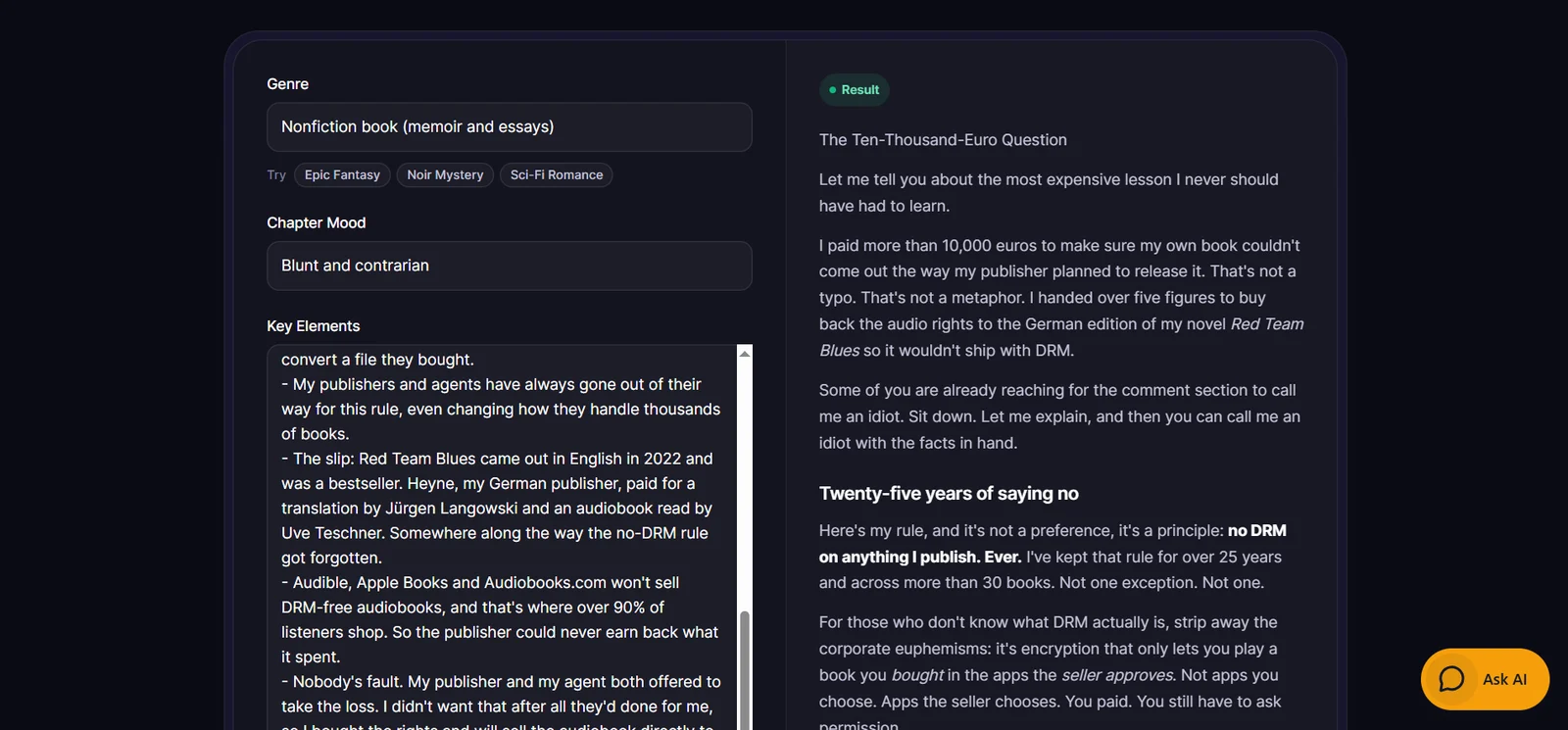
Text in the image: Genre: "Nonfiction book (memoir and essays)". Chapter Mood: "Blunt and contrarian". Key Elements: our notes. Result: "The Ten-Thousand-Euro Question. Let me tell you about the most expensive lesson I never should have had to learn."
Which AI chapter generator sounded most like the author?
None of the chat tools matched Doctorow's rhythm. They all got the first person right, but each wrote shorter sentences than he does.
| Chapter | Words | Average sentence | Sentences of 10 words or fewer | "I, me, my" per 100 words | Facts from the notes |
|---|---|---|---|---|---|
| Doctorow's real post | 821 | 25.8 words | 16% | 4.3 | 12 of 12 |
| Built&Written, Keep my wording | 659 | 25.7 words | 8% | 2.9 | 12 of 12 |
| ChatGPT (free) | 1,000 | 16.2 words | 31% | 5.0 | 12 of 12 |
| Claude (Opus 5.5) | 723 | 13.3 words | 44% | 4.6 | 12 of 12 |
| Easy-Peasy.AI (free) | 792 | 10.7 words | 63% | 4.3 | 12 of 12 |
Measured on October 31, 2026. Built&Written's numbers describe the notes' own sentences, which it kept unchanged.
- ChatGPT came closest among the chat tools. Its sentences were the longest of the three. It also ran 25% over the 800 words we asked for.
- Claude wrote the tightest chapter, and ended on a strong line of its own: "a rule you only keep when it's free isn't a rule."
- Easy-Peasy.AI turned Doctorow into a pundit. Almost two thirds of its sentences were 10 words or fewer: "Not one exception. Not one."
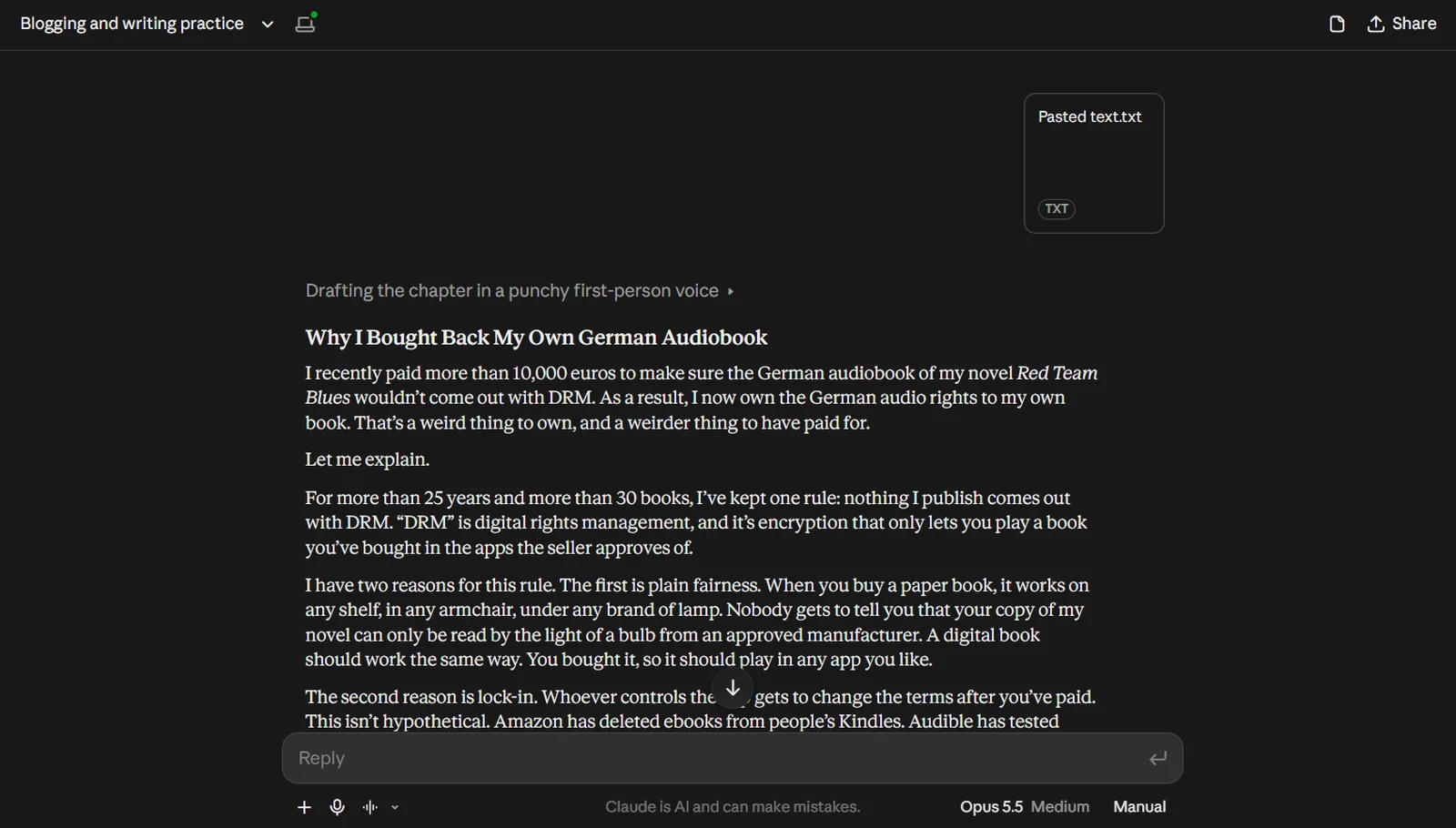
Text in the image: "Why I Bought Back My Own German Audiobook. I recently paid more than 10,000 euros to make sure the German audiobook of my novel Red Team Blues wouldn't come out with DRM." Model: "Opus 5.5 Medium".
Then our writer read all the chapters blind, next to Doctorow's real post. The Built&Written chapter came first; the others were "so so." One honest note: it read like a person because every sentence came from a person, us, writing the notes. If your notes are in your own voice, that's what you want. If they're rough bullet points, the chapter will read like rough bullet points.
Which tools made up facts or stories?
All three chat tools kept the 12 facts. Two of them added things the notes never said. In a memoir, an added detail is a claim about your life, and a reader can check it.
- Easy-Peasy.AI added the most. It wrote that breaking DRM is a felony "even for personal use," called Amazon's paid search placement "extortion," and ended with "Now thirty-one," a 31st book the notes never mention.
- ChatGPT added small scenes, like reading a paper book "in the bathtub."
- Claude added only images and opinions, such as "You're a hostage."
- Built&Written added two lines, and one slipped into the third person: "he paid it himself."
None of the tools copied Doctorow's real post: no chapter shared a run of 8 words with his text. Famous texts are different. In an earlier run with an 1880 business book by P. T. Barnum, Claude rewrote much of the real chapter from memory. If the AI has already read your sample, it may copy instead of imitate.
Why do AI chapters stop sounding like you?
AI chapters drift toward one house style: short sentences, a dramatic one-liner, a neat closing moral. Three reasons we saw:
- A tone label isn't a voice. Easy-Peasy.AI asks for a tone, not a sample, and "blunt" turned into a caricature of blunt.
- A sample teaches less than you'd hope. Even with 671 words of Doctorow, the chat tools dropped his long, winding sentences first.
- Tools fill gaps. When the notes stop, the AI keeps writing. That's where invented details come from.
For more on what makes AI text sound human, see our guide to voice matching in AI writing.
How Built&Written builds a chapter from your own words
Built&Written has a different answer to the voice problem: don't imitate the author, keep the author's sentences.
You collect what you've already written in the Writing Library, called "Your writing" in the app: notes, posts, articles. Each note gets a type. A Story, the app says, "is retold the way you told it." When you build a book from the library, you pick the pieces, Wren (Built&Written's AI writer) finds the structure, and you choose between two modes:
- Keep my wording. "Wren uses your sentences and only joins them."
- Rewrite for flow. Wren may rephrase for a smoother read. Your facts and terms stay.
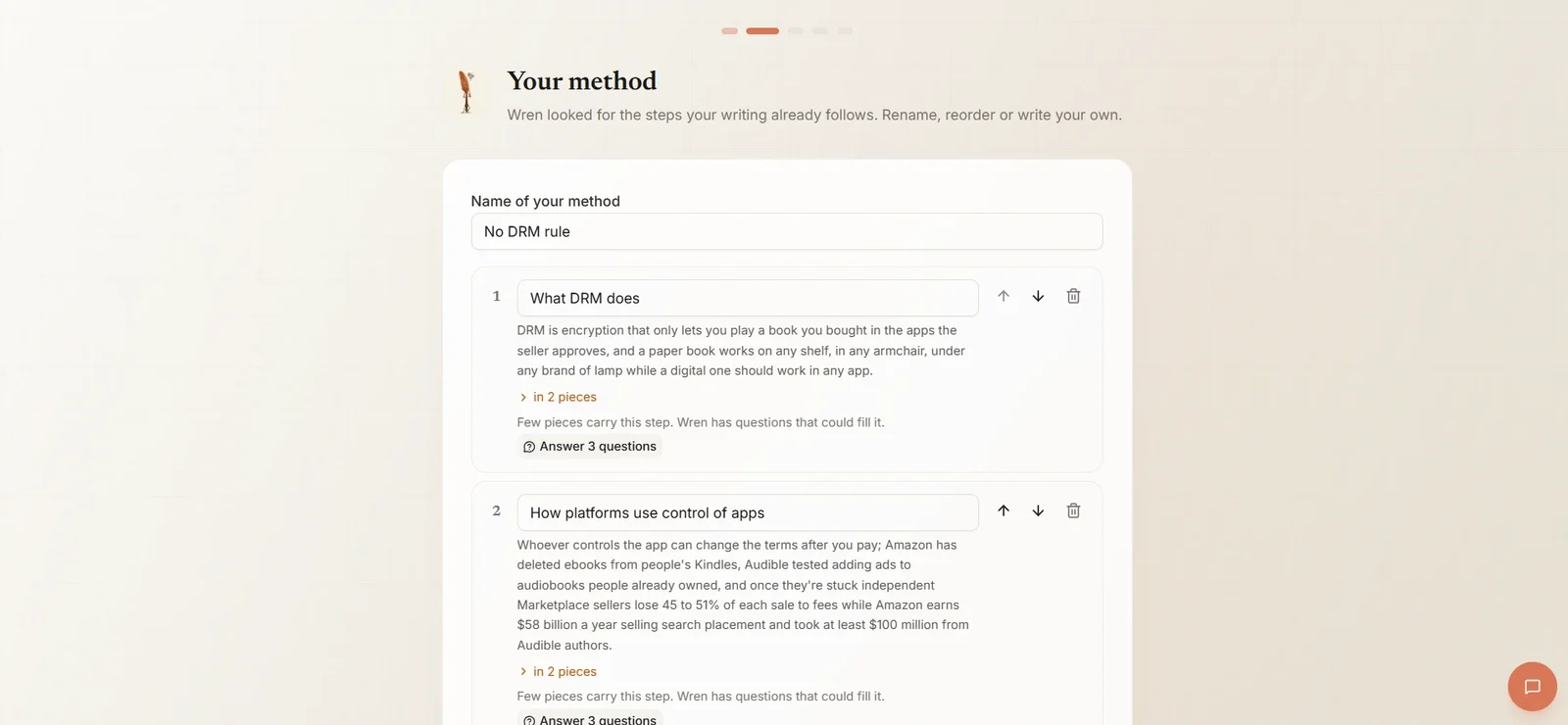
Text in the image: "Your method. Wren looked for the steps your writing already follows." Name of your method: "No DRM rule". Steps: "What DRM does", "How platforms use control of apps".
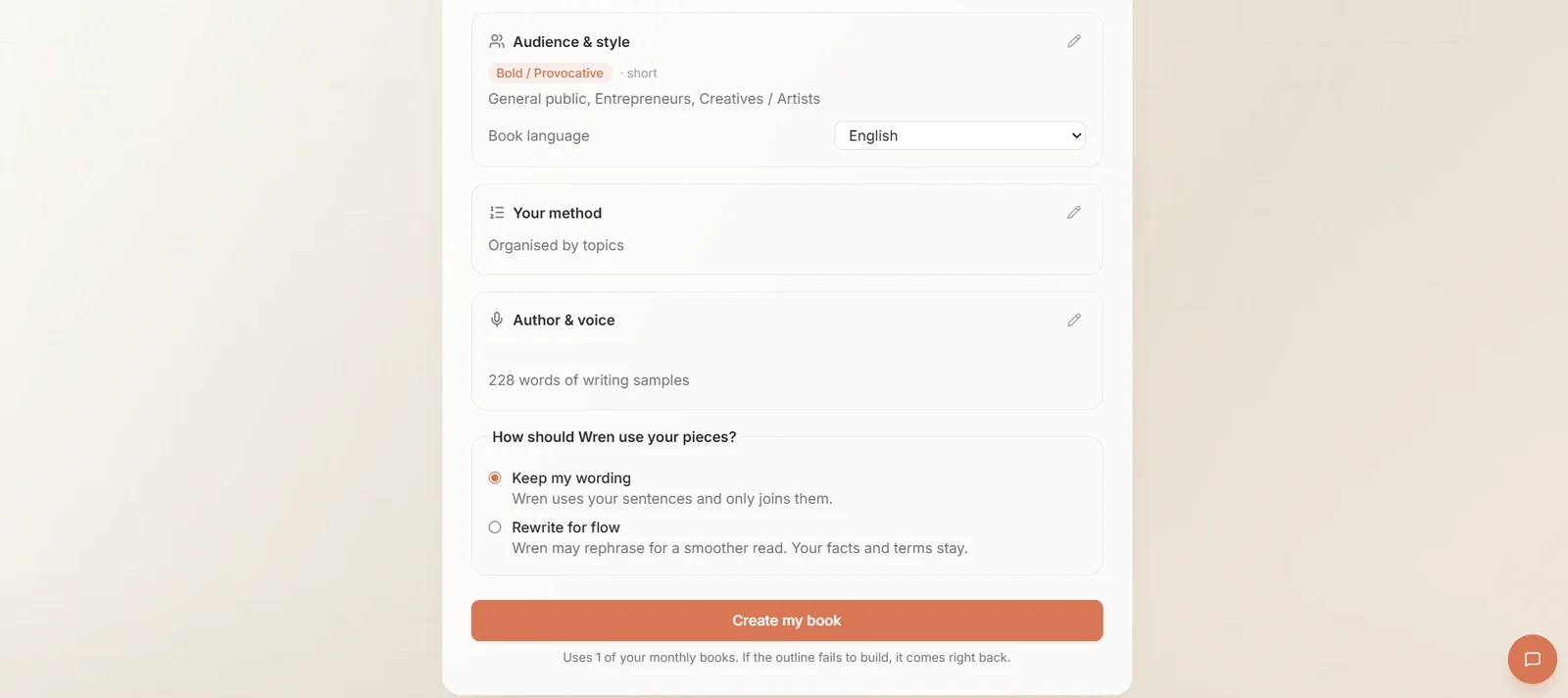
Text in the image: "Audience & style: Bold / Provocative · short". "How should Wren use your pieces? Keep my wording: Wren uses your sentences and only joins them. Rewrite for flow: Wren may rephrase for a smoother read. Your facts and terms stay."
| Step | With Built&Written, Keep my wording | Chat tool |
|---|---|---|
| Where your notes go | Saved once in your library, reused for every book | Pasted into one message |
| Who writes the sentences | You. Wren only joins them | The AI |
| Invented details | No invented facts in our test | Possible, check every line |
| Result | A formatted book, ready for print and Amazon | Text in a chat window |
Our test also showed the limits. The 12 short notes became 5 chapters and 659 words, and 12 of 37 sections stayed empty. Keep my wording rewards a full library: real posts and long notes in your own words.
KDP (Kindle Direct Publishing) is Amazon's free service for selling your book on Amazon. The library works on plans that include it, and downloading the PDF and KDP files of an AI-written book needs Entrepreneur or higher. Built&Written doesn't upload to KDP for you. You upload the files yourself.
How to get an AI chapter that sounds like you
Whatever AI book chapter generator you use, four steps help:
- Write your notes in your own voice. Full sentences the way you'd say them, not keywords.
- Add a sample of the same kind of text, such as a few pages of your blog posts or newsletters.
- Say "use only my notes," then check every fact against them. In a memoir, a new detail is a new claim.
- Read it out loud. If a line sounds like a motivational poster, rewrite it.
In free ChatGPT or Claude, paste the sample and the notes into one message, as we did. For the two chats on a full book, see Claude or ChatGPT for writing a book. For the same kind of test on whole ebooks, see four AI ebook generators given the same notes.
Final thoughts
Your voice survives best when the words on the page are yours, and that is what Built&Written is built around: you bring your notes, posts and stories, and Keep my wording turns them into a book without rewriting them.
AI chapter generators are good at facts and weak at rhythm. Every chat tool we tested kept all 12 facts, and every one wrote shorter, flatter sentences than the author.
What Built&Written gives you:
- Your sentences stay yours. Keep my wording joins your text without rewriting it, and added no events in our test.
- One library, many books. Save your writing once and pick pieces for each new book.
- Structure from your material. Wren proposes chapters from the pieces you choose, and you can edit them.
- Voice matching when you want it. Voice DNA learns your style from a few pages of your best writing.
- A finished book, not a chat log. Print-ready PDF and KDP files on Entrepreneur and up.
See how it works, or compare the plans.
Frequently asked questions
None of the chat tools we tested fully matched the author's voice. ChatGPT came closest on sentence length. The most natural chapter came from Built&Written's Keep my wording mode, because it kept the notes' own sentences.
Yes. Easy-Peasy.AI gave us one free chapter a day without an account, and free ChatGPT wrote a full chapter without signing in. Both were checked on October 31, 2026.
A few pages is enough to start, but don't expect a perfect match. Even with 671 words of sample text, the chat tools we tested kept the facts and lost the author's long sentences. Notes written in your own voice carry your voice too.
Yes. Amazon KDP allows AI-written content, but it asks you to disclose AI-generated text, images and translations when you publish. AI-assisted editing of your own writing doesn't need to be disclosed.
Sources & References
About the author

Khrystyna Balushka
More in AI Book Tools
Ready to write your book?
Turn your expertise into a professional book with Built&Written.