
How Accurate Are AI Detectors, and Do They Work on Books?
Key takeaways
- Are AI detectors accurate? On fully AI text, yes: all five tools we tested scored a ChatGPT section 100% AI. On human text, it depends on the tool.
- Do AI detectors work on books? Mostly. GPTZero, Pangram, QuillBot and Grammarly scored both human book texts 0% AI. But one wrong flag can be enough to start an accusation.
- Will editing with AI get your book flagged? Not in four of five tools. After ChatGPT polished the grammar of a human text, only ZeroGPT changed its mind, rising to 50.7% AI.
- Does Amazon KDP use AI detectors? Its rules don't mention them. KDP asks you to disclose AI-generated text, images and translations. AI-assisted editing needs no disclosure.
How do AI detectors work?
An AI detector is a tool that estimates how likely it is that a text was written by an AI model such as ChatGPT. You paste text, and it returns a score, usually a percentage.
The tool doesn't know who wrote the text. It looks for patterns. The Authors Guild lists them as sentence rhythm, choice of words, and how predictable each next word is. AI models tend to pick likely words at an even pace. People's word choices are less predictable.
A false positive is when a detector labels human writing as AI. For an author, that is the dangerous mistake.
The companies behind these tools promise near-perfect results. GPTZero says it is 96.5% accurate on mixed AI and human documents, with a false positive rate under 1%. ZeroGPT claims 98.4% detection accuracy and a false positive rate under 1%. Pangram claims one false positive in 10,000 (checked October 31 and November 1, 2026). Independent tests found something different.
How accurate are AI detectors in independent tests?
It depends on the tool, and the gap between tools is huge. Here is what independent tests found:
- OpenAI's own detector failed. OpenAI's classifier caught only 26% of AI-written text and wrongly flagged human text 9% of the time. OpenAI shut it down on July 20, 2023.
- Non-native writers get flagged more. A 2023 Stanford study found that popular detectors kept labeling essays by non-native English writers as AI-generated.
- Some tools fail on pre-AI writing. In May 2026, the Authors Guild ran ten of its own articles, all published in 2022 or earlier, through five detectors. So any AI score above zero is a mistake.
| Detector | AI score on 10 human articles (Authors Guild, May 2026) |
|---|---|
| Pangram | 0% on all ten |
| Originality.ai | 0% to 1% |
| Grammarly | 0% to 9% |
| ZeroGPT | 5.3% to 76.3% |
| Sidekicker.ai | 71% to 100% |
Source: Authors Guild, "Can AI Detectors Be Trusted?", May 26, 2026.
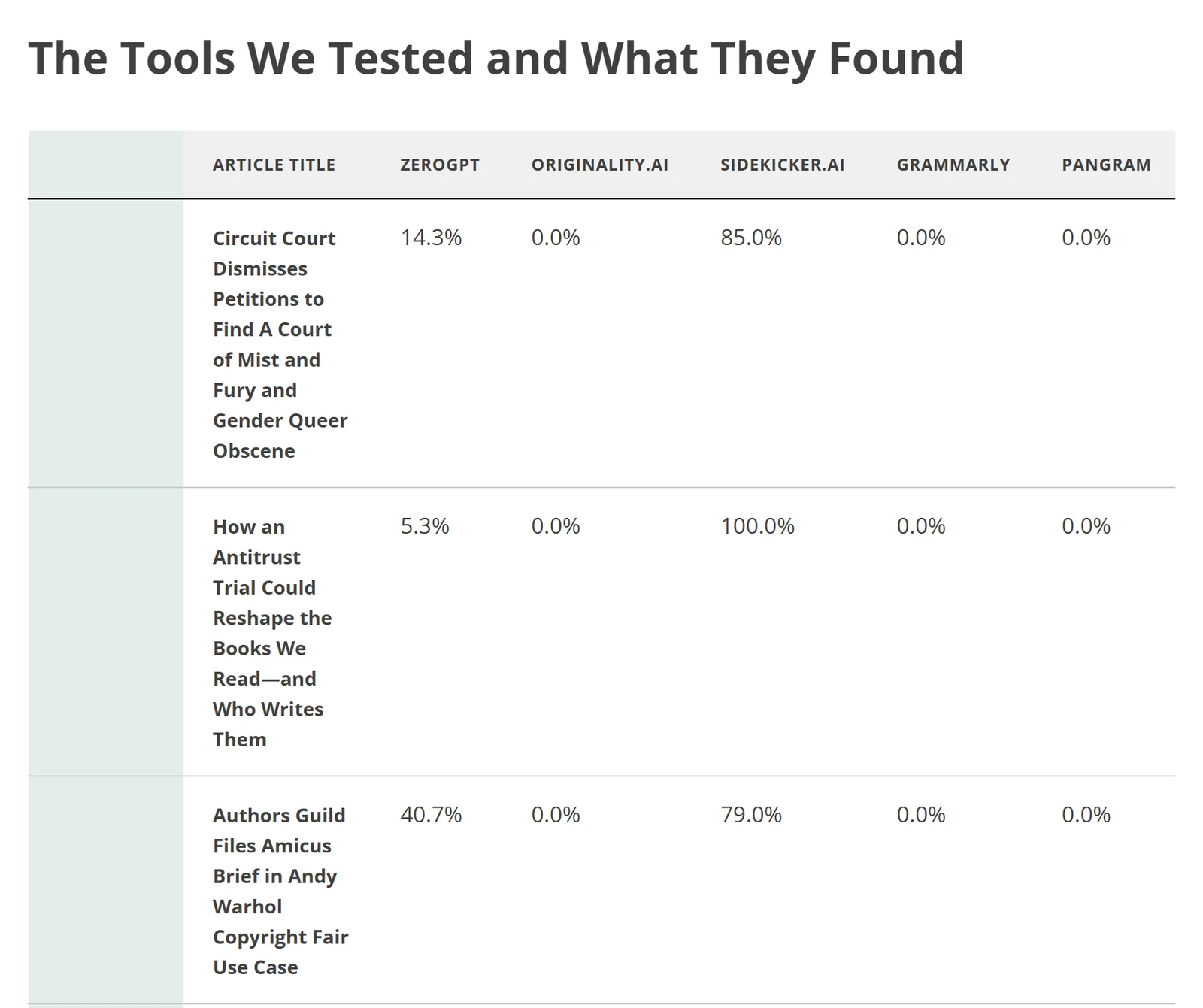
Text in the image: "The Tools We Tested and What They Found." Columns: ZeroGPT, Originality.ai, Sidekicker.ai, Grammarly, Pangram. First three articles: ZeroGPT 14.3%, 5.3%, 40.7%; Sidekicker.ai 85.0%, 100.0%, 79.0%; the other three tools 0.0%.
The Guild's verdict: a couple of tools identify human text well, but some commonly used consumer tools are "wildly inaccurate."
Do AI detectors work on books? We ran 4 texts through 5 tools
How we tested (October 31, 2026). We pasted four texts of 340 to 440 words into the free versions of GPTZero, ZeroGPT, Pangram, QuillBot and Grammarly. Two are human-written and in the public domain: a chapter opening from P. T. Barnum's The Art of Money Getting (1880, Project Gutenberg) and a section of the Federal Plain Language Guidelines (2011, U.S. government PDF). The third is the 2011 text after free ChatGPT fixed its grammar. The fourth is a section free ChatGPT wrote from scratch on the same topic. Each text ran once per tool, on free plans or without an account.
| Detector | Barnum, 1880 (human) | Guide, 2011 (human) | Same guide, polished by ChatGPT | Written by ChatGPT |
|---|---|---|---|---|
| GPTZero | 0% | 0% | 0% | 100% |
| ZeroGPT | 0% | 32.7% | 50.7% | 100% |
| Pangram | 0% | 0% | 0% | 100% |
| QuillBot | 0% | 0% | 0% | 100% |
| Grammarly | 0% | 0% | 0% | 100% |
Share of each text the tool labeled as AI. Free versions, October 31, 2026.
What the numbers say:
- Pure AI text was easy. Every tool caught the ChatGPT section at 100%, and Barnum's 1880 text scored 0% everywhere.
- ZeroGPT flagged a human. It called a third of the 2011 guide AI-written. After ChatGPT polished the grammar, ZeroGPT rose to 50.7%, while the other four still said 0%.
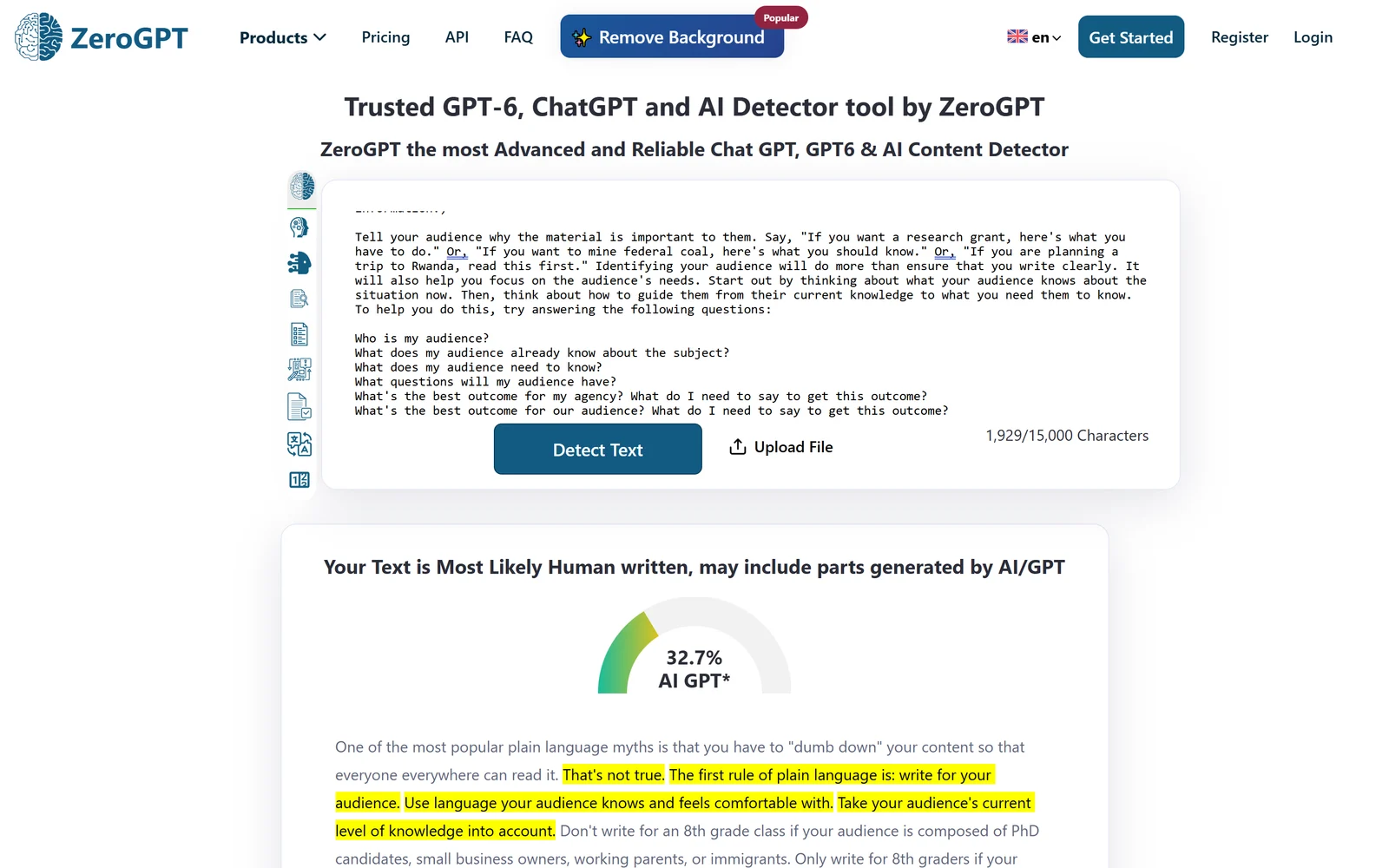
Text in the image: "Your Text is Most Likely Human written, may include parts generated by AI/GPT." "32.7% AI GPT*." Highlighted as AI: "That's not true. The first rule of plain language is: write for your audience."
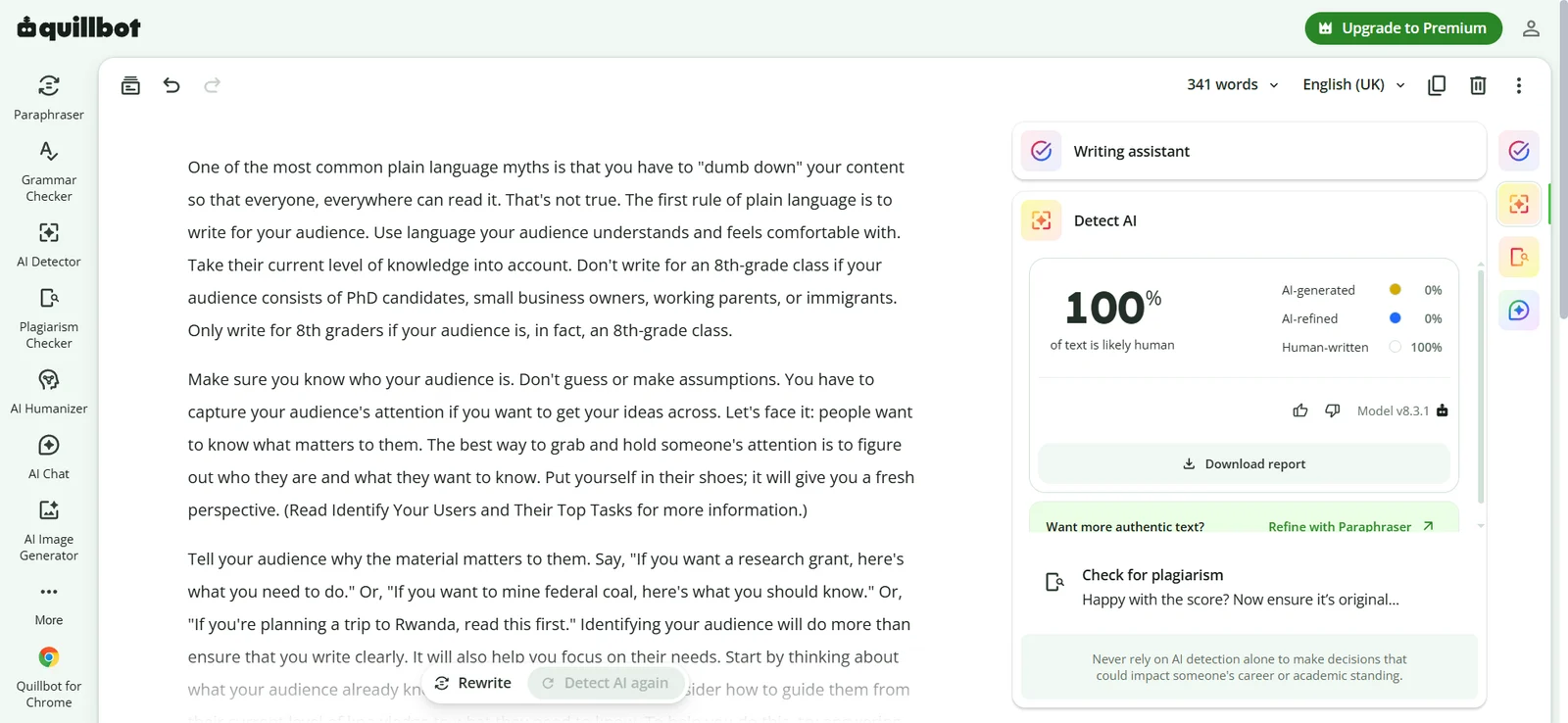
Text in the image: "100% of text is likely human", "AI-generated 0%", "AI-refined 0%", "Human-written 100%". "Never rely on AI detection alone to make decisions that could impact someone's career or academic standing."
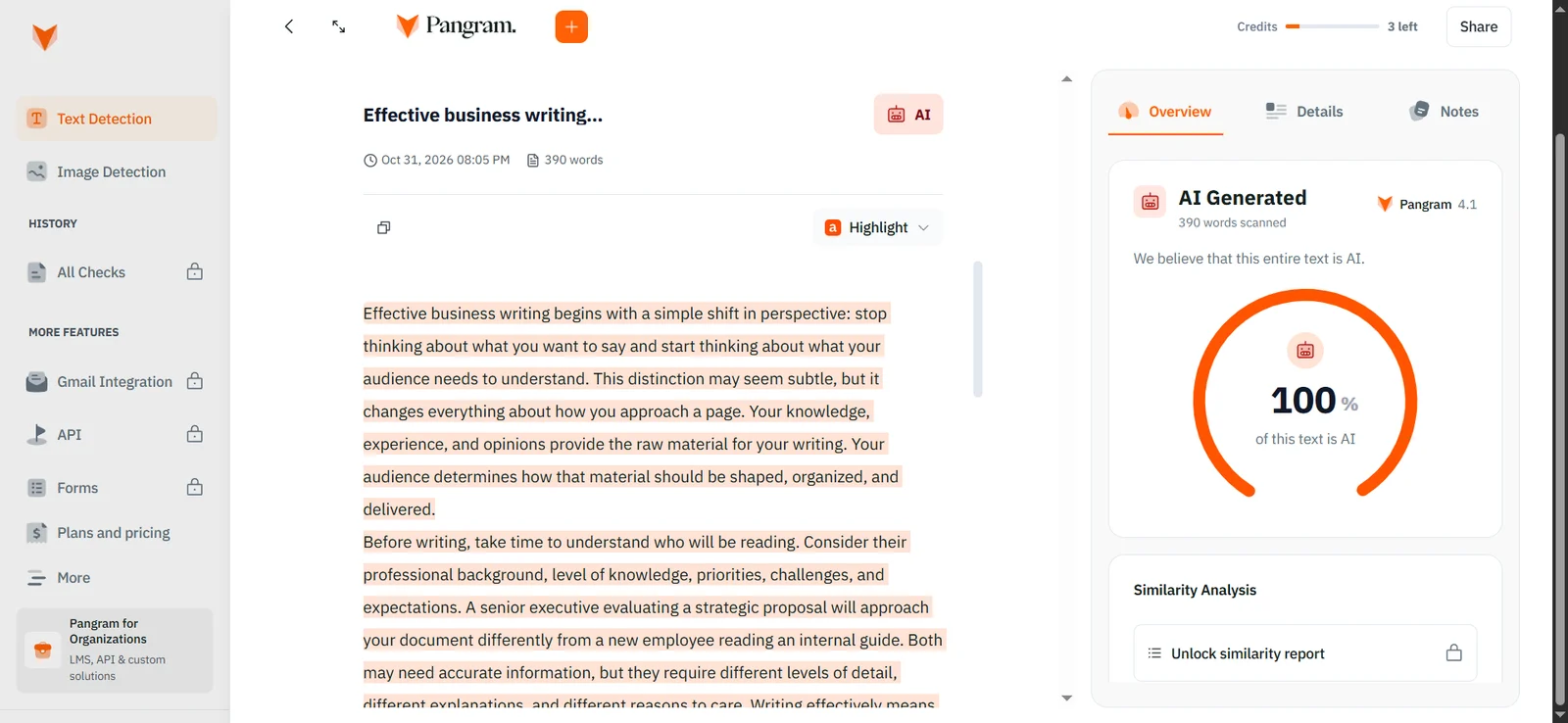
Text in the image: "AI Generated", "Pangram 4.1", "390 words scanned", "100% of this text is AI."
This was a small test: one run, short samples, and tools that update their models often (GPTZero ran model 4.1o, Pangram 4.1, QuillBot 8.3.1). Treat it as a snapshot of one day, not a ranking.
Why does an AI detector flag writing you wrote yourself?
Because a detector can't see who wrote the text, only how it reads, and some human writing reads like AI. The usual triggers:
- Plain, clear, instructional style. ZeroGPT highlighted short, simple lines in the 2011 guide, such as "That's not true." Short, plain sentences are also what AI models tend to produce.
- Grammar polishing with AI. In our test, it raised one tool's score by 18 points.
- Non-native English. The Stanford study found detectors flag it far more often.
- Short samples. OpenAI said its classifier got more reliable as text got longer.
Our list of signs your writing sounds like AI shows the patterns readers notice too.
Even the vendors warn against treating one score as proof, as QuillBot's own result panel does (figure 3).
How to write with AI and keep the book yours
The safest book is built on your own knowledge. Built&Written builds the book from material you already have, not from what a model guesses about your topic.
| Step | With Built&Written | Writing in a chat app |
|---|---|---|
| Starting point | Your posts, notes, transcripts or draft, pasted or uploaded (PDF, DOCX, RTF, TXT, MD) | What the model knows, plus what you paste into each chat |
| Voice | Voice DNA learns from samples of your own writing | Generic, unless you ask for your style every time |
| Structure | An outline you see and edit before writing starts | You stitch chapters together across chats |
| Editing | A chapter editor where every word stays yours to change | Copy and paste back and forth |
| Files for Amazon | On Entrepreneur and up: a KDP-ready print PDF, EPUB (the ebook file) and DOCX (a Word file) | None; you format somewhere else |
| KDP disclosure | Still your job: text the AI drafts counts as AI-generated | Your job |
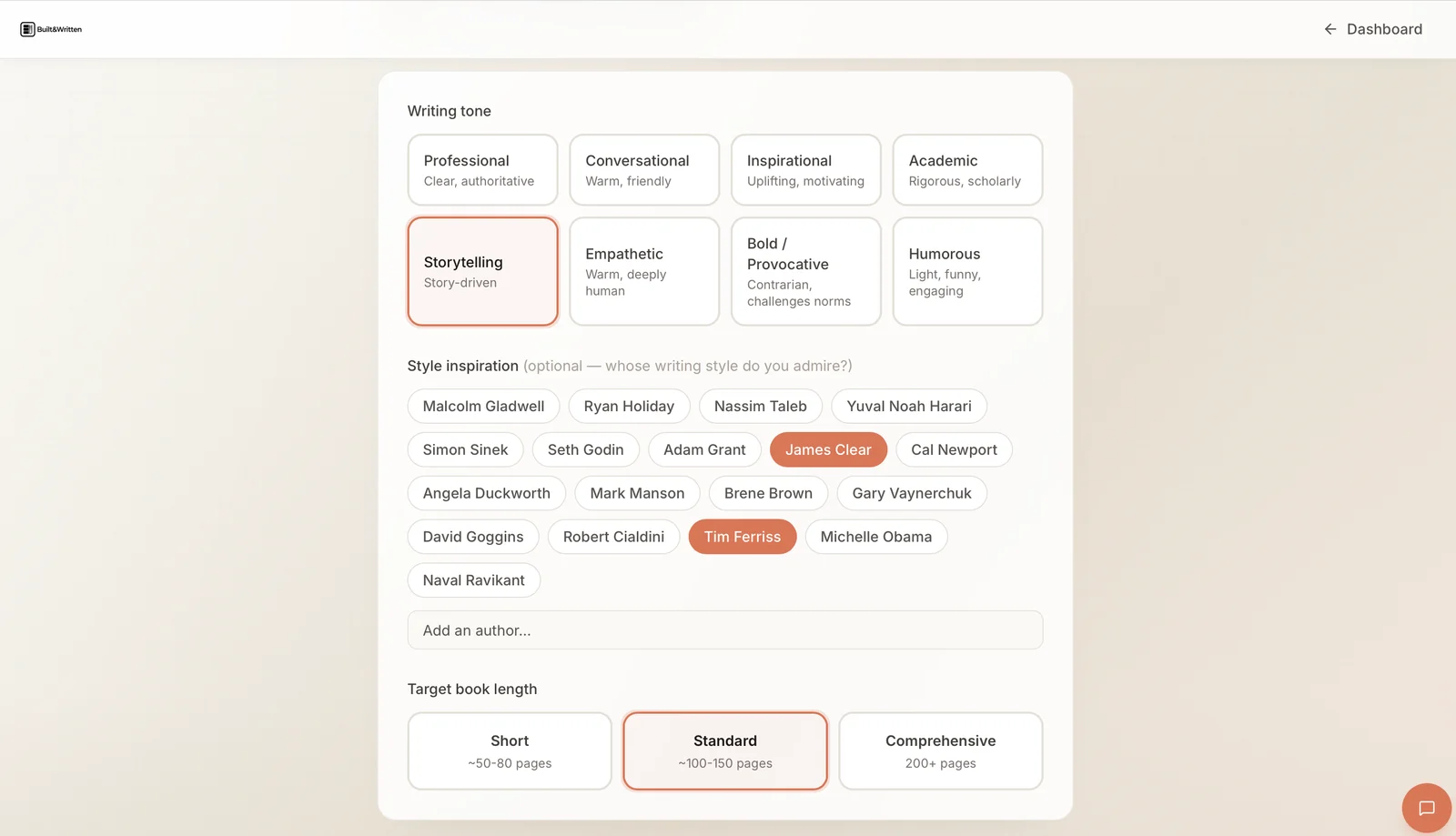
Text in the image: "Writing tone": Professional, Conversational, Inspirational, Academic, Storytelling (selected), Empathetic, Bold / Provocative, Humorous. "Style inspiration": James Clear and Tim Ferriss. "Target book length": Short, Standard (selected), Comprehensive.
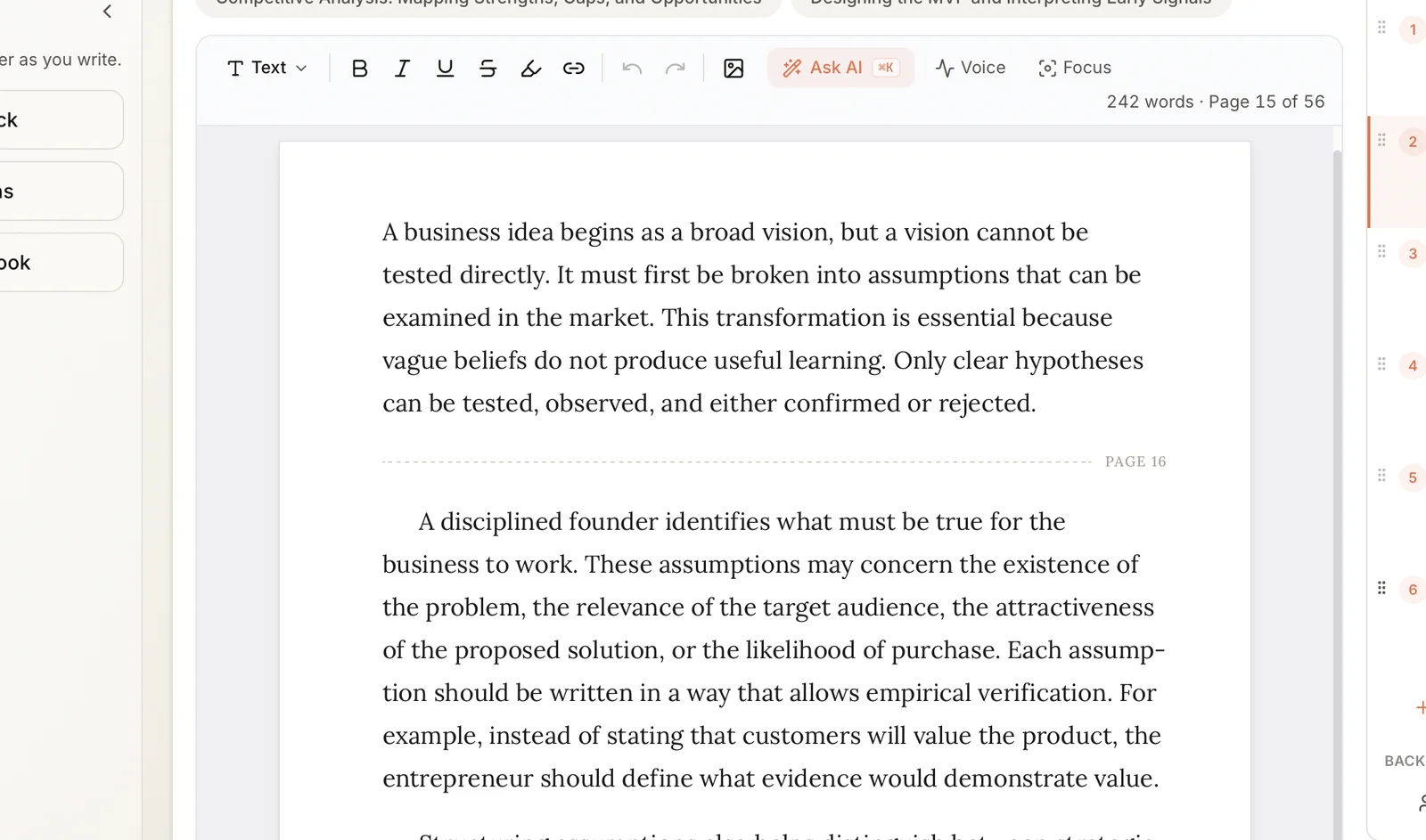
Text in the image: Toolbar: "Text", "Ask AI", "Voice", "Focus", "242 words, Page 15 of 56."
Honest limits: Built&Written doesn't hide AI use or make text "undetectable," and it doesn't answer KDP's questions for you. Writing a book with AI and downloading it needs Entrepreneur or higher. A book you wrote yourself is formatted and exported on any paid plan without changing a word.
Can Amazon KDP or a publisher detect AI in your book?
KDP's rules say nothing about scanning books with a detector. Instead, KDP asks you. Amazon KDP (Kindle Direct Publishing) is Amazon's free service for selling your book on Amazon. Its content guidelines ask you to tell it about AI-generated content when you publish a new book or republish an edited one.
Two definitions decide what you disclose:
- AI-generated: text, images or translations created by an AI tool, "even if you applied substantial edits afterwards." You must disclose it.
- AI-assisted: you wrote it, and AI helped you edit, refine, error-check or brainstorm. No disclosure needed.
You stay responsible for the whole book either way. Our guide to KDP's AI disclosure rules covers the details, and can you publish an AI-written book on KDP answers the bigger question.
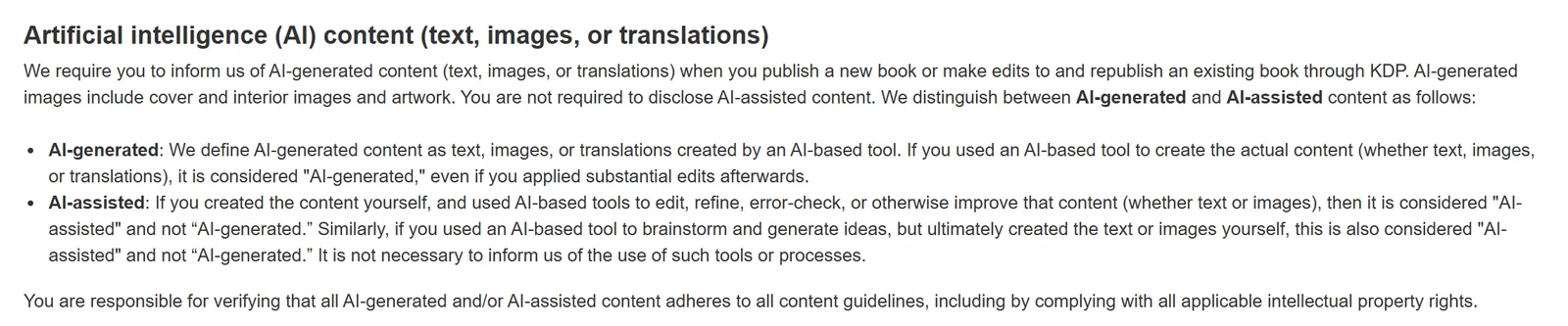
Text in the image: "We require you to inform us of AI-generated content (text, images, or translations) when you publish a new book or make edits to and republish an existing book through KDP." "You are not required to disclose AI-assisted content."
Publishers, contests and readers are another matter: some of them do run detectors. The Authors Guild reported that in May 2026, readers ran a winning story of the Commonwealth Short Story Prize through Pangram, which scored it 100% AI. The prize stood by the story. The Guild now tells publishers never to cancel a contract or pull a book based on detector results alone.
What to do if a detector flags your book
- Don't argue with one number. Ask which tool flagged the text and which passages. In our test, the same human text scored 0% in four tools and 32.7% in a fifth.
- Show your process. Keep drafts, notes, outlines and version history (Google Docs keeps one automatically). Dated files say more than any score.
- Check your KDP answer. If AI created any text, images or translations, disclose it. If AI only edited your own words, that is AI-assisted, and you don't have to.
- Ask for a human review. Point to the Authors Guild's position that a score alone should never decide who wrote a book.
- Skip the "humanizer" tools. Rewriting your book to dodge a detector changes your voice, not how the book was made.
Your best defense is a book where you can show where every fact and story came from. Our guide to writing a nonfiction book with AI without making up facts shows how.
Final thoughts
The book that survives these questions is the one built from your own ideas, stories and experience. That is the job Built&Written was built for: you bring the material you already have and get back a finished book that still sounds like you.
AI detectors are good at one thing: spotting text a chatbot wrote and nobody touched. On human writing polished by AI, the same passage scored anywhere from 0% to 50.7% depending on the tool, so no single score should decide who wrote a book. Amazon doesn't ask for a score anyway. It asks for an honest answer about AI-generated content.
What Built&Written gives you:
- Your material, not the model's guesses. Start from posts, notes, transcripts or a rough draft, up to 50,000 words.
- Your voice. Voice DNA learns how you write from a few pages of your best writing.
- An outline you approve. You see and change the chapter plan before any chapter is written.
- KDP-ready files you upload yourself. A print PDF and the KDP package for an AI-written book on Entrepreneur and up, plus EPUB and DOCX.
- A book you wrote stays word for word. Upload your manuscript and get KDP files without a changed word, on any paid plan.
Frequently asked questions
On text written entirely by AI, very accurate: all five free tools in our October 31, 2026 test scored a ChatGPT section 100% AI. On human writing, AI detector accuracy depends on the tool. Four tools scored our human texts 0% AI, while ZeroGPT scored one 32.7% and its AI-polished version 50.7%.
On AI text, yes: it scored our ChatGPT section 100% AI. On human text, not reliably: 32.7% AI on a human-written 2011 guide in our test, and 5.3% to 76.3% on the Authors Guild's pre-AI articles.
There is no industry standard, and few publishers say what they use. Readers do run detectors: in May 2026, readers flagged a Commonwealth Short Story Prize winner with Pangram. The Authors Guild advises publishers never to cancel a contract or pull a book based on a detector score alone.
There is no accepted percentage. Amazon KDP doesn't ask for a detector score. It asks whether AI created any of your text, images or translations. If you wrote the book and used AI only to edit or brainstorm, KDP calls that AI-assisted, and you don't have to disclose it.
Sources & References
About the author

Khrystyna Balushka
More in AI Book Tools
Ready to write your book?
Turn your expertise into a professional book with Built&Written.